Professional Removal Services: Navigating Standards for Safe Relocations
By Housey · Last reviewed 18th of May 2026
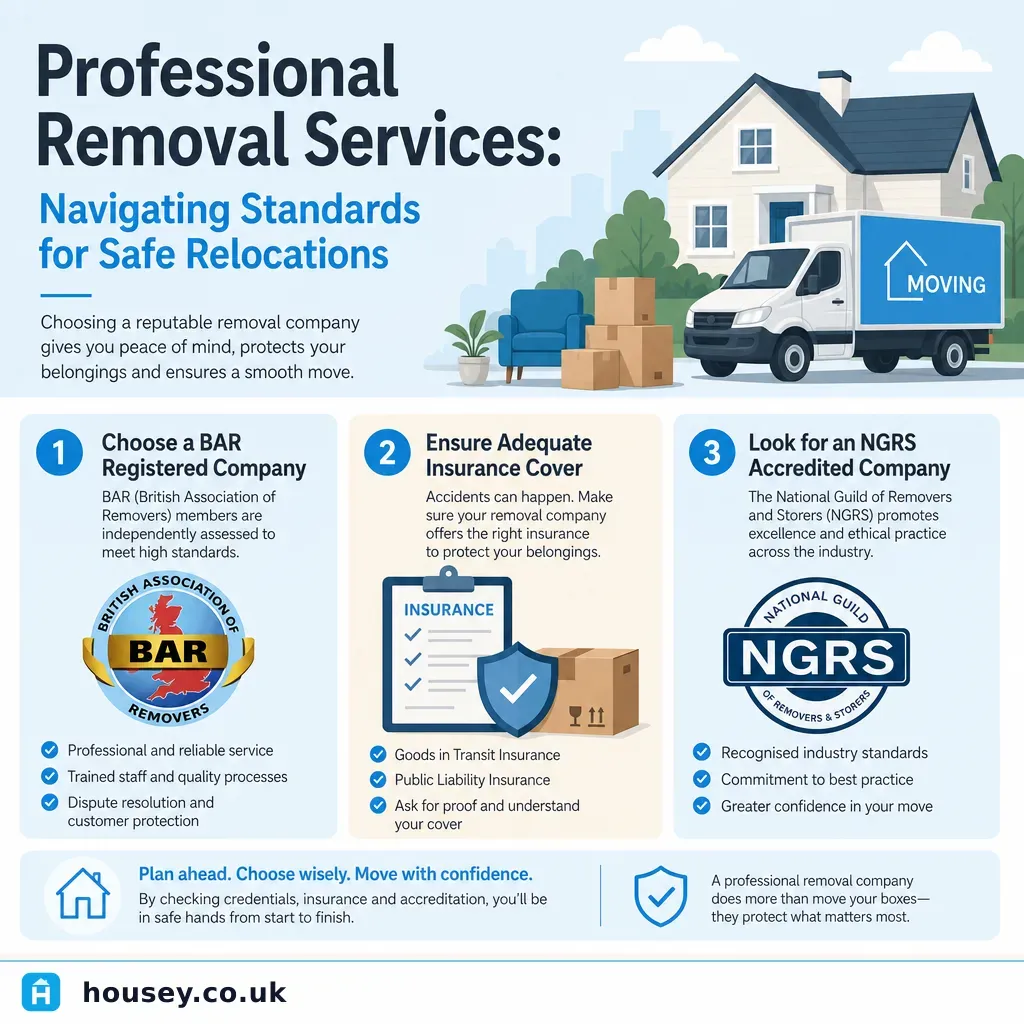
Professional Removal Services: Navigating Standards for Safe Relocations
Choosing a removal company is one of the final — and often most time-pressured — decisions in the home-moving process. Furniture damaged in transit, boxes left uninsured, and last-minute cancellations are among the most common moving-day complaints in the UK. Understanding what separates an accredited, professional removal firm from an unregulated one helps you protect your belongings, your budget, and your moving timeline before and on the day itself.
Key points
- The British Association of Removers (BAR) is the UK's principal trade association for the removals industry; members must pass a compliance inspection and participate in the BAR Advance Payment Guarantee (APG) scheme, which protects consumer pre-payments if a firm ceases trading.
- Removal companies do not require a statutory licence to operate in England and Wales — voluntary accreditation with BAR or the National Guild of Removers and Storers (NGRS) is the primary consumer protection marker.
- Goods-in-transit insurance is not automatically included in every removal quote; coverage limits, per-item caps, and exclusions must be confirmed in writing before moving day.
- Most reputable removal firms will carry out a pre-move survey (in-person or virtual) for moves above a certain volume; accepting a quote without a survey increases the risk of underpriced jobs and additional charges on the day.
- Specialist items — pianos, antiques, fine art, wine collections — may not be covered under standard goods-in-transit policies; request specialist handling and insurance confirmation in writing before instructing the firm.
What makes a professional removal company
Professional removal firms distinguish themselves through accreditation, trained staff, adequate insurance, and clear contractual terms. The key markers to look for when evaluating any firm:
BAR (British Association of Removers) membership: BAR requires members to pass a compliance inspection, hold adequate insurance, and give customers access to an independent dispute resolution scheme. BAR members must also participate in the Advance Payment Guarantee (APG), which protects pre-paid deposits if the company ceases trading before your move date.
NGRS (National Guild of Removers and Storers) membership: A further trade body with comparable vetting requirements and consumer protection provisions. NGRS members must carry adequate liability insurance and meet published membership standards.
Which? Trusted Traders and local authority trusted trader schemes: Independent assessment programmes that provide an additional quality signal, though criteria vary between schemes.
Unaccredited companies are not automatically unreliable, but they offer no independent complaints mechanism and may carry minimal or no goods-in-transit insurance. For moves involving high-value contents, long distances, or complex logistics, accreditation is a meaningful filter worth applying.
Accredited vs unaccredited: which is right for your move?
Feature | BAR or NGRS member | Unaccredited firm |
|---|---|---|
Pre-membership vetting | Yes — compliance inspection required | None required |
Advance payment protection | BAR APG scheme protects deposits | Not available |
Independent dispute resolution | BAR arbitration scheme | Civil court only |
Insurance minimum | Required by membership rules | Not standardised |
Staff training | BAR training programmes available | Variable |
Best for | Standard to complex moves; high-value contents; longer distances | Short, local moves; budget-constrained moves where risk is understood and accepted |
Not ideal for | Movers prioritising the lowest price at any cost | Anyone with high-value goods, specialist items, or complex logistics |
What to ask before accepting a removal quote
Before committing to any removal company, request written answers to the following questions:
- Is your company a current member of BAR or NGRS, and may I see your membership certificate?
- What goods-in-transit insurance do you carry, and what is the per-item and total coverage limit?
- Are high-value items — jewellery, antiques, pianos, and electronics — covered under the standard policy, or do I need to declare and insure them separately?
- Will you carry out a pre-move survey (in-person or video call) before issuing a fixed-price quote?
- What is your policy if the move overruns, or a second vehicle is needed on the day?
- Is VAT included in this quotation?
- What are your cancellation and rescheduling terms, and what deposit is required?
- Do you provide packing materials and a full packing service, and at what additional cost?
Pre-move checklist: preparing for removal day
A well-prepared move reduces the risk of damage, delays, and disputes on the day itself.
Understanding removal costs
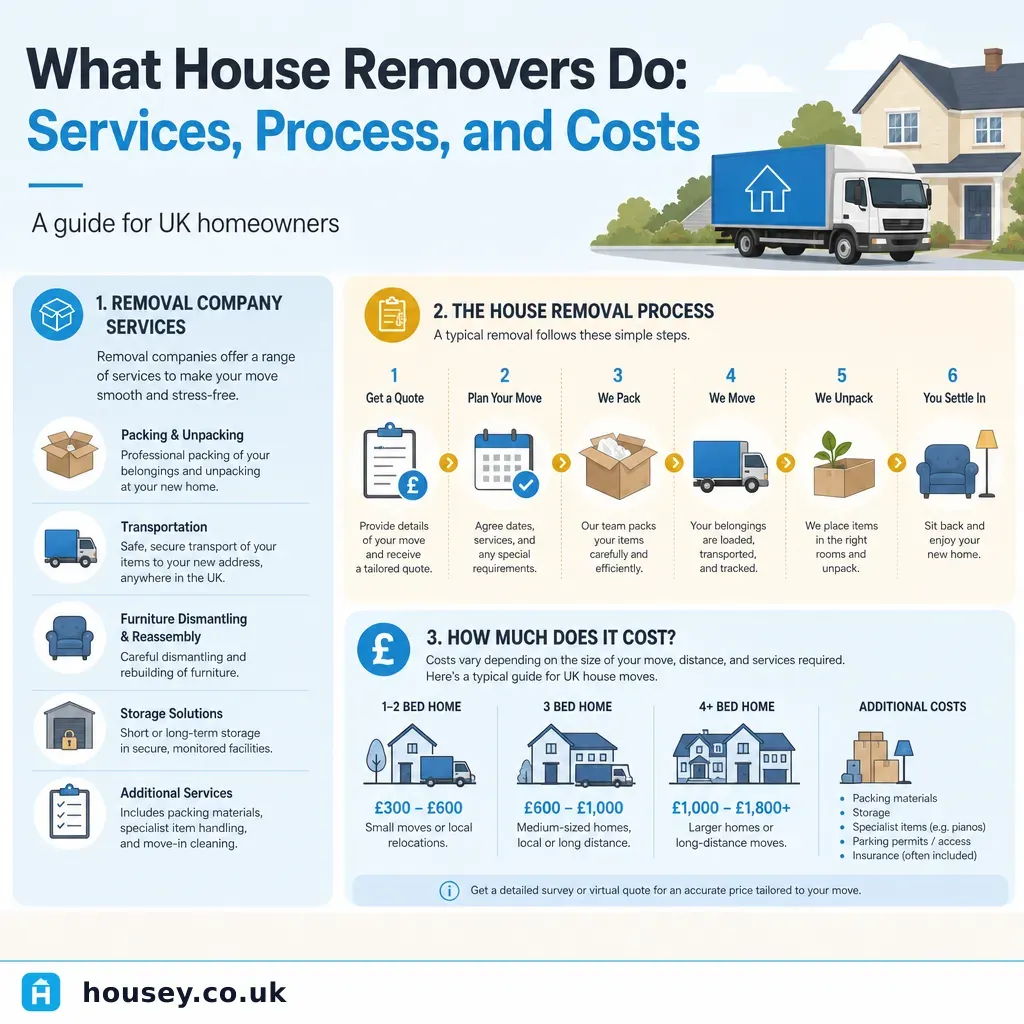
Removal costs vary widely depending on the volume of goods, distance, access at both properties, and the level of service required. Indicative UK costs, last reviewed 2026-05-18:
- Local move (within 30 miles), 2–3 bedroom home: approximately £400–£900 for a basic load-and-transport service.
- Long-distance move (over 100 miles), 3–4 bedroom home: approximately £900–£2,500 or more depending on access and volume.
- Full packing service: typically adds £200–£800+ depending on the volume of contents.
- Piano or specialist item removal: approximately £150–£500+ depending on size, access, and distance.
Costs vary significantly by region and firm. Always obtain at least three written, itemised quotes. Fixed-price contracts offer greater certainty than hourly-rate agreements — if a firm will only quote by the hour, ask explicitly what happens if the job takes longer than estimated. Indicative figures are based on BAR published guidance and indicative market rates; obtain your own quotes for accurate figures.
When to get professional help
Most residential moves are managed successfully with a reputable removal company. However, consider additional specialist support when:
- Moving antiques, fine art, wine collections, or items with significant monetary or sentimental value — specialist fine art removal firms carry tailored coverage that standard firms do not.
- Dismantling and reassembling complex fitted furniture, bespoke joinery, or conservatories — confirm whether the removal firm offers this service before booking, not on the day.
- Access at either property is particularly difficult — narrow streets, no nearby parking, or upper-floor flats without a lift — and a crane, hoist, or specialist vehicle may be required.
- The removal involves international relocation — use a BAR Overseas Group member or a FIDI-accredited international mover for cross-border moves.
How Housey can help
Housey makes it straightforward to find and compare house removals with vetted firms across the UK. Matched providers are assessed for accreditation, insurance, and professionalism, so you can plan your move with confidence — and Housey's flexible matching helps you find availability even in the busy spring and early autumn moving seasons.
Frequently asked questions
Do removal companies need to be licensed in the UK?
No. There is no statutory licensing regime for removal companies in England and Wales. This makes voluntary accreditation with the British Association of Removers (BAR) or the National Guild of Removers and Storers (NGRS) the most reliable quality marker for consumers. Always confirm current membership status before booking, as membership can lapse if a firm fails to meet ongoing requirements.
What is the BAR Advance Payment Guarantee?
The BAR Advance Payment Guarantee (APG) protects any pre-payment or deposit you make to a BAR member removal firm if the company ceases trading before your moving day. It does not replace goods-in-transit insurance. Confirm with the removal firm which protections apply to your booking, and keep written records of all payments made in advance of the move.
Is my furniture insured during the move?
Only if goods-in-transit insurance is explicitly stated in your removal contract, or if your home contents insurance policy extends cover during transit. Do not assume coverage — confirm it in writing before moving day, including per-item limits and any excluded categories such as cash, jewellery, or unboxed electrical equipment.
When should I book a removal company?
Book after exchange of contracts, when the completion date is legally fixed. Booking before exchange risks cancellation fees if the transaction falls through or dates change. Aim to instruct a removal company 3–6 weeks before your target completion date to secure availability, particularly in peak moving months such as spring and early autumn.
Can I move myself using a hired van?
Yes — self-moves using a hired van are common for smaller properties or short distances. However, standard domestic van hire policies typically exclude goods-in-transit cover, so you bear full responsibility for any damage. For properties with significant contents or longer distances, professional removal often proves more cost-effective once damage risk, packing materials, and physical labour are factored in together.
Sources and further reading
- British Association of Removers (BAR): consumer guidance — British Association of Removers
- National Guild of Removers and Storers (NGRS) — National Guild of Removers and Storers
- Moving home — Citizens Advice
- Apply for a parking suspension — GOV.UK
Useful next reads
 Buying & Moving
Moving Day Logistics: A Guide to a Successful Home Relocation
On moving day, wait for your solicitor to confirm completion before collecting keys — there is no fixed handover time and most UK completions happen between 11am and 2pm.
 Buying & Moving
Choosing a House Removal Company: What to Look For
Choose a UK removal company that belongs to the British Association of Removers (BAR) or the Removals Industry Ombudsman Scheme (RIOS), carries goods-in-transit and public liability insurance, and provides a written quote after properly surveying your home.
 Buying & Moving
How to Plan a House Move: A Practical Guide to Residential Relocations
A UK house move goes more smoothly with planning that starts 6–8 weeks before moving day.
 Buying & Moving
Managing Property Relocation in Major Urban Centres
Urban house moves require planning beyond a standard removal, particularly around vehicle emission zone compliance, parking bay suspensions, and lift access in purpose-built flats.
 Buying & Moving
What House Removers Do: Services, Process, and Costs
House removers load, transport, and unload your belongings between properties.