Identifying Yourself in Property Purchase: ID Requirements and Verification
By Housey · Last reviewed 25th of May 2026
Identifying Yourself in Property Purchase: ID Requirements and Verification
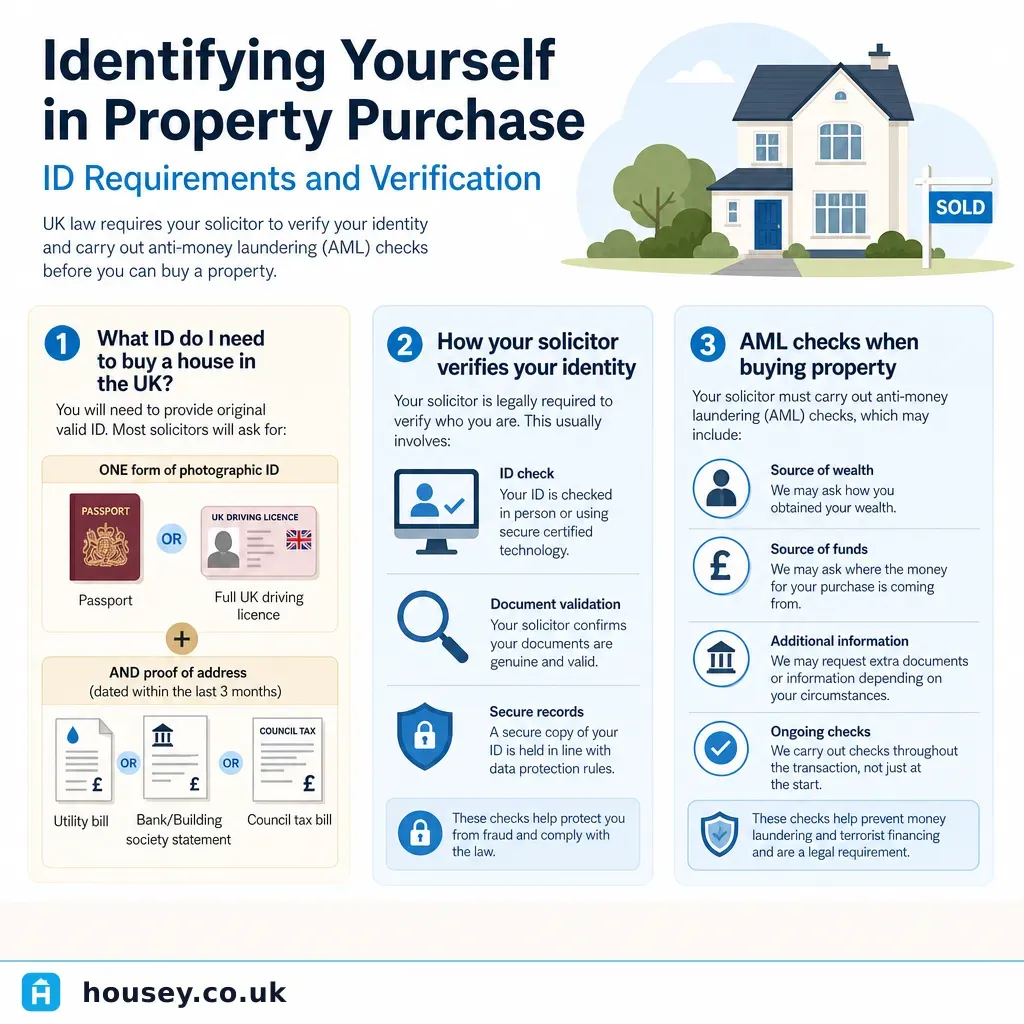
Before a conveyancing solicitor can progress your purchase, they are legally required to verify who you are. This is not bureaucratic box-ticking: UK anti-money laundering law obliges every regulated firm to confirm the identity and source of funds for each property transaction, and failure to comply can halt a purchase or expose the solicitor to serious regulatory consequences. Knowing what to prepare — and why delays happen — helps you move faster at an already pressured stage of the buying process.
Key points
- Conveyancing solicitors must comply with the Money Laundering, Terrorist Financing and Transfer of Funds (Information on the Payer) Regulations 2017, which require identity and source of funds verification before acting on any property transaction.
- Standard requirements are photographic proof of identity — typically a passport or photocard driving licence — plus proof of current address issued within the last three months.
- HM Land Registry's Digital Identity Standard (updated 2023) sets out how certified Identity Service Providers (IDSPs) can be used to satisfy identity checks electronically.
- Source of funds evidence — bank statements, a mortgage offer letter, gift letters, and probate documentation — is required separately from personal ID and is increasingly scrutinised.
- Cash buyers face the same identity and source of funds requirements as mortgage buyers; the absence of a lender conducting parallel checks typically results in more detailed source of funds enquiries from the solicitor.
Why identity verification is a legal obligation
The Money Laundering, Terrorist Financing and Transfer of Funds (Information on the Payer) Regulations 2017 require all UK solicitors and licensed conveyancers to apply Customer Due Diligence (CDD) before entering into a business relationship with a client. For property transactions, CDD covers four elements:
- Identity verification — confirming the client is who they claim to be.
- Beneficial ownership — establishing who ultimately controls the funds, particularly for company or trust purchases.
- Source of funds — evidencing where the deposit and purchase balance come from.
- Source of wealth — the broader origin of the client's financial position, applied in higher-risk or higher-value cases.
Solicitors are supervised for AML compliance by the Solicitors Regulation Authority (SRA); licensed conveyancers by the Council for Licensed Conveyancers (CLC). Non-compliance can result in prosecution and serious professional sanctions for the firm involved.
What documents are typically required
Photographic proof of identity — provide one
- Valid UK or foreign passport
- Full UK photocard driving licence
- National identity card (EU or EEA)
- Biometric Residence Permit
Proof of current address — provide one, issued within three months
- Utility bill (gas, electricity, or water — not mobile phone)
- Bank or building society statement
- Council Tax statement for the current year
- HMRC correspondence (tax return, tax credit letter)
- Mortgage statement dated within 12 months
Documents must be current and unexpired. Photocopies are generally not accepted unless certified by a regulated professional.
Source of funds documentation
Beyond personal identity, your solicitor will typically need evidence that the purchase funds are legitimate. Depending on the source, this may include:
- Bank statements showing the deposit accumulating over three to six months
- Your mortgage offer letter confirming the loan amount
- A signed gift letter from the donor plus the donor's own bank statements confirming the transfer
- A completion statement from a previous property sale
- Investment or pension withdrawal documentation
- Grant of probate or a solicitor's letter confirming receipt of an inheritance
The documentation requested is proportionate to the risk assessment the firm applies to the transaction. Higher-value purchases, offshore sources, or complex fund origins typically require more supporting evidence.
Identity verification methods: what to expect
Method | How it works | Widely accepted? | What you need | Notes |
|---|---|---|---|---|
In person at the solicitor's office | Original documents inspected and copied in person | Yes | Original documents | Least friction for most clients |
Certified copies | Originals copied and certified by a regulated professional | Yes | Originals plus certified copy | Useful for remote clients; ask the firm for their required certification format |
Digital IDSP verification | Third-party provider checks document and biometric via smartphone | Increasingly — accepted under HM Land Registry Digital Identity Standard 2023 | Smartphone and original document to photograph | Fast and convenient; not all firms have implemented this |
Video call verification | Solicitor reviews documents live via video call | Some firms | Originals shown to camera | Less standardised; protocols vary by firm |
Notarised documents (overseas buyers) | Documents notarised abroad and apostilled | Yes for international clients | Notarised originals | Adds time and cost; requirements vary by country of origin |
What not to assume
Several common misunderstandings cause avoidable delays at the identity verification stage.
One check does not cover everything. Your solicitor's AML check and your mortgage lender's separate identity verification are independent processes. You may be asked to provide documents to both.
Digital ID is not universally accepted. HM Land Registry's Digital Identity Standard has broadened what counts as compliant verification, but not every solicitor uses a certified IDSP. Confirm before attempting to submit documents digitally.
Expired documents are not acceptable. A driving licence with a former address, or a passport that expired recently, will not satisfy AML requirements. Renew before or immediately after instructing your solicitor.
A bank letter is not a bank statement. Many firms require a printed or downloaded statement showing recent transactions, not a headed confirmation letter from your bank.
A gift letter alone is not sufficient. The donor's own bank statements confirming the funds were in their account and evidencing the transfer are usually required alongside a signed gift letter.
Important limitations
This article provides general information about identity verification requirements in property purchase transactions in England and Wales as of May 2026. Requirements under the Money Laundering Regulations 2017 and HM Land Registry's Digital Identity Standard are subject to legislative and policy change. Individual firms apply their own Customer Due Diligence policies within these frameworks, and requirements may vary between firms. Nothing in this article constitutes legal or compliance advice. Always follow the specific guidance of your instructed solicitor.
When this becomes urgent
Identity verification delays can stall a transaction and affect other parties in a chain. Treat the following as requiring immediate action:
- Your passport or driving licence has expired — renewal can take several weeks, and verification cannot proceed without a current document.
- Your funds originate from multiple or complex sources and you have not yet spoken to your solicitor about what documentation to prepare.
- Exchange of contracts is approaching and you have not yet submitted the identity or source of funds documents your solicitor has requested.
What to ask a qualified professional
When instructing your conveyancing solicitor, ask:
- What identity documents do you require from me, and in what format — originals, certified copies, or digital verification?
- Do you accept digital identity verification via a certified Identity Service Provider, and if so, which service do you use?
- What source of funds documentation will I need for my deposit and the balance?
- My deposit includes a gift — what documentation will you need from the donor as well as from me?
- How long does your identity verification process take once I submit the required documents?
- If I need documents certified, who can certify them and in what format do you require?
When to get professional help
Identity verification in property purchase is managed by your solicitor and should begin as early as possible in the transaction. Contact your solicitor immediately if:
- Your passport, driving licence, or national identity card has expired.
- Your funds originate from multiple complex sources — inheritance, overseas accounts, business sale proceeds, or structured gifts.
- You are purchasing as a company, trust, or via a power of attorney — enhanced due diligence applies and additional documentation will be required.
- You are an overseas buyer — notarisation and apostille requirements add time and cost; clarify the full process with your solicitor before instructing.
How Housey can help
Housey connects buyers with regulated conveyancing solicitors who will guide you through identity verification and every stage of the purchase process. Compare quotes from vetted firms through our conveyancing service to get your purchase moving without unnecessary delays.
Frequently asked questions
Why does my solicitor need to see my ID when buying a house?
Under the Money Laundering, Terrorist Financing and Transfer of Funds Regulations 2017, all solicitors and licensed conveyancers must verify the identity and source of funds of every property client before acting. This is a legal obligation — not a firm-by-firm policy — designed to prevent money laundering through UK property transactions.
Can I verify my identity digitally for a property purchase?
In many cases, yes. HM Land Registry's Digital Identity Standard (updated 2023) enables certified Identity Service Providers (IDSPs) to conduct compliant checks electronically. Ask your solicitor whether they use a certified digital service such as Thirdfort or Yoti. Not all firms have implemented digital verification yet, so confirm before submitting documents.
What if my identity documents have expired?
Expired documents will not satisfy AML identity requirements. If your passport or driving licence has lapsed, renew it before or immediately after instructing your solicitor. Delays in providing valid ID can slow the entire transaction and, in a property chain, affect other parties waiting for exchange.
Do cash buyers need to provide the same ID as mortgage buyers?
Yes. Identity and source of funds requirements under the Money Laundering Regulations 2017 apply to all property transactions regardless of whether a mortgage is involved. Cash buyers typically face more detailed source of funds enquiries because no lender is conducting parallel identity or affordability checks on the transaction.
Sources and further reading
- HM Land Registry Digital Identity Standard — GOV.UK / HM Land Registry
- Money Laundering, Terrorist Financing and Transfer of Funds Regulations 2017 — legislation.gov.uk
- SRA anti-money laundering guidance for solicitors — Solicitors Regulation Authority
- GOV.UK: money laundering regulations — GOV.UK
Useful next reads
 Buying & Moving
Managing Delays with Removal Companies: Rights and Resolution
If a removal company is late, your rights depend on your contract and whether the company is BAR-registered.
 Buying & Moving
Understanding Leasehold Property: Rights and Responsibilities
Leasehold means you own a time-limited interest in a property while the freeholder owns the land and building.
 Buying & Moving
The Complete Property Buying Guide: From Search to Purchase
Buying a property in England and Wales typically takes 3–6 months from accepted offer to completion.
 Buying & Moving
Leasehold Property Purchase: Complexity and Key Considerations
Buying a leasehold property means purchasing the right to occupy for a fixed term rather than owning the land outright.
 Buying & Moving
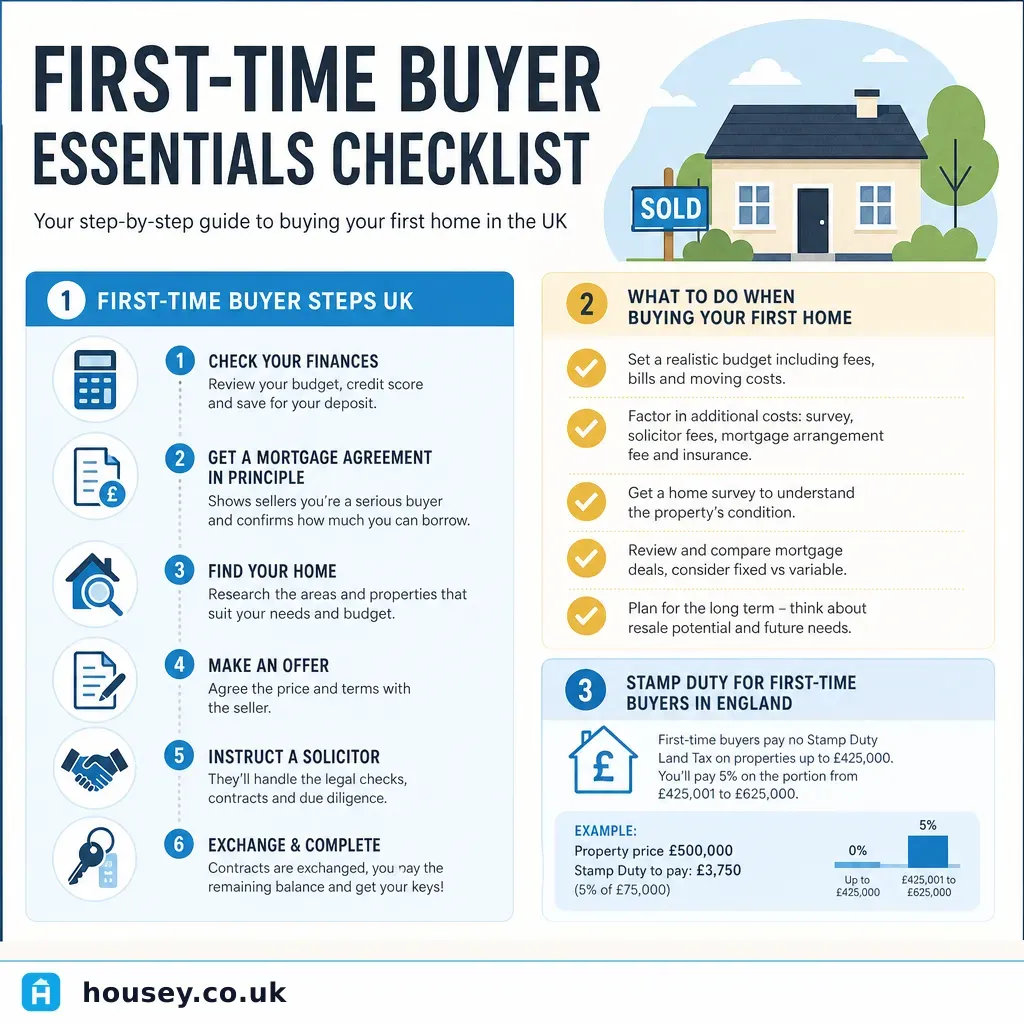
First-Time Buyer Essentials Checklist
Buying your first home involves obtaining a mortgage in principle, making an offer, instructing a solicitor, arranging a survey, and exchanging contracts before completion.