Property Viewing Checklist: What to Look for When Inspecting a Home
By Housey · Last reviewed 30th of May 2026
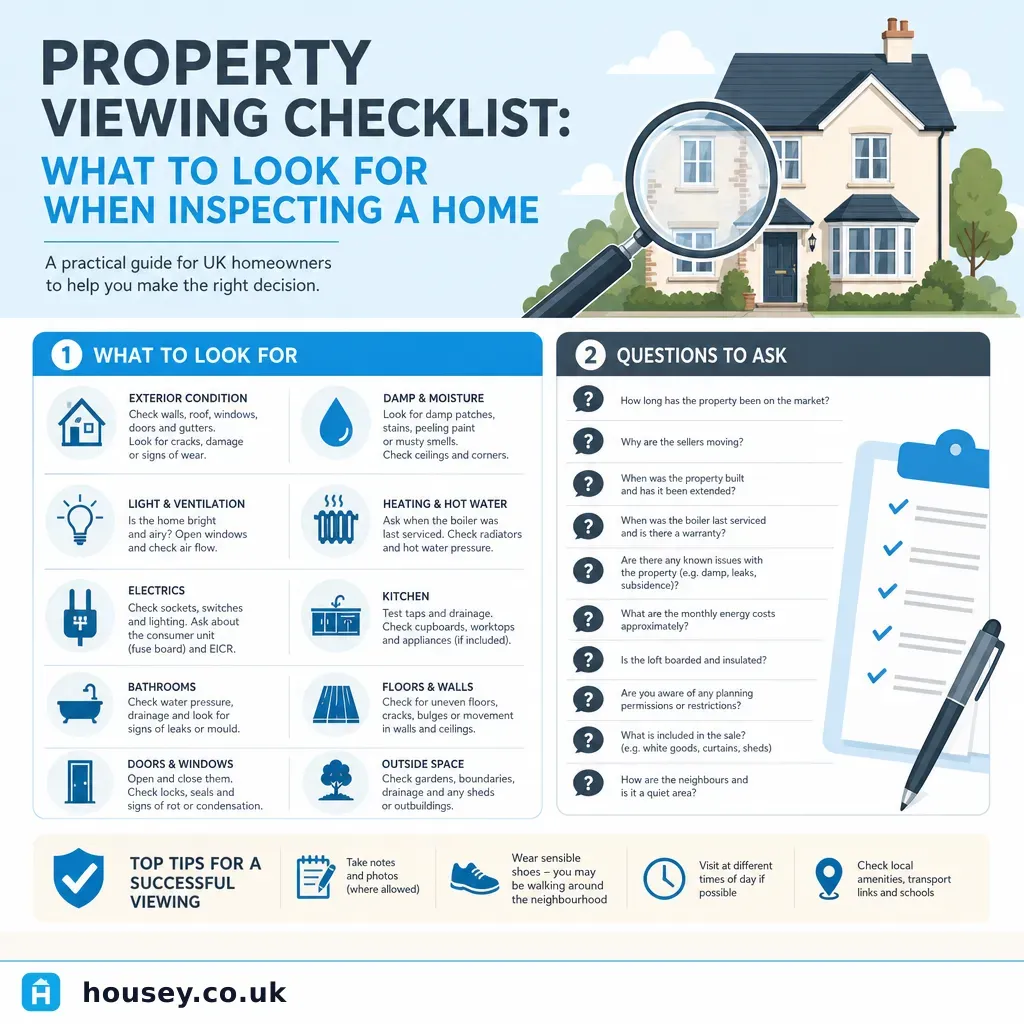
Property Viewing Checklist: What to Look for When Inspecting a Home
For most UK buyers, a property viewing is the moment a search becomes a decision — and how systematically you use it shapes everything from your offer level to your survey brief. Sellers in England and Wales are not legally required to volunteer information about defects, which means the burden of initial assessment falls squarely on the viewer. A structured approach means you leave with enough information to decide whether to proceed, what questions to put to the estate agent, and roughly what remedial costs you might face before committing to survey and legal fees.
Key points
- Sellers in England and Wales are not required to disclose defects voluntarily, but deliberate misrepresentation may constitute fraud under the Misrepresentation Act 1967.
- A viewing is not a substitute for a RICS survey; its purpose is to inform your offer decision and shape your survey brief, not to replace professional inspection.
- Properties built before 1919 are more likely to have solid walls, lime mortar, and original drainage — all factors that may affect upgrade costs and the appropriate level of survey.
- For leasehold properties, the remaining lease term, service charge history, and any planned major works should be confirmed at or before the second viewing.
- A RICS Level 2 Home Survey suits most conventional properties in reasonable condition; a Level 3 Building Survey is more appropriate for older, unusual, or visibly defective homes.
What to check outside the property
The exterior reveals a great deal about a property's condition before you step through the door. Walk around the full perimeter where the agent permits.
Structure and brickwork
- Stepped or diagonal cracks in brickwork may indicate settlement or structural movement; note their width, length, and whether they cross mortar joints or through bricks.
- Bowing or leaning walls — hold your eye level with the wall face to spot deflection.
- Missing, crumbling, or heavily repointed mortar. Some repointing is routine maintenance; extensive recent repointing over cracking can indicate an attempt to conceal movement.
Roof
- Missing, slipped, or broken tiles or slates.
- A sagging ridge line or visible deflection in the roof plane when viewed from street level.
- Condition of chimney stacks, flashings, and leadwork — poorly maintained flashings are a common source of water ingress.
- Gutters and downpipes: overflowing, detached, or full of vegetation. Long-term overspill causes persistent damp in the walls below.
Windows and doors
- Frame condition — rot in timber frames and corrosion in steel-framed windows (common in 1930s–1950s properties).
- Misting between the panes of double-glazed units indicates failed seals; the unit will need replacing.
Drainage and boundaries
- Note the position of manhole covers — their location affects any future extension or landscaping.
- Check soil pipes and waste pipes for obvious leaks or detached fittings.
What to check inside the property
Work methodically room by room rather than being guided by the estate agent.
Damp and moisture
- Damp patches at low level on external walls — possible rising damp or a failed damp-proof course.
- Damp patches at high level or in corners — possible penetrating damp from the roof or blocked gutters.
- A musty smell, particularly in ground-floor rooms, under-stair cupboards, and bathrooms.
- Tide marks, fresh paint over isolated patches, or recently replastered sections of wall.
Walls, floors, and ceilings
- Cracks in plaster — hairline cracks are common and low-risk; cracks that are wide, stepped, or accompanied by movement in doors or windows warrant further investigation.
- Sloping floors or uneven thresholds between rooms.
- Bulging or bowed plasterwork.
Doors and windows
- Do all internal and external doors and windows open and close smoothly? Sticking can indicate settlement or subsidence.
Heating and hot water
- Note the age and model of the boiler — most gas boilers have a useful life of around 10–15 years.
- Note the fuel type: gas, oil, LPG, electric, or heat pump. Off-gas properties can carry higher running costs.
- Check whether radiators are hot all the way through or cold at the top, which may indicate sludge build-up.
Electrics
- Age and type of consumer unit (fuse board) — wire-fused boards are likely to need replacement and may not support modern demand.
- Number of sockets per room — insufficient sockets in older properties can indicate a need for rewiring.
Loft (if accessible)
- Insulation depth — the recommended level is 270–300 mm of mineral wool.
- Signs of water ingress, damaged roofing felt, or missing sarking felt.
Cellar or basement (if present)
- Active damp, efflorescence, or standing water.
- Evidence of previous tanking or waterproofing — ask for guarantees.
Homeowner viewing checklist
Print or screenshot this before your next viewing.
Outside
Inside
Leasehold-specific
Red flags that warrant a RICS Level 3 survey
Most conventional properties in reasonable condition suit a RICS Level 2 survey. Consider upgrading to a RICS Level 3 survey or commissioning a structural survey if you observe any of the following at viewing:
- Structural cracks — stepped, wide (greater than 3 mm), or accompanied by movement in floors or door frames.
- Active or historic damp — tide marks, efflorescence, mould, or staining on internal walls.
- A property built before 1919, particularly one with solid-wall construction.
- Any obvious previous extension, loft conversion, or structural alteration without clear supporting documentation.
- A flat or low-pitch roof covering a significant area of the property.
- Signs consistent with subsidence: uneven floors, sticking doors, or diagonal cracks at window and door corners.
- A property the estate agent confirms has been empty for an extended period.
What not to assume
- Don't assume a newly decorated property is problem-free. Fresh paint, new plaster, and replacement carpets can conceal recent damp treatment, crack repairs, or other remedial work. Ask when works were carried out and request supporting documentation or guarantees.
- Don't assume loft insulation is at the recommended level. Many older properties have inadequate depths, or the loft has been partially converted without proper thermal detailing.
- Don't assume planning permission and building control approval were obtained for visible extensions. Ask the estate agent to confirm these documents are available — your solicitor will check during conveyancing, but knowing early prevents late surprises.
- Don't assume the boiler has been recently serviced. Ask for the last Gas Safe service record.
- Don't assume a leasehold flat has a straightforward lease. Lease terms vary enormously; the headline figures — remaining term, ground rent, service charge level — are worth establishing before you spend money on surveys and legal fees.
When to get professional help
A viewing is no substitute for a professional survey. Commission one — and seek specialist advice — in the following situations:
- You have identified one or more red flags from the section above.
- The property is pre-1919 or has non-standard construction (timber frame, prefabricated concrete, thatched roof).
- The seller cannot produce planning permission or building control sign-off for a visible extension or conversion.
- You suspect Japanese knotweed in the garden — identified by bamboo-like hollow stems and broad heart-shaped leaves, particularly near water or boundary fences.
- The lease term is below 80 years — seek lease extension advice from a solicitor before exchange.
A RICS Level 2 survey is appropriate for most conventional purchases; a RICS Level 3 survey is more suitable for older, larger, or visibly defective properties. Where structural concerns were identified at viewing, a structural survey may be advisable in addition. Your conveyancing solicitors will carry out legal and title checks covering leasehold terms, planning history, and building control records.
How Housey can help
Housey connects buyers with qualified professionals throughout the purchase process. Once you have identified a property to proceed with, you can find vetted providers for a RICS Level 2 survey or RICS Level 3 survey through Housey, as well as structural survey specialists if specific defects need further investigation. When you are ready to progress legally, Housey can also connect you with conveyancing solicitors.
Frequently asked questions
How many times should I view a property before making an offer?
At minimum, twice: once as a general walk-through, and a second time to work through the checklist above systematically, ideally at a different time of day. A third visit before exchange — after receiving your survey report — lets you revisit items the surveyor flagged and check anything missed on earlier visits.
What red flags should I watch out for at a viewing?
Key concerns include: structural cracks (stepped, wide, or accompanied by floor or door movement), active or historic damp at low or high level on walls, a boiler over 15 years old, an outdated wire-fused consumer unit, misted double-glazing throughout, and undisclosed building works without documentation. For leasehold properties, a short lease and unexplained high service charges are significant financial red flags.
Should I get a survey even if the property looks fine at viewing?
Yes. Many significant defects — damp behind plasterboard, roof structure problems, drainage faults, inadequate foundations — are not visible during a normal viewing. A RICS Level 2 Home Survey, or Level 3 for older or more complex properties, provides a professional assessment from someone with the training and liability to identify defects that an untrained viewer would not be expected to spot.
Can I bring a builder to a property viewing?
Yes, and it can be useful for a rough cost estimate on obvious remedial works or planned alterations. However, a builder is not a substitute for a RICS survey — they are assessing buildability and cost, not providing a professional defect report with associated liability. Arrange for the builder to attend a second viewing with the estate agent's agreement.
Sources and further reading
- RICS Home Surveys — information for buyers — RICS
- Buying or selling your home — GOV.UK
- Leasehold property: buying and selling — GOV.UK
- Citizens Advice — Buying a home — Citizens Advice
- Misrepresentation Act 1967 — legislation.gov.uk
Useful next reads
 Buying & Moving
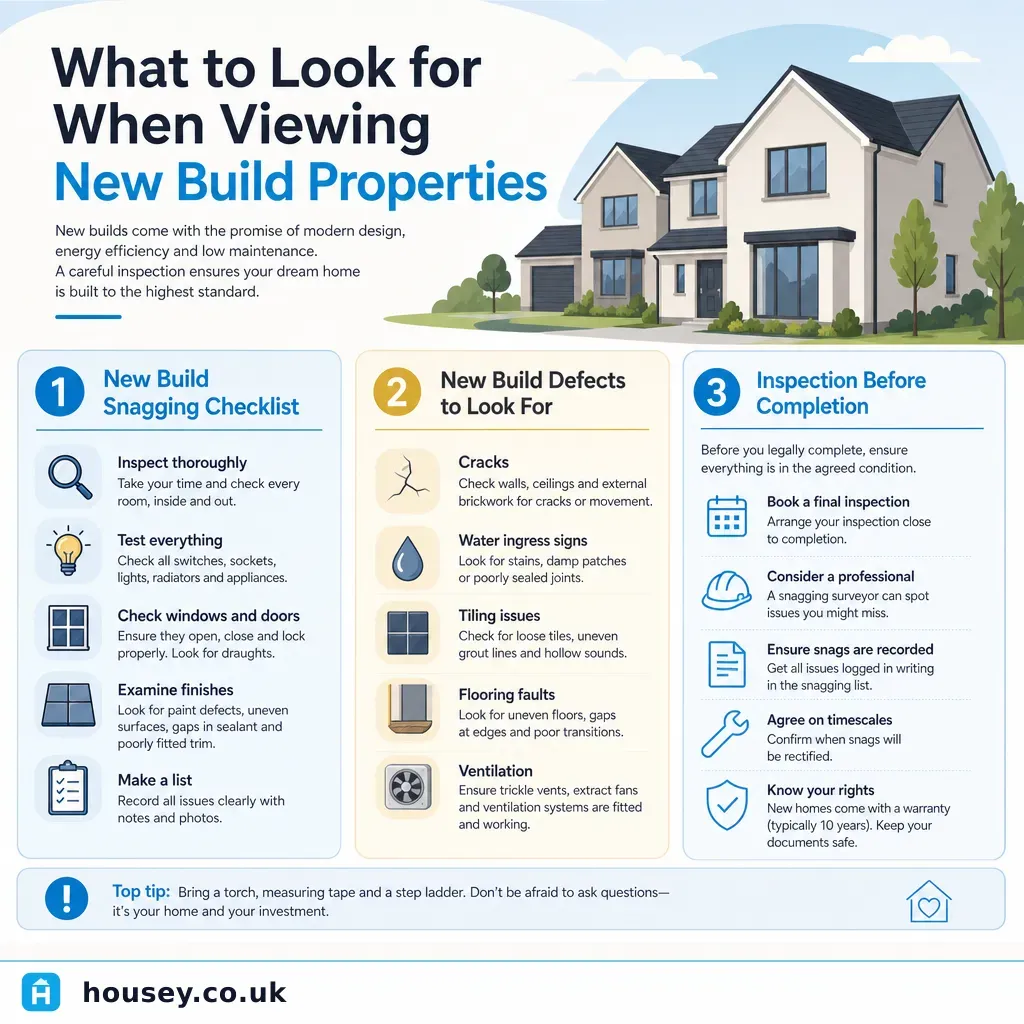
What to Look for When Viewing New Build Properties
Before completing on a new build, check every door, window, socket, and tap in person and look for cracks, damp patches, and missing fittings.
 Buying & Moving
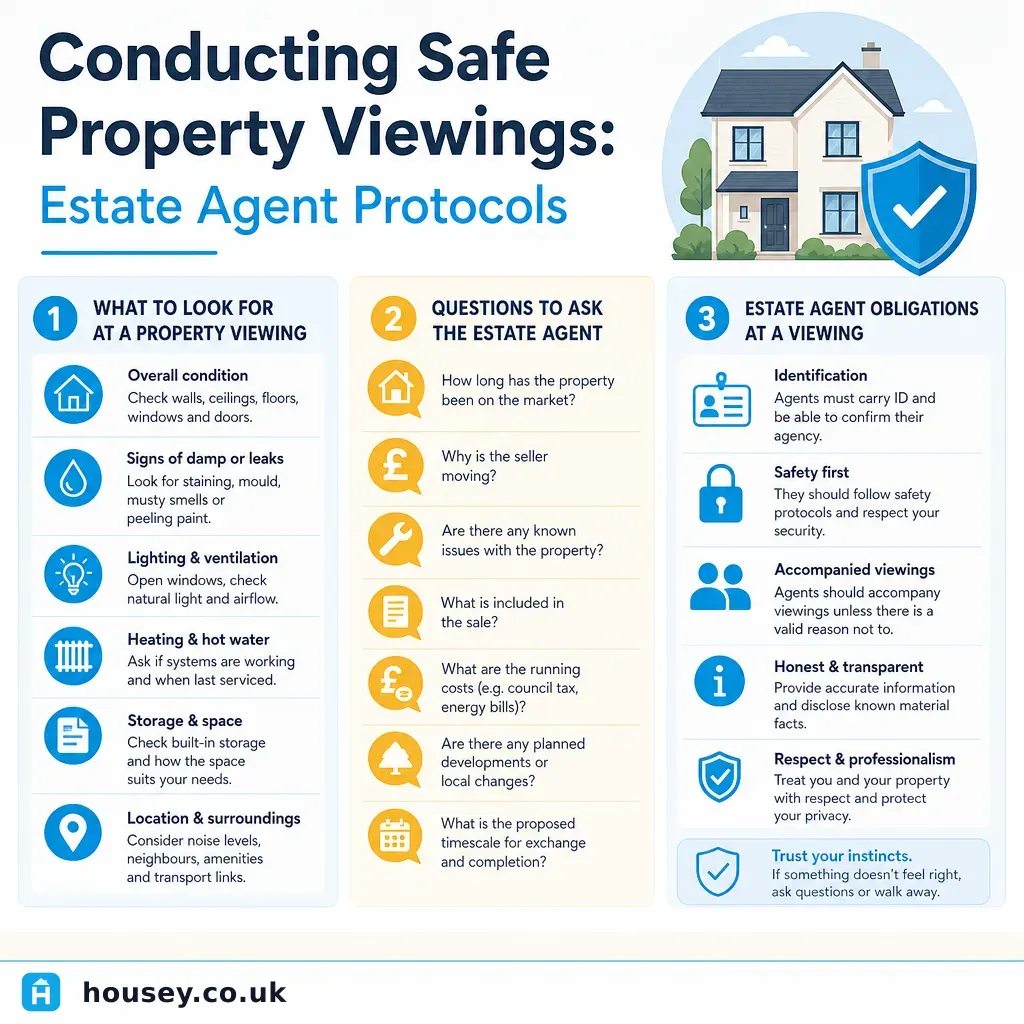
Conducting Safe Property Viewings: Estate Agent Protocols
A property viewing typically lasts 20 to 45 minutes — limited time to assess a home you may own for years.
 Buying & Moving
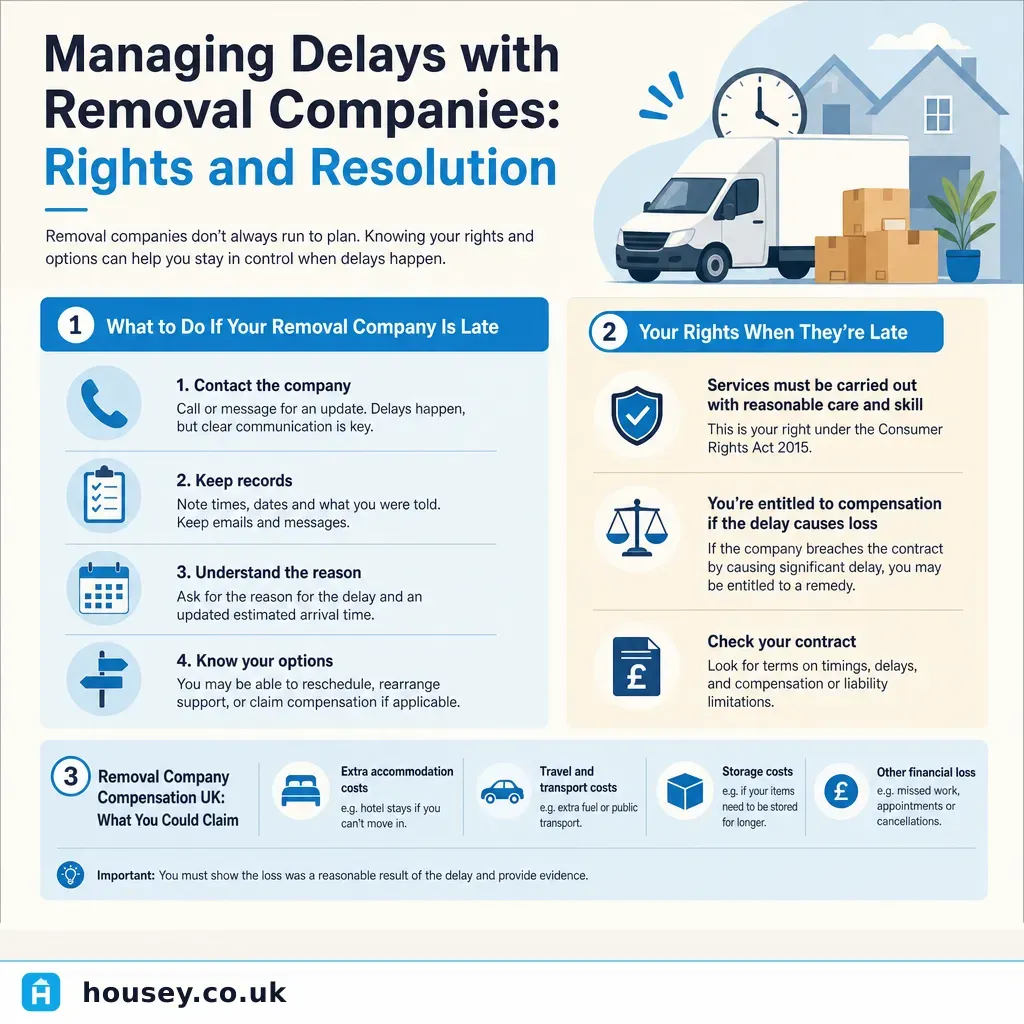
Managing Delays with Removal Companies: Rights and Resolution
If a removal company is late, your rights depend on your contract and whether the company is BAR-registered.
 Buying & Moving
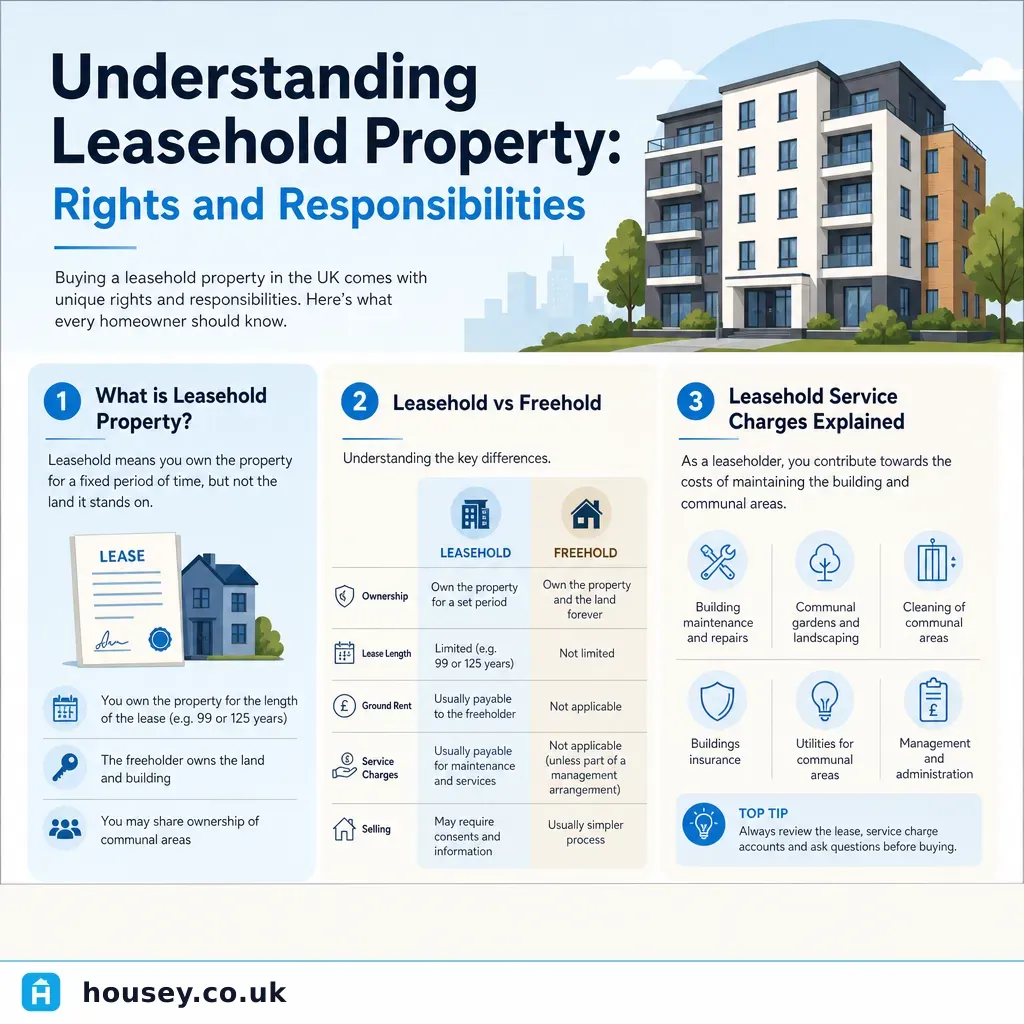
Understanding Leasehold Property: Rights and Responsibilities
Leasehold means you own a time-limited interest in a property while the freeholder owns the land and building.
 Buying & Moving
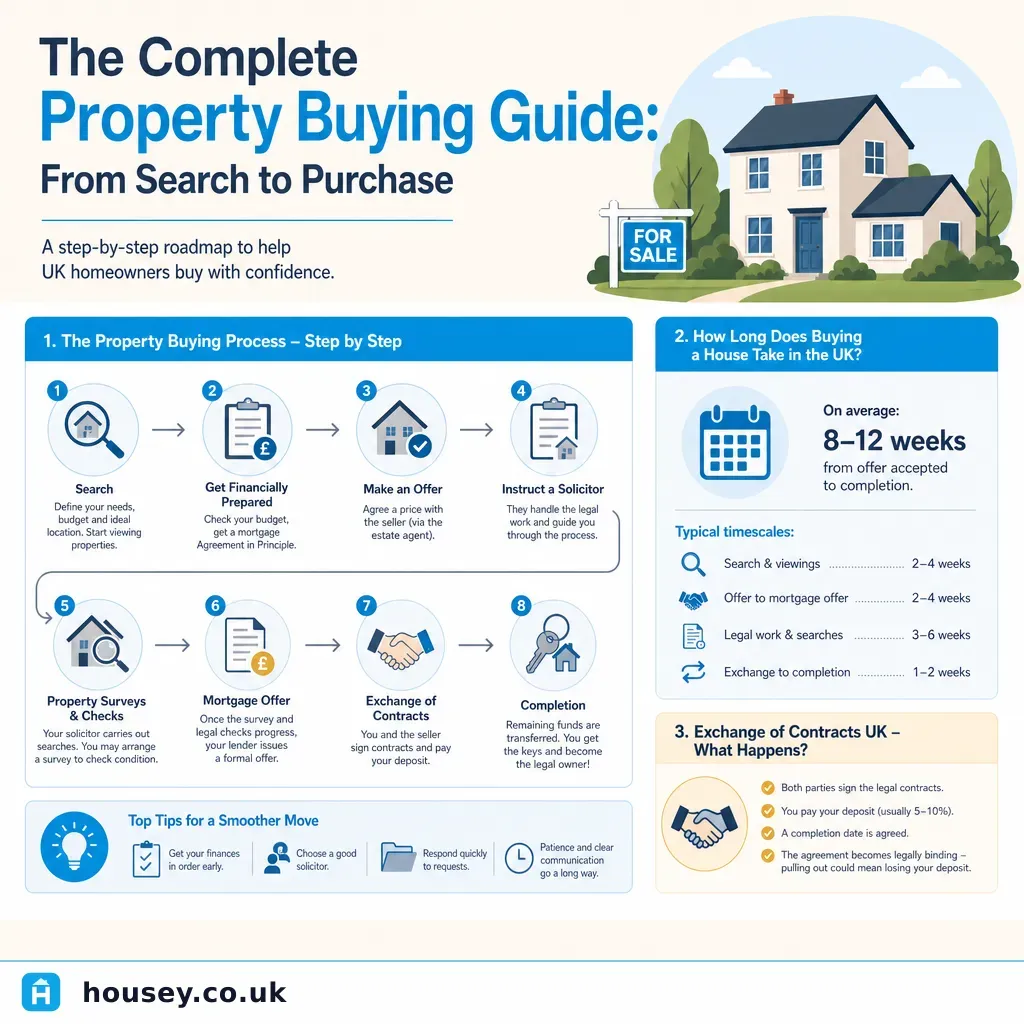
The Complete Property Buying Guide: From Search to Purchase
Buying a property in England and Wales typically takes 3–6 months from accepted offer to completion.