What to Look for When Viewing New Build Properties
By Housey · Last reviewed 19th of May 2026
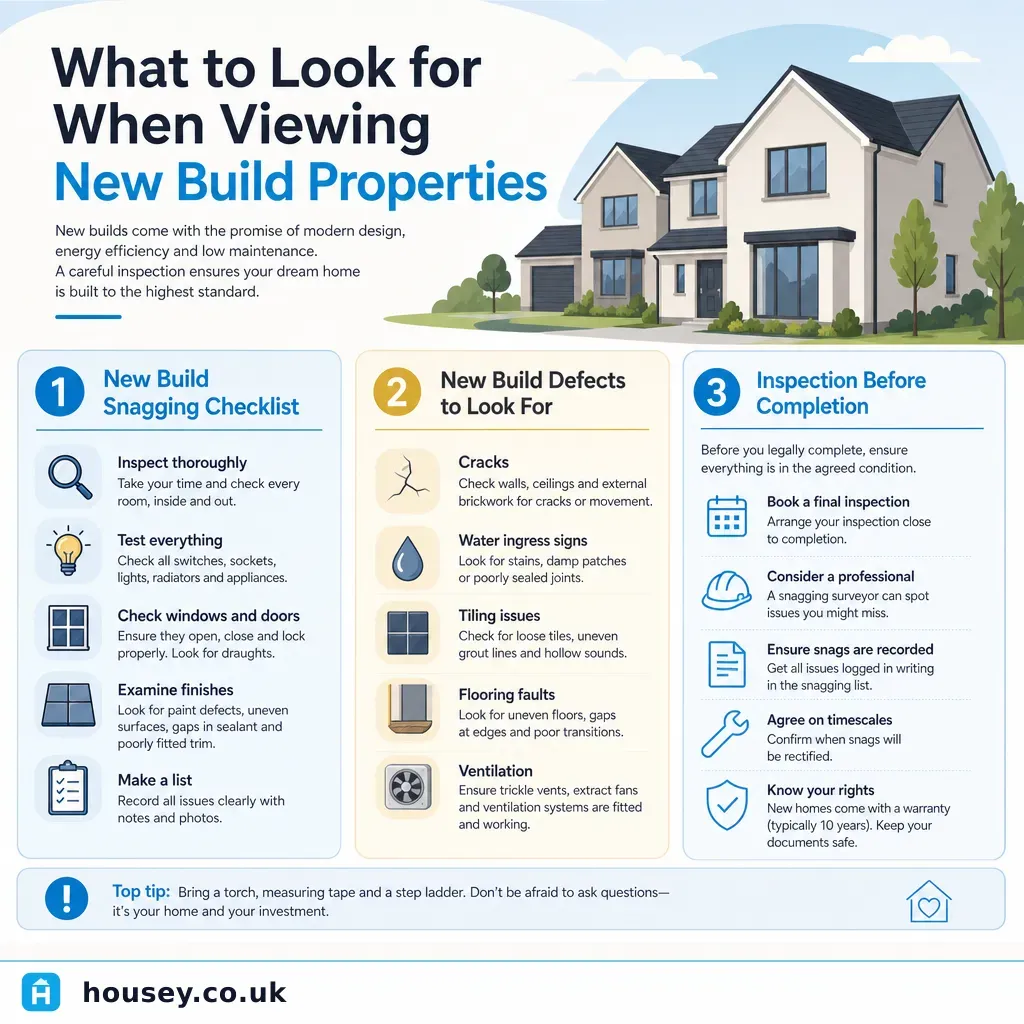
What to Look for When Viewing New Build Properties
Buying a new build home in England or Wales involves a different set of checks from purchasing an older property. Developers hand over homes on tight completion schedules, and build quality can vary noticeably between sites, contractors, and individual plots on the same development. Understanding what to scrutinise during your viewing — and before legal completion — gives you the best chance of entering your new home with outstanding defects already resolved.
Key points
- The NHBC Buildmark warranty covers builder defects in years one and two, and structural and weatherproofing defects in years three to ten; your window for reporting snags directly to the developer sits within that initial two-year period.
- A Building Regulations completion certificate must be issued before a new build is lawfully occupied — ask your conveyancer to confirm this is in place before you exchange contracts.
- The Consumer Code for Home Builders requires registered developers to provide a clear reservation agreement, a predicted completion date, and a documented complaints process.
- New builds completed from June 2022 must meet updated Part L (conservation of fuel and power) standards; ask for the Energy Performance Certificate before exchange and check the rating reflects current requirements.
- Professional snagging surveyors recommend securing access before legal completion, when developers are typically most responsive to a formal defect list and still motivated to fix problems promptly.
What snagging actually means
Snagging is the process of identifying defects, unfinished items, or work that does not meet the standard specified in your contract or required under Building Regulations. Snags range from the cosmetic — paint runs, missing sealant, misaligned doors — through to functional and regulatory failures.
Three categories are worth distinguishing:
- Cosmetic snags: scuffs, chips, incomplete decoration, uneven tiling. Developers are not always contractually required to remedy purely cosmetic defects not specified in the sales contract.
- Functional snags: doors or windows that do not open or close correctly, light switches that do not operate, extractor fans not connected to an external duct.
- Regulatory snags: items that do not comply with Building Regulations — the most serious category, potentially affecting safety, building insurance, and future resale.
Room-by-room viewing checklist
Work methodically through the property. Bring a torch, a spirit level, a phone charger to test sockets, and a notepad or phone to photograph defects.
External and structure
- Check the roof line is straight and tiles or slates are not cracked, displaced, or missing
- Inspect brickwork or render for cracks, particularly around window and door openings
- Confirm gutters and downpipes are secured and fall toward outlets without sagging
- Verify the damp-proof course is visible and not bridged by soil, render, or paving
- Check that drives, paths, and paving drain away from the building
- Confirm garden boundaries, fencing, walls, and gates match the plot plan
Throughout the interior
- Open every door and window — they should operate smoothly without binding, dragging, or sticking
- Test every electrical socket using your phone charger; note any that do not work
- Check walls and ceilings for cracks, especially at wall-ceiling junctions and above window openings
- Look for gaps at skirting boards, architraves, and between kitchen units and walls
- Test all taps; run hot water for 30 seconds and check under sinks for drips or water staining
Kitchen and utility
- Confirm all cabinet doors and drawers align and close flush without catching
- Test the hob, oven, and extractor fan; confirm the extractor vents externally, not into the loft
- Verify all appliances listed in the specification are present and connected
- Inspect grouting and silicone around the sink and splashback for gaps or discolouration
Bathrooms and en-suites
- Run taps and showers simultaneously if possible to test water pressure
- Inspect silicone around the bath, shower tray, and basin for gaps or voids
- Check tiles are flat and grout lines are consistent throughout
- Confirm mechanical ventilation activates automatically when the light is switched on, as required under Building Regulations Part F
Loft and roof space
- If accessible, check insulation depth and coverage — current guidance indicates approximately 270 mm of mineral wool in a cold accessible loft
- Look for visible daylight at eaves or between tiles, damp patches, and cracked or notched rafters
Red flags that need urgent attention
Some findings during a viewing warrant professional assessment before you proceed to exchange:
- Cracks wider than approximately 0.3 mm, particularly stepped or diagonal cracks through brickwork
- Wet or damp patches on ground-floor slabs, walls, or ceilings
- Condensation or misting trapped inside double-glazed units
- An extractor fan that vents into the loft rather than externally — a Building Regulations Part F non-compliance
- Any habitable room, bathroom, or kitchen without required mechanical or background ventilation
- Missing or incorrectly positioned smoke detectors or carbon monoxide alarms, required under the Smoke and Carbon Monoxide Alarm (England) Regulations 2022 and Building Regulations Part B
- A boiler or heat pump installation without a commissioning certificate
Should you commission a professional snagging survey?
A professional snagging inspector — often a former building control officer or experienced construction professional — works through the property systematically and produces a written report for the developer.
Option | Best for | Not ideal for | Typical output | Main consideration |
|---|---|---|---|---|
Self-conducted viewing checklist | All buyers as a first pass | Identifying regulatory or concealed defects | Personal notes and photographs | Easy to miss technical or hidden defects |
Professional snagging survey | Buyers wanting a formal, comprehensive defect record | Buyers on very tight completion timescales | Formal defect report for developer | Developer must have reasonable time to remedy before completion |
RICS Home Survey (Level 2 or 3) | Buyers with structural or broader condition concerns | Plots where detailed snagging is the primary need | Condition-rating report | Broader scope than snagging alone |
Booking a snagging survey before legal completion is preferable in most cases: developers are more likely to remedy defects while they still own the property than after you have moved in.
What happens after you move in
Under the NHBC Buildmark warranty — or equivalent schemes from LABC Warranty or Premier Guarantee — you have two years to report builder defects directly to the developer. After this, structural and weatherproofing cover continues to year ten, but claims are handled by the warranty provider rather than the developer.
Keep a written record of every defect reported, the date, and any response received. Where a developer fails to respond within a reasonable period, the Consumer Code for Home Builders offers access to an Independent Dispute Resolution scheme.
When to get professional help
Most cosmetic snags can be noted and submitted in writing to the developer yourself. Seek professional help if:
- You are buying off-plan and cannot inspect the finished property before exchanging contracts
- Structural cracks, damp evidence, or drainage problems are found during your viewing
- Your developer dismisses a defect you believe is a Building Regulations non-compliance
- You want an independent, professionally evidenced report that carries weight in a formal dispute
How Housey can help
Housey connects you with qualified specialists for a new-build snagging survey before or after legal completion. If you need a broader condition assessment, RICS Home Surveys are available through RICS-accredited surveyors. Where Building Regulations compliance is specifically in question, a building control consultant can advise whether the work on your plot meets current standards.
Frequently asked questions
Can I get a snagging survey before I legally complete?
In most cases, yes. Developers registered with the Consumer Code for Home Builders must permit reasonable access for a pre-completion inspection. Arrange this through your solicitor with adequate notice. The Code provides a dispute resolution route if access is unreasonably refused.
Does a new build warranty cover everything?
No. The NHBC Buildmark and similar schemes cover builder defects in years one and two, and structural and weatherproofing defects in years three to ten. They do not cover general wear and tear, homeowner-caused damage, or appliance failures once the manufacturer's guarantee has expired.
What if my developer becomes insolvent during the two-year defect period?
If your developer is insolvent, the warranty provider — typically NHBC, LABC Warranty, or Premier Guarantee — steps in to handle valid claims. Confirming that a recognised warranty scheme is in place before exchange is one reason to check this with your solicitor early in the conveyancing process.
Is a RICS survey worth commissioning on a new build?
A RICS Home Survey assesses condition rather than producing a detailed snag list, but it can identify structural concerns, drainage issues, or non-compliance that a snagging inspector may not formally report. For standard plots in apparent good condition, a professional snagging survey is often the more targeted choice.
Sources and further reading
- Consumer Code for Home Builders — Consumer Code for Home Builders
- NHBC Buildmark warranty — NHBC
- Building Regulations Approved Documents — GOV.UK
- Smoke and Carbon Monoxide Alarm (England) Regulations 2022 — legislation.gov.uk
- Buying a new build home — Citizens Advice
Useful next reads
 Buying & Moving
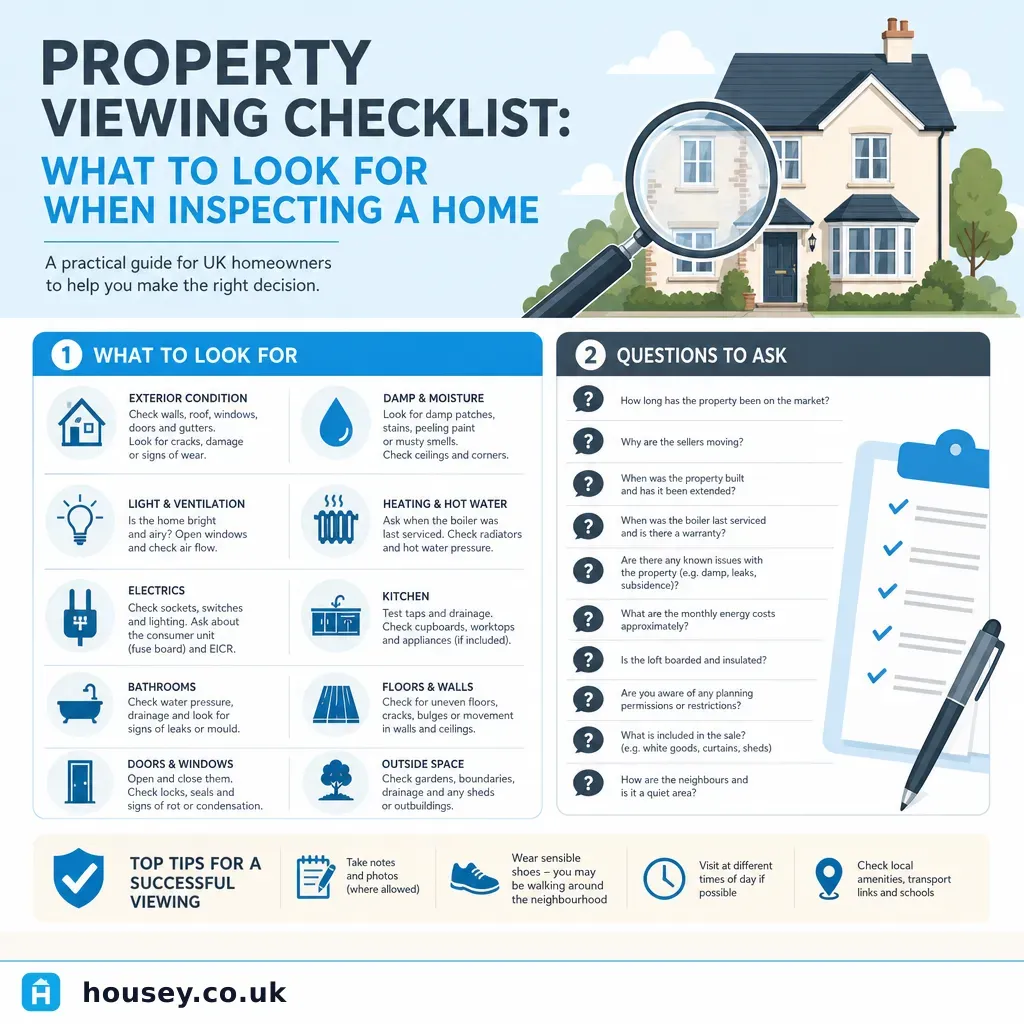
Property Viewing Checklist: What to Look for When Inspecting a Home
A property viewing is your first chance to assess condition before committing to survey and legal costs.
 Buying & Moving
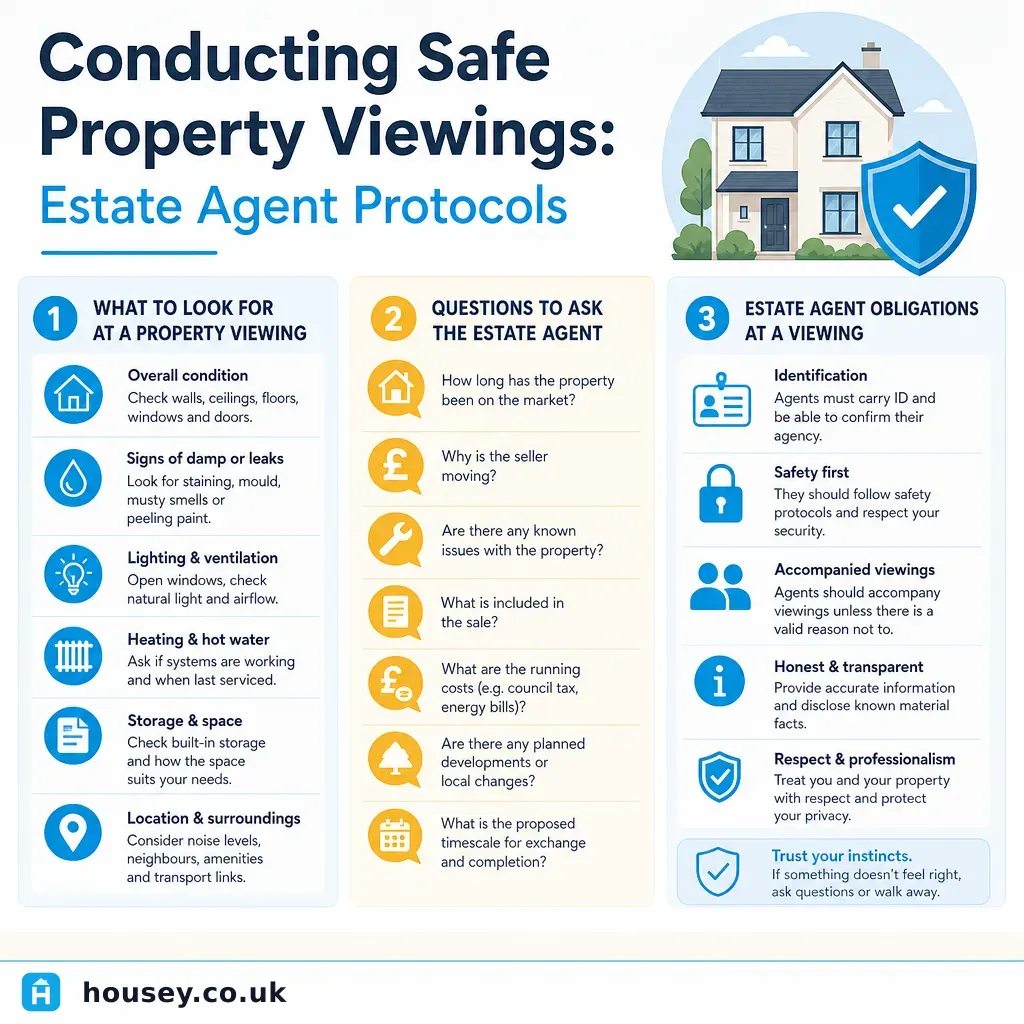
Conducting Safe Property Viewings: Estate Agent Protocols
A property viewing typically lasts 20 to 45 minutes — limited time to assess a home you may own for years.
 Buying & Moving
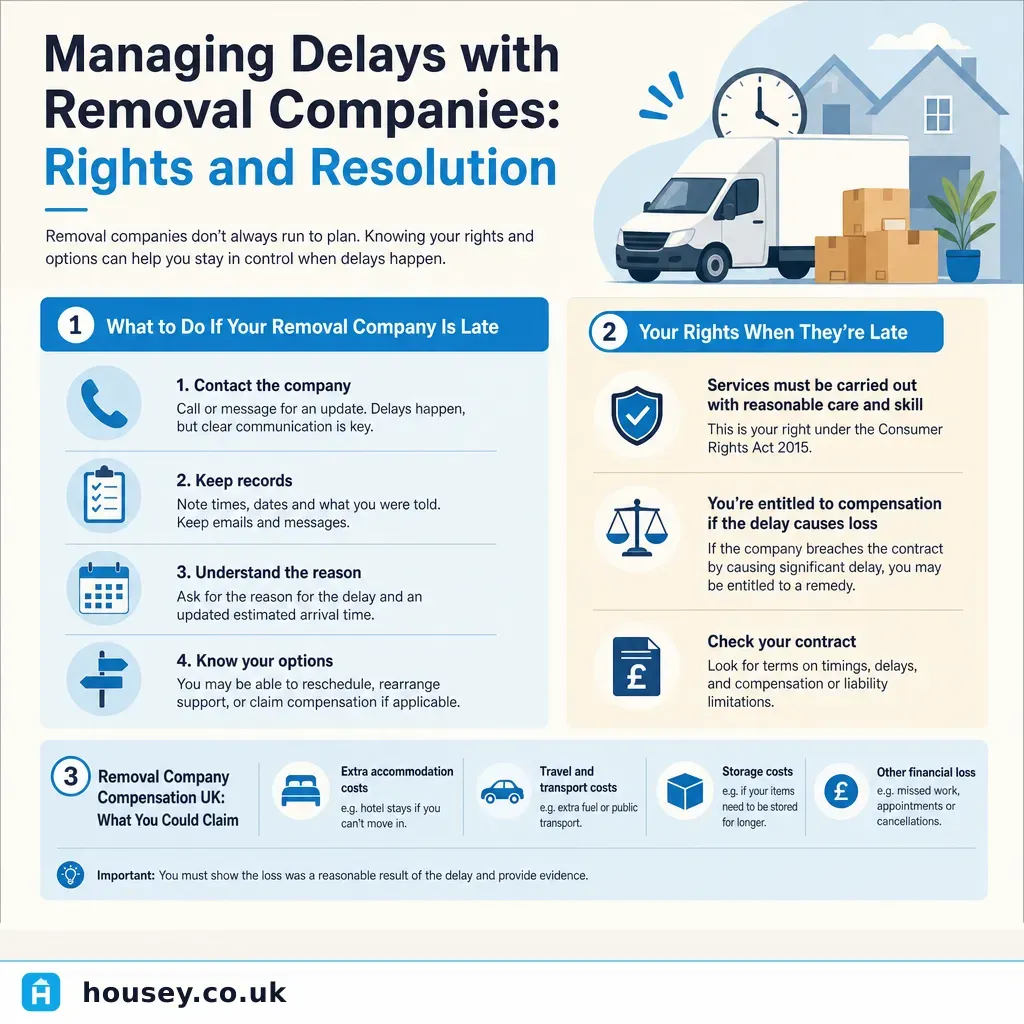
Managing Delays with Removal Companies: Rights and Resolution
If a removal company is late, your rights depend on your contract and whether the company is BAR-registered.
 Buying & Moving
Understanding Leasehold Property: Rights and Responsibilities
Leasehold means you own a time-limited interest in a property while the freeholder owns the land and building.
 Buying & Moving
The Complete Property Buying Guide: From Search to Purchase
Buying a property in England and Wales typically takes 3–6 months from accepted offer to completion.