Conducting Safe Property Viewings: Estate Agent Protocols
By Housey · Last reviewed 18th of May 2026
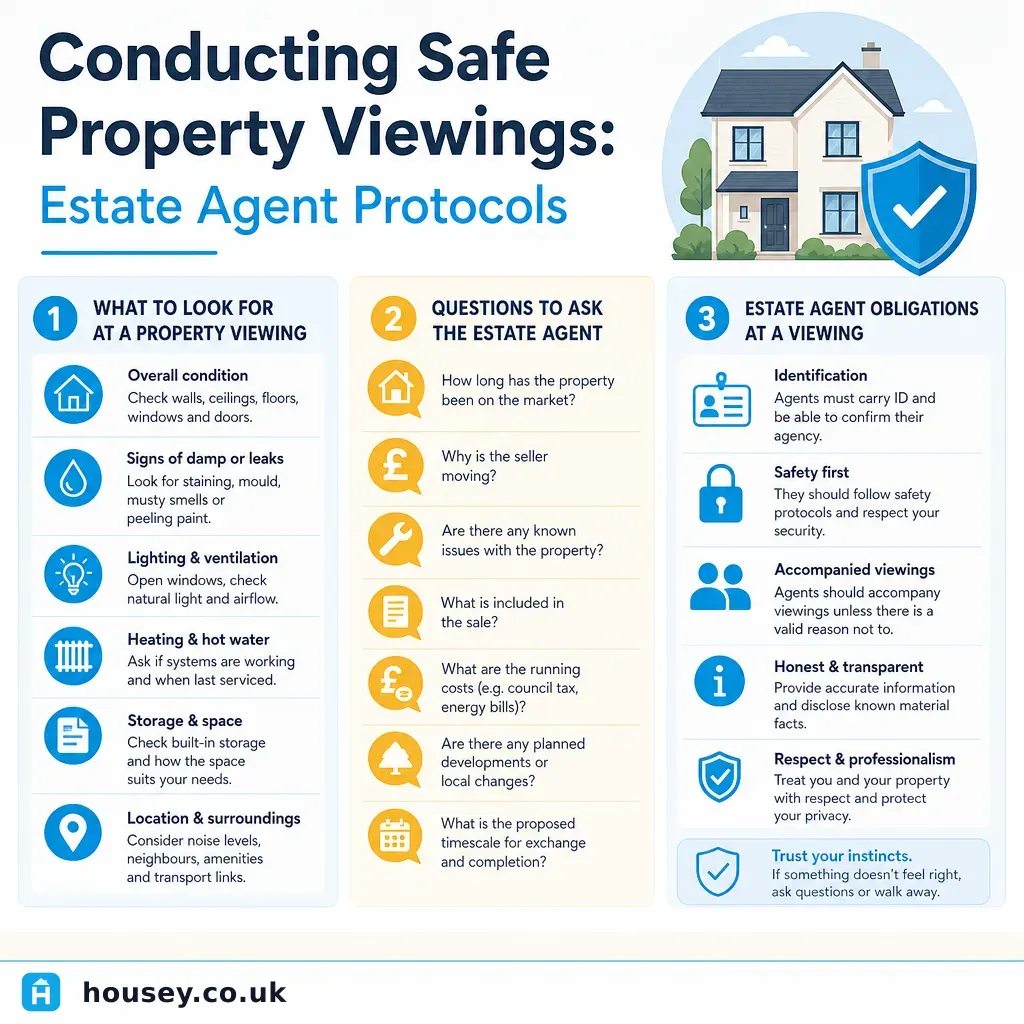
Conducting Safe Property Viewings: Estate Agent Protocols
Property viewings are brief windows into homes you may eventually own — too short for the inspection they deserve if you arrive unfocused. Many buyers leave a first viewing having asked few questions and checked little beyond the décor, relying on the estate agent to frame what they see. Understanding what agents are legally required to tell you, and what you should be checking independently, puts you in a far stronger position before deciding whether to make an offer.
Key points
- Estate agents in England and Wales must belong to a government-approved redress scheme — either The Property Ombudsman or the Property Redress Scheme — under the Consumers, Estate Agents and Redress Act 2007.
- National Trading Standards material information guidance (phased in from 2022) requires agents to disclose property details in three categories: Part A (price, tenure, council tax band), Part B (construction type, utilities, parking), and Part C (flood risk, restrictive covenants, leasehold details).
- Under the Estate Agents Act 1979, agents must pass on all offers to the seller promptly — they cannot legally withhold or delay your offer regardless of the amount.
- You are entitled to request a second viewing at any point before exchange; estate agents should accommodate reasonable requests without applying pressure to offer.
- Photographs of structural features taken during a viewing for your own personal use are permissible; you do not require the agent's permission to document a property you are considering purchasing.
What estate agents are legally required to tell you
The National Trading Standards Estate and Letting Agency Team (NTSELAT) introduced phased material information requirements from 2022. Agents must disclose property information upfront — not just on request — across three categories:
- Part A (must appear before marketing begins): asking price, council tax band, and tenure (freehold or leasehold).
- Part B (must be included in the listing): property construction type, number of rooms, utility supplies, heating type, and parking arrangements.
- Part C (must be disclosed before a sale is agreed): flood risk, planning restrictions, restrictive covenants, rights of way, and leasehold details including lease length, annual service charge, and ground rent.
If an agent has not disclosed Part C information before your viewing, you are entitled to ask for it directly. Agents belonging to Propertymark — the professional membership body for estate agents — are also bound by a code of conduct that supplements these statutory duties.
Room-by-room viewing checklist
Use this checklist during every viewing. Take photographs of anything you want to examine later or share with a surveyor.
Exterior and approach:
Interior — general:
Practical checks:
Red flags to watch for
Some observations during a viewing warrant further professional investigation before making an offer.
Structural and condition red flags:
- Stepped cracks through brickwork or wide diagonal cracks at corners of windows and doors — may indicate subsidence or structural movement; requires a structural engineer's opinion before proceeding.
- Persistent damp smell with tide marks on walls or swollen skirting boards — may indicate rising or penetrating damp requiring specialist investigation.
- Bulging or bowing external walls — a structural concern; do not proceed to offer without a professional assessment.
- Fresh plaster, new paint in isolated patches, or recently laid flooring in isolated areas — may be concealing damp or cracking.
- Japanese knotweed in the garden — sellers must declare it on the TA6 property information form; it can affect mortgage eligibility and requires professional treatment.
Agent conduct red flags:
- Reluctance or inability to disclose the seller's chain position, asking price rationale, or Part C material information.
- Pressure to make an offer at or immediately after the viewing without adequate reflection time.
- Refusal or discouragement when a second viewing is requested.
What to ask the estate agent
These questions give you information the agent may not volunteer but must answer honestly under the Estate Agents Act 1979.
About the property:
- Has the property had any structural alterations, extensions, or loft conversions? Were building regulations completion certificates obtained?
- Is there a known history of damp, flooding, or structural movement?
- How long has the property been on the market, and have there been any previous sales that fell through — and if so, why?
- What is included in the sale — fitted appliances, garden structures, light fittings?
- What is the council tax band and approximate annual charge?
About the seller and chain:
- Is the seller in a chain? How many properties long?
- Does the seller have a preferred or flexible completion timeline?
- Has the seller already found their next property to move to?
- Are there any existing offers currently on the table?
If the property is leasehold:
- What is the current lease length?
- What are the annual service charge and ground rent figures?
- Are there any upcoming major works or reserve fund notices?
- Who is the managing agent and freeholder?
What not to assume
Common assumption | Reality |
|---|---|
"Fresh paint means the property is well maintained" | Recent decoration can conceal damp, cracking, or other defects. Check behind and beneath any isolated new finishes carefully. |
"The agent will tell me everything important" | Agents act for the seller. They must not lie, but they are not obliged to volunteer every negative. Ask directly. |
"Requesting a second viewing is unusual" | A second viewing before making an offer is standard practice; a reputable agent should always accommodate it. |
"Leasehold just means I share a building" | Leaseholds carry service charges, ground rent, and potential lease extension costs that significantly affect total cost of ownership. |
"The asking price reflects market value" | Asking prices are set by sellers; verified sold prices are available free of charge via HM Land Registry Price Paid Data on GOV.UK. |
When to get professional help
A viewing is an initial assessment, not a structural inspection. If it raises concerns, the correct response is not to ask the agent further — it is to commission a professional survey. Consider instructing a qualified surveyor or specialist if:
- You notice any of the structural or condition red flags listed above.
- The property was built before 1919 or has been significantly extended or altered.
- The property is in a known flood-risk area, on a sloped site, or adjacent to large or mature trees.
- You are planning a significant offer and want professional input on condition before committing to survey costs — a paid pre-offer consultation with a surveyor is possible in some cases.
How Housey can help
Housey's marketplace connects buyers with vetted local surveyors, structural engineers, and other property specialists. If a viewing raises questions you cannot answer from observation alone, Housey makes it straightforward to find and compare quotes from RICS-registered professionals before you commit to making an offer.
Frequently asked questions
Can I request a second viewing before making an offer?
Yes. A second viewing before making an offer is entirely standard practice, and a reputable agent should accommodate it without applying pressure. Use the second visit to check areas you did not inspect carefully the first time, observe the property at a different time of day to assess light and noise, and bring a trusted contact or builder if you have specific concerns about the condition.
Should I visit a property at different times of day?
If you are seriously considering making an offer, a second visit at a different time can reveal aspects a single evening viewing would miss — morning light in south-facing rooms, weekday traffic on a seemingly quiet road, or weekend noise from neighbouring properties. This is particularly useful for terraced homes, flats, and properties adjacent to commercial premises or main roads.
What should I photograph during a property viewing?
Photograph anything you want to examine later or share with a surveyor or trusted contact: external walls, ceiling stains, cracks in walls or floors, the boiler model and age, the electrical consumer unit, and any areas of apparent damp or unusual repair. Structural features are generally acceptable to document. Check with the agent before photographing areas containing the seller's personal possessions.
What does an estate agent have to disclose at a property viewing?
Under the Estate Agents Act 1979 and NTSELAT material information guidance, agents must not make false representations and must disclose material information upfront — including tenure, council tax band, flood risk, leasehold details, and restrictive covenants. If you believe an agent has withheld material information, you can complain to their redress scheme: The Property Ombudsman or the Property Redress Scheme.
Sources and further reading
- Estate Agents Act 1979 — legislation.gov.uk — Statutory obligations of estate agents in England and Wales
- Material information in property listings — NTSELAT — Guidance on required upfront disclosures
- The Property Ombudsman — Government-approved redress scheme for property complaints
- Professional Standards — Propertymark — Code of conduct for member estate agents
- Buying a home — Citizens Advice — Independent guidance on the purchase process
Useful next reads
 Buying & Moving
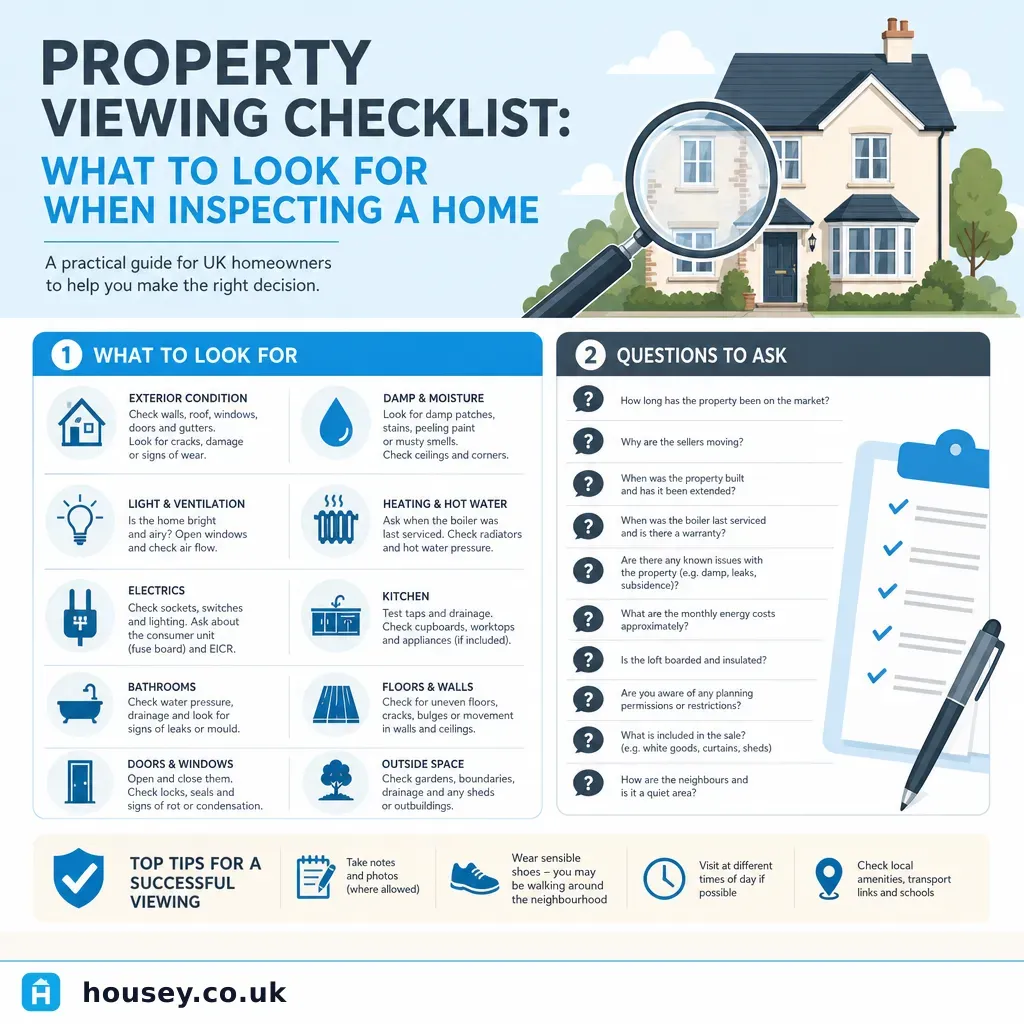
Property Viewing Checklist: What to Look for When Inspecting a Home
A property viewing is your first chance to assess condition before committing to survey and legal costs.
 Buying & Moving
Identifying and Resolving Delays in Property Transactions
Delays in UK property transactions most often arise from slow local authority searches, incomplete identity documents, mortgage hold-ups, leasehold complications, or a problem elsewhere in the chain.
 Buying & Moving
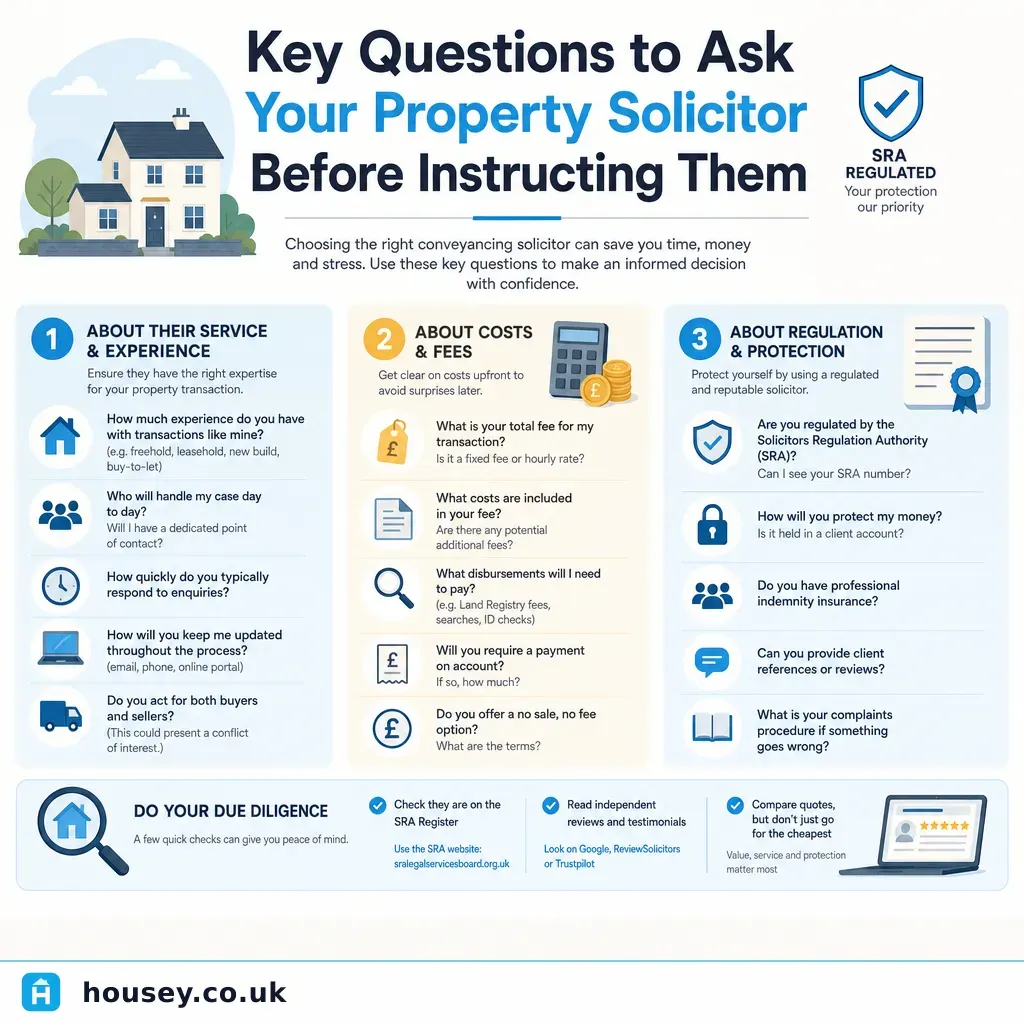
Key Questions to Ask Your Property Solicitor Before Instructing Them
Before instructing a property solicitor, ask whether they are on your mortgage lender's approved panel, whether their quote is fixed and includes VAT and all disbursements, who will personally handle your case, and what their abortive-fee policy is.
 Buying & Moving
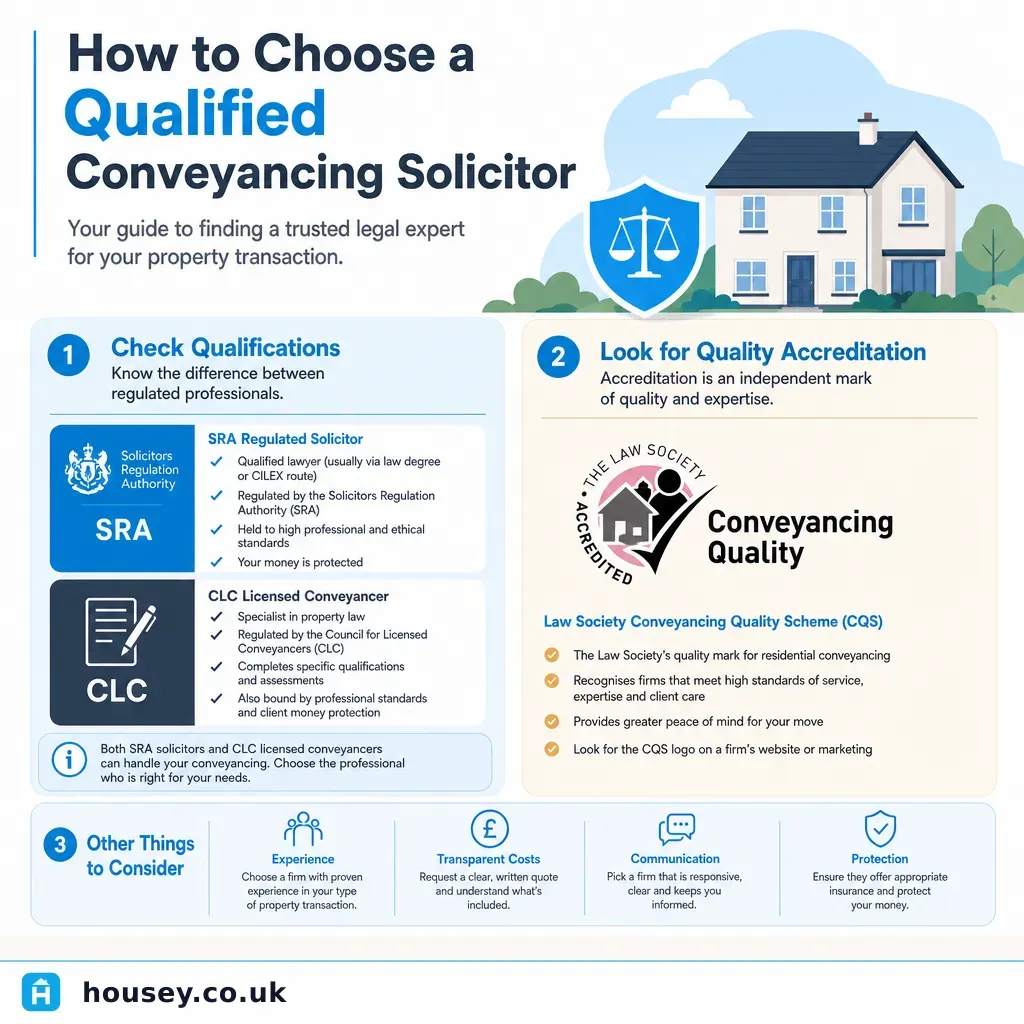
How to Choose a Qualified Conveyancing Solicitor
To choose a qualified conveyancing solicitor, verify they are regulated by the Solicitors Regulation Authority (SRA) or the Council for Licensed Conveyancers (CLC), check whether they hold Law Society CQS accreditation, and confirm they are on your mortgage lender's approved panel.
 Buying & Moving
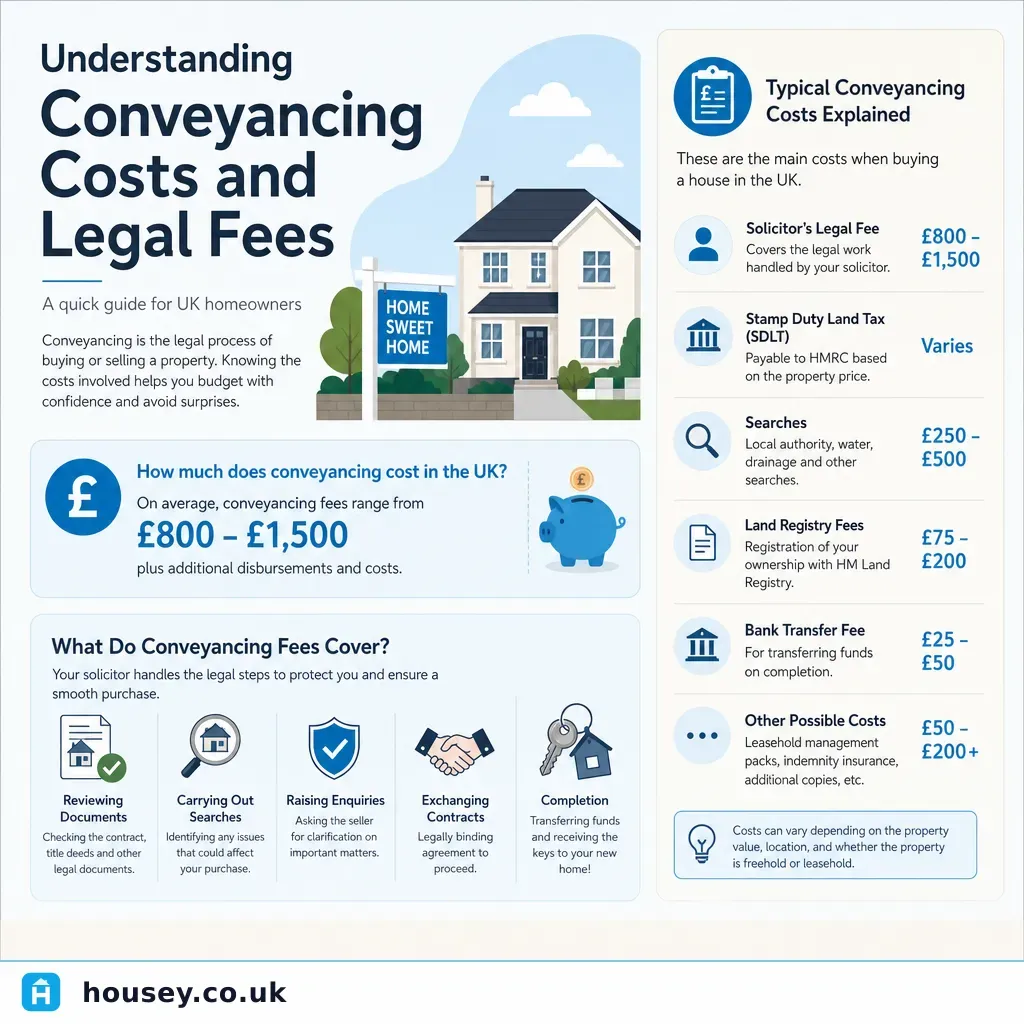
Understanding Conveyancing Costs and Legal Fees
Conveyancing costs in England and Wales include a solicitor's or licensed conveyancer's professional fee plus disbursements such as searches, Land Registry registration, and bank transfer charges.