Purchasing Listed Buildings: Special Considerations and Requirements
By Housey · Last reviewed 25th of May 2026
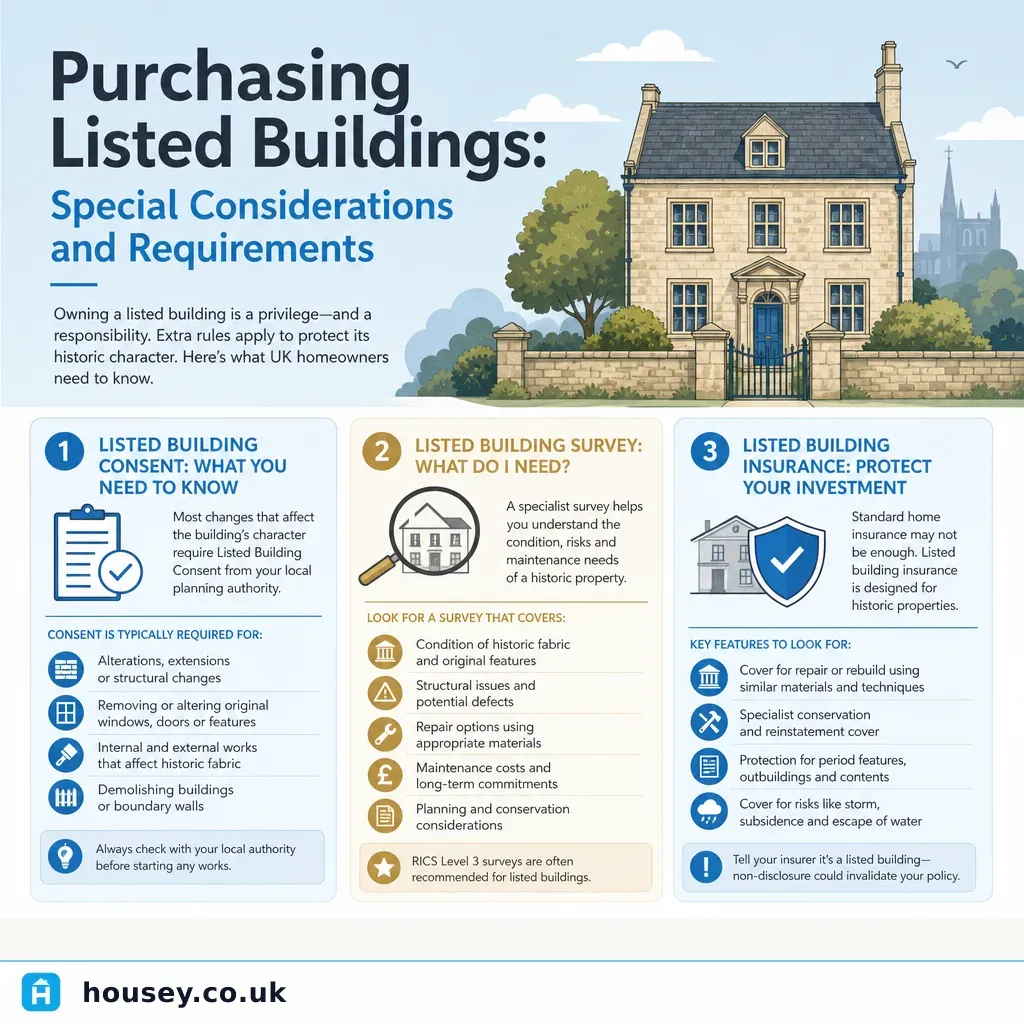
Purchasing Listed Buildings: Special Considerations and Requirements
Buying a listed building can be one of the most rewarding property decisions a UK homeowner makes — but the legal, regulatory, and physical constraints that come with heritage designation make it a very different transaction from a standard residential purchase. Listed status affects what you can alter, insure, maintain, and finance, and many buyers only discover the full implications after exchange.
Key points
- There are approximately 500,000 listed buildings in England; around 92% are Grade II, 5.5% are Grade II*, and 2% are Grade I (the highest protection).
- Listed Building Consent (LBC) is required for any works that would affect the character of a listed building — separate from and additional to planning permission.
- Carrying out works without LBC is a criminal offence under the Planning (Listed Buildings and Conservation Areas) Act 1990, with no statutory time limit on prosecution.
- A RICS Level 3 Building Survey — ideally by a surveyor with experience of historic buildings — is strongly recommended over a Level 2 for listed property.
- Approved alterations to listed buildings currently attract zero-rated VAT; repairs and maintenance remain subject to 20% VAT.
What does "listed" mean in practice for a buyer?
Listed status means the building is recognised as being of special architectural or historic interest under the Planning (Listed Buildings and Conservation Areas) Act 1990. The designation is applied in England by Historic England on behalf of the Secretary of State. Scotland, Wales, and Northern Ireland operate equivalent but distinct systems through Historic Environment Scotland, Cadw, and the Historic Environment Division respectively.
The listing covers the entire building, any objects or structures fixed to it, and any structure within the curtilage — the land and outbuildings associated with the property — that predates 1 July 1948. This is often broader than buyers expect: a garden wall, stable block, or historic gate may be listed even if not explicitly named in the listing description.
Grade | Proportion of listed buildings | Level of significance |
|---|---|---|
Grade I | ~2% | Exceptional interest |
Grade II* ("two-star") | ~5.5% | Particularly important, more than special interest |
Grade II | ~92% | Nationally important and of special interest |
What is Listed Building Consent and why does it matter?
Listed Building Consent (LBC) is required for any works that would affect the special architectural or historic character of a listed building — internal as well as external. Replacing windows with double-glazed units, removing a partition wall, replastering with modern cement, re-roofing with different tile types, or installing services in a way that damages historic fabric may all require LBC.
Critically, unauthorised works are a criminal offence under section 9 of the Act, and there is no statutory time limit on prosecution. A buyer can inherit exposure to enforcement action or criminal proceedings arising from works carried out by previous owners, which makes pre-purchase investigation essential.
Your conveyancer should check whether any LBC applications have been made, what conditions were attached, and whether works appear to have been carried out without consent. A heritage surveyor or conservation architect can identify physical evidence of alterations that may not match the paper trail.
What survey do you need for a listed building?
A standard RICS Level 2 Home Survey is unlikely to be adequate for a listed building. Most listed properties predate 1919, are built with traditional materials and lime-based construction, and may have ongoing damp, movement, or repair issues that require specialist interpretation.
A RICS Level 3 Building Survey — ideally carried out by a surveyor with experience of historic buildings — is the appropriate starting point. For more complex properties, a specialist heritage building survey from a conservation-accredited professional (AABC or RIBA Conservation accreditation) provides the detailed fabric analysis a standard survey cannot.
Key areas a heritage survey should cover:
- Condition and specification of historic materials: stone, brick, timber, lime render, slate, and cast iron.
- Evidence of historic or recent unauthorised alterations to the fabric.
- Damp in solid walls, which behave very differently from cavity-wall construction.
- Structural movement — traditional buildings often show historical settlement that is stable but requires specialist interpretation.
- Quality and specification of any repair or restoration works already carried out.
- Energy upgrade options and constraints within the LBC framework.
Worked example: purchasing a Grade II terraced house
A buyer purchasing a Grade II mid-terrace built around 1840 in a northern English market town might encounter: an LBC on record for a rear extension with conditions about window styles; no consent visible for a bathroom conversion in the 1990s that removed a chimney breast; and a specialist surveyor's report recommending repointing with lime mortar and attention to historic timber floors.
Before exchange, this buyer would need to verify the LBC conditions were complied with, take advice on the chimney breast removal (potentially requiring retrospective LBC or indemnity insurance), confirm specialist buildings insurance is obtainable and affordable, and factor ongoing maintenance costs into their financial planning. Traditional materials and specialist contractors typically cost significantly more than standard modern alternatives — this should be reflected in any budget or mortgage affordability assessment.
Important limitations
This article provides general information about listed buildings in England. Listing grades, consent requirements, and enforcement practice differ in Scotland (Historic Environment Scotland), Wales (Cadw), and Northern Ireland (Historic Environment Division). Planning and heritage rules vary by local authority and conservation area designation. This article is not legal advice. Always instruct a qualified solicitor experienced in heritage property and obtain independent advice from a conservation-accredited professional before exchanging contracts.
What to ask a qualified professional
Before exchanging on a listed building, ask:
- Has the conveyancer reviewed the listing description, curtilage extent, and the full LBC application history on the local planning portal?
- Has the surveyor specifically assessed the building for unauthorised works, traditional material condition, and solid-wall damp?
- Does the surveyor or heritage consultant hold AABC or RIBA Conservation accreditation?
- What is the local planning authority's typical approach to LBC applications for this building type and location?
- Is there any outstanding enforcement notice or enforcement risk associated with previous works?
- What are the insurer's exact reinstatement and contractor requirements for this property?
- What energy improvement measures are permitted within the listed building constraints, and which would require LBC?
When to get professional help
Seek specialist advice before exchange — not after. In particular:
- If the listing description mentions specific features (staircases, panelling, windows, chimneys) that appear to have been altered or removed.
- If there are recent extensions or internal alterations with no LBC visible on the local planning portal.
- If the surveyor flags active damp, structural movement, or decayed historic fabric.
- If the property is in a conservation area in addition to being listed — this adds a further consent layer for demolition and some alterations.
- If your mortgage lender expresses hesitation — some lenders restrict lending on Grade I and Grade II* properties.
How Housey can help
Housey connects buyers of listed and heritage properties with specialist professionals across the UK. Whether you need a heritage and conservation consultant to assess LBC risk and traditional construction, or a conveyancer experienced in listed building transactions to investigate title and consent history, our network helps you find the right professional before you commit.
Frequently asked questions
Do I need planning permission as well as Listed Building Consent?
These are two separate consents. Planning permission may be required for changes of use or extensions, while Listed Building Consent is required for works affecting the special character of the listed building. Some works require both; others require only one. Your local planning authority and a conservation professional can advise on your specific proposals before you commit to any alterations.
Can I improve the energy efficiency of a listed building?
Energy improvements are possible in many listed buildings but must be carefully planned. Measures such as secondary glazing, draught-proofing, and some internal insulation systems may be acceptable with or without Listed Building Consent depending on the property and local authority. Solid-wall external insulation and full double glazing are often refused. A conservation-accredited energy assessor can identify suitable options for your property.
Will I need specialist building insurance for a listed property?
Yes. Standard home insurance policies often do not adequately cover listed buildings. You will need a specialist policy covering traditional materials, like-for-like reinstatement costs, and potentially accidental damage to historic fabric. Some policies require repairs to be carried out by accredited contractors. Confirm cover terms with a specialist insurer before exchanging contracts.
What happens if the previous owner carried out unauthorised works?
Unauthorised works on a listed building carry criminal liability that can in some circumstances affect new owners. Your conveyancer should investigate the history of any works and advise whether indemnity insurance is appropriate or whether retrospective Listed Building Consent should be sought before exchange. Never assume works visible in the property were properly consented without checking the planning portal.
Sources and further reading
- Planning (Listed Buildings and Conservation Areas) Act 1990 — legislation.gov.uk
- Listed buildings guidance — Historic England / GOV.UK
- National Heritage List for England — Historic England
- Energy efficiency and historic buildings — Historic England
- RICS Home Survey Standard — RICS
Useful next reads
 Planning & Pre-Build
Heritage Property: Preserving Historic Homes and Conservation Standards
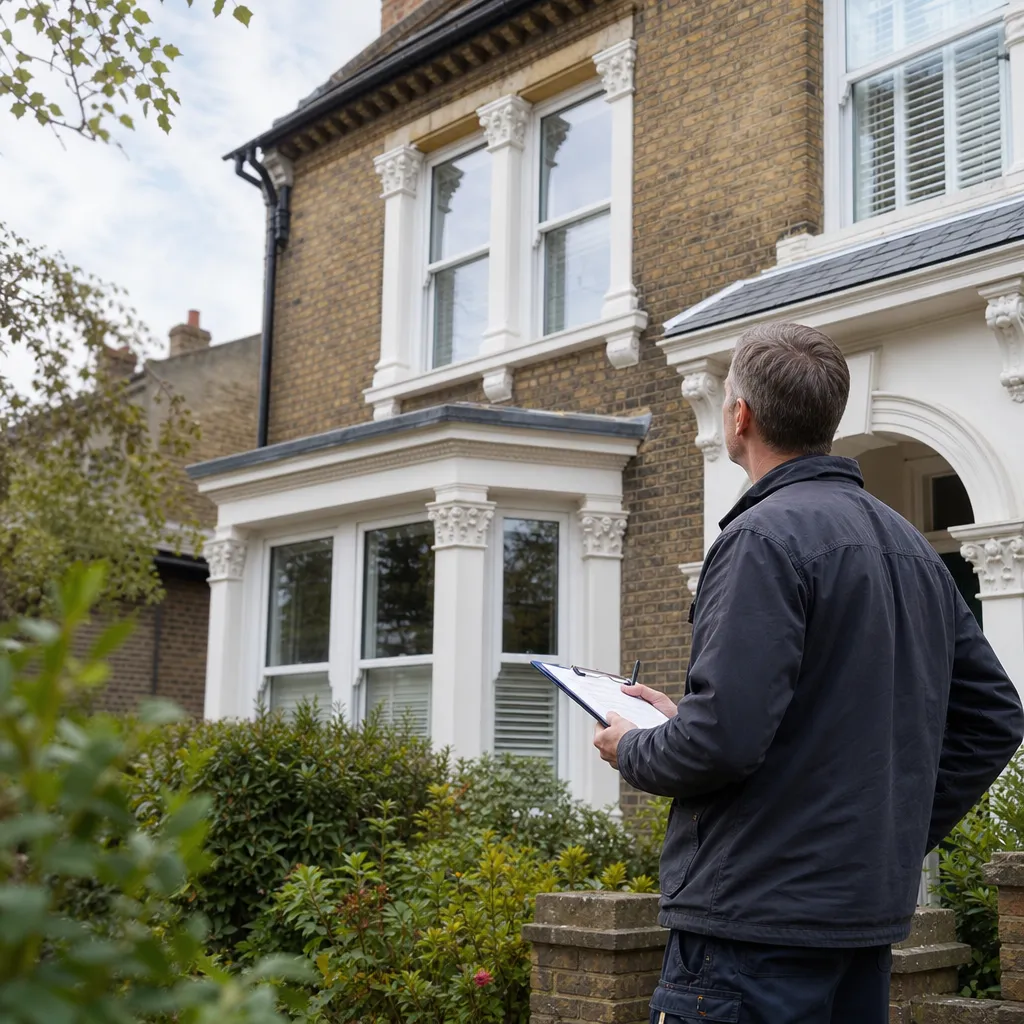
Listed buildings in the UK require Listed Building Consent for most works — internal and external — that affect their special architectural or historic interest.
 Planning & Pre-Build
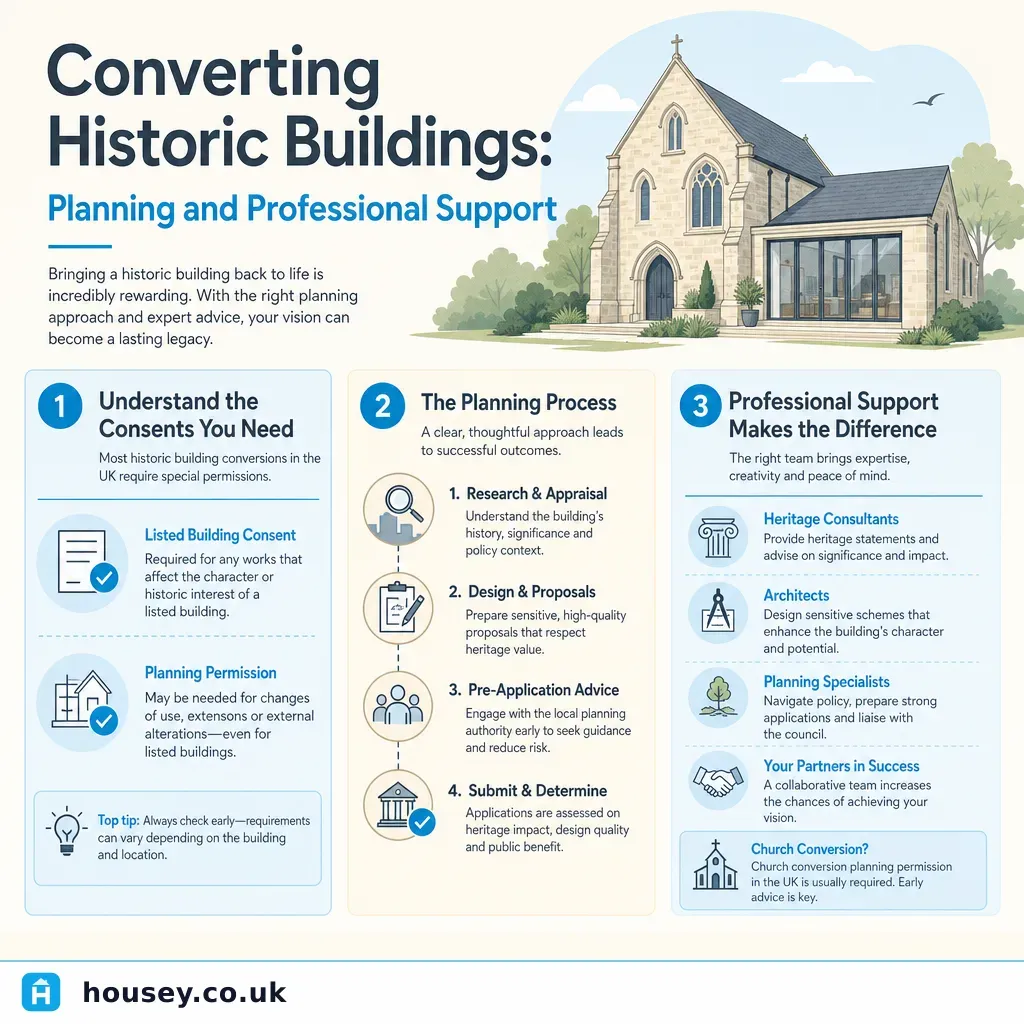
Converting Historic Buildings: Planning and Professional Support
Converting a historic or listed building in the UK requires Listed Building Consent in addition to planning permission, both granted by the local planning authority.
 Planning & Pre-Build
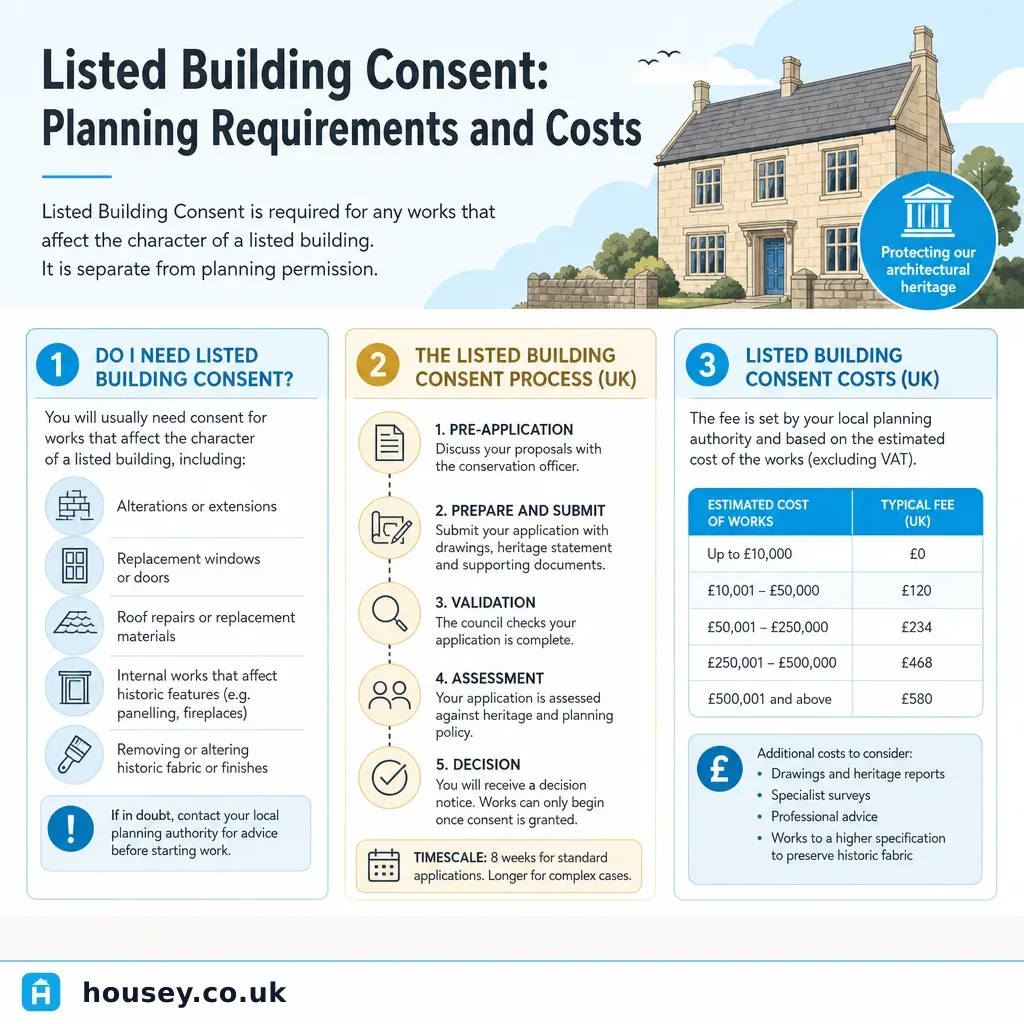
Listed Building Consent: Planning Requirements and Costs
Listed Building Consent is required for any works that affect the character of a listed building as a building of special architectural or historic interest — including internal alterations.
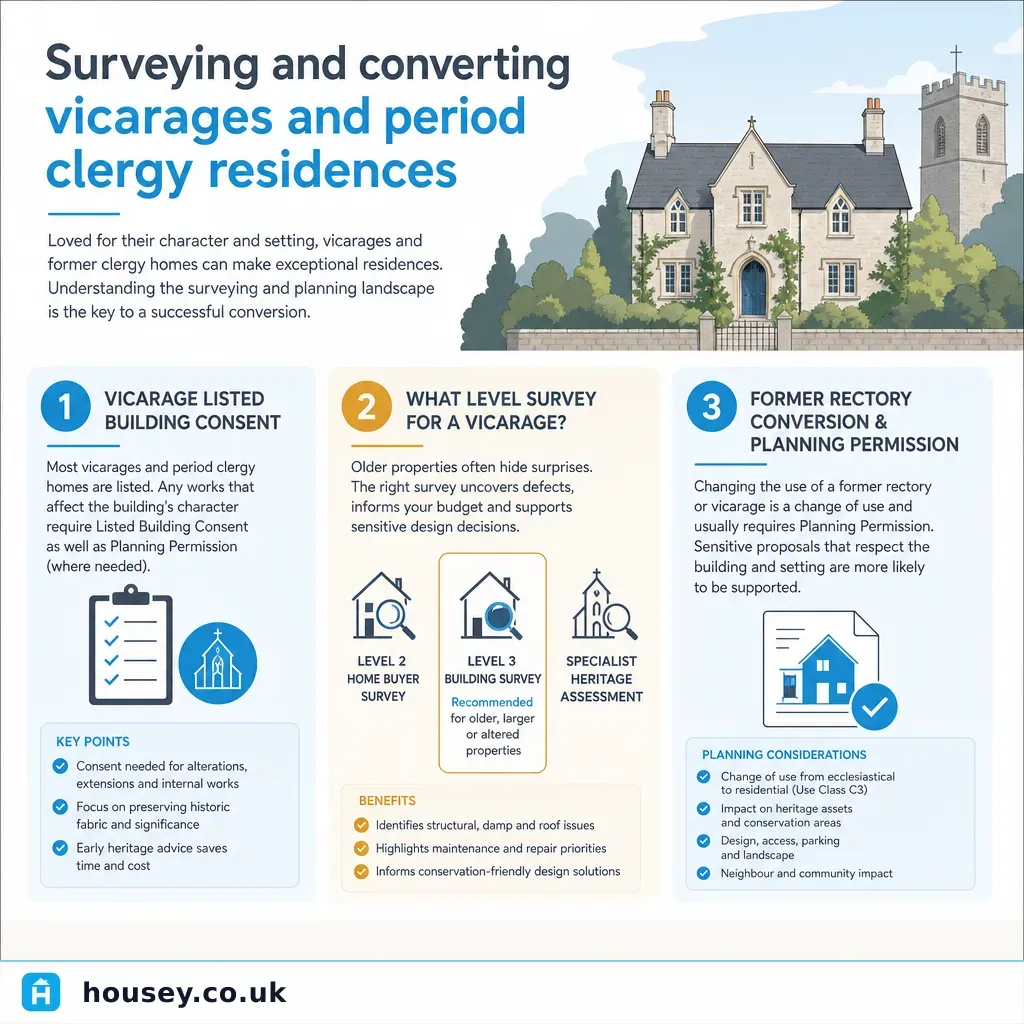 Planning & Pre-Build
Surveying and converting vicarages and period clergy residences
Former vicarages are often listed buildings subject to full planning and Listed Building Consent rules once sold privately.
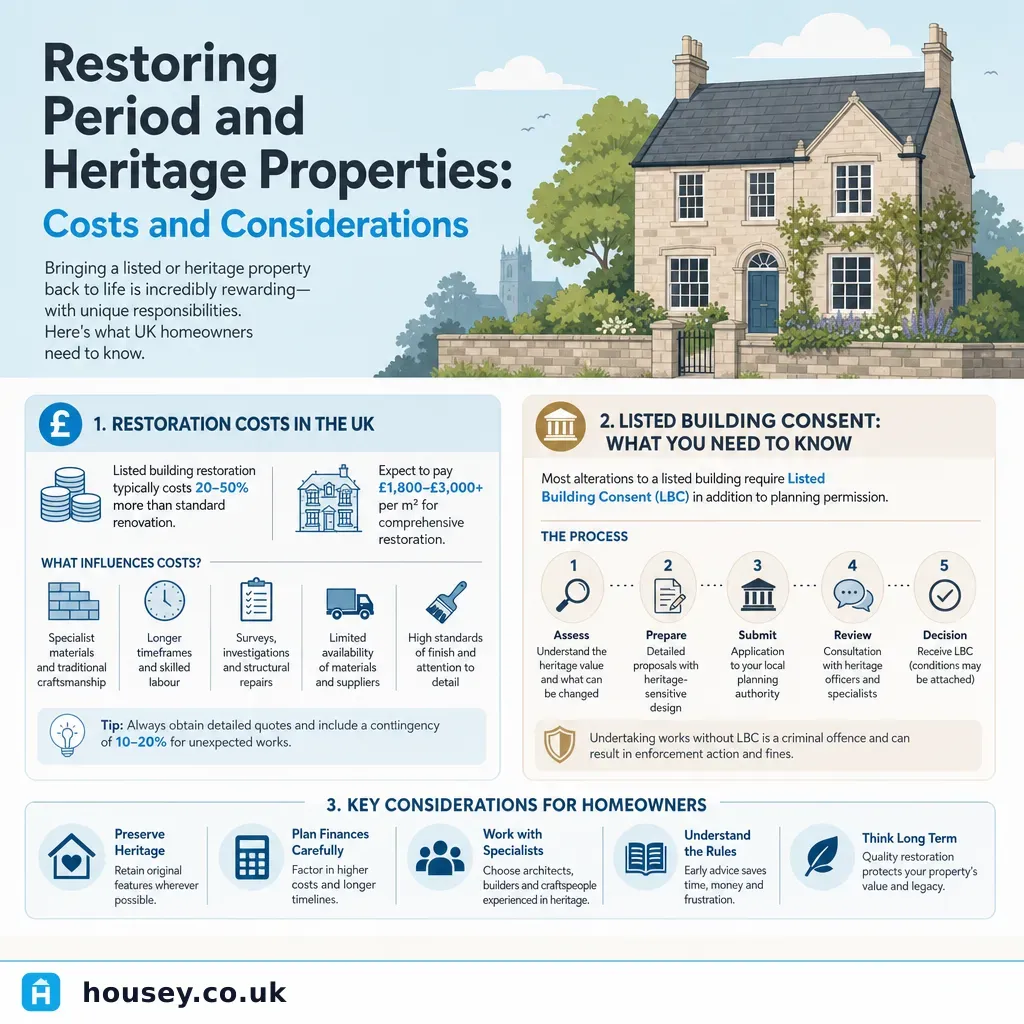 Planning & Pre-Build
Restoring Period and Heritage Properties: Costs and Considerations
Restoring a period or heritage property requires listed building consent for most alterations, use of traditional materials such as lime mortar, and specialist contractors.