Recognising the Right Time to Sell Your Property
By Housey · Last reviewed 24th of May 2026
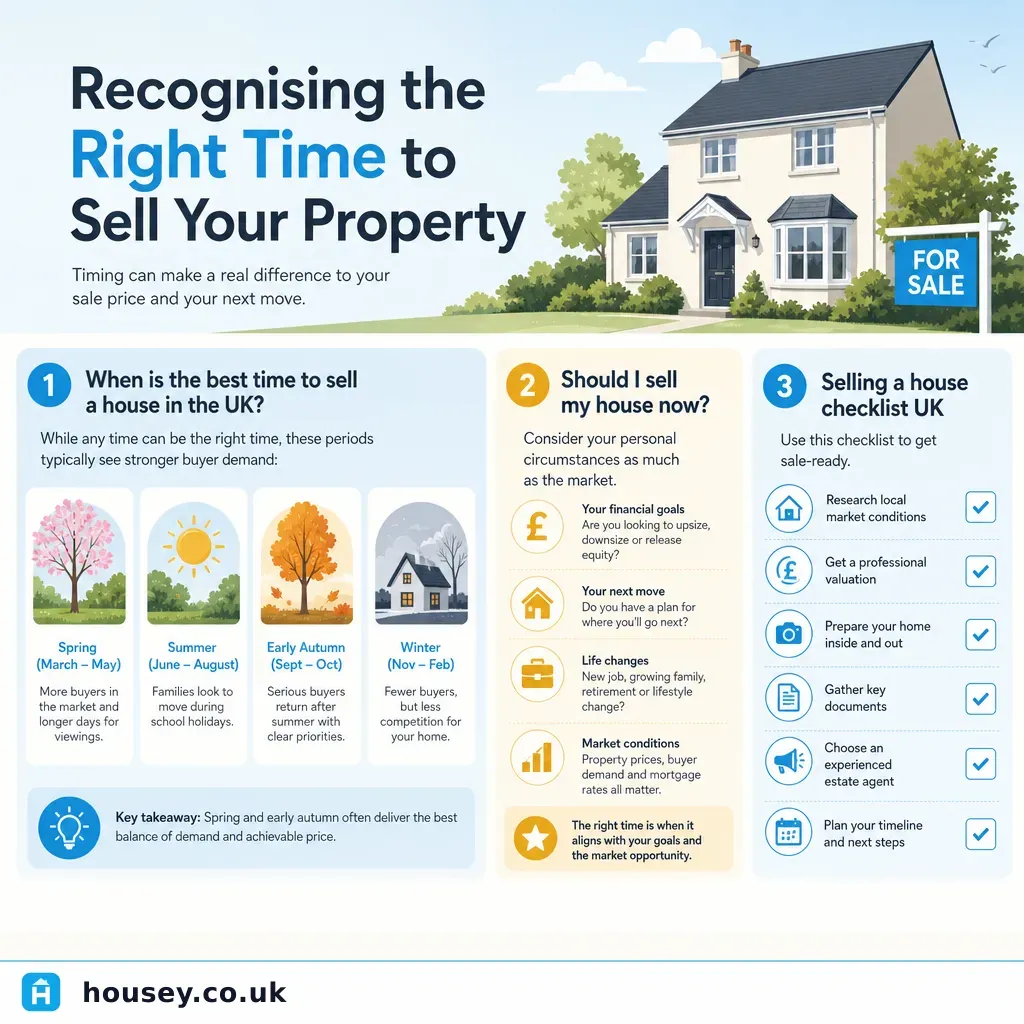
Recognising the Right Time to Sell Your Property
Deciding when to put your home on the market is rarely as simple as watching a property price index. The right time emerges from a combination of personal circumstances, local market conditions, the state of the property itself, and whether you have the capacity to manage a sale properly. Sellers who focus exclusively on national market news often overlook the factors closer to home — including the condition of the property and their own financial position — that make a far bigger practical difference to the outcome.
Key points
- Spring (March to May) is historically the strongest selling season for UK residential property; autumn (September to October) is the second most active window, with higher buyer enquiries and better natural light for viewings and photography.
- An Energy Performance Certificate (EPC) is a legal requirement before marketing any property for sale in England, Wales, and Scotland; without one, an estate agent cannot legally advertise the property.
- Capital Gains Tax (CGT) applies to gains on properties that are not your primary residence; the residential property CGT rate for higher-rate taxpayers is 24% (from April 2024, per HMRC), and gains must be reported and tax paid within 60 days of the completion date.
- Estate agent fees in England typically range from 1% to 3% of the sale price plus VAT; online agents often charge flat fees payable regardless of whether the property sells.
- Leasehold properties with fewer than 80 years remaining on the lease face a significantly narrowed buyer pool, as many mortgage lenders will not lend below this threshold — consider extending the lease before marketing.
When does the UK market favour sellers?
Property market activity in England and Wales follows broadly consistent seasonal patterns, though local factors — school catchment reputation, commuter demand, coastal or rural appeal — frequently have more impact on your specific sale than national statistics.
More active selling periods:
- Spring (March–May): Buyer enquiries and new listings both peak as the days lengthen, gardens look presentable, and families act with urgency to move before the summer school holidays. Rightmove consistently records its highest search volumes during this window.
- Autumn (September–October): A second wave of motivated buyers enters the market after the summer. Many are returning to a search begun in spring and are more decisive, keen to complete before Christmas.
Quieter selling periods:
- August: Holiday-season distraction reduces the active buyer pool and slows solicitors and surveyors, lengthening chains.
- December–January: Activity drops sharply before Christmas and recovers slowly through January. Properties listed in this window often take longer to sell and may attract lower offers, though a buyer active in December is usually highly committed.
Personal circumstances often matter more than market timing
Many sellers wait for a better market while the cost of delay — mortgage payments, maintenance, missed opportunities — quietly accumulates. In practice, several personal factors tend to determine the timeline regardless of market conditions:
- Life events — divorce, bereavement, job relocation, a growing family, or retirement frequently make the decision for you.
- Financial position — if a fixed mortgage rate is ending, if carrying costs exceed rental income, or if you need to release equity, delay may not be financially neutral.
- A direct approach from a buyer — if a neighbour or acquaintance has expressed genuine interest, acting outside the traditional season is often worthwhile.
- Property condition — if significant maintenance is needed, the decision is usually to spend and sell at a higher price, or sell in current condition to buyers seeking a project. An independent survey can help you quantify the likely price difference.
Which professional do you need when selling?
Task | Professional to instruct | Relevant qualification or body |
|---|---|---|
Setting a marketing price | Estate agent | Propertymark (NAEA) member or RICS-regulated agent |
Independent valuation | Chartered surveyor | RICS Registered Valuer |
Legal transfer of ownership | Conveyancer or solicitor | Council for Licensed Conveyancers (CLC) or Solicitors Regulation Authority (SRA) |
EPC production | Domestic Energy Assessor | Accredited under an approved scheme (e.g., Elmhurst, Stroma) |
Pre-sale structural check | Building surveyor | RICS member |
Should I sell now? A decision framework
- Sell now if you have owned the property for several years and built a meaningful capital gain, your personal circumstances have changed, or carrying the property is becoming financially or practically burdensome.
- Wait until spring if you are currently in November or December with no urgent pressure — a spring listing typically attracts a wider, more active buyer pool.
- Sell before major renovations if the planned works are cosmetic (decoration, new kitchen units, landscaping). Buyers often prefer to choose their own finishes, and the spend rarely returns pound-for-pound in the sale price.
- Address structural defects first if the property has known issues — damp, a failing roof, or movement — that will be identified in a buyer's RICS survey. Unresolved defects invite significant price reductions or late-stage fall-throughs.
- Get an independent RICS valuation if you are unsure what your property is worth. Agent valuations can be optimistic to win the instruction; a RICS Registered Valuer provides an impartial market value assessment.
- Consult a tax adviser if the property is not your primary residence — the 60-day CGT reporting and payment deadline runs from the completion date, and an error can be costly.
Pre-sale checklist
A well-prepared property typically sells faster and at a price closer to the asking figure. Before you instruct an estate agent:
Red flags: situations where the timing may need to change
Pause before listing if any of the following apply:
- Significant structural issues — a buyer's RICS survey will expose damp, movement, or roof failure. Selling in this condition risks either a very low offer or a fall-through after survey; weigh up the cost of rectification against the likely reduction.
- Mortgage arrears — lenders may restrict your ability to complete a sale in certain circumstances; contact your mortgage provider before instructing an agent.
- Short lease — a leasehold flat with fewer than 80 years remaining will struggle to attract buyers who need a mortgage. Consider extending the lease before marketing to maximise your buyer pool.
- Unresolved planning enforcement — an enforcement notice on the property must be disclosed and will deter many buyers; resolve it before marketing where possible.
- Pending major works to shared areas — in a leasehold flat, a freeholder's notice of major cladding, lift, or structural works can cause buyers and their lenders to withdraw. Check the position carefully with your solicitor before listing.
When to get professional help
Always instruct a solicitor for conveyancing — property transactions are legally complex and cannot be managed safely without qualified legal representation. Take additional professional advice if:
- The property is not your primary residence and CGT liability will apply
- There are boundary disputes, rights of way, or title defects that need resolving before marketing
- The property is listed or in a conservation area and works may have been carried out without consent
- You are selling a leasehold property with a short lease, pending major works, or unresolved service charge disputes
How Housey can help
Housey connects homeowners with experienced solicitors who can manage the legal process from instruction to completion. Before you set your asking price, our network of RICS-registered surveyors can provide an independent property valuation so you go to market with confidence. Find a conveyancing solicitor for your property sale through Housey today.
Frequently asked questions
How long does it take to sell a house in England?
From listing to legal completion, the process typically takes between three and six months in England, though this varies considerably by location, property type, and market conditions. Around one in four agreed sales fall through before completion, so building contingency time into your plans is sensible. Chains involving multiple buyers and sellers tend to take longest.
Do I need an EPC to sell my home?
Yes. An Energy Performance Certificate is a legal requirement before you market a property for sale in England, Wales, and Scotland. It must be produced by an accredited Domestic Energy Assessor. Your estate agent cannot legally advertise the property without one. EPCs are valid for 10 years — check the national EPC register on GOV.UK to see if an existing certificate is still current.
Should I accept the first offer I receive?
Not automatically. Ask your estate agent to verify the buyer's financial position — whether they have a mortgage in principle, a property to sell, and how many links are in the chain above them. A lower offer from a chain-free buyer with a mortgage agreed can sometimes be preferable to a higher figure from a buyer still relying on their own sale completing.
What is the difference between an estate agent valuation and a RICS valuation?
An estate agent's valuation is an informal marketing opinion — what the agent believes they can achieve in current market conditions — and is usually provided free to win the instruction. A RICS Registered Valuer's report is a formal, independent opinion of market value used by mortgage lenders, for probate, and for tax purposes. Estate agent valuations can be optimistic; an independent RICS valuation provides a more objective baseline.
Can I sell my property while a planning application is pending or refused?
You can sell with a planning application pending, but buyers may be cautious. Works carried out without permission must be disclosed, and refused applications that affected the property's use or value should also be disclosed. Buyers and their mortgage lenders may insist on resolution before proceeding. Speak to your solicitor about your specific disclosure obligations before marketing begins.
Sources and further reading
- Buying or selling your home — GOV.UK
- Energy Performance Certificates — GOV.UK
- Capital Gains Tax: what you pay it on, rates and allowances — HMRC / GOV.UK
- Find a RICS surveyor or valuer — Royal Institution of Chartered Surveyors
Useful next reads
 Buying & Moving
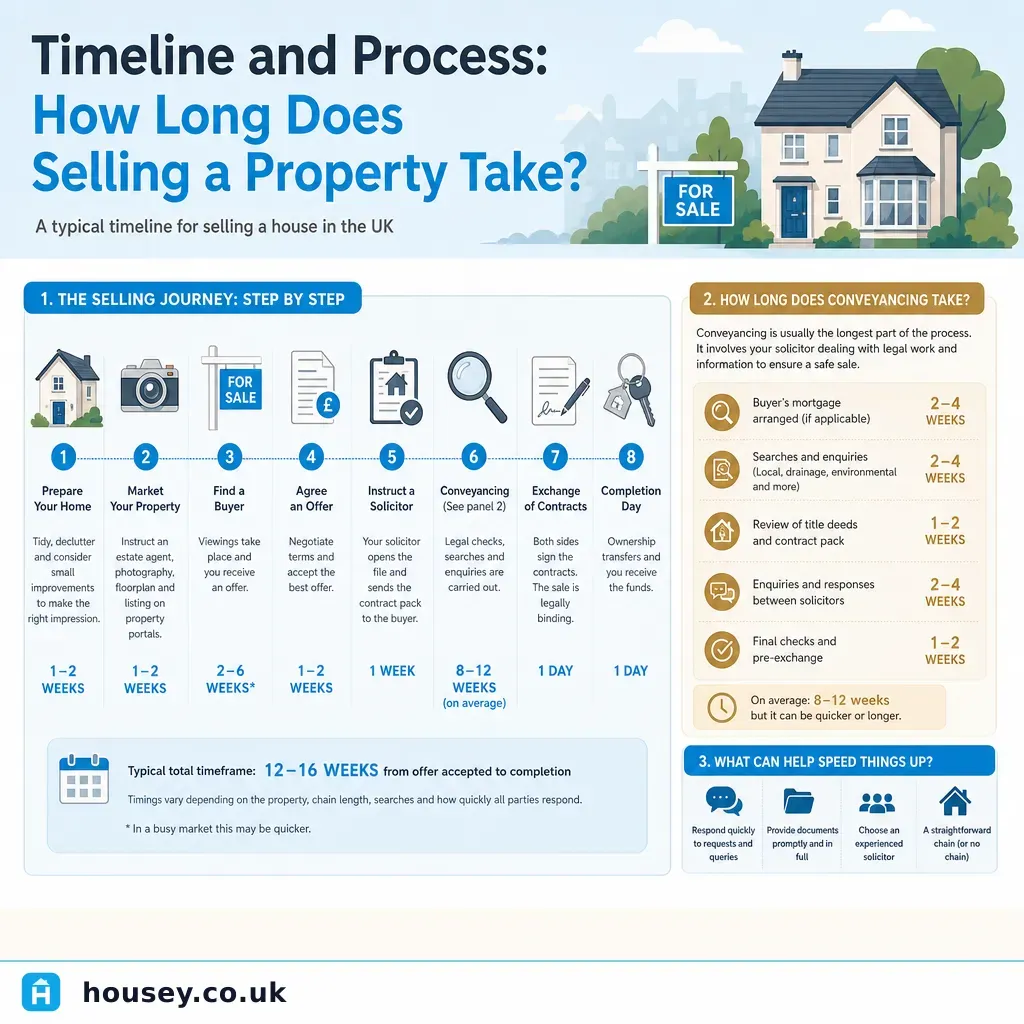
Timeline and Process: How Long Does Selling a Property Take?
Selling a property in England and Wales typically takes 4 to 6 months from listing to completion.
 Buying & Moving
Valuing Your Property for Rapid Sale: Strategic Pricing Guidance
Pricing a UK home for a quick sale means setting an asking price supported by recent comparable sales evidence — not significantly above it.
 Buying & Moving
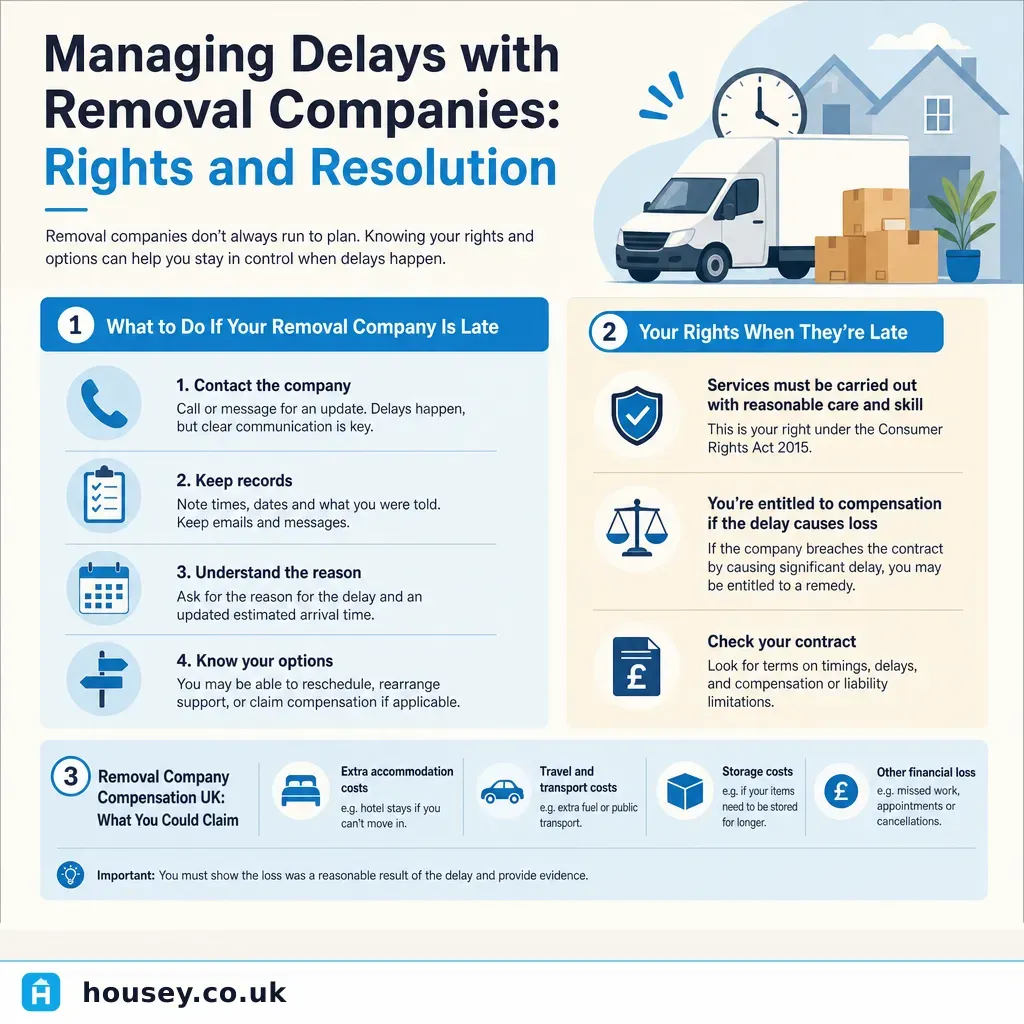
Managing Delays with Removal Companies: Rights and Resolution
If a removal company is late, your rights depend on your contract and whether the company is BAR-registered.
 Buying & Moving
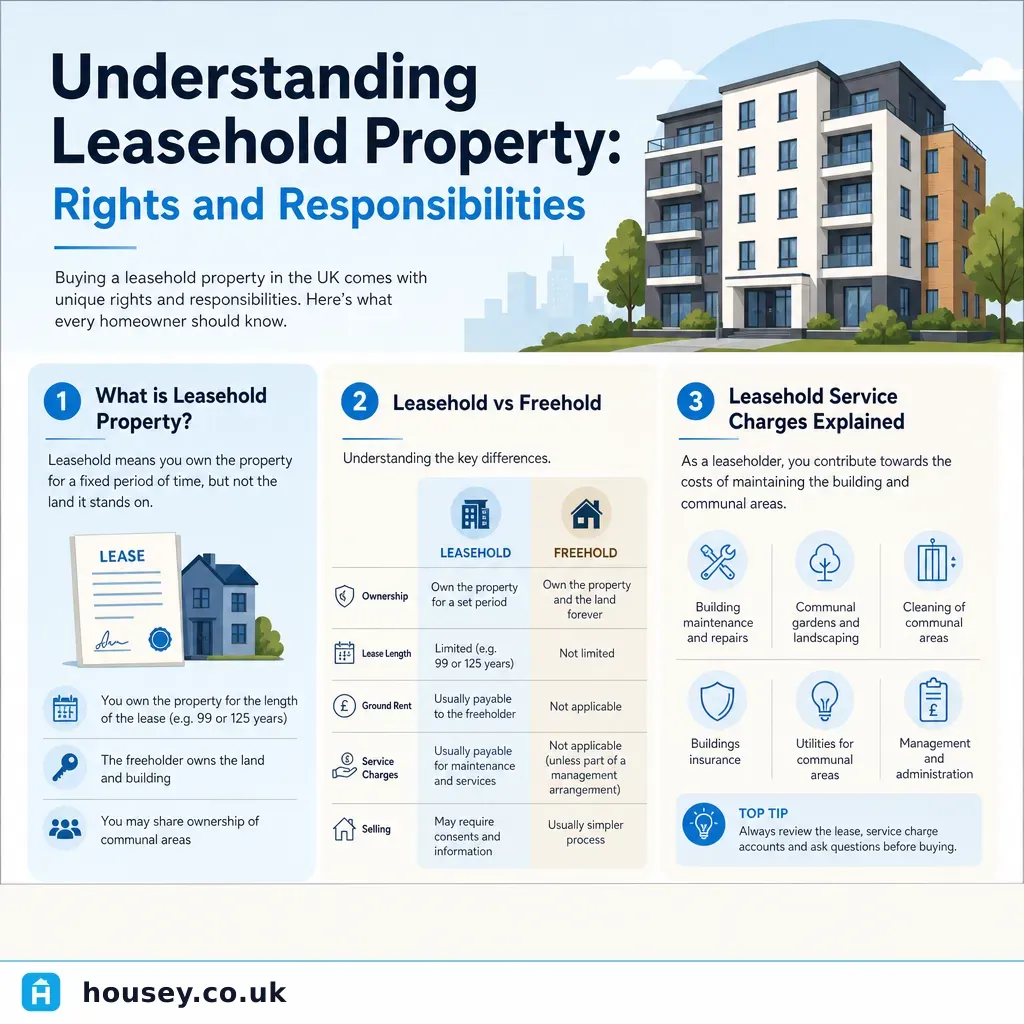
Understanding Leasehold Property: Rights and Responsibilities
Leasehold means you own a time-limited interest in a property while the freeholder owns the land and building.
 Buying & Moving
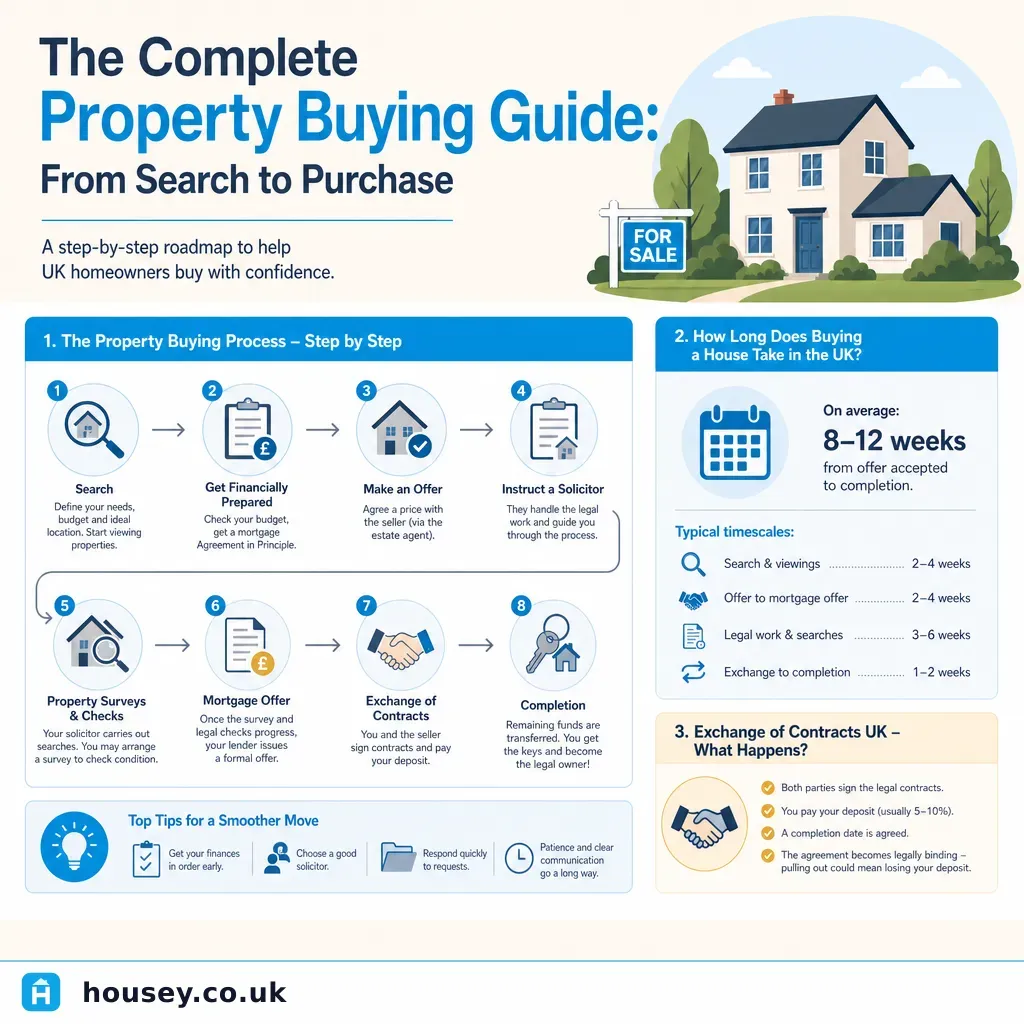
The Complete Property Buying Guide: From Search to Purchase
Buying a property in England and Wales typically takes 3–6 months from accepted offer to completion.