Resin-Bound Driveways: Installation Process and Performance Benefits
By Housey · Last reviewed 18th of May 2026
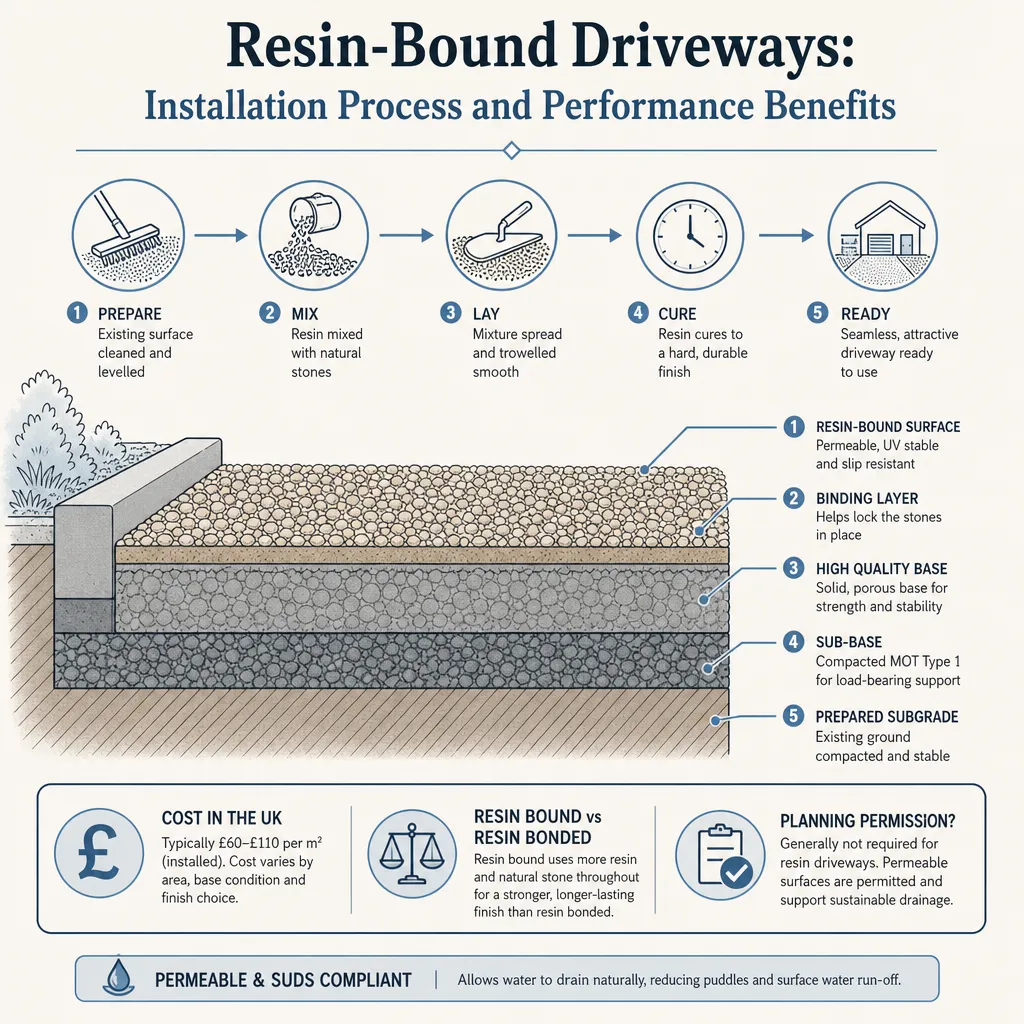
Resin-Bound Driveways: Installation Process and Performance Benefits
Front driveway replacement has become one of the most popular home improvement projects across the UK, with resin-bound surfacing now accounting for a significant share of new residential installations. For homeowners comparing block paving, tarmac, gravel, or concrete, understanding precisely how resin-bound surfacing is installed — and what its genuine performance advantages are — makes it easier to evaluate quotes and set realistic expectations before work begins.
Key points
- Resin-bound surfacing is porous: rainwater drains through the surface layer, satisfying Sustainable Urban Drainage System (SuDS) requirements and typically removing the need for planning permission for front driveways in England under the GPDO 2015.
- Resin-bonded surfacing is a different product — aggregate is scattered onto a wet resin base coat and is NOT porous; confusing the two when comparing quotes is a common and potentially costly mistake.
- The existing base (substrate) must be sound, structurally adequate, and free from significant cracking or damp damage; a failing base requires excavation and reconstruction before resin can be applied.
- Indicative installed costs for resin-bound driveways range from approximately £40–£100 per m², depending on aggregate type, base condition, area size, and region (Indicative UK costs, last reviewed 2026-05-18).
- A correctly installed resin-bound surface using UV-stable polyurethane resin should last 15–25 years with minimal routine maintenance.
Resin-bound vs. resin-bonded: the critical difference
These two products are frequently confused — even on installer quotes — but they differ significantly in appearance, performance, and planning implications:
Feature | Resin-bound | Resin-bonded |
|---|---|---|
How it is made | Aggregate and resin mixed together, trowelled smooth | Resin applied to base first, aggregate scattered on top |
Surface texture | Smooth and flush — no loose material underfoot | Slightly rough — some loose chips initially |
Porosity | Yes — porous and SuDS compliant | No — impermeable unless separate drainage is added |
Planning for front driveways (England) | Not usually required | May require planning or additional drainage provision |
Indicative installed cost | £40–£100/m² | £25–£60/m² |
Expected lifespan | 15–25 years | 5–10 years |
Indicative UK costs, last reviewed 2026-05-18.
For most UK homeowners replacing a front driveway, resin-bound is the correct product to specify. Always confirm in writing which product is quoted before accepting any proposal.
Planning permission and SuDS compliance
Under the Town and Country Planning (General Permitted Development) (England) Order 2015, front garden paving exceeding 5 m² requires either:
- A porous or permeable surface material, or
- A drainage arrangement that directs run-off to a lawn, border, or soakaway — not to the public highway or a surface water sewer
Resin-bound surfacing satisfies the porosity requirement directly — water percolates through the resin and aggregate layer into the sub-base and drains naturally. A planning application is therefore not typically required for a standard front driveway in England.
Exceptions apply: listed buildings, conservation areas, and properties subject to Article 4 Directions may still require consent even for permeable surfaces. Scotland and Wales have their own separate planning regimes. Check with your local planning authority if there is any uncertainty about your property.
The installation process: step by step
Understanding the installation sequence helps you assess contractor proposals and identify shortcuts that may affect long-term performance.
1. Site survey and base assessment A qualified installer should visit the site before quoting. They assess the existing surface for structural integrity, drainage fall, edge detail requirements, and whether the base can support the resin or must be reconstructed. A quote issued without a site visit should be treated with caution.
2. Edge restraints Aluminium or plastic edging is fixed around the perimeter to contain the resin mix and define the finished level. Accurate edge placement is essential — incorrect heights cause water pooling or an uneven finish along the boundaries.
3. Base preparation If the existing tarmac or concrete is sound, it is cleaned, repaired, and used as the substrate. If it is cracked, sunken, or moisture-damaged, the area is excavated and a new compacted sub-base (typically MOT Type 1 hardcore) and binder course are constructed. Base preparation is the most significant variable in both cost and long-term performance.
4. Mixing and application The resin and aggregate are combined in a forced-action mixer on site and worked in timed batches. The mixed material has a limited working window — approximately 20–30 minutes in warm weather. It is poured and trowelled to a consistent depth, typically 15–18 mm for a residential driveway.
5. Curing The surface is usually walkable within 4–6 hours and safe for vehicle use after approximately 24–48 hours, depending on ambient temperature and humidity. Resin should not be applied when temperatures are below 5°C or when rain is forecast within the working window.
What affects the cost?
Cost driver | Typical impact |
|---|---|
Existing base condition | Failed base requires excavation — adds £20–£40/m² or more |
Area size | Larger areas reduce cost per m² |
Aggregate type | Standard quartz is most economical; marble, flint, or premium blends cost more |
Region | Labour costs are higher in London and the South East |
Edge complexity | Curves, steps, or garage thresholds add time and material |
Waste removal | Skip hire is often quoted separately |
Indicative UK costs, last reviewed 2026-05-18.
Red flags when choosing a contractor
- No site visit before quoting — base condition cannot be assessed accurately from photographs or measurements alone.
- A quote specifying resin-bonded when you requested resin-bound, or no clear distinction made between the two products.
- An unusually low price per m² that does not address base preparation as a separate or conditional cost item.
- No information provided about the resin brand, UV stability rating, or British Board of Agrément (BBA) certification — UV-unstable resins yellow and degrade within a few years.
- Inability to confirm SuDS porosity compliance in writing.
- No workmanship guarantee offered beyond the manufacturer's material warranty.
- Application proposed in cold weather (below 5°C) or wet conditions without a covered or heated working environment.
What to ask before accepting a quote
- Is this resin-bound (porous) or resin-bonded — and can you confirm this distinction in the written quote?
- What resin brand and aggregate specification are you using, and what is the UV stability or BBA certification?
- What is your assessment of my existing base — is base preparation included, or costed separately as a conditional item?
- At what depth will the resin layer be applied?
- What are your minimum temperature and weather conditions for installation?
- How long before vehicles can use the finished surface?
- What workmanship guarantee do you provide, and is it backed in writing?
- Is VAT included in the price?
When to get professional help
Resin-bound surfacing requires specialist mixing equipment and timed application — it is not a practical DIY project. Engage a professional groundwork contractor if:
- Your existing driveway has significant cracking, sinkage, or drainage failures — these are structural base issues that a surface treatment alone will not resolve.
- The area involves steps, drainage channels, or a tight threshold level at a garage door — these details require careful specification and execution.
- The property is in a conservation area or is listed — consent requirements should be confirmed before any surfacing work begins.
- You want to integrate EV charger cabling, drainage gullies, or external lighting into the driveway — groundwork coordination is needed before the resin is applied.
How Housey can help
Housey connects you with vetted driveway installers who specialise in resin-bound surfacing, and groundworkers who can assess and reconstruct failing bases before the resin coat is applied. Compare written quotes from local professionals in one place.
Frequently asked questions
Is a resin-bound driveway worth the extra cost?
Resin-bound driveways typically cost more upfront than tarmac or gravel but require significantly less maintenance over 15–25 years. The smooth finish, wide aggregate colour choice, and SuDS compliance make it a popular option for homeowners where kerb appeal and drainage conformance both matter.
How long does a resin-bound driveway last?
A correctly installed resin-bound surface using UV-stable resin should last 15–25 years. Lifespan is heavily influenced by base quality — a properly prepared and structurally sound base is more important than the resin brand itself. Poor base preparation is the most common cause of premature failure.
Does a resin driveway need planning permission?
In most cases in England, no — resin-bound surfaces are porous and meet the SuDS requirement for front driveways, so planning permission is not usually needed. However, listed buildings, conservation areas, and some Article 4 Direction areas may still require consent. Always check with your local planning authority if unsure.
Can resin be laid over an existing tarmac driveway?
Yes, if the existing tarmac is structurally sound, adequately level, and well-drained. A competent installer will assess the base during their survey visit. If the base is failing or cracked, it must be reconstructed first — resin applied over a poor base will crack and delaminate over time.
What colours and aggregates are available for resin driveways?
Most installers offer a range of natural aggregate colours — golden gravel, silver grey, russet, and blended tones are common. Premium options include marble and flint chips. Always confirm that the aggregate has been tested for UV stability, as some cheaper options fade or discolour within a few years.
Sources and further reading
- Planning Portal: paving your front garden — Planning Portal
- Town and Country Planning (General Permitted Development) (England) Order 2015 — legislation.gov.uk
- GOV.UK: sustainable drainage systems guidance — GOV.UK
- CIRIA SuDS Manual — CIRIA
Useful next reads
 Improvement & Build
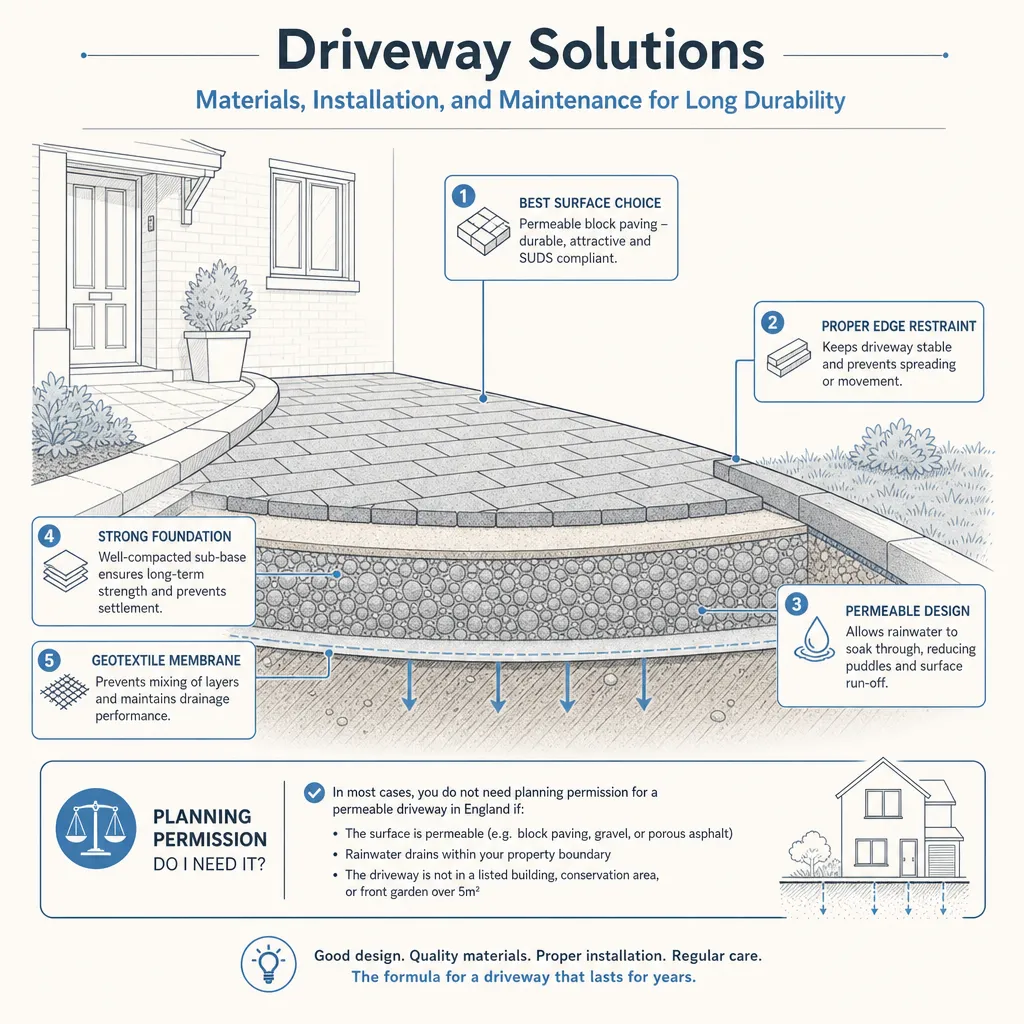
Driveway Solutions: Materials, Installation, and Maintenance for Long Durability
In England, driveways over 5 square metres need planning permission unless they use a permeable surface or drain to a lawn or border.
 Improvement & Build
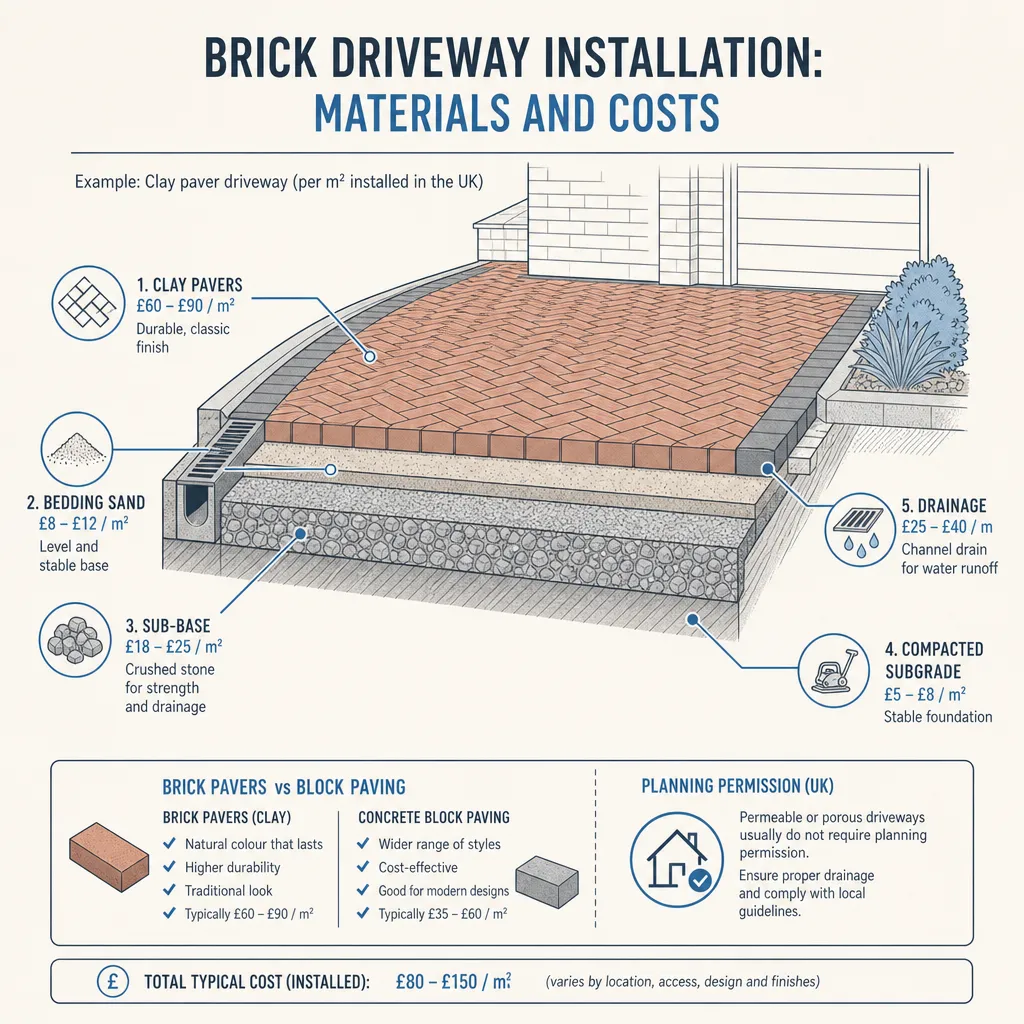
Brick Driveway Installation: Materials and Costs
A brick or clay paver driveway typically costs £90–£150 per square metre installed in the UK, depending on material grade, sub-base requirements, and regional labour rates.
 Improvement & Build
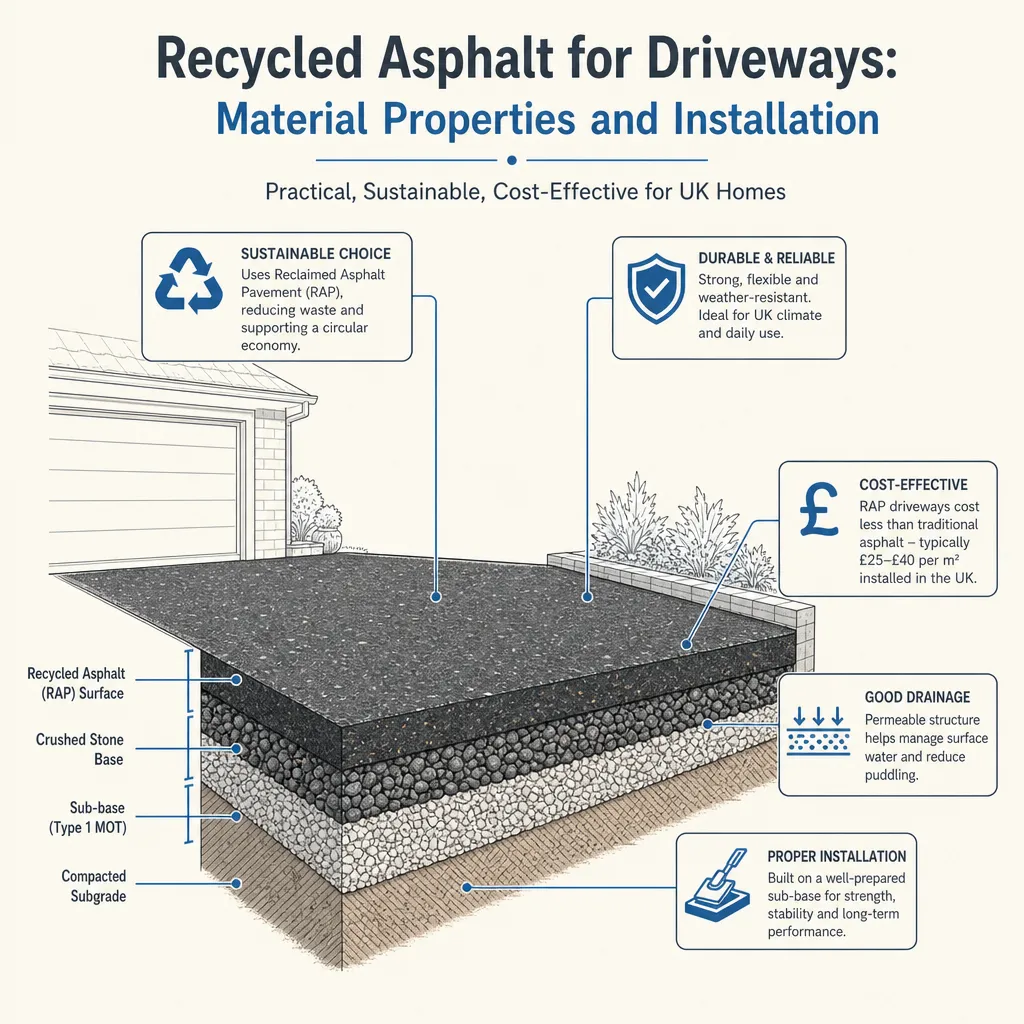
Recycled Asphalt for Driveways: Material Properties and Installation
Recycled asphalt (RAP) uses reclaimed road material and costs less than virgin asphalt, making it a budget-friendly option for UK driveways.
 Improvement & Build
Small kitchen renovation: budgeting for costs and planning your project
A small kitchen renovation in the UK typically costs £5,000–£15,000 for a full refresh including new units, worktops, tiling, and appliances, though costs vary widely by specification, region, and whether structural changes or rewiring are involved.
 Improvement & Build
Conservatories and Garden Extensions: Design and Building Guide
Most conservatories qualify as permitted development in England if they are single-storey, within 50% of original curtilage, and meet dimensional limits.