Reducing Moving Costs: Smart Strategies for Your Property Relocation
By Housey · Last reviewed 18th of May 2026
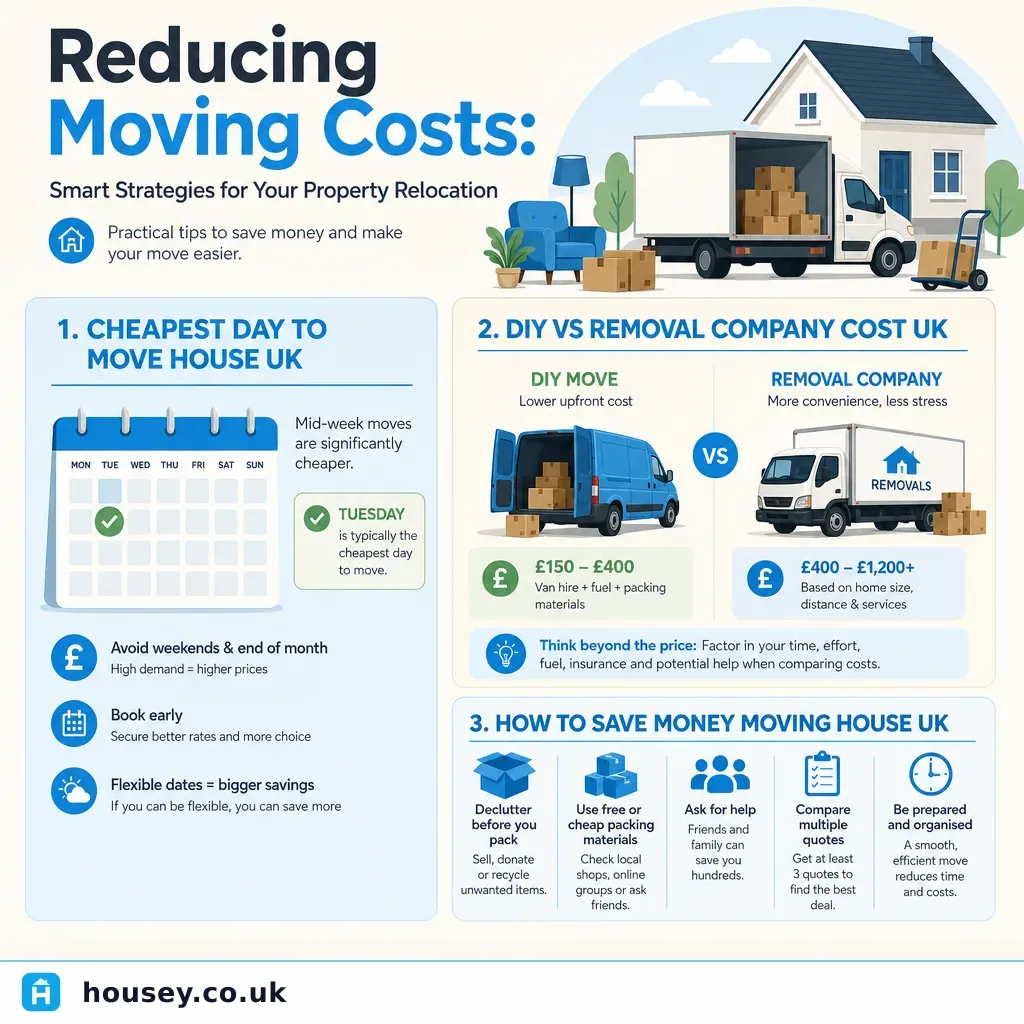
Reducing Moving Costs: Smart Strategies for Your Property Relocation
Moving house in the UK involves considerably more expense than the headline price of a removal company suggests. Buyers and sellers face transaction taxes, legal fees, surveys, and sundry admin charges that, taken together, often surprise even experienced movers. Knowing which costs are fixed by legislation and which can be meaningfully reduced with planning and timing is the starting point for protecting your moving budget.
Key points
- Stamp Duty Land Tax in England is the largest transaction cost for most buyers; first-time buyers benefit from relief on properties up to £500,000 (as of May 2026 — check GOV.UK for the current threshold, as rates have changed in recent years).
- Removal company costs vary significantly by distance, volume, day of the week, and season; mid-week, off-peak moves are typically cheaper than Friday or end-of-month bookings.
- Adding packing services to a removals quote can increase the base price by 30–50%; DIY packing reduces cost but shifts responsibility for breakages to the homeowner.
- Temporary storage at a self-storage facility typically costs £100–£200 per month for a one-bedroom flat's contents (indicative UK costs, last reviewed 2026-05-18; costs vary significantly by location and unit size).
- Buildings and contents insurance should be in place for the new property from the day of exchange — gaps in cover between properties are a common and costly oversight.
The main costs of moving house in the UK
Before targeting savings, it helps to see the full picture of where money goes:
Cost | Typical range | Notes |
|---|---|---|
Stamp Duty Land Tax (England) | 0–5%+ of purchase price | First-time buyer relief available; different rates apply in Scotland (LBTT) and Wales (LTT) |
Conveyancing fees | £1,000–£2,500+ | Includes legal fees, disbursements, and searches; leasehold transactions typically cost more |
Removal company | £400–£3,000+ | Depends on distance, volume, and service level |
RICS home survey | £400–£1,500+ | Level 2 or Level 3 depending on property type and condition |
Mortgage arrangement fee | £0–£2,000 | Can often be added to the loan |
EPC (seller) | £60–£120 | Required when marketing a property for sale |
Royal Mail Redirection | ~£33 for 3 months | Useful while notifying all contacts of your new address |
Indicative UK costs, last reviewed 2026-05-18. Obtain individual quotes for your specific circumstances.
Where savings are most achievable
Not every cost is negotiable. Stamp duty is set by legislation, and legal disbursements — Land Registry fees, search fees, bank transfer charges — are fixed by the relevant authorities. But several of the largest variable costs contain genuine room for savings.
Removal company: The same move quoted by four different firms can vary by hundreds of pounds. Getting three to four quotes based on a specific inventory is essential. Mid-week moves and off-peak months — late autumn and winter, avoiding school holidays — are consistently cheaper than Fridays or end-of-month dates.
Conveyancing: Legal fees vary significantly between solicitors and licensed conveyancers. Online conveyancers often quote lower than traditional high-street firms. However, the cheapest quote is not always best value; slow communication or errors can cost far more in delays than the saving on fees. Always confirm whether quotes are fixed-fee and check exactly what is included.
Packing: DIY packing eliminates packing labour charges entirely. Free boxes from supermarkets and a careful labelling system reduce both cost and confusion on moving day. Note that most removals firms will not insure items packed by the owner against breakage.
Storage: If you can co-ordinate exchange and completion on the same day, you may not need storage at all. If temporary storage is needed, compare self-storage facilities directly rather than accepting a removals company's own storage offer, which is often priced at a premium.
Homeowner checklist: actions to reduce moving costs
DIY versus full-service removal: which saves more?
A full-service removal includes packing, transport, and unpacking. A self-move using a hired van is cheapest in theory, but carries hidden costs and risks.
Approach | Potential saving vs full service | Risks | Best for |
|---|---|---|---|
Full-service removal company | Baseline — no saving | Fewest risks; professional and insured | Anyone with significant furniture or fragile items |
Removal company, DIY packing | 20–40% | Breakages may not be covered by removals insurer | Budget-conscious movers with time to pack carefully |
Self-drive hire van | 60–70% | Physical strain, driving liability, no specialist packing, fuel costs | Single people, small flats, short distances |
Man and van service | 30–50% | Variable insurance and professionalism; verify credentials before booking | Small moves, students, minimal furniture |
Indicative comparison based on UK market conditions; obtain individual quotes.
Timing your move to reduce costs
The UK property market has predictable peak periods. Spring (March–May) and the pre-summer rush (June–July) are the most competitive times for removals and conveyancing services, with prices reflecting demand. Autumn moves (September–November) are typically cheaper. December can yield lower removal rates but is complicated by office closures.
If you have flexibility on your completion date, agreeing a mid-week, non-month-end date with all parties can unlock meaningful savings on removal quotes and sometimes improve conveyancing turnaround times.
When to get professional help
If your transaction involves a chain, unusual tenure such as leasehold or shared ownership, or a property with outstanding building regulations sign-off, cutting costs on conveyancing is rarely worthwhile. Poor legal work can result in delays, disputes at completion, or title problems that cost far more to resolve than the original saving on fees.
If you are moving antiques, a piano, large artworks, or specialist equipment, use a removals firm with relevant experience — not simply the cheapest general quote.
How Housey can help
Housey helps you compare quotes from vetted house removals companies across the UK, so you can find competitive prices without sacrificing reliability. We also connect homeowners with experienced conveyancing solicitors who offer clear, fixed-fee quotes — so you know exactly what you are paying before you commit.
Frequently asked questions
What is the cheapest day to move house in the UK?
Mid-week moves — Tuesday, Wednesday, or Thursday — are typically cheaper than Friday moves, which are the most in-demand day for removal companies. End-of-month and school holiday dates also attract premium pricing. Booking early and offering some flexibility on dates is the most reliable way to access lower prices.
Is it cheaper to use a man and van or a removal company?
A man and van is usually cheaper than a full removal company, but the level of insurance, packing care, and professionalism varies widely. For a small, straightforward move over a short distance it can be an effective saving. For larger homes or valuable contents, the risk of damage or delay may outweigh the cost difference.
Can I negotiate with a conveyancing solicitor on fees?
Some solicitors will negotiate on their professional fee, particularly for straightforward freehold transactions or returning clients. However, disbursements — Land Registry fees, search fees, bank transfer charges — are outside the solicitor's control and cannot be reduced. Always ask for a full, itemised, fixed-fee quote before instructing.
How far in advance should I book a removal company?
For moves during peak periods such as April through July and school holidays, aim to book 6–8 weeks ahead. For off-peak moves, 3–4 weeks is usually sufficient, though earlier booking always gives you more negotiating leverage and a greater choice of available dates.
Sources and further reading
- Stamp Duty Land Tax rates and thresholds — GOV.UK
- Land Transaction Tax (Wales) — GOV.UK
- Land and Buildings Transaction Tax (Scotland) — Revenue Scotland
- Moving home — Citizens Advice
- Find a solicitor — The Law Society
Useful next reads
 Buying & Moving
Accelerating Your House Move: Strategies for Faster Property Transactions
The average time from offer to completion in England and Wales is around 12–16 weeks.
 Buying & Moving
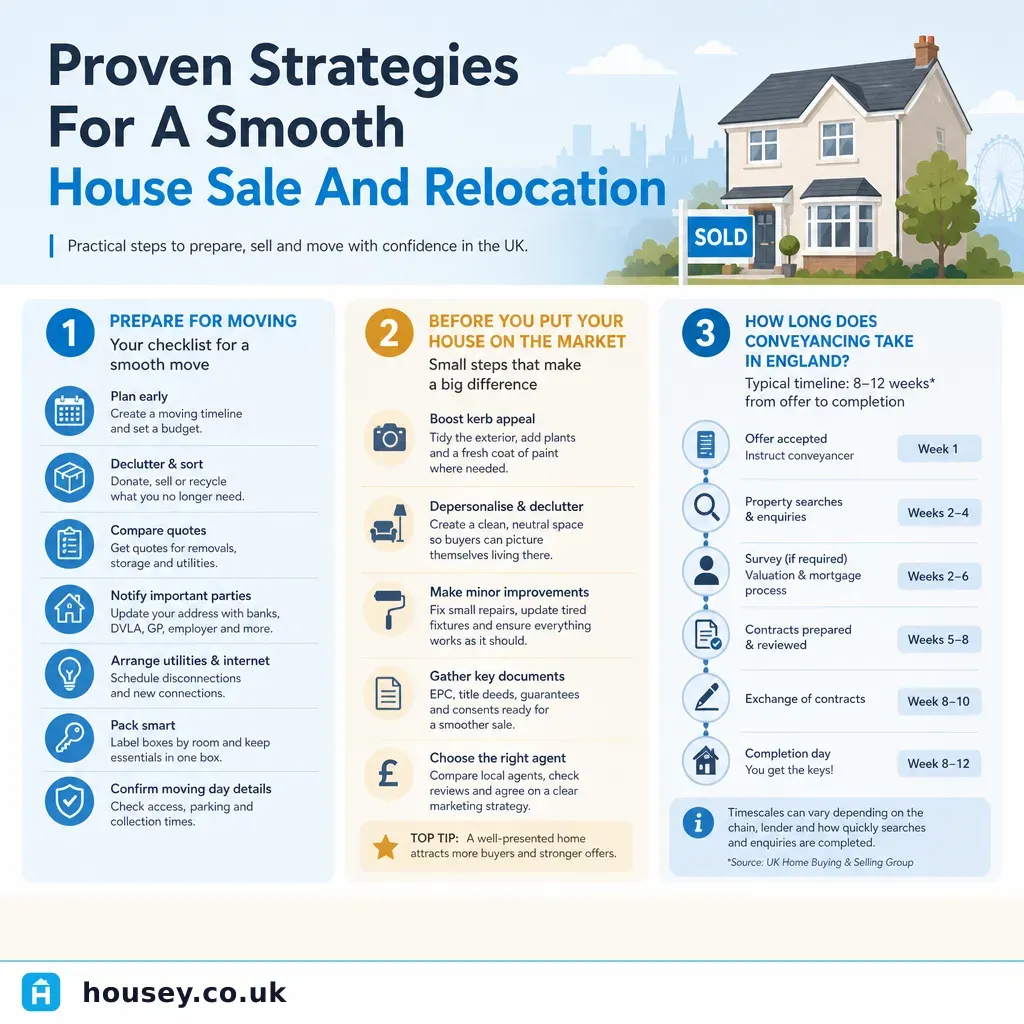
Proven Strategies For A Smooth House Sale And Relocation
Selling a house and relocating smoothly in the UK depends on preparation at every stage: instructing a solicitor early, presenting the property well for marketing, and booking removals before your completion date is confirmed.
 Buying & Moving
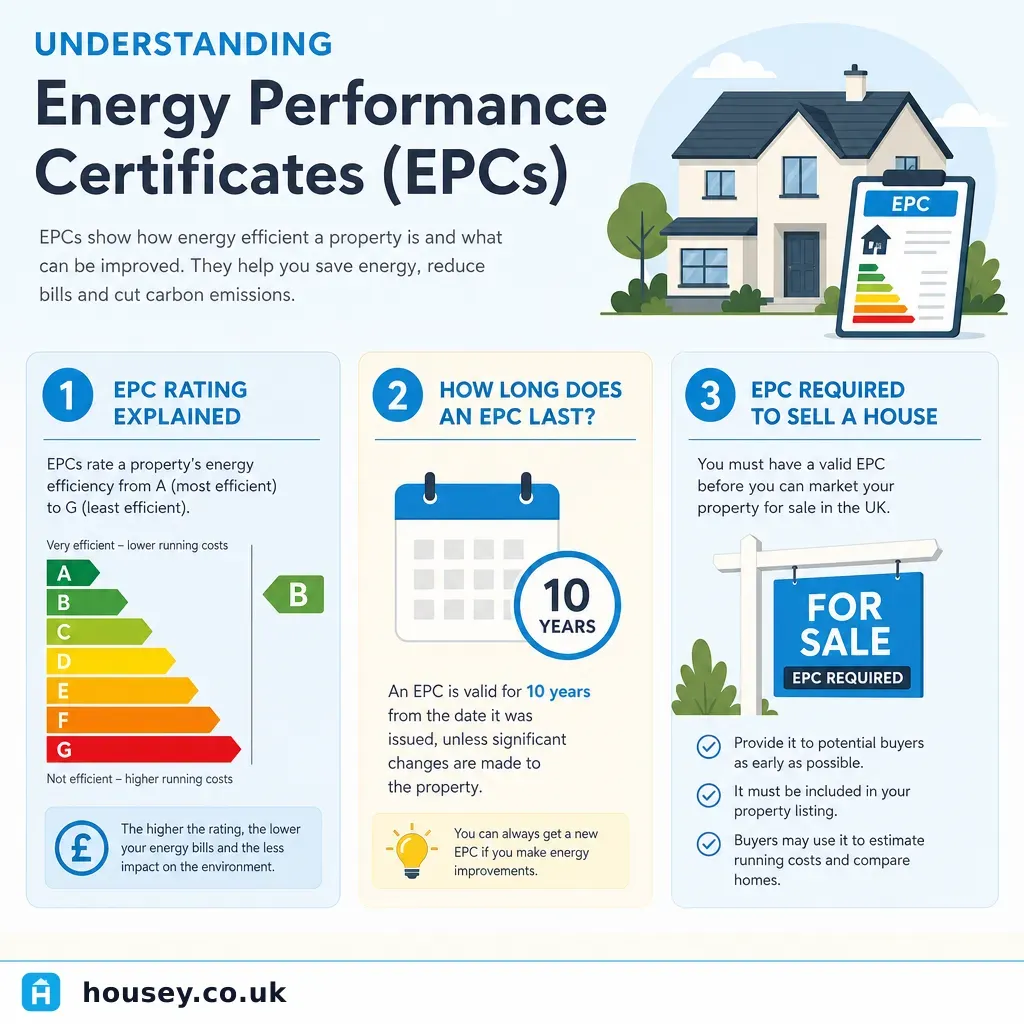
Understanding Energy Performance Certificates (EPCs)
An Energy Performance Certificate (EPC) rates a property's energy efficiency from A (most efficient) to G (least).
 Buying & Moving
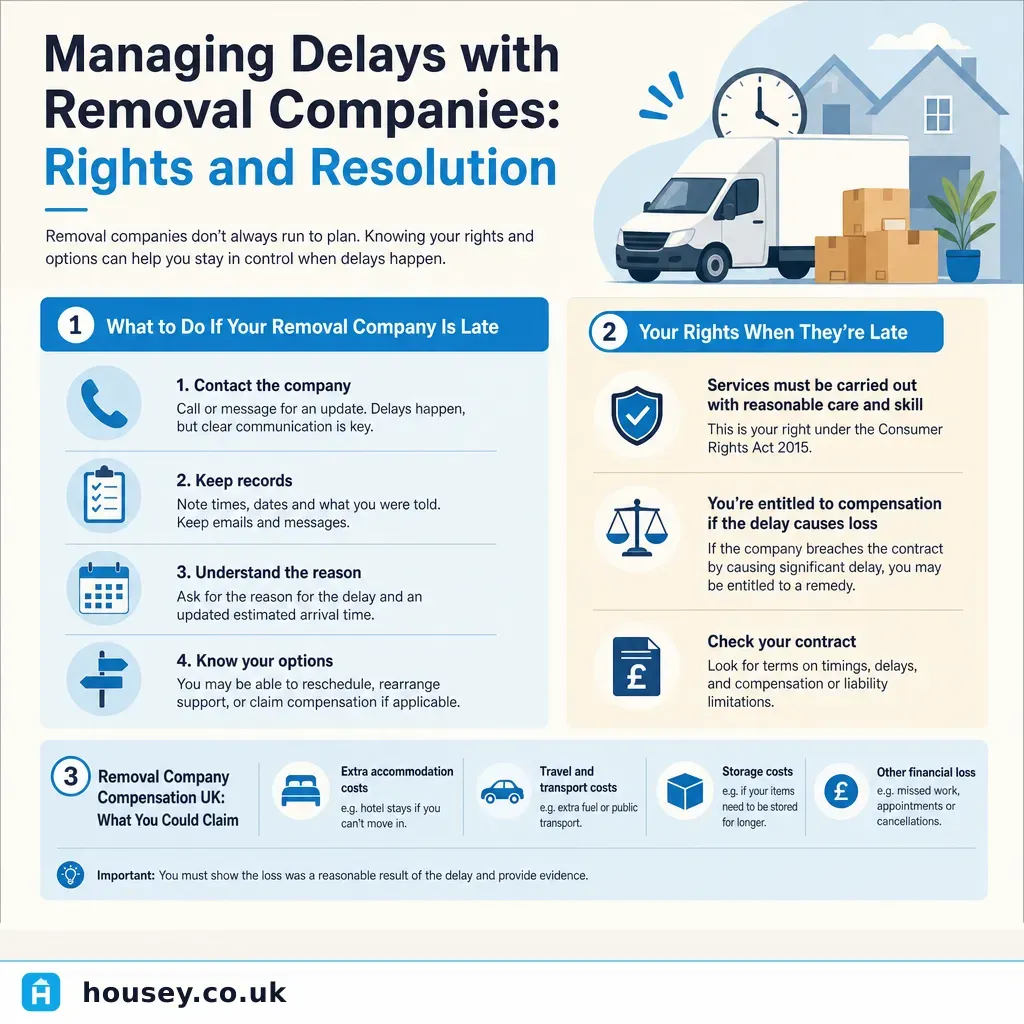
Managing Delays with Removal Companies: Rights and Resolution
If a removal company is late, your rights depend on your contract and whether the company is BAR-registered.
 Buying & Moving
Understanding Leasehold Property: Rights and Responsibilities
Leasehold means you own a time-limited interest in a property while the freeholder owns the land and building.