Understanding Energy Performance Certificates (EPCs)
By Housey · Last reviewed 11th of May 2026
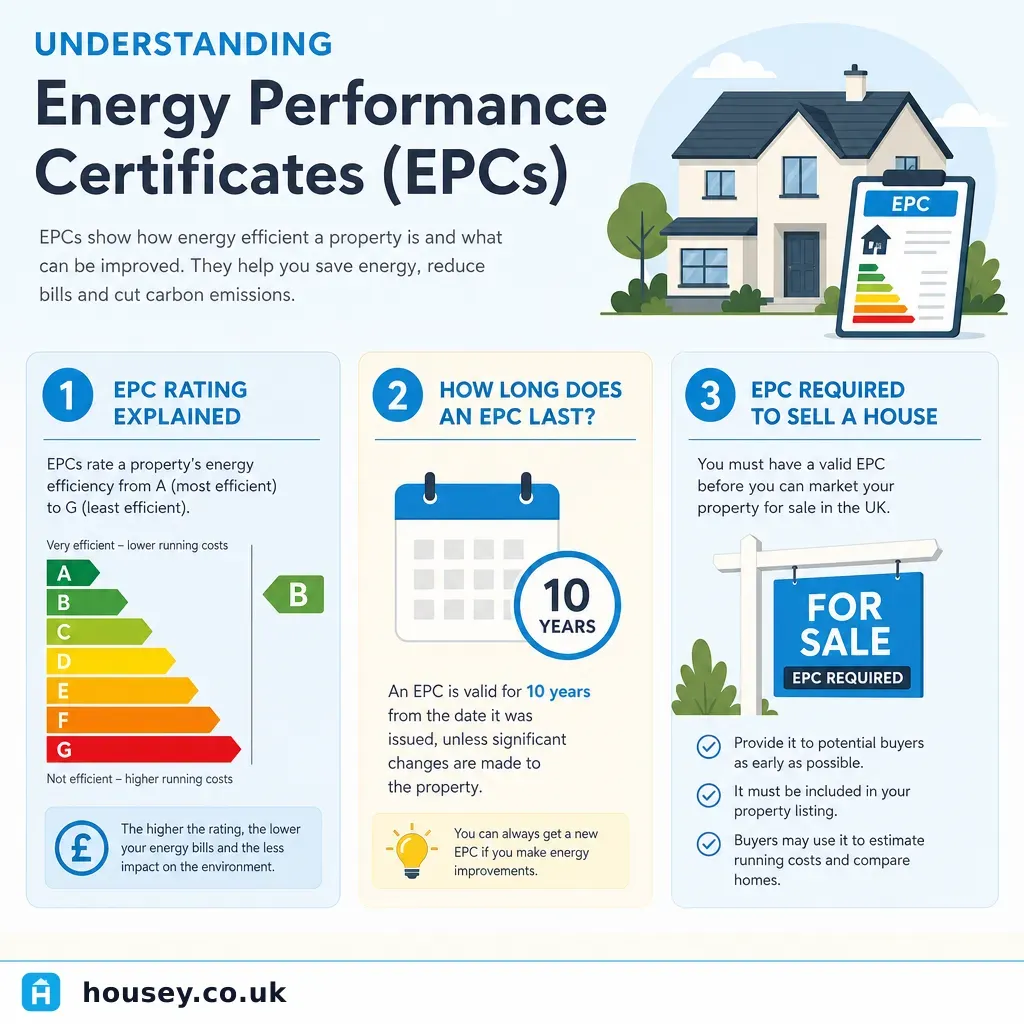
Understanding Energy Performance Certificates (EPCs)
When you put a home on the market, rent it out, or commission a new build, an Energy Performance Certificate (EPC) is one of the first legal requirements you will encounter. For buyers, an EPC is a useful snapshot of running costs and the work needed to improve efficiency; for landlords, the minimum rating threshold carries real enforcement risk. Understanding what the certificate actually tells you — and what it doesn't — helps you make better decisions at every stage of the transaction.
Key points
- EPCs are legally required before marketing a property for sale or rent in England, Wales, and Scotland.
- Ratings run from A (most efficient) to G (least efficient); the UK average for homes is approximately D.
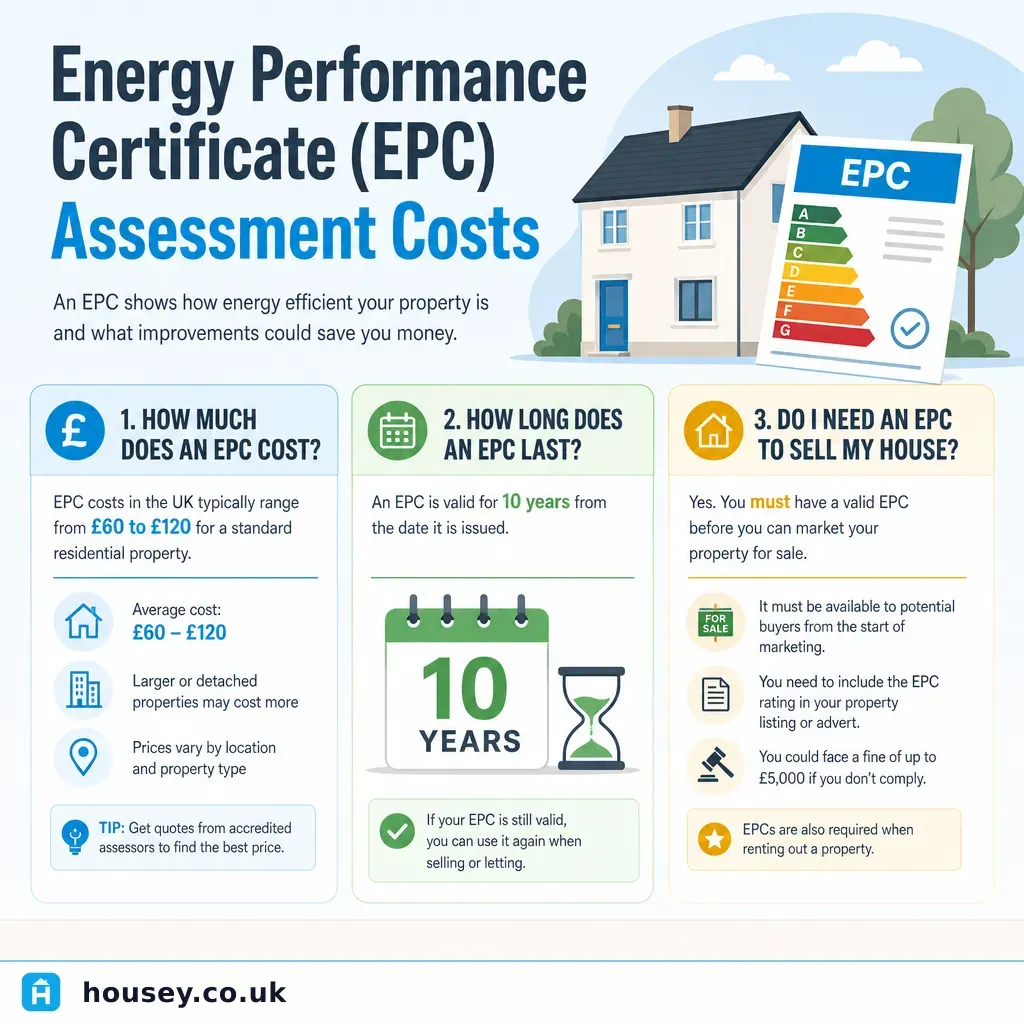
- A valid EPC lasts 10 years from the date of issue.
- Rental properties in England must achieve a minimum EPC rating of E under the Minimum Energy Efficiency Standards (MEES) Regulations 2018, or landlords risk fines of up to £30,000 per property.
- Only a qualified Domestic Energy Assessor (DEA) accredited under a government-approved scheme (such as Elmhurst Energy, Stroma, or ECMK) can issue a valid EPC.
What the A–G rating scale means
An EPC assigns two scores: an energy-efficiency rating (the headline A–G grade) and an environmental impact rating based on CO₂ emissions. The numerical score behind the grade runs from 1 (least efficient) to 100+ (most efficient).
Band | Score range | Typical property profile |
|---|---|---|
A | 92–100+ | Highly insulated new-build or deep-retrofit home |
B | 81–91 | Well-insulated modern home, heat pump or high-efficiency boiler |
C | 69–80 | Modern semi or 1990s house with cavity wall and loft insulation |
D | 55–68 | UK average; typical 1930s–1970s semi with some upgrades |
E | 39–54 | Older property with limited insulation; may need improvement before letting |
F | 21–38 | Poor fabric performance; landlords cannot let without a valid MEES exemption |
G | 1–20 | Solid-wall uninsulated or older system; lettings banned without exemption |
The certificate also lists the property's current and potential ratings, showing what score could be achieved if the recommended improvements were carried out.
When an EPC is legally required
Under the Energy Performance of Buildings (England and Wales) Regulations 2012, an EPC is required when:
- Selling a residential property — must be ordered before marketing begins and made available to prospective buyers on request.
- Renting a residential property — required at the start of a new tenancy; the landlord must provide a copy to each new tenant.
- Building a new home — must be produced at completion.
A few exemptions apply, including listed buildings where compliance measures would unacceptably alter the property's character, certain temporary structures, and some places of worship.
Minimum Energy Efficiency Standards (MEES) for landlords
Since April 2020, privately rented homes in England and Wales rated F or G have required a landlord exemption to be let legally. The minimum lawful rating under current MEES Regulations is E. The government has consulted on raising the minimum to C by 2030 for new tenancies, though as of May 2026 this has not yet been enacted. Check GOV.UK's MEES landlord guidance for the latest position before marketing a property to let.
What happens during a domestic EPC assessment
A DEA visits the property and records physical characteristics rather than measuring actual energy use. The assessor typically:
- Notes construction type, age band, and floor area.
- Records wall, roof, and floor insulation type and estimated thickness.
- Checks the heating system (boiler type, age, controls, thermostat), hot water cylinder, and any secondary heating.
- Records glazing type (single, double, or triple; frame material).
- Notes lighting — the proportion of low-energy fittings.
- May check solar panels, mechanical ventilation, or heat pump presence.
Data is entered into the government-approved RdSAP (Reduced Standard Assessment Procedure) software, which calculates the rating. A typical visit takes 30–60 minutes. The assessor does not need to lift floorboards — they make evidence-based assumptions where direct inspection is not possible.
Homeowner checklist — preparing for an EPC assessment
How long an EPC is valid and when you need a new one
An EPC is valid for 10 years from the date of issue. If a certificate exists on the register and is less than 10 years old, it can be reused for a new sale or tenancy without a fresh assessment — unless significant energy-related improvements have been made and you want the certificate to reflect them. You can check whether a valid EPC exists at the Find an energy certificate service on GOV.UK.
EPC costs
Indicative UK costs, last reviewed 2026-05-11. Domestic EPC assessments typically range from £60 to £130 depending on property size, assessor, and region. Costs are generally higher in London and for larger homes. Always confirm that the fee includes lodgement on the national EPC register — lodgement is a legal requirement and should be included as standard.
Important limitations
The information in this guide is general and reflects the regulatory position as of May 2026. EPC regulations — particularly minimum rating requirements for rented properties — are subject to change. Nothing in this article constitutes legal advice. Landlords with non-compliant properties should seek specialist advice before marketing or renting. If you receive an EPC you believe is inaccurate, you can request a reassessment from a different DEA or raise a complaint through the assessor's accreditation scheme.
When this becomes urgent
- You are preparing to let a property currently rated F or G — you cannot legally market it without improvement works or a valid MEES exemption.
- Exchange of contracts is approaching and no valid EPC exists — the absence may delay or complicate the transaction.
- Your existing EPC expires before a planned new let — you will need a new assessment before marketing.
What to ask a qualified professional
When commissioning a Domestic Energy Assessor:
- Which accreditation scheme are you registered with, and can I verify your membership online?
- Will the certificate be lodged on the national register, and when?
- What evidence can I provide to improve the accuracy of the rating?
- If the rating is lower than expected, can you explain the specific factors depressing the score?
When seeking advice on improving your rating:
- Which improvements give the biggest rating uplift for the lowest cost in my property type?
- Are there government or energy-supplier grants I may qualify for — such as ECO4 or the Great British Insulation Scheme?
- What improvements are feasible given my property's construction and tenure?
When to get professional help
Consult a qualified DEA or energy-efficiency consultant if:
- Your property is rated E, F, or G and you intend to let it.
- You are planning major works such as insulation or a heating system replacement and want to understand the EPC impact before committing.
- You have received an EPC you believe is incorrect and wish to challenge it.
- You are buying a home and want an independent view of the realistic cost of reaching a higher band.
How Housey can help
Housey connects you with accredited EPC assessors and energy-efficiency consultants who can assess your property, explain your options, and help you plan cost-effective improvements. If you are buying and want the full picture before exchange, a valuation survey can be instructed alongside an EPC assessment to give you a comprehensive view of the property's condition and running costs.
Frequently asked questions
Do I need a new EPC every time I get a new tenant?
No. Provided a valid EPC (less than 10 years old) exists on the national register, you can use it for consecutive tenancies without commissioning a new one. You must give each new tenant a copy at the start of their tenancy.
Can a listed building be sold or let without an EPC?
Listed buildings in England and Wales are exempt from the EPC requirement where compliance with energy-efficiency requirements would unacceptably alter the character or appearance of the building. The exemption is not automatic — check the specific criteria on GOV.UK and keep documentation of why the exemption applies.
What happens if a landlord lets a property with an F or G rating?
A landlord who lets a qualifying property below the E rating without a valid MEES exemption can face a civil penalty of up to £30,000 per property per breach. The local weights and measures authority — usually the local trading standards team — holds enforcement powers.
How can I improve my EPC rating quickly before a sale?
The fastest gains typically come from loft insulation, draught-proofing, and replacing halogen fittings with LED equivalents — all completable quickly and at relatively low cost. Boiler upgrades and cavity wall insulation offer larger rating improvements but take longer to arrange.
Sources and further reading
- Energy Performance of Buildings (England and Wales) Regulations 2012 — legislation.gov.uk
- Find an energy certificate — GOV.UK
- Domestic private rented property: minimum energy efficiency standard — landlord guidance — GOV.UK
- Cavity Insulation Guarantee Agency (CIGA) register — CIGA
- Energy Saving Trust: home energy efficiency advice — Energy Saving Trust
Useful next reads
 Buying & Moving
What Do EPC Ratings Tell You? Understanding Energy Performance Certificates When Buying Property
An Energy Performance Certificate (EPC) rates a property from A (most efficient) to G (least efficient) using a score out of 100, based on estimated energy costs, insulation, heating systems, and carbon emissions.
 Buying & Moving
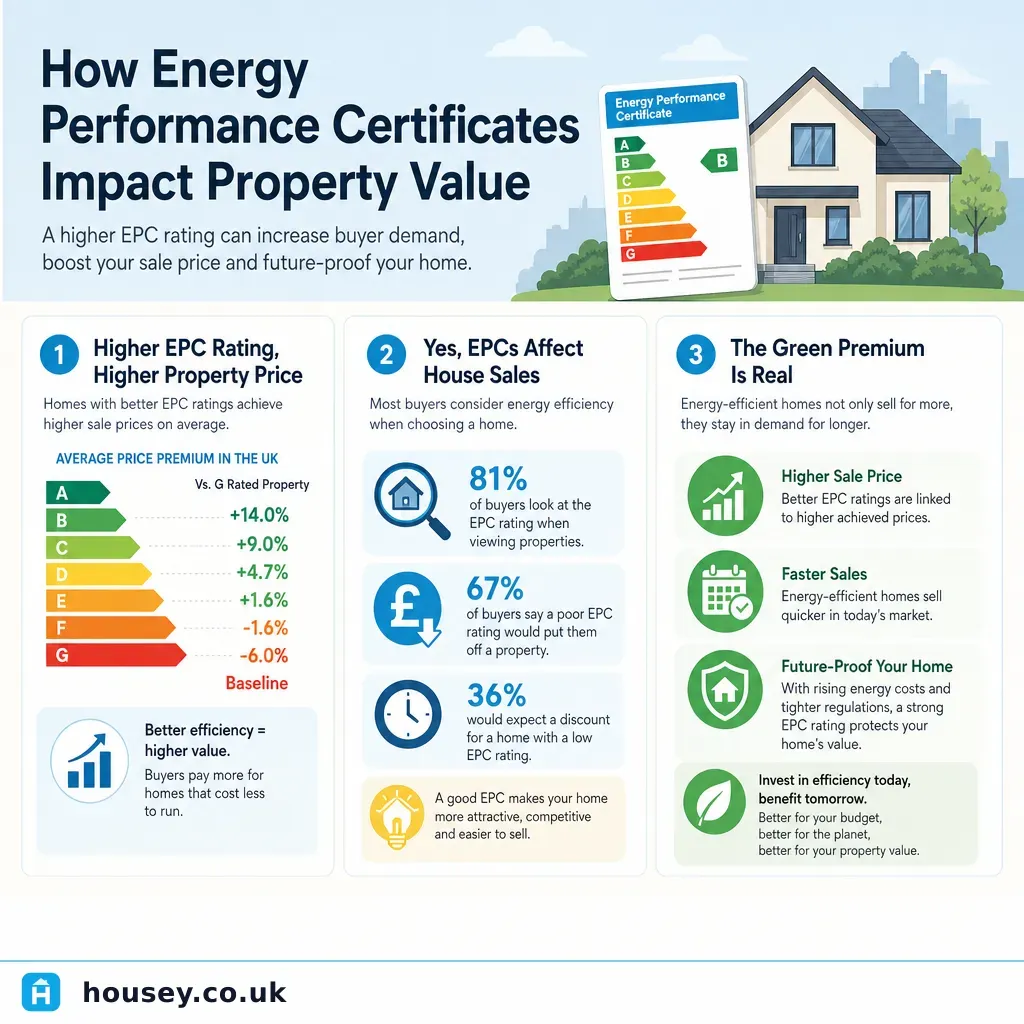
How Energy Performance Certificates Impact Property Value
A higher EPC rating can add measurable value to a UK property through a 'green premium' on open market sales, preferential green mortgage rates, and stronger buyer confidence.
 Buying & Moving
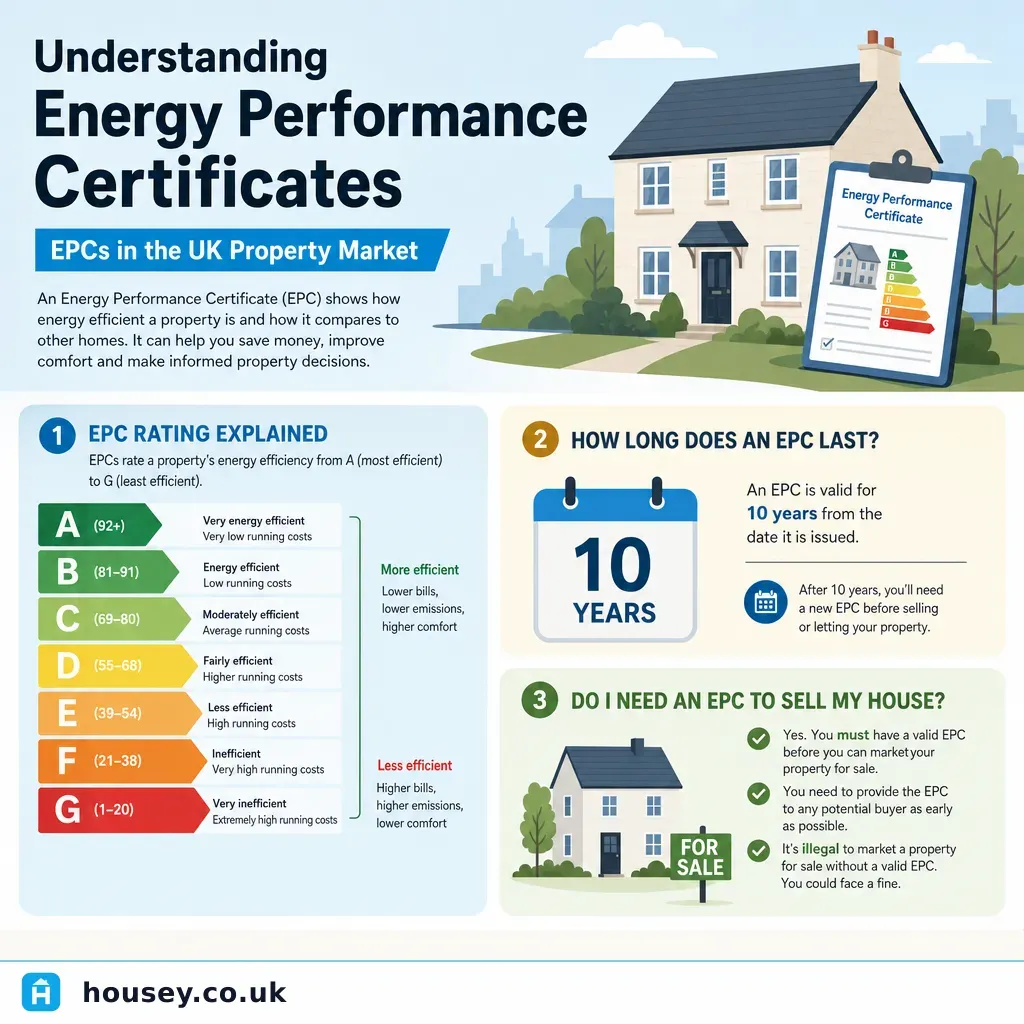
Understanding Energy Performance Certificates: EPCs in the UK Property Market
An Energy Performance Certificate (EPC) rates a property's energy efficiency on a scale from A (most efficient) to G (least efficient).
 Buying & Moving
Energy Performance Certificate (EPC) Assessment Costs
An EPC typically costs between £60 and £120 for a standard UK home, though prices vary by property size and assessor.
 Buying & Moving
Accelerating Your House Move: Strategies for Faster Property Transactions
The average time from offer to completion in England and Wales is around 12–16 weeks.