Referral Fees in Conveyancing: Impact on Your Service Choice
By Housey · Last reviewed 25th of May 2026

Referral Fees in Conveyancing: Impact on Your Service Choice
When an estate agent or mortgage broker recommends a conveyancer, there is often a financial arrangement between the two firms that the buyer or seller may never be told about unless they ask directly. Referral fees in conveyancing are legal in England and Wales, but they shape how conveyancers are selected, how their services are priced, and — in some cases — how independently they act on your behalf.
Key points
- Referral fees in conveyancing are permitted under Solicitors Regulation Authority (SRA) and Council for Licensed Conveyancers (CLC) rules, provided they are disclosed to the client.
- Estate agents who receive or pay referral fees must disclose this under the Estate Agents Act 1979 and the Consumer Protection from Unfair Trading Regulations 2008.
- A typical referral fee is £100–£300 per transaction, though it can be higher; this cost is usually built into the conveyancer's quoted fee to the client.
- You have no legal obligation to use the conveyancer recommended by your estate agent or mortgage broker — your right to choose independently is legally protected.
- SRA transparency rules (updated 2024) require regulated firms to publish pricing and referral arrangements clearly on their websites.
What is a referral fee and how does it work?
A referral fee is a payment made by a conveyancer — or their firm — to a third party, most commonly an estate agent or mortgage broker, in return for introducing a client. The third party recommends the conveyancer; the conveyancer pays for the introduction, typically at or around completion.
The mechanics are straightforward:
- You use an estate agent to buy or sell a property.
- The agent recommends their preferred solicitor or an in-house conveyancing service.
- If you instruct that conveyancer, a referral fee is paid by the conveyancer to the agent at completion.
- The conveyancer recovers this cost through their pricing, or by operating at higher volume with thinner per-file margins.
This is entirely legal. Both the SRA and the CLC permit referral arrangements, provided the fee is disclosed, your freedom to choose independently is preserved, and the firm's professional duties to you as the client are not compromised.
How referral fees affect pricing and service quality
The referral fee model has two main effects on how conveyancing firms operate.
Effect on pricing: A conveyancer paying £200 per transaction to a referring agent must price their services to recover that cost — through their headline fee, disbursement markup, or high-volume throughput. This does not necessarily mean referred conveyancers are more expensive than non-referred ones, but their pricing structure is different and less straightforwardly comparable when you receive a quote.
Effect on service: High-volume referral-scheme conveyancers often carry more files per fee earner, relying on process efficiency to manage capacity. For standard freehold transactions this can work well. For complex matters — leasehold, new-build, listed buildings, or unusual titles — individual attention and specialist experience may matter more than throughput.
Conveyancer source | Typical model | Likely strengths | Points to check |
|---|---|---|---|
Estate agent referral | High volume, referral-fed | Competitive pricing, process-driven | Caseload per fee earner; communication responsiveness |
Mortgage broker referral | Often online or panel firm | Integrated with mortgage workflow | Local knowledge; leasehold or complex-title experience |
Independent or self-sourced | Variable | No third-party financial influence | Quality varies; obtain multiple quotes |
Personal recommendation | Variable | Known track record | Confirm current capacity and accreditation |
What disclosures are you entitled to?
Under current SRA and CLC rules, your conveyancer must disclose that a referral arrangement exists and provide — or make available — the amount of the fee. The disclosure must be clear and not buried in small print.
Estate agents are separately required under the Estate Agents Act 1979 to disclose any financial arrangement with service providers they recommend, including conveyancers. Under the Consumer Protection from Unfair Trading Regulations 2008, failing to disclose a material commercial relationship that would affect a consumer's decision is potentially a criminal offence.
If you are not told about a referral fee and later discover one existed, you can raise a complaint with the SRA, the CLC, or the Property Ombudsman depending on which regulated party is involved.
Homeowner checklist: choosing a conveyancer independently
Before accepting a recommended conveyancer, work through this checklist:
What to ask before accepting a recommended conveyancer
- Is a referral fee being paid for this introduction, and if so, what is the amount?
- How many active files does the fee earner assigned to my matter typically carry at one time?
- Who specifically will work on my file, and what are their qualifications?
- What is included in the fixed fee, and what additional charges might apply during the transaction?
- Are you on my mortgage lender's approved panel?
- How do you handle complications — title defects, missing consents, or delayed management packs?
- What costs will I owe if the transaction does not proceed to completion?
Important limitations
This article provides general information about referral fee arrangements in residential conveyancing in England and Wales. The regulatory frameworks of the SRA and CLC differ in some respects. Scottish and Northern Irish property law and conveyancing regulation differ substantially from the regime described here. This article is not legal advice. For advice on your specific transaction, instruct a qualified, regulated professional.
When to get professional help
Instruct a conveyancer as soon as your offer is accepted. If you have concerns about a referral arrangement:
- Raise them directly with the conveyancer in writing before giving instructions.
- If a firm declines to disclose whether a referral fee exists, consider instructing a different firm.
- If you believe a referral fee has not been disclosed as required, complain to the SRA, the CLC, or the Property Ombudsman.
- For complex transactions — leasehold, listed, new-build, shared ownership — prioritise specialist experience over the convenience of an estate agent introduction.
How Housey can help
Housey makes it straightforward to compare conveyancing services from regulated professionals without a referral-fee layer influencing which providers you see. All quotes on Housey are sourced independently of estate agents and brokers, so you can compare on the merits of service, accreditation, and cost.
Frequently asked questions
Are referral fees in conveyancing illegal?
No. Referral fees in conveyancing are legal in England and Wales provided they are disclosed to the client in accordance with SRA and CLC rules. The regulatory requirement is transparency — the arrangement must be declared to you and your right to choose your own conveyancer respected. Non-disclosure can amount to a regulatory breach or, in some circumstances, a criminal offence under consumer protection legislation.
Can my estate agent insist I use their recommended conveyancer?
No. Estate agents cannot make using a particular conveyancer a condition of a sale or purchase. Any pressure of this kind should be resisted, and persistent coercion may breach the Consumer Protection from Unfair Trading Regulations 2008. You are entitled to instruct any regulated conveyancer of your choice, regardless of who the estate agent recommends.
Does using a referred conveyancer mean I receive worse service?
Not necessarily. Many high-volume referral-scheme firms offer efficient, well-priced services for standard transactions. The concern is that the recommendation may reflect a commercial relationship rather than your best interests, and that the pricing structure may include a cost that is not immediately transparent. Independent comparison is always worthwhile before accepting any recommendation.
How do I find a conveyancer without going through an estate agent?
Search the Law Society's Find a Solicitor directory, the CLC's register of licensed conveyancers, or compare professionals through platforms such as Housey. Ask friends or colleagues who have recently bought or sold for personal recommendations. Always obtain at least two quotes with full disbursement breakdowns before deciding.
Sources and further reading
- Referral arrangements — guidance for solicitors — Solicitors Regulation Authority
- Referral fees — licensed conveyancer guidance — Council for Licensed Conveyancers
- Estate Agents Act 1979 — legislation.gov.uk
- Consumer Protection from Unfair Trading Regulations 2008 — legislation.gov.uk
- Buying or selling your home — GOV.UK
- Find a Solicitor — Law Society
Useful next reads
 Buying & Moving
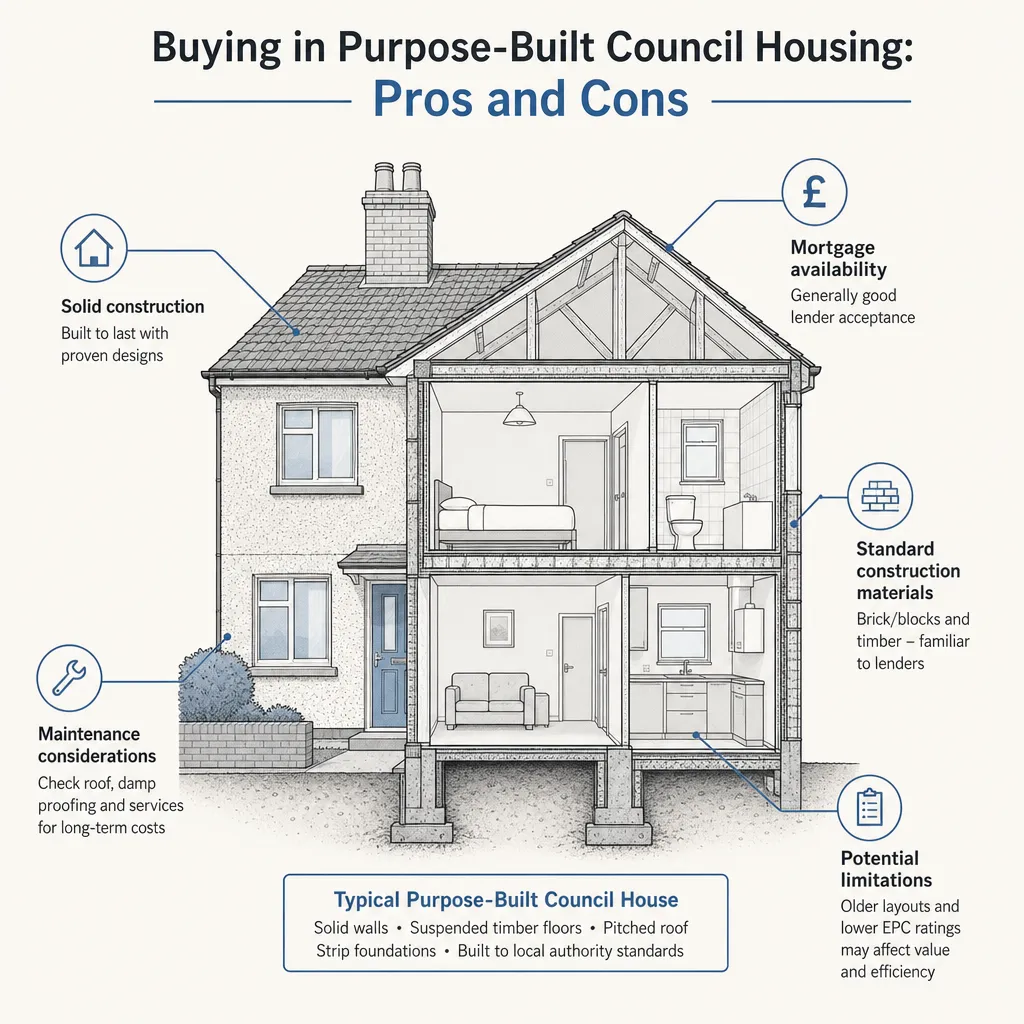
Buying in Purpose-Built Council Housing: Pros and Cons
Purpose-built council housing — typically 1950s–1980s blocks, maisonettes, or estate houses — can offer good value and generous room sizes, but buyers should check construction type before applying for a mortgage.
 Buying & Moving
New Build Homes: Advantages and Disadvantages for Buyers
New build homes offer energy efficiency, modern layouts, and structural warranties — typically a 10-year NHBC Buildmark or equivalent.
 Buying & Moving
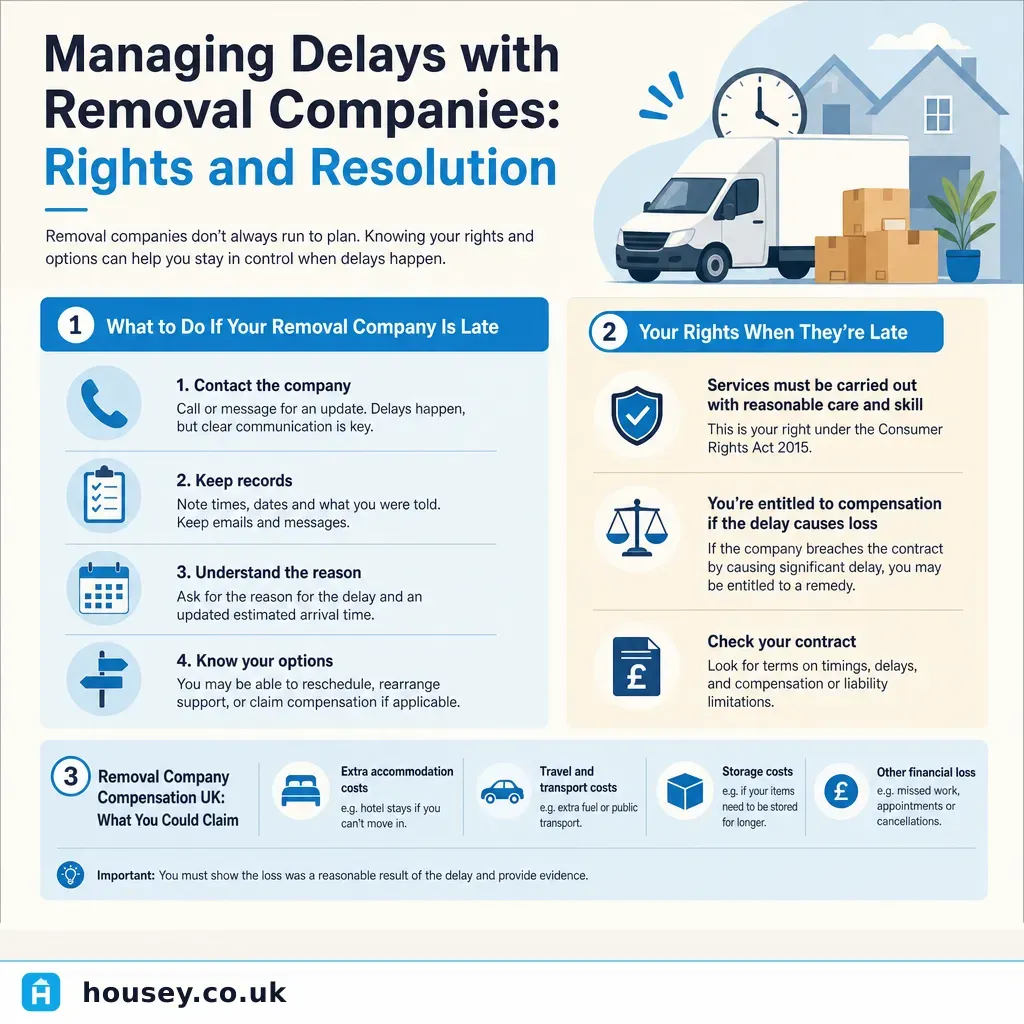
Managing Delays with Removal Companies: Rights and Resolution
If a removal company is late, your rights depend on your contract and whether the company is BAR-registered.
 Buying & Moving
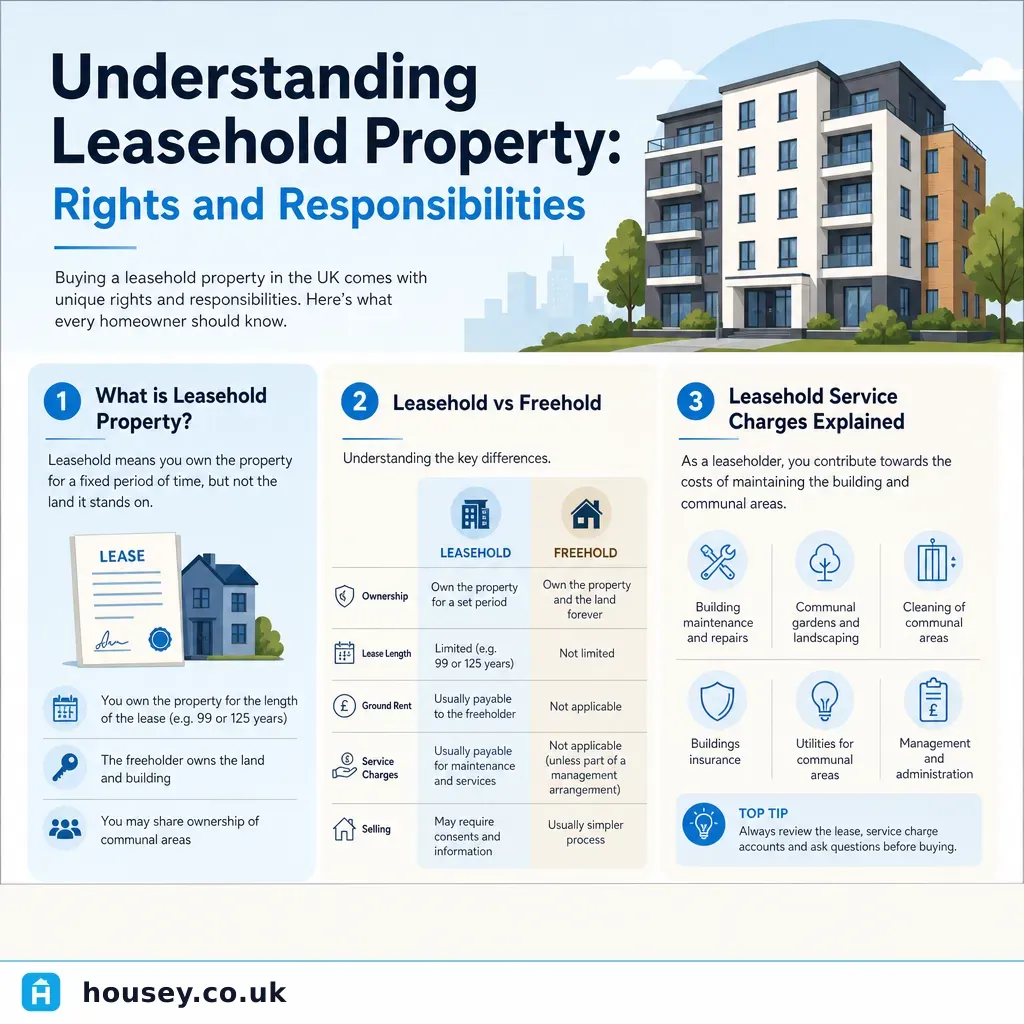
Understanding Leasehold Property: Rights and Responsibilities
Leasehold means you own a time-limited interest in a property while the freeholder owns the land and building.
 Buying & Moving
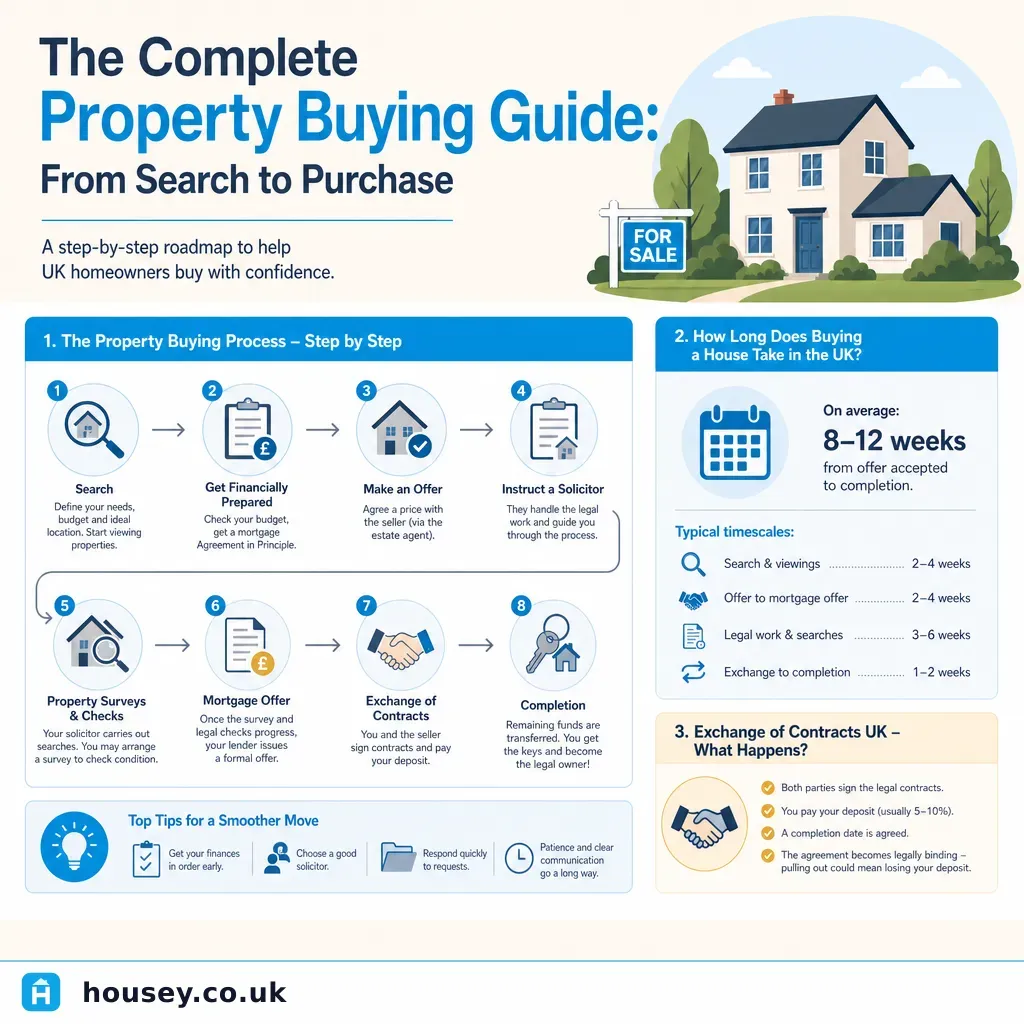
The Complete Property Buying Guide: From Search to Purchase
Buying a property in England and Wales typically takes 3–6 months from accepted offer to completion.