Buying in Purpose-Built Council Housing: Pros and Cons
By Housey · Last reviewed 30th of May 2026
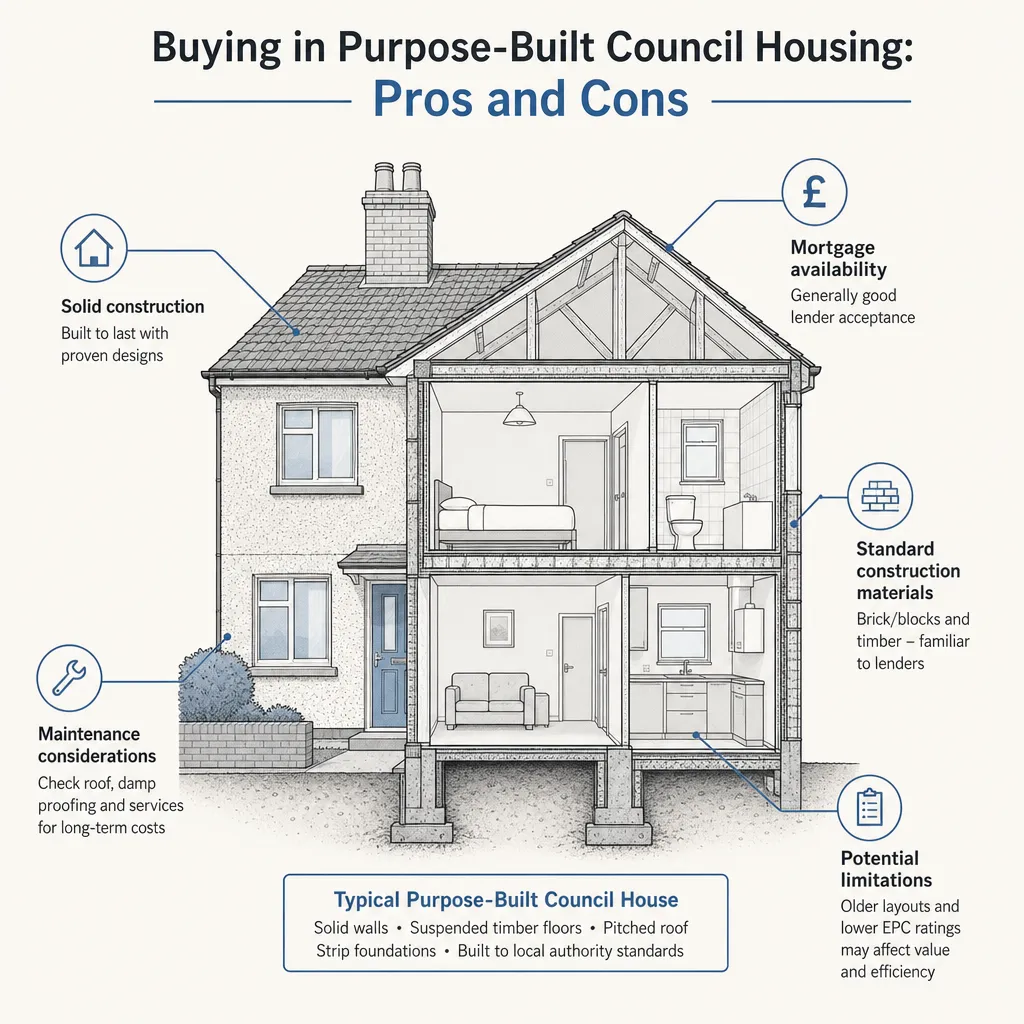
Buying in Purpose-Built Council Housing: Pros and Cons
Purpose-built council housing — the estates, maisonettes, and low-rise blocks constructed by local authorities from the 1930s through to the 1980s — represents a significant proportion of the UK's existing residential stock and appears on the open market regularly as ex-local authority (ex-LA) homes. Buyers approaching these properties face a specific set of legal, financial, and structural questions that are largely absent from purchasing a comparable privately built home of the same era. Getting the right answers before making an offer can make the difference between a sound investment and a costly complication.
Key points
- Non-standard construction types — including Laing Easiform, Wimpey No-Fines, BISF steel-frame, and large-panel concrete systems — are common in council-built estates and can restrict mortgage availability from mainstream lenders.
- If a property was originally sold under the Right to Buy scheme and is resold within five years of that first sale, the original discount may be repayable in full or in part — a covenant that can bind subsequent purchasers.
- Leasehold ex-council flats often retain the local authority or a housing association as freeholder, meaning service charges and major works notices (Section 20 notices) can be significant and unpredictable.
- A RICS Level 2 or Level 3 Home Survey is strongly advisable for ex-council properties, particularly older blocks where flat roofs, concrete spalling, and communal systems may be deteriorating.
- Permitted development rights are sometimes restricted on larger estates subject to an Article 4 Direction, meaning alterations that would normally be permitted require a full planning application.
Pros of buying purpose-built council housing
Space and build quality
Many council houses built during the 1960s and 1970s were constructed to Parker Morris standards — minimum space and storage requirements introduced for public housing in 1967 and withdrawn as a mandatory standard in 1981. In practice, this means council-era houses frequently offer larger room sizes, more storage, and bigger gardens than equivalent private builds from the same period. Compared to new-build properties in particular, the difference in usable floor area can be considerable.
Value relative to comparable homes
Ex-local authority properties often carry a lower asking price per square metre than privately built homes in the same street or neighbourhood. For buyers who are comfortable with the due diligence required, this can represent genuine value — particularly in areas where overall house prices have risen sharply.
Established locations and infrastructure
Local authorities tended to site housing estates near schools, bus routes, health centres, and local shops. Many estates are close to town or city centres. The surrounding infrastructure is typically more developed than in newer speculative residential developments built on greenfield land.
Solid construction in conventional builds
Not all council housing uses non-standard construction. Many smaller estates built from the 1950s onwards used conventional brick-and-block methods and perform well in surveys. These properties attract standard mortgage products and present no more complexity than any other home of a similar age.
Cons and risks of buying purpose-built council housing
Non-standard construction and mortgage restrictions
This is the most significant financial risk for buyers. Local authorities used a wide range of construction systems during the post-war housing drive, many of which are classified as non-standard by mortgage lenders:
Construction type | Common era | Typical mortgage availability | Key consideration |
|---|---|---|---|
Traditional brick and block | All eras | Good — mainstream lenders | Standard product; survey confirms condition |
Laing Easiform (cast in-situ concrete) | 1920s–1960s | Restricted — specialist lenders | Specialist survey report often required |
Wimpey No-Fines (aggregate concrete) | 1940s–1960s | Restricted — some lenders accept | Condition-dependent; check for spalling |
BISF steel-frame | 1940s–1950s | Restricted — specialist lenders | Structural re-survey may be required |
Large-panel system (LPS) blocks | 1960s–1970s | Often declined — very limited | Structural certificates may be needed |
Reema / Cornish Unit | 1940s–1960s | Restricted — specialist lenders | Listed as defective under the Housing Act 1985 |
Indicative guidance based on general lender practice, last reviewed 2026-05-30. Always confirm with a mortgage broker before making an offer.
If you cannot identify the construction method from the seller's documentation or marketing materials, a RICS surveyor can assess this as part of a Level 2 or Level 3 Home Survey.
Right to Buy resale covenants
If the property was first sold to a tenant under the Right to Buy scheme, a resale covenant is likely to be registered on the title. Under the Housing Act 1985 and subsequent regulations, a purchaser who exercised Right to Buy must repay a proportion of the discount if they sell within five years of the original purchase:
- Year 1: 100% of the discount repayable
- Year 2: 80%
- Year 3: 60%
- Year 4: 40%
- Year 5: 20%
- After 5 years: no repayment required
This covenant can bind subsequent owners who purchase within the five-year window. Your conveyancer should check the Office Copy Entries at HM Land Registry and flag any such obligation before you exchange.
Service charges and major works (leasehold flats)
Ex-council flats are almost always leasehold. The freeholder is typically the local authority or a housing association, and service charges cover communal maintenance, cleaning, building insurance, and estate upkeep. Under the Landlord and Tenant Act 1985, charges must be reasonable, but disputes are common.
A Section 20 major works notice — issued when planned works exceed £250 per leaseholder — can arrive unexpectedly and run to thousands of pounds per flat. Before exchange, ask your solicitor to check for any pending or recently completed Section 20 consultations.
Permitted development restrictions
Some council estates are subject to an Article 4 Direction under the Town and Country Planning (General Permitted Development) (England) Order 2015, which removes certain permitted development rights that would otherwise allow changes such as extensions, outbuildings, or window alterations without planning permission. Before assuming you can alter the property freely, check with the local planning authority.
Pre-offer checklist for ex-council property buyers
When to get professional help
Non-standard construction and leasehold complexity are two of the most common reasons ex-council property purchases become complicated or fall through. Get professional guidance if:
- The construction type cannot be confirmed from marketing materials or seller documentation.
- A mortgage broker advises the property is difficult to lend on — a surveyor's written opinion and a specialist broker are both needed.
- The title reveals a Right to Buy resale covenant with an unexpired period.
- The service charge history shows large year-on-year increases, or the seller cannot produce three years of accounts.
- The property is a leasehold flat and the remaining lease term is below 80 years — lease extension adds complexity and cost.
How Housey can help
If you are considering an ex-council property, Housey can connect you with a conveyancer experienced in local authority property who can check for Right to Buy covenants and leasehold title issues, and with a RICS-accredited surveyor offering a RICS Level 2 Home Survey suited to the property's age and construction type. Getting the right professionals involved early can prevent costly surprises after exchange.
Frequently asked questions
Will a mortgage lender accept a purpose-built council property?
It depends on the construction type. Many high-street lenders will mortgage conventional brick-and-block ex-council houses without restriction. Properties built with concrete panels, steel frames, or prefabricated systems — common in 1950s to 1970s local authority housing — are often classed as non-standard and some lenders will decline them outright. A whole-of-market mortgage broker can identify willing lenders for your specific construction type.
Are there resale restrictions on ex-council properties?
If the property was originally purchased under the Right to Buy scheme and is being resold within five years of that first sale, the original discount may be repayable in whole or in part. This obligation can bind subsequent owners within the relevant period. Your solicitor should check the title deeds and HM Land Registry entries for any such covenant before you exchange contracts.
What are the typical service charges on ex-council flats?
Service charges on leasehold ex-council flats vary widely and can include estate maintenance, communal cleaning, building insurance, and major works contributions. Charges are set by the freeholder — often the local authority or a housing association — and can increase significantly if major works are planned. Ask the seller for three years of service charge accounts and check for any Section 20 major works notices.
Should I get a survey on a purpose-built council property?
Yes. A RICS Level 2 or Level 3 Home Survey is advisable for any ex-council property, particularly older blocks where construction materials, flat roof condition, drainage, and window systems may have deteriorated. A survey can identify the construction type, flag potential defects, and help you assess whether a mortgage lender is likely to be satisfied with the property's condition.
Sources and further reading
- Right to Buy: buying your council home — GOV.UK
- HM Land Registry: official copies of register entries — HM Land Registry
- RICS: Find a surveyor — Royal Institution of Chartered Surveyors
- Citizens Advice: Leasehold property — Citizens Advice
Useful next reads
 Buying & Moving
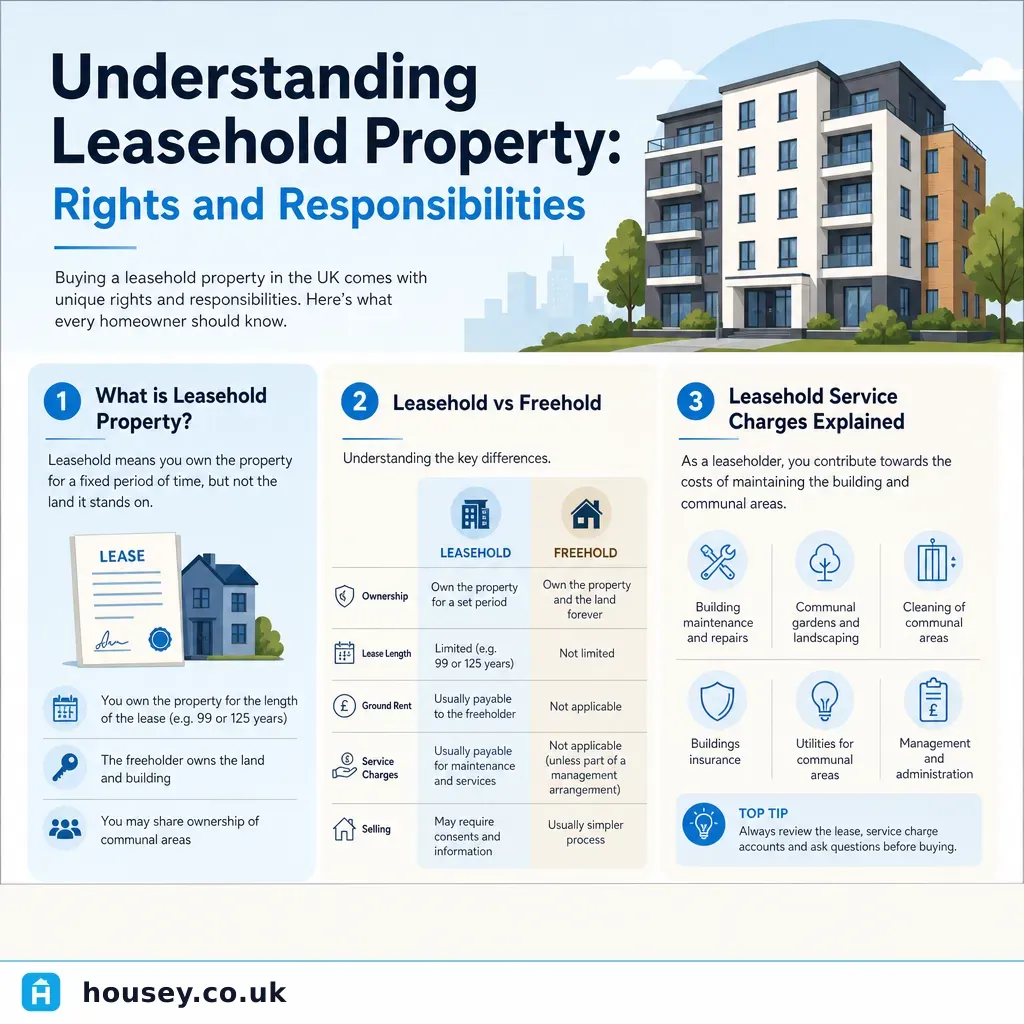
Understanding Leasehold Property: Rights and Responsibilities
Leasehold means you own a time-limited interest in a property while the freeholder owns the land and building.
 Buying & Moving
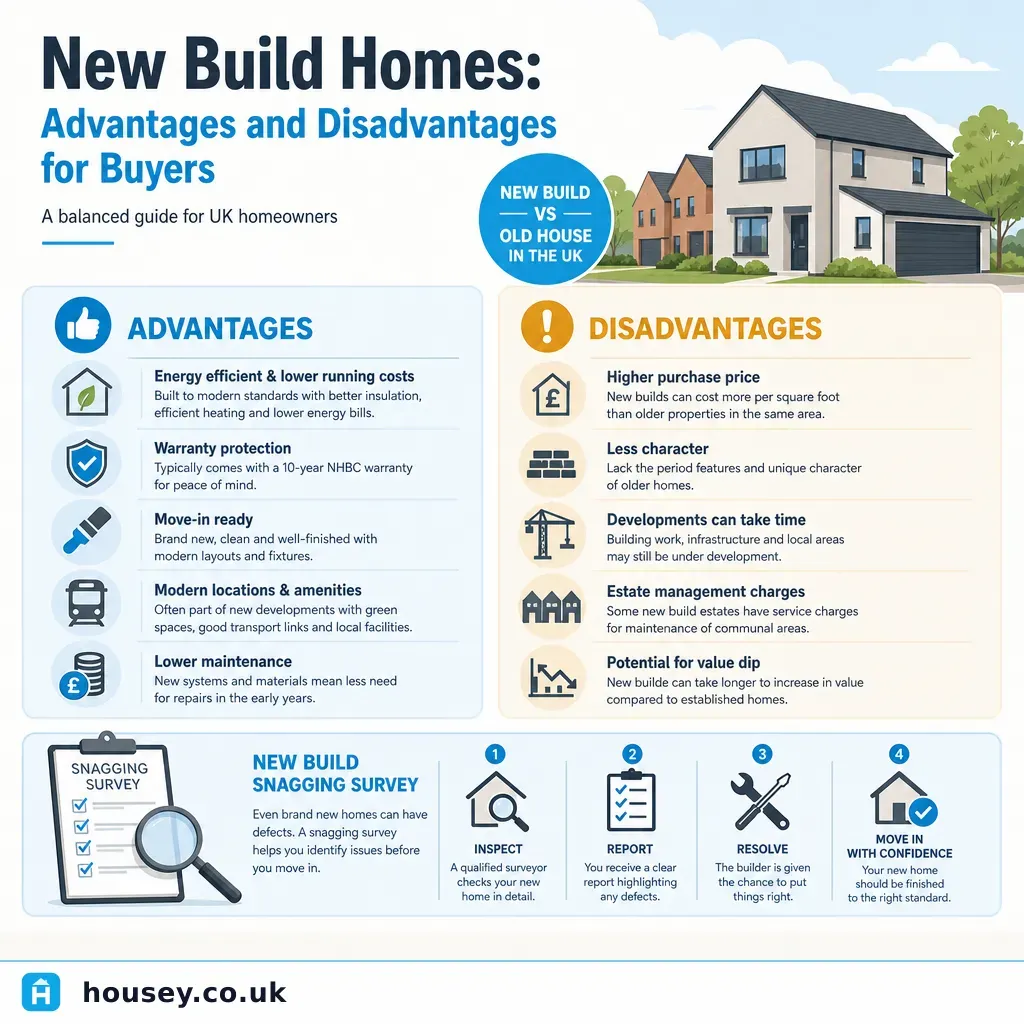
New Build Homes: Advantages and Disadvantages for Buyers
New build homes offer energy efficiency, modern layouts, and structural warranties — typically a 10-year NHBC Buildmark or equivalent.
 Buying & Moving
Golfing communities and properties near St Andrews
St Andrews and the surrounding villages in north-east Fife attract golf-motivated buyers from the UK and overseas.
 Buying & Moving
Referral Fees in Conveyancing: Impact on Your Service Choice
Referral fees in UK conveyancing are legal but must be disclosed to you.
 Buying & Moving
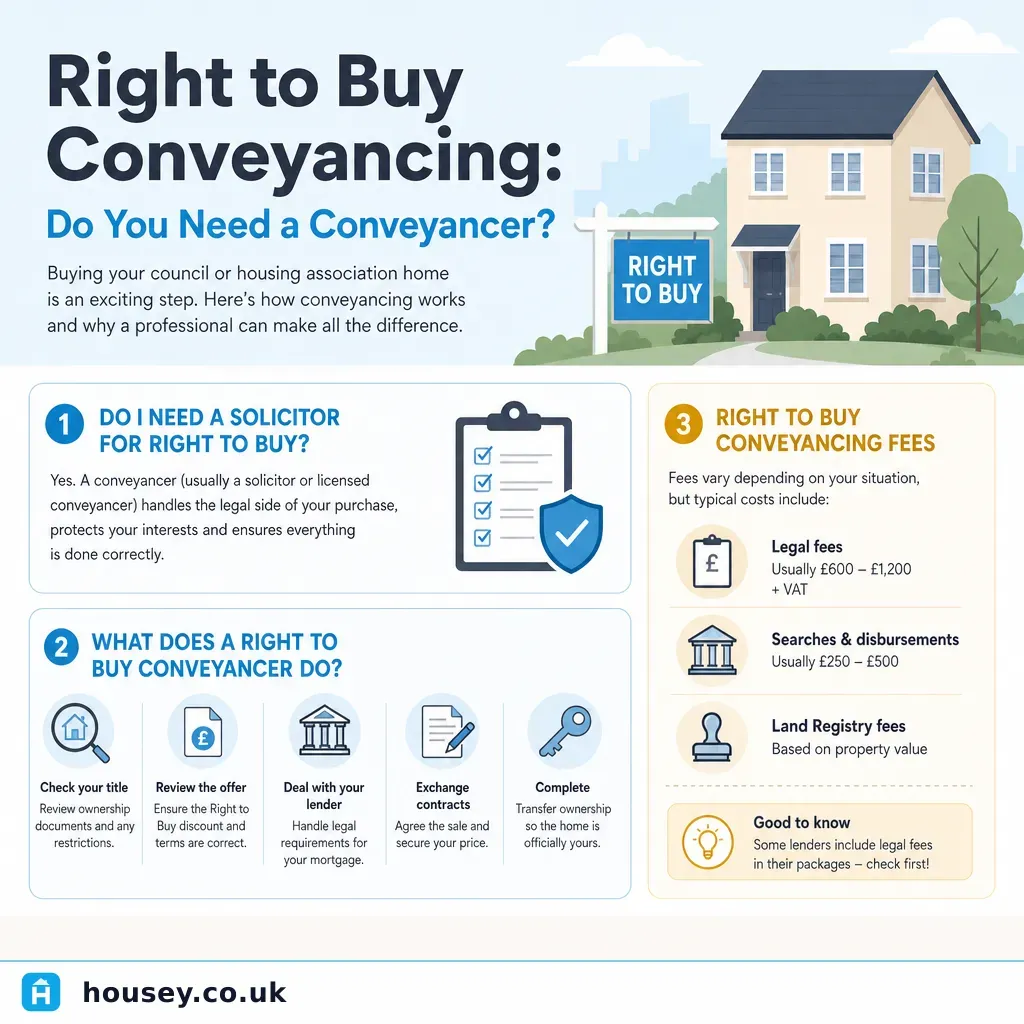
Right to Buy Conveyancing: Do You Need a Conveyancer?
You are not legally required to instruct a conveyancer for a Right to Buy purchase, but it is strongly advisable.