Rekeying Locks When Moving to a New Property
By Housey · Last reviewed 1st of June 2026
Rekeying Locks When Moving to a New Property
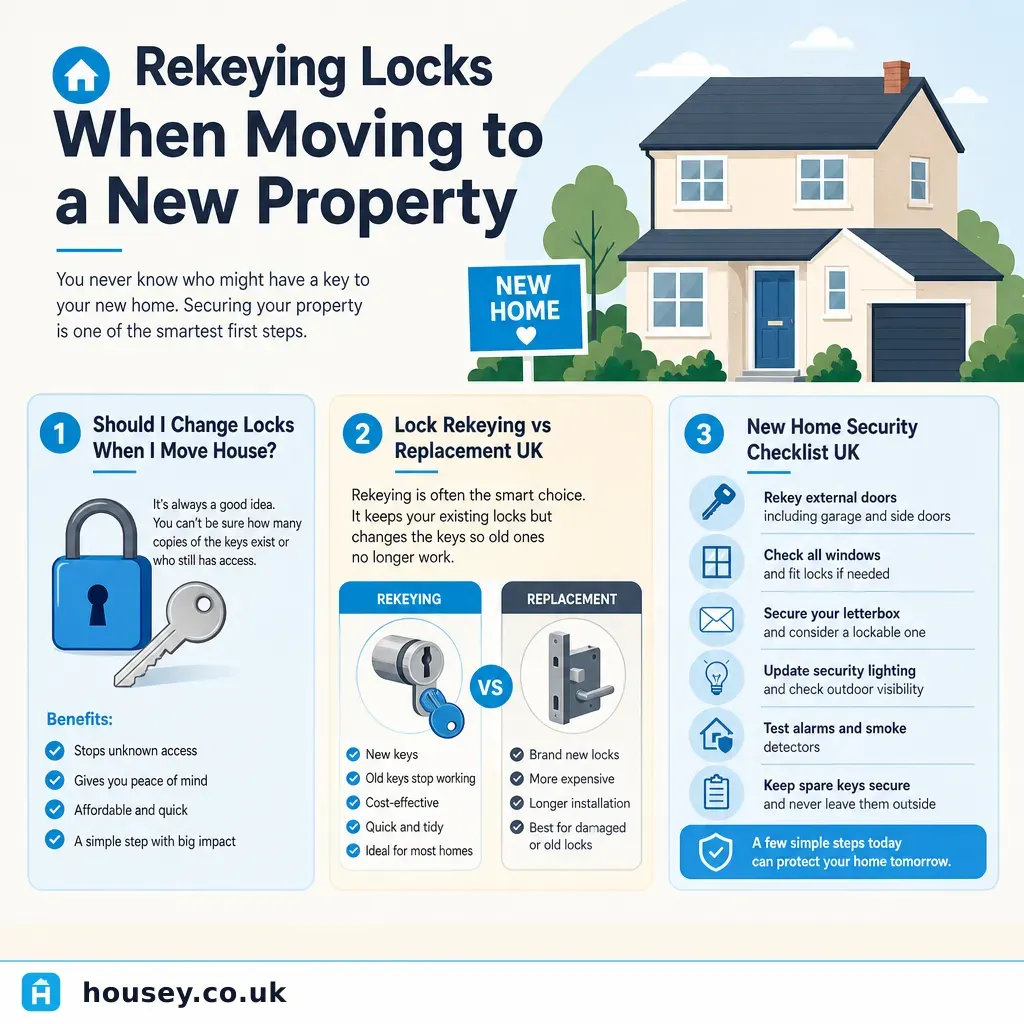
The moment you collect the keys at completion, you inherit every copy made during the property's previous ownership — and there is no reliable way to account for them all. Estate agents, previous owners, tradespeople, cleaners, and neighbours may hold copies, and the Law Society's property information form cannot independently verify how many were ever cut. Acting promptly on this risk is one of the simplest and most cost-effective security improvements a new homeowner can make in the first days after moving in.
Key points
- The Law Society's TA6 Property Information Form asks sellers to confirm how many key sets they hand over at completion, but does not require accounting for all copies made during the property's ownership — there is no independent verification mechanism.
- Rekeying changes only the internal pin configuration of an existing cylinder; the lock mechanism and all hardware remain, and the old key no longer operates the lock.
- The Master Locksmiths Association (MLA) indicates that rekeying a standard euro cylinder typically costs £40–£90 per lock in the UK; full lock replacement usually runs to £60–£150+ per point (indicative UK figures, last reviewed 2026-06-01).
- Multi-point locking systems with euro profile cylinders are generally straightforward to rekey; older five-lever mortice locks may be more cost-effective to replace outright.
- Some home insurance policies specify that external doors must carry BS 3621-compliant locks — confirm the rekeyed or replacement configuration still meets your policy requirements before work starts.
Rekeying versus replacing: which is right for your situation?
Rekeying and replacement achieve the same primary outcome — existing keys no longer work — but differ in cost, disruption, and suitability for different lock types.
| Rekeying | Lock replacement |
|---|---|---|
How it works | Locksmith repins the cylinder; new key cut to new combination | Old mechanism removed; new lock mechanism or cylinder fitted |
Typical UK cost per lock | £40–£90 (indicative, 2026) | £60–£150+ (indicative, 2026) |
Best for | Good-condition euro cylinders; multi-point systems | Worn, damaged, or non-BS-compliant locks |
Hardware retained? | Yes — handle, plate, and frame unchanged | No — new lock case or cylinder fitted |
Can upgrade security grade? | Limited — same cylinder, just a new key combination | Yes — specify a higher-rated cylinder or mechanism |
Time on site | 20–40 minutes per lock | 30–90 minutes per lock |
Indicative UK costs, last reviewed 2026-06-01. Quotes vary by location, lock type, and professional.
When rekeying is not the right choice
Rekeying is appropriate when the lock mechanism is in good condition and already meets required standards. It is not the right approach when:
- The existing lock does not carry a BS 3621 or TS007 marking and your insurer requires it.
- The cylinder shows visible wear, damage, or has previously been subjected to a snap or pick attack.
- You want to upgrade to a higher-security anti-snap or anti-pick cylinder — rekeying retains the existing cylinder's security grade.
- The property has older-style rim locks or warded locks where replacement is the simpler and often cheaper route.
Ask your locksmith to price both rekeying and replacement at the same visit, and check the final specification satisfies your insurance policy requirements.
Moving-in security checklist
Work through this before and immediately after completion:
Worked example: a 1990s semi in the East Midlands
Sarah and Marcus completed on a 1995 three-bedroom semi-detached in Nottingham. At exchange, their solicitor asked how many key copies existed. The seller confirmed three sets would be handed over but noted that two additional sets had been given to a neighbour 'years ago' and were never recovered.
The property had a composite front door with a euro cylinder multi-point lock, a uPVC rear door with the same system, and a uPVC side gate with a padlock.
An MLA-approved locksmith visited the morning after completion. The recommendation: rekey both door cylinders — both were in good condition and already TS007 2-star rated — and replace the side gate padlock, which was worn and carried no BS rating. Total cost: £95 for the two rekeys and £35 for a new padlock, completed in under 90 minutes. Sarah photographed the new hardware markings and filed them with her completion documents for future reference.
What to ask your locksmith before booking
- Are you a member of the Master Locksmiths Association or another recognised trade body?
- Do you recommend rekeying or replacement for each lock, and what is the reason for each recommendation?
- Will the completed locks still comply with BS 3621 or TS007 ratings required by most home insurers?
- Will you provide a receipt or written confirmation of the work done and the specification fitted?
- Can you inspect all external lock points in a single visit and quote for the full job at once?
- How many new key sets will you cut, and what is the cost per additional copy?
When to get professional help
Rekeying is specialist work. Do not attempt to disassemble a lock cylinder without specific training — incorrect reassembly can leave the lock inoperable or with reduced security. If you move in and find any of the following, arrange a locksmith as a priority:
- A cylinder that is cracked, visibly forced, or has scratches consistent with a picking or bump attack.
- A door that will not lock securely, or a multi-point lock that does not engage all locking points cleanly.
- A door frame showing signs of a previous forced entry attempt, such as splintered timber or a displaced strike plate.
How Housey can help
Housey helps you plan and manage every stage of the move. Whether you need trusted house removals or local security professionals to help get your new home protected from day one, Housey connects you with vetted tradespeople and lets you compare quotes in one place.
Frequently asked questions
Is there a legal requirement to change locks when moving house in the UK?
No UK law requires buyers to change or rekey locks after purchasing a property. However, given the uncertainty over how many copies exist, it is widely recommended by insurers, police crime prevention officers, and organisations including the Master Locksmiths Association as a straightforward and cost-effective precaution for any new homeowner.
Can I rekey a Yale-type rim lock myself?
Some newer rim locks use a replaceable euro cylinder insert that a competent DIYer can swap without specialist tools. However, classic Yale-type rim cylinders use a proprietary pin format that typically requires a locksmith to rekey. If in doubt, ask a locksmith for a price — the work is usually straightforward and takes under 30 minutes.
Will rekeying affect my home insurance?
Not if the rekeyed configuration still matches the cylinder grade specified in your policy. Most policies require a BS 3621 key-operated deadlock on external doors; rekeying maintains the same mechanism and grade. If replacing rather than rekeying, ensure the new cylinder carries the required standard marking, and notify your insurer in writing.
How long does rekeying take?
A single euro cylinder typically takes a locksmith 20–30 minutes to rekey on site. A full house with front door, rear door, and any secondary external access points can usually be completed within two hours. Allow extra time if locks are older, corroded, or difficult to access without prior disassembly.
Sources and further reading
- Master Locksmiths Association: find an approved locksmith — Master Locksmiths Association
- Law Society: TA6 Property Information Form — The Law Society
- Secured by Design: home security guidance — Police Crime Prevention Initiatives
- BS 3621:2007+A2:2012 Thief resistant lock assemblies — BSI Group
- GOV.UK: keeping your home safe — GOV.UK
Useful next reads
 Buying & Moving
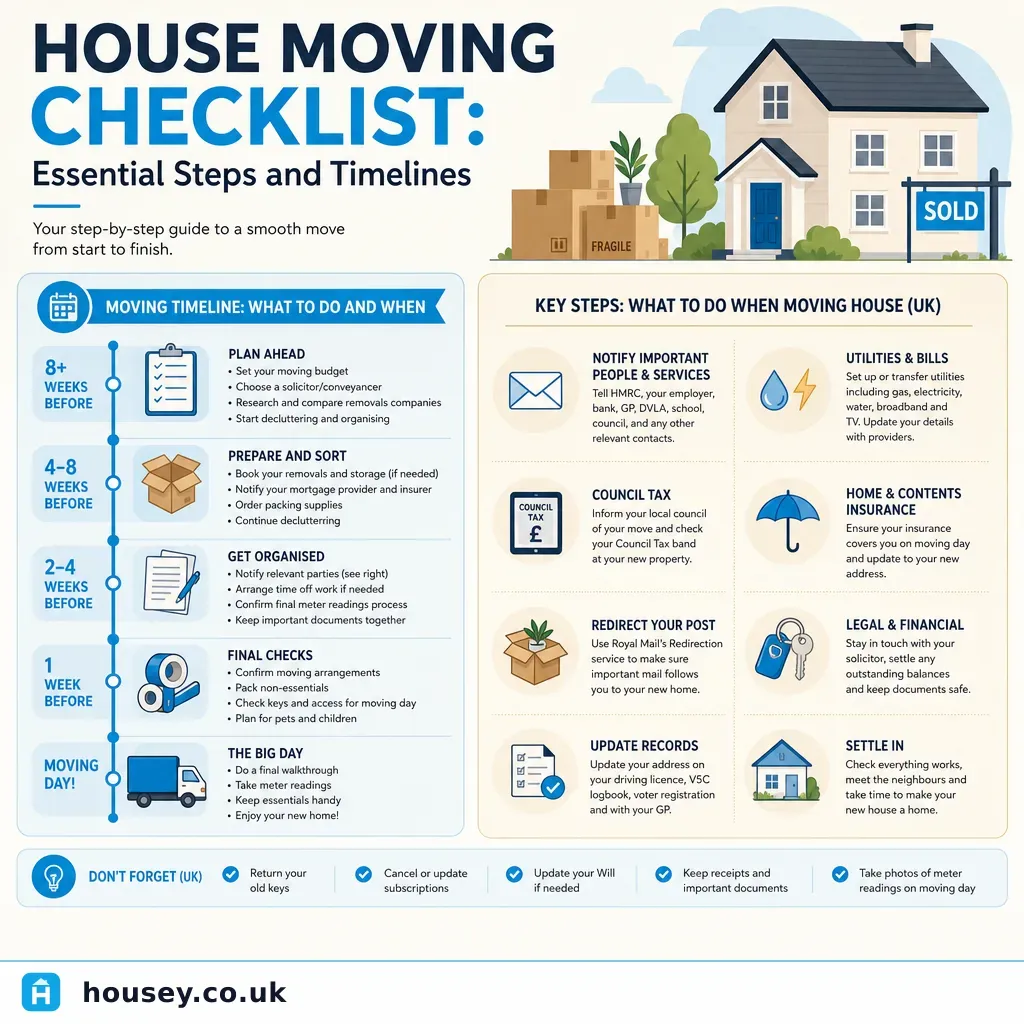
House Moving Checklist: Essential Steps and Timelines
A UK house move typically spans 8–12 weeks of preparation: book removals 4–6 weeks out, notify the DVLA, HMRC, and utilities as exchange approaches, take meter readings on moving day, and update Council Tax and the electoral register on arrival.
 Buying & Moving
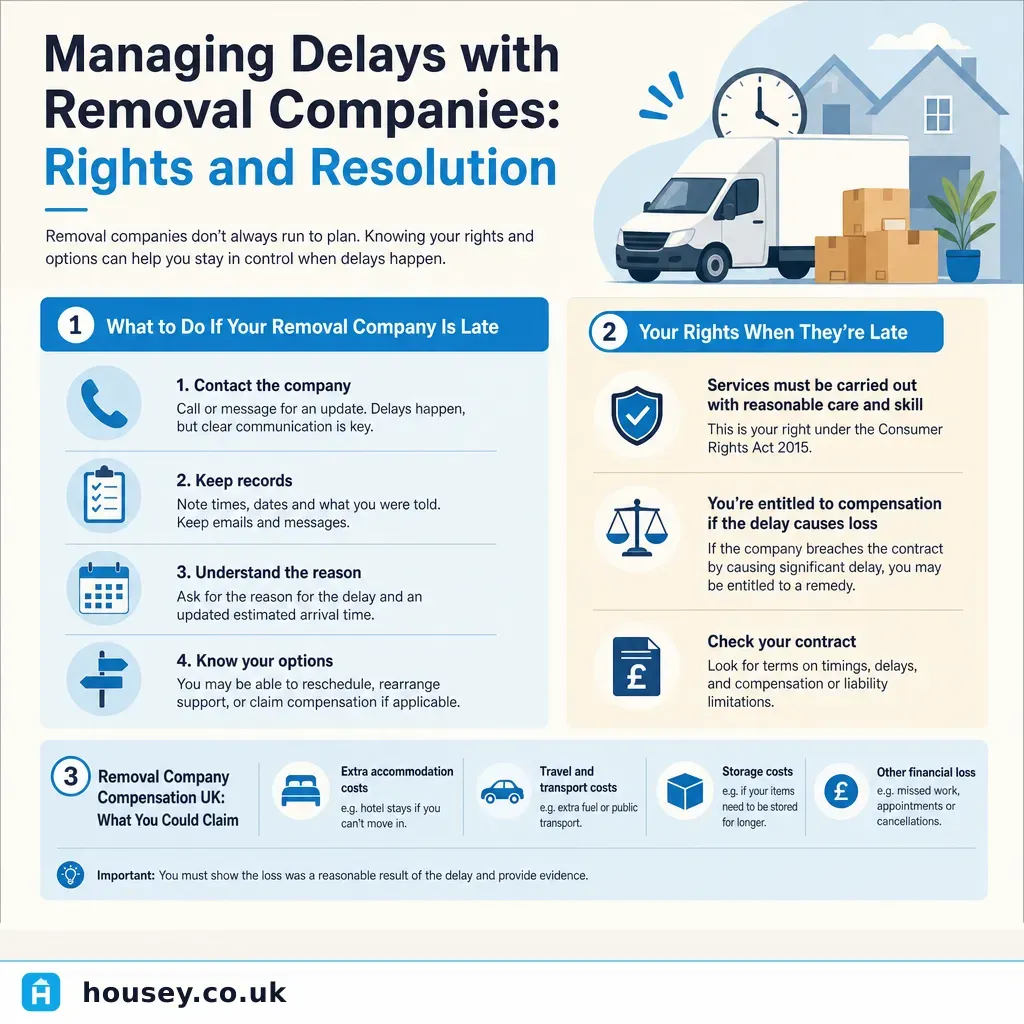
Managing Delays with Removal Companies: Rights and Resolution
If a removal company is late, your rights depend on your contract and whether the company is BAR-registered.
 Buying & Moving
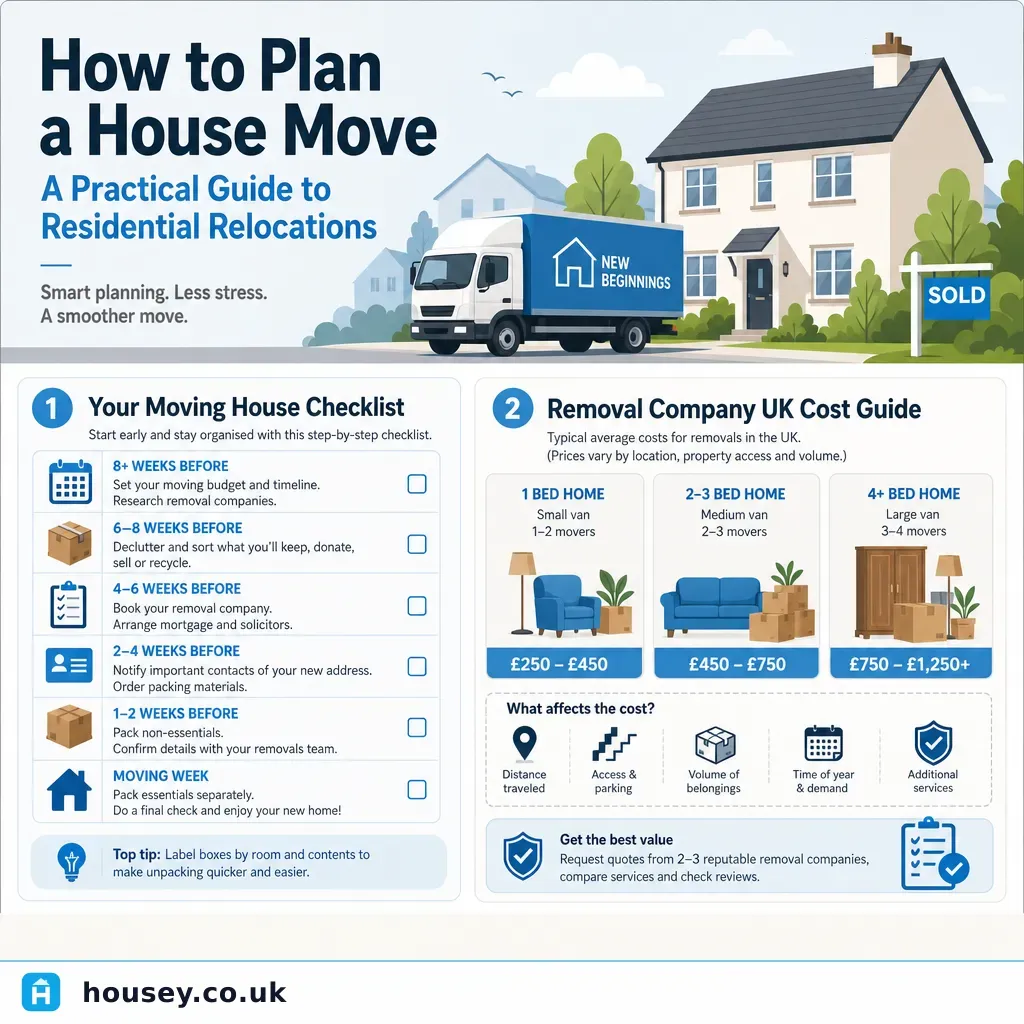
How to Plan a House Move: A Practical Guide to Residential Relocations
A UK house move goes more smoothly with planning that starts 6–8 weeks before moving day.
 Buying & Moving
Managing Property Relocation in Major Urban Centres
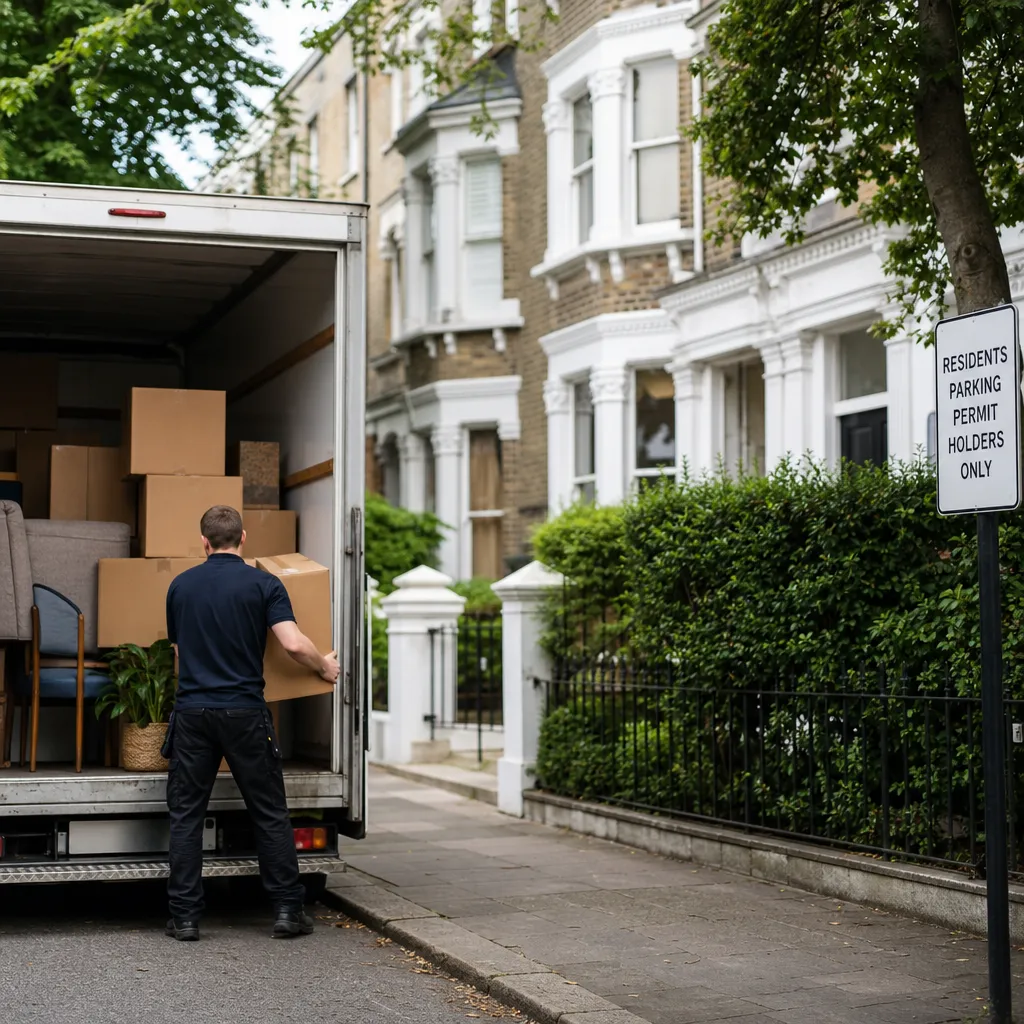
Urban house moves require planning beyond a standard removal, particularly around vehicle emission zone compliance, parking bay suspensions, and lift access in purpose-built flats.
 Buying & Moving
Relocating Home: Planning and Logistics Checklist
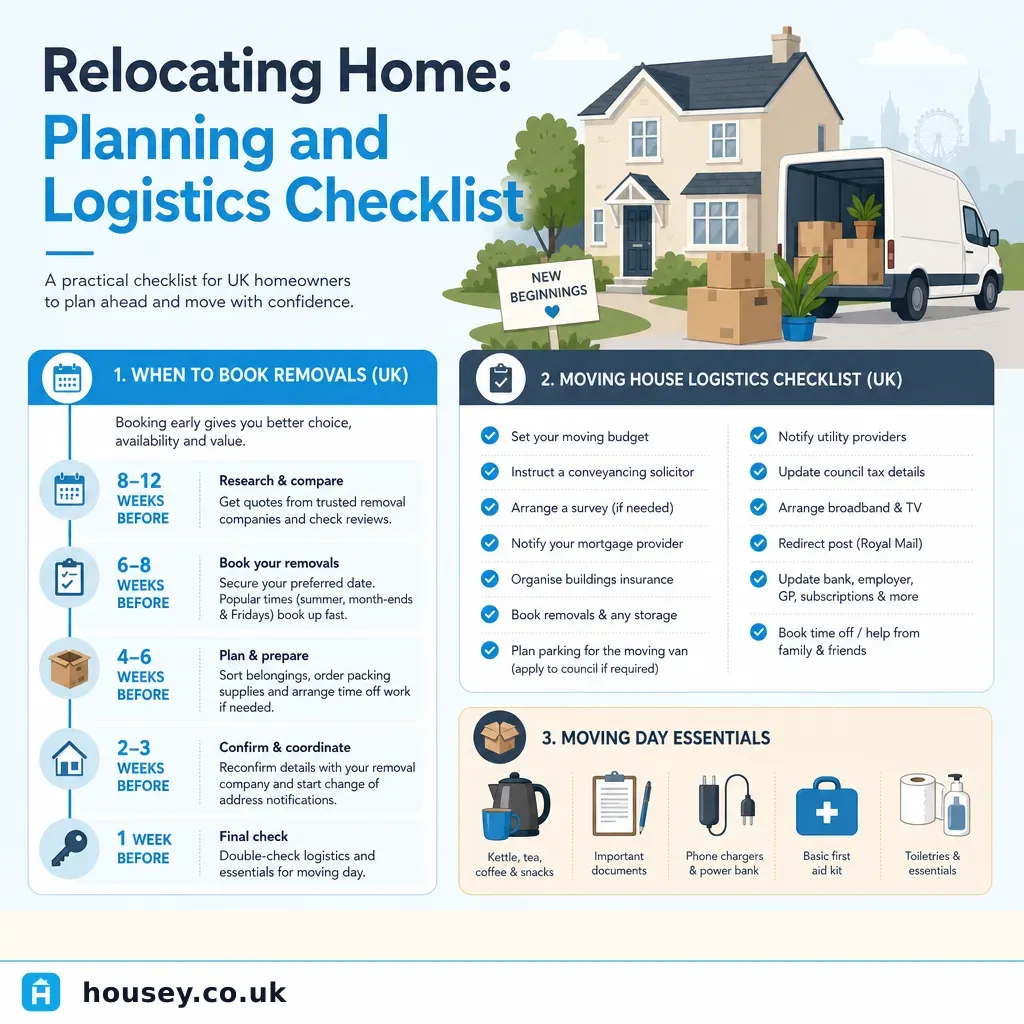
Successful home relocation in the UK typically requires 8–12 weeks of advance planning.