Relocating to London: Essential Guidance
By Housey · Last reviewed 30th of May 2026
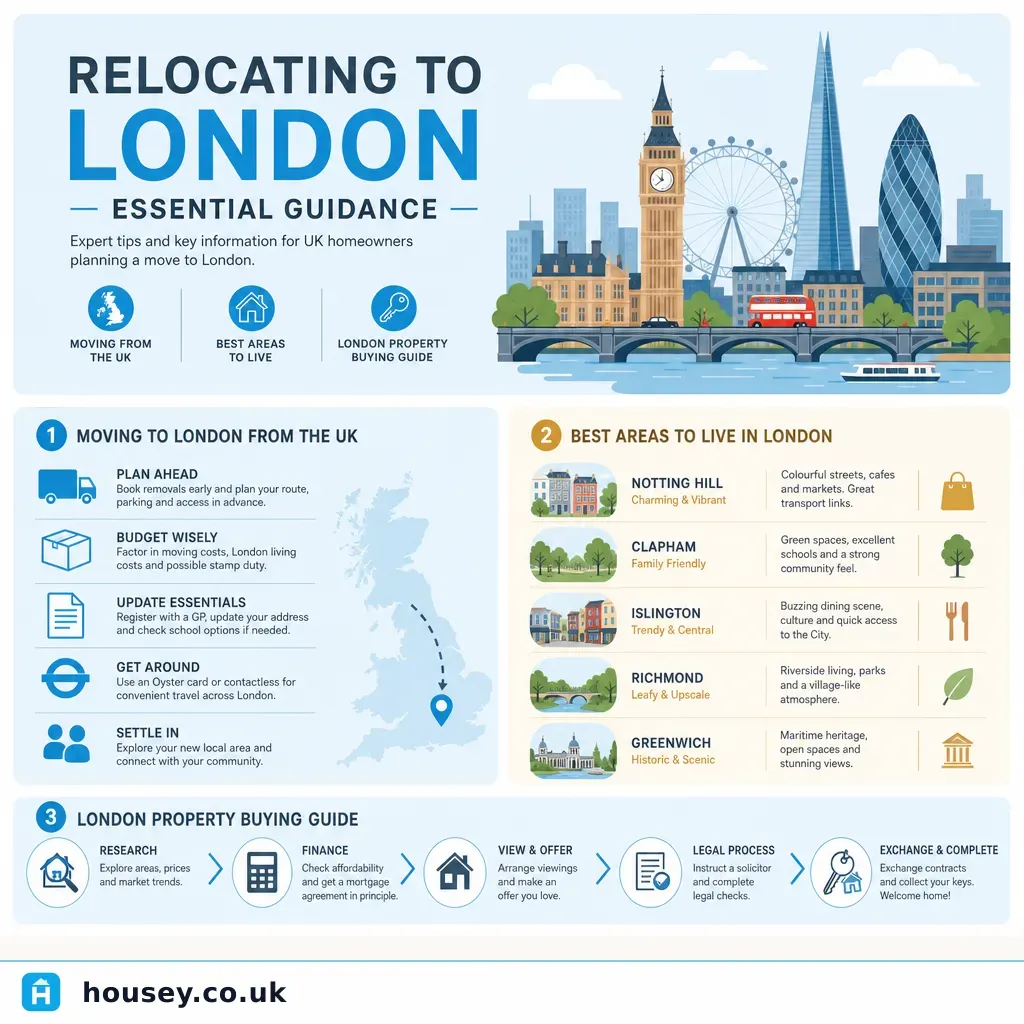
Relocating to London: Essential Guidance
London's 32 boroughs, mixed tenure landscape, and the sheer scale of its property market make relocating to the capital more complex than most UK moves. Whether you are arriving from another part of Britain or from overseas, decisions about area, commute tolerance, tenure type, and legal due diligence need to be made well before completion day — each one affects both your budget and your long-term satisfaction with the move.
Key points
- Stamp Duty Land Tax (SDLT) in England applies on the portion of the purchase price above £125,000 for existing homeowners as of April 2025; first-time buyers pay 0% on the first £300,000, then 5% up to £500,000.
- The average London house price exceeded £520,000 in early 2026, ranging from under £350,000 in outer boroughs to over £1 million in prime central areas (HM Land Registry UK HPI).
- Leasehold tenure is the norm for London flats; a lease with fewer than 80 years remaining is harder to mortgage and significantly more expensive to extend.
- London conveyancing typically takes 10–16 weeks from offer acceptance to completion; leasehold transactions and long chains regularly take longer.
- Most removal firms recommend booking 6–8 weeks in advance for London moves, particularly for completions on a Friday or at the end of the month.
Choosing the right area for your relocation
London's Transport for London (TfL) zone system is a practical starting point for balancing commute time against price. Zones 1 and 2 are the most central and expensive; Zones 3 to 6 offer more space for less money with a longer but usually reliable commute.
Inner vs outer London at a glance
Factor | Inner London (Zones 1–2) | Outer London (Zones 3–6) |
|---|---|---|
Typical price range (2026) | £650,000–£1m+ | £350,000–£600,000 |
Common property types | Flats, period conversions | Semis, detached, terraces |
Commute to central London | 10–30 minutes | 30–60 minutes |
Outdoor space | Often limited | More likely |
Council tax | Generally higher | Generally lower |
School catchment pressure | High in most boroughs | Variable |
Which area should you choose?
- Choose inner London (Zones 1–2) if you work centrally every day and prioritise walkability and short commutes over space.
- Choose Zones 3–4 (Walthamstow, Ealing, Bromley, Lewisham) if you want more floor space and a garden, and can accept a 30–45 minute commute.
- Choose Zones 5–6 (Croydon, Sutton, Barking, Romford) if maximising space for your budget is the priority and longer travel times are acceptable.
- Check the relevant borough council website if schools are a key factor — catchment boundaries can shift annually.
- Use the TfL Journey Planner to test realistic peak-hour travel times before committing to a neighbourhood.
Understanding tenure: freehold vs leasehold in London
A high proportion of London flats are leasehold: the buyer owns the right to occupy the property for the remaining lease term, not the land or building. Before proceeding on any leasehold purchase, check:
- The remaining lease length. Under 80 years triggers premium costs for lease extension and limits most mortgage lenders; under 70 years effectively excludes standard mortgage finance.
- Annual service charge levels and whether a major works reserve fund is in place.
- Whether the building requires an EWS1 fire-safety certificate — generally required for buildings above 11 metres where external wall materials are uncertain, following post-Grenfell cladding regulation.
- Ground rent terms. Ground rents that escalate or double periodically have historically created mortgage and resale difficulties.
Houses in London are more commonly freehold. If the property sits in a conservation area, check with the local planning authority before planning any external alterations — many boroughs have Article 4 Directions that restrict permitted development rights.
Budgeting for a London move
Indicative UK costs, last reviewed 2026-05-30. Obtain written quotes for your specific transaction; use the GOV.UK SDLT calculator for exact tax figures.
Cost item | Indicative range |
|---|---|
Conveyancing (freehold purchase) | £1,200–£2,000 + VAT |
Conveyancing (leasehold purchase) | £1,500–£2,500 + VAT |
SDLT on £450,000 (existing owner) | £12,500 |
SDLT on £450,000 (first-time buyer) | £7,500 |
RICS Level 2 Home Survey | £400–£700 |
RICS Level 3 Building Survey | £600–£1,200 |
Removal firm (within London, 2-bedroom) | £600–£1,200 |
Removal firm (long-distance to London) | £1,200–£2,500 |
A worked London relocation scenario
The situation: A couple relocating from Bristol to a 3-bedroom Victorian terrace in Walthamstow (Zone 3), purchasing at £575,000. Neither is a first-time buyer.
SDLT: Based on April 2025 rates: 0% on £0–£125,000, 2% on £125,001–£250,000 (= £2,500), 5% on £250,001–£575,000 (= £16,250). Total approximately £18,750. Confirm via the GOV.UK SDLT calculator.
Survey: The 1905-built terrace had a visible ground-floor rear extension of unknown date. A RICS Level 3 Building Survey was instructed to assess the extension junction, roof slopes, and chimney stacks in detail.
Conveyancing: Freehold title; solicitor instructed on the same day as offer acceptance. No chain below; exchange achieved in 9 weeks.
Removals: Three quotes were obtained; a BAR-member firm was booked 7 weeks in advance for a Thursday completion, avoiding the Friday bottleneck. A storage unit held non-essential boxes during a 2-week overlap.
Outcome: Completion on time. Minor survey findings — repointing needed at the rear gable — were renegotiated off the purchase price before exchange.
What to ask a removal firm before booking
- Are you a member of the British Association of Removers (BAR) or hold equivalent accreditation?
- Is the quote based on a physical survey of the property, or a phone or online estimate?
- Does the price include dismantling and reassembling furniture?
- Is VAT included in the quoted price?
- What is your protocol if legal completion is delayed on the day?
- Do you offer storage if the chain falls through on moving day?
- What does goods-in-transit insurance cover, and what are the per-item claim limits?
When to get professional help
Most London relocations are manageable with careful early planning, but professional input is essential at specific points:
- Lease length under 85 years — instruct a solicitor before making an offer; the cost of lease extension should be factored into your purchase budget.
- Survey flags structural movement or damp — commission a specialist structural engineer or damp surveyor rather than relying on a general survey caveat.
- Building lacks an EWS1 certificate — do not proceed without clarity from your mortgage lender on whether finance will be offered.
- Purchase involves non-standard tenure (shared ownership, Help to Buy equity loan, right-to-buy) — instruct a conveyancer with specific experience in that scheme.
How Housey can help
Housey connects you with trusted professionals across every stage of a London relocation. Compare quotes for house removals to find an accredited firm suited to your move size and date. Instruct a local solicitor through our conveyancing service from the moment your offer is accepted. And commission a valuation survey to understand your property's condition and value before exchange.
Frequently asked questions
How long does it take to buy a property in London?
Most London purchases take 10–16 weeks from offer accepted to completion. Leasehold transactions, longer chains, or mortgage complications can extend this. Well-prepared freehold purchases in short chains have occasionally completed in around 8 weeks. Instructing a conveyancer on the day of offer acceptance and returning paperwork promptly both help.
What is the EWS1 form and why does it matter when buying a London flat?
The External Wall System (EWS1) form is a fire-safety assessment for residential buildings above 11 metres where combustible cladding may be present. Mortgage lenders often require a valid EWS1 before offering finance on affected buildings. Ask the building's managing agent whether one exists before making an offer on a flat in a medium or high-rise block.
Should I rent before buying in London?
Renting in your target area for 6–12 months before committing to a purchase is practical if you are new to London. It lets you test commute times, understand the neighbourhood, check school catchments in person, and avoid locking in a major financial decision before you know the area well.
What survey type is best for a Victorian London property?
For a Victorian terrace or period conversion, a RICS Level 3 Building Survey is usually more appropriate than a RICS Level 2 Home Survey. Older properties are more likely to have hidden defects — damp, timber decay, roof issues, and undisclosed alterations — that a Level 3 survey covers in greater depth. Discuss the property's age and condition with your surveyor before selecting the level.
Sources and further reading
- Stamp Duty Land Tax calculator — HM Revenue & Customs / GOV.UK
- UK House Price Index — HM Land Registry
- Leasehold property: your rights — GOV.UK
- RICS Home Surveys — RICS
- British Association of Removers: find a member — BAR
- TfL Journey Planner — Transport for London
Useful next reads
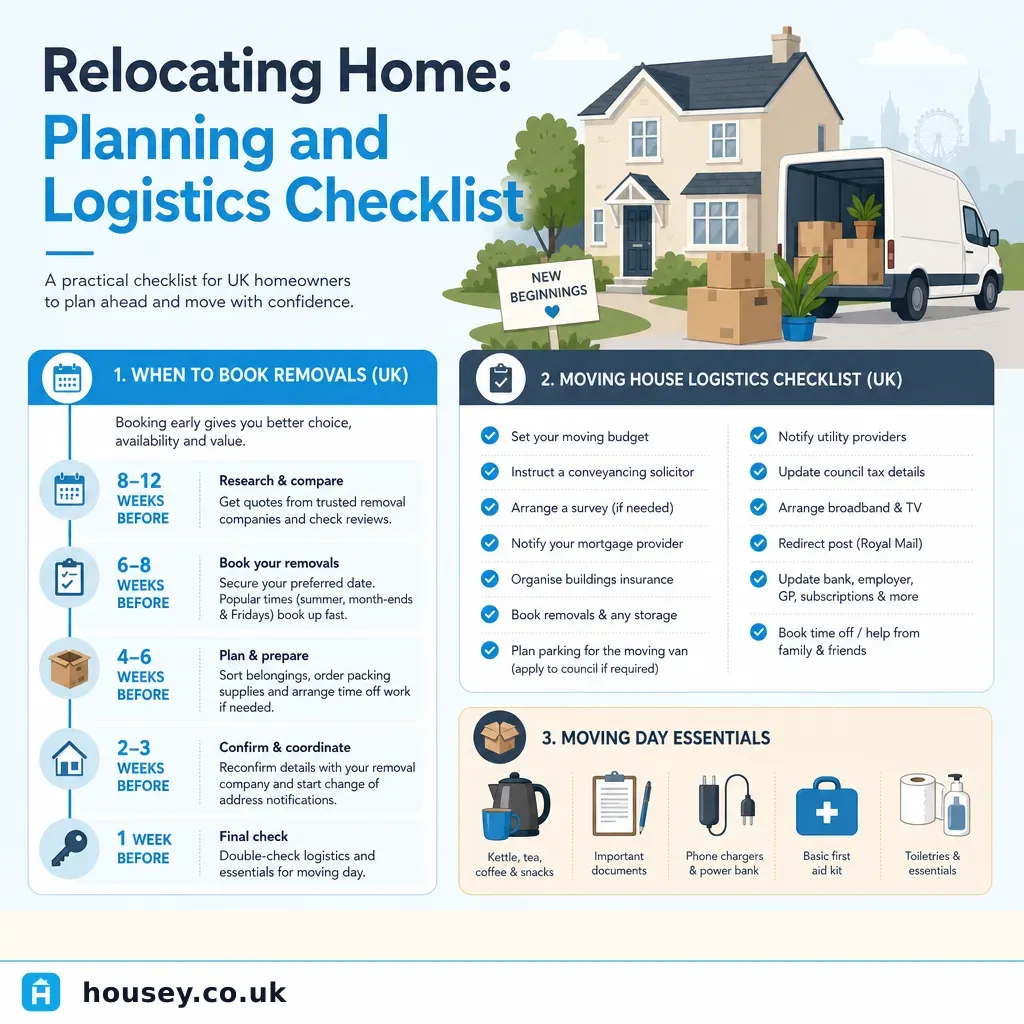 Buying & Moving
Relocating Home: Planning and Logistics Checklist
Successful home relocation in the UK typically requires 8–12 weeks of advance planning.
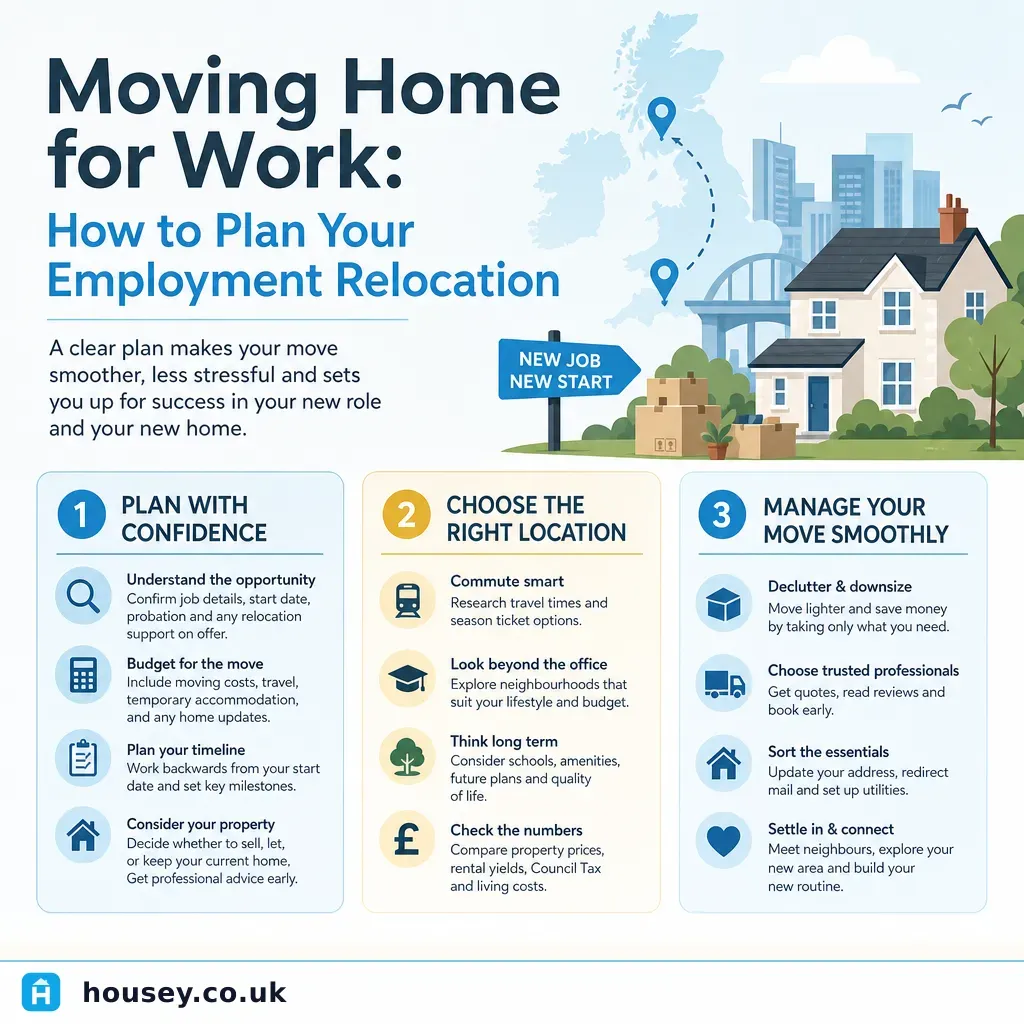 Buying & Moving
Moving Home for Work: How to Plan Your Employment Relocation
Moving home for a new job requires coordinating property timelines, removal logistics, and employer reimbursement simultaneously.
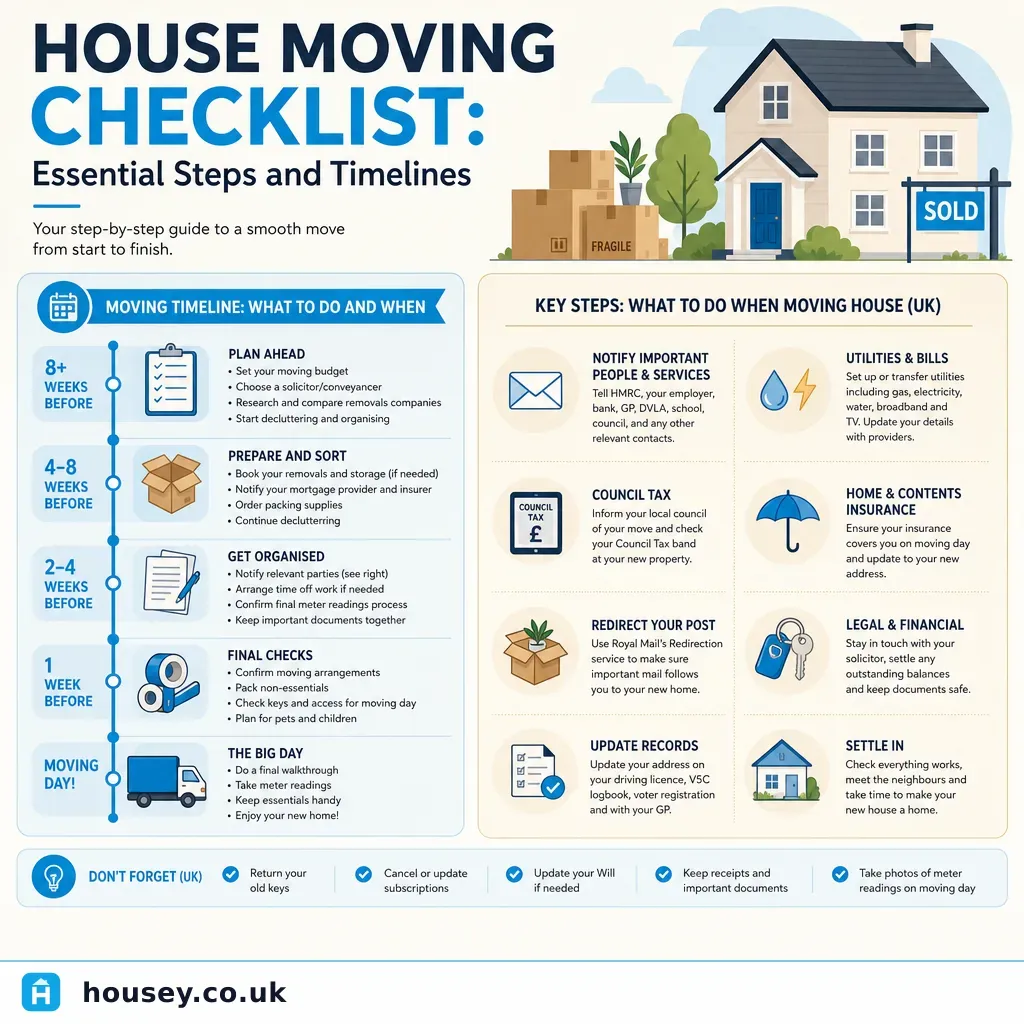 Buying & Moving
House Moving Checklist: Essential Steps and Timelines
A UK house move typically spans 8–12 weeks of preparation: book removals 4–6 weeks out, notify the DVLA, HMRC, and utilities as exchange approaches, take meter readings on moving day, and update Council Tax and the electoral register on arrival.
 Buying & Moving
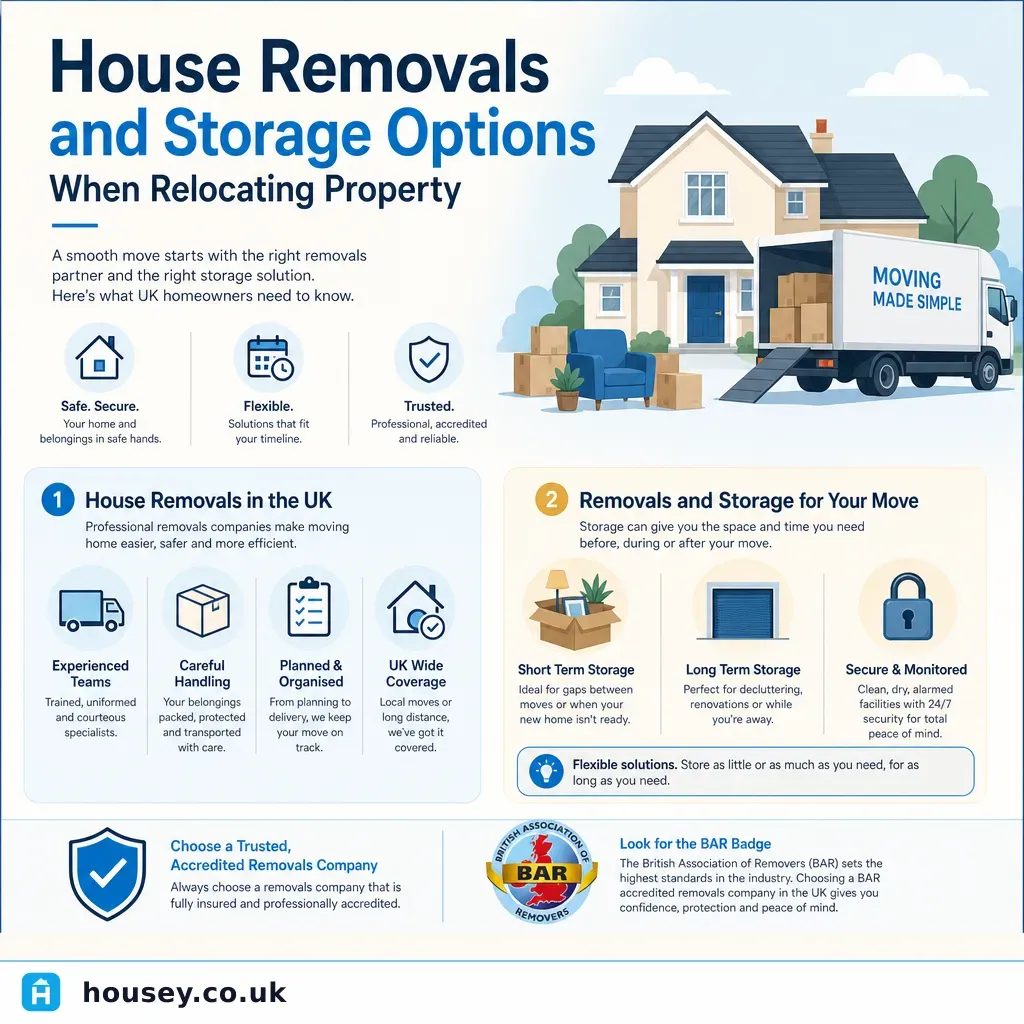
House Removals and Storage Options When Relocating Property
Choosing the right combination of removals service and storage depends on move size, timeline, and budget.
 Buying & Moving
Choosing a House Removal Company: What to Look For
Choose a UK removal company that belongs to the British Association of Removers (BAR) or the Removals Industry Ombudsman Scheme (RIOS), carries goods-in-transit and public liability insurance, and provides a written quote after properly surveying your home.