Right to Buy Scheme: Purchasing Your Council Home Explained
By Housey · Last reviewed 30th of May 2026
Right to Buy Scheme: Purchasing Your Council Home Explained
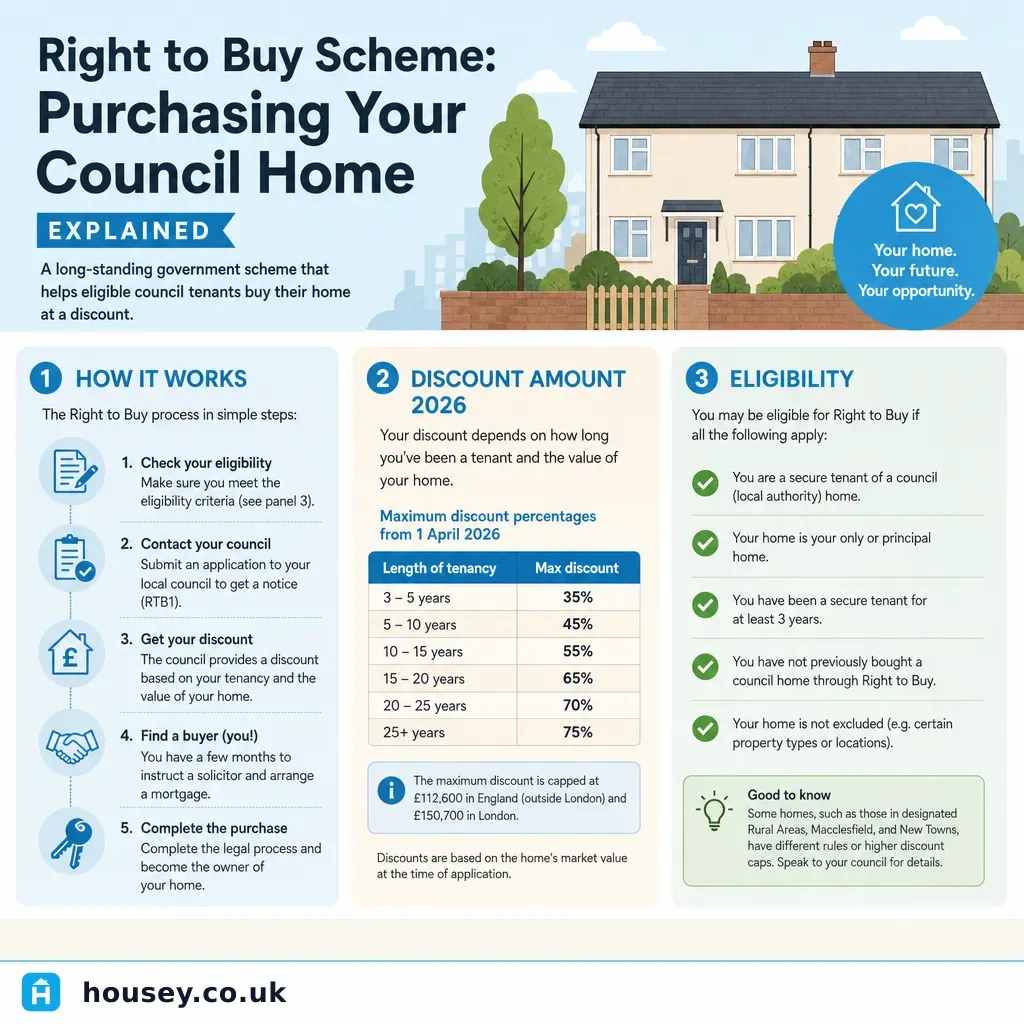
Right to Buy has enabled hundreds of thousands of secure council tenants in England to purchase their homes at a substantial discount since the scheme was introduced under the Housing Act 1980. The scheme remains active for eligible tenants, though eligibility rules, discount levels, and excluded property categories have evolved considerably over the decades — and the decision to buy carries legal and financial commitments that go well beyond the headline discount figure.
Key points
- Right to Buy is available to secure council tenants in England who have held a qualifying public sector tenancy for at least three years, whether consecutive or cumulative across different public sector landlords.
- Maximum discounts are £102,400 outside London and £136,400 in London, as uprated in 2022; these figures are reviewed periodically by government and may change.
- Houses attract a 35% discount from year three of qualifying tenancy, rising by 1% per additional year to a maximum of 70%; flats attract a 50% discount rising by 2% per year to the same 70% ceiling.
- If you sell within five years of completing a Right to Buy purchase, you must repay a proportion of the discount: 100% in year one, reducing by 20 percentage points annually to 20% in year five.
- Right to Buy applies in England only — Scotland abolished the scheme in 2016 and Wales in 2019; housing association tenants may be eligible under Preserved Right to Buy or Right to Acquire instead.
Who is eligible for Right to Buy?
To qualify you must:
- Be a secure tenant of an English local authority (council).
- Have held a public sector tenancy for at least three years — cumulative periods across different public sector landlords count, including councils, housing associations (where applicable), NHS trusts, and the armed forces.
- Occupy the property as your only or principal home.
- Not be subject to a bankruptcy order, debt relief order, or undischarged bankruptcy.
- Not be subject to a court possession order relating to your tenancy.
Joint tenants can apply together or individually. Family members who have lived in the property continuously for the past 12 months may be able to join the application. Right to Buy does not apply in Scotland or Wales, and Northern Ireland operates a separate scheme.
How the discount is calculated
The discount depends on your qualifying tenancy length and the type of property:
Houses: 35% discount after three years of qualifying tenancy, plus 1% for each complete additional year, up to a maximum of 70% — subject to the £102,400 (or £136,400 in London) cash cap.
Flats: 50% discount after three years, plus 2% for each complete additional year, up to a maximum of 70% — subject to the same cash cap.
The discount is applied to the current open-market value of the property, established by an independent valuation commissioned by your landlord. If you disagree with the valuation, you can request a review by the District Valuer within three months of receiving the Section 125 offer notice.
Worked example: council house in Leicestershire
Consider a secure council tenant in Leicestershire who has held a public sector tenancy for 18 years and lives in a three-bedroom terraced house currently valued at £185,000.
- Qualifying tenancy: 18 years → 15 complete years beyond the three-year minimum (for a house).
- Discount percentage: 35% + (15 × 1%) = 50%.
- 50% of £185,000 = £92,500.
- The £102,400 cap is not reached, so the full £92,500 discount applies.
- Purchase price: £185,000 − £92,500 = £92,500.
In London, the same calculation would apply against the higher £136,400 cap. Where market values are substantially higher, the cash cap is more likely to limit the discount in percentage terms.
This is an illustrative example only. Your actual discount depends on your specific tenancy history, the independent valuation of your property, and any deductions for landlord improvements made in the past ten years.
The Right to Buy application process
- Check eligibility — review your tenancy agreement, confirm your qualifying years, and verify the property is not in an excluded category.
- Complete form RTB1 — the Right to Buy application form, available from your landlord or GOV.UK.
- Landlord responds — your landlord must respond within four weeks (eight weeks if you have been with the current landlord for under three years), confirming or denying the Right to Buy.
- Section 125 notice — if approved, your landlord issues a formal offer notice setting out the proposed purchase price, discount, and property description. You have 12 weeks to accept or decline.
- Challenge the valuation if needed — if you believe the valuation is too high, apply for a District Valuer assessment within three months of receiving the Section 125 notice.
- Instruct a solicitor — to handle the conveyancing and legal transfer of title.
- Arrange mortgage finance — lenders treat Right to Buy purchases as standard residential transactions; the discounted price is used as the basis for the loan.
- Legal completion — title transfers and you become the registered owner at HM Land Registry.
Is Right to Buy right for you? A decision framework
- Apply if you have held a qualifying tenancy for at least three years, plan to remain in the property for the medium term, and can comfortably afford mortgage repayments alongside ongoing homeownership costs such as repairs, buildings insurance, and service charges where applicable.
- Consider carefully if the property is a flat — service charges will continue and may increase substantially after purchase, and you will be responsible for your share of communal repairs, which can be significant in older blocks.
- Do not apply if you expect to sell or move within five years — the discount repayment rules mean the financial benefit may be largely or wholly eliminated.
- Seek advice first if you have rent arrears, are receiving housing benefit, or have a complex tenancy history — these factors can affect your eligibility and mortgage options.
- Check with your landlord if the property has been extensively modernised at the landlord's expense in the past ten years — the cost of those improvements may be deducted from your discount.
Right to Buy buyer checklist
Before submitting your RTB1 application:
Important limitations
This article provides general information about the Right to Buy scheme in England as at 2026. Eligibility rules, discount levels, and excluded property categories can and do change. Discount caps have been revised several times and may change again. This guide does not constitute legal or financial advice. Your landlord's assessment of eligibility and their valuation are governed by specific statutory rules, and you have formal rights to challenge both. A solicitor should advise on your individual circumstances before you commit to any purchase under the scheme.
When to get professional help
Right to Buy involves a legally binding financial commitment that is difficult to reverse. Take professional advice before you submit your RTB1 application, not only at the point of legal completion. In particular:
- If you receive a Section 125 notice and disagree with the valuation, the three-month deadline to challenge it through the District Valuer passes quickly — act promptly.
- If the property is a flat, ask a solicitor to explain your service charge and ground rent obligations, and what your liability for communal repairs could be, before you accept the offer.
- If you have any uncertainty about your qualifying tenancy years or whether the property is eligible, take advice from Citizens Advice or a housing solicitor before submitting form RTB1.
What to ask a qualified professional
Solicitor:
- Are there any covenants, planning conditions, or restrictions on the title that would affect how I can use or sell the property?
- Is the property registered at HM Land Registry, and are there any entries I should understand before committing to purchase?
- What are my precise obligations under the service charge or ground rent provisions if this is a flat?
- What would I owe in discount repayment if I sold in each of the first five years?
Surveyor:
- What is your independent assessment of the open-market value of this property?
- Are there any structural defects, signs of damp, or maintenance issues I should factor into my decision?
- Are there any features of this property — construction type, roofing system, heating — that might affect its mortgageability on standard terms?
Mortgage broker:
- Which lenders are likely to accept this property given its construction type, tenure, and condition?
- How does the Right to Buy discount affect the loan-to-value calculation, and are there any lender restrictions I should know about?
- What would the monthly repayments be at current rates, and how do they compare with my current rent?
How Housey can help
Housey connects Right to Buy applicants with regulated professionals who understand the process. Compare quotes from independent valuation surveyors who can provide an objective assessment of your property's market value — particularly useful if you are considering challenging the landlord's figure — or find an experienced conveyancing solicitor to handle the legal transfer and explain your obligations as a new owner.
Frequently asked questions
Who is eligible for Right to Buy?
You must be a secure council tenant in England with at least three years of qualifying public sector tenancy, occupying the property as your only or principal home. You must not be subject to a bankruptcy order, debt relief order, or an active possession order relating to your tenancy. Joint tenants can apply together or separately, and qualifying family members who have lived in the property for at least 12 months may join the application.
How much discount can I get under Right to Buy?
The maximum discount is £102,400 outside London or £136,400 in London, reviewed periodically by government. For houses, the discount starts at 35% after three qualifying years, rising by 1% per additional year to a maximum of 70%. For flats, the starting discount is 50%, rising by 2% per year to 70%. The lower of the applicable percentage or the cash cap will apply.
What happens if I sell my Right to Buy home within five years?
You must repay a proportion of the discount: 100% if sold in year one, 80% in year two, 60% in year three, 40% in year four, and 20% in year five. No repayment is required from year six onwards. The repayment is calculated by applying the discount percentage to the resale price — so if the property has risen in value, the repayment amount in cash terms may exceed the original discount figure.
Can housing association tenants use Right to Buy?
Not usually under the standard Right to Buy scheme. Housing association tenants may be eligible for Preserved Right to Buy — if their tenancy transferred from a council while they were an existing secure tenant — or the Right to Acquire scheme, which offers a smaller fixed discount. Eligibility depends on when the transfer took place and the type of housing association. Check directly with your landlord which scheme, if any, applies to you.
Do I need a solicitor for a Right to Buy purchase?
Yes. The transfer of title from a local authority to a private individual involves standard conveyancing: title registration, searches, mortgage arrangements, and a legal contract. You should instruct an independent solicitor who acts solely in your interests. Your landlord may suggest solicitors, but you are not obliged to use them and should confirm any solicitor you instruct is genuinely independent.
Sources and further reading
- Right to Buy: buying your council home — GOV.UK
- Right to Buy application form RTB1 — GOV.UK
- District Valuer Services — GOV.UK
- Leasehold service charges and other charges — GOV.UK
- Citizens Advice: Right to Buy — Citizens Advice
Useful next reads
 Buying & Moving
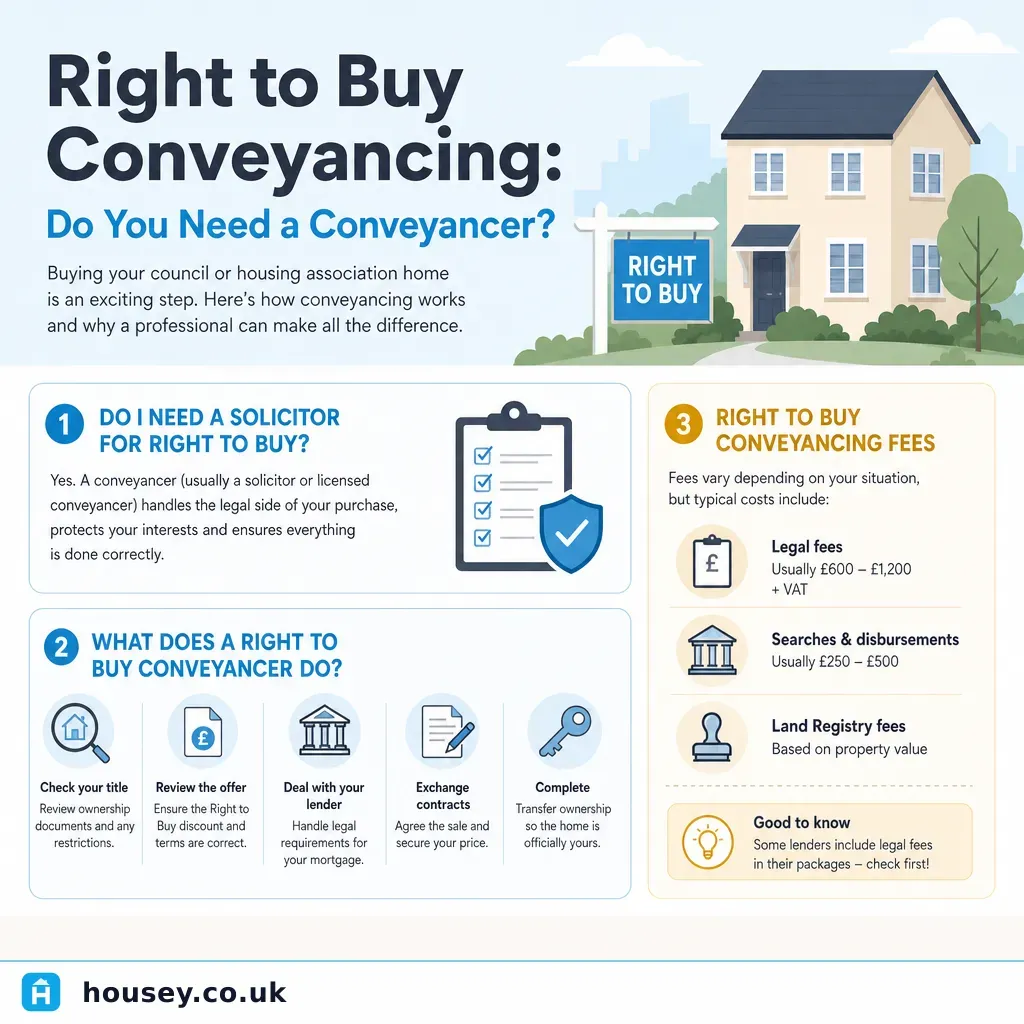
Right to Buy Conveyancing: Do You Need a Conveyancer?
You are not legally required to instruct a conveyancer for a Right to Buy purchase, but it is strongly advisable.
 Buying & Moving
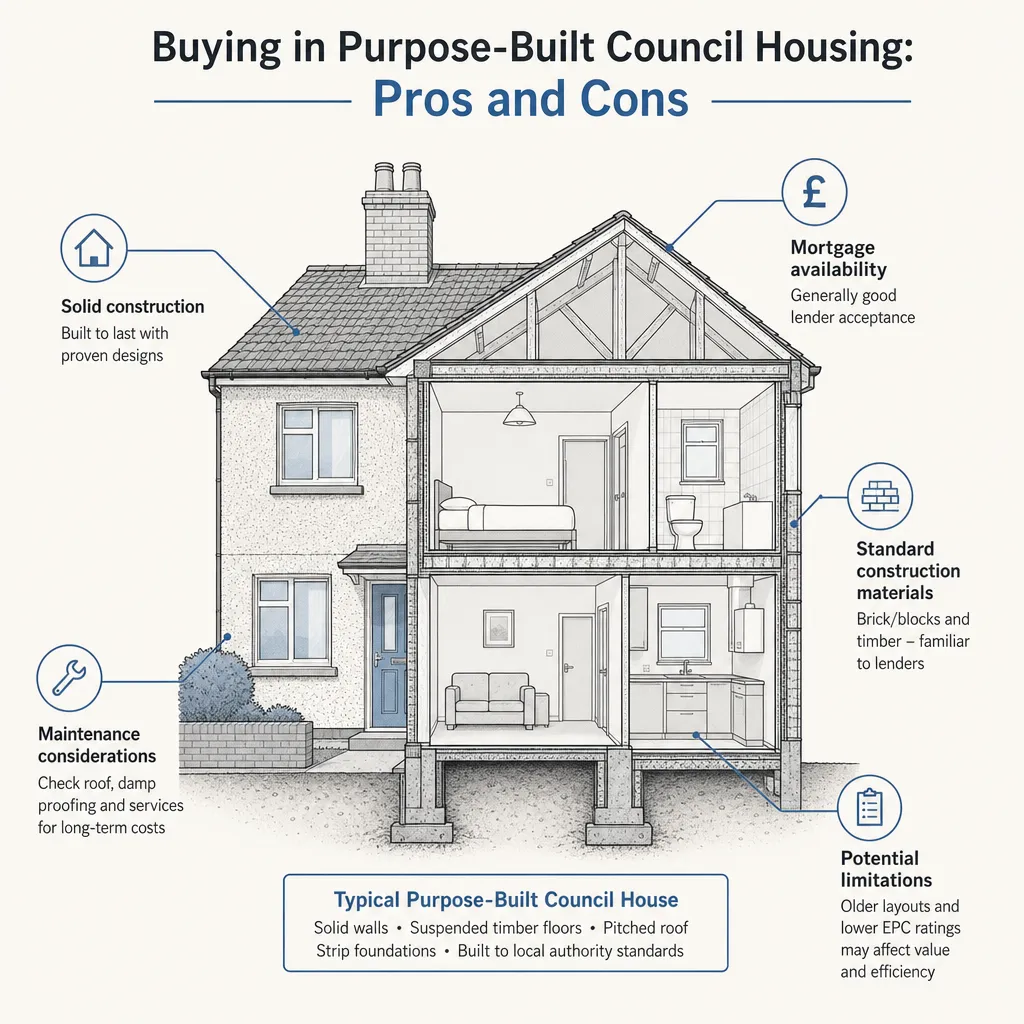
Buying in Purpose-Built Council Housing: Pros and Cons
Purpose-built council housing — typically 1950s–1980s blocks, maisonettes, or estate houses — can offer good value and generous room sizes, but buyers should check construction type before applying for a mortgage.
 Buying & Moving
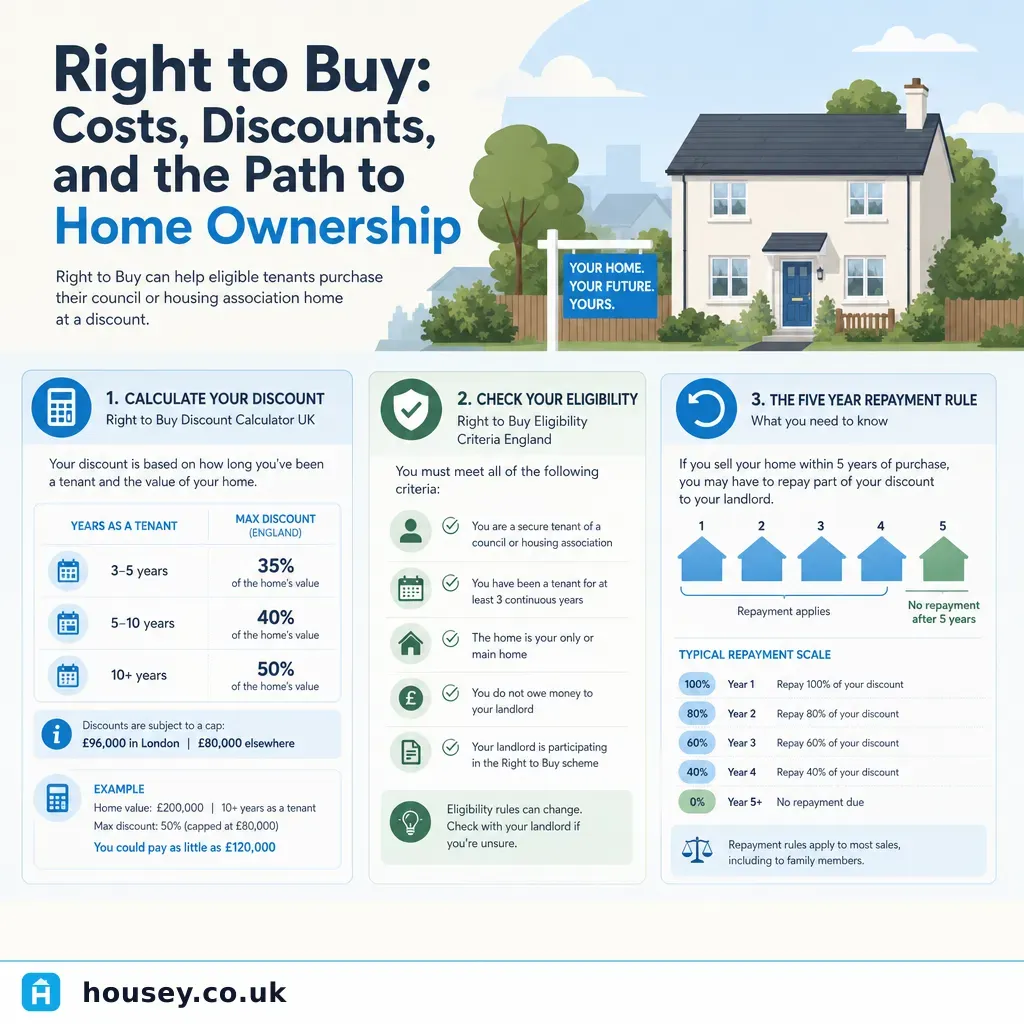
Right to Buy: Costs, Discounts, and the Path to Home Ownership
Right to Buy lets eligible council tenants in England buy their home at a government-funded discount — between 35% and 70% of its value, depending on tenancy length and property type.
 Buying & Moving
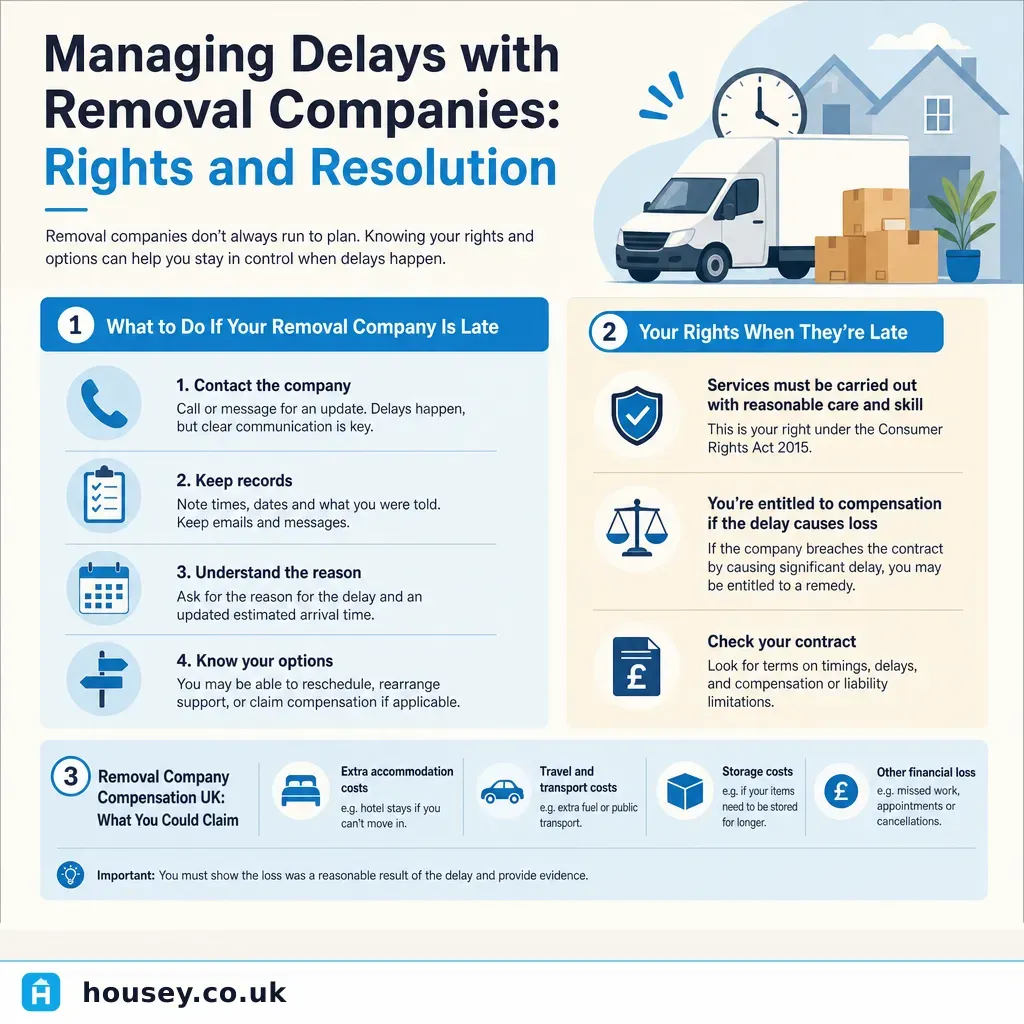
Managing Delays with Removal Companies: Rights and Resolution
If a removal company is late, your rights depend on your contract and whether the company is BAR-registered.
 Buying & Moving
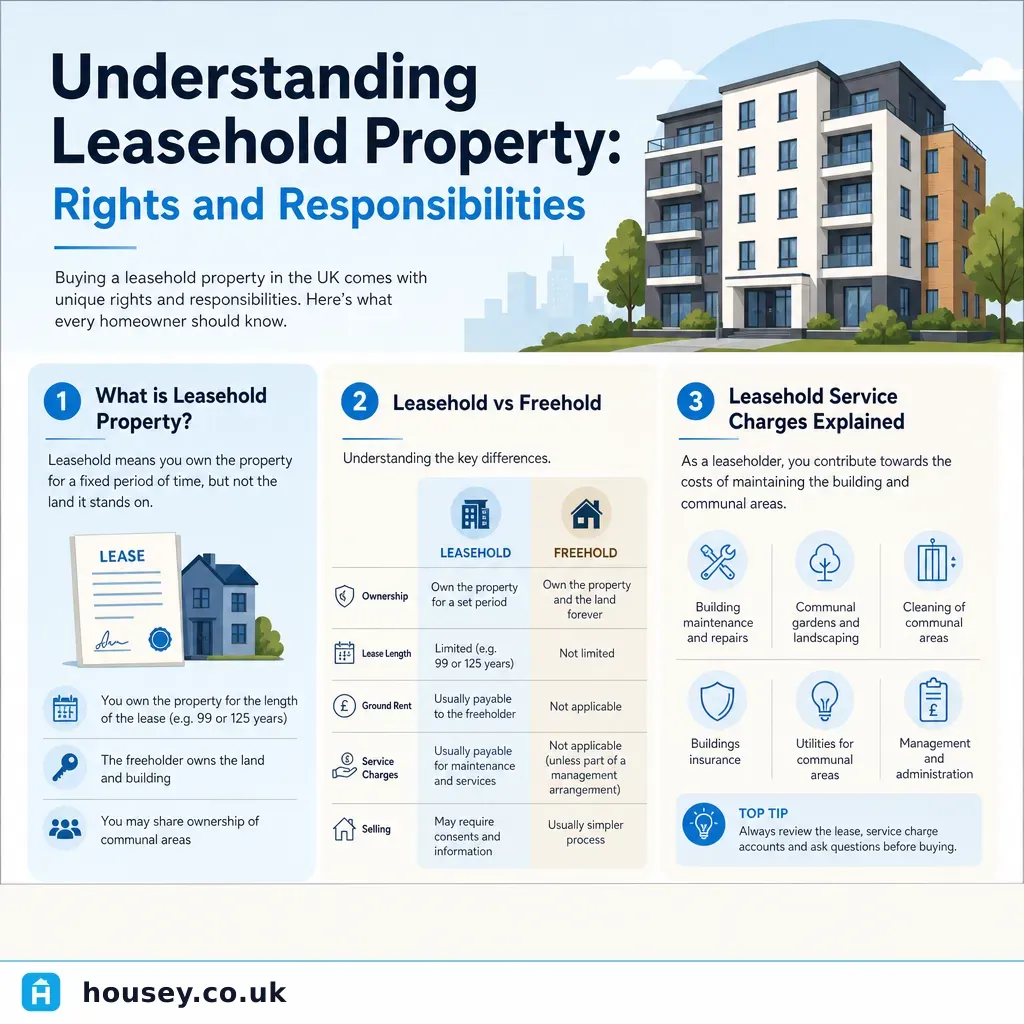
Understanding Leasehold Property: Rights and Responsibilities
Leasehold means you own a time-limited interest in a property while the freeholder owns the land and building.