Right to Buy Conveyancing: Do You Need a Conveyancer?
By Housey · Last reviewed 25th of May 2026
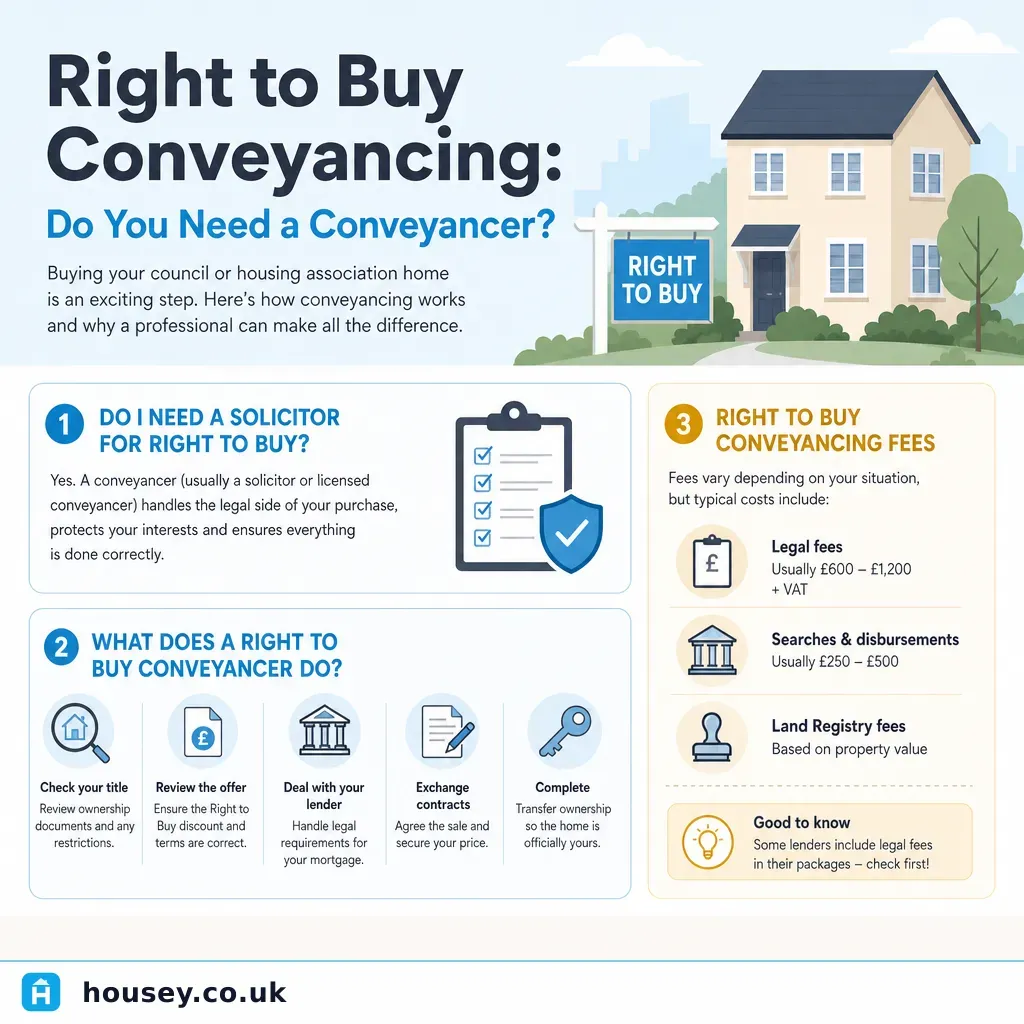
Right to Buy Conveyancing: Do You Need a Conveyancer?
The Right to Buy scheme allows eligible council and housing association tenants in England to purchase their home at a substantial discount, but the legal process of transferring ownership is more involved than many buyers anticipate. Whether you are funding the purchase outright or with a mortgage, understanding what conveyancing involves — and who is legally representing whom — before you accept an offer notice can help you avoid delays, protect your rights, and ensure you are clear on your ongoing obligations after completion.
Key points
- Right to Buy in England is governed by the Housing Act 1985 (as amended); the council instructs its own solicitors to act for the landlord — not for you.
- If you are obtaining a mortgage, your lender will require you to instruct a solicitor or licensed conveyancer from its approved panel as a condition of the mortgage offer.
- Discount repayment clawback applies if you sell within five years of completion: up to 100% in year one, reducing to 20% in year five.
- Flats and maisonettes purchased under Right to Buy are sold on a leasehold basis (typically 125 years); the lease terms require careful review before exchange.
- Stamp Duty Land Tax (SDLT) is calculated on the discounted price you pay — not the full market value — but may still be payable depending on the amount.
Is a conveyancer legally required for a Right to Buy purchase?
There is no statutory requirement to instruct a solicitor or licensed conveyancer when buying under Right to Buy. In practice, however, self-conveyancing in a Right to Buy transaction carries considerable risk.
The council's own solicitors prepare the transfer documentation and act exclusively in the landlord's interests — they have no duty of care to you. If you are obtaining a mortgage, as most Right to Buy buyers do, your lender will require you to instruct a conveyancer from its approved panel; failure to comply will invalidate your mortgage offer. Even for cash buyers, the documentation involved — transfer deeds, SDLT returns, HM Land Registry registration, and (for flats) a full lease review — is substantial enough that professional legal advice is strongly advisable in every case.
What a Right to Buy conveyancer does
A solicitor or licensed conveyancer acting for you will typically:
- Review the formal Right to Buy offer notice (form RTB2 or RTB3) and confirm the discount calculation is correct.
- Check the title at HM Land Registry and identify any restrictive covenants, rights of way, or charges affecting the property.
- For flats and maisonettes: review the full lease, including service charge provisions, ground rent terms, and any major works liability.
- Raise enquiries with the council regarding outstanding repairs, building safety compliance, and any known disputes.
- Prepare and submit the SDLT return to HMRC.
- Register the transfer of title — and any new mortgage charge — at HM Land Registry.
- Advise on the five-year discount repayment clawback and ensure the charge is registered correctly at Land Registry.
Discount clawback and the right of first refusal
One of the most important aspects of Right to Buy conveyancing is the discount repayment obligation. If you sell your Right to Buy home within five years of completion, you must repay a portion of the discount to the council. The repayment reduces proportionally each year — 100% in year one, declining to 20% in year five — and a clawback charge is registered at Land Registry. This charge must be formally discharged on any subsequent sale or remortgage within the five-year window.
Additionally, during the same five-year period, the council has a statutory right of first refusal: you must offer the property back to the council (or a nominated social landlord) at current market value before selling on the open market. Failing to comply can have serious legal and financial consequences. Your conveyancer must explain both obligations clearly before you sign any documentation.
Decision tree: do you need a conveyancer?
- Are you obtaining a mortgage? Yes: instructing a conveyancer on your lender's approved panel is a condition of your mortgage offer — you have no practical choice.
- Are you purchasing a flat or maisonette? Yes: leasehold conveyancing involves a full lease review and additional enquiries; professional advice is strongly advisable.
- Are you unsure whether the discount calculation in your offer notice is correct? Yes: instruct a conveyancer to check the council's figures independently.
- Are you a cash buyer purchasing a freehold house? Self-conveyancing is technically possible but carries significant risk; independent legal advice is still strongly recommended.
What to check in a conveyancing quote
When comparing quotes for Right to Buy conveyancing, ask each firm to confirm:
- Whether their fee covers a leasehold transaction (if applicable) or freehold only — there is usually a supplement for flats.
- Whether they are on your mortgage lender's approved conveyancing panel.
- Which disbursements are included: Land Registry fees, SDLT return, search fees, and bank transfer charges.
- Whether there is an additional charge for registering the discount repayment charge or handling council-specific documentation.
- Their estimated timeline from instruction to completion.
- Whether VAT is included in the quoted fee.
Important limitations
This article provides general information about Right to Buy conveyancing in England. The scheme operates differently in Scotland (where it ended in 2016) and Wales (where new applications were closed in 2019). Discount caps, qualifying criteria, and clawback terms are subject to change; always check current GOV.UK guidance on Right to Buy for figures that apply to your application. Nothing in this article constitutes legal advice — you should not rely on it as a substitute for professional advice tailored to your specific property and circumstances.
When this becomes urgent
Seek professional legal advice without delay if:
- You have received an RTB2 offer notice and are unsure whether the discount or purchase price is calculated correctly.
- Your council has failed to respond within statutory timescales and you may have a right to claim a reduction in the purchase price.
- You are considering selling, remortgaging, or subletting within five years of your Right to Buy completion.
- Your flat's lease contains unusual service charge escalation, major works, or building safety provisions you do not fully understand.
What to ask a qualified professional
Before instructing a solicitor or licensed conveyancer for a Right to Buy purchase, ask:
- Are you on my mortgage lender's approved conveyancing panel?
- What is your full fee, including all disbursements and VAT?
- Can you review the RTB2 offer notice and confirm the discount and purchase price are correctly calculated?
- How will you register the discount repayment charge, and what do I need to do if I want to sell or remortgage within five years?
- For flats: what does the lease review involve, and are there any terms I should be aware of before I commit?
- What is your estimated timeline from instruction to completion?
How Housey can help
Housey connects buyers with qualified conveyancers experienced in Right to Buy transactions. Compare quotes from regulated professionals and get clear, upfront fee breakdowns through our conveyancing service.
Frequently asked questions
Can I use the same solicitor as the council for a Right to Buy purchase?
No. The council's solicitors act solely for the council as seller. Instructing the same firm would create a conflict of interest, and solicitors are professionally prohibited from acting for both parties in a residential property transaction in these circumstances. You should instruct your own independent solicitor or licensed conveyancer.
How long does Right to Buy conveyancing take?
The Right to Buy process from application to completion commonly takes four to twelve months. Once you have accepted an offer notice, conveyancing typically takes eight to twelve weeks, depending on title complexity, mortgage requirements, any lease review for flats, and the responsiveness of the council's solicitors.
Do I pay Stamp Duty Land Tax on a Right to Buy purchase?
SDLT is calculated on the discounted price you actually pay, not the full market value. Many Right to Buy purchases fall below the current SDLT threshold, but this depends on your discounted purchase price and personal circumstances. Your conveyancer will prepare and submit the SDLT return as part of the transaction.
What happens if my council delays the Right to Buy sale unreasonably?
The Housing Act 1985 sets statutory timescales for each stage of the Right to Buy process. If the council causes unreasonable delay, you may be entitled to serve a delay notice and ultimately claim a reduction in the purchase price. Seek advice from a solicitor experienced in Right to Buy if the council is not progressing the sale within the required timescales.
Sources and further reading
- Right to Buy: buying your council home — GOV.UK
- Housing Act 1985 — legislation.gov.uk
- Stamp Duty Land Tax — GOV.UK
- Search for land and property information — HM Land Registry
Useful next reads
 Buying & Moving
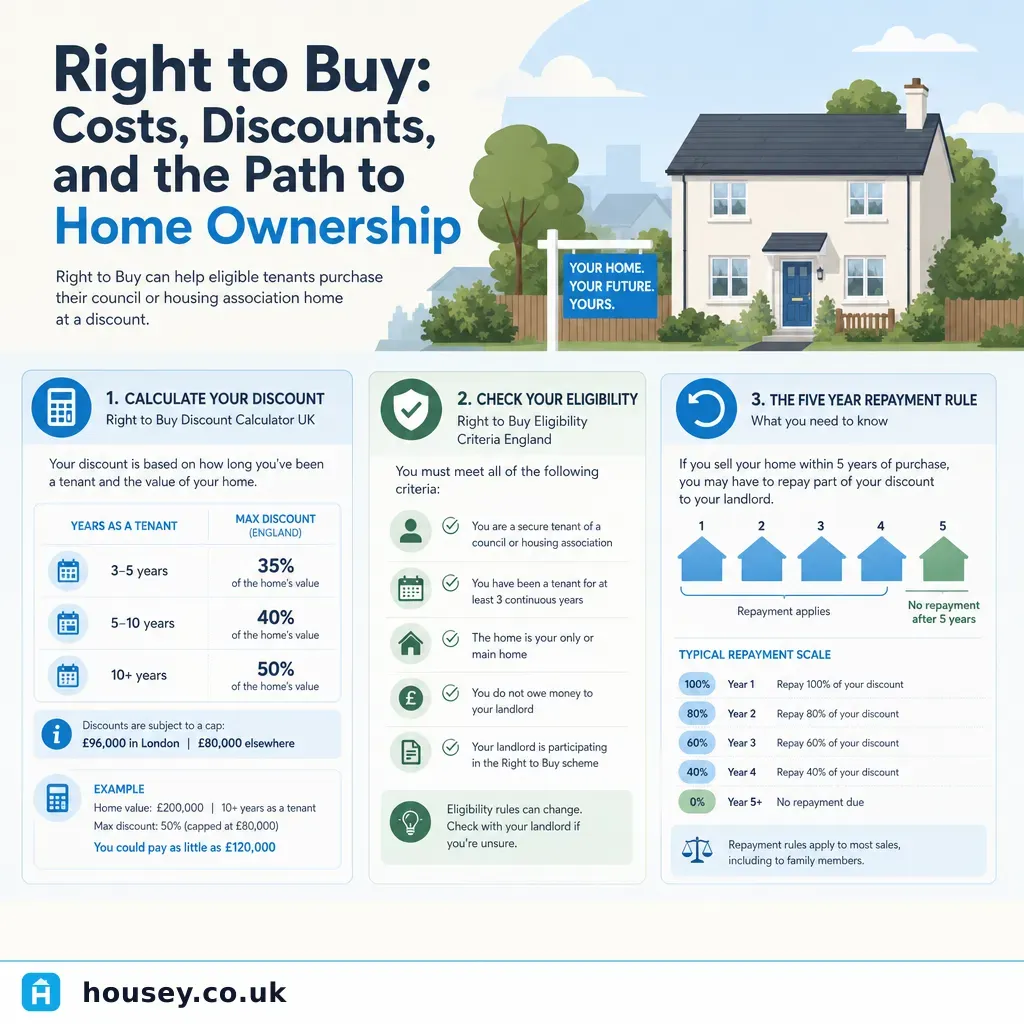
Right to Buy: Costs, Discounts, and the Path to Home Ownership
Right to Buy lets eligible council tenants in England buy their home at a government-funded discount — between 35% and 70% of its value, depending on tenancy length and property type.
 Buying & Moving
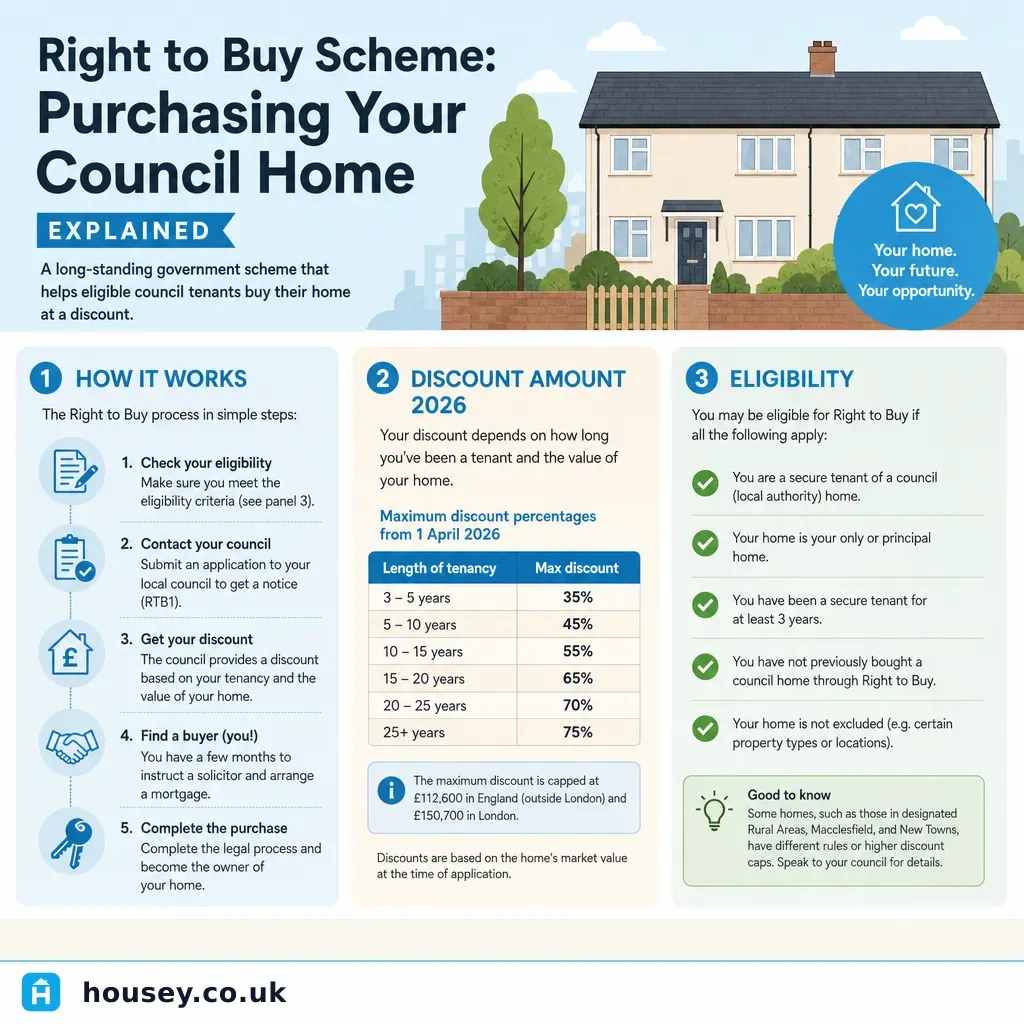
Right to Buy Scheme: Purchasing Your Council Home Explained
Right to Buy allows eligible secure council tenants in England to purchase their home at a discount of up to £102,400 outside London, or £136,400 in London, depending on qualifying tenancy length and property type.
 Buying & Moving
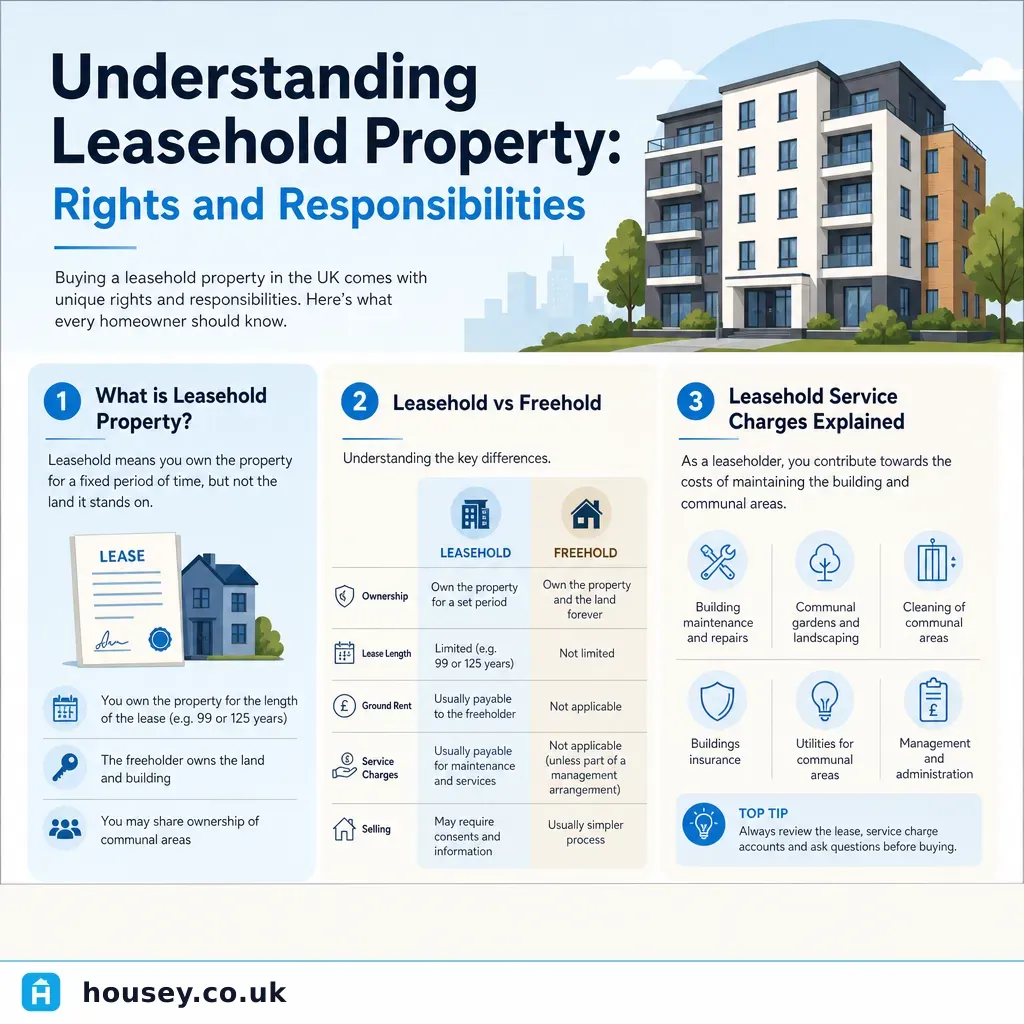
Understanding Leasehold Property: Rights and Responsibilities
Leasehold means you own a time-limited interest in a property while the freeholder owns the land and building.
 Buying & Moving
Navigating Simultaneous Purchase and Sale of Property
When buying and selling simultaneously in England and Wales, both sets of contracts are exchanged on the same day — this is called simultaneous exchange.
 Buying & Moving
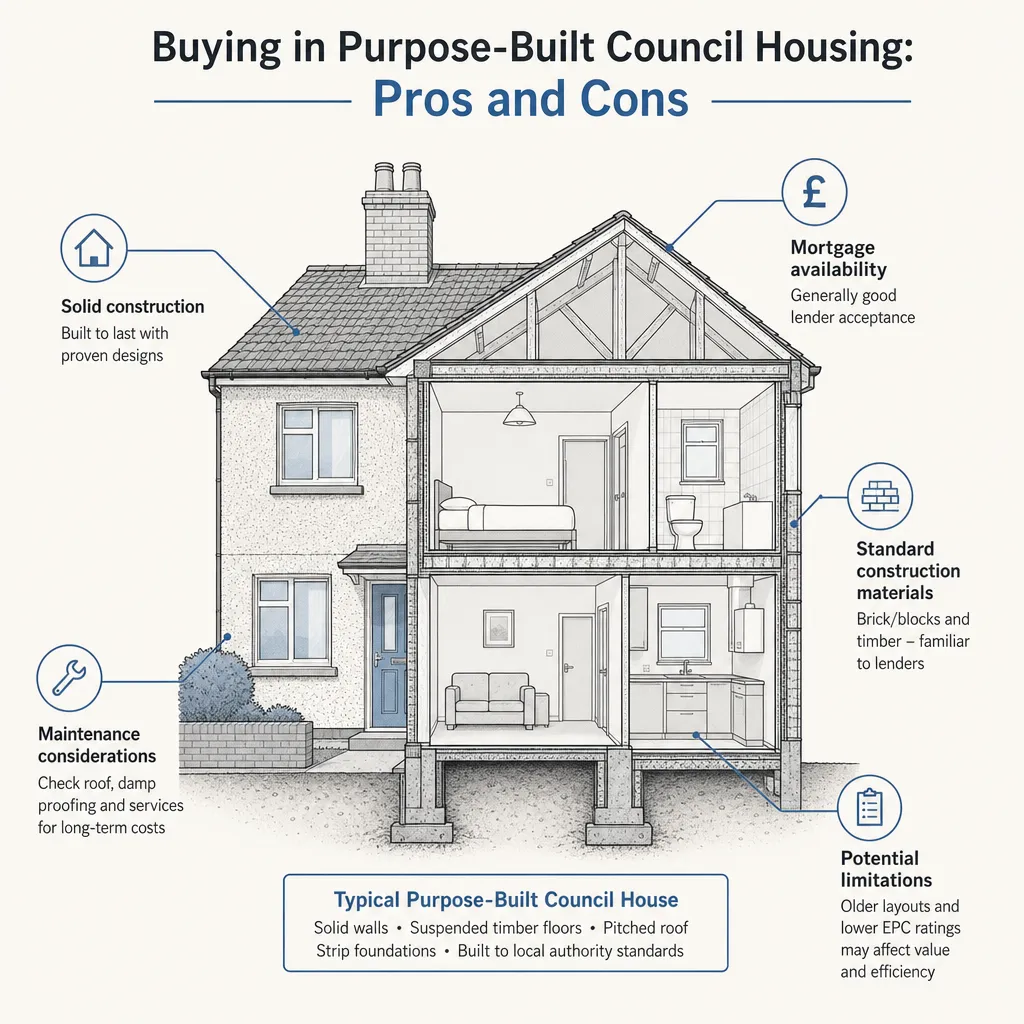
Buying in Purpose-Built Council Housing: Pros and Cons
Purpose-built council housing — typically 1950s–1980s blocks, maisonettes, or estate houses — can offer good value and generous room sizes, but buyers should check construction type before applying for a mortgage.