Right to Buy: Costs, Discounts, and the Path to Home Ownership
By Housey · Last reviewed 24th of May 2026
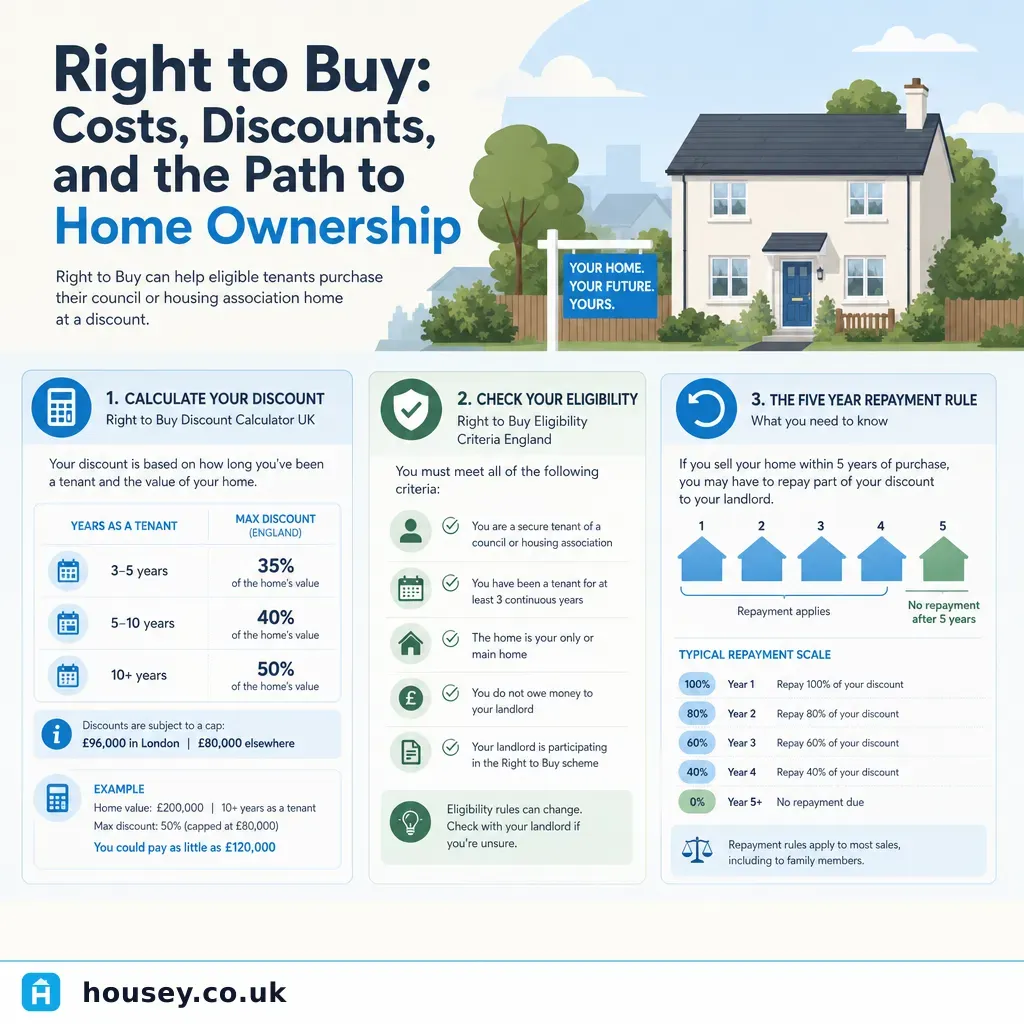
Right to Buy: Costs, Discounts, and the Path to Home Ownership
The Right to Buy scheme has helped hundreds of thousands of council tenants in England become homeowners since its introduction in 1980, yet the full picture — discounts, costs, legal obligations, and risks — is rarely understood until the process is already underway. Whether you have held your tenancy for a few years or several decades, the financial and legal steps between application and completion are more involved than the headline discount figure suggests, and the obligations that follow purchase can last for years.
Key points
- Right to Buy is available to secure council tenants in England who have held a qualifying public sector tenancy for at least three years — not necessarily consecutive or with the same landlord.
- Discounts start at 35% for houses and 50% for flats after three years, rising annually to a maximum of 70%, subject to a cash cap of £96,010 outside London and £127,940 in London (GOV.UK, April 2023).
- Wales abolished Right to Buy in January 2019; Scotland abolished it in 2016. Northern Ireland operates its own House Sales Scheme.
- If you sell within five years of purchase, you must repay a sliding proportion of the discount — 100% in year one, falling to 20% in year five, calculated on the market value at the time of sale.
- On top of the discounted purchase price, budget for solicitor fees, a mortgage arrangement fee, an independent RICS survey or valuation, and buildings insurance — which becomes the owner's responsibility from completion.
Who qualifies for Right to Buy?
To be eligible in England, you must:
- Be a secure council tenant — most council tenants are, but check your tenancy agreement if you are unsure of your tenancy type.
- Have held a public sector tenancy for at least three years — this can span multiple tenancies with different public sector landlords, provided each qualifying period is counted.
- Use the property as your only or main home.
- Not be subject to a possession order or certain bankruptcy proceedings.
You can apply jointly with family members who share the tenancy, or with family members who have lived with you for at least the past 12 months, even if they are not named on the tenancy agreement.
Which properties are excluded?
Some properties fall outside the scheme:
- Housing association properties (these fall under the separate Right to Acquire scheme, where eligible)
- Sheltered housing or homes designated for elderly or disabled residents
- Properties scheduled for demolition
- Some rural properties where the local authority holds a rural exemption
How the discount is calculated
The discount depends on how long you have held a qualifying public sector tenancy and whether your home is a house or a flat.
Property type | Discount after 3 years | Annual increase | Maximum discount rate |
|---|---|---|---|
House | 35% | +1% per additional year | 70% or cash cap |
Flat | 50% | +2% per additional year | 70% or cash cap |
The cash cap limits the monetary value of the discount regardless of the percentage. Outside London the cap is £96,010; in London it is £127,940 (GOV.UK, April 2023). The discount cannot exceed the property's full market value.
Worked UK property scenario — a 1980s council house in the Midlands: A tenant with 15 years of qualifying public sector tenancy applies to buy their three-bedroom semi-detached house, valued at £180,000. The discount rate is 35% plus 12 additional years at 1% = 47%. The discount is £84,600, giving a purchase price of £95,400. The cash cap (£96,010) is not breached, so the full percentage discount applies. The buyer would need a mortgage of approximately £95,400, plus legal fees, a survey, and any SDLT liability.
What Right to Buy actually costs
The discounted purchase price is not the only expenditure. Most buyers need a mortgage, and professional fees add meaningfully to the overall cost.
Indicative UK costs, last reviewed 2026-05-24. Costs vary; obtain your own quotes from qualified professionals.
Cost item | Typical range | Notes |
|---|---|---|
Conveyancing / solicitor fees | £1,000–£2,000+ | Seek at least two quotes from solicitors experienced in Right to Buy |
Mortgage arrangement fee | £0–£2,000 | Depends on lender and product |
Independent RICS Level 2 or Level 3 survey | £400–£800+ | The landlord's valuation is not a condition survey; a RICS survey reveals the property's condition |
Stamp Duty Land Tax (SDLT) | Often £0 on discounted prices | First-time buyer relief may apply; use the GOV.UK SDLT calculator |
Buildings insurance | Annual premium | Owner's responsibility from completion — budget for this ongoing cost |
Service charges (leasehold flats) | Varies significantly | Review the past three years of accounts before exchanging contracts |
You are entitled to an independent RICS valuation if you dispute the landlord's figure — you must request this within three months of receiving the Section 125 offer notice.
The Right to Buy legal process
- Submit form RTB1 — the official application form, available on GOV.UK; this formally starts your application.
- Receive the Section 125 notice — the landlord must respond within four weeks (eight weeks for leaseholds), stating the purchase price, discount, and any service charge estimates.
- Dispute the valuation if needed — you have three months from the Section 125 notice to request an independent RICS valuation if you believe the price is set too high.
- Instruct a solicitor — choose a conveyancer with specific Right to Buy experience.
- Arrange a mortgage — not all lenders offer Right to Buy products; a whole-of-market mortgage broker can identify suitable options.
- Exchange and complete — the landlord must not delay unreasonably; formal procedures exist to challenge stalling.
Homeowner checklist before you commit
The five-year repayment rule
If you sell the property within five years of completion, you must repay a proportion of the discount. The repayment is calculated on the market value at the time of sale, not the original purchase price — so if the property has risen in value, you repay more in monetary terms than you originally received.
Year of sale after completion | Proportion of discount to repay |
|---|---|
Year 1 | 100% |
Year 2 | 80% |
Year 3 | 60% |
Year 4 | 40% |
Year 5 | 20% |
Transfers between spouses or civil partners and certain other exempt transactions may not trigger repayment — your solicitor can advise on your specific circumstances.
Important limitations
This article provides general information about the Right to Buy scheme in England and is not legal, financial, or mortgage advice. Eligibility rules, discount caps, and legal requirements change over time and vary by property type, landlord, and tenancy history. Your specific situation must be assessed by a qualified solicitor and, where relevant, a regulated mortgage adviser before you make any application or financial commitment.
When this becomes urgent
Seek professional advice promptly if:
- The landlord has indicated plans to demolish or redevelop your home — this can affect your eligibility window and must be investigated before plans are finalised.
- You have received a Section 125 notice and are approaching the three-month deadline to dispute the valuation — arranging an independent RICS valuation takes time.
- The landlord appears to be causing unreasonable delays — the RTB6 and RTB8 delay notice procedures have specific timeframes that must not be missed, as they affect the discount repayment calculation.
What to ask a qualified professional
Before instructing a solicitor or progressing your application, consider asking:
- Does my full tenancy history — including time with previous public sector landlords — count towards the three-year qualifying period?
- Is this property excluded from Right to Buy for any reason I may not be aware of?
- What is the landlord's basis for the valuation, and is an independent RICS valuation advisable in my case?
- What are the service charge liabilities if I am buying a leasehold flat, and have there been any large past or upcoming works?
- Which mortgage lenders are most appropriate for Right to Buy transactions in my circumstances?
- What are my obligations if I wish to let the property or sell it within five years of purchase?
When to get professional help
Right to Buy involves interlocking legal and financial decisions. Always instruct a qualified solicitor — this is not a transaction to manage without legal representation. Additionally, take professional advice if:
- You are unsure whether your tenancy history qualifies or how to count your years of tenure
- The landlord's valuation appears significantly above local market evidence
- The property is a leasehold flat with complex or unusually high service charges
- You intend to raise capital against the property or let it shortly after purchase
- Any dispute arises with the landlord about the timeline, valuation, or eligibility
How Housey can help
Housey connects you with conveyancers experienced in Right to Buy transactions and with RICS surveyors who can provide an independent assessment before you accept the landlord's offer. Use our Right to Buy conveyancing service to compare solicitor quotes, or find a qualified RICS valuation surveyor to review the Section 125 offer before you commit.
Frequently asked questions
Can I buy my housing association home through Right to Buy?
Housing association tenants are not usually eligible for Right to Buy. You may qualify for the separate Right to Acquire scheme if your home was built or transferred after 1997. Discounts are smaller — typically £9,000 to £16,000 depending on your region. Check GOV.UK for current eligibility requirements and participating properties.
Can I use Right to Buy if I have rent arrears?
Rent arrears do not automatically disqualify you from applying, but the landlord may decline your application or require repayment before completing the sale. Arrears also affect your mortgage eligibility. Clear any arrears before or during the application process and discuss your position with your solicitor at the earliest opportunity.
What happens if the council delays my Right to Buy application?
There are formal procedures to challenge delays. If the landlord misses the deadline for sending a Section 125 notice, you can serve an Initial Notice of Delay (RTB6) and, if the delay continues, an Operative Notice of Delay (RTB8) — allowing you to deduct the delay period from any repayable discount. GOV.UK guidance sets out the full process.
Do I pay Stamp Duty Land Tax on a Right to Buy purchase?
SDLT is calculated on the discounted purchase price, not the market value. At lower purchase prices, many buyers owe little or no SDLT — particularly first-time buyers who benefit from relief on the first £425,000. Use the GOV.UK SDLT calculator for your specific figures, as thresholds and reliefs can change.
Can I rent out my Right to Buy property after purchase?
Subletting is generally permitted once you have lived in the property as your main home, but you should check your mortgage terms and inform your lender. If you sublet within five years of purchase it may affect your discount repayment obligations. Always seek legal advice before renting out a former council home.
Sources and further reading
- Right to Buy: buying your council home — GOV.UK
- Right to Acquire: buying your housing association home — GOV.UK
- Stamp Duty Land Tax calculator — HM Revenue & Customs
- RICS Home Survey Standards — Royal Institution of Chartered Surveyors
Useful next reads
 Buying & Moving
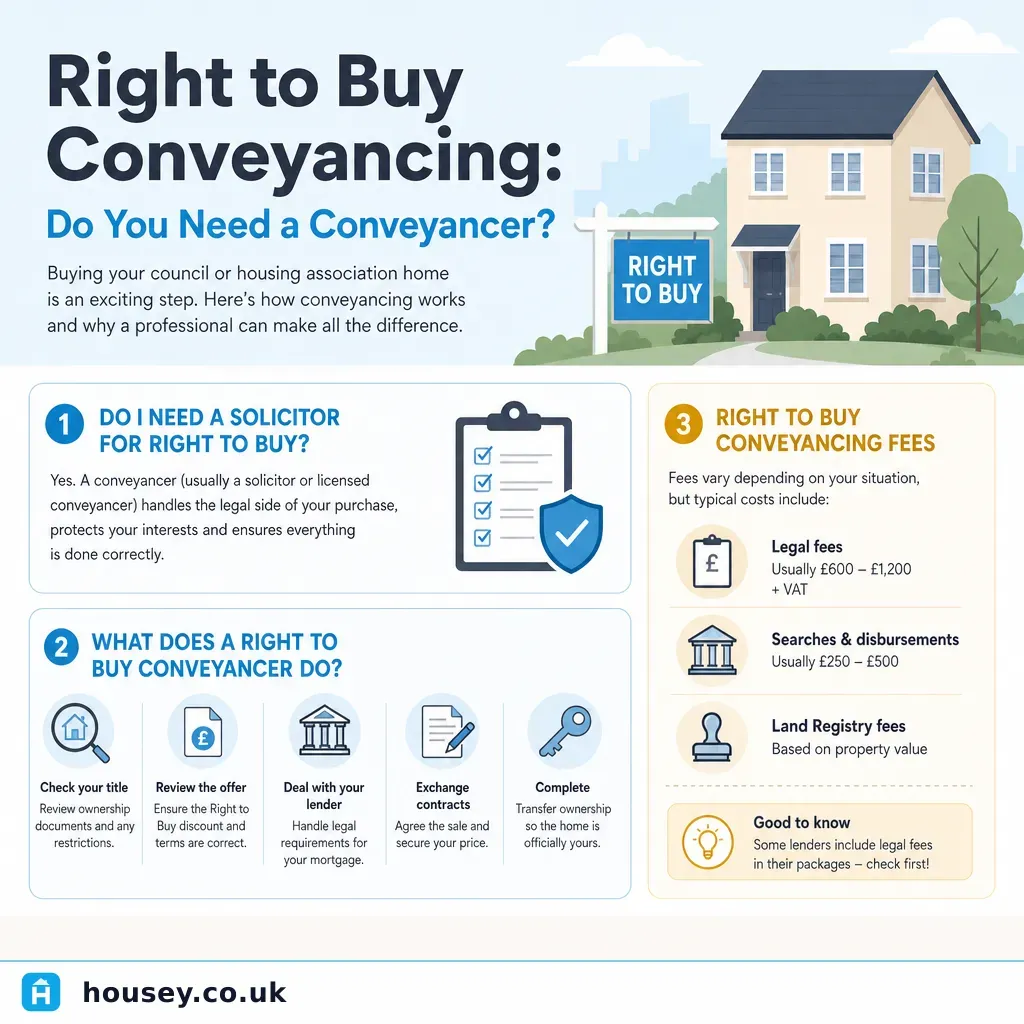
Right to Buy Conveyancing: Do You Need a Conveyancer?
You are not legally required to instruct a conveyancer for a Right to Buy purchase, but it is strongly advisable.
 Buying & Moving
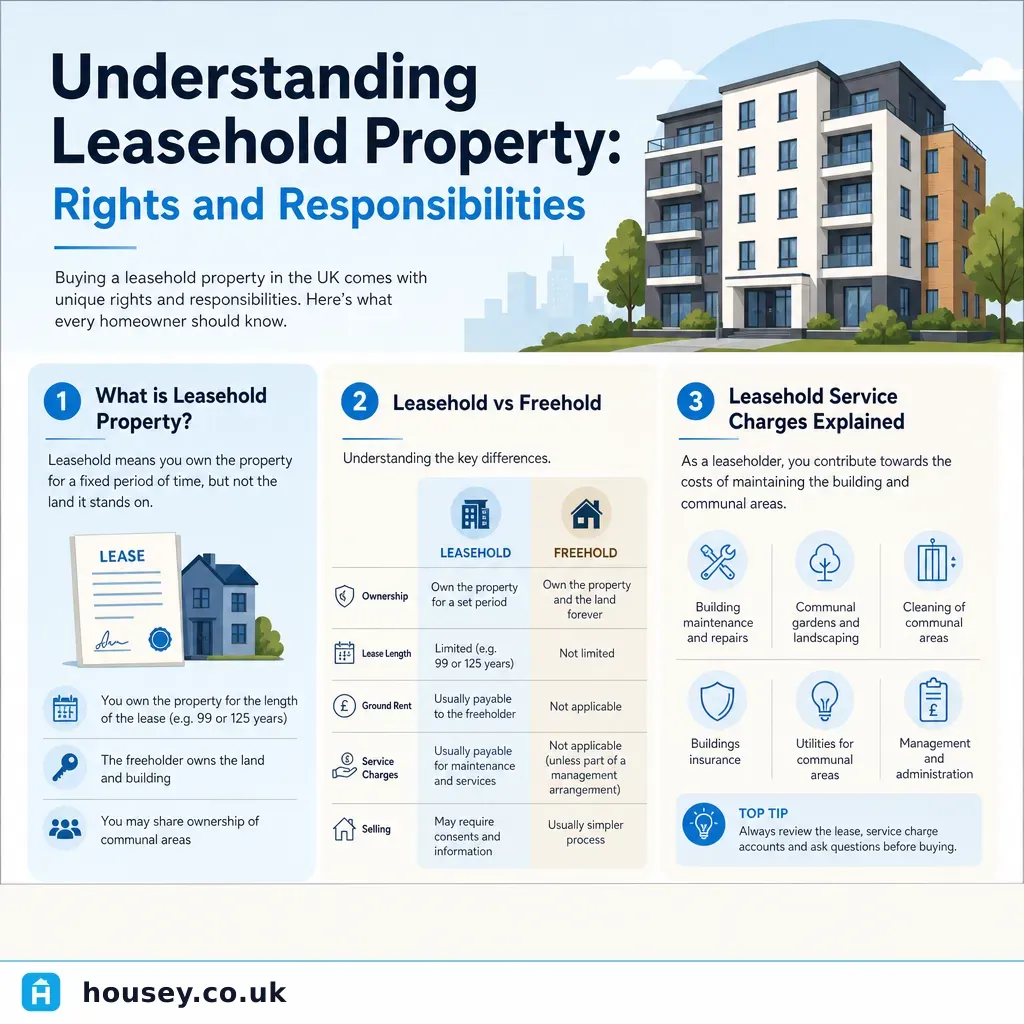
Understanding Leasehold Property: Rights and Responsibilities
Leasehold means you own a time-limited interest in a property while the freeholder owns the land and building.
 Buying & Moving
Navigating Simultaneous Purchase and Sale of Property
When buying and selling simultaneously in England and Wales, both sets of contracts are exchanged on the same day — this is called simultaneous exchange.
 Buying & Moving
Essential Steps to Selling Your Home Successfully
Selling your home successfully in the UK involves obtaining a valid EPC, choosing an estate agent or alternative method, instructing a solicitor or conveyancer early, and completing the Seller's Property Information Form accurately.
 Buying & Moving
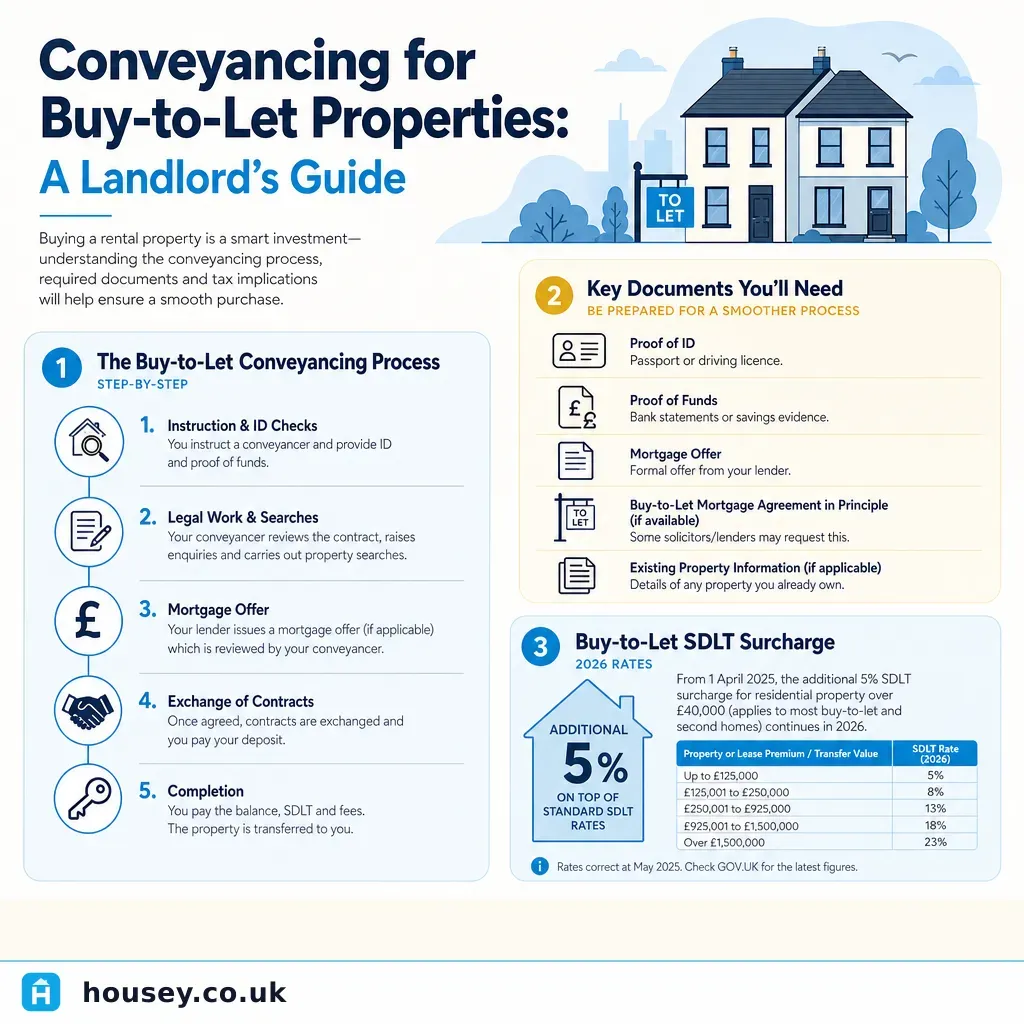
Conveyancing for Buy-to-Let Properties: A Landlord's Guide
Buy-to-let conveyancing follows the same legal process as any residential purchase but adds several layers: a 5% SDLT additional dwelling surcharge in England, review of any existing tenancy agreements, checking local authority licensing requirements, and ensuring buy-to-let mortgage conditions are correctly recorded.