Safe House Moving Practices: Health and Safety Protocols for Your Relocation
By Housey · Last reviewed 18th of May 2026
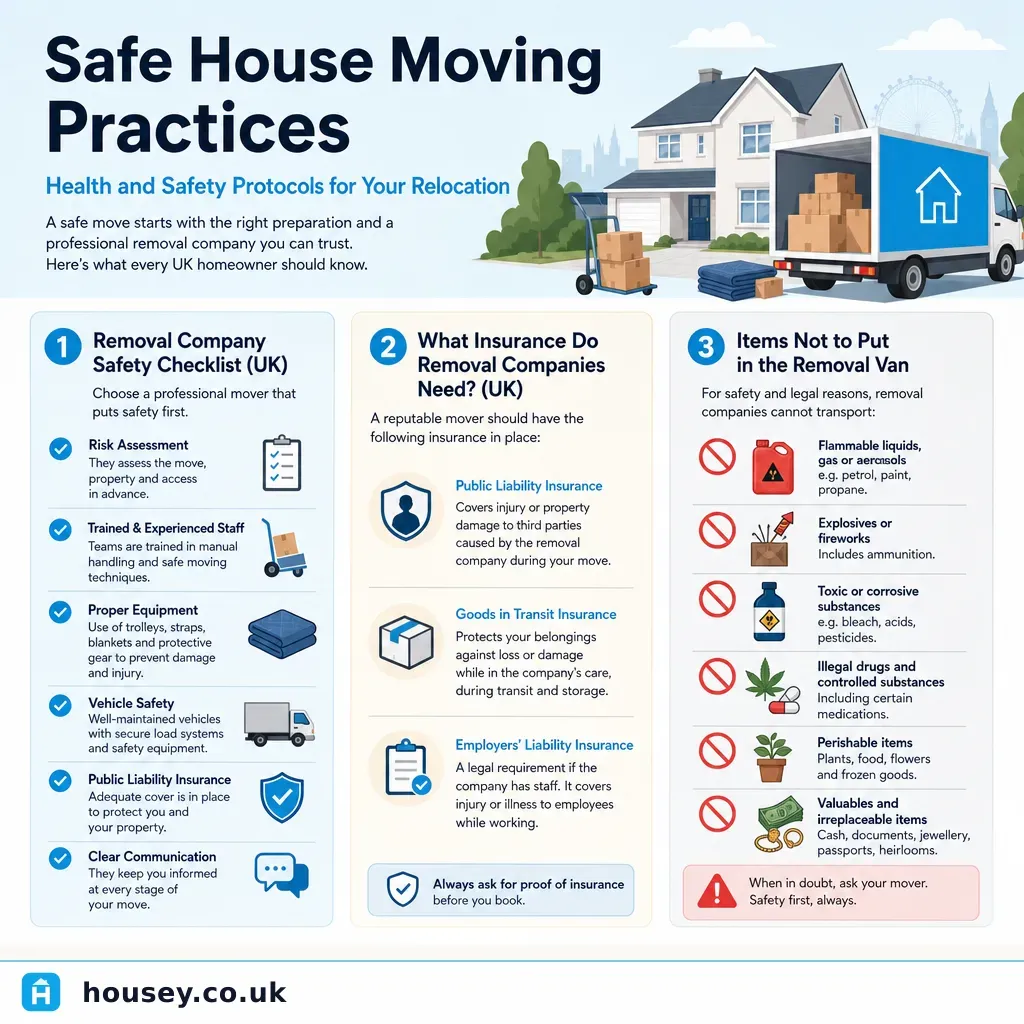
Safe House Moving Practices: Health and Safety Protocols for Your Relocation
Moving day is physically demanding and logistically complex. Without proper planning, it carries a meaningful risk of injury to those doing the lifting, damage to belongings in transit, and loss of important documents — risks that apply equally whether you are using a full-service removal firm, a man-and-van service, or organising the move yourself with friends and family.
Key points
- Manual handling injuries — back strains, sprains, and crush injuries from lifting and carrying — account for over a third of all workplace injuries reported to HSE annually; the same physical risks apply on a domestic move.
- The HSE Manual Handling Operations Regulations 1992 set a general guideline of no more than 25 kg for a solo lift by a fit adult; even lighter loads cause injury when carried awkwardly or repeatedly over a long day.
- Reputable removal firms carry public liability insurance — always ask to see the current certificate before instructing any company.
- Prescription medications, passports, property completion documents, and irreplaceable valuables should travel with you in your own vehicle, not in the removal van.
- Your home contents insurance may or may not cover items in transit on moving day — check the policy wording before the move, not after a claim is refused.
What are the main risks when moving house?
The risks on moving day cluster into three categories: personal injury, property damage, and document or data loss.
Personal injury risks
- Musculoskeletal strain from heavy or repeated lifting, particularly to the lower back, shoulders, and knees
- Trips and falls on loose packing materials, trailing cables, wet floors, or unfamiliar thresholds at either property
- Crush injuries from furniture moving through doorways, stairwells, or at the loading area
- Overexertion in warm weather or when wearing unsuitable footwear
Property damage risks
- Furniture and fittings scratched against doorframes and staircases during manoeuvring
- Fragile items broken by inadequate packing materials or boxes that are too large for heavy contents
- Electrical appliances damaged by insufficient padding or transit shock
- Water damage from washing machines or dishwashers that were not fully drained before moving
Document and data risks
- Identity documents misfiled or lost among packing boxes during a rushed move
- Computer hard drives and storage devices damaged in transit or accidentally left behind
- Property documents — completion statements, Land Registry title deeds, Energy Performance Certificates — misplaced or handed to the wrong party in the confusion of moving day
Your moving-day safety checklist
Two weeks before moving day
The day before
On moving day
After moving in
Which removal service do you need?
Service type | Best for | Not ideal for | Indicative cost (last reviewed 2026-05-18) |
|---|---|---|---|
Full-service removal firm (BAR-accredited) | Families, large homes, long distances, fragile or high-value items | Budget-constrained moves of very light loads | £800–£2,500+ |
Man-and-van service | Small flats, single-room moves, short distances | Large volumes or specialist items such as pianos or antiques | £200–£600 |
Self-hire van | Very small volumes, short distances, physically capable movers | Large homes, solo movers, restricted access properties | £80–£200/day (van hire only) |
Specialist removals (piano, art, antiques) | High-value or fragile specialist items requiring bespoke handling | Standard household contents | Variable — obtain specific quotes |
What to ask a removal firm before instructing them
- Do you hold public liability insurance, and can I see the current certificate?
- Are you a member of the British Association of Removers or another recognised trade body?
- What packing materials and equipment will your team bring to the job?
- How do you handle fragile or specialist items such as mirrors, artwork, or electrical equipment?
- What is your claims process if something is damaged in transit, and what is your excess?
- Is VAT included in the quote?
- What is your cancellation and rescheduling policy if the completion date changes at short notice?
- Do you provide an itemised inventory before loading and again after delivery?
Red flags when choosing a removal company
Be cautious if a removal firm:
- Provides no written quote, or a quote that changes significantly on the day of the move
- Is unwilling to provide insurance documentation when asked before or at the point of instruction
- Has no physical business address or verifiable registered company number
- Demands full payment entirely in cash upfront
- Has no trade body membership, no verifiable online reviews, and no traceable business history
- Operatives arrive in unmarked vans, without uniform, or without adequate equipment — trolleys, blankets, straps — for the job described
When to get professional help
Most household moves benefit from a professional removal firm. Use specialist services in these situations:
- Piano or grand piano: requires trained operatives and specialist equipment — a standard removal firm without piano experience should not attempt this
- Fine art or antiques: specialist transport firms use climate-controlled vehicles and bespoke crating to protect high-value or fragile pieces
- Accessibility needs: if anyone in the household has mobility limitations, discuss requirements in advance so the team is appropriately resourced and the move is planned to minimise risk
- Properties with restricted access: narrow lanes, no-parking zones, or multiple flights of stairs may require a firm with a stair-lift vehicle, hoisting equipment, or a smaller access vehicle
Never attempt to move items over 25 kg without proper handling equipment and at least one other person. If you are unsure whether an item is safe to move, leave it for the professional removal team.
How Housey can help
Housey connects homeowners with vetted house removal companies so you can compare quotes, check accreditations, and book with confidence — whether you are moving a one-bedroom flat across town or a five-bedroom family home to another part of the country.
Frequently asked questions
Do removal companies have to carry insurance in the UK?
There is no statutory requirement for removal companies to hold public liability insurance, but any reputable firm will carry it. Members of the British Association of Removers (BAR) are required to hold it under the association's code of practice. Always ask to see the current insurance certificate before instructing any firm, and verify that your own home contents policy also covers items in transit on moving day.
What items should I never put in a removal van?
Prescription and over-the-counter medications, passports and identity documents, property completion paperwork, financial documents, computer hard drives and data storage, irreplaceable photographs or heirlooms, high-value jewellery, and cash. These should travel in your own vehicle. Most removal firms will also refuse to transport hazardous materials including aerosols, paint, gas canisters, and corrosive substances — check your firm's terms before packing day.
How can I protect my back when moving house?
Bend at the knees rather than the back when lifting, keep the load close to your body, and avoid twisting while carrying. Use a sack barrow or moving straps for anything heavy or awkward. The HSE Manual Handling Operations Regulations 1992 set 25 kg as a general maximum for a solo lift by a fit adult, but even lighter items cause injury when carried repeatedly. If a professional removal team is doing the work, let them — that is what you are paying for.
Sources and further reading
- Manual handling at work: a brief guide (INDG143) — HSE
- Manual Handling Operations Regulations 1992 — legislation.gov.uk
- British Association of Removers — BAR
- Royal Mail address redirection service — Royal Mail
- Home insurance when moving house — Citizens Advice
Useful next reads
 Buying & Moving
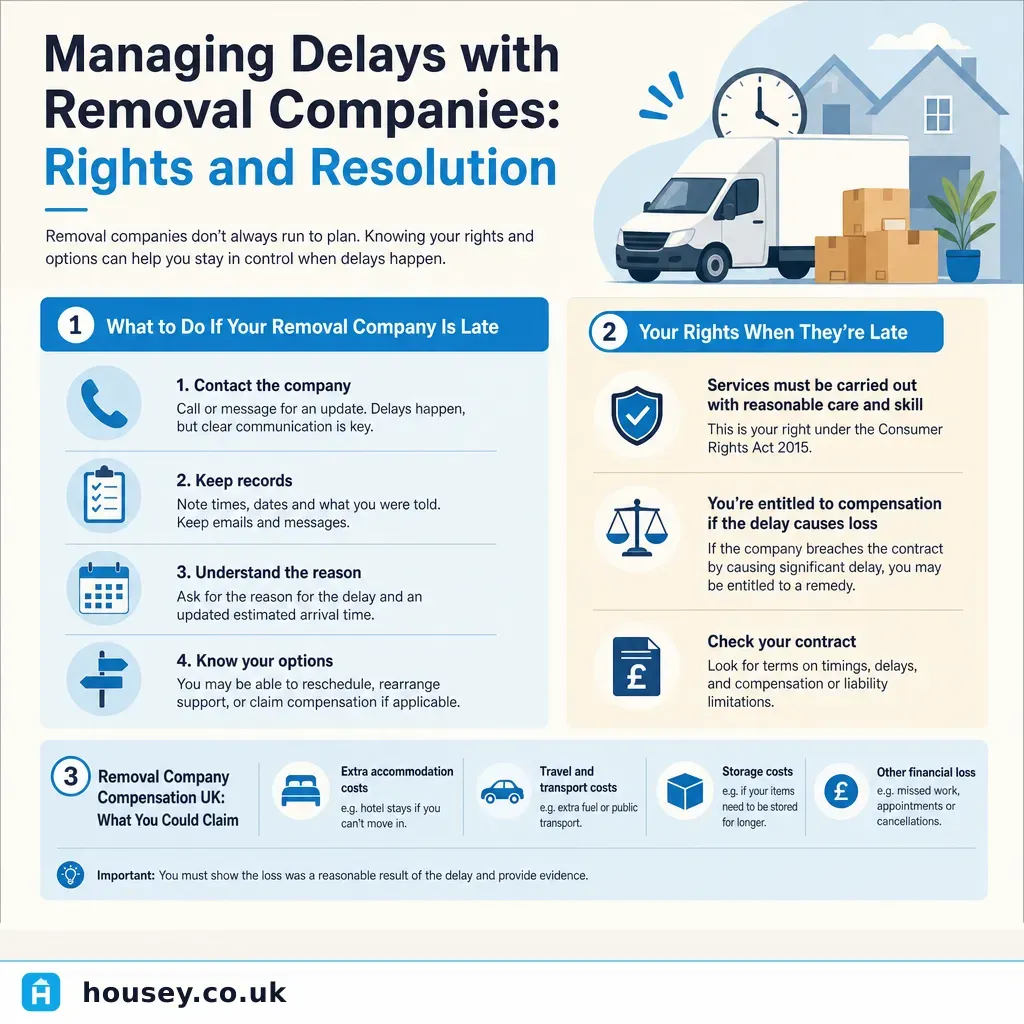
Managing Delays with Removal Companies: Rights and Resolution
If a removal company is late, your rights depend on your contract and whether the company is BAR-registered.
 Buying & Moving
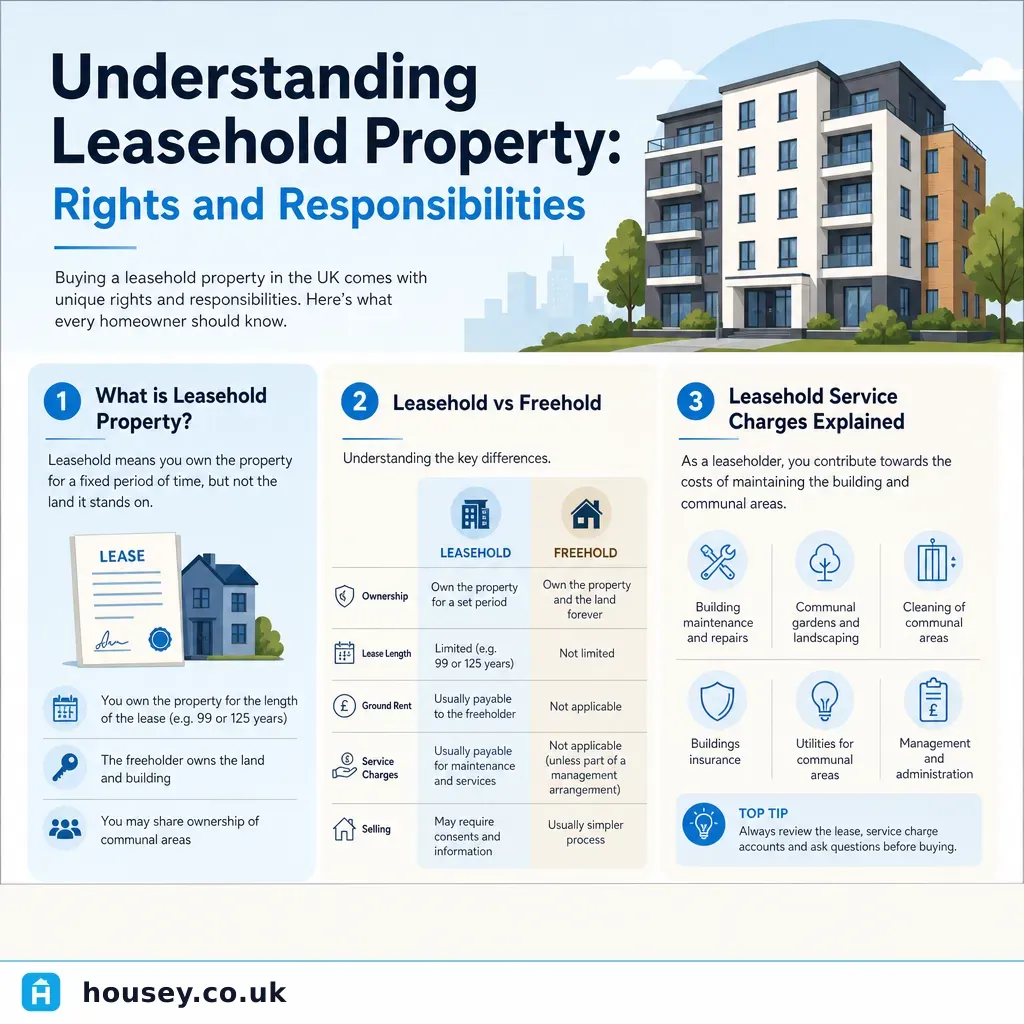
Understanding Leasehold Property: Rights and Responsibilities
Leasehold means you own a time-limited interest in a property while the freeholder owns the land and building.
 Buying & Moving
The Complete Property Buying Guide: From Search to Purchase
Buying a property in England and Wales typically takes 3–6 months from accepted offer to completion.
 Buying & Moving
Leasehold Property Purchase: Complexity and Key Considerations
Buying a leasehold property means purchasing the right to occupy for a fixed term rather than owning the land outright.
 Buying & Moving
First-Time Buyer Essentials Checklist
Buying your first home involves obtaining a mortgage in principle, making an offer, instructing a solicitor, arranging a survey, and exchanging contracts before completion.