Scottish Property Transaction Terminology: A Reference Guide
By Housey · Last reviewed 24th of May 2026

Scottish Property Transaction Terminology: A Reference Guide
Anyone buying or selling a home in Scotland — especially those relocating from England or Wales — quickly encounters legal and procedural terms that have no direct equivalent south of the border. A term like missives sounds straightforwardly technical but describes a process with major legal consequences; confusing it with the English concept of making an offer can result in costly misunderstandings at a critical moment in a transaction. This guide sets out the most important terms in plain English.
Key points
- Missives are binding contractual letters exchanged between solicitors; once concluded, withdrawal can expose the withdrawing party to significant financial liability — there is no non-binding offer period equivalent to that in England.
- The Home Report (mandatory under the Housing (Scotland) Act 2006) must be provided by the seller before marketing, and contains a Single Survey, an Energy Report, and a Property Questionnaire.
- Land and Buildings Transaction Tax (LBTT), administered by Revenue Scotland, applies in Scotland instead of Stamp Duty Land Tax (SDLT); rates and thresholds are set by the Scottish Parliament.
- Title to Scottish property is registered at the Land Register of Scotland, maintained by Registers of Scotland — a body entirely separate from HM Land Registry.
- Real burdens and servitudes are conditions and rights attached to Scottish title deeds that survive changes of ownership and can materially restrict or benefit use of a property.
Core terms A–Z
Burdens (real burdens)
Conditions attached to a title deed that bind the property and all future owners permanently. Examples include restrictions on use (residential only), obligations to maintain shared walls or access roads, and prohibitions on further subdivision. Real burdens are enforceable by a neighbouring owner with a legitimate interest. Reformed and regulated by the Title Conditions (Scotland) Act 2003.
Closing date
When multiple buyers note interest in a property, the selling solicitor sets a closing date by which all formal written offers must be submitted. Offers are sealed bids; the seller reviews them and selects their preferred offer (usually the financially strongest). Missing a closing date typically removes a buyer from consideration entirely.
Date of entry
The agreed completion date in a Scottish property transaction — equivalent to the completion date in England. On the date of entry, funds are transferred between solicitors and keys are released to the buyer. The date of entry is agreed within the missives.
Disposition
The legal deed by which ownership of a Scottish property is transferred from seller to buyer. After settlement, the buyer's solicitor registers the disposition at the Land Register of Scotland. The disposition is the Scottish equivalent of the transfer deed used in English conveyancing.
Feudal tenure
The historical system of land ownership in Scotland, abolished by the Abolition of Feudal Tenure etc. (Scotland) Act 2000 (effective 28 November 2004). Prior to abolition, landowners held title from a feudal superior and owed certain obligations. Most feudal burdens were extinguished at abolition, though some were preserved by statutory notice under the Title Conditions (Scotland) Act 2003.
General Register of Sasines
The world's oldest public register of title deeds, dating to 1617. Older Scottish properties may have their title recorded here rather than in the Land Register. When such a property is sold or mortgaged, the transaction triggers first registration in the Land Register — a process known as inducing first registration.
Home Report
A mandatory report provided by the seller before a Scottish property can be marketed (required since 1 December 2008 under the Housing (Scotland) Act 2006). The Home Report contains three components:
Component | Contents |
|---|---|
Single Survey | RICS-qualified condition inspection and indicative market valuation |
Energy Report | Energy Performance Certificate (EPC) |
Property Questionnaire | Seller-declared information: council tax band, alterations, disputes, factoring arrangements, utilities |
Buyers may request the Home Report before making a formal offer. For older or more complex properties, buyers should consider commissioning an additional independent survey beyond the seller-instructed Single Survey.
Inhibition
A court order that prevents a property owner from selling or burdening their property. Solicitors conduct inhibition searches as a standard part of Scottish conveyancing due diligence to confirm no inhibition is registered against the seller before missives are concluded.
Land Register of Scotland
The main public register of property title in Scotland, maintained by Registers of Scotland. Titles in the Land Register are displayed on a map-based cadastral system. Since 2014, all new dealings with land in Scotland must be registered in the Land Register rather than the older Sasines Register.
LBTT (Land and Buildings Transaction Tax)
The Scottish equivalent of Stamp Duty Land Tax (SDLT), administered by Revenue Scotland. LBTT applies to residential and commercial property purchases above the relevant nil-rate threshold. An Additional Dwelling Supplement (ADS) applies when buying an additional residential property. Rates and thresholds are set by the Scottish Parliament and differ from those in England; always check Revenue Scotland for current figures.
Missives
The formal letters exchanged between the buyer's solicitor and the seller's solicitor that — when concluded — form a binding contract for the sale of the property. Each letter may contain conditions, qualifications, and responses. Conclusion of missives is equivalent in legal effect to exchange of contracts in England, but the process is different: there is no single simultaneous moment of exchange; instead, a series of letters is negotiated until both sides issue letters in identical terms. Once missives are concluded, withdrawal exposes the withdrawing party to liability for the other side's losses.
Noting interest
The informal notification given — usually by the buyer's solicitor to the selling agent — that a buyer is interested in a property. Noting interest is not legally binding and does not commit the buyer to making an offer. Its principal practical effect is that the selling agent should notify the buyer if a closing date is set.
Offers over / Fixed price / Offers around
Pricing conventions used in Scottish property listings:
- Offers over (OO): the listed price is a guide; buyers typically offer above it, particularly at a competitive closing date.
- Fixed price: the first buyer to offer the fixed price and be accepted usually wins; no competitive bidding process is used.
- Offers around (OA): an invitation to offer near the stated price; more open to negotiation than offers over.
Registers of Scotland
The Scottish Government agency that manages the Land Register of Scotland, the General Register of Sasines, and other Scottish property-related registers. It is entirely separate from HM Land Registry, which covers England and Wales.
Servitudes
Rights benefiting one property (the dominant tenement) that burden a neighbouring property (the servient tenement). Common examples include rights of access over a path, rights to lay pipes or services, and rights to draw water. Servitudes are attached to the land and pass with ownership; they are broadly equivalent to easements in English property law.
Settlement
The final stage of a Scottish property transaction, occurring on the date of entry, when funds are transferred from the buyer's solicitor to the seller's solicitor and keys are released to the buyer.
Single Survey
The condition and valuation report within the Home Report, carried out by a RICS-qualified surveyor. It uses a three-point condition rating scale: 1 (no immediate action required), 2 (repair or maintenance required), and 3 (urgent attention required). It also provides an indicative market valuation. Crucially, the Single Survey is instructed and paid for by the seller, not the buyer.
Standard security
The Scottish equivalent of a mortgage or legal charge over a property. When a lender provides a mortgage secured on a Scottish property, a Standard Security is registered against the title at the Land Register of Scotland. On full repayment of the mortgage, a Discharge of Standard Security is registered to remove it from the title.
Title sheet
A record within the Land Register of Scotland showing the property description, the registered owner, any securities (standard securities / mortgages), and any burdens or servitudes affecting the title. The title sheet replaces the traditional bundle of historical title deeds once a property undergoes first registration.
Warrandice
A warranty given by the seller in the Disposition confirming they have the right to sell the property and that the buyer's ownership will not be challenged by a third party. Absolute warrandice is the standard form in most Scottish residential transactions and is broadly equivalent to full title guarantee in English conveyancing.
Decision tree: when to act on key terms
- Note interest as soon as you want to be considered for a property — before a closing date is set by the selling solicitor.
- Instruct your Scottish solicitor before noting interest, not after you have received confirmation of an accepted offer.
- Request the Home Report before submitting a formal offer; check the Single Survey condition ratings before bidding.
- Commission an additional independent survey if the Single Survey shows condition ratings of 2 or 3, or if the property is pre-1919, stone-built, a tenement flat, or has visible structural concerns.
- Do not conclude missives until your mortgage offer is confirmed, survey concerns are addressed, and your proposed date of entry is achievable.
- Ask your solicitor to review the title sheet for real burdens, servitudes, and any inhibition registered against the seller before concluding missives.
Important limitations
This reference guide provides general explanations of Scottish property terminology. Scots law is a distinct legal system and the definitions and processes described here are necessarily general. Individual transactions vary considerably. Nothing in this guide constitutes legal advice. Always instruct a solicitor qualified and regulated by the Law Society of Scotland for any Scottish property transaction.
When this becomes urgent
Seek professional advice immediately if:
- You are uncertain whether missives have been concluded on your transaction
- The Single Survey shows a condition rating of 3 on any element of the property
- You have been asked to sign or return a legal document and are unsure of its effect
- An inhibition against the seller has been found during conveyancing searches
- You are approaching a closing date and need to submit a formal offer promptly
What to ask a qualified professional
Scottish solicitor — before instructing:
- Are you experienced in residential Scottish conveyancing for the type and location of property I am buying?
- Which real burdens and servitudes affect the title sheet, and do any restrict my intended use of the property?
- Are there any inhibitions registered against the seller?
- Is there anything in the Property Questionnaire that warrants further investigation before I make an offer?
RICS surveyor — before commissioning an additional survey:
- Given the condition ratings in the Single Survey, what level of additional survey do you recommend for this property?
- Are there construction types or specific defects in this property that require specialist investigation?
When to get professional help
Scottish property law is complex and many terms carry legal consequences that differ from their apparent English equivalents. Always instruct a Law Society of Scotland-regulated solicitor for any Scottish transaction. Seek immediate professional advice if the Single Survey shows a condition rating of 3, unusual title burdens restrict the property, an inhibition is found against the seller, or you are unclear about the status of missives in your transaction.
How Housey can help
Housey connects buyers and sellers with solicitors experienced in Scottish conveyancing solicitors and with RICS-qualified surveyors who can provide Scottish Home Reports and additional independent building surveys beyond the standard Home Report Single Survey.
Frequently asked questions
What is the difference between missives and exchange of contracts?
Missives are the binding contractual letters exchanged between solicitors in Scotland. When all letters have been agreed and matched, missives are concluded — creating a binding contract. This is similar in effect to exchange of contracts in England, but differs in process: there is no single simultaneous moment; instead, letters are negotiated until both sides agree. Once concluded, withdrawal carries financial liability for the withdrawing party.
Do I need a solicitor or can I use a licensed conveyancer for a Scottish purchase?
You must use a solicitor regulated by the Law Society of Scotland. Licensed conveyancers, who are authorised to act in England and Wales, cannot practise Scottish conveyancing. If you are buying in Scotland while selling in England, you will need two separate legal representatives — one in each jurisdiction. Your English solicitor may be able to recommend a Scottish counterpart.
What is the Additional Dwelling Supplement?
The ADS is a surcharge on top of standard LBTT that applies when you purchase an additional residential property in Scotland while already owning another residential property anywhere in the world. The rate is set by the Scottish Parliament; check Revenue Scotland for current figures. If you sell your previous main residence within 18 months of paying ADS, you may be eligible to reclaim it.
What does a condition rating 3 in the Home Report Single Survey mean?
A rating of 3 means urgent attention is required. You can still make an offer, but factor repair costs into your bid, commission an independent RICS Level 3 Building Survey for a detailed assessment, and inform your mortgage lender — some lenders will not advance without remedial works being agreed. A condition 3 item should always be investigated by a qualified professional before missives are concluded.
Sources and further reading
- Buying a home in Scotland — mygov.scot / Scottish Government
- Home Reports — mygov.scot / Scottish Government
- Land and Buildings Transaction Tax — Revenue Scotland
- Registers of Scotland — Registers of Scotland
- Title Conditions (Scotland) Act 2003 — legislation.gov.uk
- Abolition of Feudal Tenure etc. (Scotland) Act 2000 — legislation.gov.uk
- Housing (Scotland) Act 2006 — legislation.gov.uk
- Law Society of Scotland — Law Society of Scotland
Useful next reads
 Buying & Moving
Golfing communities and properties near St Andrews
St Andrews and the surrounding villages in north-east Fife attract golf-motivated buyers from the UK and overseas.
 Buying & Moving
Top Property Services in Scotland: Market Leaders and Specialists
Scotland has a separate legal system, planning framework, and building standards from England and Wales.
 Buying & Moving
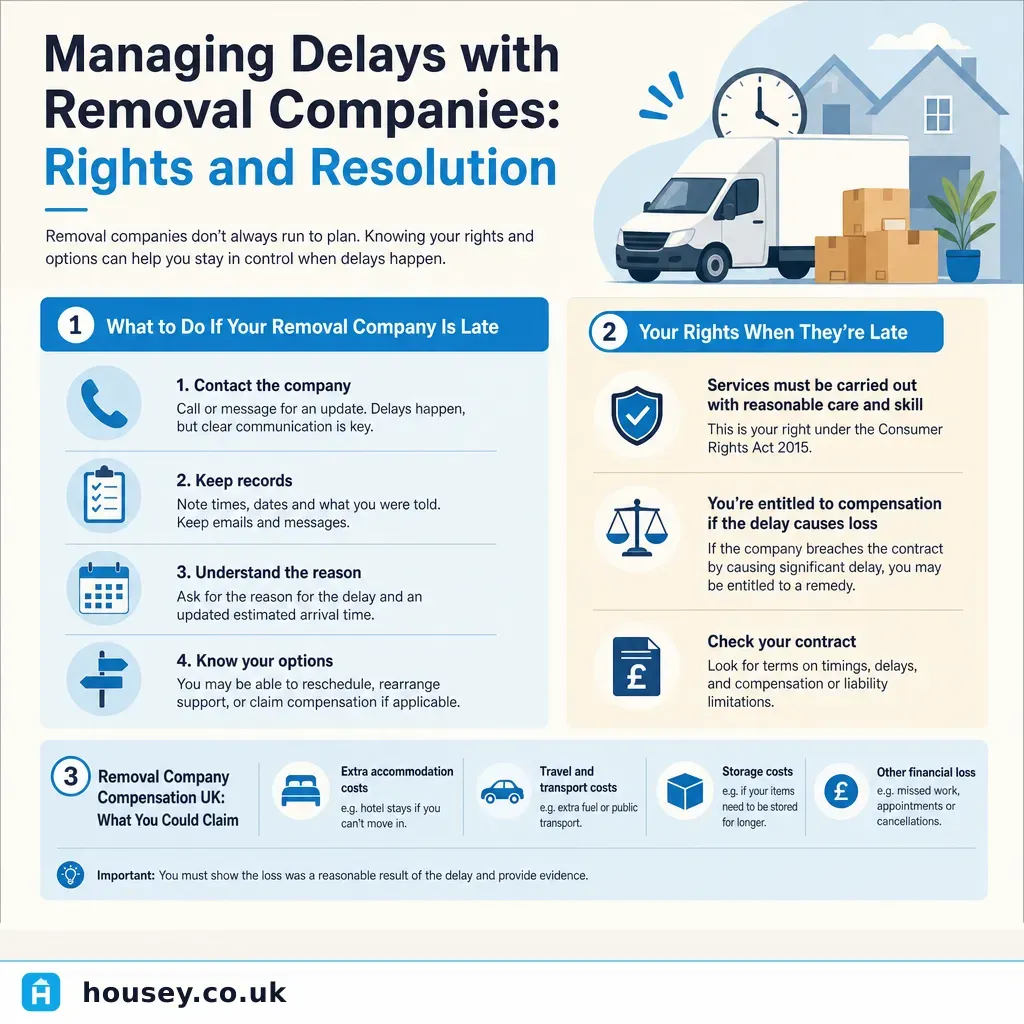
Managing Delays with Removal Companies: Rights and Resolution
If a removal company is late, your rights depend on your contract and whether the company is BAR-registered.
 Buying & Moving
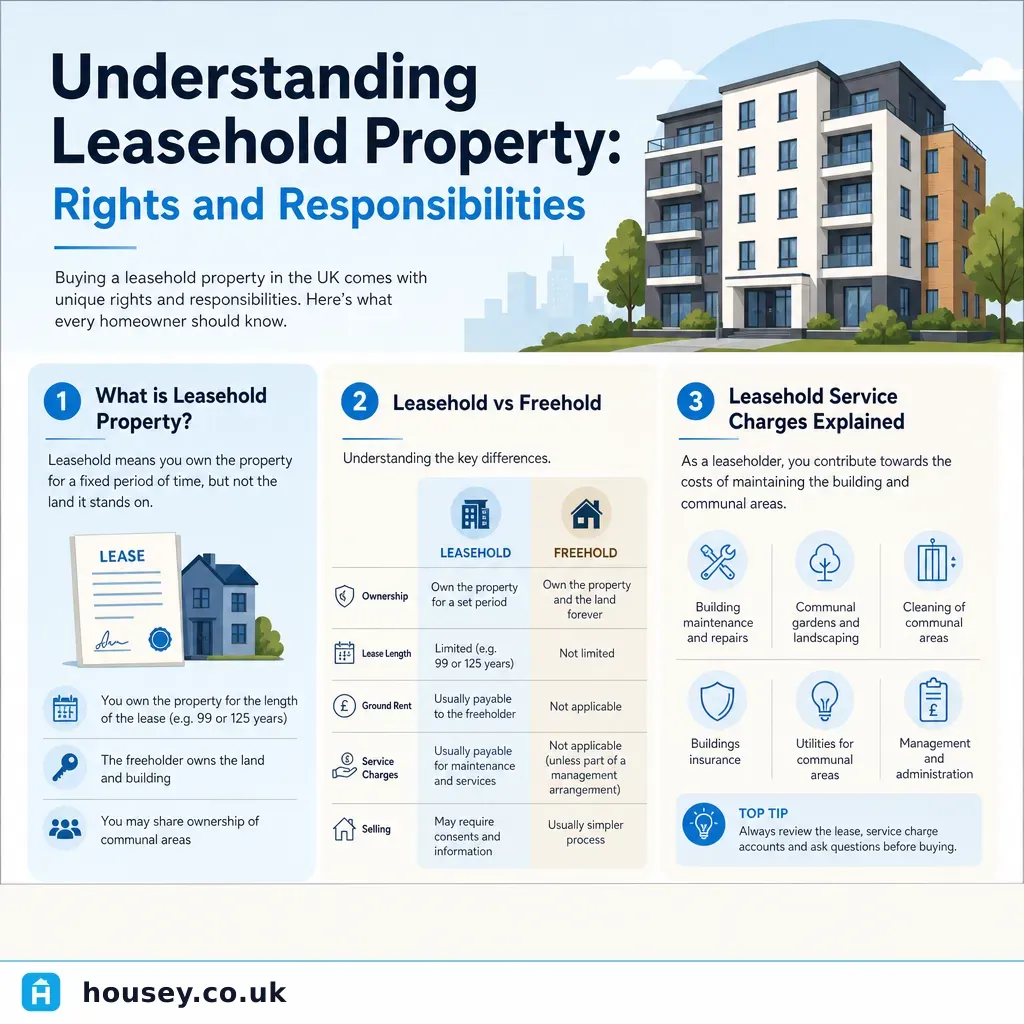
Understanding Leasehold Property: Rights and Responsibilities
Leasehold means you own a time-limited interest in a property while the freeholder owns the land and building.
 Buying & Moving
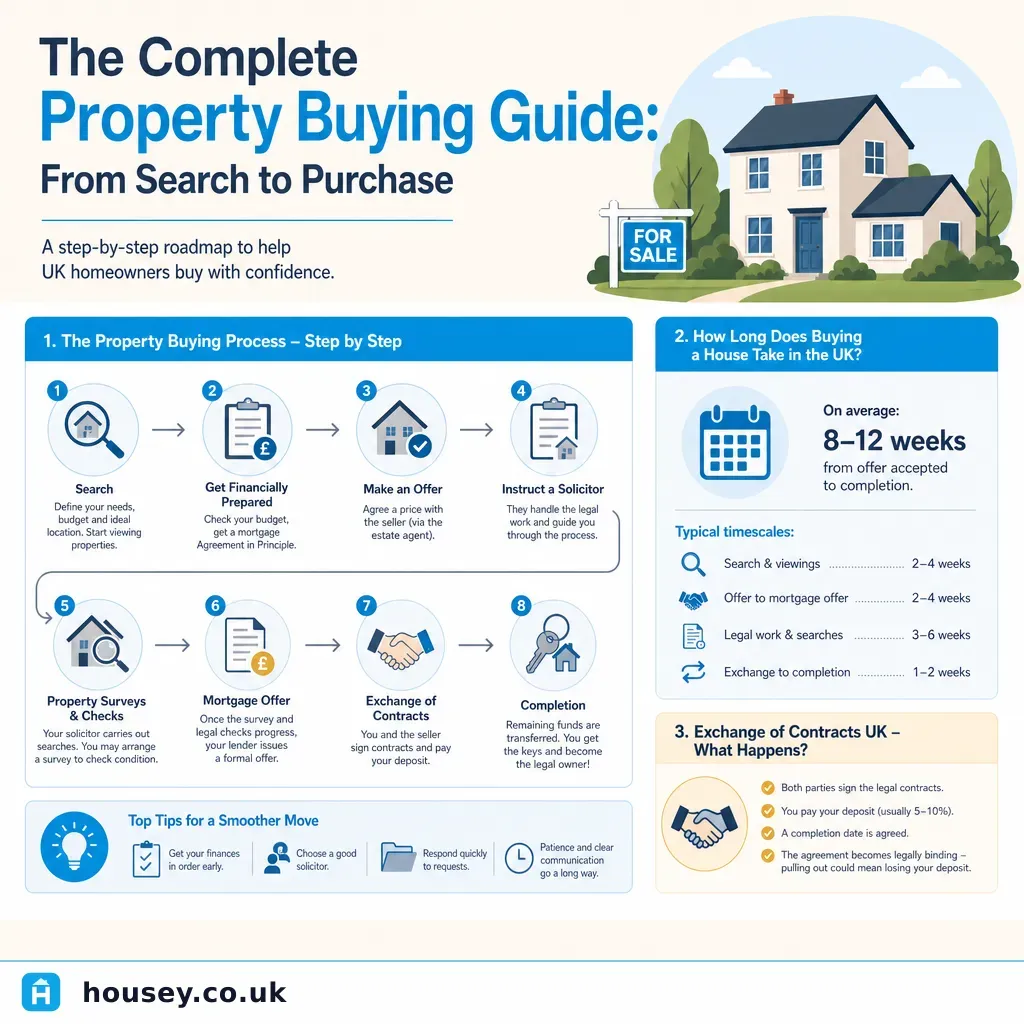
The Complete Property Buying Guide: From Search to Purchase
Buying a property in England and Wales typically takes 3–6 months from accepted offer to completion.