Selecting a Concrete Paving Specialist: Key Questions to Ask
By Housey · Last reviewed 18th of May 2026
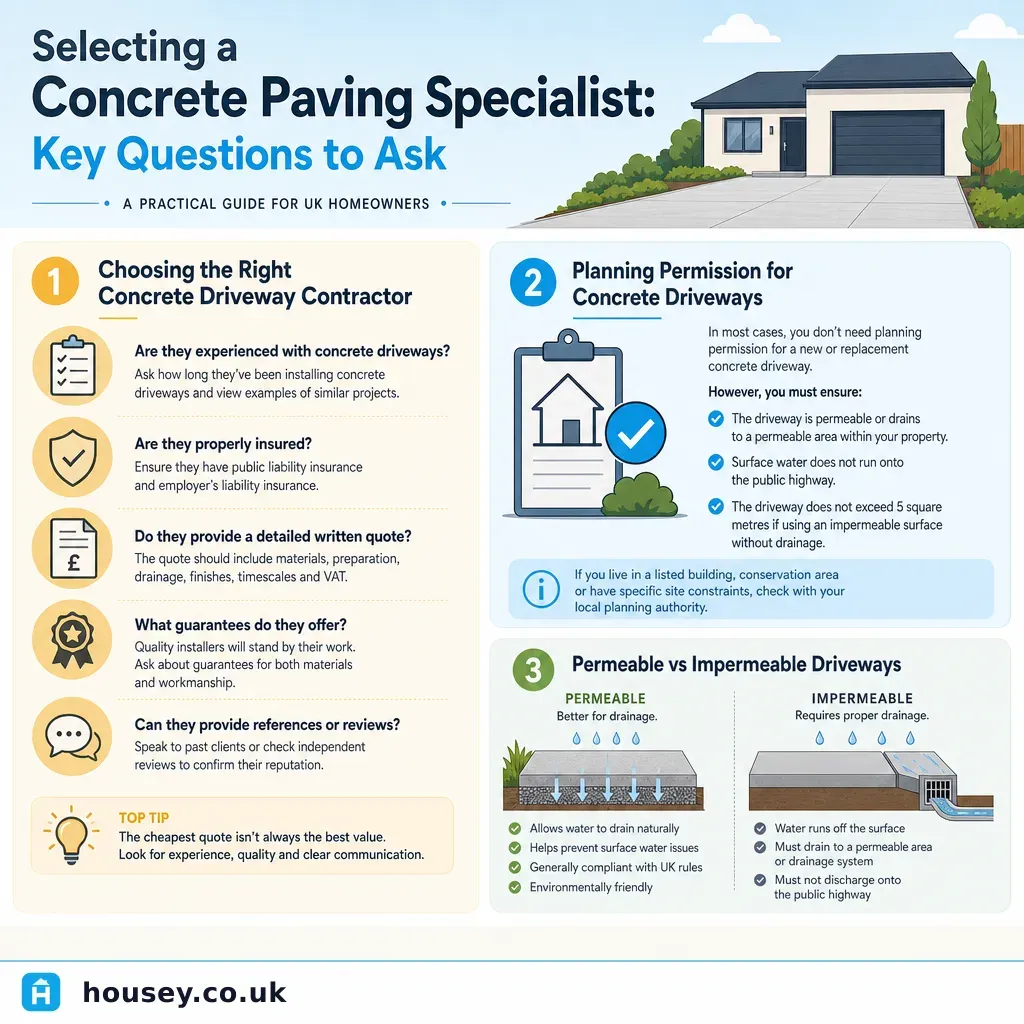
Selecting a Concrete Paving Specialist: Key Questions to Ask
Concrete paving covers a wide range of residential applications — from block-paved driveways and imprinted concrete forecourts to in-situ brushed slabs and resin-bound surfaces. The specialist you choose and the conversations you have before work starts will determine whether your new surface performs reliably for decades or begins to crack and settle within a few years. UK homeowners often discover too late that planning rules, drainage requirements, or material specifications were not properly addressed at the outset.
Key points
- In England, impermeable driveways over 5 m² in a front garden must either use permeable construction or drain to a lawn, border, or soakaway — not directly to the highway or public sewer — under Schedule 2, Part 1, Class F of the Town and Country Planning (General Permitted Development) (England) Order 2015.
- BS 7533 is the British Standard covering the design and installation of concrete block paving — specifying installation to this standard is a mark of professional practice.
- For a domestic driveway slab, a C30 concrete mix with A142 steel reinforcement mesh on a minimum 150 mm compacted Type 1 sub-base is a widely cited specification for residential concrete paving.
- Expansion joints are required in in-situ concrete to control shrinkage cracking — typically every 3–4 m — and their omission is one of the most common causes of premature cracking in domestic concrete paving.
- Sustainable Drainage Systems (SuDS)-compliant paving such as permeable block paving or resin-bound gravel avoids planning permission requirements for front driveways and is increasingly specified as a condition of planning approval by local authorities.
Planning permission and drainage: what you need to know
This is the area where many homeowners are caught out, and where the choice of specialist makes a significant practical difference.
- Permeable surface (permeable block paving, resin-bound gravel, loose gravel): no planning permission required for a front garden driveway in England, regardless of size.
- Impermeable surface (standard in-situ concrete, tarmac, non-permeable block paving) over 5 m²: planning permission is required unless surface water drainage runs to a lawn, planting bed, or soakaway — not to the highway or public sewer.
Your specialist should raise this question unprompted. If they do not, ask directly: is the proposed surface permeable, and how will surface water be managed? Get the answer confirmed in writing before work starts. For current guidance, see GOV.UK planning permission guidance.
Which type of concrete paving is right for your project?
Use this decision tree to narrow your choice before speaking to a specialist.
- Choose permeable block paving if you need a front garden driveway, want to avoid planning permission, require a surface that can bear car loads, and prefer a finish where individual blocks can be lifted and relaid if future utility access is needed.
- Choose in-situ concrete if you need a single continuous surface for a rear garden, path, or utility area, are comfortable with the planning and drainage requirements, and want a lower material cost.
- Choose imprinted (pattern-imprinted) concrete if you want the aesthetic of stone or brick at a lower material cost — but note that surface colour can fade and visible repairs are harder to disguise than with block paving.
- Choose resin-bound paving if you want a permeable, decorative, low-maintenance finish with full SuDS compliance — typically a higher upfront cost but increasingly popular for front driveways.
- Seek specialist or engineering advice if ground conditions include heavy clay, tree roots near the surface, or made ground, as these may require a more detailed sub-base specification or a geotechnical assessment.
Paving type | Best for | Planning (front garden, England) | Repairability | Typical cost (per m²) |
|---|---|---|---|---|
Permeable block paving | Driveways, parking, paths | No permission needed | High — blocks relaid individually | £60–£120 supply and lay |
In-situ concrete (plain) | Paths, rear slabs, utility areas | May need permission if impermeable over 5 m² | Low — cracks are visible | £50–£100 supply and lay |
Imprinted/pattern concrete | Decorative front driveways | May need permission if impermeable over 5 m² | Moderate — fading and patching visible | £70–£130 supply and lay |
Resin-bound gravel | Decorative, SuDS-compliant driveways | No permission needed (permeable) | Moderate | £80–£150 supply and lay |
Indicative UK costs, last reviewed 2026-05-18. Prices vary by region, access, ground conditions, and contractor. Obtain at least three itemised quotes.
What to ask a concrete paving specialist
About qualifications and credentials
- Are you a member of the Interpave network, or do you hold registered contractor status with a manufacturer such as Marshalls or Brett?
- Can you provide references from comparable driveway or paving projects completed in the last 12 months?
- Do your operatives hold CSCS cards, and do you carry public liability insurance of at least £1 million?
About the specification
- What paving product or concrete mix are you specifying, and does it comply with BS 7533 (for block paving) or BS 8500 (for in-situ concrete)?
- What sub-base depth are you proposing, and will it be compacted in layers to achieve the required bearing capacity?
- Where will expansion joints be placed, and at what centres?
- Is the proposed surface permeable or impermeable, and how does this affect planning permission for my property?
- How will surface water drain — to a soakaway, permeable sub-base, or a drainage channel?
About the project and contract
- Is VAT included in the quoted price?
- What does the price exclude — skip hire, kerb removal, manhole adjustments, edging restraints?
- What are the payment terms and stages?
- What defects liability period do you offer?
- Who is responsible for any planning applications or building control notifications required?
Red flags to watch for
- No mention of planning permission for a front driveway: any specialist who does not raise the permeable or impermeable question unprompted should be challenged on it before work is agreed.
- No expansion joints proposed for in-situ concrete: expansion joints are a standard requirement, not an optional extra, and their absence almost guarantees future cracking.
- Sub-base thinner than 100 mm for a vehicle-bearing surface: for a domestic driveway, 100 mm is typically the minimum acceptable; 150 mm provides a better performance margin.
- Unwillingness to state the concrete mix grade in writing: a professional should be able to specify the mix and commit to it before starting work.
- An implausibly short installation timeline: concrete curing requirements mean quality work cannot always be accelerated without compromising the finished result.
When to get professional help
A qualified concrete paving specialist will handle most domestic driveway and path projects. Seek additional expertise if:
- Ground conditions include clay with high-shrinkage potential, tree roots close to the surface, or areas of poor bearing capacity — a structural or geotechnical assessment should come before specification.
- The project involves significant level changes, retaining edges, or drainage infrastructure beyond a simple channel — a civil engineer may be needed to review the design.
- You are planning a large hardstanding for commercial or shared-access use where structural loading requires formal engineering design.
- The property is listed or within a conservation area — contact your local planning authority before commissioning any external works.
How Housey can help
Housey connects homeowners with local driveway installers and groundworkers experienced in concrete paving across the UK. Receive up to four comparable, itemised quotes from vetted specialists and review their credentials, references, and insurance documentation before making a decision.
Frequently asked questions
Does a concrete driveway need planning permission in England?
If the surface is permeable — meaning water drains through it — no planning permission is needed for a front garden driveway, regardless of size. If the surface is impermeable and over 5 m², planning permission is required unless surface water drains to a lawn, border, or soakaway rather than directly to the highway or public sewer. Rules differ in Wales, Scotland, and Northern Ireland. Always check with your local planning authority if you are uncertain.
How long should a concrete driveway last?
A correctly specified and installed concrete driveway — appropriate mix, adequate sub-base, properly spaced expansion joints, and good drainage — should last 25–40 years before major remediation is needed. Premature cracking, settlement, or surface spalling is almost always caused by inadequate sub-base depth, the wrong concrete grade, or missing expansion joints rather than material quality alone.
Can a concrete driveway be laid in wet weather?
In-situ concrete should not be poured in heavy rain, in freezing conditions, or when frost is forecast during the curing period. Your specialist should plan the pour around suitable weather windows and use polythene sheeting to protect fresh concrete if rain is expected. Permeable block paving is generally more tolerant of installation during typical UK wet weather.
What is the difference between pattern-imprinted concrete and block paving?
Pattern-imprinted concrete is poured as a single continuous slab, then pressed with moulds and coloured to resemble stone or brick. Repairs to the surface coating are more visible and the colour can fade over time. Block paving uses individual units that can be lifted and relaid independently, making repairs less obvious and accommodating future utility access without visible patching.
Sources and further reading
- GOV.UK — planning permission guidance — GOV.UK
- Town and Country Planning (General Permitted Development) (England) Order 2015 — Schedule 2 — legislation.gov.uk
- Building Regulations Approved Document H (drainage and waste disposal) — GOV.UK
- Interpave — the precast concrete paving association — Interpave
- Construction Skills Certification Scheme (CSCS) — CSCS
Useful next reads
 Improvement & Build
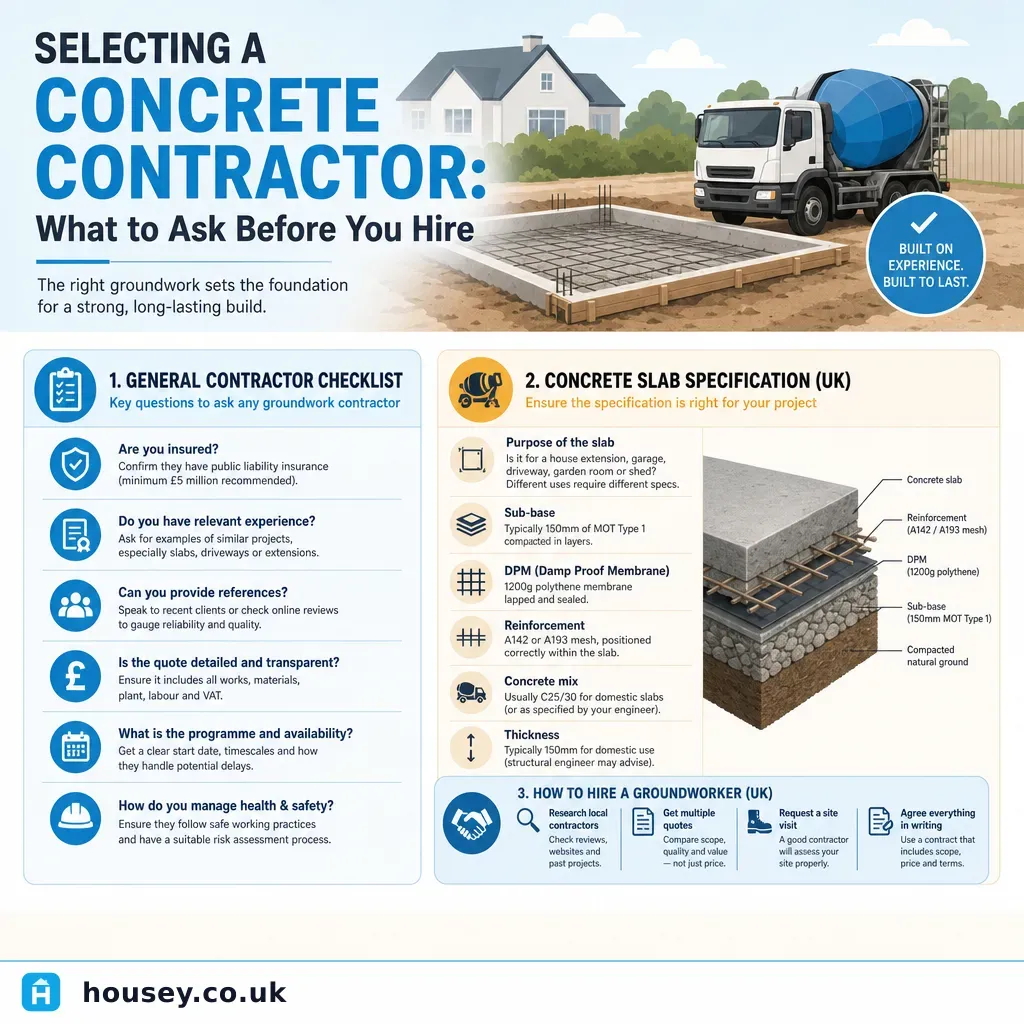
Selecting a Concrete Contractor: What to Ask Before You Hire
When choosing a concrete contractor, ask for proof of public liability insurance, a written specification stating the concrete mix to BS 8500, sub-base depth, and whether expansion joints are included.
 Improvement & Build
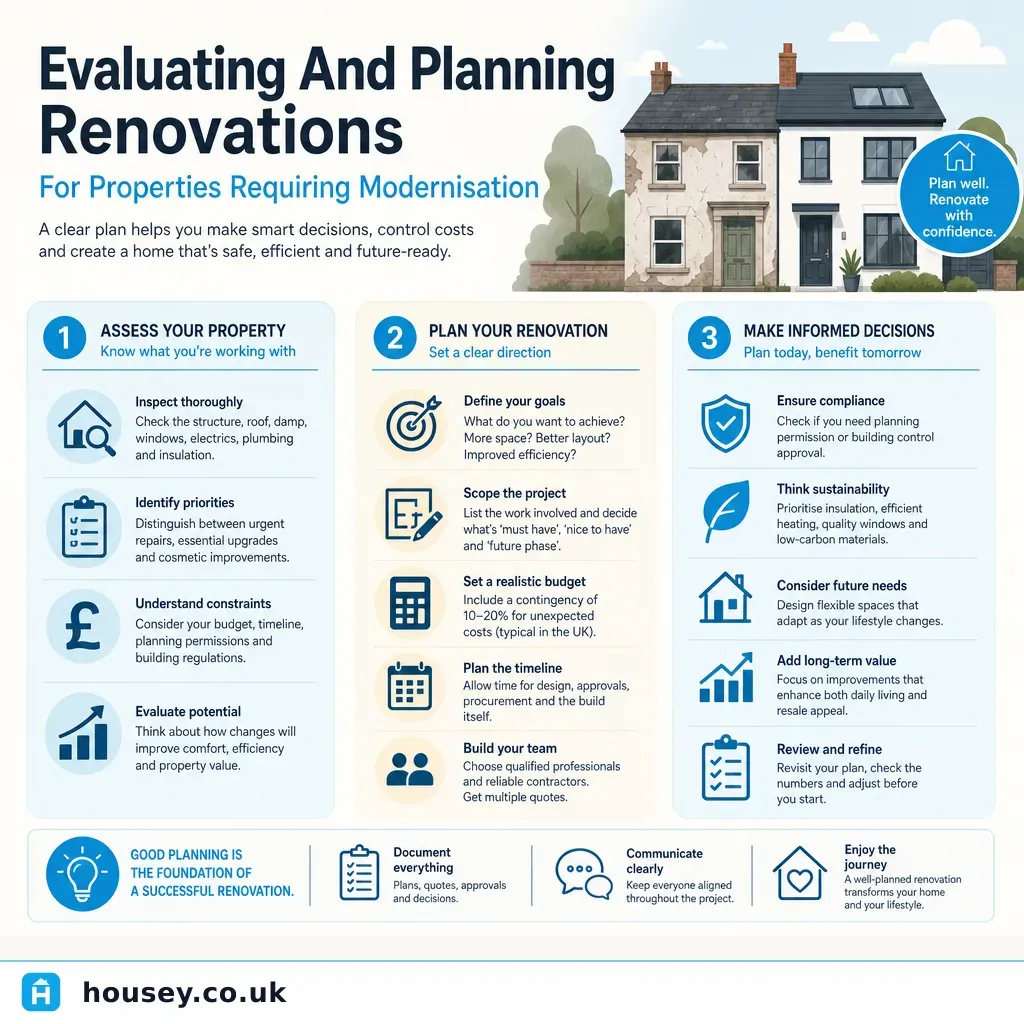
Evaluating And Planning Renovations For Properties Requiring Modernisation
Start by commissioning a condition survey — RICS Level 3 for pre-1919 properties — to identify structural defects, damp, and services issues before finalising a budget.
 Improvement & Build
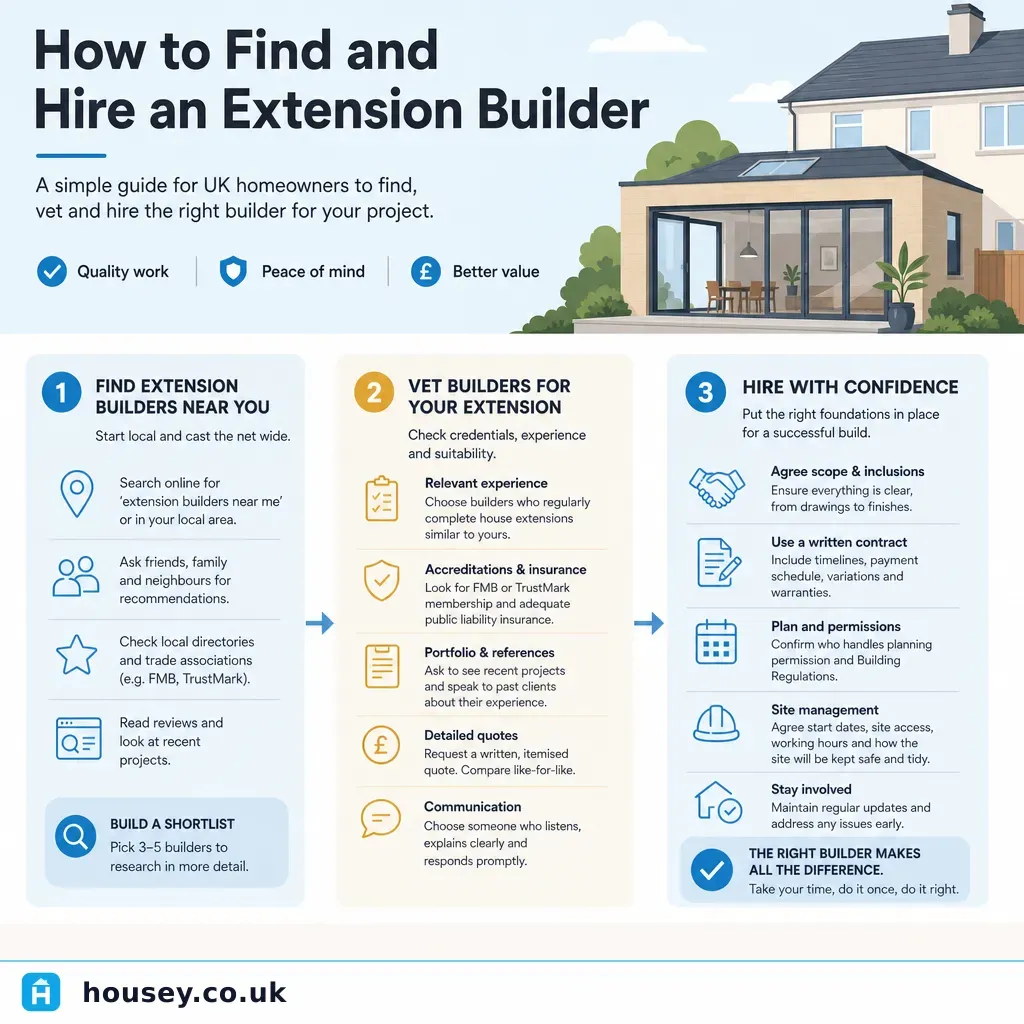
How to Find and Hire an Extension Builder
To hire a reliable extension builder, get at least three detailed written quotes from contractors with documented experience of similar projects.
 Improvement & Build
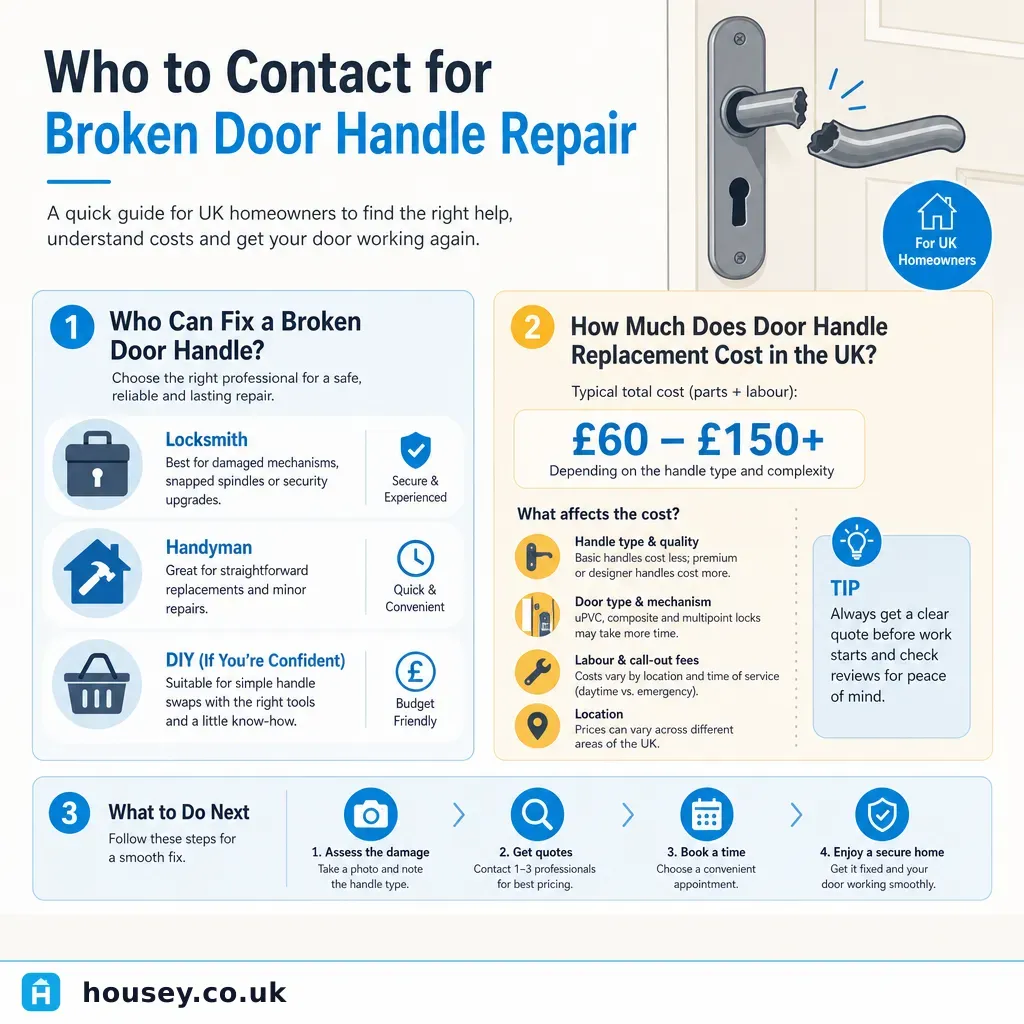
Who to Contact for Broken Door Handle Repair
For a broken door handle, a general handyperson can handle most internal timber door repairs, while a joiner or locksmith is better suited to external doors, particularly if the lock mechanism is affected.
 Improvement & Build
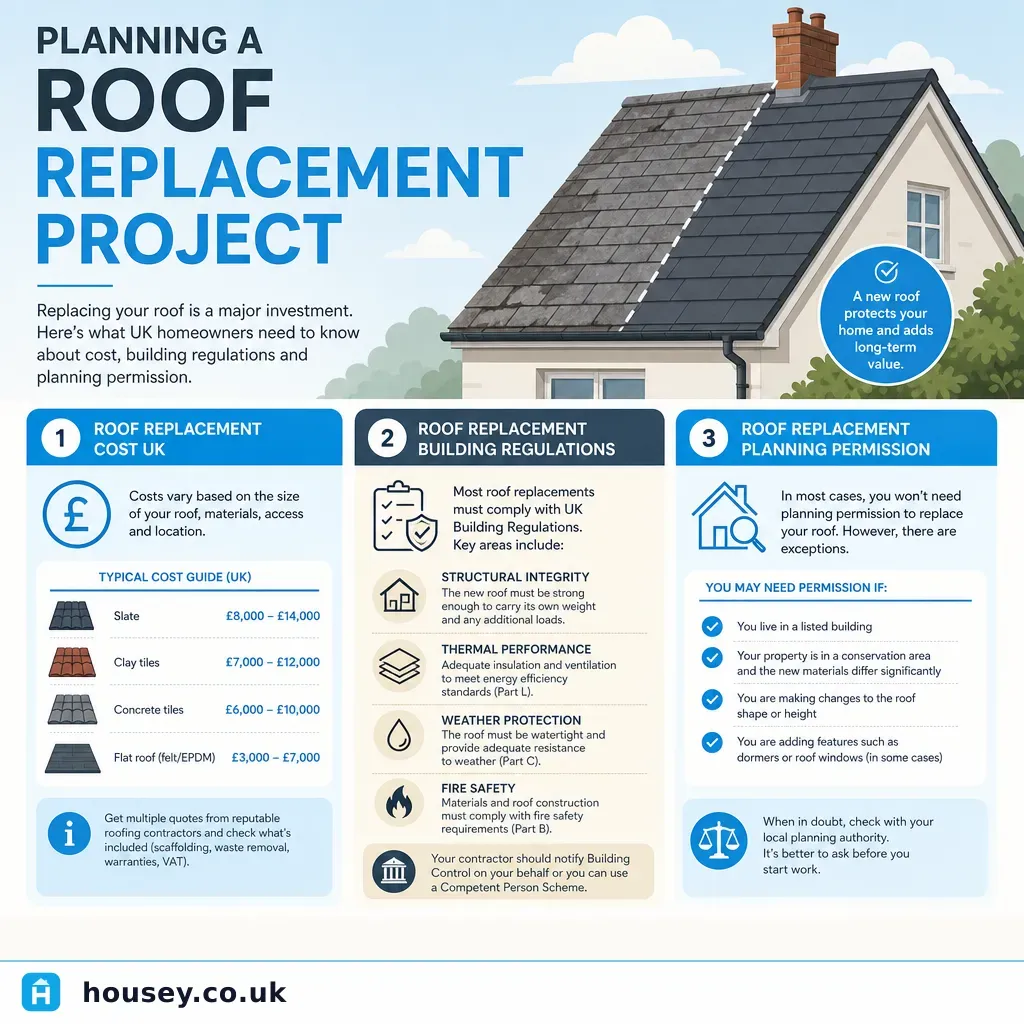
Planning a Roof Replacement Project
A roof replacement project involves stripping the existing covering, renewing the sarking felt and battens, and laying new tiles, slates, or a flat-roof membrane.