Planning a Roof Replacement Project
By Housey · Last reviewed 19th of May 2026
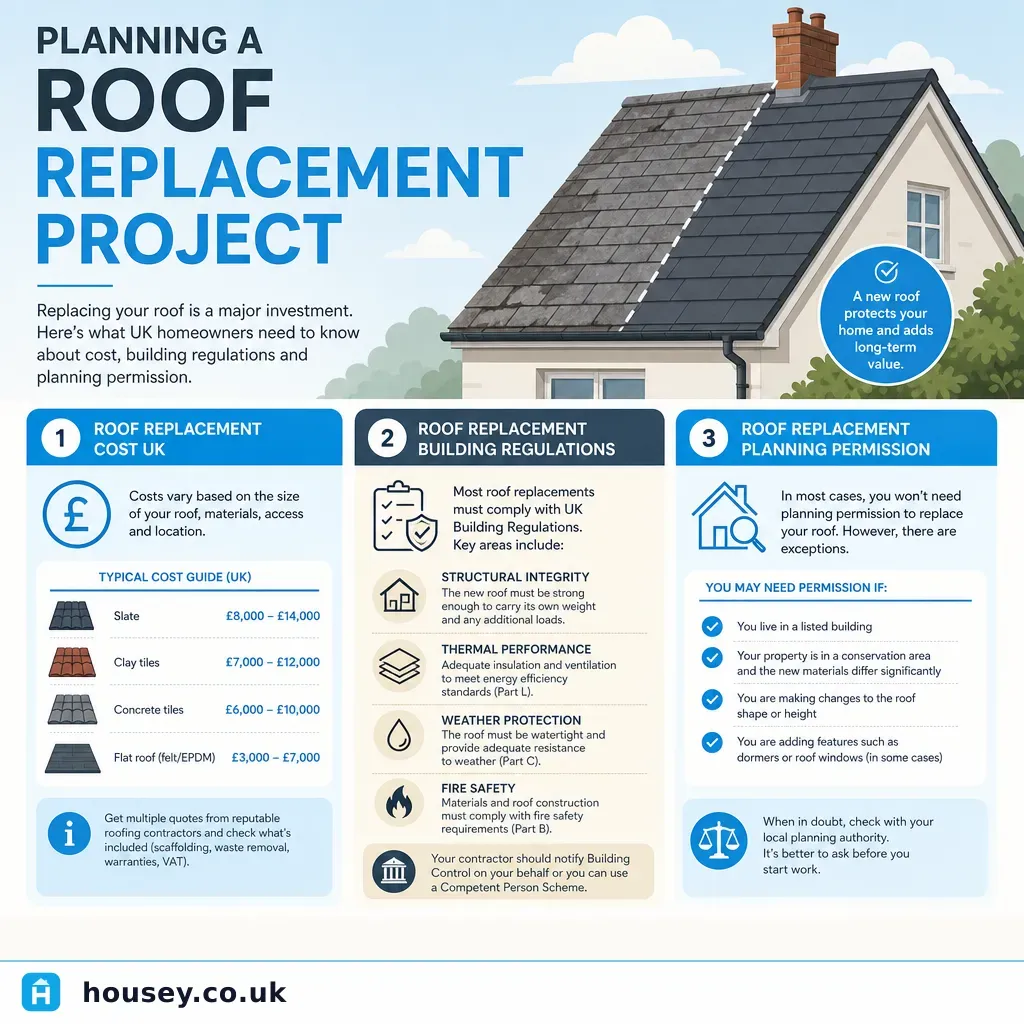
Planning a Roof Replacement Project
A full roof replacement is one of the larger home-improvement projects most UK homeowners will face — it involves scaffold, structural exposure, material selection, and regulatory compliance. The decisions made before work starts, from material choice to contractor selection, determine whether the project runs smoothly or runs into costly delays and disputes. Planning carefully at the outset protects both the building and the budget.
Key points
- Most like-for-like roof replacements (same material, same pitch) fall under permitted development and do not need a planning application, but changing the material type, height, or roof shape usually requires one.
- Building Regulations Approved Document L requires a U-value of 0.16 W/m²K for pitched roofs and 0.18 W/m²K for flat roofs when more than 25% of the roof area is being renewed.
- Scaffold costs (typically £600–£1,500 for a standard 3-bedroom house) are often priced separately by roofing contractors — always confirm whether scaffold is included in any quote.
- A pre-replacement inspection to check rafter condition, purlin integrity, and chimney flashings is strongly advisable — hidden timber repairs can significantly increase project cost.
- Contractors registered under the Competent Roofer scheme can self-certify Building Regulations compliance, avoiding the need for a separate local authority building control application.
Do you need planning permission?
Planning and regulatory decision guide
- Permitted development likely applies if the replacement uses the same material type (tile for tile, slate for slate), the same pitch, and does not alter the roof shape, height, or footprint.
- Planning permission required if changing material type in a conservation area or where an Article 4 direction has removed permitted development rights, or if the alteration changes the pitch or height.
- Listed building consent required for any alterations to a listed building — including like-for-like tile replacement.
- Building Regulations approval always required if more than 25% of the roof area is being replaced, regardless of whether planning permission is needed.
- Check with your local planning authority if the property is in a national park, AONB, or if you are uncertain about local restrictions.
Wales and Scotland operate under separate planning systems. Verify requirements with your local authority if outside England.
Choosing the right roofing material
Material | Typical lifespan | Approx installed cost (per m²) | Best suited to | Key considerations |
|---|---|---|---|---|
Concrete interlocking tiles | 40–60 years | £35–£60/m² | 1950s–1990s housing; new builds | Heavier than slate; check rafter capacity; widely available |
Clay plain tiles | 60–100+ years | £50–£90/m² | Victorian, Edwardian; conservation areas | Authentic period appearance; longer lifespan |
Natural slate | 80–150 years | £60–£110/m² | Period properties; upland areas | Premium choice; Welsh and Spanish variants available |
Fibre-cement slate | 30–40 years | £40–£70/m² | Mid-budget replacement for failing natural slate | Lighter than natural slate; check local planning views |
GRP fibreglass flat roof | 20–30 years | £50–£100/m² | Flat or low-pitch extensions | Seamless; requires certified installer for manufacturer warranty |
EPDM rubber flat roof | 30–50 years | £40–£80/m² | Flat roofs of all sizes | Excellent longevity; fewer seams than traditional felt |
Indicative UK installed costs, last reviewed 2026-05-19. Prices exclude scaffold and waste disposal. Obtain at least three itemised quotes.
Structural assessment before work starts
Before committing to a specification, a pre-replacement survey is strongly advisable. A roofer or chartered surveyor should check:
- Rafter condition: Rot at eaves is common in Victorian and Edwardian properties where roof ventilation was limited.
- Purlins and ridge beam: Sagging or split purlins need repair before re-tiling; addressing these while scaffold is in place is far cheaper than a return visit later.
- Chimney stacks: Cracked pots, failed flaunching, and deteriorated flashings are best tackled at the same time as the re-roof.
- Flat-roof deck: Delaminated or rotted deck boards must be replaced before the new membrane is applied.
- Roof insulation: Building Regulations require the new roof to meet the relevant U-value; inadequate existing insulation must be upgraded at this stage.
What to ask before accepting a quote
- What is included? Strip-off and disposal of existing tiles, new breathable felt or membrane, new battens, tiles or slates, flashings, ridge, hip, and verge details.
- Is scaffold included? If not, obtain a separate scaffold quote and add it to the comparison before deciding.
- What qualifications does the contractor hold? Ask for Competent Roofer or TrustMark registration, or confirm they will submit a building control application independently.
- What guarantee does the work carry? Workmanship guarantees of 10–20 years are common on complete re-roofs — ask whether an insurance-backed warranty (IBW) is available.
- What could change the price? Rotten rafters, failed purlins, chimney work, and additional insulation requirements are the most common additions — ask how these will be identified and priced during strip-off.
- Is VAT included? Roofing work on existing residential properties is typically charged at 20% VAT.
- How long will the project take? A standard 3-bedroom semi typically takes 3–7 working days for the roofing works.
- How will the site be protected overnight? Confirm the contractor will use waterproof sheeting if the work extends over more than one day.
Project timeline
A typical re-roof on a 3-bedroom semi-detached house follows this sequence:
- Pre-contract survey (1 day) — roofer or structural assessor inspects the loft and roof externally.
- Planning and building control — confirm whether a planning application is needed (allow up to 8 weeks if so); register with building control before or at the start of work.
- Scaffold erection (1 day) — typically erected 1–2 days before roofing starts.
- Strip-off (1–2 days) — existing tiles, battens, and felt are removed; rotten timbers are identified and quoted separately.
- Timber repairs (if needed) — rafter repairs, purlin packing, or ridge work completed before new covering is applied.
- New felt and battens (1 day) — breathable roofing membrane and counter-battens fixed.
- Tiling or slating (2–4 days) — new covering laid; ridges, hips, and verges finished.
- Flashings and gutters (1 day) — lead or alternative flashings installed; gutters re-hung if required.
- Building control inspection — arranged by the contractor under Competent Roofer, or via a separate application.
- Scaffold strike (1 day) — once all works are signed off.
Important limitations
This article provides general information about roof replacement in England. Planning rules, Building Regulations requirements, and structural conditions vary significantly by property type, age, location, and condition. This guide does not constitute planning, legal, or structural advice. Rules may differ in Wales and Scotland. A qualified professional should assess your specific property before work is commissioned.
When this becomes urgent
Seek professional advice without delay if:
- Work has already started or been completed without the necessary building control or planning approval — retrospective consent is possible but time-sensitive
- A structural concern such as rotten rafters or failing purlins has been found during strip-off that was not included in the original quote
- You are exchanging contracts on a property where recent roof replacement lacks a building control completion certificate
What to ask a qualified professional
Before instructing a roofing contractor:
- Is a planning application required for my specific replacement, or does it fall under permitted development?
- Will you register the work under the Competent Roofer scheme, or do I need a separate building control application?
- What does the thermal performance sign-off process involve, and what documents will I receive on completion?
- How will additional timber repairs found during strip-off be identified and priced?
- What does the workmanship guarantee cover, and is it backed by an insurance-backed warranty?
When to get professional help
A roof replacement is not a DIY project. Working at height on a stripped roof is among the most hazardous domestic tasks, and incorrect installation of flashings or verges can lead to water ingress that may not be apparent for months. Engage a professional if:
- You need a structural assessment before or during the project — a chartered surveyor or structural engineer is appropriate for anything beyond routine rafter condition checks
- Building control compliance is required — a building control consultant can guide the application and inspection process
- The project involves multiple contractors (roofer, scaffold company, chimney specialist) — a project manager can coordinate sequencing and quality oversight from a single point of contact
How Housey can help
Housey makes it straightforward to find and compare vetted roofers for the replacement works, and can also connect you with building control consultants to navigate the compliance process, or project managers if you need coordinated oversight of scaffold, roofing, and chimney contractors from start to finish.
Frequently asked questions
Do I need planning permission to replace my roof?
Most like-for-like replacements fall under permitted development and do not require a planning application. You will need planning permission if you are in a conservation area, AONB, or national park; if the property is listed; or if the replacement changes the material type where an Article 4 direction applies. Always check with your local planning authority if uncertain.
How much does a full roof replacement cost in the UK?
A like-for-like concrete tile re-roof on a standard 3-bedroom semi-detached house typically costs £4,500–£8,000 including scaffold. Natural slate or clay tile roofs often cost £8,000–£15,000 or more depending on size and specification. Flat-roof replacements vary widely by area and system. Indicative UK costs, last reviewed 2026-05-19. Obtain at least three itemised quotes.
How long does a roof replacement take?
Most standard re-roofs on a 3–4 bedroom house take 3–7 working days for the roofing team. Scaffold typically remains in place for 1–2 weeks in total including erection and striking. Projects involving significant timber repairs, chimney work, or larger roofs will take longer.
Do I need Building Regulations approval for a roof replacement?
Yes, if more than 25% of the roof surface area is being renewed. Approved Document L requires the thermal performance of the replaced roof to meet current standards — 0.16 W/m²K for a pitched roof and 0.18 W/m²K for a flat roof. Contractors registered under the Competent Roofer scheme can self-certify; otherwise a building control application is needed before work starts.
Sources and further reading
- Building Regulations Approved Document L: Conservation of Fuel and Power — GOV.UK
- Planning Portal — roof alterations and permitted development — Planning Portal
- Competent Roofer scheme — NFRC / TrustMark
- Working safely on roofs — Health and Safety Executive
- NHBC Standards — roof construction — NHBC
Useful next reads
 Improvement & Build
Selecting and Hiring a Remodelling Contractor
Hiring a remodelling contractor starts with a written scope of works and a shortlist of at least three companies registered with TrustMark or the Federation of Master Builders.
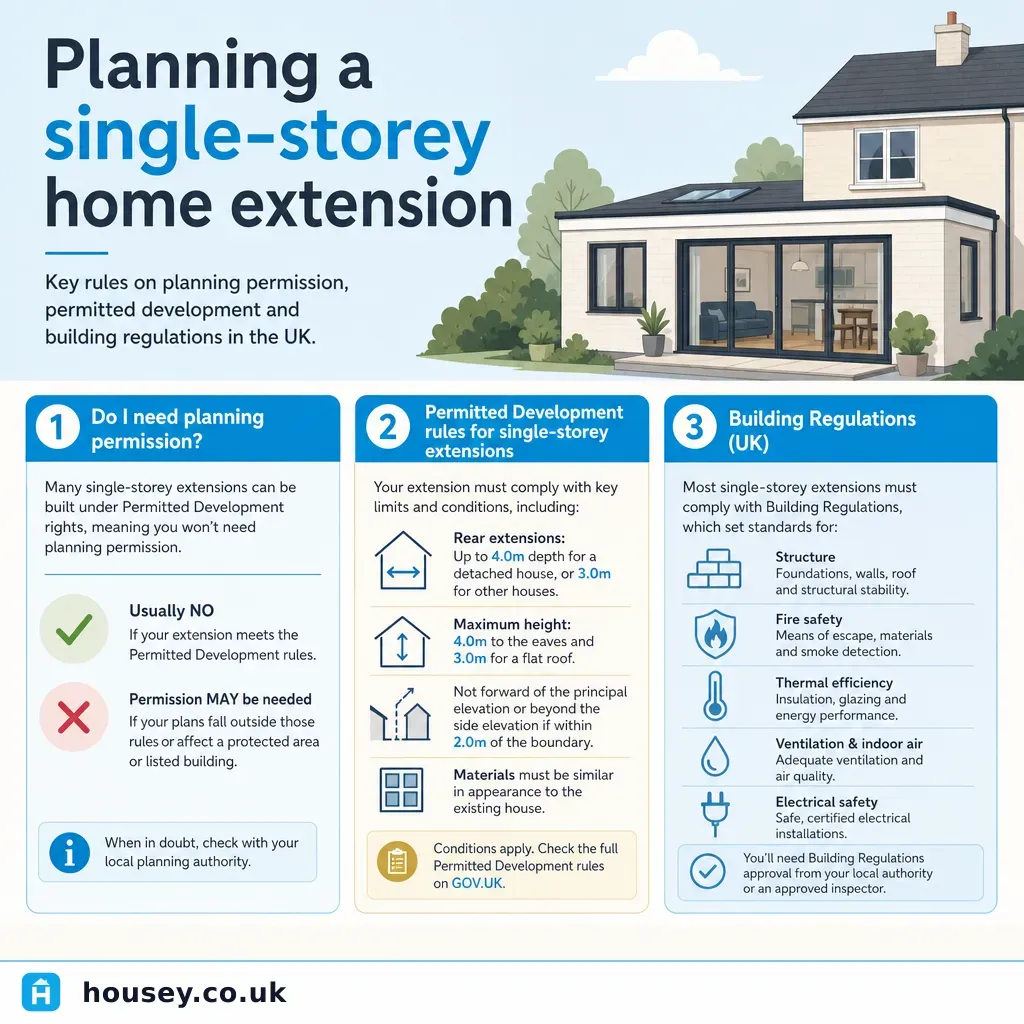 Improvement & Build
Planning a single-storey home extension
A single-storey extension may fall under permitted development rights, avoiding full planning permission, but only if it meets size, height, and boundary conditions simultaneously.
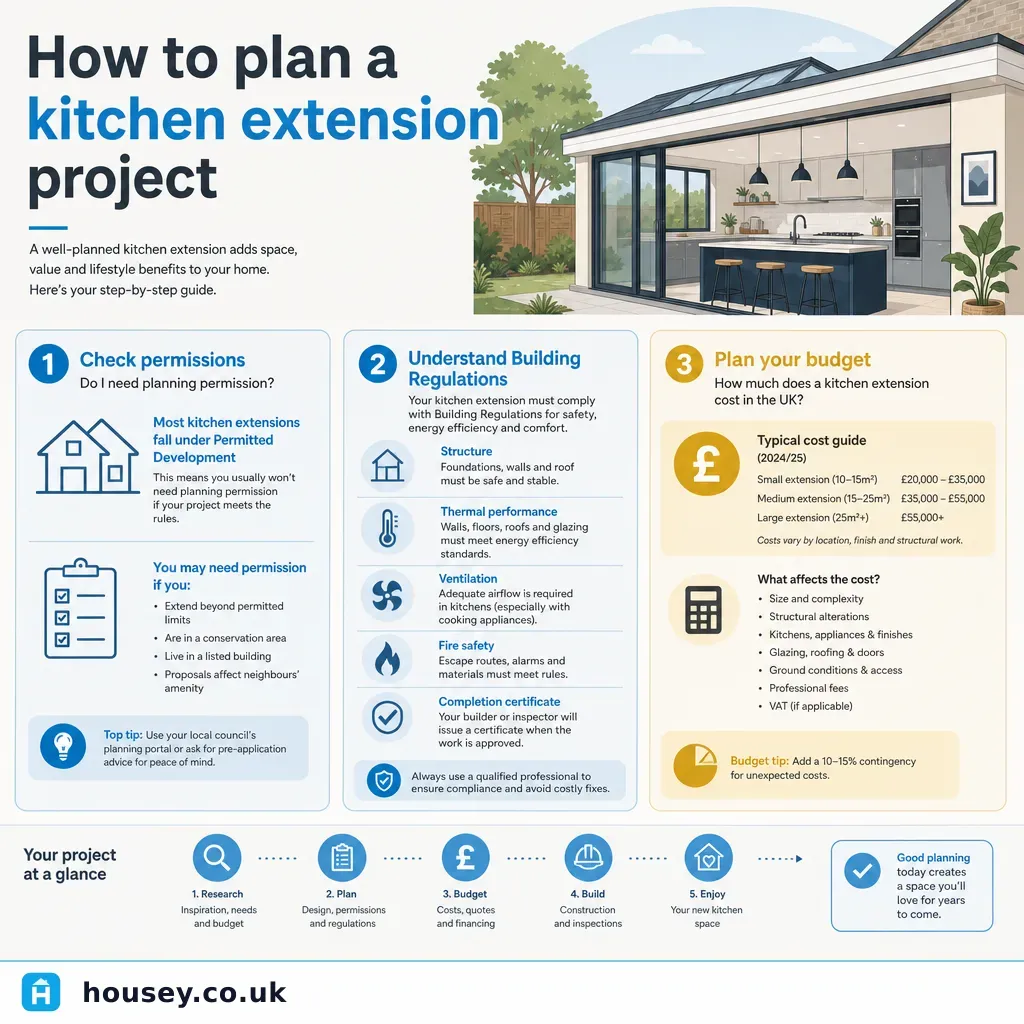 Improvement & Build
How to plan a kitchen extension project
Planning a kitchen extension means checking whether permitted development or planning permission applies, appointing an architect for drawings, obtaining Building Regulations approval, and commissioning a structural engineer for any wall removals.
 Improvement & Build
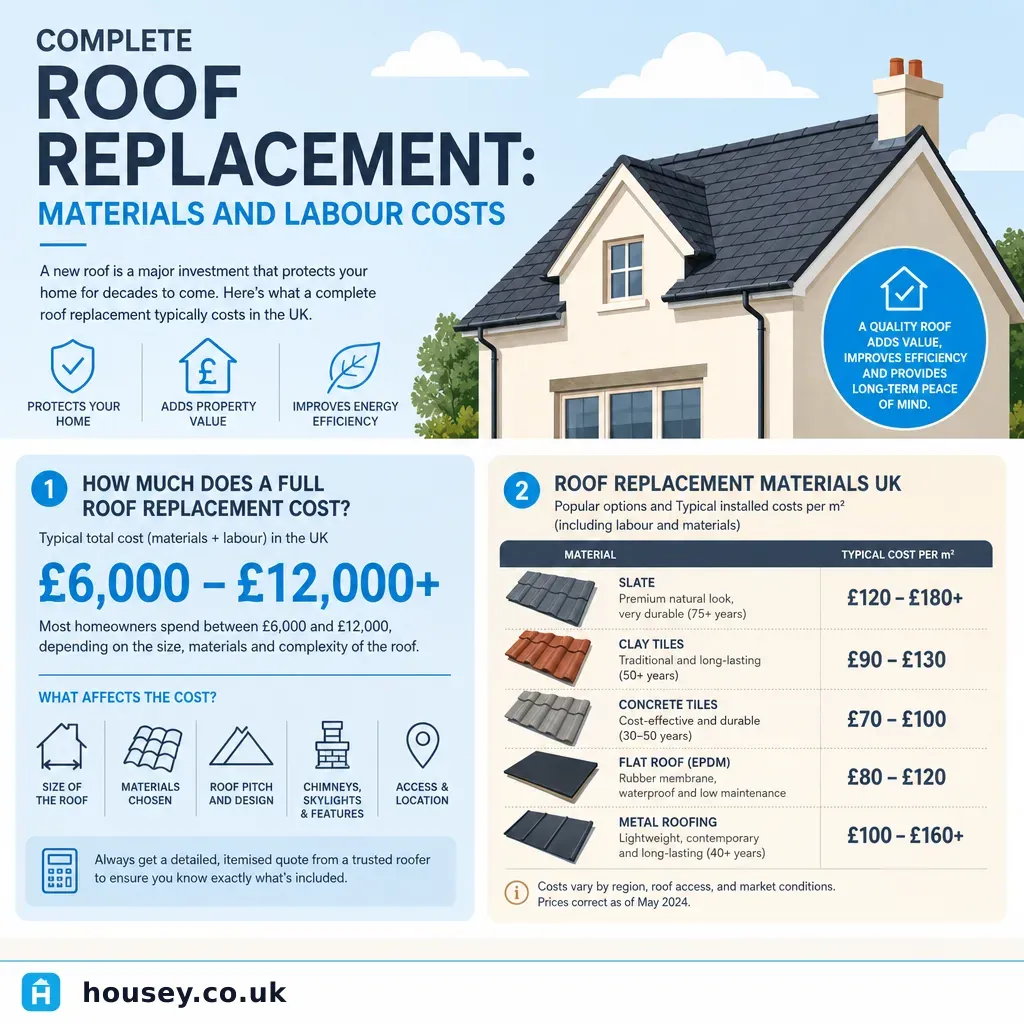
Complete Roof Replacement: Materials and Labour Costs
A complete roof replacement on a typical three-bedroom semi-detached house costs between £5,500 and £14,000, depending on material, roof complexity, and region.
 Improvement & Build
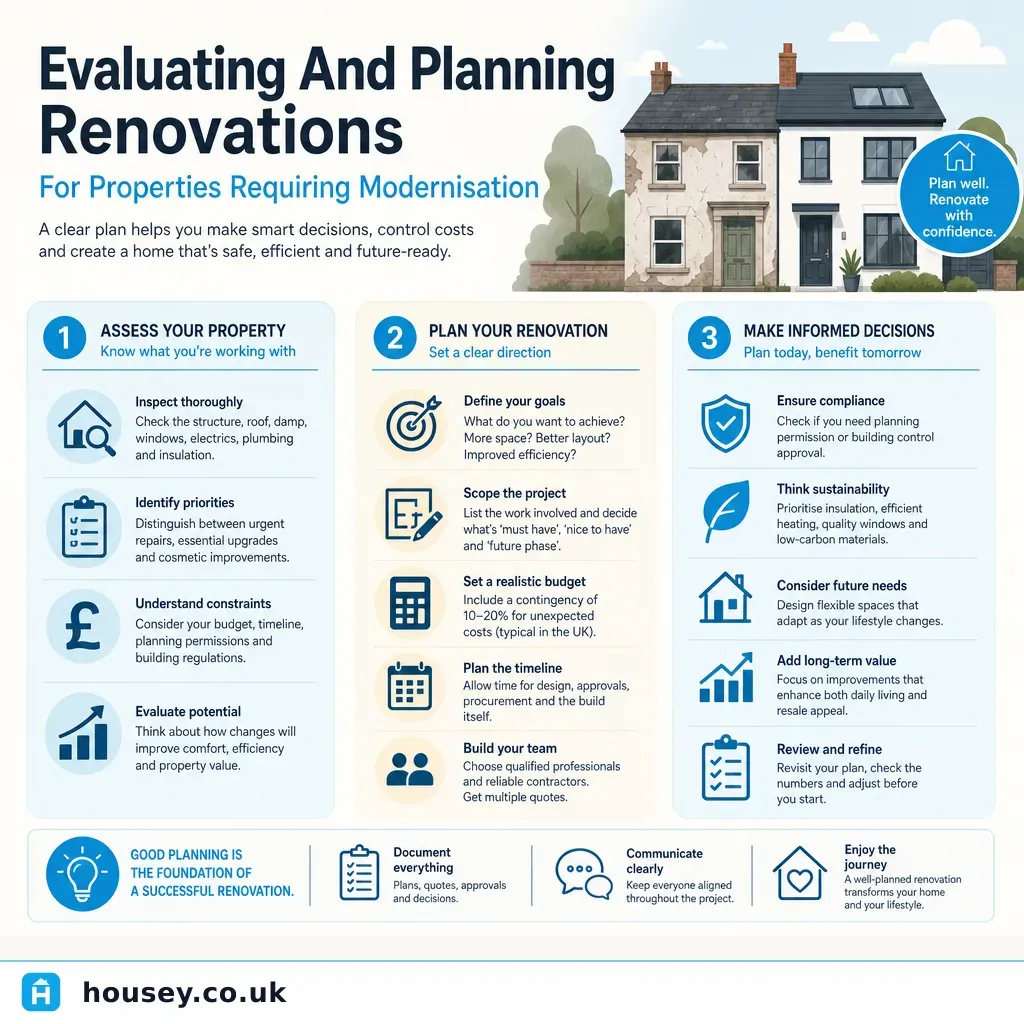
Evaluating And Planning Renovations For Properties Requiring Modernisation
Start by commissioning a condition survey — RICS Level 3 for pre-1919 properties — to identify structural defects, damp, and services issues before finalising a budget.