Selling Your Property Privately: Process and Considerations
By Housey · Last reviewed 25th of May 2026
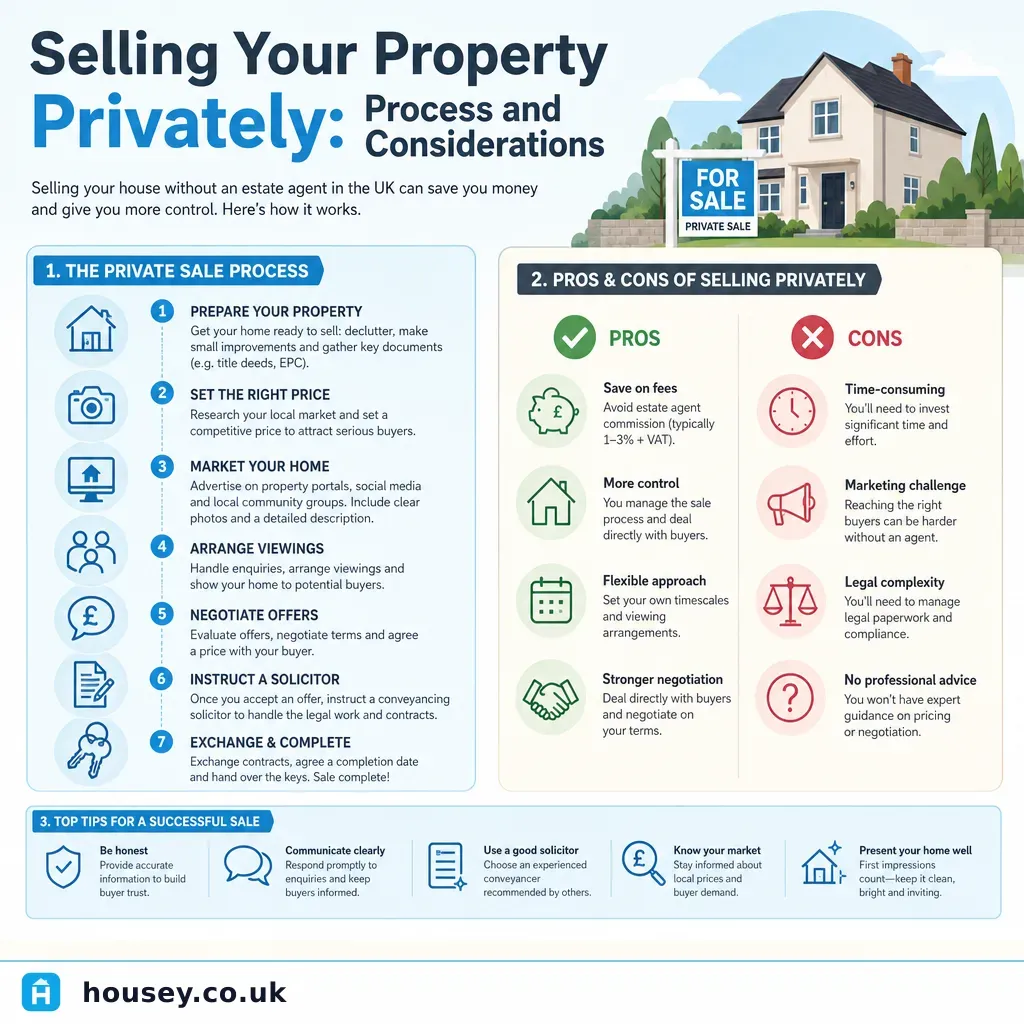
Selling Your Property Privately: Process and Considerations
Private property sales — where the seller markets the home and manages the process without using an estate agent — have become more accessible in the UK as online platforms and list-only agencies have grown. The main attraction is avoiding standard agency commission, which typically ranges from 1% to 3% of the sale price plus VAT. But a private sale does not remove legal obligations, and it places considerable practical responsibility on the seller throughout the process.
Key points
- Selling a property privately is entirely legal in England, Wales, Scotland, and Northern Ireland — there is no statutory requirement to use an estate agent.
- An Energy Performance Certificate (EPC) is legally required before marketing begins under the Energy Performance of Buildings (England and Wales) Regulations 2012; failure to have one in place before marketing can result in a fine of up to £200.
- The Consumer Protection from Unfair Trading Regulations 2008 prohibit misleading or inaccurate statements in property marketing — these obligations apply equally to private sellers.
- Rightmove and Zoopla do not accept listings directly from private sellers; access to these portals requires instructing a regulated estate agent, including list-only or hybrid services.
- A solicitor regulated by the SRA or a licensed conveyancer regulated by the CLC is required for conveyancing; a private sale does not mean self-conveyancing.
Should you sell privately? A decision tree
- Sell privately if you already have a known buyer (a neighbour, family member, or colleague), you are confident in your pricing and negotiation ability, and you have time to manage enquiries and viewings yourself.
- Use a list-only or hybrid agent if you want access to Rightmove and Zoopla to reach a broad audience but prefer to save on full agency commission. Typical fixed fees range from £500 to £1,500 (Indicative UK costs, last reviewed 2026-05-25).
- Use a traditional estate agent if you need maximum buyer reach, prefer professional marketing and negotiation support, or are selling in a slow market where presentation and pricing expertise matter most.
- Take legal advice before proceeding if your property has a short lease, planning complications, unresolved building regulations matters, known structural issues, or a current tenant.
What the private sale process involves
Selling privately removes the estate agent as intermediary but does not change the legal steps. Here is the typical sequence in England and Wales:
- Obtain an EPC — legally required before marketing, unless an exemption applies (valid certificates last 10 years; check the national EPC register on GOV.UK).
- Set a realistic asking price — consider instructing an independent RICS valuation or reviewing HM Land Registry price paid data for comparable sales in your area.
- Prepare marketing materials — professional photographs, an accurate written description, and a floor plan. All statements must be accurate under the Consumer Protection from Unfair Trading Regulations 2008.
- List the property — use private sale platforms or a list-only agent to gain Rightmove or Zoopla presence.
- Manage viewings and enquiries — you will handle all buyer contact and arrange viewings yourself.
- Negotiate and accept an offer — in England and Wales, this is not legally binding until exchange of contracts.
- Instruct a solicitor or licensed conveyancer — identical to any sale; begin this process as soon as a buyer is found.
- Progress through conveyancing — including completing the TA6 property information form, responding to the buyer's solicitor's enquiries, and reaching exchange and completion.
Legal requirements you cannot skip
Requirement | Legal basis | Who provides it |
|---|---|---|
Energy Performance Certificate (EPC) | Energy Performance of Buildings (England and Wales) Regulations 2012 | Accredited energy assessor (search GOV.UK EPC register) |
Accurate property descriptions | Consumer Protection from Unfair Trading Regulations 2008 | Seller's responsibility |
Property information forms (TA6, TA10) | Part of the standard conveyancing pack | Prepared with your solicitor |
Solicitor or licensed conveyancer | Legal transfer of ownership requires a regulated professional | Solicitor (SRA-regulated) or licensed conveyancer (CLC-regulated) |
Leasehold compliance (if applicable) | Leasehold Reform Act and individual lease terms | Your solicitor will advise |
What not to assume when selling privately
Private sellers sometimes underestimate what is involved. Common misconceptions:
- "I will save money on everything." You avoid agency fees but still pay for the EPC, solicitor fees, photography, and platform listing costs. On a £300,000 home, a 1.5% agency fee would be £4,500 — weigh this against your time investment and more limited marketing reach.
- "My buyer does not need their own solicitor." Both buyer and seller need separate legal representation. The buyer's solicitor works for the buyer, not for you.
- "A private sale is faster." Without an agent coordinating communication, delays in responding to enquiries, arranging viewings, or progressing paperwork can slow the process compared to a professionally managed sale.
- "The portal's estimated value is accurate enough for pricing." Automated valuations carry wide margins of error. An overpriced private listing has fewer viewings to begin with — reducing your ability to generate competitive interest.
- "I don't have to disclose problems." Property information forms require honest disclosure of known defects, disputes, and planning history. Deliberate non-disclosure can result in legal claims against you after completion.
Private sale vs. estate agent vs. online agent: a comparison
Approach | Typical cost | Portal access | Who manages viewings | Key risk |
|---|---|---|---|---|
Traditional estate agent | 1–3% of sale price + VAT (Indicative, last reviewed 2026-05-25) | Yes, via agent | Agent | Higher cost; variable service quality between firms |
Online or hybrid agent (list only) | Fixed fee £500–£1,500 (Indicative, last reviewed 2026-05-25) | Yes, via agent's account | Seller | Less support; seller negotiates and chases progress independently |
Fully private sale | £200–£600 for EPC, photos, platform (Indicative, last reviewed 2026-05-25) | No, unless via paid portal add-on | Seller | Limited buyer reach; no professional marketing or negotiation support |
Important limitations
This article provides general information about private property sales in England and Wales. Rules differ in Scotland and Northern Ireland. Conveyancing law, EPC requirements, and consumer protection obligations may be interpreted and applied differently depending on individual circumstances and property type. Nothing in this article constitutes legal advice. Always instruct a qualified solicitor or licensed conveyancer before completing any property transaction.
What to ask a qualified professional
Ask your solicitor or licensed conveyancer before marketing:
- What property information and documentation do I need to prepare, and are there any outstanding issues with the title or planning history?
- Are there any leasehold or tenure matters I should resolve before marketing begins?
- What conveyancing searches will the buyer's solicitor require, and how long do they typically take in this area?
- If I have carried out alterations or extensions, do I need to resolve any building regulations or planning compliance gaps before sale?
When to get professional help
Consider using a traditional or hybrid estate agent, or seek specialist legal advice, if:
- The property is leasehold with fewer than 80 years remaining on the lease
- There are unresolved planning or building regulations issues from past works
- The property is subject to a boundary dispute, right of way, or neighbour dispute
- A previous sale has fallen through for legal or structural reasons
- There is a current or former tenancy to unwind before completion
How Housey can help
Whether you sell privately or through an agent, you will need a regulated professional for the legal transfer. Housey connects sellers with regulated conveyancing solicitors so you can compare quotes from qualified providers. If you want an independent view of your property's value before setting an asking price, a professional RICS valuation from a registered valuer gives you credible, evidence-based pricing support.
Frequently asked questions
Is it legal to sell your house without an estate agent in the UK?
Yes. There is no legal requirement to use an estate agent when selling residential property in England, Wales, Scotland, or Northern Ireland. You must still comply with consumer protection and marketing regulations, obtain a valid EPC before marketing begins, and instruct a solicitor or licensed conveyancer to handle the legal transfer of ownership.
Do I need a solicitor for a private property sale?
Yes. Conveyancing — the legal process of transferring property ownership — must be handled by a solicitor regulated by the Solicitors Regulation Authority (SRA) or a licensed conveyancer regulated by the Council for Licensed Conveyancers (CLC). You cannot legally transfer ownership of property in the UK without a qualified professional managing the process.
How do I market my property without a high-street estate agent?
You can list on private sale websites such as TheHouseShop or HouseSimple. To appear on Rightmove or Zoopla, you need to use a list-only or hybrid estate agent who offers portal access as part of a fixed-fee service. Prepare professional photographs, an accurate written description, and a floor plan to make your listing competitive against agent-marketed properties in your area.
What are the main risks of selling privately?
The principal risks are a smaller potential buyer pool than agent-marketed properties, no professional negotiation or pricing support, and the risk of legal or disclosure errors if you are unfamiliar with property information requirements. Non-disclosure of known defects or disputes in the property information forms can result in claims against you after completion. Instructing a solicitor early and completing documentation thoroughly reduces these risks significantly.
Sources and further reading
- Energy Performance Certificates: buying and selling — GOV.UK
- Consumer Protection from Unfair Trading Regulations 2008 — legislation.gov.uk
- Selling your home — GOV.UK
- HM Land Registry: price paid data — HM Land Registry
- Selling your home: Citizens Advice — Citizens Advice
Useful next reads
 Buying & Moving
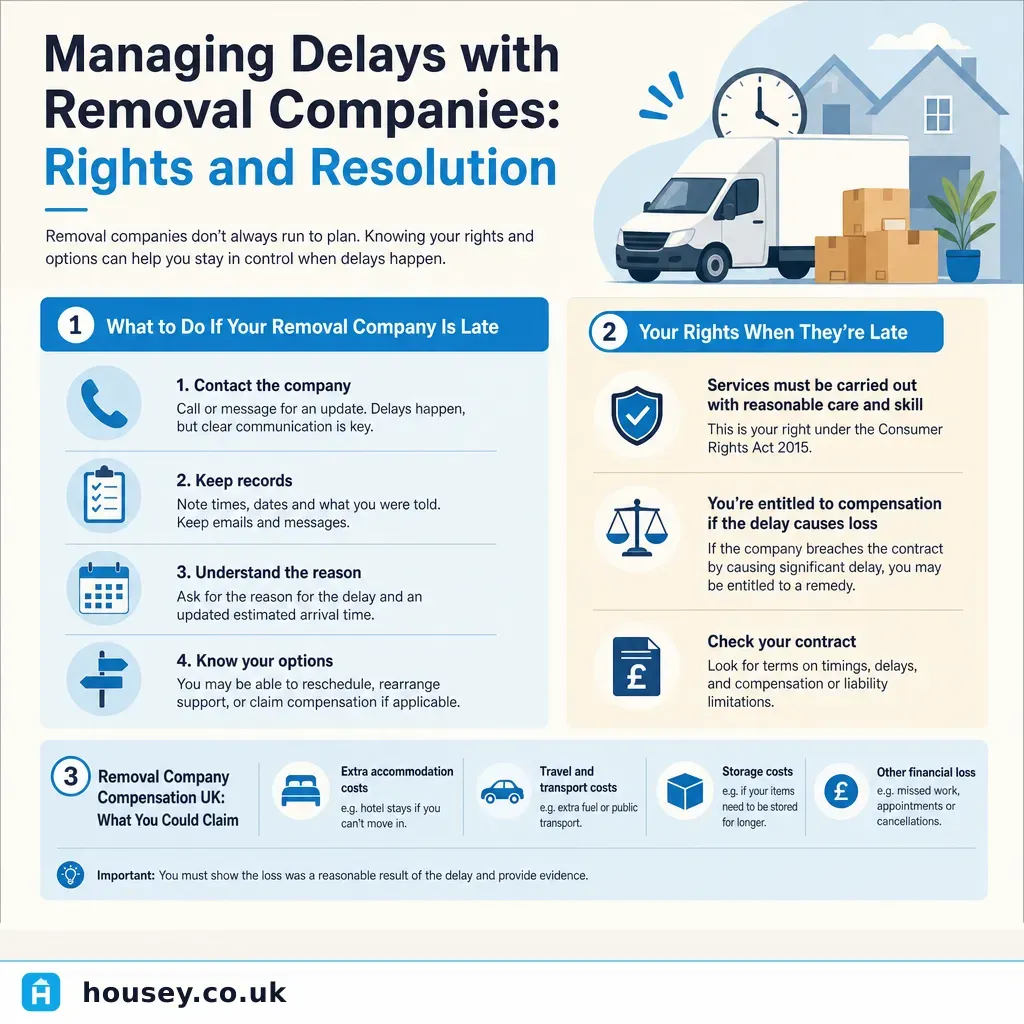
Managing Delays with Removal Companies: Rights and Resolution
If a removal company is late, your rights depend on your contract and whether the company is BAR-registered.
 Buying & Moving
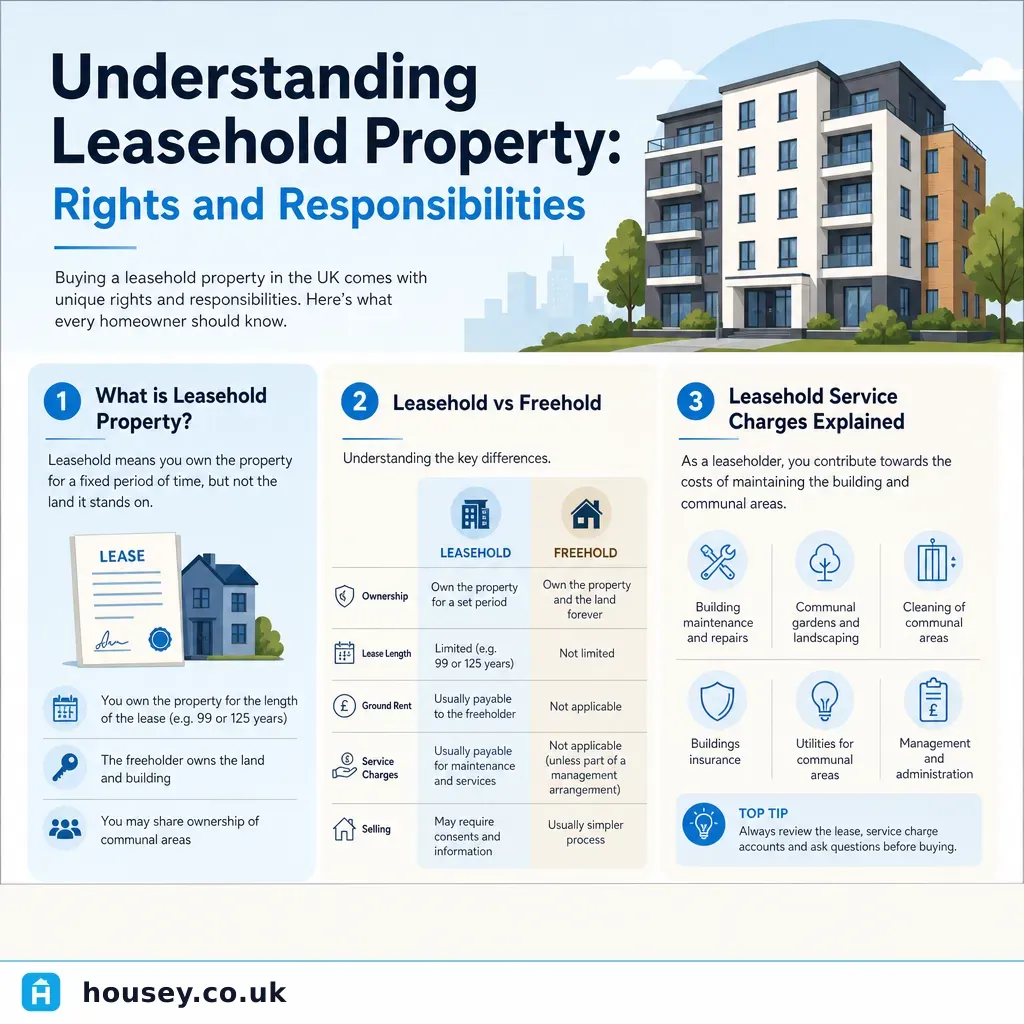
Understanding Leasehold Property: Rights and Responsibilities
Leasehold means you own a time-limited interest in a property while the freeholder owns the land and building.
 Buying & Moving
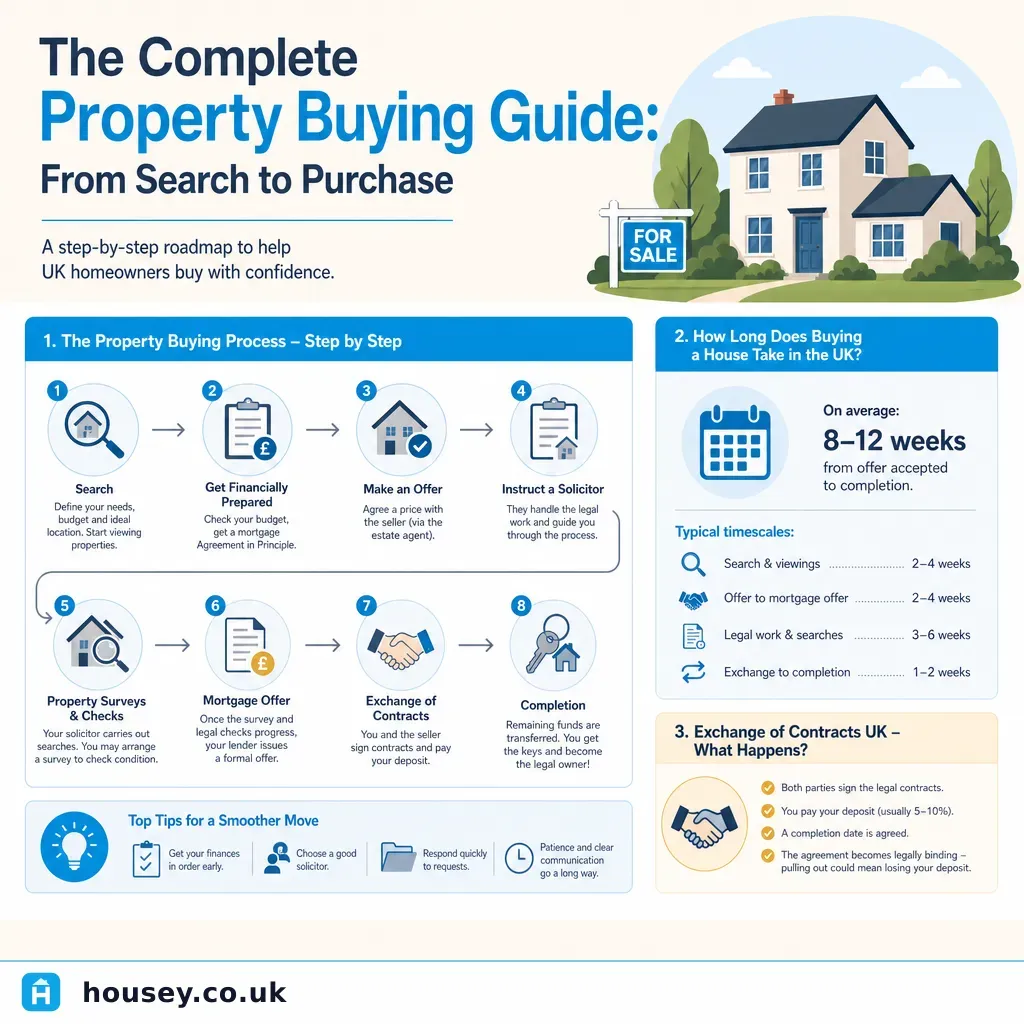
The Complete Property Buying Guide: From Search to Purchase
Buying a property in England and Wales typically takes 3–6 months from accepted offer to completion.
 Buying & Moving
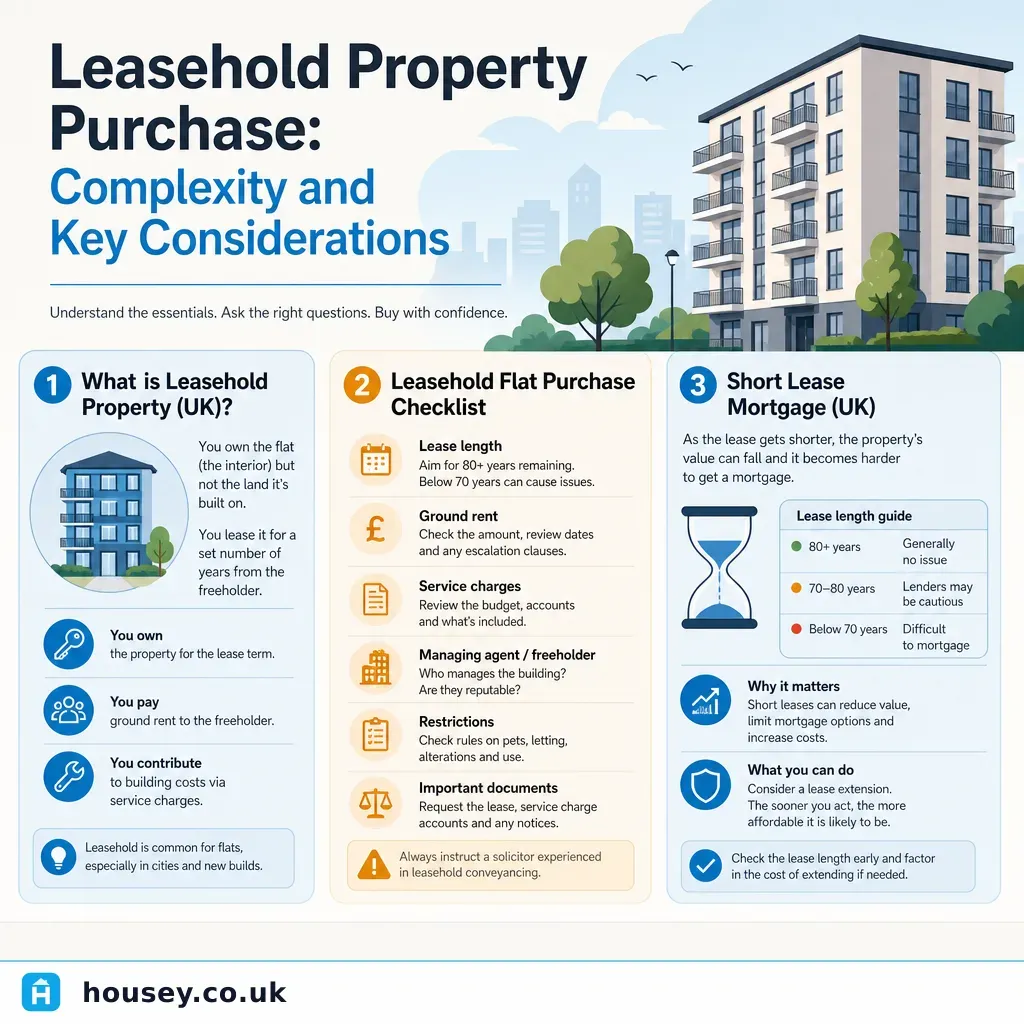
Leasehold Property Purchase: Complexity and Key Considerations
Buying a leasehold property means purchasing the right to occupy for a fixed term rather than owning the land outright.
 Buying & Moving
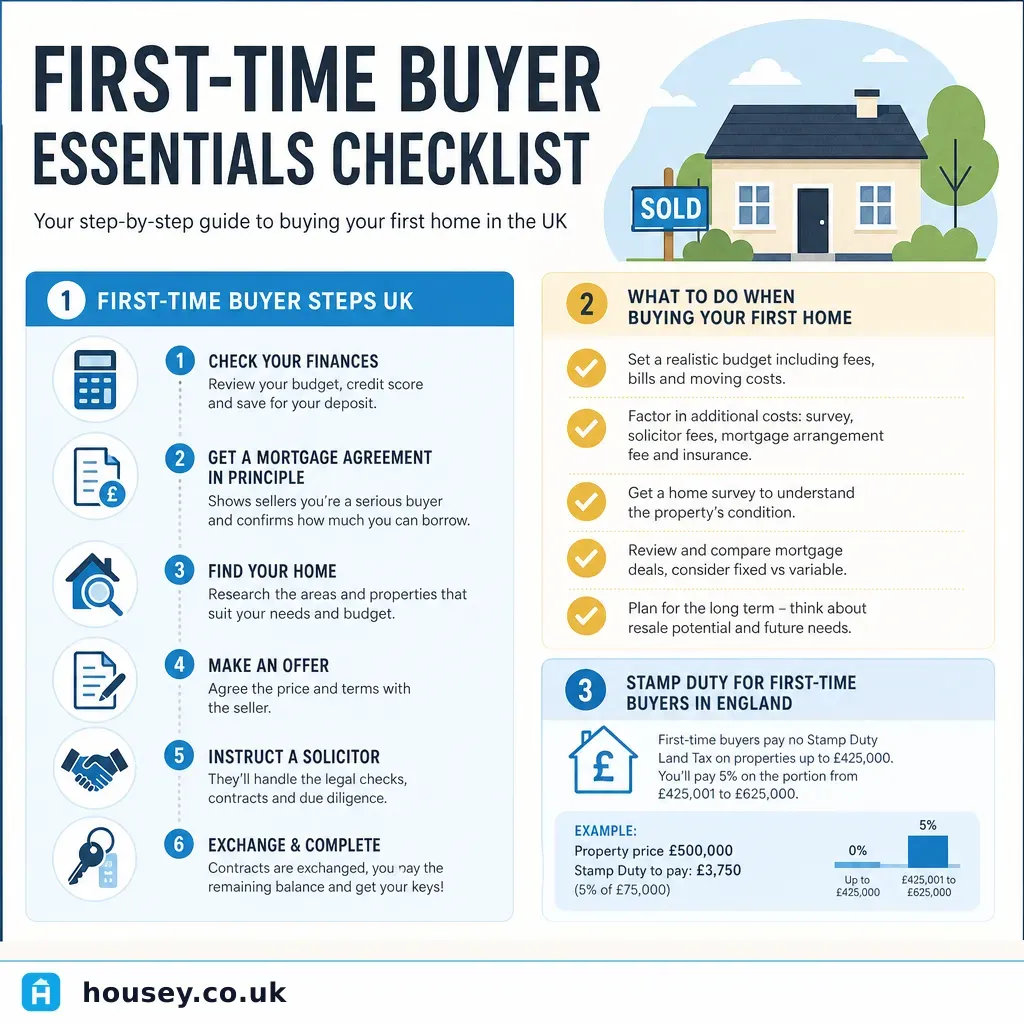
First-Time Buyer Essentials Checklist
Buying your first home involves obtaining a mortgage in principle, making an offer, instructing a solicitor, arranging a survey, and exchanging contracts before completion.