Small kitchen renovation: budgeting for costs and planning your project
By Housey · Last reviewed 31st of May 2026

Small kitchen renovation: budgeting for costs and planning your project
A kitchen renovation is one of the most impactful home improvements a UK homeowner can undertake — and one of the easiest to overspend on without a clear plan. The question of cost is rarely straightforward: even a compact kitchen can vary enormously in scope depending on whether you are simply swapping units and worktops, repositioning appliances, or rerouting electrics, plumbing, and drainage. Most homeowners begin planning when a kitchen becomes dated, poorly laid out, or when they move into a new property and want to put their own stamp on the space.
Key points
- A full small kitchen renovation — replacing units, worktops, tiling, and appliances — typically costs £5,000–£15,000 in the UK depending on specification and region (Indicative UK costs, last reviewed 2026-05-31).
- Gas connections and hob installations must be carried out by a Gas Safe registered engineer — this is a legal requirement, not an option.
- Electrical work in kitchens must comply with Building Regulations Part P in England and Wales; use an NICEIC- or NAPIT-registered electrician who can self-certify the work.
- Kitchen units and worktops typically account for 40–50% of the total renovation cost; electrics and plumbing for a further 15–25%.
- A 15–20% contingency budget is prudent — concealed problems such as damp sub-floors, outdated pipework, or inadequate wiring are common in older UK homes once strip-out begins.
What a small kitchen renovation costs in the UK
Costs range widely because the scope can vary from a cosmetic refresh to a full structural remodel. The breakdown below covers the most common scenarios for a small to medium UK kitchen of roughly 8–15 m².
Scope | Indicative cost range (UK, 2026) | What is included |
|---|---|---|
Cosmetic refresh (doors, handles, worktops only) | £1,000–£4,000 | New cabinet doors, worktops, taps — carcasses retained |
Mid-range full replacement, same layout | £5,000–£10,000 | New units, worktops, appliances, tiling; same plumbing and electrical positions |
Higher-specification full replacement | £10,000–£20,000 | Quartz or granite worktops, integrated appliances, new flooring, upgraded electrics |
Layout change with plumbing or electrical rerouting | Add £1,500–£5,000 to above | Gas or electrical rerouting, drainage repositioning |
Kitchen extended into adjacent room | £15,000–£40,000+ | Structural work, possible planning consent, larger footprint |
Indicative UK costs, last reviewed 2026-05-31. Costs vary significantly by region, specification, and contractor. Obtain at least three itemised quotes.
Understanding the main cost drivers
Units and worktops
Kitchen units are the single largest cost item in most renovations. Flat-pack units from major retailers typically cost £1,500–£4,000 for a small kitchen, while trade rigid units or designer ranges can reach £8,000–£20,000 or more. Worktops range from around £200 for basic laminate to £2,000–£5,000 or above for quartz or granite on a small run.
The choice between flat-pack and rigid bespoke units affects not just cost but the trades involved. Flat-pack can be fitted by a competent kitchen fitter (typically £500–£1,500 for a small kitchen); bespoke or heavier rigid units usually require a more experienced installer and can involve longer lead times.
Electrics and plumbing
Any work to fixed electrical installations in a kitchen — adding or moving sockets, fitting a new extractor fan circuit, or wiring integrated appliances — must comply with Building Regulations Approved Document P in England and Wales. Use a registered competent person (NICEIC or NAPIT) who can self-certify the work, or notify your local building control authority if your chosen electrician is not scheme-registered.
Gas connections — hooking up a hob, moving a gas supply point — must be carried out by a Gas Safe registered engineer. This applies regardless of the scale of the project.
Moving a sink requires disconnecting and reconnecting waste and water supply pipework. This does not require regulatory notification in most cases, but should be carried out by a plumber to ensure correct fall on the waste pipe and to avoid leaks inside wall cavities.
Tiling, flooring, and decoration
Tiling a kitchen splashback typically costs £300–£800 for materials and labour in a small kitchen. Full-height tiling or complex mosaic patterns cost more. Flooring replacement — vinyl, luxury vinyl tile (LVT), or porcelain — typically runs £600–£2,000 depending on material and the condition of the sub-floor beneath. Decorating (plastering, painting) usually adds £300–£800.
Worked UK property scenario: 1970s semi in the East Midlands
To illustrate how costs stack up in practice, consider a homeowner renovating a small galley kitchen in a 1970s semi-detached house:
Scope: replace existing base and wall units; fit new laminate worktops; replace the electric hob in the same position; retile the splashback; replace floor with LVT; repaint walls. No layout changes, no gas work, no structural alterations.
Approximate cost breakdown:
Item | Indicative cost |
|---|---|
Flat-pack units (trade quality) | £2,200 |
Laminate worktops | £450 |
Kitchen fitter (supply and fit labour) | £1,100 |
Electrician (hob connection, additional socket) | £280 |
Splashback tiling (supply and fit) | £500 |
LVT flooring (supply and fit) | £650 |
Painting and decoration | £350 |
Hob and extractor (appliances) | £600 |
Approximate total | £6,130 |
Indicative UK costs, last reviewed 2026-05-31.
This scope is achievable without planning permission or a building regulations application, provided no structural changes are made. A homeowner aiming for a higher-specification finish — quartz worktops, integrated appliances, underfloor heating — could reasonably expect to spend £10,000–£14,000 for the same footprint.
Homeowner checklist: planning your kitchen renovation
Work through this list before approaching tradespeople for quotes — vague briefs produce unreliable prices.
What to ask before accepting a quote
Before committing to a contractor, ask:
- Is VAT included in the quoted price?
- Who is responsible for removing and disposing of the old kitchen?
- Are electrics and plumbing included, or do you need to source separate trades?
- What warranties or guarantees apply to units, worktops, and installation?
- What happens if hidden problems are found once strip-out begins?
- What is the expected programme, and when can work start?
- Will a Gas Safe registered engineer connect the hob if it is gas?
When to get professional help
A kitchen renovation involves multiple trades and regulatory touchpoints. Seek design or project management input if:
- You want to change the kitchen layout significantly
- The project involves removing or altering a wall — load-bearing status must be confirmed by a structural engineer or building control before any wall is touched
- You want to extend the kitchen into an adjacent room
- You are unsure whether planning permission is needed
A design-and-build firm can coordinate units, worktops, and all trades under one contract, which simplifies the process and makes accountability clearer if problems arise. For projects that extend the kitchen footprint into new space, extension builders can advise on structural and planning requirements alongside the kitchen fit-out.
How Housey can help
Housey connects you with vetted design-and-build firms and extension builders who can take your kitchen from concept to completion. Whether you need a straightforward like-for-like replacement or a more ambitious kitchen extension, Housey can match you with local specialists who provide itemised quotes.
Frequently asked questions
Does a kitchen renovation need building regulations approval in the UK?
A straightforward like-for-like kitchen replacement — new units and appliances in the same positions — does not normally require building regulations approval. Approval is needed if the renovation involves structural changes, new drainage runs, or electrical work not self-certified by a registered competent person. All gas connections must be carried out by a Gas Safe registered engineer regardless of approval status.
How long does a small kitchen renovation take?
A straightforward small kitchen renovation in the same layout typically takes 5–10 working days from strip-out to completion, assuming materials are on site. Projects involving plumbing rerouting, electrical work, tiling, and new flooring may take two to three weeks. Budget for disruption to cooking facilities throughout the works.
Should I use a kitchen designer or a design-and-build firm?
A kitchen designer focuses on space planning and specification, often charging a separate design fee of £500–£2,000. A design-and-build firm handles design, supply, and installation under one contract. For a small kitchen, a design-and-build firm is usually more practical. For complex or high-specification projects, an independent designer gives more control over the specification before committing to a supplier.
What is the best way to reduce costs on a small kitchen renovation?
Keep the same layout to avoid expensive plumbing and electrical rerouting. Choose flat-pack units with a good-quality door rather than fully bespoke joinery. Use laminate or solid timber worktops instead of quartz. Source appliances independently rather than through the kitchen supplier. Set a clear itemised budget before approaching tradespeople — it helps you compare quotes on a like-for-like basis and avoids scope creep.
Sources and further reading
- Building Regulations Approved Document P: Electrical safety — GOV.UK
- Gas Safe Register: find a registered engineer — Gas Safe Register
- Federation of Master Builders: consumer guides — Federation of Master Builders
- Planning Portal: when do you need planning permission? — Planning Portal
- GOV.UK: building regulations approval — GOV.UK
Useful next reads
 Improvement & Build
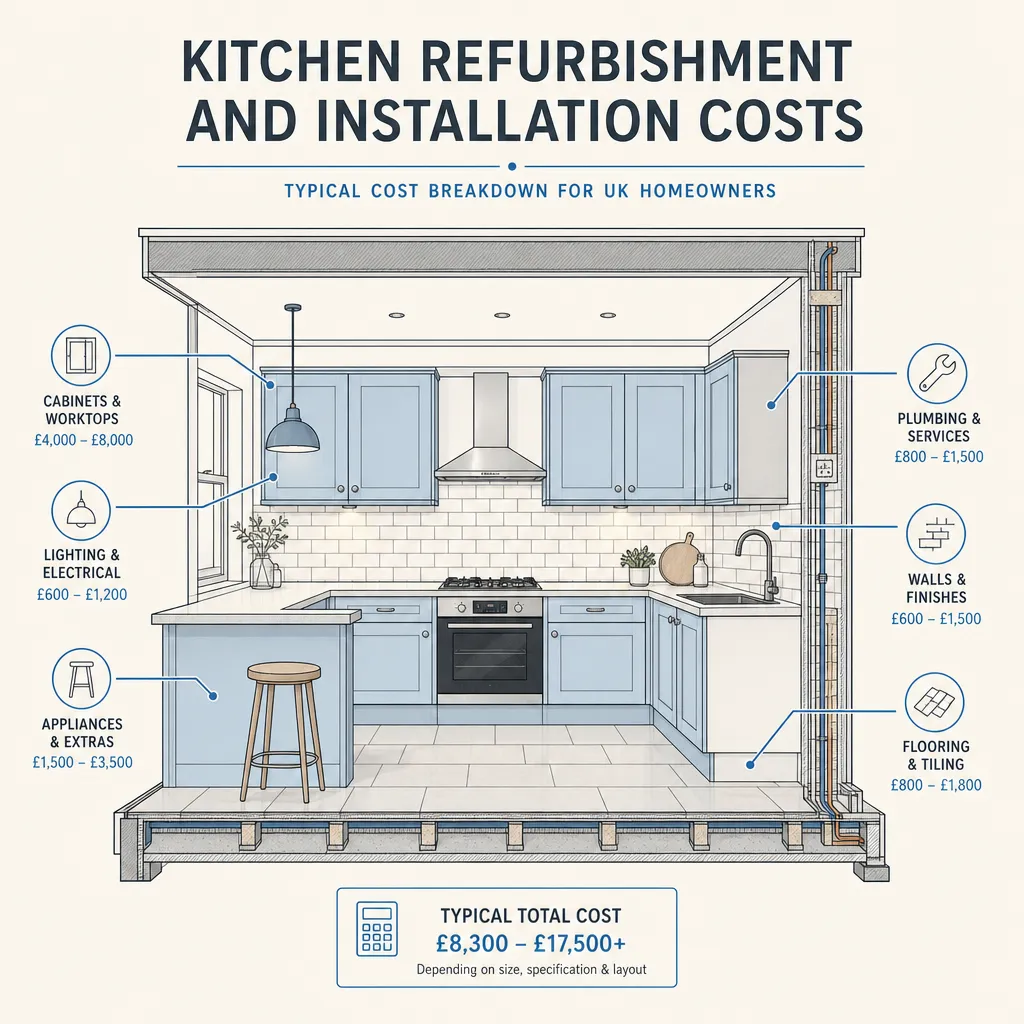
Kitchen Refurbishment and Installation Costs
A kitchen refurbishment in the UK typically costs between £3,000 and £40,000 or more, depending on whether you are replacing units only or carrying out a full design-and-build project.
 Improvement & Build
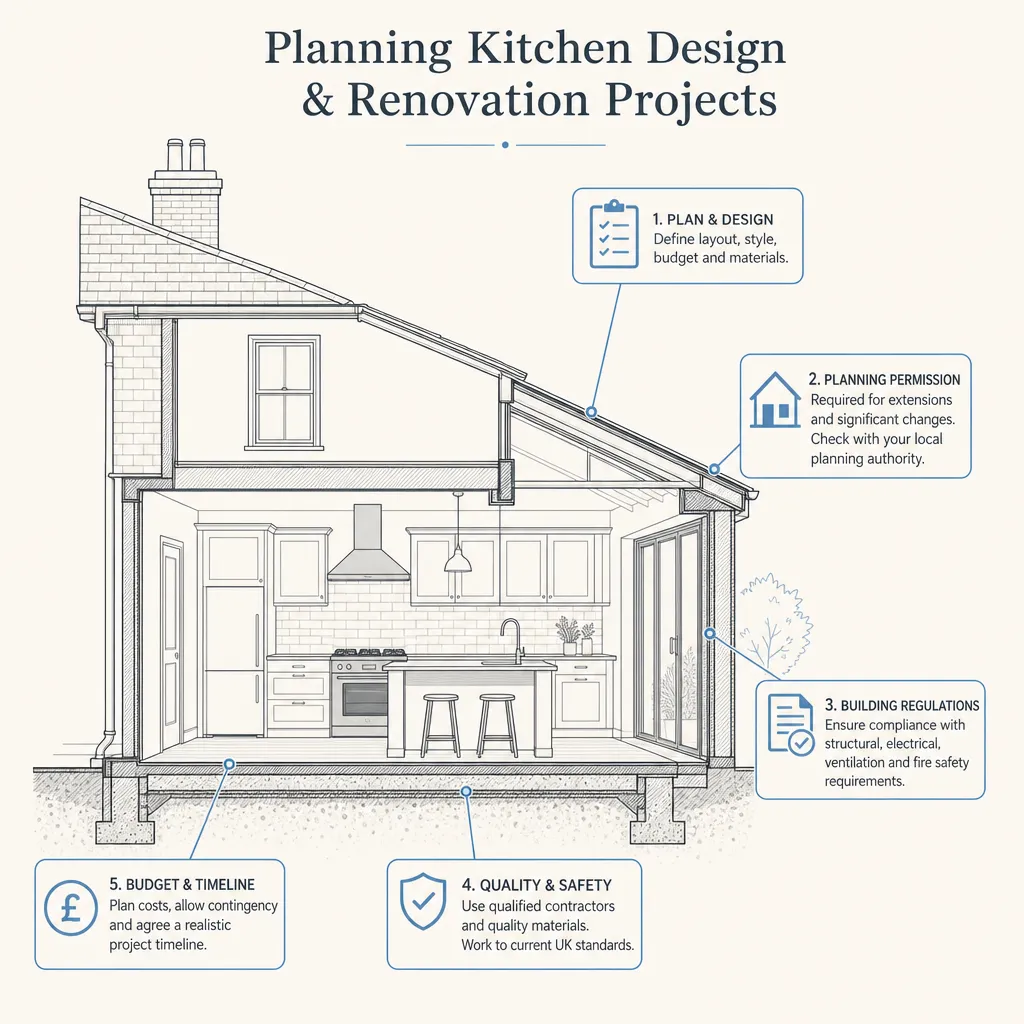
Planning kitchen design and renovation projects
Planning a kitchen renovation in the UK typically involves choosing a layout, setting a budget, deciding which contractors you need, and understanding which regulations apply.
 Improvement & Build
Window Replacement Cost Calculator and Pricing Guide
Replacing a standard uPVC double-glazed casement window in the UK typically costs £400–£800 supply and fit.
 Improvement & Build
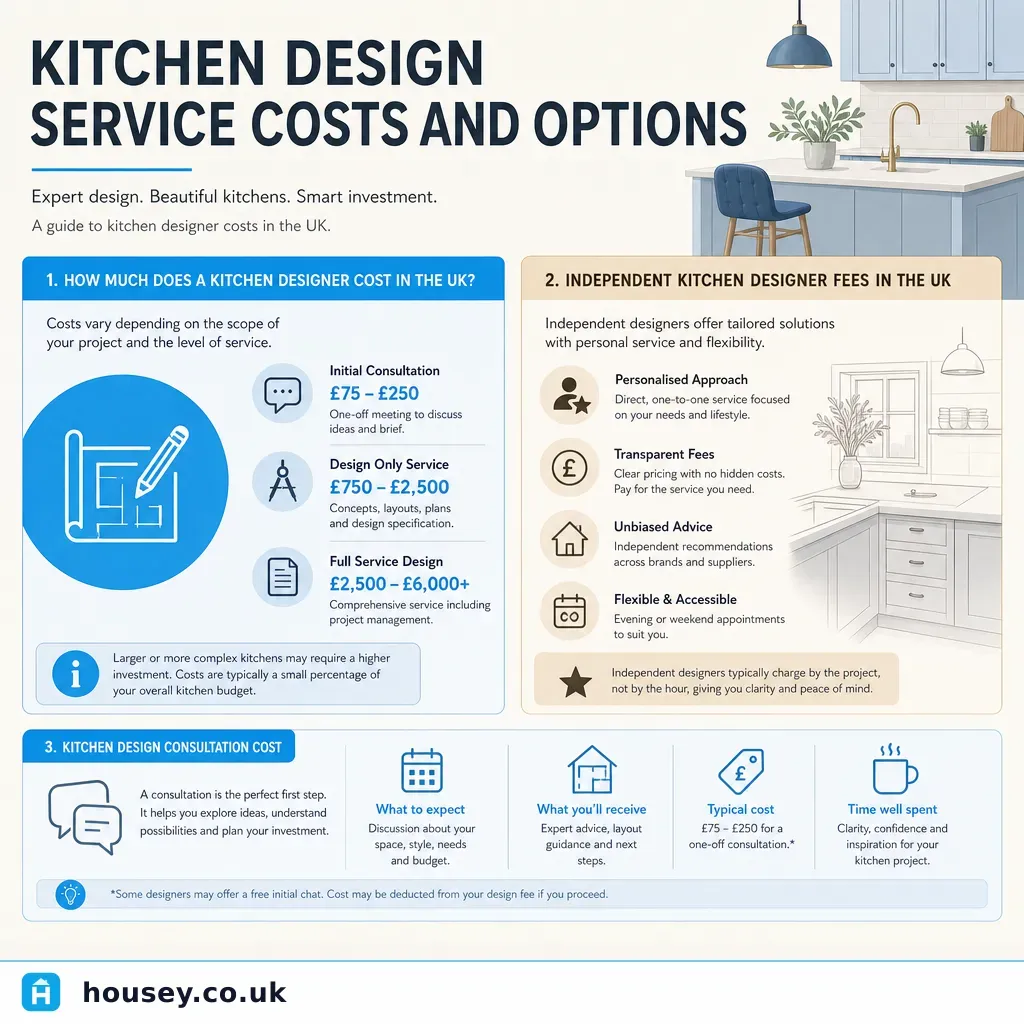
Kitchen Design Service Costs and Options
Independent kitchen designers in the UK typically charge £500–£3,000 for a design package; kitchen retailers usually provide a free design service tied to their own product range.
 Improvement & Build
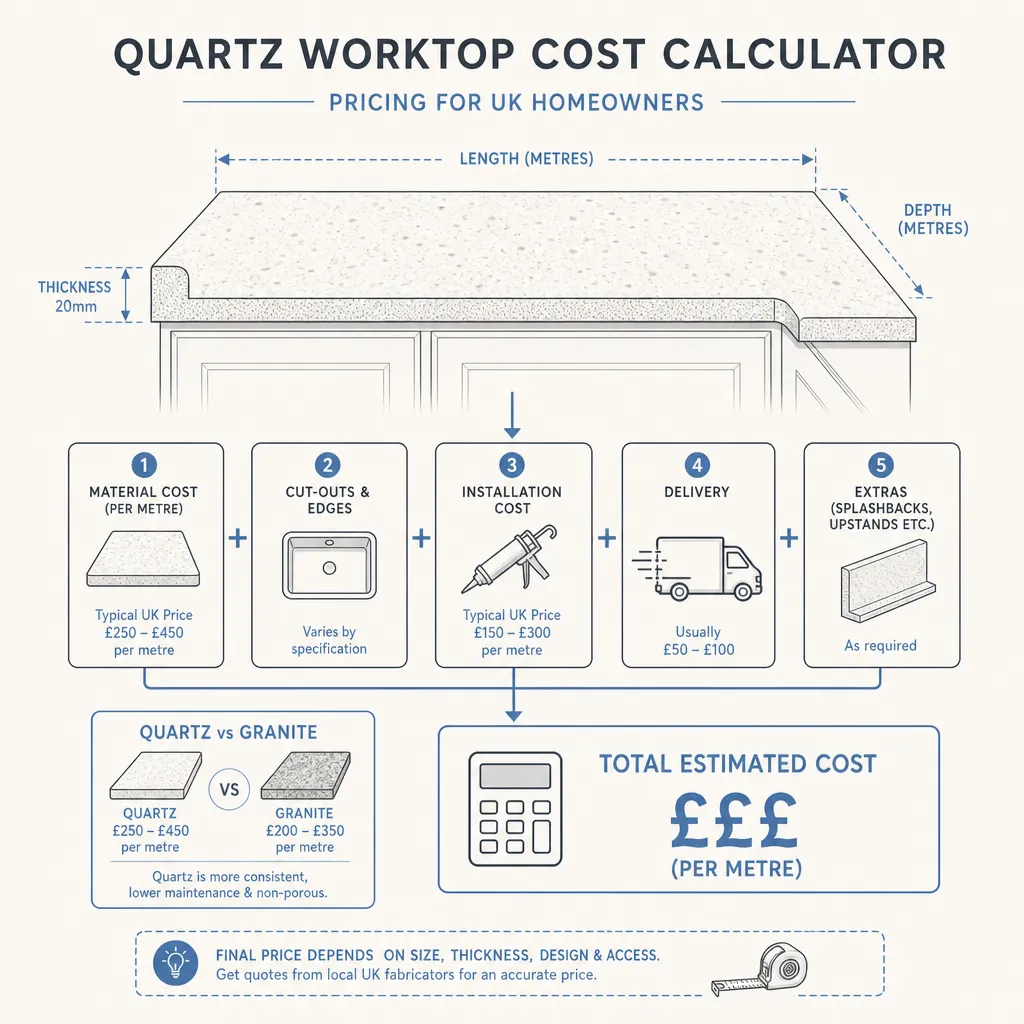
Quartz Worktop Cost Calculator and Pricing
Quartz worktops in the UK typically cost £250–£600 per linear metre for supply and professional installation, putting a standard 4–5 metre kitchen at £1,000–£3,000.