Planning kitchen design and renovation projects
By Housey · Last reviewed 30th of May 2026
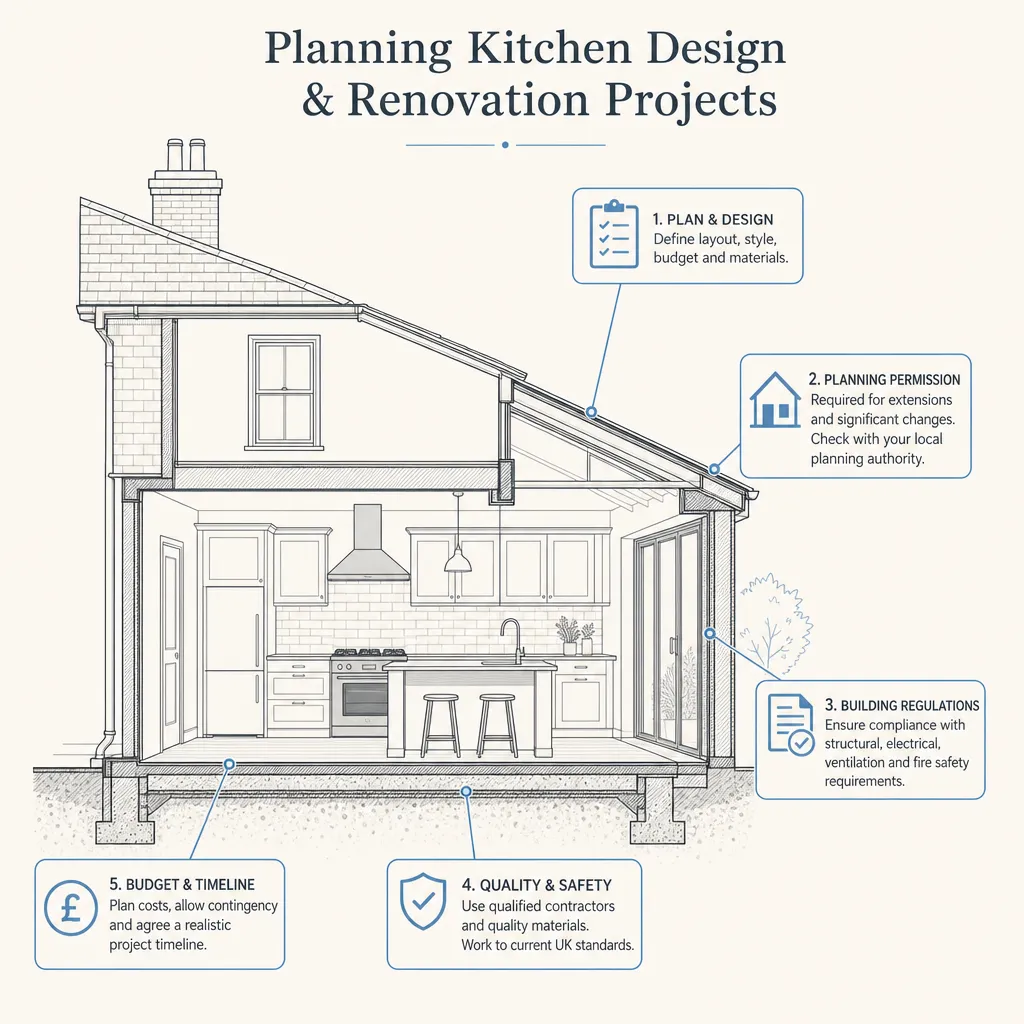
Planning kitchen design and renovation projects
The kitchen is typically the most complex room to renovate in a UK home — combining gas, electrical, plumbing, and structural considerations in a single project with tight sequencing and significant cost. Whether you are replacing ageing fitted units in a 1980s semi or reconfiguring an open-plan space in a Victorian terrace, the planning decisions made before work begins have a disproportionate effect on the outcome. Understanding which elements require professional sign-off, where Building Regulations apply, and how to sequence the trades is the foundation of a project that stays on budget and on time.
Key points
- Gas appliances — hobs, range cookers, and gas connections — must be installed by a Gas Safe registered engineer; this is a legal requirement under the Gas Safety (Installation and Use) Regulations 1998.
- Kitchen electrical work is notifiable under Building Regulations Part P if it involves new circuits, consumer unit alterations, or work within defined zones near sinks; use a Part P-registered electrician or notify building control before work starts.
- Planning permission is not normally required for an internal kitchen refit; extensions to create a larger kitchen may require planning permission or permitted development prior approval depending on size and location.
- Listed Building Consent may be required for any alteration to a listed kitchen — including fitting new units — even where the work appears routine; check with your local planning authority before proceeding.
- The Construction (Design and Management) Regulations 2015 (CDM 2015) may apply where more than one contractor is involved; as a domestic client, the homeowner takes on specific responsibilities.
Do I need planning permission or building regulations approval?
These are two separate questions. Planning permission controls what you build and how it looks externally. Building Regulations approval ensures work is safe and meets minimum standards for structure and services.
Planning permission: decision tree
- Internal kitchen refit only, no extension or structural changes: Planning permission not required in most cases. If the property is listed, check whether Listed Building Consent is needed before starting any work.
- Kitchen in a conservation area: Internal works do not normally need planning permission, but changes to the external appearance of the building may. Check with your local planning authority.
- Kitchen in a listed building: Contact the local planning authority before starting any works. Internal alterations can require Listed Building Consent; unauthorised works are a criminal offence.
- Kitchen as part of a single-storey rear extension: May fall within permitted development if it meets the conditions in the Town and Country Planning (General Permitted Development) (England) Order 2015. Check for Article 4 Directions and whether prior approval is required for larger extensions.
- Kitchen requiring structural changes or forming part of a larger extension: Likely requires a full planning application. Check with your local planning authority before committing to any design.
Building Regulations: decision tree
- Like-for-like unit and worktop replacement, same positions, no service changes: Building Regulations approval generally not required.
- New or relocated gas appliances: A Gas Safe registered engineer installs and self-certifies under their competent-person scheme.
- New electrical circuits, consumer unit work, or electrical work in defined zones near sinks: Requires a Part P-registered electrician who self-certifies, or notification to building control before work begins.
- Structural work — removing a wall, installing an RSJ or steel beam: Building Regulations Part A applies; notify building control and obtain approval before work starts.
- New drainage connections or significant changes to waste routes: Building Regulations Part H applies; building control notification may be required.
Kitchen layout options
Layout determines how well a kitchen functions day-to-day. The classic work triangle — linking hob, sink, and fridge — remains a useful planning reference, though open-plan kitchens increasingly work with separate cooking, preparation, and clearing zones.
Layout | Best for | Limitations |
|---|---|---|
Single-wall | Narrow rooms, open-plan spaces where the kitchen occupies one run | Limited storage; congested with multiple users |
L-shaped | Mid-sized rooms with a corner available | Corner cabinets need carousel or pull-out fittings to avoid dead space |
U-shaped | Larger kitchens with good natural light | Requires sufficient floor area; can feel enclosed in smaller rooms |
Island | Open-plan spaces with adequate floor area | Requires services under or near island; not suited to small rooms |
Galley (parallel runs) | Long narrow rooms with doors at each end | Traffic through the workspace; less sociable for family kitchens |
Managing contractors and regulated work
Most kitchen renovations involve at minimum a kitchen fitter, plumber, and electrician. Larger projects add a gas engineer, structural engineer, and building control inspector.
Gas Safe registered engineers must carry out all gas work. Ask to see the engineer's Gas Safe ID card and verify their registration on the Gas Safe Register website before work starts. Never allow an unregistered person to work on gas appliances or pipework.
Part P-registered electricians (registered with NICEIC, NAPIT, or another approved competent-person scheme) can self-certify kitchen electrical work. If using a non-registered electrician, you or they must notify building control before notifiable work begins and arrange a completion inspection.
Structural engineers should be involved wherever walls are being removed or steel beams installed. A structural engineer produces calculations and a specification; do not rely on a builder's verbal assessment alone for structural alterations.
Kitchen renovation project checklist
What to ask before accepting a quote
- What is included and excluded — specifically, does this quote cover gas, electrical, and plumbing work, or are these separate appointments?
- Who will carry out each element, and what qualifications, registrations, or accreditations do they hold?
- What completion certificates, guarantees, or warranties will be provided on completion?
- Is VAT included in the quoted price?
- What assumptions is the quote based on, and what could change the price if hidden issues are found (buried pipework, lintels in poor condition, unexpected materials)?
- What is the payment schedule, and is a retention held until work is signed off?
Indicative costs
Indicative UK costs, last reviewed 2026-05-30. Costs vary significantly by specification, region, contractor, and project complexity. Always obtain multiple written quotes before committing.
- Like-for-like kitchen refit (new units and appliances, same layout): £5,000–£15,000+
- Full kitchen renovation (new layout, relocated services, complete refit): £15,000–£35,000+
- Kitchen as part of a single-storey rear extension: £30,000–£80,000+, depending on extension size, glazing specification, and groundworks complexity
These ranges exclude planning application fees, structural engineer fees, building control fees, and any Party Wall Act requirements where applicable.
When to get professional help
Several elements of a kitchen renovation legally require or strongly benefit from specialist input:
- Structural alterations: Instruct a chartered structural engineer before any wall removal or beam installation. Do not rely on a builder's verbal assessment.
- Gas installation: Only a Gas Safe registered engineer may carry out gas work. Verify registration before any work starts.
- Electrical work near water: Use a Part P-registered electrician for all notifiable electrical work; request an electrical installation certificate on completion.
- Listed buildings: Consult the local planning authority and instruct an experienced solicitor or conservation specialist if Listed Building Consent is required.
- Extension projects: An architect or design-and-build firm can coordinate planning, building regulations, and contractor management, reducing the risk of costly changes mid-build.
Important limitations
This article provides general guidance on kitchen renovation planning in England. Rules and requirements vary depending on property type, location, age of building, and scope of works. Planning rules differ in Wales, Scotland, and Northern Ireland. Nothing in this article constitutes legal, structural, or safety advice. A qualified professional should assess the specific circumstances of your property and project before any work begins.
What to ask a qualified professional
Before appointing contractors for regulated elements of a kitchen renovation, confirm the following:
Gas Safe registered engineer:
- Can I see your Gas Safe ID card, and may I verify your registration on the Gas Safe Register website before work starts?
- What documentation and certificate will you provide on completion, and how will the work be registered?
- If relocating a gas supply point, what does that involve in terms of pipework, testing, and additional cost?
Part P-registered electrician:
- Are you registered with NICEIC, NAPIT, or another approved competent-person scheme for domestic electrical work?
- Will you self-certify this work, or will a building control notification and inspection be required?
- What electrical installation certificate will I receive, and when?
Structural engineer (if removing walls or installing beams):
- Are you a Chartered Engineer (CEng MIStructE or equivalent) qualified to sign off structural calculations?
- Will you produce structural calculations and a specification suitable for building control submission?
- Will you inspect the installed works on site, or is a building control inspection sufficient?
Kitchen designer or design-and-build firm:
- What is included in the design fee — 3D renders, a written specification, site visits during the build?
- Do you project-manage the trades, or do I need to appoint and coordinate contractors separately?
- What happens to the price and programme if structural unknowns are uncovered during the works?
How Housey can help
If your kitchen project involves an extension or significant design work, Housey can connect you with vetted design-and-build firms who coordinate design, planning consent, and construction under one roof. For structural extension projects, you can also find experienced extension builders through the platform.
Frequently asked questions
Do I need planning permission to renovate my kitchen?
In most cases, no. An internal kitchen refit — replacing units, worktops, or appliances within the existing footprint — does not require planning permission. If your property is listed, however, you may need Listed Building Consent even for internal works. Any extension to create a larger kitchen may require planning permission or permitted development prior approval, depending on size and location.
Does gas work in my kitchen need to be done by a registered professional?
Yes, and by law. All gas work — including fitting or relocating gas hobs, range cookers, and gas boiler connections — must be carried out by a Gas Safe registered engineer. This is a legal requirement under the Gas Safety (Installation and Use) Regulations 1998. Verify any engineer's registration on the Gas Safe Register website before work begins.
What building regulations approvals do I need for a kitchen renovation?
It depends on scope. A like-for-like unit replacement typically needs no approval. New or relocated gas appliances are self-certified by the Gas Safe engineer. Notifiable electrical work near sinks requires a Part P-registered electrician or building control notification. Structural alterations — removing walls or installing steel beams — require Building Regulations Part A approval before work starts.
How long does a typical kitchen renovation take?
A straightforward refit with no structural changes often takes one to two weeks once units are on site. Projects involving new gas routes, electrical alterations, or plumbing changes may take two to four weeks. A kitchen forming part of a rear extension typically takes three to six months from planning consent to completion, depending on extension size and contractor availability.
Sources and further reading
- Building Regulations Approved Document Part P: electrical safety — GOV.UK
- Gas Safe Register: find and verify registered engineers — Gas Safe Register
- GOV.UK planning practice guidance: when is permission required? — GOV.UK
- NICEIC: find a registered contractor — NICEIC
- Historic England: alterations to listed buildings — Historic England
- HSE: Construction (Design and Management) Regulations 2015 — Health and Safety Executive
Useful next reads
 Improvement & Build
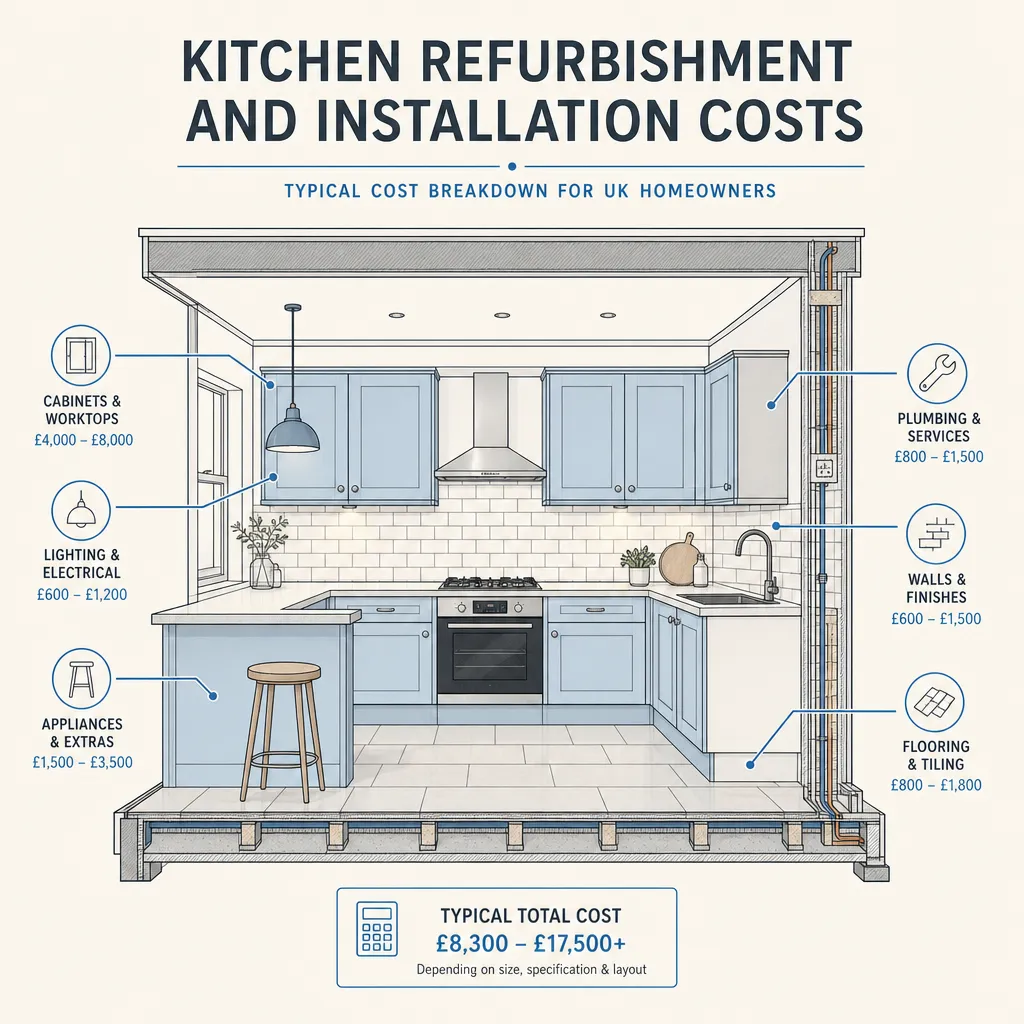
Kitchen Refurbishment and Installation Costs
A kitchen refurbishment in the UK typically costs between £3,000 and £40,000 or more, depending on whether you are replacing units only or carrying out a full design-and-build project.
 Improvement & Build
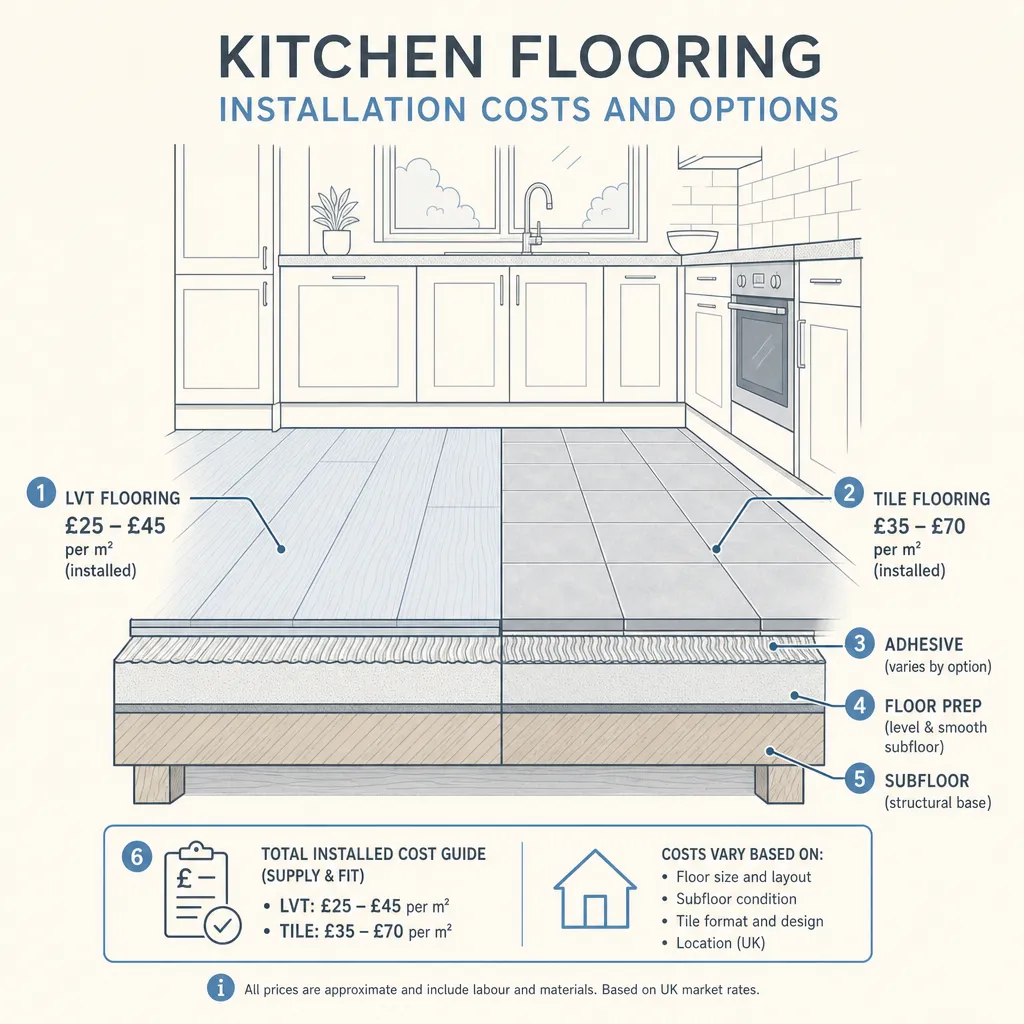
Kitchen Flooring Installation Costs and Options
Kitchen flooring in the UK typically costs £15–£100+ per m² installed, depending on material and subfloor condition.
 Improvement & Build
Small kitchen renovation: budgeting for costs and planning your project
A small kitchen renovation in the UK typically costs £5,000–£15,000 for a full refresh including new units, worktops, tiling, and appliances, though costs vary widely by specification, region, and whether structural changes or rewiring are involved.
 Improvement & Build
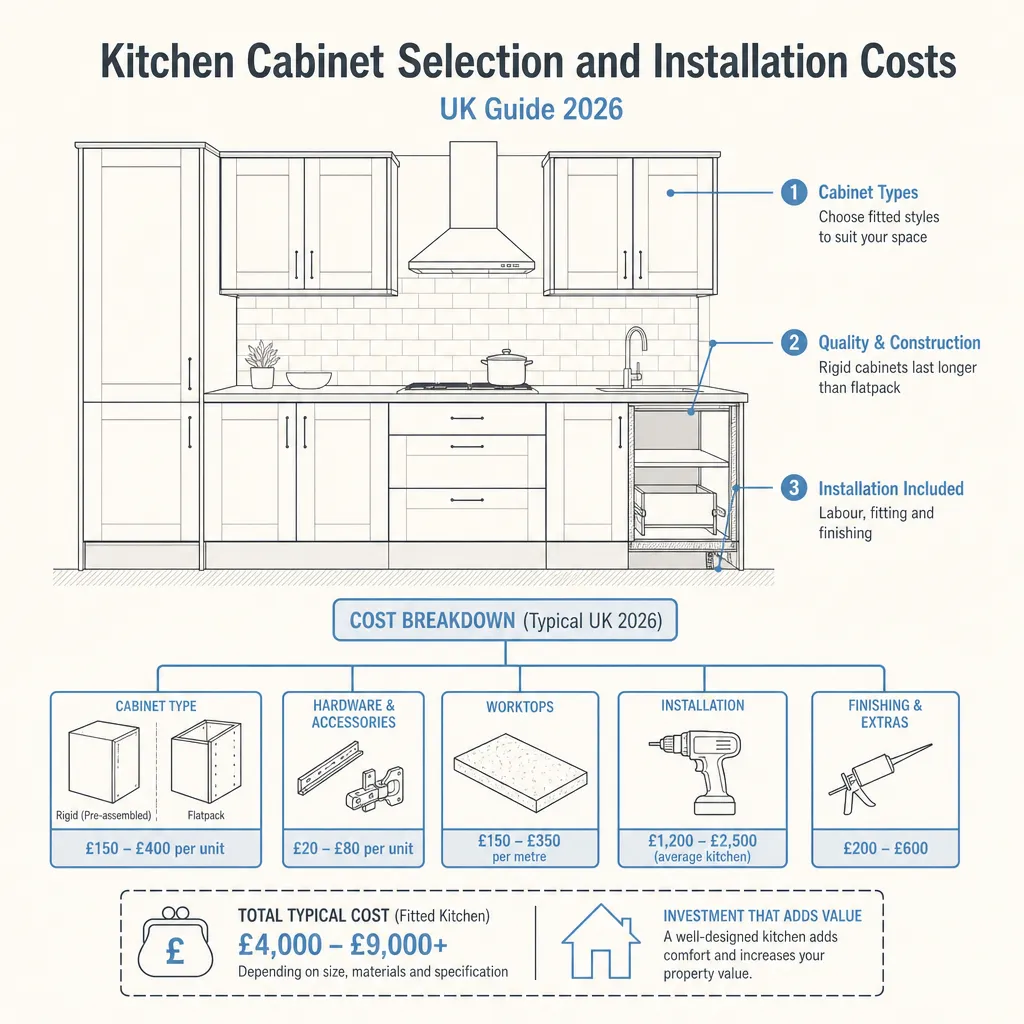
Kitchen Cabinet Selection and Installation Costs
Kitchen cabinet costs in the UK range from around £1,500 for flatpack units with self-installation to £15,000 or more for fully bespoke, professionally fitted kitchens.
 Improvement & Build
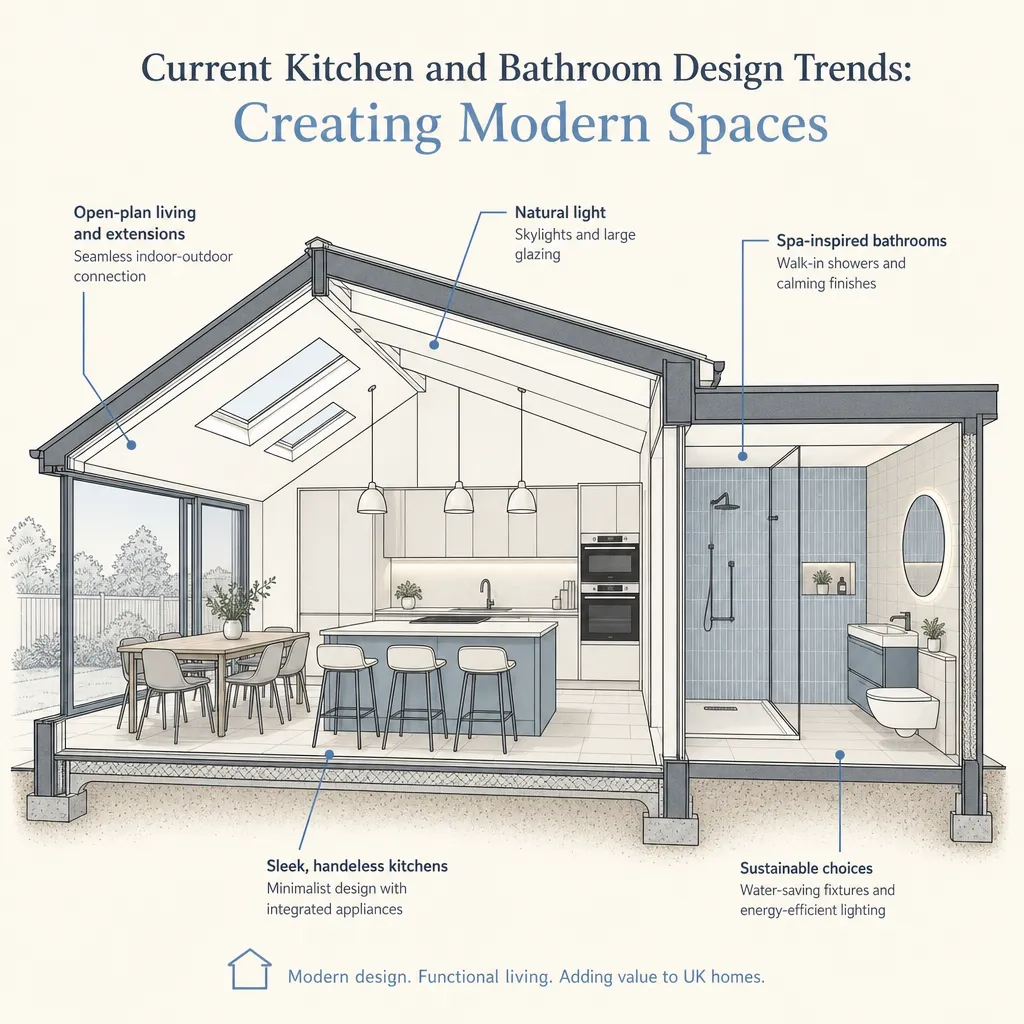
Current Kitchen and Bathroom Design Trends: Creating Modern Spaces
In 2026, UK kitchen design favours open-plan layouts, handleless cabinetry, and quartz composite worktops, while bathrooms trend towards walk-in showers, freestanding baths, and fluted tiles.