Specialist Considerations When Acquiring Historic and Listed Properties
By Housey · Last reviewed 30th of May 2026
Specialist Considerations When Acquiring Historic and Listed Properties
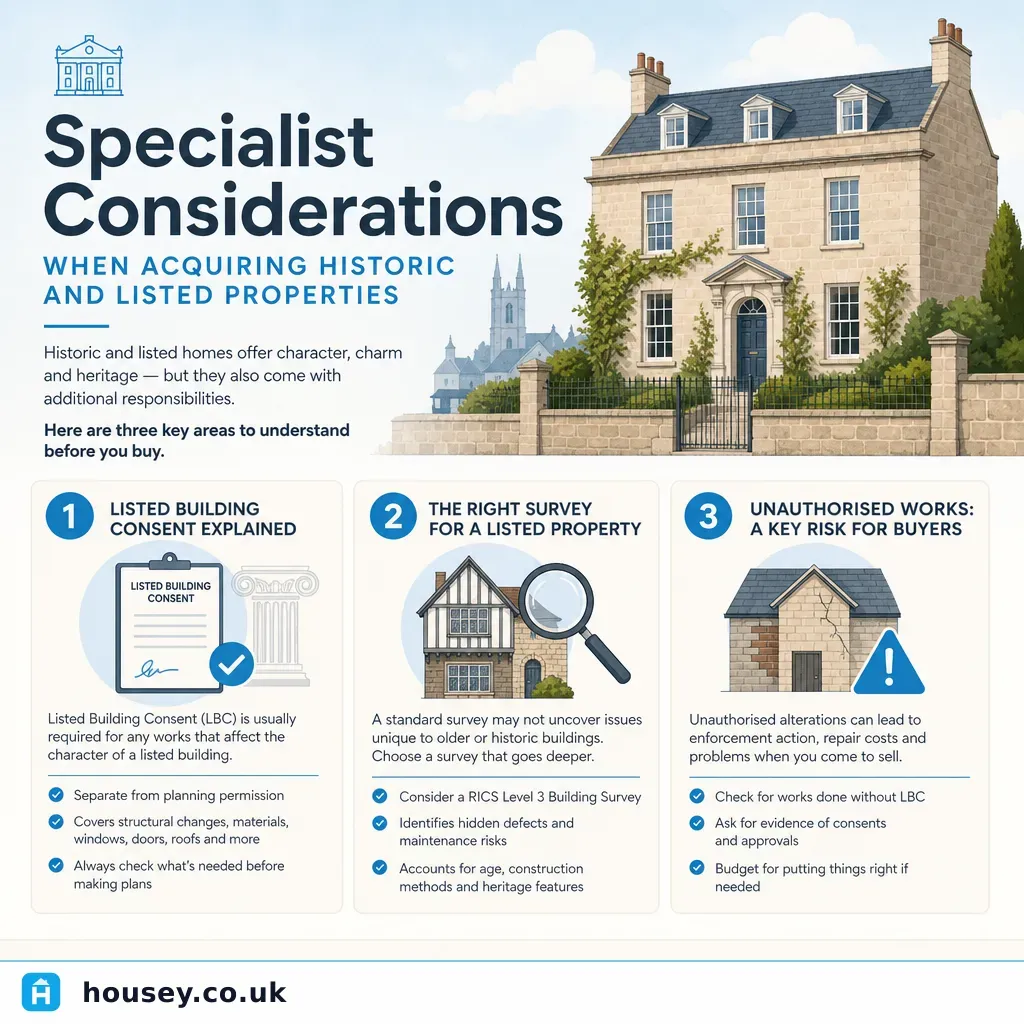
Historic and listed properties attract buyers for their character, craftsmanship, and sense of place. But they carry obligations and risks that standard conveyancing and surveys are not designed to uncover. Whether you are considering a Grade II stone cottage or a Grade I country house, understanding the regulatory regime before you commit is essential — the consequences of getting it wrong can include costly reinstatement works and, in serious cases, criminal liability.
Key points
- England has approximately 500,000 listed buildings; more than 92% are Grade II, with Grade II* (~5.5%) and Grade I (~2%) indicating particularly important or exceptional buildings.
- Listed Building Consent (LBC) is required for any works affecting the special architectural or historic interest of a listed building — internal changes included — under the Planning (Listed Buildings and Conservation Areas) Act 1990.
- Unauthorised works by a previous owner transfer with the property: you may inherit a legal obligation to reinstate, and face enforcement action, even for alterations you did not commission.
- A RICS Level 3 Building Survey is the minimum appropriate inspection for any listed or historic property; some lenders additionally require a specialist heritage report.
- Listed buildings are generally exempt from mandatory Energy Performance Certificates (EPCs) where compliance would unacceptably alter their character — but energy upgrade works still require LBC if they affect the building's special interest.
What "listed" means when you buy
Listing designates a building as being of special architectural or historic interest. In England, Historic England maintains the National Heritage List for England (NHLE), which is publicly searchable online. Scotland, Wales, and Northern Ireland maintain separate lists managed by Historic Environment Scotland, Cadw, and the Historic Environment Division respectively.
Listing covers the whole building — not just the façade — including later extensions, fixtures integral to the structure, and sometimes structures within the curtilage (the land immediately surrounding the building). Your solicitor should check the NHLE entry and the local planning authority's (LPA) records to confirm the precise extent of the designation.
Listed building grades in England: comparison table
Grade | Significance | Approximate share | Typical LPA approach to LBC |
|---|---|---|---|
Grade II | Special interest; warranting preservation | ~92% | LBC required; standard local authority process |
Grade II* | Particularly important; more than special interest | ~5.5% | LBC required; closer LPA scrutiny; Historic England often consulted |
Grade I | Exceptional interest | ~2% | LBC required; Historic England typically consulted on all applications |
Scotland uses Categories A, B, and C; Wales uses Grades I, II*, and II; Northern Ireland uses Grades A, B+, B1, and B2.
Regulatory obligations you inherit as a buyer
When you purchase a listed property, you do not only acquire the physical building — you acquire its regulatory history. Carrying out unauthorised works on a listed building is a criminal offence under section 9 of the Planning (Listed Buildings and Conservation Areas) Act 1990, and can result in unlimited fines or imprisonment. Enforcement notices can be served against the current owner regardless of who originally carried out the works.
Before exchange, your solicitor should:
- Search for any extant enforcement notices or LBC applications registered against the property.
- Obtain copies of any previous LBC approvals and check works were completed in accordance with them.
- Confirm whether the property sits within a Conservation Area, which adds further restrictions on demolition and some external alterations.
If unauthorised works are found, the options are typically to seek retrospective consent (which the LPA may refuse), to obtain an indemnity insurance policy (which does not make the works lawful but protects the parties financially), or to negotiate a price reduction that reflects the risk.
Which professionals do you need?
Decision tree: survey and specialist selection
- Choose a RICS Level 3 Building Survey from a surveyor with demonstrable listed-buildings experience for any listed property — this is the baseline, not the ceiling.
- Commission a specialist heritage building surveyor if the property is Grade I, Grade II*, or built using non-standard historic materials such as timber frame, wattle-and-daub, lime render, or cob.
- Instruct a heritage or conservation consultant if you plan alterations after purchase, need pre-application planning advice, or if the LPA has an enforcement history with the property.
- Engage a structural engineer with historic-buildings experience if there are visible cracks, settlement, or signs of movement — a standard visual survey is unlikely to be sufficient for diagnosis.
- Use a specialist conveyancing solicitor with listed-building experience if there are outstanding consents, enforcement notices, or complex curtilage questions.
Which professional for which situation?
Situation | Professional to instruct | Why |
|---|---|---|
Pre-purchase physical inspection | RICS Level 3 surveyor with listed-buildings experience | Identifies defects, construction risks, and heritage constraints |
Planned works after purchase | Heritage or conservation consultant | Advises on LBC prospects before you commit to buying |
Structural movement or cracks | Structural engineer (historic specialism) | Diagnoses root cause; general surveys may not go far enough |
Unauthorised previous works found | Specialist conveyancing solicitor and heritage consultant | Assesses retrospective consent prospects or indemnity route |
Energy upgrade planning | Retrofit coordinator with PAS 2035 heritage experience | Avoids moisture damage and conservation enforcement |
Red flags to identify before making an offer
- Plastic uPVC windows or doors installed on a listed building — likely without LBC; may require removal at the buyer's cost.
- Cavity wall insulation in a breathable solid-wall building — can cause serious moisture and structural damage; check for LBC approval.
- A new extension or outbuilding with no LBC documentation visible on the LPA's public planning portal.
- Recent kitchen or bathroom works not matched by any LBC record on the planning portal.
- Cracks to lime render or masonry not disclosed in the seller's TA6 Property Information Form.
- Evidence of damp-proof course injection in a building relying on breathability — may indicate inappropriate treatment of a moisture problem rather than its resolution.
Important limitations
This article provides general information only. Listed building regulations, local planning authority policies, and the precise extent of individual designations vary significantly by building, LPA, and region. Nothing in this guide constitutes legal or professional advice. A qualified heritage surveyor, conservation consultant, and specialist solicitor must assess your specific property before you commit to purchase. EPC exemption status and energy-upgrade consent requirements should be confirmed directly with the relevant LPA.
When to get professional help
Seek specialist advice before making any offer if you are new to listed-building ownership. If unauthorised works are discovered after exchange, contact a specialist solicitor immediately. Never commission any works — including redecorating or cleaning stonework — without first confirming with the LPA whether LBC is required.
Seek immediate professional assessment if:
- Any crack in masonry is widening, stepped through brickwork, or accompanied by sticking doors or windows.
- The vendor cannot produce LBC documentation for visible alterations.
- There is any suggestion of asbestos-containing materials (common in mid-20th century additions to historic buildings).
- The property has been vacant for an extended period and shows signs of water ingress or roof deterioration.
What to ask a qualified professional
Before instructing a surveyor:
- Do you have specific experience surveying listed buildings of this construction type and grade?
- Will your report identify existing alterations that may not have had Listed Building Consent?
- Will you comment on the likely LBC requirements for any works I have in mind?
Before instructing a solicitor:
- Will you search the National Heritage List, the LPA enforcement register, and the LBC history before exchange?
- How do you advise on handling unauthorised works discovered during a transaction?
- Do you have experience with listed-building curtilage questions and complex designations?
Before instructing a heritage consultant:
- What is your pre-application experience with this particular local planning authority?
- Can you advise on energy-efficiency improvements compatible with this building's listed status?
- Are you familiar with Historic England's guidance on energy efficiency and historic buildings?
How Housey can help
Housey connects you with experienced heritage and conservation consultants and specialists who can provide a RICS Level 3 survey for listed and historic properties. If you are still deciding on the right survey level, you can also compare quotes for a RICS Home Survey from vetted local professionals. Submit a single request and receive quotes before you exchange.
Frequently asked questions
Do I need listed building consent for internal changes?
Yes, in most cases. Listed Building Consent is required for any works that affect the special architectural or historic interest of the building, including internal alterations such as removing walls, altering fireplaces, replacing historic floors, and fitting new fixtures. The test is the impact on the building's character, not whether the change is visible from outside. Always check with your local planning authority before any works begin.
What survey should I get for a listed property?
A RICS Level 3 Building Survey is the minimum appropriate level for any listed or historic property. For Grade I or Grade II* buildings, or those with complex historic materials such as timber frame or lime construction, commission a surveyor with specific listed-buildings experience. A RICS Level 2 Home Survey is unlikely to provide sufficient depth of inspection for non-standard construction types.
Is it harder to get a mortgage on a listed property?
Some lenders impose additional conditions — including specialist heritage valuations — for listed properties, particularly Grade I and II*. Check your preferred lender's requirements before commissioning a survey. Specialist mortgage brokers familiar with historic homes can help identify willing lenders and appropriate products for your circumstances.
What happens if a previous owner made unauthorised changes?
Unauthorised works pass with the building. As the incoming owner, you could face an enforcement notice requiring reinstatement at your cost. Your solicitor should identify any such works before exchange and advise on whether retrospective consent is realistic, whether an indemnity policy is appropriate, or whether the risk warrants renegotiating the price or withdrawing from the purchase.
Sources and further reading
- National Heritage List for England (NHLE) — Historic England
- Planning (Listed Buildings and Conservation Areas) Act 1990 — legislation.gov.uk
- Energy efficiency and historic buildings — Historic England
- RICS Home Survey Standard — RICS
- Listed buildings and conservation areas — GOV.UK
Useful next reads
 Planning & Pre-Build
Heritage Property: Preserving Historic Homes and Conservation Standards
Listed buildings in the UK require Listed Building Consent for most works — internal and external — that affect their special architectural or historic interest.
 Planning & Pre-Build
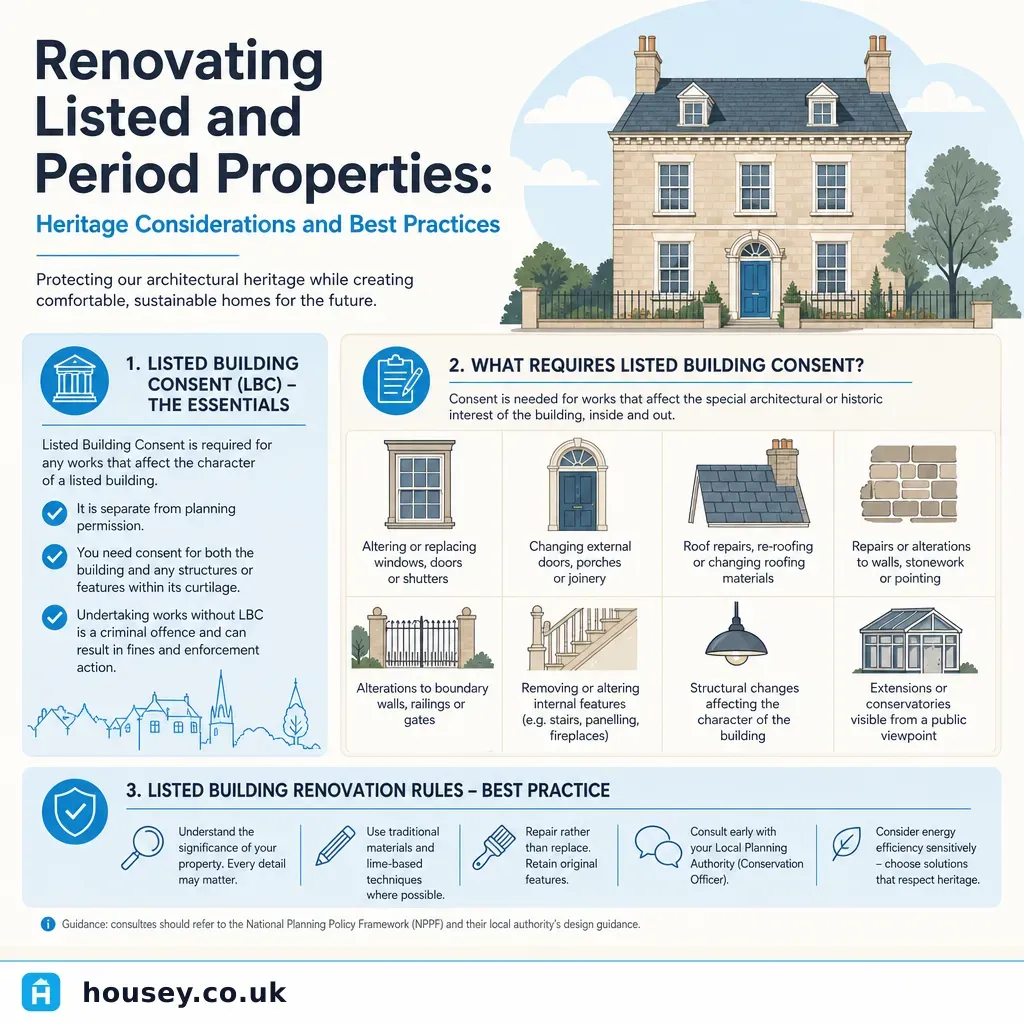
Renovating Listed and Period Properties: Heritage Considerations and Best Practices
Renovating a listed or period property in the UK requires Listed Building Consent for most alterations — internally and externally — separate from planning permission.
 Planning & Pre-Build
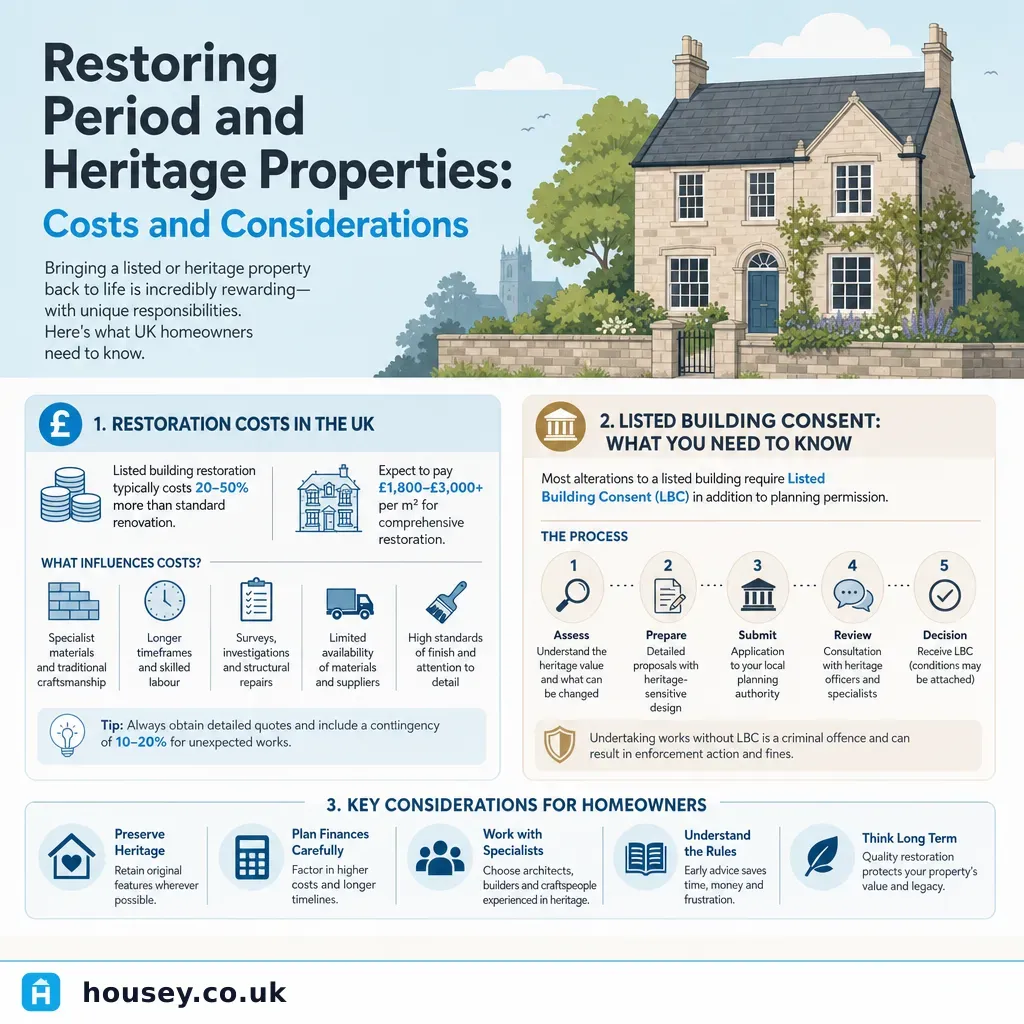
Restoring Period and Heritage Properties: Costs and Considerations
Restoring a period or heritage property requires listed building consent for most alterations, use of traditional materials such as lime mortar, and specialist contractors.
 Planning & Pre-Build
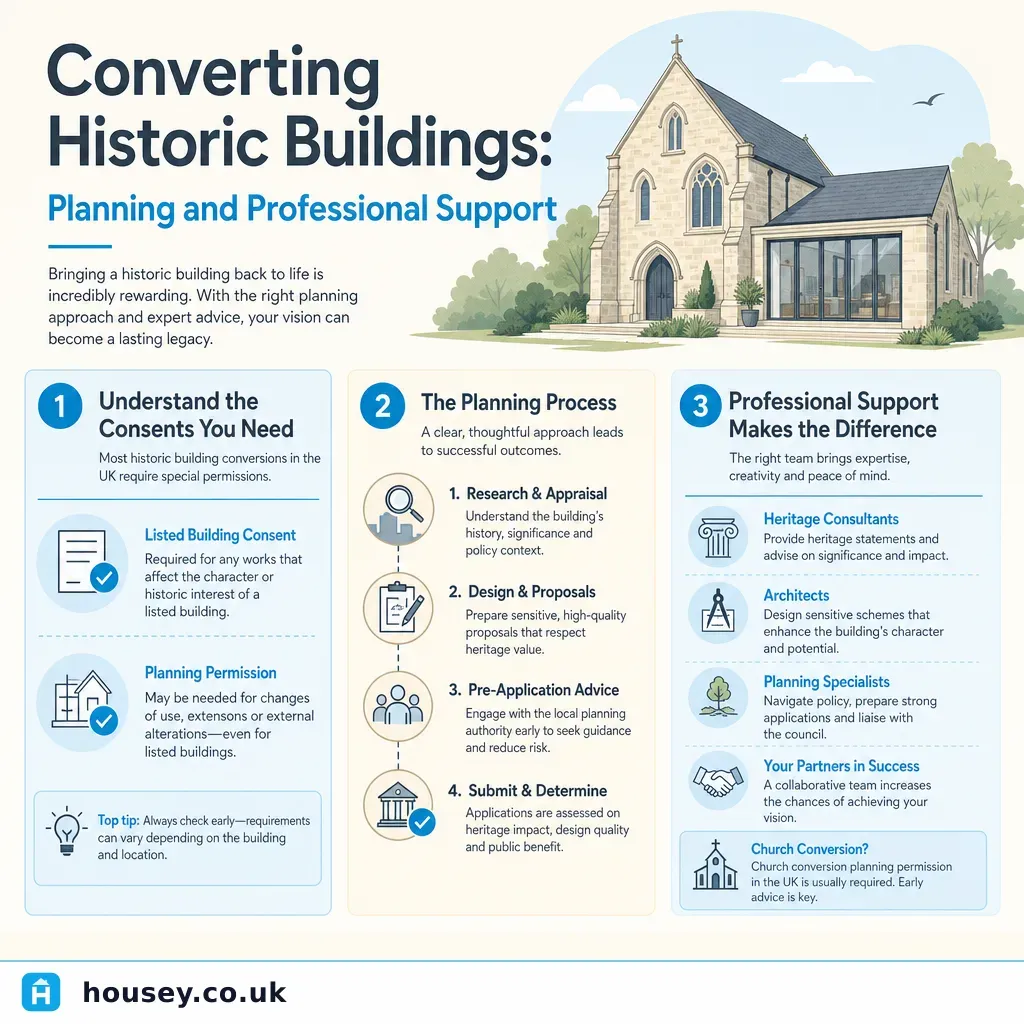
Converting Historic Buildings: Planning and Professional Support
Converting a historic or listed building in the UK requires Listed Building Consent in addition to planning permission, both granted by the local planning authority.
 Planning & Pre-Build
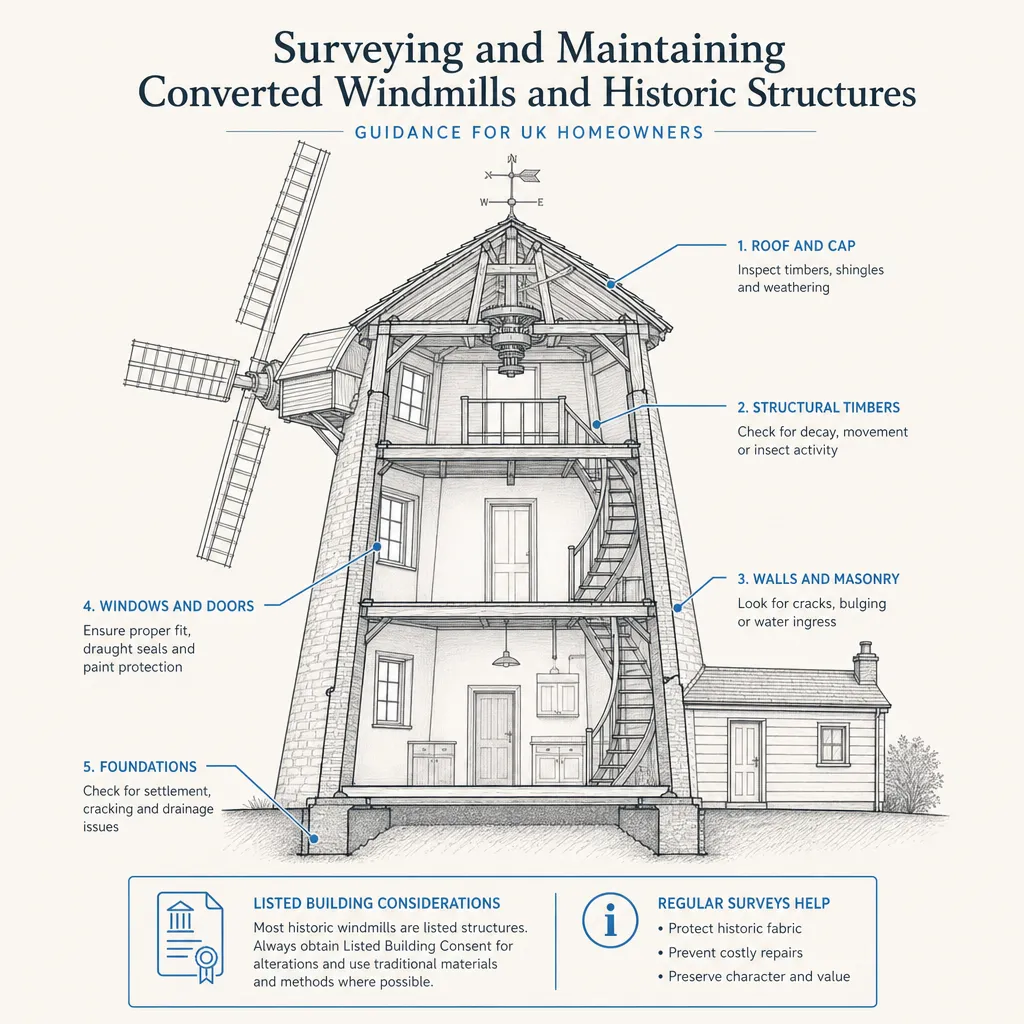
Surveying and Maintaining Converted Windmills and Historic Structures
Converted windmills and other historic structures typically require a specialist heritage building survey, not a standard RICS inspection.