Planning and Building Regulations for School Building Conversions
By Housey · Last reviewed 30th of May 2026
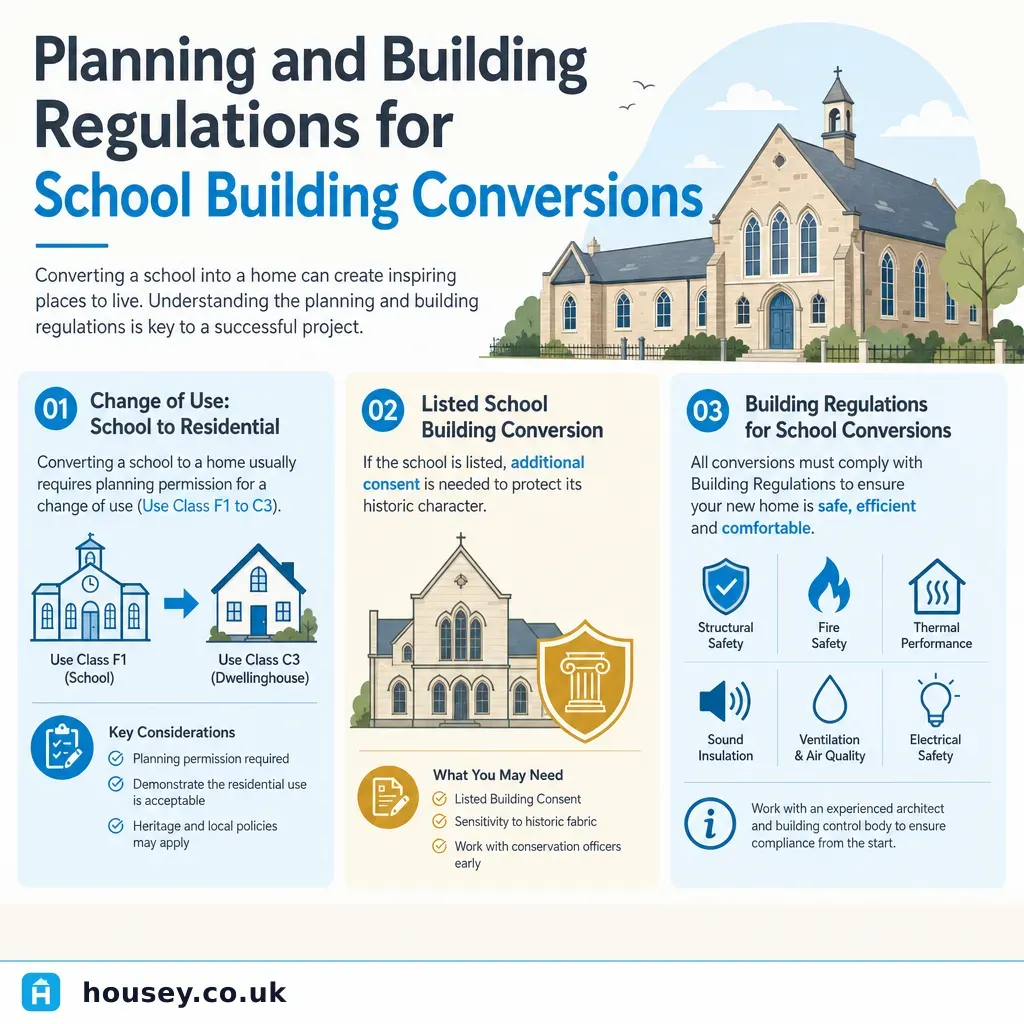
Planning and Building Regulations for School Building Conversions
Converting a redundant school into homes, apartments, or a mixed-use development is an increasingly common route for local authorities, developers, and private buyers across England and Wales. These projects sit at the intersection of planning law, building regulations, and often heritage legislation — making early professional advice essential before any design work is commissioned. The consequences of proceeding without the correct consents can include enforcement action, costly retrospective applications, and — in listed building cases — criminal liability.
Key points
- Converting a school from educational use (Use Class F.1) to residential use (Use Class C3) under the Town and Country Planning (Use Classes) Order 1987 requires a full planning application — there is no general permitted development right for this change of use in England.
- If the building is listed, Listed Building Consent must be obtained under the Planning (Listed Buildings and Conservation Areas) Act 1990 before any works affecting the building's character, including internal alterations, can proceed.
- Building Regulations approval is required under the Building Regulations 2010, with Approved Documents A (structure), B (fire safety), F (ventilation), L (energy efficiency), and M (accessibility) all typically relevant to a school conversion.
- Many former schools sit within conservation areas or are subject to Article 4 Directions, which remove certain permitted development rights and require additional planning justification for external alterations.
- Older school buildings commonly support bat roosts — a protected species consideration that affects both the programme and design of a conversion, as ecological surveys are season-dependent and cannot simply be commissioned at short notice.
What counts as a change of use for a school?
Under the Town and Country Planning (Use Classes) Order 1987 (as amended), most state and independent school buildings are classified as Use Class F.1 (Learning and Non-Residential Institutions). Converting to residential use — whether individual houses, flats, or a retirement community — means moving to Use Class C3 (Dwellinghouses).
This change of use is not covered by permitted development rights under the Town and Country Planning (General Permitted Development) (England) Order 2015. A full planning application is required in virtually all cases.
Some conversions to certain sui generis uses — such as a small hotel, hostel, or artists' studios — may also require planning permission, though the analysis differs. Planning consultants can advise on the most appropriate use class for a specific project at an early stage. Pre-application discussions with the local planning authority are strongly advisable before design work is commissioned.
Planning permission: what the application involves
A change-of-use planning application for a school conversion will typically require:
- Planning statement explaining the proposal, its compliance with national and local policy, and why the educational use is no longer viable
- Design and access statement where the site falls within a designated area or the development exceeds specified thresholds
- Heritage impact assessment if the building is listed or within a conservation area
- Transport and access report where the site previously generated significant traffic movements
- Ecology survey if the building or grounds may support protected species — bat survey seasons run approximately April to October, and missing the survey window can delay a programme by months
Local planning policy may also require the applicant to demonstrate that the educational use has been properly marketed or that there is no longer a community need for the building before residential conversion will be supported. Check your local authority's development plan policies before preparing an application.
Listed buildings and conservation areas
Many Victorian and Edwardian schools were designed to civic standards that now attract statutory or local listing. Others sit within conservation areas designated under the Planning (Listed Buildings and Conservation Areas) Act 1990.
Listed buildings: If the school is listed (Grade I, Grade II*, or Grade II in England), Listed Building Consent is required for any works affecting the building's character — internally as well as externally. Removing original tiling, altering Victorian windows, or subdividing a school hall can all require consent. Carrying out works without consent constitutes a criminal offence under Section 7 of the 1990 Act.
Conservation areas: Even where a building is not listed, a conservation area designation affects what can be done to external appearances. Article 4 Directions may remove permitted development rights that would otherwise allow minor works without planning permission. Heritage and conservation consultants can assess designation status and advise on the scope of consent required before design begins.
Decision tree: which consents do you need?
- Is the school a listed building? → Listed Building Consent required in addition to planning permission. Instruct a heritage consultant alongside your planning consultant.
- Is the building in a conservation area? → External alterations will require planning permission. Check whether an Article 4 Direction applies to your specific site.
- Is the site in a National Park, AONB, or World Heritage Site? → Policies are typically more restrictive; pre-application engagement with the authority is essential before any design work begins.
- Is there a Tree Preservation Order on trees within the curtilage? → Works to or near those trees require separate consent from the local planning authority.
- Does the building or grounds show signs of bat activity? → Commission an ecology survey before design work is finalised. Bat roost mitigation may be required as a planning condition and can affect the design significantly.
- Any conversion to residential use in England: Full planning permission for change of use is required. Building Regulations approval is separately required for all conversion works.
Building regulations for school conversions
Planning permission and building regulations are separate processes. Even where planning is granted, the conversion works must comply with the Building Regulations 2010 and the relevant Approved Documents. The table below outlines the Approved Documents most commonly relevant to a school-to-residential conversion.
Approved Document | What it covers | Typical requirement for school conversions |
|---|---|---|
Part A — Structure | Structural stability | Structural engineer's assessment confirming the existing structure can support new residential loads and any additional floors |
Part B — Fire safety | Compartmentation, means of escape, fire detection | New fire compartmentation between residential units; protected escape routes throughout the building |
Part F — Ventilation | Indoor air quality | Residential ventilation standards differ from large open school rooms; new mechanical or natural ventilation systems are often required |
Part L — Conservation of fuel and power | Thermal performance | Window upgrades and roof and wall insulation to meet current energy efficiency standards for new dwellings |
Part M — Access and use | Accessibility | Accessible entrances and routes to residential units; sanitary facilities at entrance level |
Part K — Protection from falling | Guarding to stairs and level changes | Guarding to all stairs, balconies, and significant level changes in the new residential layout |
Building control consultants can manage the building regulations approval process, liaise with the Registered Building Control Approver, and ensure design details address compliance requirements before works begin on site.
The Building Safety Act 2022 and higher-risk buildings
If the school conversion produces a residential building of seven storeys or more, or over 18 metres in height, it falls within the Higher-Risk Buildings regime under the Building Safety Act 2022. This triggers mandatory involvement of the Building Safety Regulator and a gateway approval process covering design, construction, and occupation.
Most school conversions will not reach this threshold, but where additional storeys are proposed, the final building height should be confirmed during the design stage — before building regulations approval is sought — to establish whether the higher-risk regime applies.
Important limitations
This article provides general information about the planning and building regulations framework applicable to school building conversions in England. Planning policy, listed building status, conservation area boundaries, and local development plan policies vary significantly between local planning authorities and individual properties. Nothing in this article constitutes legal, planning, structural, or heritage advice. Qualified planning consultants, heritage and conservation consultants, and structural engineers should assess your specific proposal before any work is commissioned or any application submitted.
Planning and building standards rules differ in Wales, Scotland, and Northern Ireland, where separate legislation and policy frameworks apply.
What to ask a qualified professional
Before instructing professionals for a school conversion project, ask:
- Is this building listed, and at what grade? What does that mean for our proposed internal and external alterations?
- Is the site in a conservation area, and are there any Article 4 Directions in place?
- What is the local planning authority's published policy on loss of educational or community use, and will we need to demonstrate marketing?
- Are ecology surveys required, and when do they need to be commissioned relative to the planning application programme?
- What pre-application discussions would you recommend, and what would they cost?
- How long do you expect the planning and Listed Building Consent process to take from submission to decision?
- Will the conversion trigger the Higher-Risk Buildings regime under the Building Safety Act 2022?
- Which Approved Documents will present the greatest compliance challenges, and are there known conflicts between heritage requirements and modern building regulations energy efficiency standards?
When to get professional help
School conversions combine planning law, heritage legislation, ecology, and building regulations in ways that can produce costly surprises if not managed from the outset. Seek professional advice immediately if:
- You are considering purchasing a former school and want to understand its conversion potential before exchange of contracts
- The building is listed or within a conservation area, or you are unsure of its current designation status
- You have received a pre-application response from the local planning authority raising heritage or ecology concerns
- The proposed development involves additional storeys or significant structural alterations
- You have received enforcement correspondence from the local planning authority
- The building shows signs of bat activity or has not recently had an ecological assessment
How Housey can help
Housey connects you with experienced planning consultants, heritage and conservation consultants, building control consultants, and structural engineers who understand the demands of school and community building conversions. Request quotes, compare credentials, and find professionals familiar with your local planning authority's policies and heritage designations.
Frequently asked questions
Do I always need planning permission to convert a school into flats?
Yes. Converting a school from Use Class F.1 (educational) to Use Class C3 (residential) in England requires a full planning application. There is no permitted development right for this change of use. Building regulations approval is also separately required for the conversion works. If the building is listed, Listed Building Consent is needed in addition to planning permission.
How long does planning permission for a school conversion take?
A standard planning application has a statutory determination period of eight weeks. Major or complex applications involving heritage assets are often determined within 13 weeks. Pre-application discussions, ecology surveys, and preparation of supporting reports — such as heritage impact assessments — can add several months to the overall programme before a formal application is submitted.
What happens if the school is Grade II listed?
A listed school requires both full planning permission for the change of use and Listed Building Consent for any works affecting its character. This covers internal as well as external alterations. The local planning authority must consult Historic England for Grade I and Grade II* buildings. Both consents must be granted before any work begins.
Are there VAT reliefs for converting a listed school?
Approved alterations to listed buildings can attract the reduced 5% VAT rate on building services. Conversions from non-residential to residential use may also qualify for VAT relief. These rules are complex and property-specific. Seek advice from a VAT specialist or your planning consultant before works commence, as mistakes can be costly to correct.
Sources and further reading
- Apply for planning permission — GOV.UK
- Planning (Listed Buildings and Conservation Areas) Act 1990 — legislation.gov.uk
- Town and Country Planning (Use Classes) Order 1987 — legislation.gov.uk
- Listed building consent — Historic England
- Building Safety Act 2022 — GOV.UK
- Town and Country Planning (General Permitted Development) (England) Order 2015 — legislation.gov.uk
Useful next reads
 Planning & Pre-Build
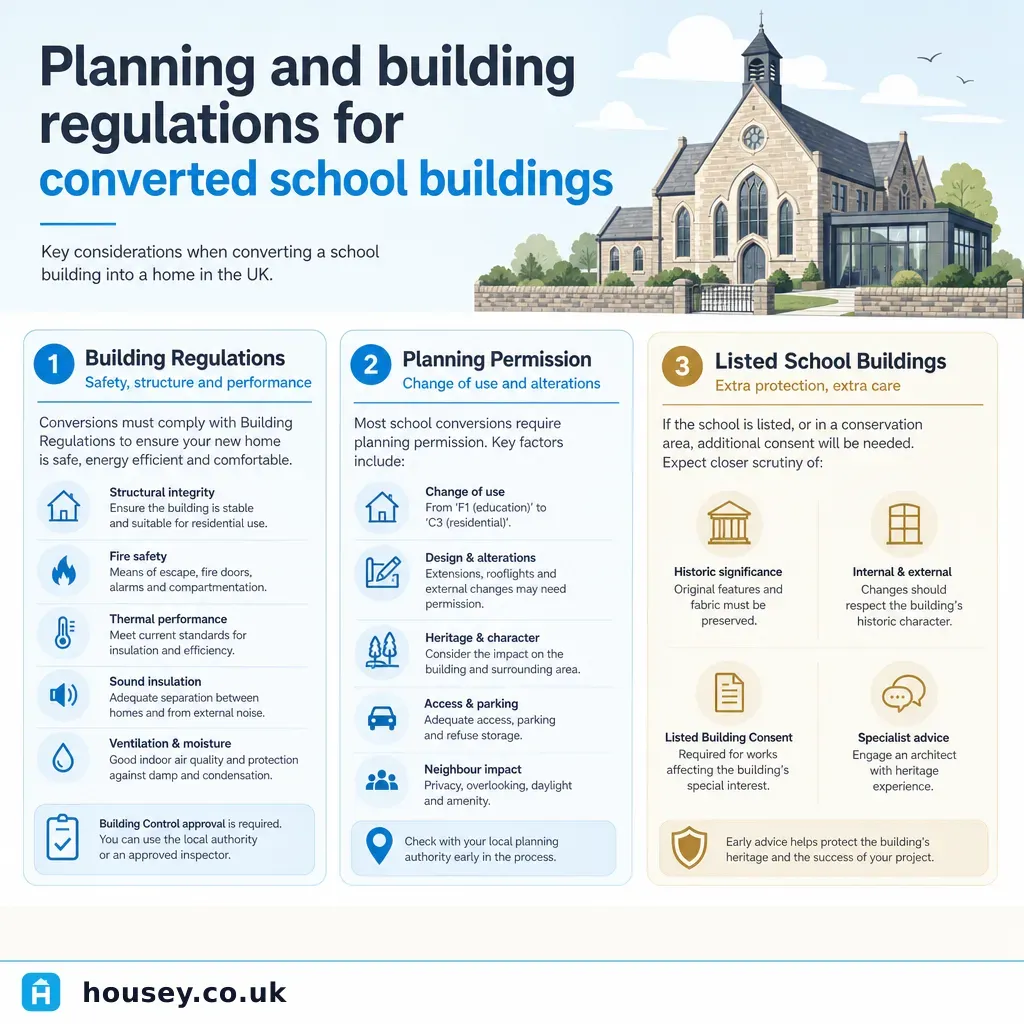
Planning and building regulations for converted school buildings
Converting a school building to residential use in England requires a full planning application — there is no permitted development route for F.
 Planning & Pre-Build
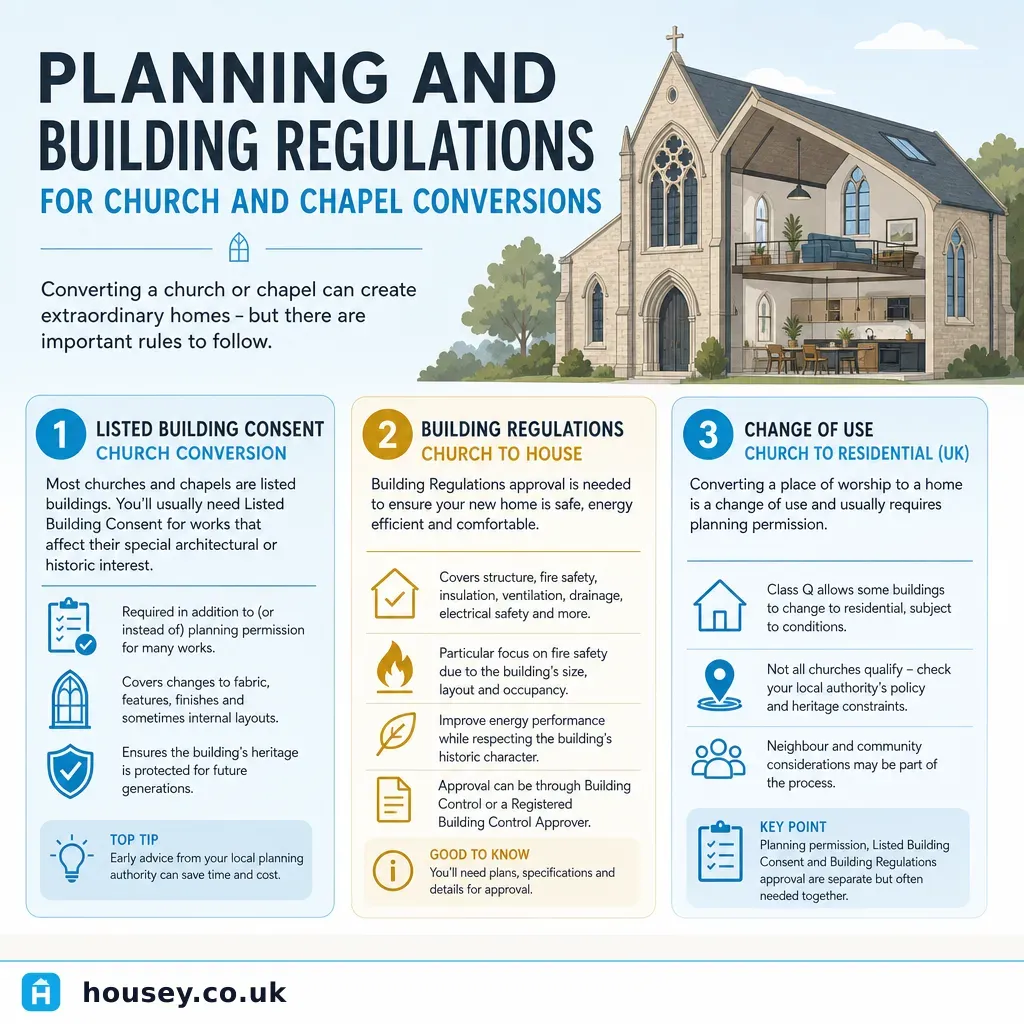
Planning and Building Regulations for Church and Chapel Conversions
Converting a church or chapel to residential use requires planning permission for change of use from Class F1 to Class C3, and listed building consent if the building is listed.
 Planning & Pre-Build
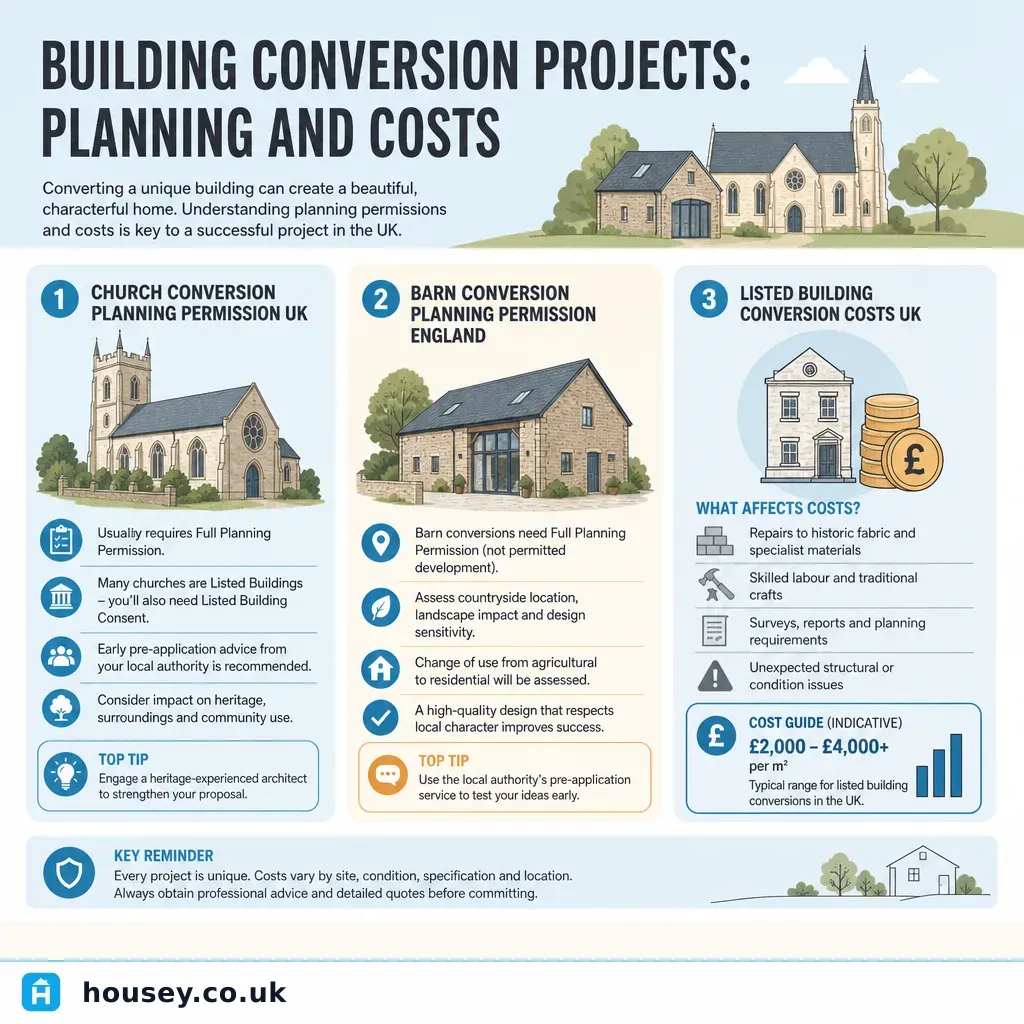
Building Conversion Projects: Planning and Costs
Converting a non-residential building in the UK — such as a barn, church, or commercial property — typically requires full planning permission and often Listed Building Consent.
 Planning & Pre-Build
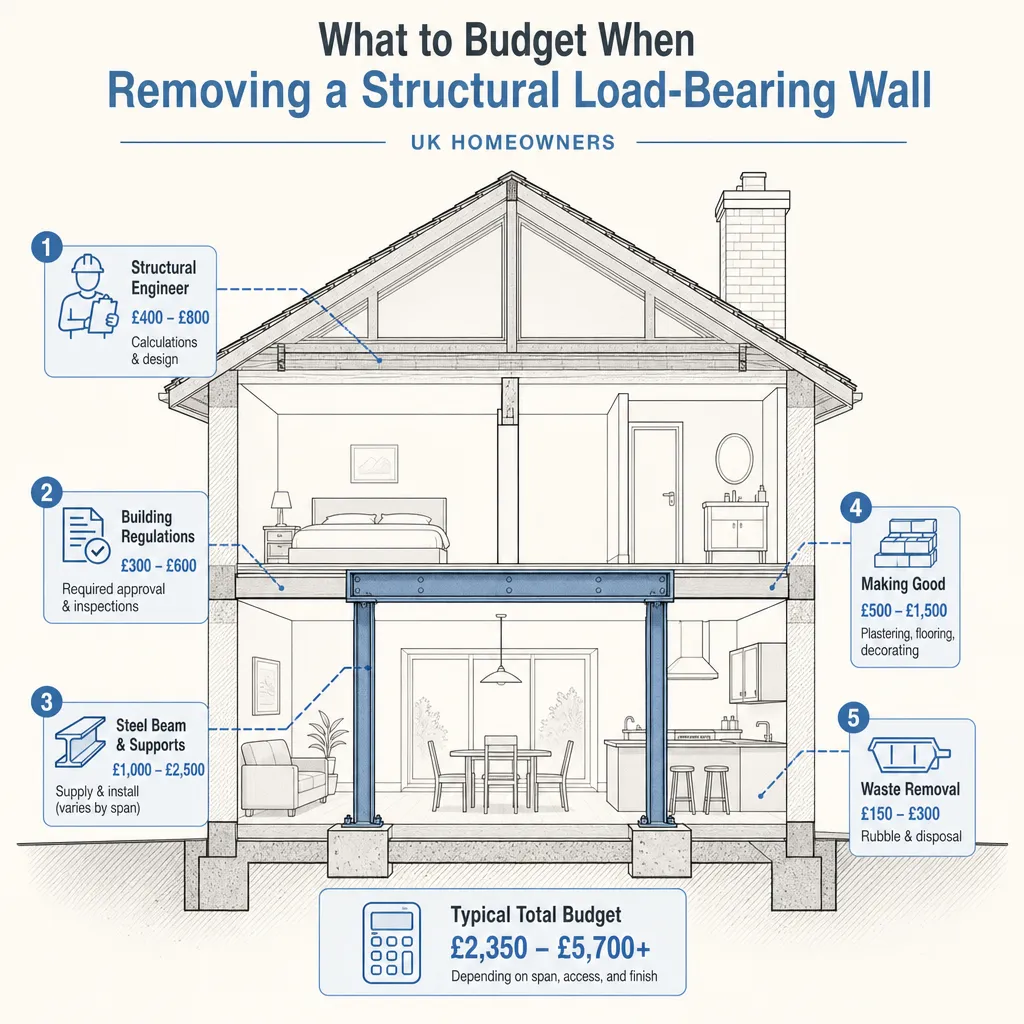
What to Budget When Removing a Structural Load-Bearing Wall
Removing a load-bearing wall in a typical UK home costs £2,500–£8,000 or more in total, covering a structural engineer's calculations, Building Regulations approval, the steel beam, builder's labour, and replastering.
 Planning & Pre-Build
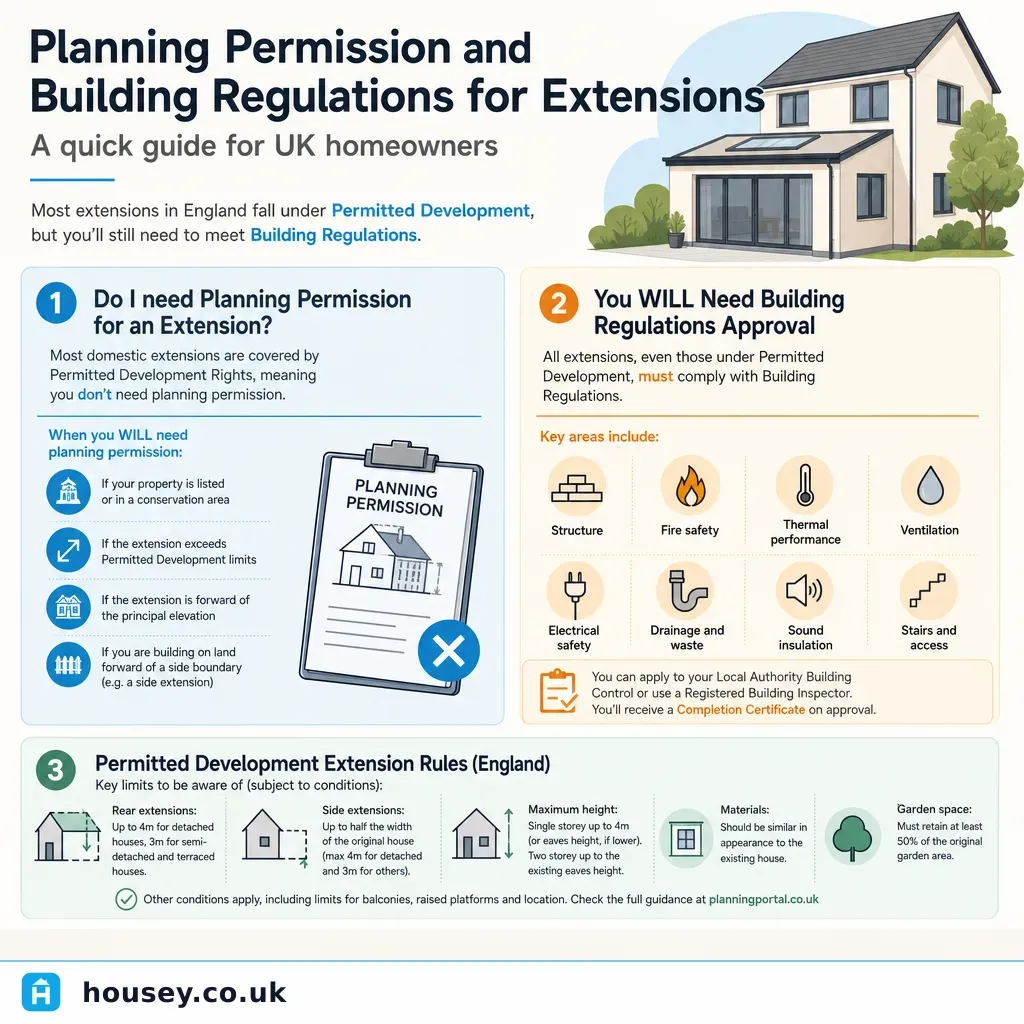
Planning Permission and Building Regulations for Extensions
UK home extensions usually require both planning permission and Building Regulations approval, though most smaller rear extensions qualify as Permitted Development under the GPDO 2015 and need no planning application.