Tarmacadam Driveway Installation Pricing
By Housey · Last reviewed 11th of May 2026
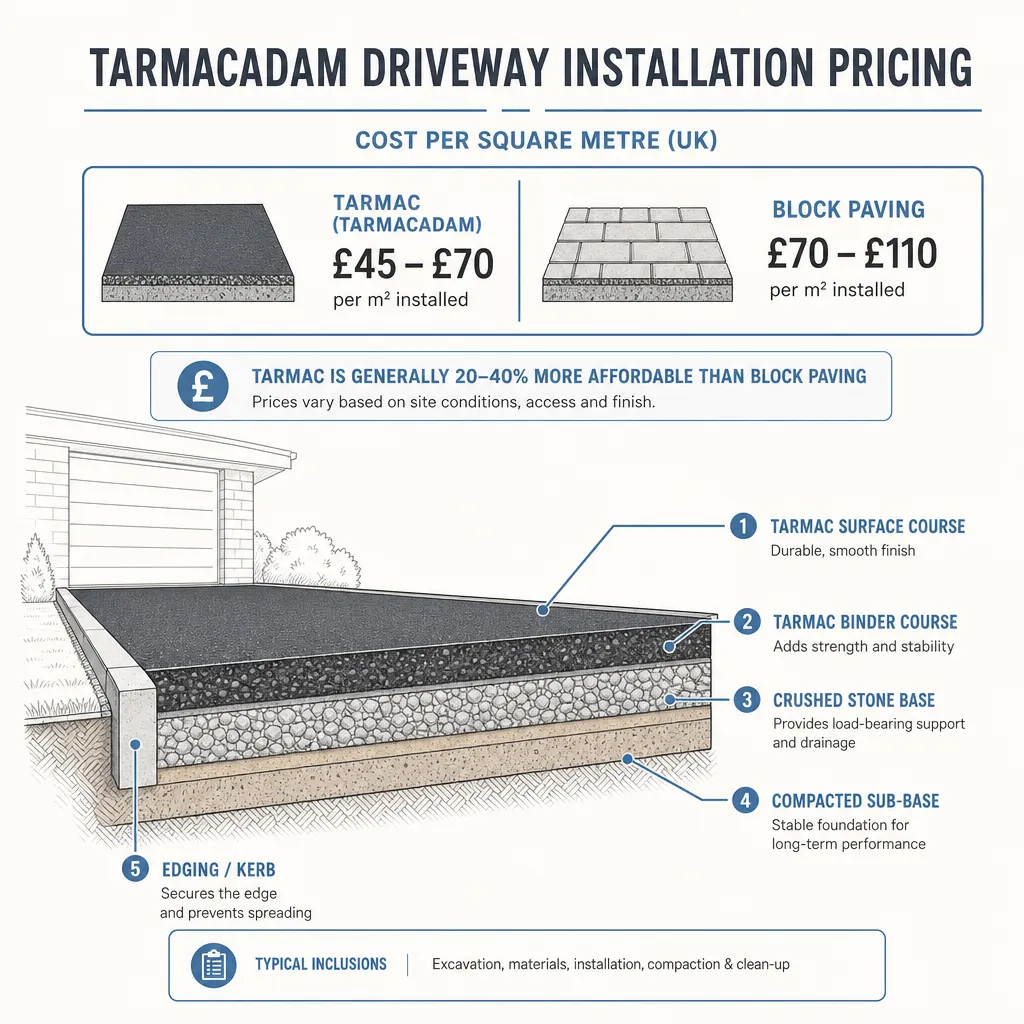
Tarmacadam Driveway Installation Pricing
Replacing or installing a driveway is one of the most visible improvements a UK homeowner can make to the exterior of their property. Tarmacadam — commonly known as tarmac — remains one of the most popular driveway choices in England, Scotland, and Wales, combining relatively low upfront cost with a durable, clean finish that suits everything from a 1930s semi to a modern new-build plot. Understanding what drives the price will help you get fair quotes and avoid costly surprises when work begins.
Key points
- Tarmacadam driveways are installed in two layers: a base course (binder layer) and a wearing course (surface layer), each typically 25–40 mm thick.
- Indicative UK installation costs range from £50 to £100 or more per square metre for supply and lay, depending on size, access, and existing surface condition (Indicative UK costs, last reviewed 2026-05-11).
- Driveways installed after 1 October 2008 require planning permission only if water drains to an impermeable surface without adequate management — porous tarmac or drainage to a lawn or border is generally permitted development under GOV.UK guidance.
- A quality tarmacadam surface, properly laid and periodically sealed, can last 20–30 years; edge areas are typically the first to deteriorate.
- Hot-lay tarmac is the only appropriate material for a new driveway installation — cold-lay patching compound is a repair product only and will not produce a lasting result.
How much does a tarmac driveway cost?
The price depends on the area size, sub-base condition, access, any existing surface to remove, and your location. Labour costs tend to be higher in London and the South East.
Driveway size | Typical total cost | Notes |
|---|---|---|
Small (up to 25 m²) | £1,500–£3,000 | Single car, front garden plot |
Medium (25–50 m²) | £2,500–£5,500 | Double-width or short run |
Large (50–100 m²) | £4,500–£9,000+ | Double car or long approach |
Indicative UK costs, last reviewed 2026-05-11. Costs vary by region, contractor, and site conditions.
Costs increase significantly if the existing surface needs full removal and disposal, the sub-base requires deep excavation due to poor ground conditions, drainage channels or kerbing are needed, or site access is restricted. Always confirm whether VAT is included in any quote, and budget separately for edging strips (£5–£15 per linear metre) and optional sealcoating after installation.
Tarmac versus other driveway surfaces
Choosing a surface material involves balancing cost, appearance, maintenance, and longevity. The comparison below uses a medium driveway of approximately 40 m² as a reference point.
Surface | Indicative cost (40 m²) | Lifespan | Maintenance | Best for |
|---|---|---|---|---|
Tarmacadam | £2,800–£5,000 | 20–30 years | Low; seal every 3–5 years | Low-maintenance, budget-conscious, resurfacing |
Block paving | £4,000–£8,000 | 25–40 years | Moderate; weeding, re-levelling | Aesthetics, kerb appeal, customisation |
Resin-bound gravel | £3,500–£7,000 | 15–25 years | Low; avoid heavy point loads | Permeable, decorative finish |
Concrete | £3,500–£7,000 | 30–40 years | Low; can stain and crack | Long lifespan, clean look |
Loose gravel | £500–£2,000 | Ongoing top-up | High; raking, weed control | Lowest upfront cost, rural settings |
Indicative UK costs, last reviewed 2026-05-11.
What the installation process involves
Understanding the stages helps you question any contractor who skips steps.
- Site survey and marking out — the contractor measures the area and checks drainage falls.
- Excavation — existing surface and unsuitable material is removed, typically to 150–200 mm depth.
- Sub-base preparation — compacted Type 1 MOT crushed stone is laid to 100–150 mm depth to form a stable foundation.
- Base course (binder layer) — hot-lay tarmacadam is spread and roller-compacted, approximately 25–40 mm thick.
- Wearing course (surface layer) — a finer hot-lay course provides the smooth finished surface.
- Edging and kerbing — concrete haunching or block edging contains the tarmac and prevents edge spread.
- Drainage check — surface falls are confirmed to direct water appropriately.
A properly installed surface should be ready for foot traffic within 24–48 hours and vehicles within 2–5 days in warm weather.
Does a tarmac driveway need planning permission?
In England, under permitted development rules updated in October 2008, no planning permission is required if the surface is porous, or if water drains to a lawn, border, or soakaway rather than to a public sewer or highway. Impermeable tarmac draining to the road or sewer does require permission.
Rules differ in Wales, Scotland, and Northern Ireland. Listed buildings and properties in conservation areas may face additional restrictions — always consult your local planning authority before starting work.
Worked example: resurfacing a 1970s semi-detached driveway
A homeowner in the Midlands has a 35 m² cracked concrete driveway in poor condition requiring full removal. They collect quotes from two contractors.
Contractor A — itemised quote (inc. VAT):
- Concrete removal and disposal: £400
- Sub-base repair and compaction: £300
- Tarmac base course (35 m²): £700
- Tarmac wearing course (35 m²): £600
- Concrete block edging (20 linear metres): £300
- Total: £2,300
Contractor B: Single all-in price of £2,800 (VAT inclusive, no breakdown provided).
Without an itemised breakdown from Contractor B, the homeowner cannot verify whether the sub-base repair is included, which grade of tarmac is specified, or whether cheaper cold-lay material has been substituted. Requesting an itemised quote before accepting is always advisable.
What to ask before accepting a driveway quote
- Is this hot-lay or cold-lay tarmac? New driveways must use hot-lay material.
- What depth and type of sub-base will be laid (Type 1 MOT or equivalent)?
- Is removal and disposal of the existing surface included in the price?
- What edging is included, and how is it fixed?
- Is VAT included in the quoted figure?
- How long before the surface can bear vehicle traffic?
- What warranty do you provide on the finished installation?
- Can you provide evidence of public liability insurance?
When to get professional help
Most tarmac driveway installations are straightforward. However, seek additional advice before proceeding if the ground is waterlogged or shows signs of subsidence, there are drainage gullies or services within the driveway area, the site is steeply sloped, or the property is listed or in a conservation area.
Be cautious of unsolicited doorstep offers of discounted tarmac from contractors claiming to have leftover material — these rarely produce a lasting finish and may leave you with a dangerous, crumbling surface within months.
How Housey can help
Housey connects homeowners across the UK with vetted driveway installers who can survey your plot, advise on drainage and planning requirements, and provide clear itemised quotes. Compare multiple contractors in your area before committing.
Frequently asked questions
How long does a tarmac driveway last?
A properly installed tarmacadam driveway — with a compacted Type 1 MOT sub-base, two-layer hot-lay construction, and correct drainage — will typically last 20 to 30 years. Edge degradation and cracking usually appear first. Periodic sealcoating every three to five years and prompt repair of small cracks can significantly extend the surface life.
Can I tarmac my own driveway?
Hot-lay tarmacadam requires specialist paving equipment and must be laid quickly before it cools. DIY installation is not practical for most homeowners. Cold-lay patching products exist for minor repairs but are not appropriate for a new installation or full resurfacing. Always engage a professional contractor for any substantial driveway work.
Does a new tarmac driveway add value to my home?
A neat, well-maintained driveway generally improves kerb appeal and can be a positive factor for prospective buyers, particularly where off-street parking is scarce. Its effect on a formal surveyor's valuation depends on many property-specific factors; a driveway alone is unlikely to significantly alter the assessed market value.
How is tarmac different from asphalt?
The two terms are often used interchangeably in the UK domestic market. Technically, tarmacadam originally used tar as the binder, whereas modern asphalt uses bitumen. Today, virtually all domestic driveways in the UK use bitumen-bound macadam. When a UK contractor quotes for tarmac, they almost always mean modern bituminous macadam.
Sources and further reading
- When is permission required? — GOV.UK — GOV.UK Planning Portal
- Sustainable drainage systems — GOV.UK — GOV.UK
- Chartered Institute of Building — CIOB
Useful next reads
 Improvement & Build
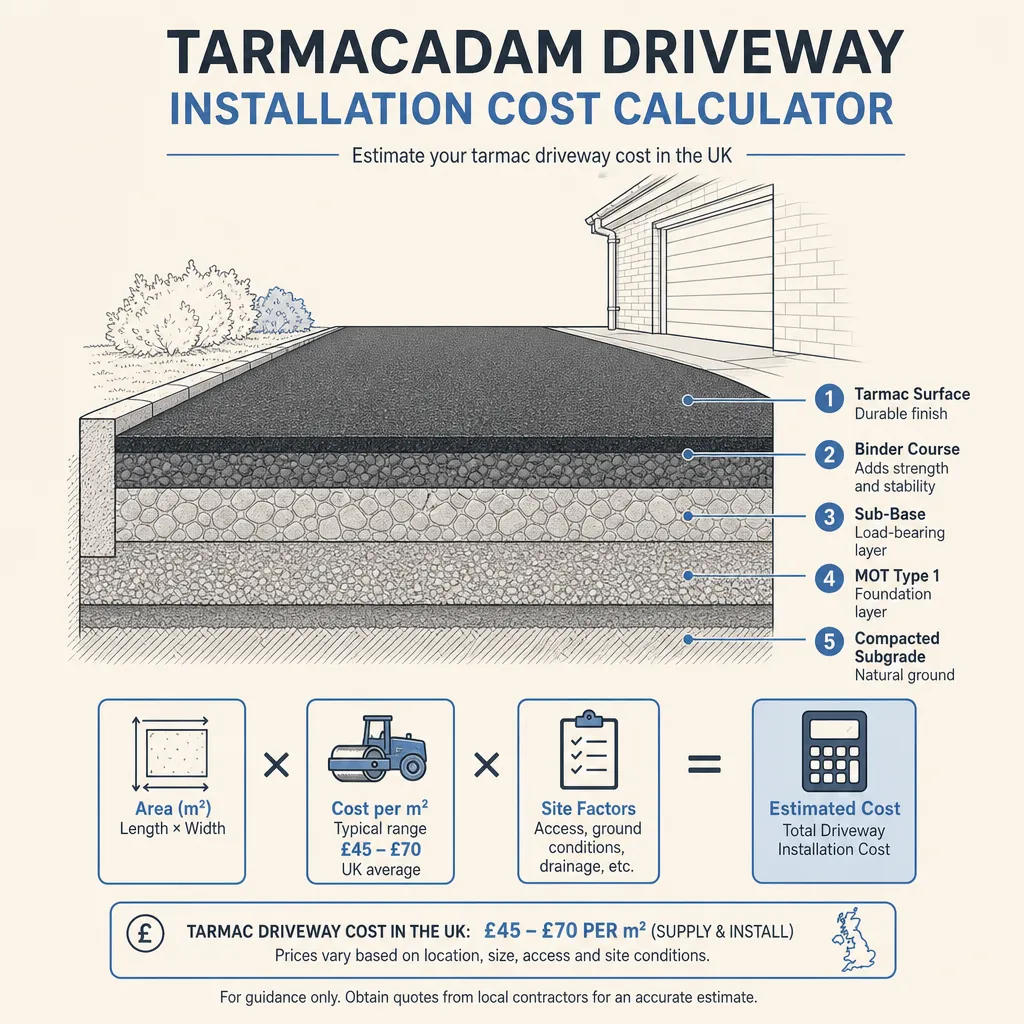
Tarmacadam Driveway Installation Cost Calculator
Tarmacadam driveway installation costs approximately £50–£100 per sq m in the UK for a full new installation, or £20–£50 per sq m for resurfacing over a sound existing base.
 Improvement & Build
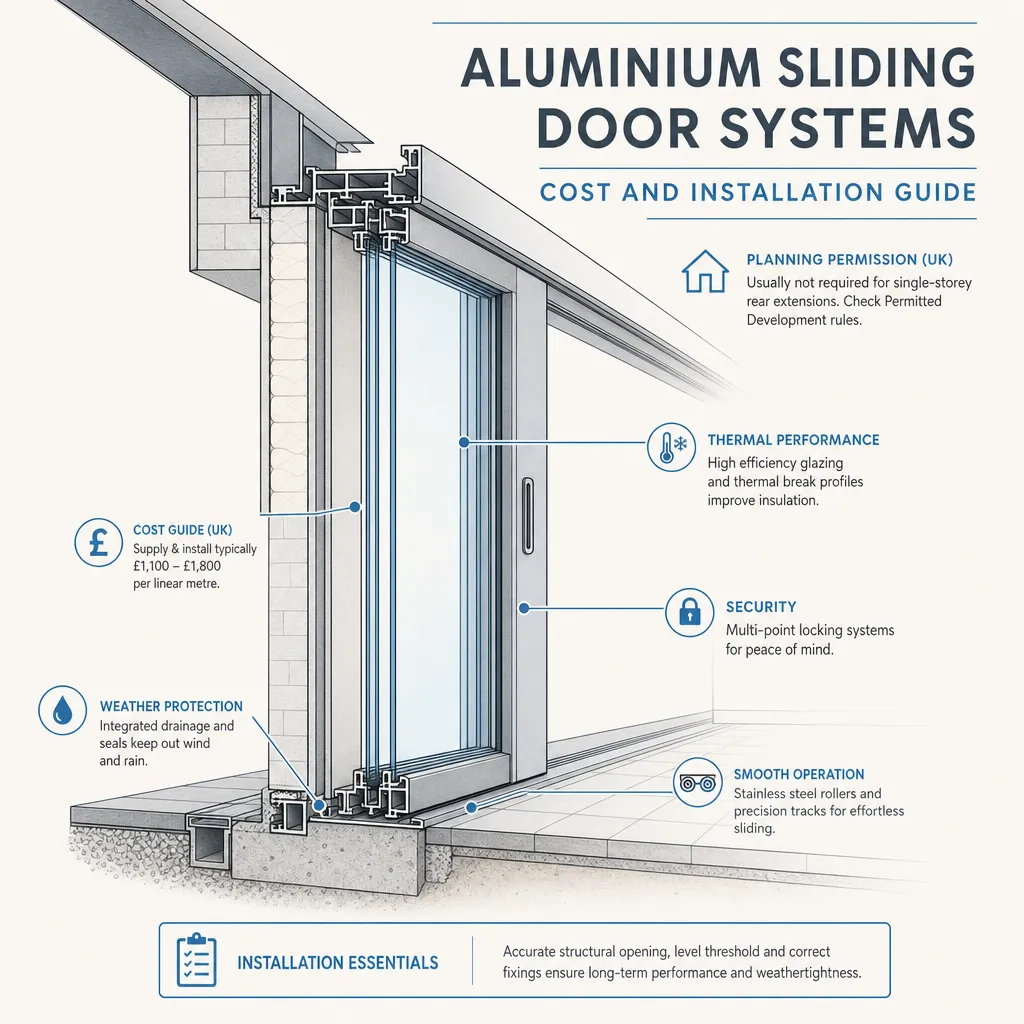
Aluminium Sliding Door Systems: Cost and Installation Guide
Aluminium sliding doors typically cost £2,500–£7,000 supply and fitted for a standard opening.
 Improvement & Build
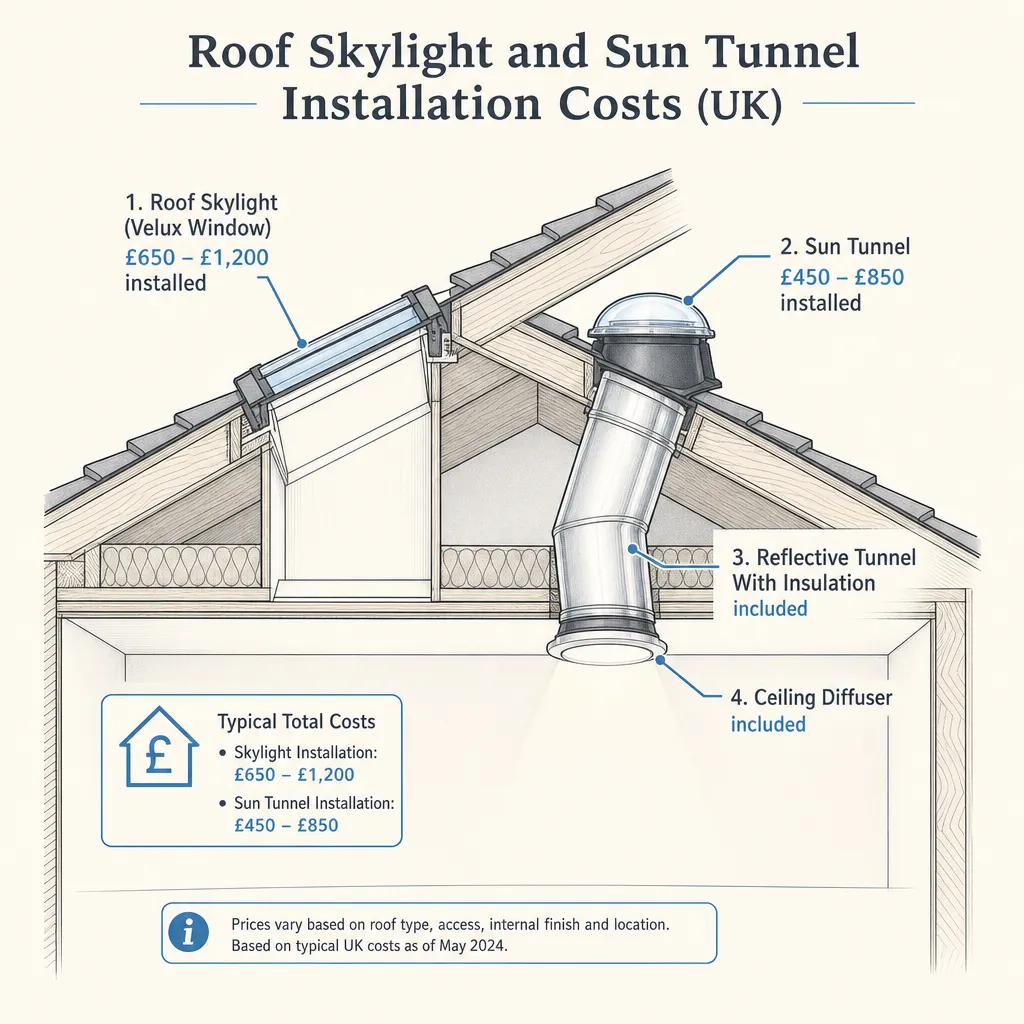
Roof Skylight and Sun Tunnel Installation Costs
A standard pitched-roof skylight costs £800–£3,000 installed in the UK, including flashings and basic making good.
 Improvement & Build
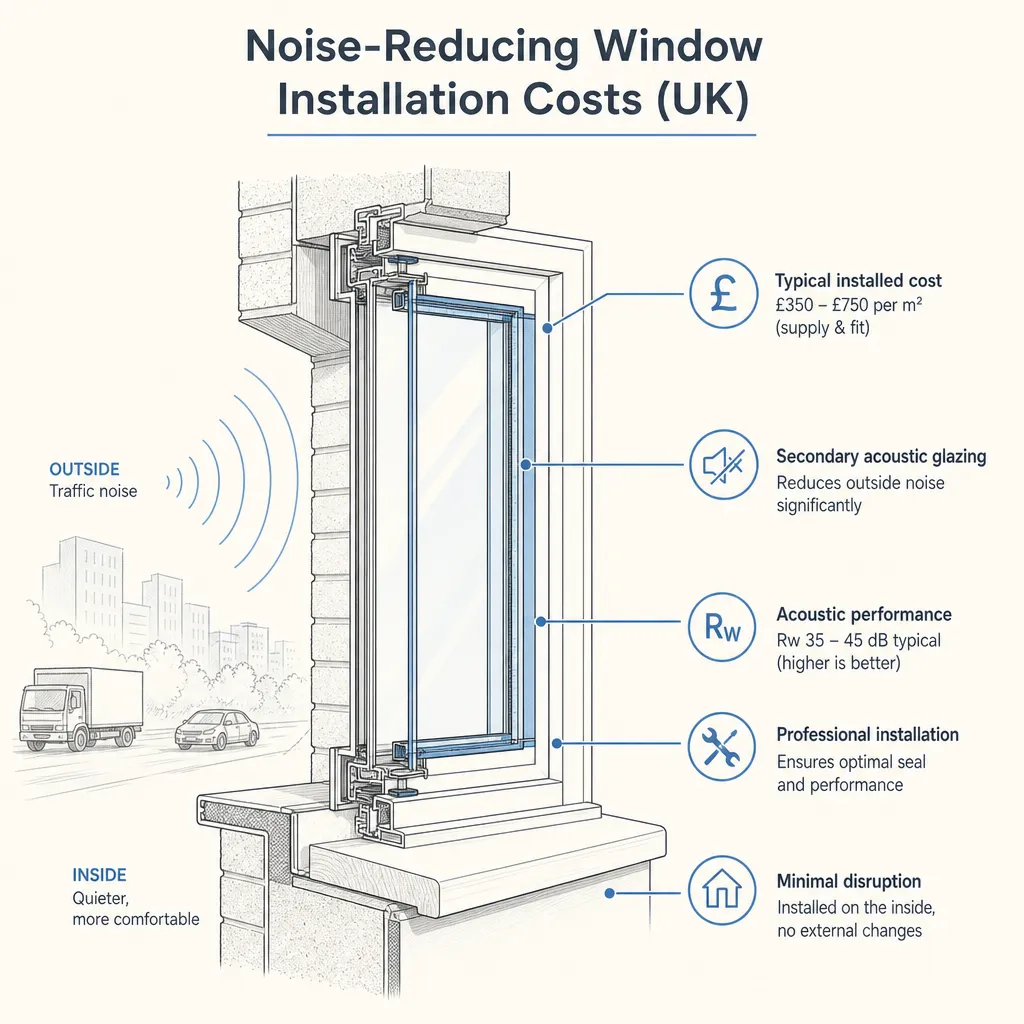
Noise-Reducing Window Installation Costs
Noise-reducing window installation in the UK typically costs £400–£1,500 per window depending on glazing specification, frame material, and property type.
 Improvement & Build
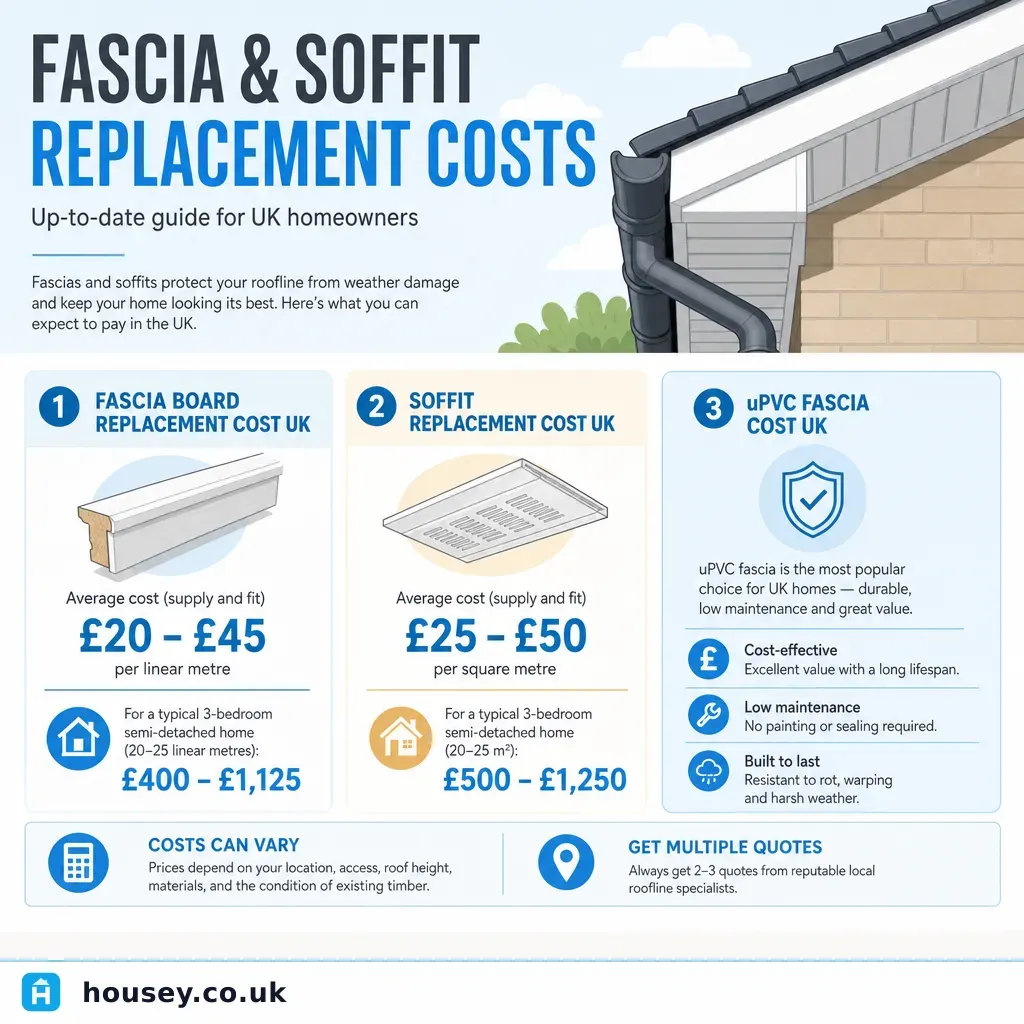
Fascia and Soffit Replacement Costs
Fascia and soffit replacement for a semi-detached house in the UK typically costs £1,800–£4,500 for uPVC boards and new guttering.