Tree Stump Removal Methods and Professional Assistance
By Housey · Last reviewed 19th of May 2026
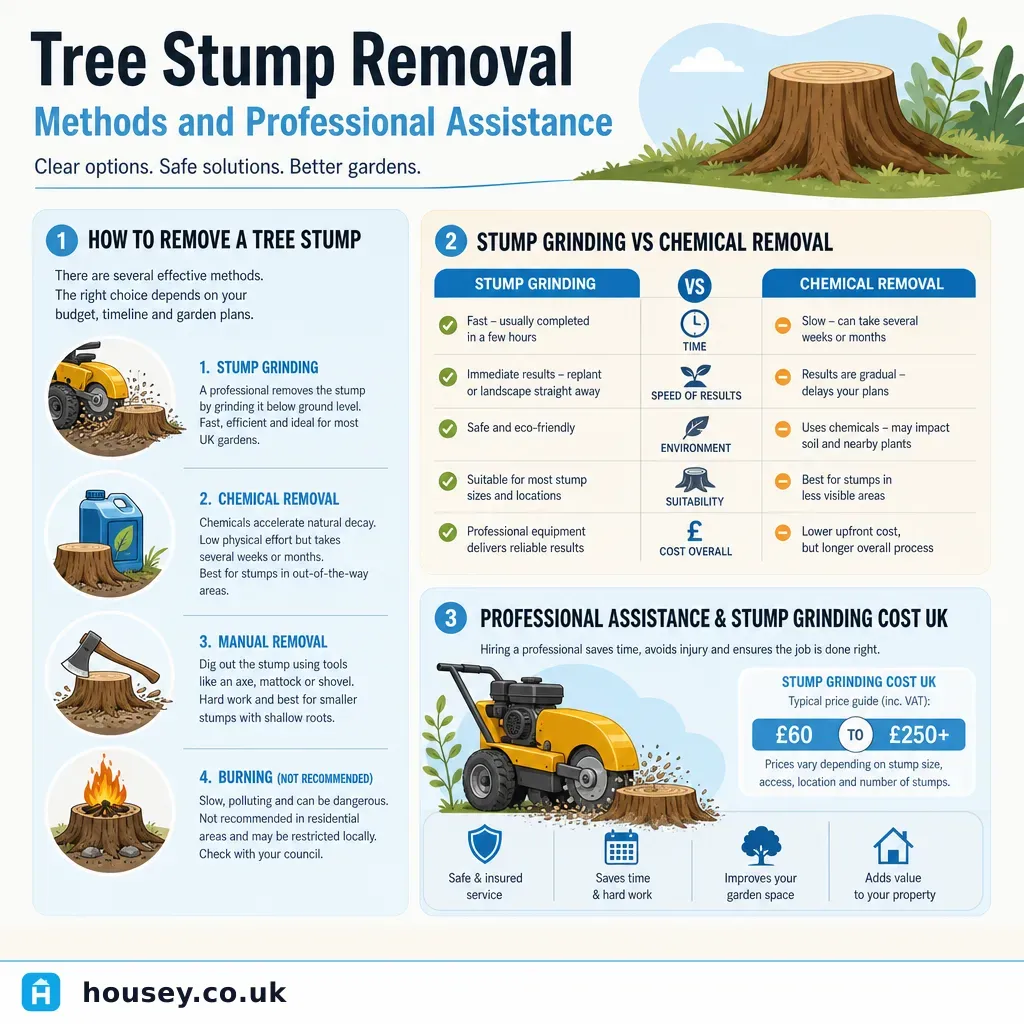
Tree Stump Removal Methods and Professional Assistance
A felled tree often leaves its most persistent problem behind: the stump. Whether you are reclaiming lawn space, preparing ground for an extension, laying a patio, or preventing vigorous re-sprouting, removing a tree stump properly requires matching the right method to the specific situation. The size of the stump, the tree species, the accessibility of the site, and what you plan to do with the cleared ground all influence whether stump grinding, chemical treatment, or excavation is the right approach.
Key points
- Stump grinding is the most widely used professional method in the UK, typically achieving clearance to 150–300 mm below finished ground level and converting the stump to wood chips within a few hours.
- Chemical stump-kill products — usually potassium nitrate-based — are available to the public but take 6–12 months to work and are unsuitable where you need to replant or build quickly.
- If the tree had a Tree Preservation Order (TPO) or stood in a conservation area, the stump and root system may still be subject to legal protection — check with your local planning authority before instructing any contractor.
- Species including willow, poplar, cherry, and elder can re-shoot vigorously from residual roots even after grinding; herbicide treatment of the cut surface can suppress regrowth.
- Before any excavation near a tree, locate underground gas, electricity, water, and telecoms services; roots frequently grow alongside buried pipes and cables.
Stump removal methods compared
Method | Best for | Limitations | Typical cost (indicative, 2026) | Time to completion |
|---|---|---|---|---|
Stump grinding | Most situations; large stumps; site clearance for turf or planting | Leaves root system in ground; machinery needs site access | £100–£350 per stump | 30 min–2 hrs on site |
Chemical treatment | Remote or inaccessible stumps; low-priority clearance | Very slow (6–12 months); unsuitable before building, paving, or replanting | £10–£30 DIY product cost | 6–12+ months |
Manual excavation | Small stumps (under ~150 mm diameter); soft soil; accessible site | Impractical for large stumps; labour intensive | From £80 professional; DIY feasible for small stumps | Hours to a full day |
Full root excavation | Stumps where all root material must be removed before foundation or slab work | Significant ground disruption; expensive; requires plant machinery | £500–£2,000+ depending on stump size | 1–2 days |
Burning / charring | Very remote rural sites in dry conditions | Prohibited in most urban and suburban areas; fire risk; slow | Low (fuel costs only) | Several days |
Indicative UK costs, last reviewed 2026-05-19. Costs vary significantly by stump diameter, access, root depth, species, and contractor location.
Stump grinding: what it involves and when to use it
Stump grinding is the professional standard for most domestic stump removals. A petrol-powered grinder — ranging from compact walk-behind machines (available for hire) to larger tracked units used by tree surgeons — uses a rotating cutting disc to chip the stump and surface roots down to a set depth, typically 150–300 mm below finished ground level.
What grinding leaves behind: The stump becomes wood chips (arisings), which can be left as mulch or removed from site at additional cost. The root system remains in the ground and decays naturally over 5–15 years, depending on species and soil conditions.
Stump grinding is appropriate when:
- You want to restore lawn, plant beds, or soft landscaping in the cleared area
- You need the ground cleared within days or weeks rather than months
- Machinery can access the site (most garden situations can be accommodated with a compact machine)
- The future use does not require complete root removal
Grinding alone may not be sufficient when:
- You are laying a new driveway, patio, or hard surface — decaying roots can cause localised settlement beneath rigid surfaces
- A structure, extension, or significant load is being placed in the root zone — root voids can compromise ground stability
- A structural engineer or building control officer has specified complete root removal
Chemical and manual methods
Chemical stump removal uses potassium nitrate or similar compounds to accelerate biological decay. You drill holes into the stump, apply the product, and wait. Treated stumps become spongy over 6–12 months and can eventually be broken up with an axe or mattock. This method is low effort but very slow, making it unsuitable where you need the ground cleared for construction, paving, or replanting within the year.
Manual excavation is practical only for small stumps, typically under 150 mm trunk diameter. The technique involves exposing lateral roots with a mattock, severing them with a pruning saw or loppers, and rocking the stump to free the taproot. For anything larger, the root mass becomes too extensive for hand tools alone to manage efficiently or safely.
Considerations before you start
Checklist before instructing a contractor
Underground services near tree stumps
Roots frequently grow alongside or around buried water pipes, gas mains, and electricity cables, particularly in established gardens. If you are having a stump removed near any known service run, confirm with your contractor whether a cable avoidance tool (CAT) sweep is included in their scope. Striking a gas main or electricity cable during stump grinding is rare but carries serious consequences.
What to ask before accepting a quote
- To what depth will the stump be ground, and is that sufficient for my intended use of the cleared area?
- Will the root system be left in the ground, or is full excavation available if required?
- Is removal of wood chip arisings and excavated spoil included in the price, or charged separately?
- What qualifications and insurance does the operative or company hold for stump grinding and tree surgery work?
- Is VAT included in the quoted figure?
- What access is required, and what happens to the price if access is more restricted than assumed?
- Have underground services been checked, or do I need to arrange a utility trace independently?
- Can you treat stump regrowth or apply cut-surface herbicide at the same visit?
When to get professional help
Stump grinding involves fast-moving machinery, flying debris, vibration, and potential proximity to underground services or structures. Hire a qualified professional for any stump over 200 mm in diameter, for stumps close to buildings, walls, or service runs, and wherever the cleared ground is to be used for construction or hard paving. Check that the contractor carries adequate public liability insurance — a minimum of £2 million, and ideally £5 million or more — and that operatives are trained in machine operation under relevant NPTC or equivalent certification.
How Housey can help
Housey connects you with vetted local tree surgeons and groundworkers who can assess your stump, recommend the right removal method, and carry out the work safely — whether you need a single garden stump ground out before relaying a lawn, or a full site clearance ahead of building works.
Frequently asked questions
How much does stump grinding cost in the UK?
Stump grinding typically costs £100–£350 per stump for a standard garden stump, depending on its diameter, species, access, and required depth. Multiple stumps may attract a lower per-stump rate. Removing arisings (wood chip) is often charged separately. Indicative UK costs, last reviewed 2026-05-19.
Can I remove a tree stump myself?
For small stumps under approximately 150 mm in diameter, manual removal with a mattock and pruning saw is feasible. Larger stumps require a stump grinder, which is available for hire but requires training and appropriate safety equipment. For stumps near buildings, walls, or underground services, professional removal is strongly recommended.
How long does it take for a stump to rot naturally?
Softwood species such as pine may soften significantly within 3–5 years; hardwood species such as oak may take 10–20 years to decay meaningfully. Natural decay leaves underground root voids that can cause ground settlement. If you plan to build, pave, or replant over the area, removal is preferable to leaving the stump in place.
Will a tree stump re-sprout after removal?
Species that readily re-shoot — including willow, cherry, hazel, elder, and poplar — may send up new growth from residual roots even after grinding. Ask your tree surgeon about stump treatment with an approved herbicide applied to the cut surface. This must comply with UK pesticide regulations and should be carried out by a certified operative.
Do I need permission to remove a tree stump?
Usually not, if the tree was already felled legally. However, if the tree had a Tree Preservation Order or was in a conservation area, the stump and root system may still be protected. Some TPO trees can only be felled with prior written consent from the local planning authority. Check with your council before instructing a contractor.
Sources and further reading
- Tree Preservation Orders and trees in conservation areas — GOV.UK
- Arboricultural Association — Guidance for tree owners — Arboricultural Association
- Health and Safety Executive — Safe use of machinery in arboriculture — Health and Safety Executive
- Lines Search Before U Dig — locate underground utilities — LSBUD
Useful next reads
 Improvement & Build
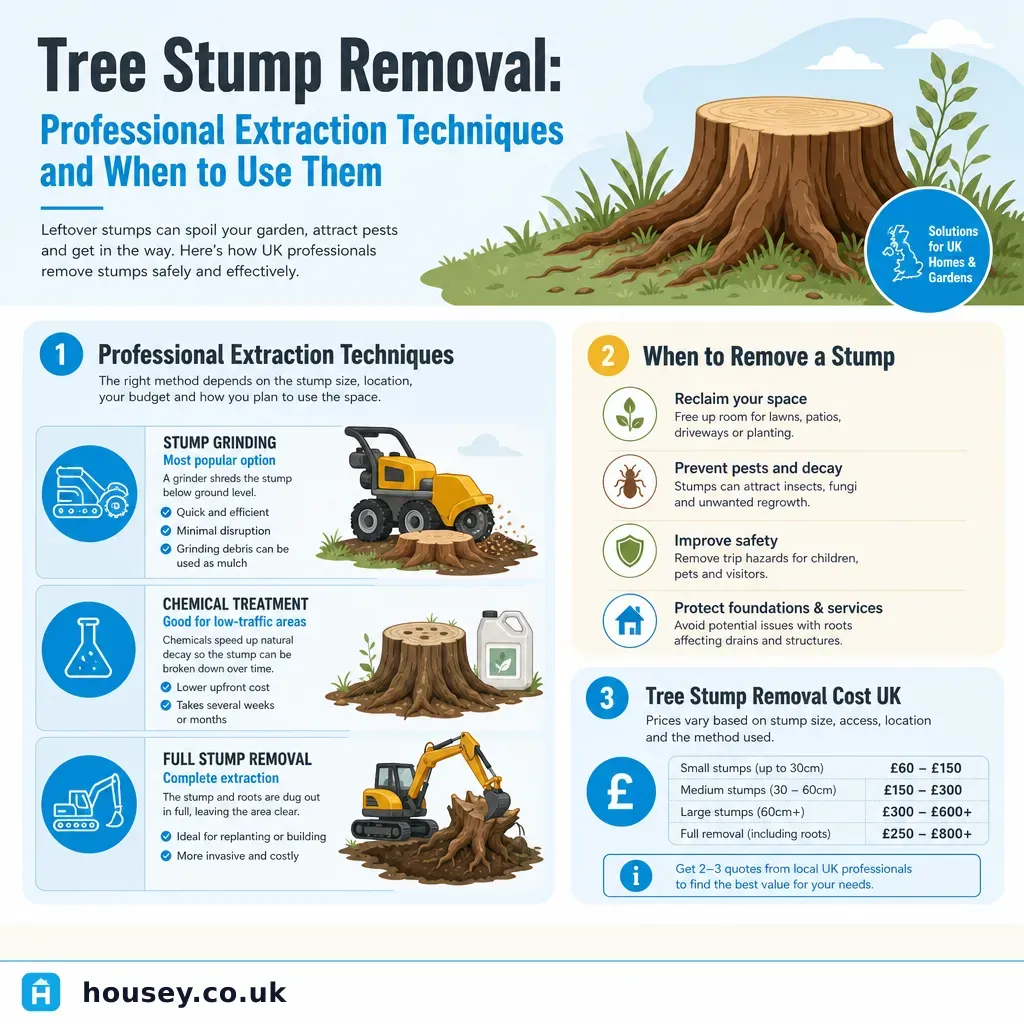
Tree Stump Removal: Professional Extraction Techniques and When to Use Them
Tree stumps in UK gardens can be removed by grinding, mechanical extraction, or chemical treatment.
 Improvement & Build
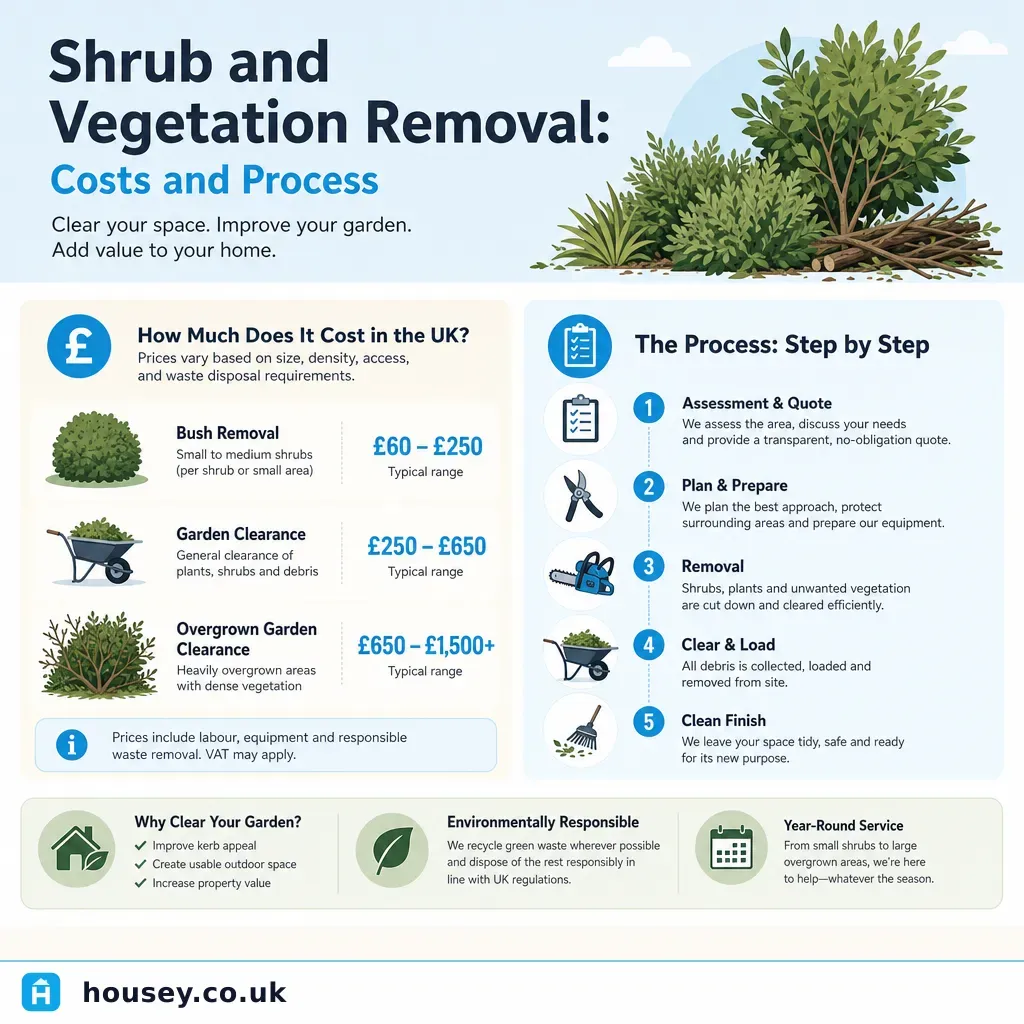
Shrub and Vegetation Removal: Costs and Process
Shrub and vegetation removal costs £50–£2,500 or more depending on area size, species involved, and whether stumps need grinding.
 Improvement & Build
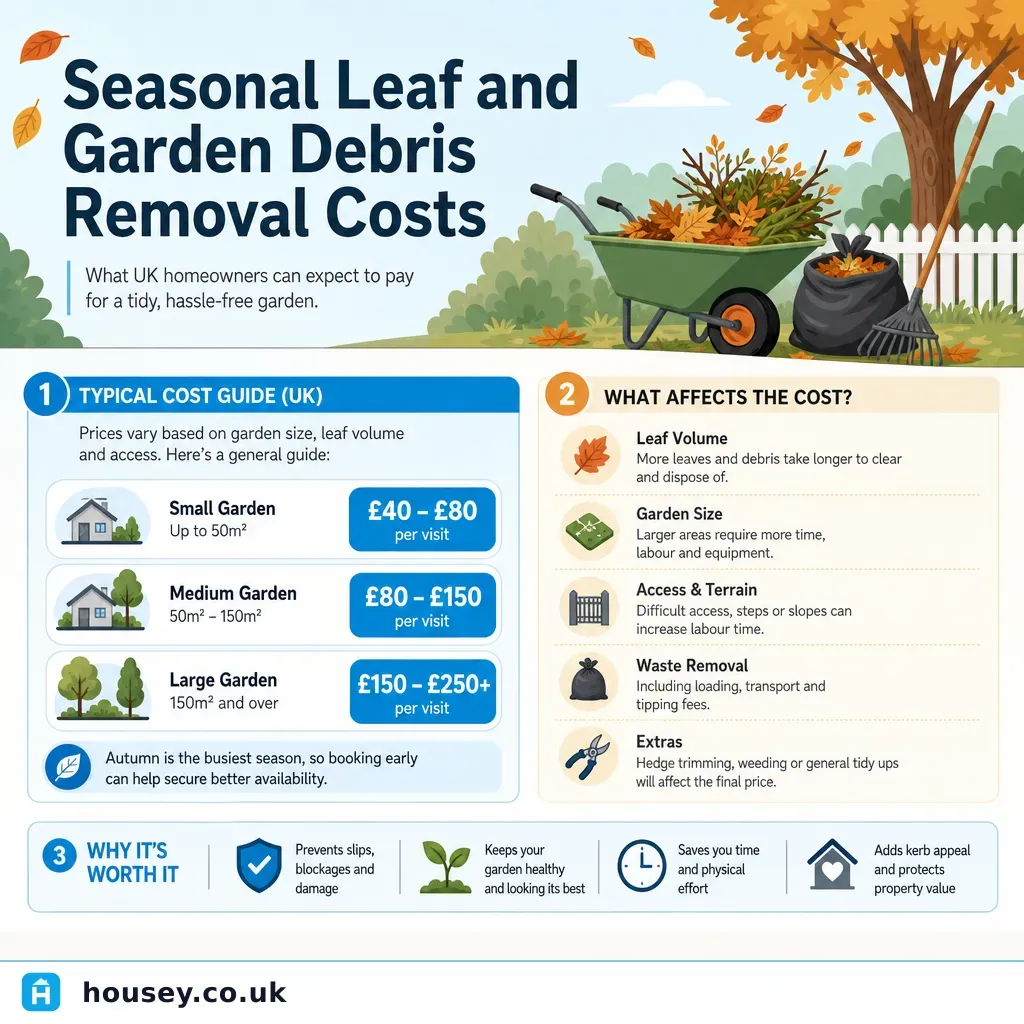
Seasonal Leaf and Garden Debris Removal Costs
Professional leaf clearance for a small to medium UK garden typically costs £60 to £150 for a single autumn visit, rising to £350 or more for large gardens with mature trees.
 Improvement & Build
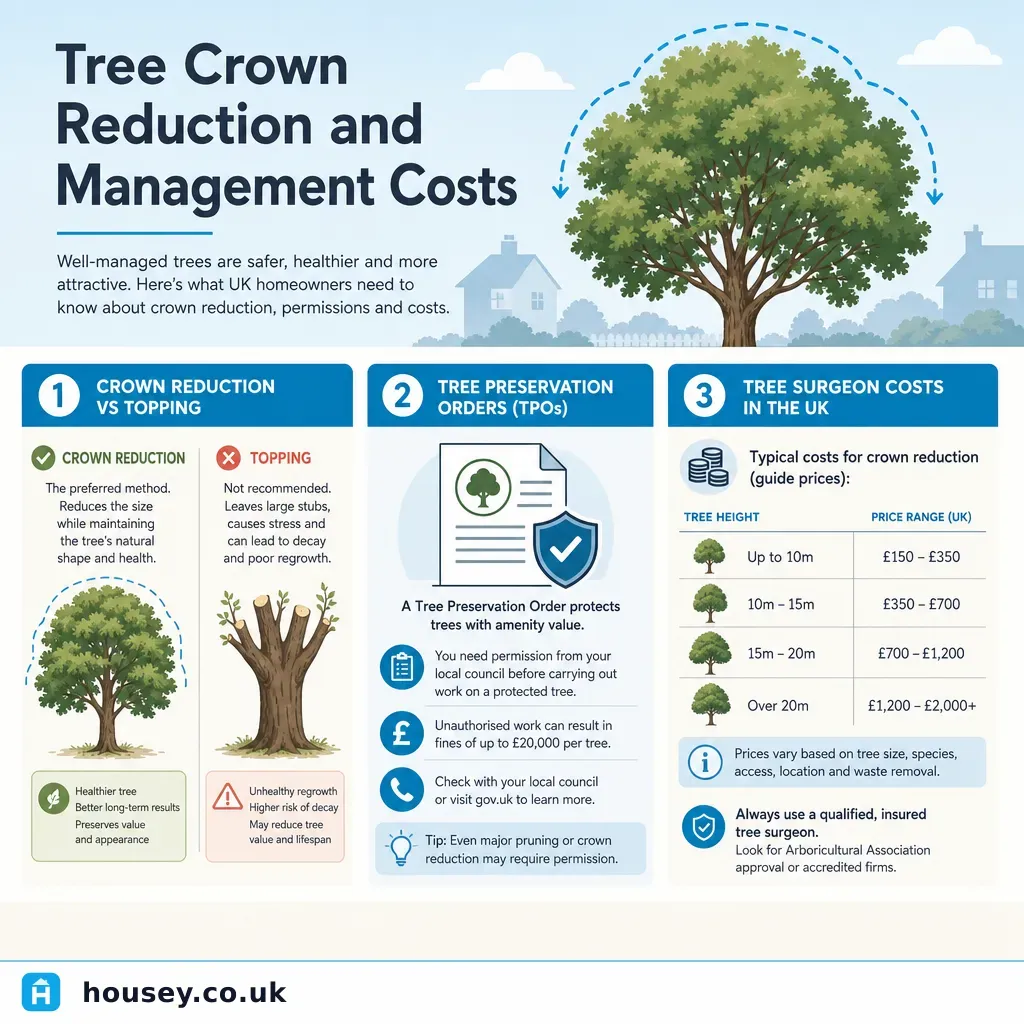
Tree Crown Reduction and Management Costs
Crown reduction reduces a tree's overall size by 15–30% while preserving its natural shape, and must follow BS 3998:2010.
 Improvement & Build
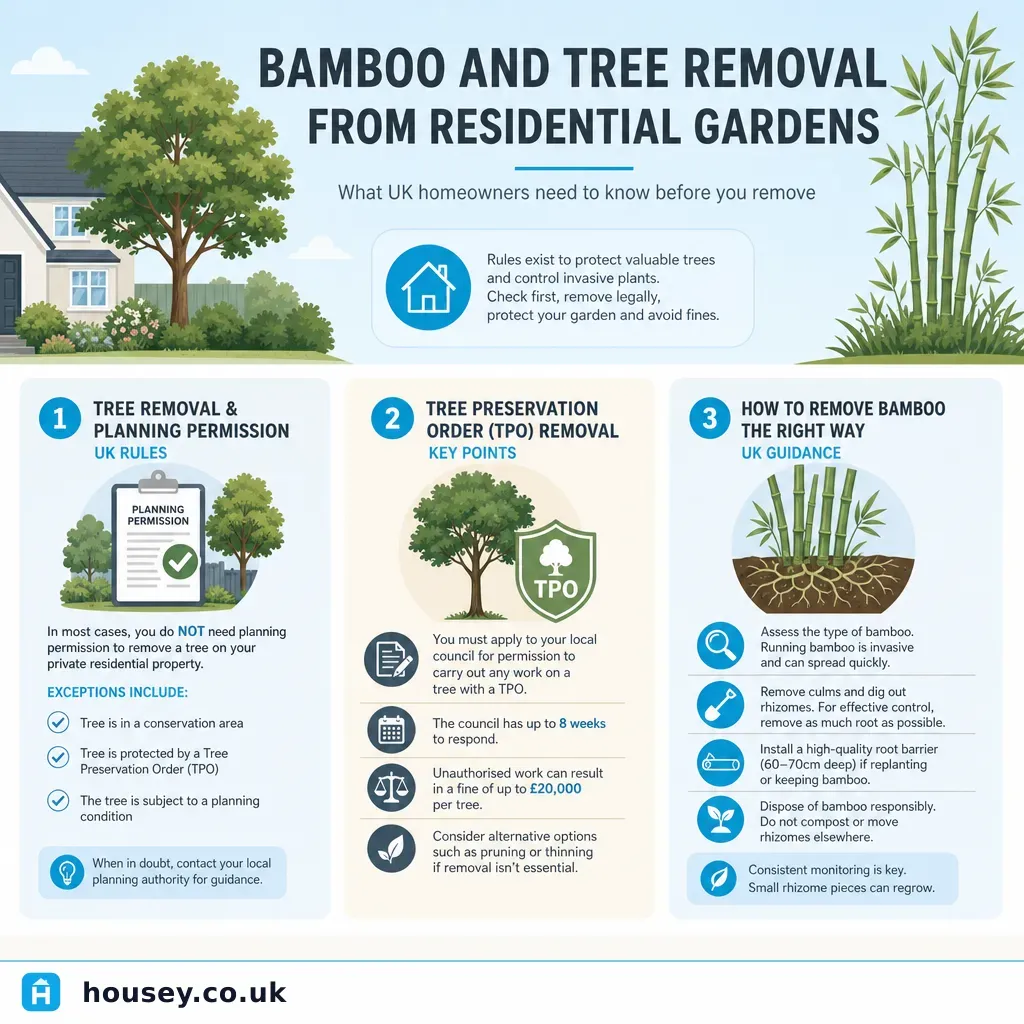
Bamboo and Tree Removal from Residential Gardens
Tree removal in UK gardens may need local authority approval if the tree has a Tree Preservation Order or sits in a conservation area.