Tree Stump Removal: Professional Extraction Techniques and When to Use Them
By Housey · Last reviewed 18th of May 2026
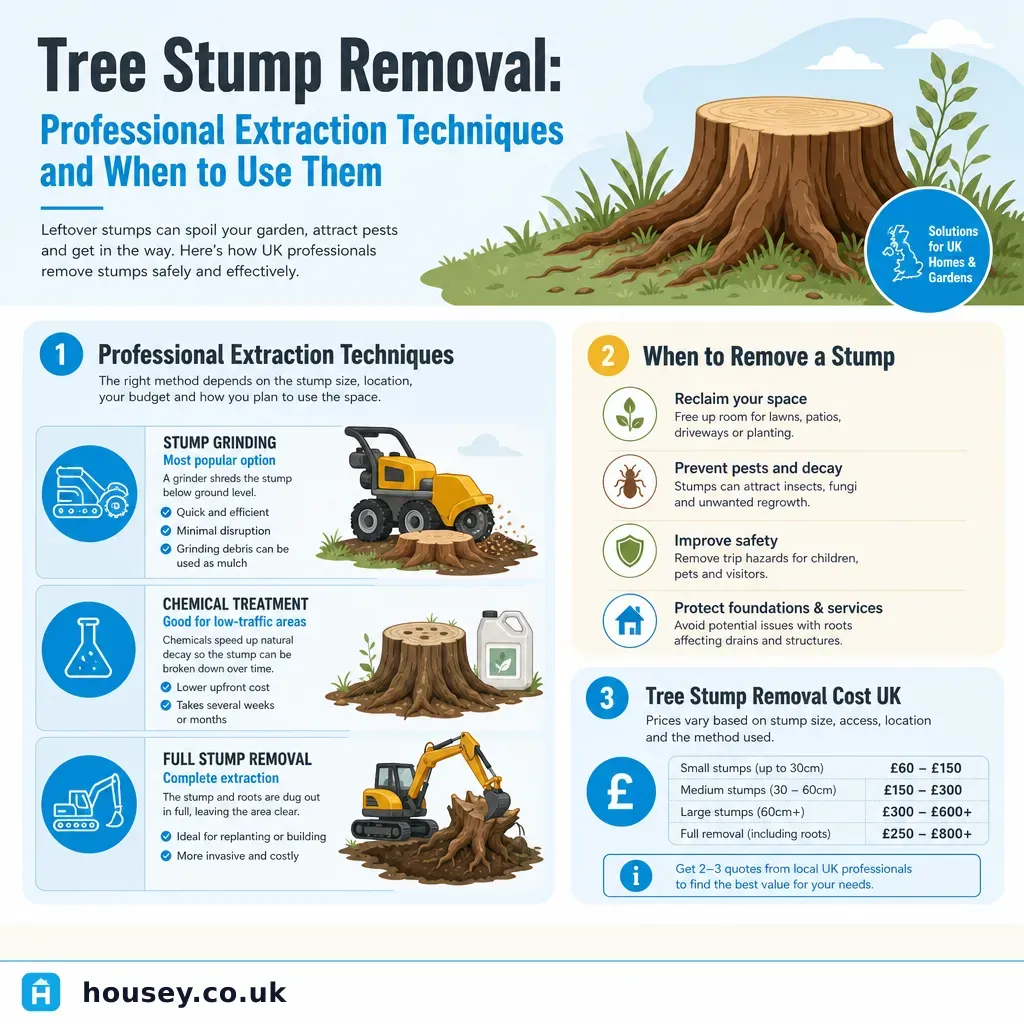
Tree Stump Removal: Professional Extraction Techniques and When to Use Them
Leftover stumps are one of the most persistent challenges UK homeowners face after a tree has been felled, died, or come down in a storm. Whether a stump sits in a front garden earmarked for a new driveway or in a back garden where replanting is planned, the removal method matters — not just for tidiness, but for the long-term safety of nearby structures, underground services, and surrounding planting.
Key points
- Stump grinding is the standard professional method, typically reducing a stump to 200–300 mm below ground level while leaving roots to decay naturally in the ground.
- Chemical stump killers containing glyphosate or potassium nitrate are available from garden centres but can take 6–12 months to break down the stump fully.
- A tree covered by a Tree Preservation Order (TPO) may require written consent from the local planning authority before the stump or roots are disturbed — check before instructing any work.
- Stumps within approximately 3 metres of building foundations, drainage runs, or retaining walls should be assessed for root proximity before grinding or extraction begins.
- Some species — particularly willow, poplar, cherry, and elm — can produce regenerative shoots from root fragments left in the ground; full extraction or chemical treatment may be preferable to grinding alone for these trees.
Which removal method is right for your situation?
Three principal methods are used for residential stump removal, each with different equipment requirements, timescales, and suitability.
Method | Best for | Not ideal for | Typical result | Main risk if wrong choice |
|---|---|---|---|---|
Stump grinding | Most domestic stumps; speed and tidiness | Stumps near structures or buried services; replanting immediately in the same spot | Wood chip mulch; roots left to decay | Grinding near buried services or foundations can cause damage |
Mechanical extraction | Complete root removal; open ground ahead of hard landscaping | Confined gardens; stumps close to walls, drains, or fences | Full stump and major root mass removed | Significant ground disturbance; may require reinstatement works |
Chemical treatment | Small or inaccessible stumps; no time pressure | Near vegetable beds, watercourses, or areas accessible to children or pets | Stump decays over 6–12 months | Slow; regrowth risk if product is applied incorrectly |
Decision tree — which method should you choose?
- Choose stump grinding if the stump is in a standard domestic garden, away from structures and buried services, and you want quick, tidy results.
- Choose mechanical extraction if the ground must be fully cleared — for a new patio, driveway, or planting area — and there is adequate access space for machinery.
- Choose chemical treatment if the stump is small, machinery access is impossible, and you can wait several months for results.
- Ask a qualified tree surgeon if the tree was large (over 500 mm diameter at stump level), is a species prone to resprouting, or sits close to any below-ground structure.
- Check with your local planning authority if the tree may have been subject to a TPO or if your property is in a conservation area.
What happens during professional stump grinding?
A stump grinder uses a rotating disc fitted with carbide teeth to chip the stump progressively below ground. Professional-grade machines range from compact walk-behind units suited to tight residential gardens to tracked machines capable of handling stumps over 1 metre in diameter. The typical process for a residential job:
- Services check — a responsible contractor checks for underground gas, water, and electrical services before grinding begins, using utility plans or a cable avoidance tool (CAT).
- Grinding in passes — the operator reduces the stump in stages, typically to 200–300 mm below finished ground level. Greater depth can be requested where new paving or a planting bed is planned.
- Chip handling — grinding produces a significant volume of wood chip. Some contractors include removal in their price; others leave it for composting on site. Clarify this before booking.
- Void reinstatement — the resulting hole can be filled with topsoil and seeded. Confirm whether this is included in the quoted price or charged separately.
Indicative UK costs, last reviewed 2026-05-18: professional stump grinding for a single residential stump typically ranges from £60 to £200 or more, depending on stump diameter, access, and location. Discounts are commonly available for multiple stumps treated in one visit. Always obtain at least two or three quotes from qualified arborists.
Stumps near structures — when extra caution is needed
Tree roots can extend well beyond the canopy line, and species with aggressive root systems — willow, poplar, and large oaks in particular — can affect drainage runs, foundations, and boundary structures. Before removing a stump close to any building or underground service:
- Request an underground services check from utility providers or instruct a registered cable-avoidance contractor before grinding begins.
- If the tree was large and close to the property, consider whether a structural assessment is warranted before mechanical extraction disturbs significant root mass near foundations.
- Be aware that roots often cross boundary lines. A large-scale extraction may disturb ground on a neighbouring plot; discuss this with your neighbour before works begin.
What to ask before accepting a quote
- What removal method will be used, and why is it appropriate for this stump?
- How deep will grinding go, and will roots be left to decay or addressed directly?
- Is wood chip removal included, or is there an additional charge?
- Will the contractor check for underground services before starting?
- What happens if additional root complexity or access difficulties are discovered once work is underway?
- Is VAT included in the quoted price?
- Do they hold an NPTC (Lantra Awards) qualification and membership of the Arboricultural Association?
Tree Preservation Orders and conservation areas
If the tree that left the stump was protected by a Tree Preservation Order, the order may still apply to the stump and root system. Removing or disturbing protected material without local planning authority consent is a criminal offence under the Town and Country Planning Act 1990 and can attract an unlimited fine.
In a conservation area, any tree with a trunk diameter exceeding 75 mm (measured at 1.5 m height) requires at least six weeks' written notice to the local planning authority before stump removal proceeds. Check the GOV.UK guidance on tree preservation orders to confirm your obligations before instructing any work.
When to get professional help
For most residential stumps, a qualified arborist with appropriate equipment is the right choice. Seek professional advice if:
- The stump is within approximately 3 metres of your house, a boundary wall, or a drainage run.
- The original tree was large, had a wide canopy, or belongs to a species known for aggressive root systems.
- You notice cracking in nearby paving, walls, or paths that may indicate root or soil movement.
- You are uncertain whether the tree was protected by a TPO or whether the property is in a conservation area.
- Site access is restricted in a way that may require specialist equipment or a formal risk assessment.
How Housey can help
Housey connects UK homeowners with vetted tree surgeons who can assess, quote for, and carry out professional stump grinding or extraction. Compare quotes from local arborists, check their credentials, and instruct work with confidence.
Frequently asked questions
Will the roots decay on their own after stump grinding?
In most cases, yes. Grinding removes the above-ground and near-surface stump material; remaining roots die and slowly decompose over several years. This rarely causes problems for lawns or planting beds, but if you plan to replant a new tree in exactly the same spot, allowing 12–24 months for decay — or arranging full extraction — is worth considering.
Can I remove a tree stump myself?
Small stumps under 200 mm in diameter can sometimes be removed manually with a mattock, spade, and loppers, though it is hard physical work. Stump grinders are available from tool-hire companies, but operator experience matters — grinding near buried services or foundations can be dangerous. For stumps over 300 mm or near structures, professional removal is strongly advisable.
How long does stump grinding take?
A single residential stump typically takes 30–90 minutes for a professional with appropriate equipment, depending on diameter, wood hardness, and site access. Multiple stumps treated in a single visit are usually more cost-efficient, so grouping several jobs together can reduce the per-stump cost significantly.
Does stump removal require planning permission?
Not usually for a standard garden stump with no Tree Preservation Order. However, if the original tree was covered by a TPO or the property is in a conservation area, consent or prior written notice to the local planning authority may be required before the stump or roots are disturbed. Check with your local planning authority if in any doubt.
Sources and further reading
- Tree preservation orders and trees in conservation areas — GOV.UK
- Find an Arboricultural Association Approved Contractor — Arboricultural Association
- Trees: advice on planting and care — Royal Horticultural Society
Useful next reads
 Improvement & Build
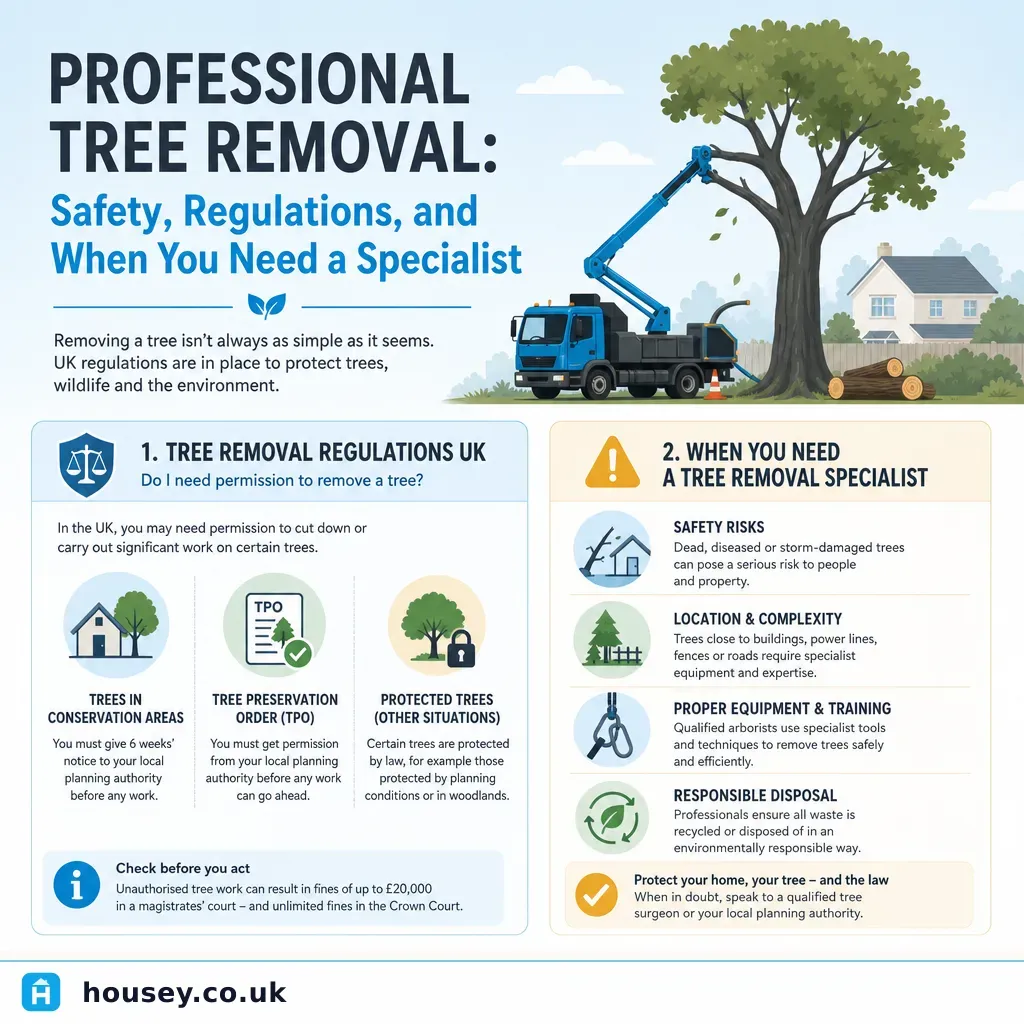
Professional Tree Removal: Safety, Regulations, and When You Need a Specialist
Professional tree removal in the UK often requires checking for Tree Preservation Orders or conservation area protections before any work begins.
 Improvement & Build
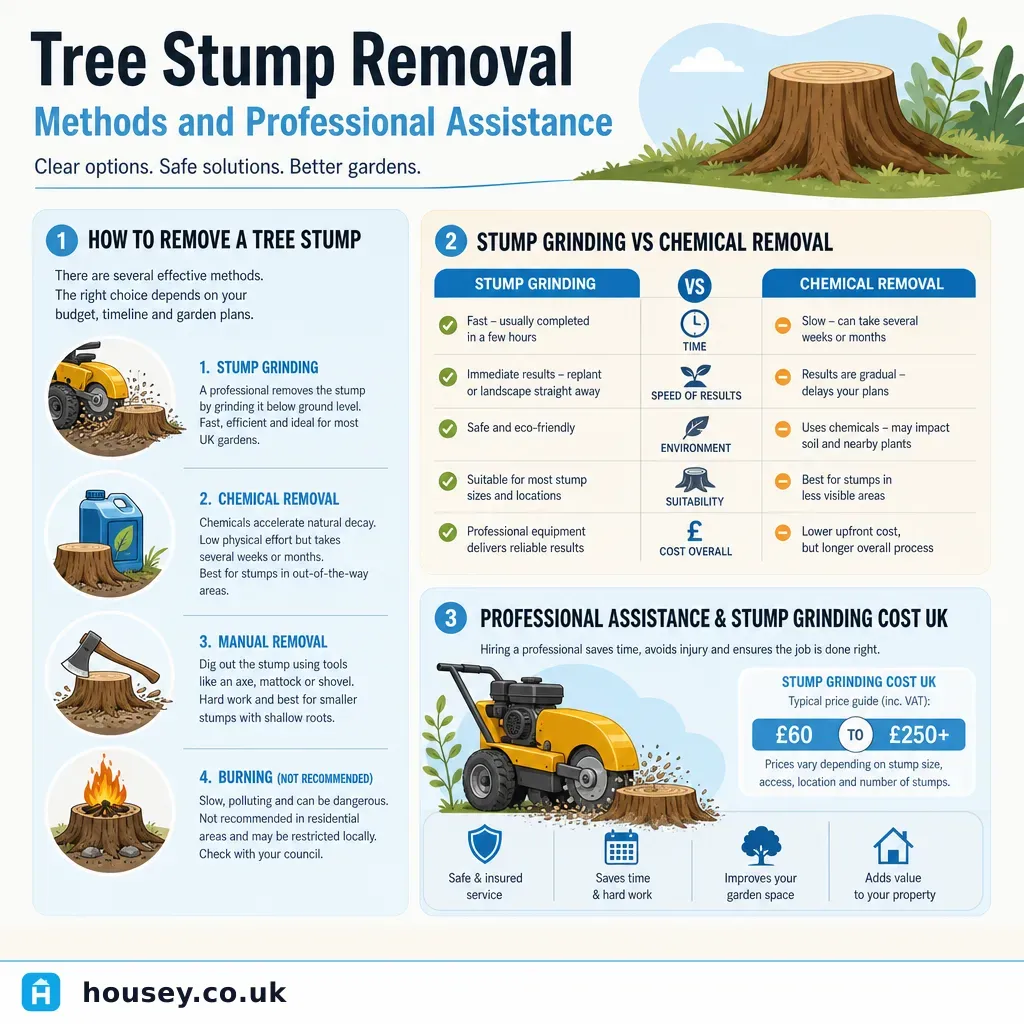
Tree Stump Removal Methods and Professional Assistance
Tree stump removal is most commonly done by stump grinding, which reduces the stump to wood chips 150–300 mm below ground level within a few hours.
 Improvement & Build
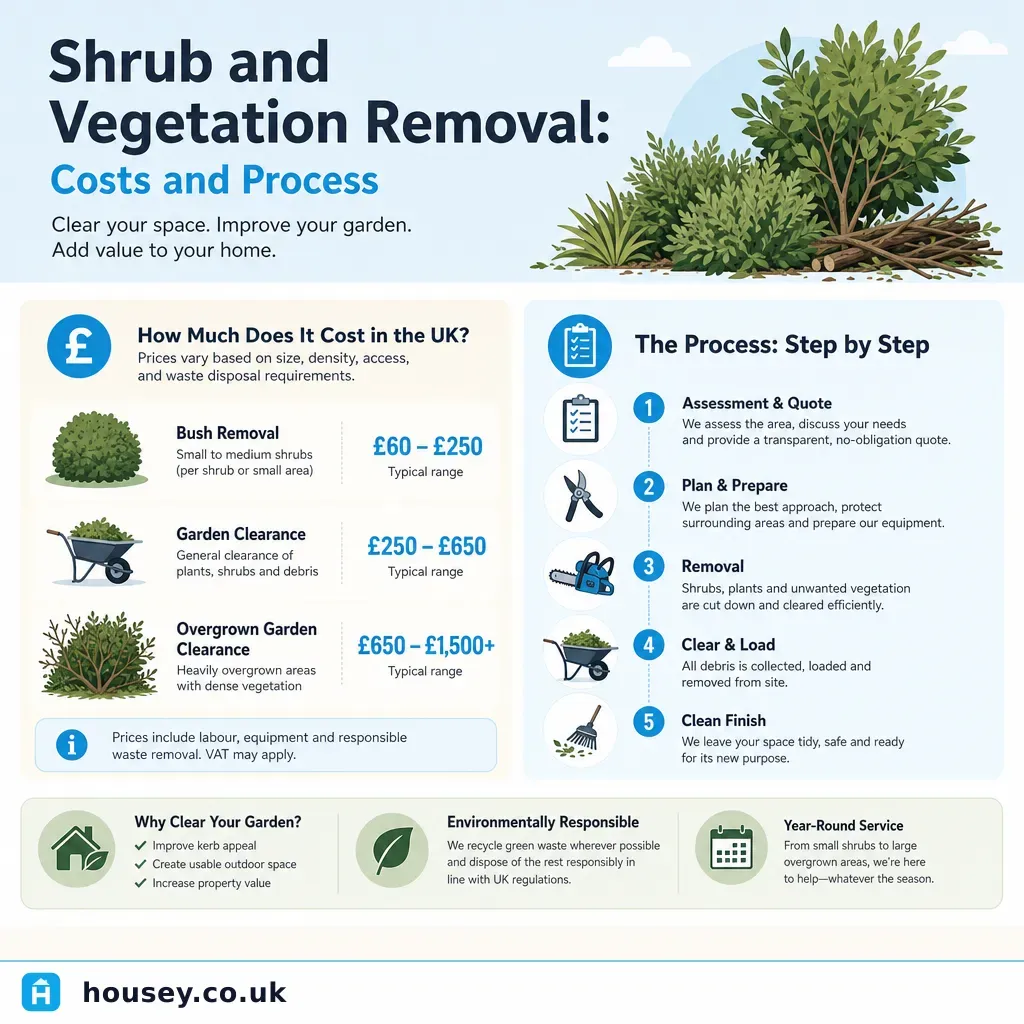
Shrub and Vegetation Removal: Costs and Process
Shrub and vegetation removal costs £50–£2,500 or more depending on area size, species involved, and whether stumps need grinding.
 Improvement & Build
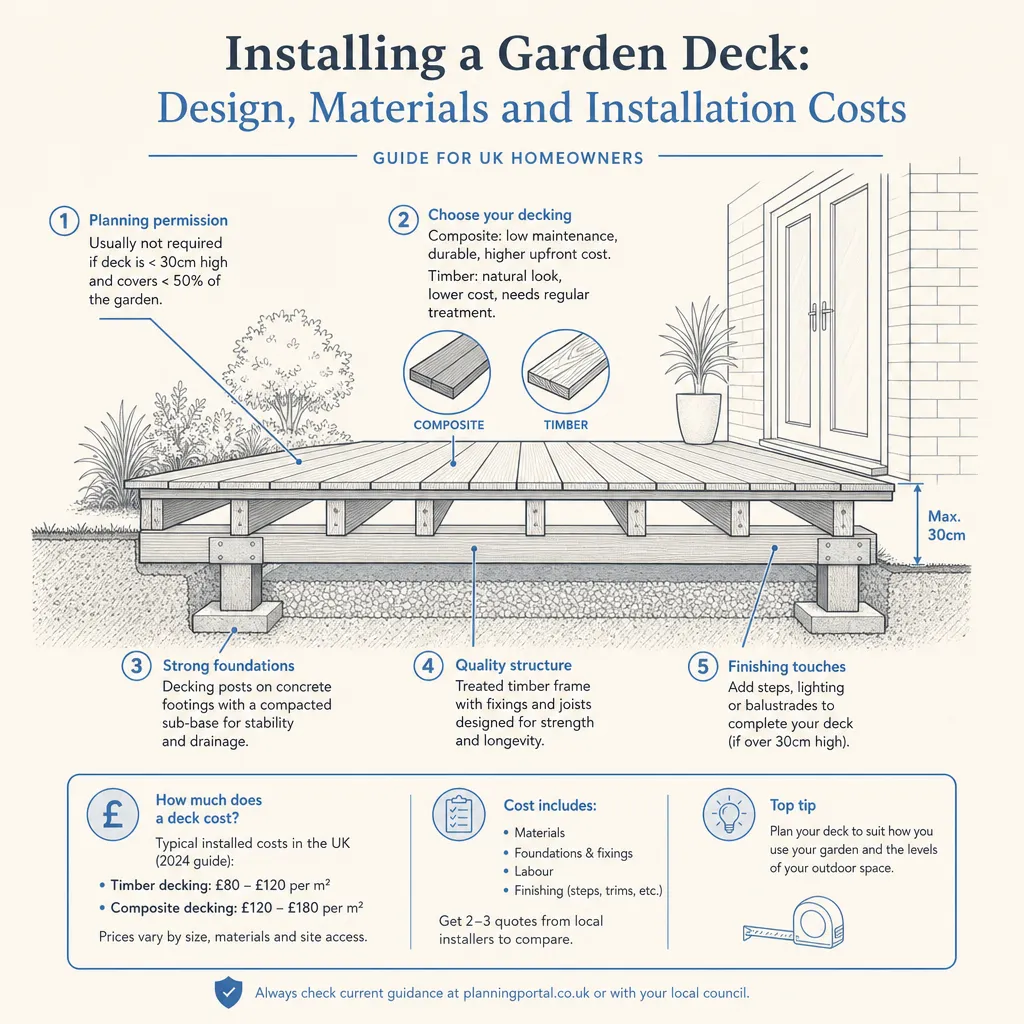
Installing a Garden Deck: Design, Materials and Installation Costs
Garden decking costs £80–250 per m² installed in the UK depending on material — softwood is cheapest, composite the most durable.
 Improvement & Build
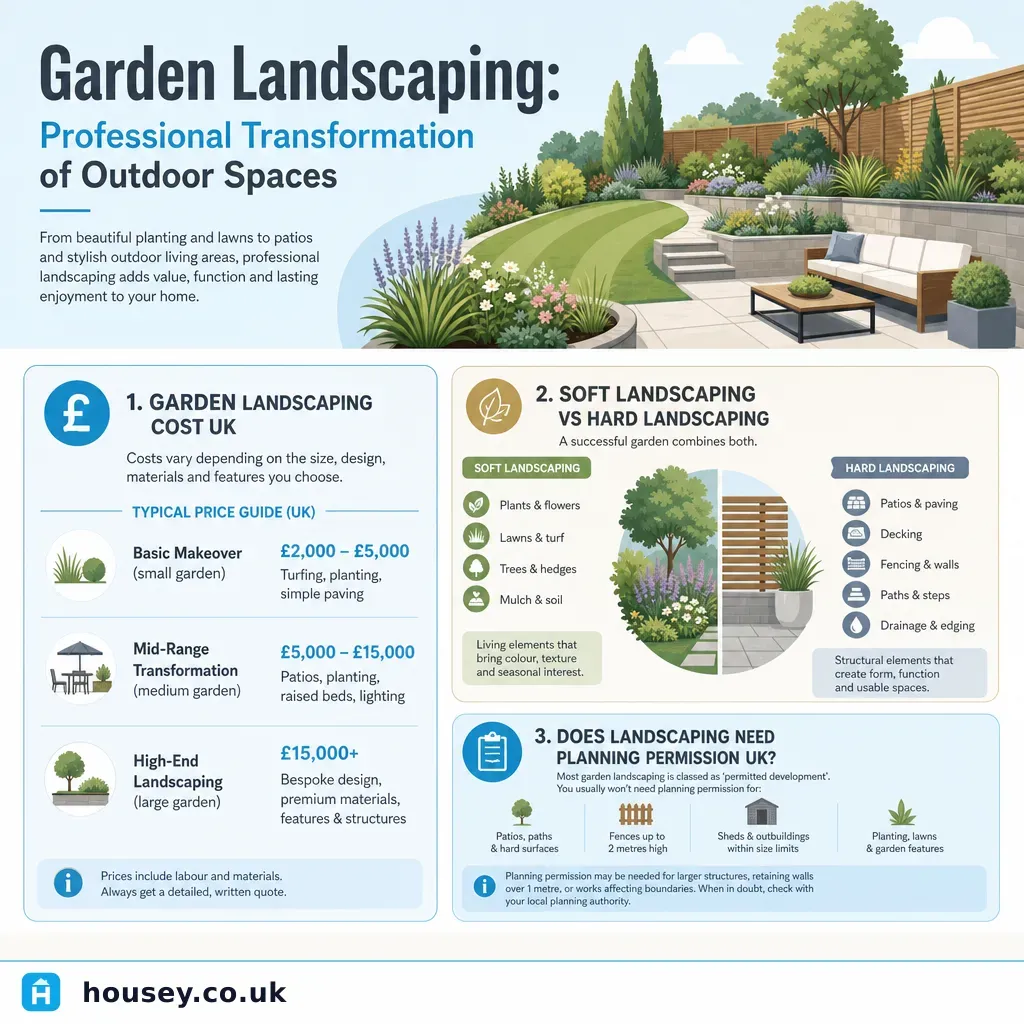
Garden Landscaping: Professional Transformation of Outdoor Spaces
Garden landscaping covers all physical works to reshape and improve an outdoor space, from earthworks and hard landscaping such as patios, paths, and walls, to planting, drainage, and lawn installation.