Tree Crown Reduction and Management Costs
By Housey · Last reviewed 11th of May 2026
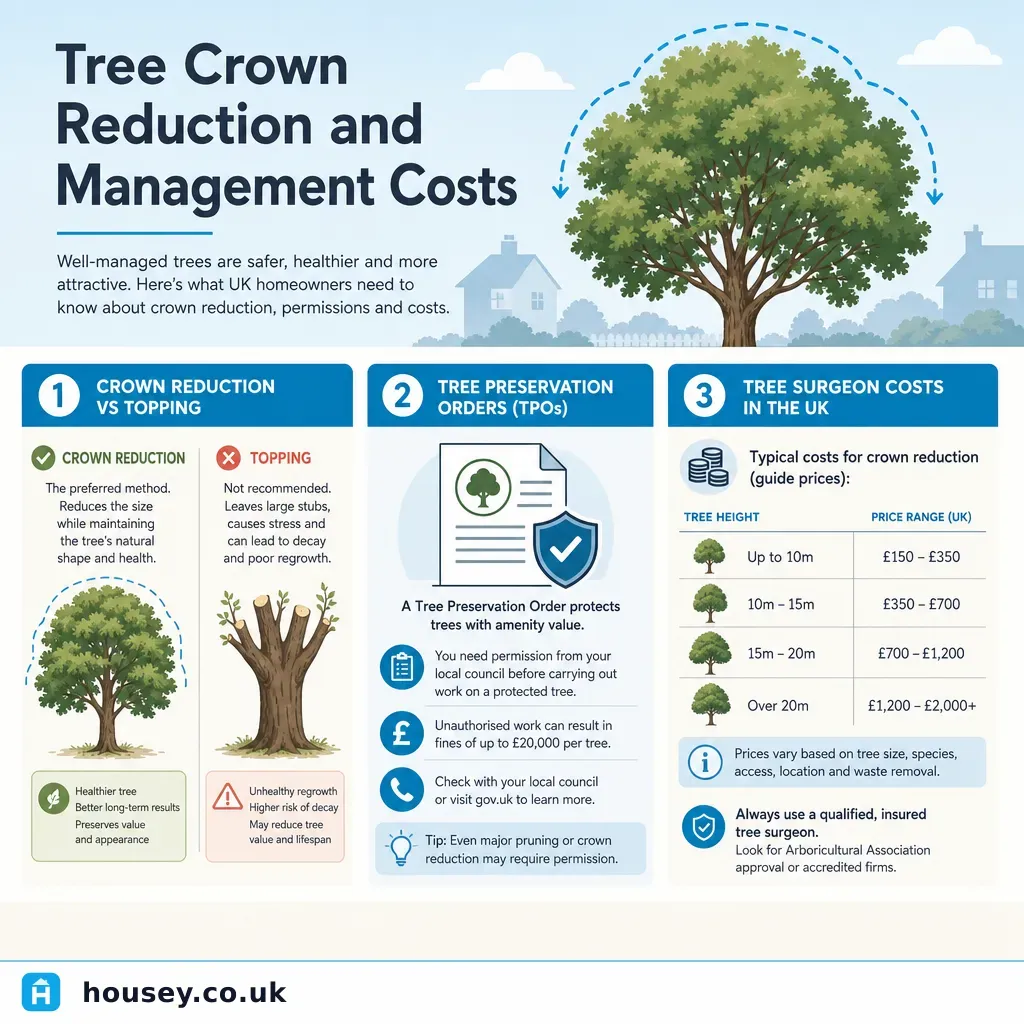
Tree Crown Reduction and Management Costs
Crown reduction comes up when a tree is casting too much shade, growing too close to a building, or interfering with overhead cables. It is a precise operation that requires the right technique to avoid long-term damage to the tree, and in many UK properties there are legal constraints — Tree Preservation Orders or conservation area rules — that determine whether you can carry out any work at all. Getting the approach and the contractor right matters both for the health of the tree and for avoiding enforcement action.
Key points
- Crown reduction must follow BS 3998:2010 (Recommendations for Tree Work) — work that does not meet this standard risks long-term tree decline or death.
- Any tree with a Tree Preservation Order (TPO) requires written consent from your local planning authority (LPA) before any pruning; applications are free and the LPA typically has eight weeks to decide.
- Trees in conservation areas: you must give your LPA six weeks' written notice before carrying out any work on a qualifying tree, even without a TPO, under Section 211 of the Town and Country Planning Act 1990.
- Crown reduction reduces overall dimensions by 15–30% while maintaining natural form; topping — removing the entire crown to stubs — is widely condemned as harmful practice and is not recognised as crown reduction by the Arboricultural Association.
- Indicative UK costs for crown reduction range from approximately £150 for a small tree to £1,500 or more for a large, complex specimen requiring specialist access equipment. Indicative UK costs, last reviewed 2026-05-11.
What is crown reduction and how does it differ from other tree work?
Crown reduction is one of several tree management operations, each with a different purpose and outcome. Choosing the wrong operation — or instructing a contractor who uses the wrong technique — can damage the tree, reduce its structural integrity, or fail to achieve the intended result.
Operation | What it involves | Best for | Not a substitute for |
|---|---|---|---|
Crown reduction | Reducing overall canopy height and spread while maintaining shape; cutting back to lateral branches | Controlling size, reducing load, improving light | Removing deadwood (a separate operation) |
Crown lifting | Removing lower branches to raise the canopy's base | Clearance for pathways, vehicles, buildings | Crown reduction — the overall canopy size remains the same |
Crown thinning | Removing selected branches throughout the canopy without changing overall height | Improving light penetration and air circulation | Reducing height or spread |
Deadwooding | Removing dead, dying, or diseased branches | Reducing risk of falling limbs | Any other form of shaping |
Pollarding | Cutting back to main stems on a regular cycle | Controlling size long-term on suitable species | Mature trees not previously pollarded |
Felling | Complete removal | Trees beyond management or presenting a hazard | Carrying out before checking for TPO or conservation area status |
Crown reduction is generally appropriate when a tree has outgrown its space but remains healthy and structurally sound. If a tree is dead, diseased, or presents an immediate hazard, a different management approach — possibly including felling — may be needed.
Do you need permission for crown reduction?
This is one of the most important questions to answer before any work begins.
Tree Preservation Orders (TPOs): If your tree has a TPO, you must apply to your local planning authority for consent before any pruning, including crown reduction. Applications are free of charge. The LPA typically has eight weeks to decide; some authorities process applications faster. Working on a TPO tree without consent is a criminal offence under the Town and Country Planning Act 1990, with fines of up to £20,000.
Conservation areas: Under Section 211 of the Town and Country Planning Act 1990, you must give six weeks' written notice to your LPA before carrying out any work on a tree in a conservation area with a stem diameter over 75 mm at 1.5 m above ground. The LPA may raise no objection, impose conditions, or make the tree subject to a TPO. Check your council's planning portal to confirm whether your property falls within a conservation area.
No TPO, not in a conservation area: You are generally free to commission tree work without permission, though you still have a duty of care and should use a qualified contractor who follows BS 3998:2010.
Trees near boundaries: Crown reduction affecting branches overhanging a neighbour's property may require their agreement. Your neighbour has the right to cut branches back to the boundary line but cannot enter your property to do so. Speak to your neighbour before instructing any work that affects shared boundaries.
How much does crown reduction cost in the UK?
Costs depend on the tree's height, spread, species, condition, ease of access, proximity to structures, and whether specialist equipment such as a cherry picker or crane is needed. Obtain at least three written quotes from Arboricultural Association approved contractors or equivalent.
Indicative UK costs, last reviewed 2026-05-11 (per tree, including removal of arisings):
Tree size | Examples | Approx. cost range |
|---|---|---|
Small (up to 5 m) | Young apple, ornamental cherry, hazel | £150–£350 |
Medium (5–10 m) | Silver birch, rowan, magnolia | £300–£600 |
Large (10–20 m) | Mature oak, beech, horse chestnut | £600–£1,200 |
Very large (over 20 m) | Mature woodland trees, established leylandii | £1,000–£2,500+ |
These are guide figures only. Quotes should be in writing, describe the work, specify the species and degree of reduction as a percentage, and reference BS 3998:2010.
Red flags when hiring a tree surgeon
- No proof of public liability insurance. Reputable contractors carry a minimum of £5 million public liability insurance for tree work. Ask for the certificate before any work begins.
- No mention of TPO or conservation area check. A competent contractor will ask about legal constraints before quoting, not after.
- Quoting by phone or from a distance. Accurate pricing requires an on-site inspection — any remote quote should be treated as provisional.
- Proposing topping as an alternative. This indicates the contractor does not follow recognised arboricultural practice and risks lasting damage to the tree.
- No written specification. Get a written quote describing the work, species, degree of reduction, and what happens to the cut material.
- Very low quote with no clear justification. Underpriced tree work often indicates inadequate insurance, unqualified operatives, or shortcuts on safety.
- Pressure to start immediately without checking permissions. Any contractor who advises skipping the TPO check is exposing you to criminal liability.
What to ask before hiring a tree surgeon
- Are you an Arboricultural Association approved contractor, or do you hold equivalent professional accreditation?
- Can I see your public liability insurance certificate (minimum £5 million for tree work)?
- Will you check whether the tree has a TPO or is in a conservation area before starting?
- Will the work specification reference BS 3998:2010?
- What percentage reduction are you proposing, and will you cut back to suitable lateral branches?
- Is removal of arisings (cut material) included in the quoted price?
- Is VAT included in the quote?
- Will you carry out a documented risk assessment before work begins?
When to get professional help
Tree work should always be carried out by a qualified tree surgeon. Working at height in a tree is one of the highest-risk activities in outdoor trades and is subject to the Work at Height Regulations 2005. Do not attempt crown reduction yourself. Seek urgent professional advice if:
- The tree shows signs of structural failure such as large cracks, a notable lean, or soil heave at the base.
- Dead or hanging branches are immediately above a pathway, driveway, or occupied building.
- The tree has been damaged in a storm and requires urgent assessment.
- You are unsure whether the tree has a TPO — do not carry out any work until you have confirmed this with your LPA.
How Housey can help
Housey connects you with qualified, insured tree surgeons in your area who can assess your tree, advise on TPO and conservation area obligations, and provide written quotes that reference BS 3998:2010. Compare up to four local professionals before instructing any work.
Frequently asked questions
How much does crown reduction reduce a tree's size?
A typical crown reduction removes 15–30% of the canopy volume. Greater reductions are generally not recommended in a single operation as they stress the tree and stimulate excessive regrowth. If larger reductions are needed, they are usually carried out in stages over several years by a qualified arborist following BS 3998:2010.
Can I carry out crown reduction myself?
Tree work is hazardous and should only be carried out by qualified tree surgeons with appropriate equipment, training, and insurance. Working at height in a tree without proper training puts you and others at serious risk. Additionally, if the tree has a TPO, carrying out work without consent is a criminal offence regardless of who does it.
How long does crown reduction take?
A small to medium tree can often be completed in half a day. Large trees with difficult access, particularly those close to buildings or requiring specialist equipment such as a cherry picker, may take a full day or more. Your contractor should give a time estimate after inspecting the tree on site.
Does crown reduction damage trees?
When carried out correctly to BS 3998:2010 by a qualified arborist, crown reduction maintains tree health and encourages natural regrowth from appropriate lateral branches. Topping — cutting the main stem to stubs without regard for lateral branches — causes significant long-term harm and is not an acceptable alternative to proper crown reduction.
Who is responsible if a neighbour's tree damages my property?
Liability depends on whether the tree owner knew or should have known about the risk. If a neighbour's tree has a visible defect and causes damage, you may have a claim. Seek advice from a solicitor and consult your buildings insurer in the first instance, documenting any concerns in writing to your neighbour.
Sources and further reading
- Tree Preservation Orders and trees in conservation areas — GOV.UK
- Section 211 of the Town and Country Planning Act 1990 — legislation.gov.uk
- BS 3998:2010 Recommendations for tree work — BSI (British Standards Institution)
- Arboricultural Association — find an approved contractor — Arboricultural Association
- Work at Height Regulations 2005 — legislation.gov.uk / HSE
Useful next reads
 Improvement & Build
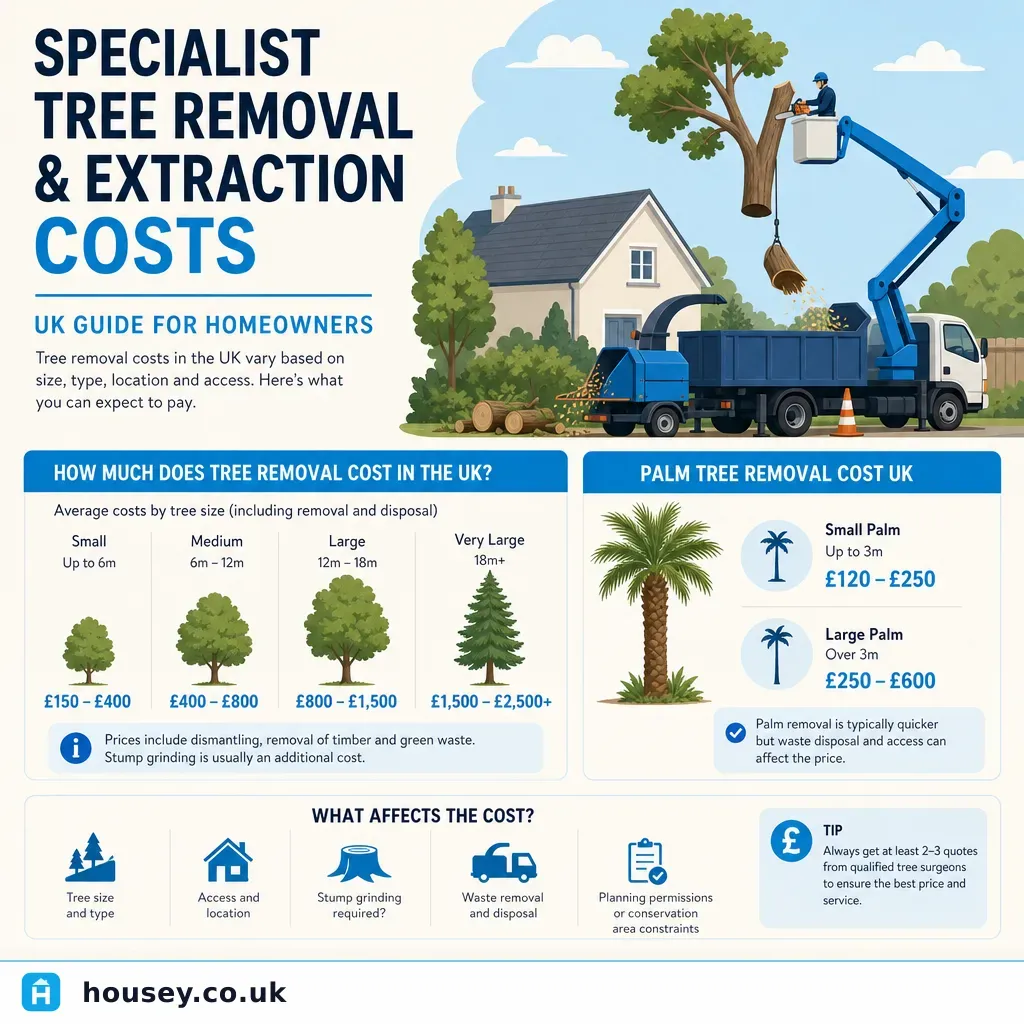
Specialist Tree Removal and Extraction Costs
Specialist tree removal costs in the UK range from around £150 for small trees to £3,000 or more for large mature specimens, with palm trees typically costing more due to specialist technique.
 Improvement & Build
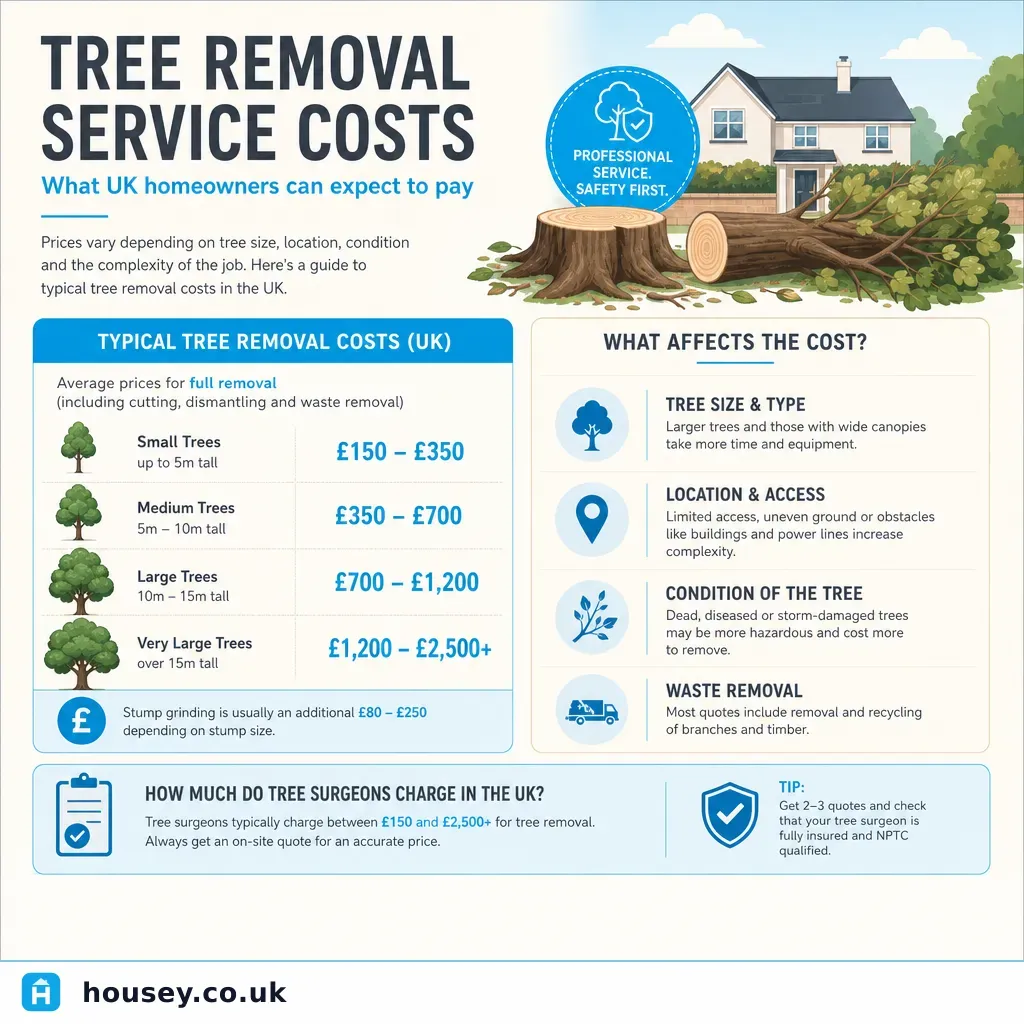
Tree Removal Service Costs
Professional tree removal costs in the UK depend on tree height, access, species, and the scope of work included.
 Improvement & Build
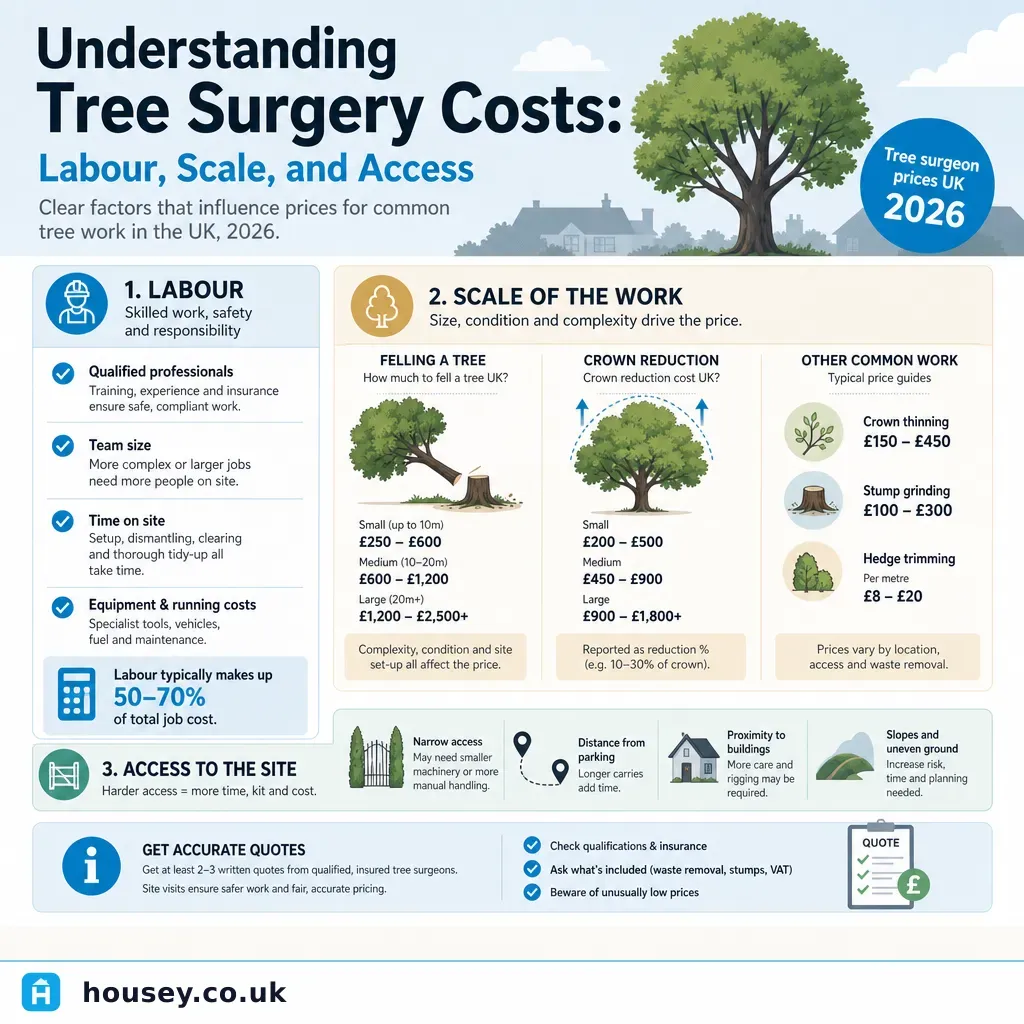
Understanding Tree Surgery Costs: Labour, Scale, and Access
Tree surgery costs in the UK depend on tree height, species, condition, and site access.
 Improvement & Build
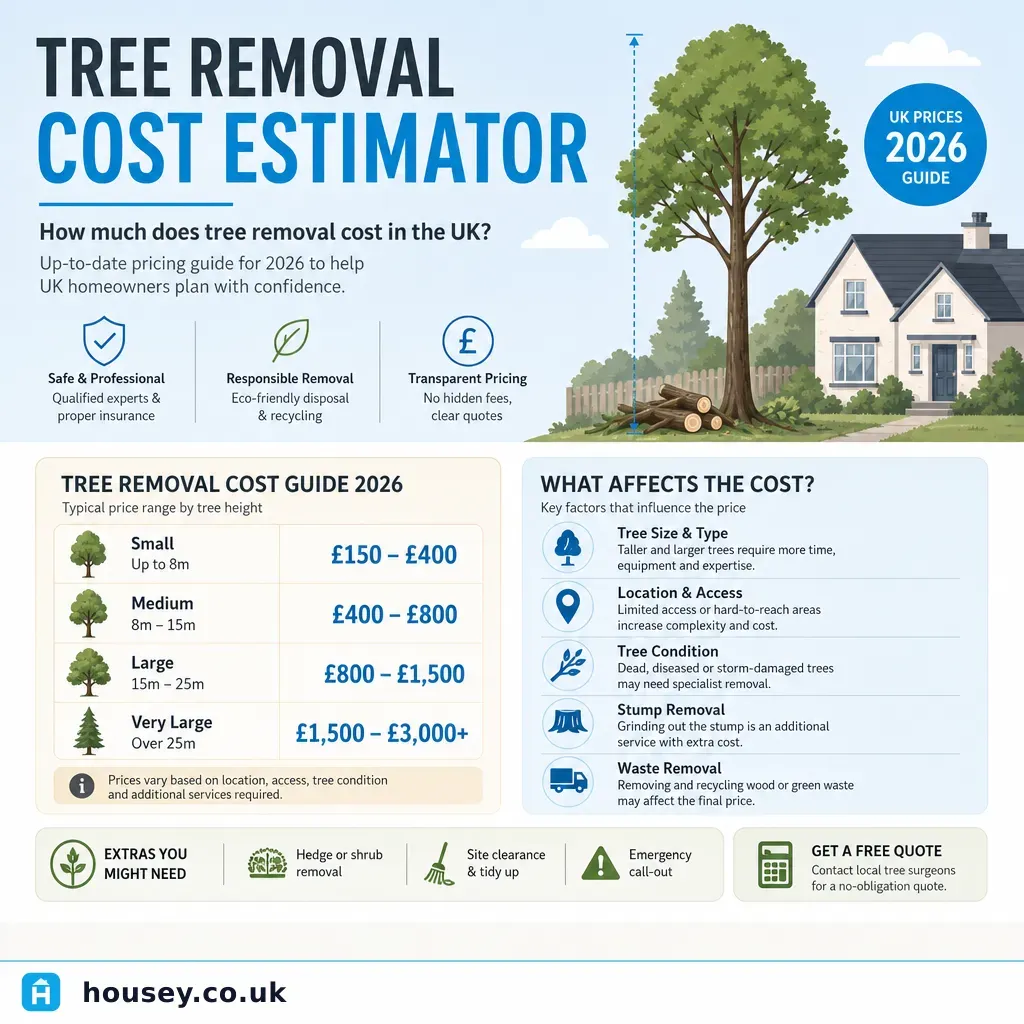
Tree Removal Cost Estimator
Tree removal in the UK costs roughly £150 to £5,000 or more, depending on the tree's height, species, access conditions, and whether stump removal is needed.
 Improvement & Build
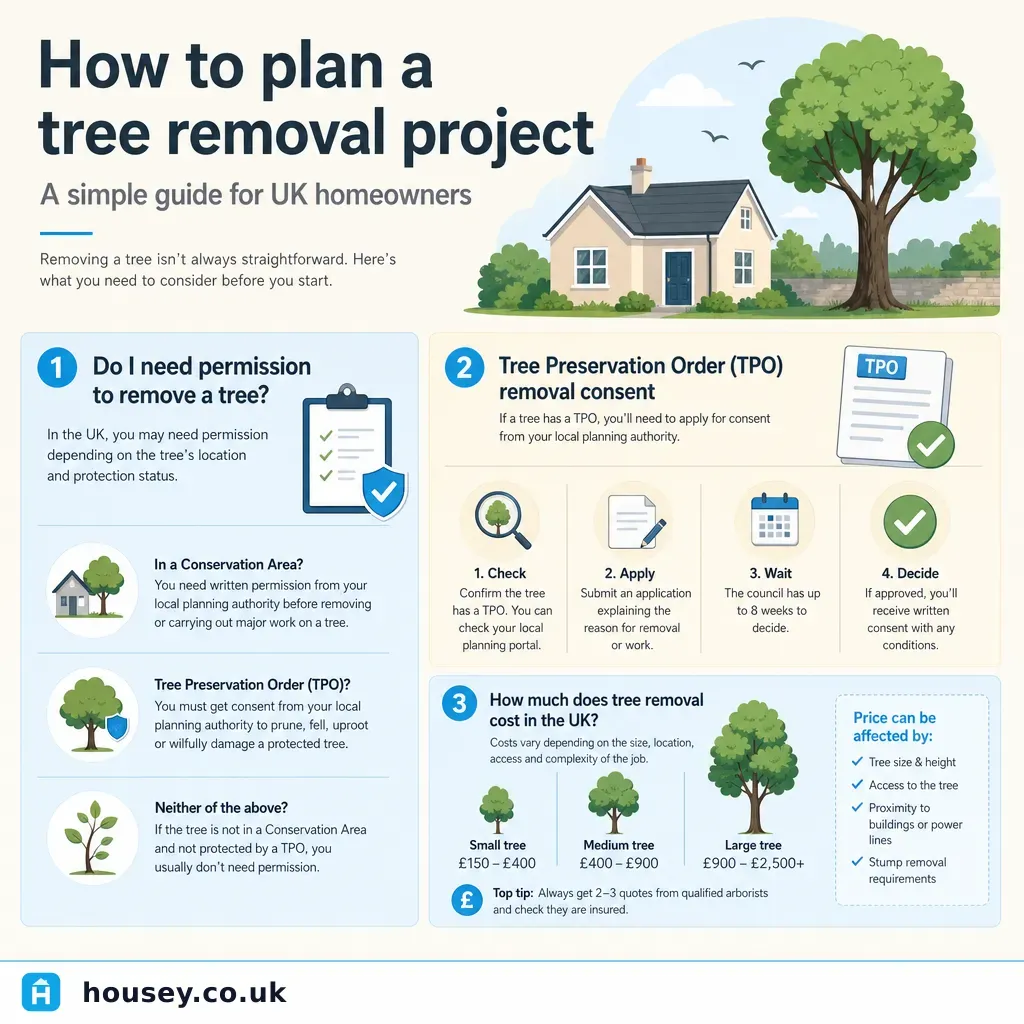
How to plan a tree removal project
Planning a tree removal project starts with checking whether the tree is protected by a Tree Preservation Order or sits in a conservation area, as both require council consent before any work begins.