Bamboo and Tree Removal from Residential Gardens
By Housey · Last reviewed 5th of May 2026
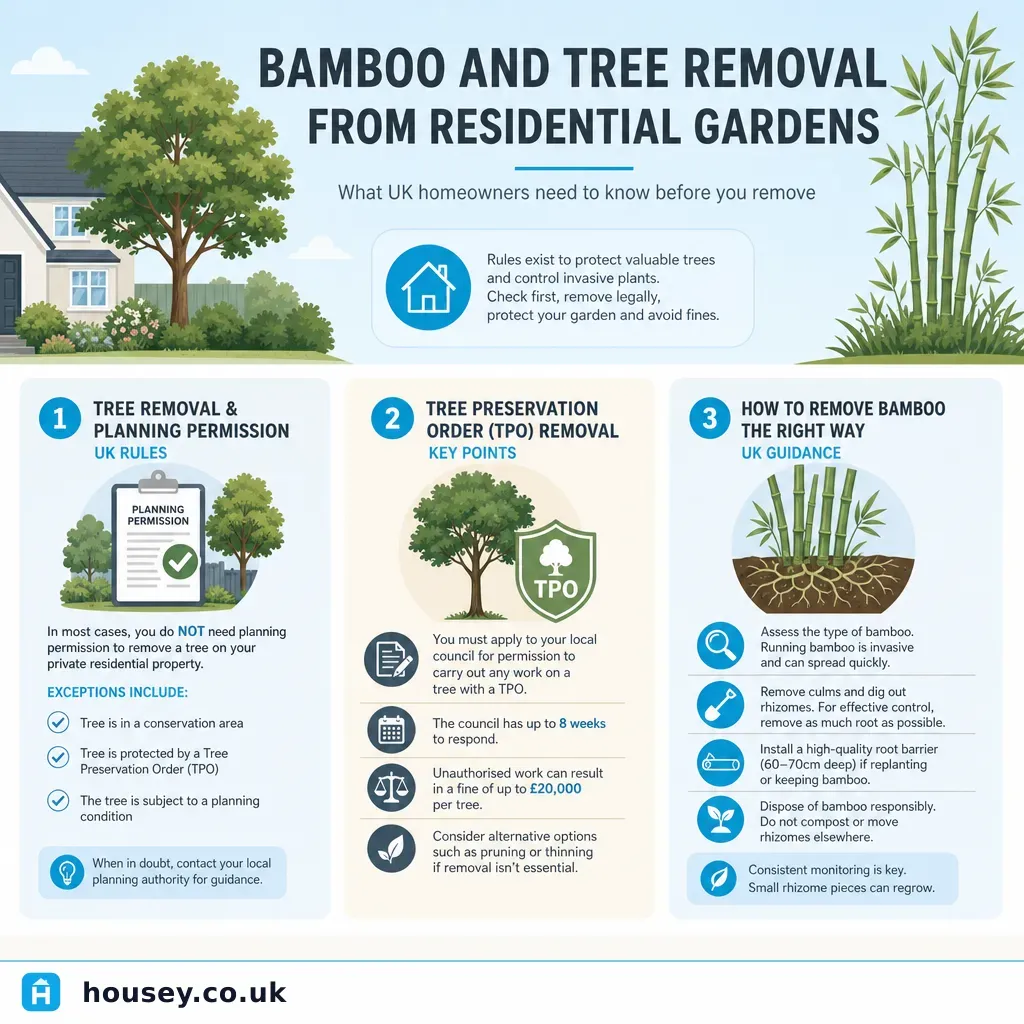
Bamboo and Tree Removal from Residential Gardens
Deciding to remove a large tree or an established bamboo clump from a UK garden can quickly become more complicated than it first appears. Planning restrictions, ecological considerations, safe working requirements, and the risk of regrowth all shape how the project should be approached — and whether a qualified professional is needed before any cutting begins. The difference between a routine clearance job and one requiring local authority approval or specialist containment can hinge on a few specific details.
Key points
- Trees protected by a Tree Preservation Order (TPO) cannot be felled without prior written consent from the local planning authority (LPA); breaching a TPO is a criminal offence under the Town and Country Planning Act 1990, with unlimited fines on conviction.
- All trees in designated conservation areas with a trunk diameter exceeding 75mm at 1.5m from ground level require six weeks' written notice to the LPA before any work begins.
- Running bamboo spreads via underground rhizomes that can extend 5–7 metres from the parent plant and penetrate drains, walls, and hard surfaces; full eradication typically takes two to three growing seasons.
- Tree surgeons undertaking professional chainsaw work should hold an NPTC qualification at the appropriate unit level — CS30/CS31 for ground-level chainsaw use, CS38 for aerial cutting — and carry adequate public liability insurance.
- Nesting birds and their eggs are protected year-round under the Wildlife and Countryside Act 1981; tree work that could disturb active nests should be assessed before proceeding, ideally between October and February.
Do you need permission to remove a tree?
Not all tree removal in a UK residential garden requires formal consent. The answer depends on whether the tree has a TPO or sits within a conservation area.
When do you need permission? A decision guide
- No TPO, not in a conservation area: Most trees can be removed without formal consent. Check with your LPA if you are unsure of the tree's status before proceeding.
- No TPO, but in a conservation area: Six weeks' written notice to the LPA is required for any tree with a trunk diameter over 75mm at 1.5m. The LPA may respond within that period by making a TPO.
- TPO applies to the tree: Apply to the LPA for consent before any work begins. The LPA has eight weeks to decide. Urgent safety situations may use a separate emergency procedure — contact the LPA first.
- Listed building or curtilage: Additional heritage considerations may apply; contact the LPA and a heritage consultant before proceeding.
- Suspected protected species present (e.g. bats roosting in tree cavities): Commission an ecological survey before any works are carried out.
You can check whether a tree has a TPO by searching your LPA's online planning portal or by contacting the council planning department directly. Most councils publish their TPO registers. Removing a protected tree without consent is a criminal offence: courts can impose unlimited fines, and the LPA can require replanting of a comparable tree at the landowner's expense.
Understanding bamboo: running vs clumping species
Not all bamboo behaves the same way in a UK garden. The key distinction is between running and clumping species.
Type | Spread behaviour | Removal difficulty | Common UK species |
|---|---|---|---|
Running bamboo | Aggressive — rhizomes spread 5–7m or more from the parent plant | High — requires excavation, root barrier, or multi-season herbicide treatment | Phyllostachys (golden, black, green bamboo) |
Clumping bamboo | Gradually expands from a central crown | Moderate — excavation of the root ball usually sufficient | Fargesia (umbrella bamboo, fountain bamboo) |
Running bamboo is frequently confused with Japanese knotweed by lenders and surveyors. However, bamboo is not currently listed under Schedule 9 of the Wildlife and Countryside Act 1981 and does not trigger the same mortgage risk process. It can still cause significant damage to hard landscaping, drainage, and neighbouring properties. If it has spread into an adjoining garden, the neighbour may have grounds for a nuisance claim — address spreading bamboo proactively.
How bamboo removal works
Full eradication of established running bamboo typically requires two to three growing seasons and a combination of methods:
- Above-ground cutting: Remove all canes at ground level to deprive rhizomes of photosynthesis. This weakens but does not kill the root system.
- Rhizome excavation: Mechanical excavation is the most thorough approach. A mini-digger may be needed for large stands.
- Herbicide treatment: Glyphosate-based products applied to freshly cut canes can be effective over two seasons. Application near watercourses is regulated by the Environment Agency — check before use.
- Root barrier installation: A vertical HDPE barrier buried to 600–700mm depth can contain further spread where full removal is impractical. This is a containment measure, not a removal method.
- Follow-up monitoring: Inspect each spring for regrowth and treat promptly to prevent re-establishment.
Bamboo waste should be disposed of responsibly. Check with your local council — some authorities accept bamboo as green waste; others require a licensed skip.
What to ask before hiring a tree surgeon or bamboo specialist
- Do you hold NPTC qualifications at the relevant unit level (CS30/CS31 for chainsaw work; CS38 for aerial cutting)?
- Do you carry public liability insurance, and at what level?
- Will you check the tree's TPO status and confirm whether the property is in a conservation area before starting?
- Is an ecological survey needed before felling, and can you advise on arranging one?
- For bamboo: what removal method do you recommend, over how many visits, and how will regrowth be managed?
- Is waste removal included in the quote?
- Will you provide a written itemised quote covering all stages of the work?
When to get professional help
Always instruct a qualified tree surgeon for large tree removal, work near structures or boundaries, or when TPO status is uncertain. For bamboo, a specialist is worth engaging where rhizomes are extensive, have spread to adjoining land, or where damage to drainage or hard landscaping is suspected. Chainsaw work at height is high-risk and should not be attempted by untrained individuals.
How Housey can help
Housey can connect you with qualified tree surgeons in your area who can assess the situation, confirm whether restrictions apply, and carry out safe removal or management works. Describe your project and receive quotes from local professionals.
Frequently asked questions
How do I check if my tree has a Tree Preservation Order?
Search your local planning authority's online planning portal or contact the planning department directly. Most councils publish their TPO registers online. If you remove a protected tree without checking and a TPO applies, you risk prosecution and a requirement to replant a comparable tree at your own expense. Your council can also confirm whether a property sits within a conservation area.
Is bamboo the same risk as Japanese knotweed for mortgages and property sales?
No. Japanese knotweed is a Schedule 9 invasive species under the Wildlife and Countryside Act 1981 and is treated as a significant concern by lenders and surveyors. Bamboo does not carry the same legal obligations, but extensive growth near boundaries or structures can raise questions during a survey and should be disclosed to buyers.
When is the best time to remove a tree or bamboo in the UK?
October to February — outside the main bird-nesting season — is generally the safest period for tree removal and bamboo excavation. Works can proceed at other times if a competent person confirms no active nests are present. Bamboo rhizome excavation is often most effective in autumn when growth has slowed and root reserves are more accessible.
How much does tree removal cost in the UK?
Indicative UK costs, last reviewed 2026-05-05. Small tree removal (up to 5m) typically costs £150–£500; medium trees (5–15m) £500–£1,500; large trees (over 15m) £1,500–£5,000 or more. Costs depend on access, species, location, stump grinding, and waste removal. Obtain at least two written quotes from NPTC-qualified contractors.
Can I remove bamboo myself?
Small clumping bamboo can often be removed by a competent homeowner using hand tools and a spade. Running bamboo with extensive rhizomes, or bamboo near structures, drains, or property boundaries, is better handled by a specialist who can assess the full extent of the root system and recommend appropriate containment or eradication methods.
Sources and further reading
- Tree Preservation Orders and trees in conservation areas — GOV.UK
- Town and Country Planning Act 1990 — legislation.gov.uk
- Wildlife and Countryside Act 1981 — legislation.gov.uk
- Invasive non-native species: guidance for landowners — GOV.UK / Environment Agency
- Using pesticides near water — Environment Agency / GOV.UK
- Arboricultural Association — find a qualified arborist — Arboricultural Association
Useful next reads
 Improvement & Build
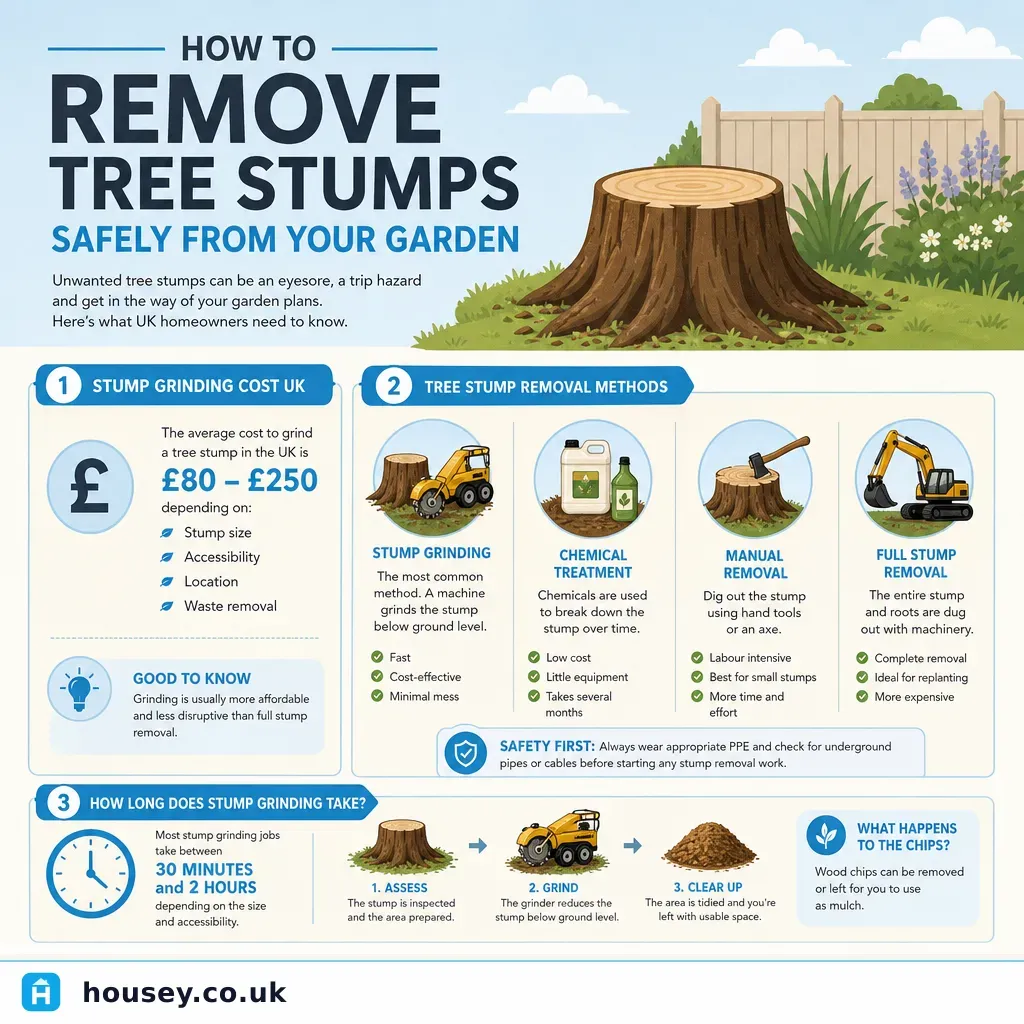
How to Remove Tree Stumps Safely from Your Garden
Tree stump removal in the UK typically involves stump grinding, chemical treatment, or manual excavation.
 Improvement & Build
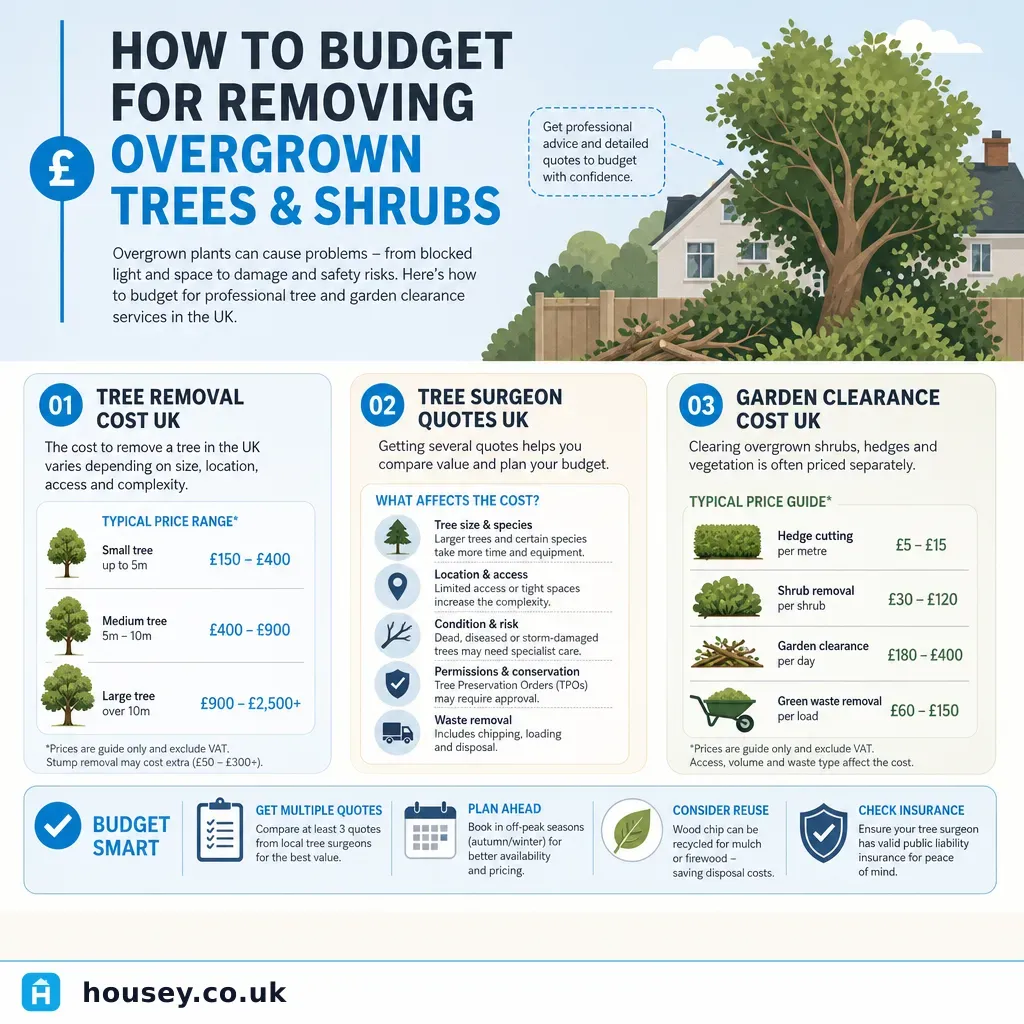
How to budget for removing overgrown trees and shrubs
Removing overgrown trees and shrubs in the UK typically costs between £200 and £2,500 depending on tree size, access, and disposal method.
 Improvement & Build
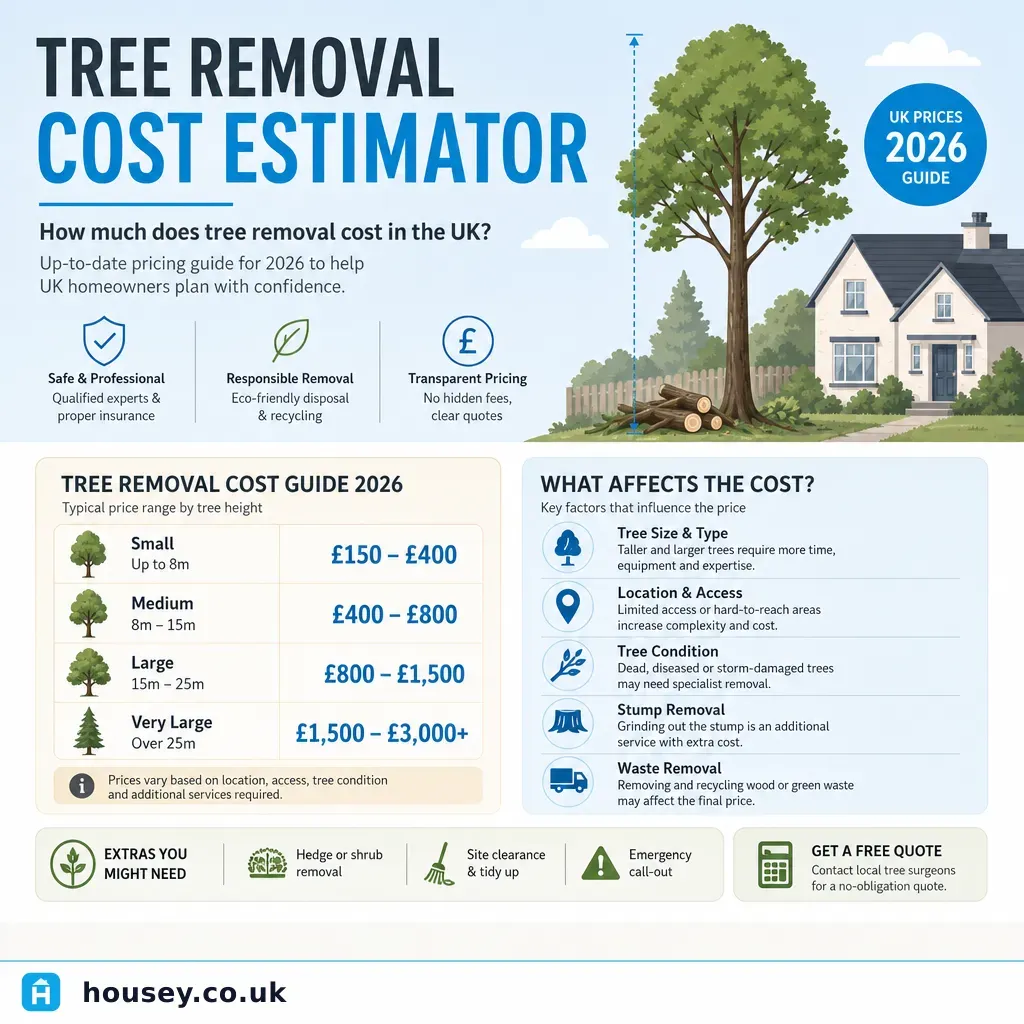
Tree Removal Cost Estimator
Tree removal in the UK costs roughly £150 to £5,000 or more, depending on the tree's height, species, access conditions, and whether stump removal is needed.
 Improvement & Build
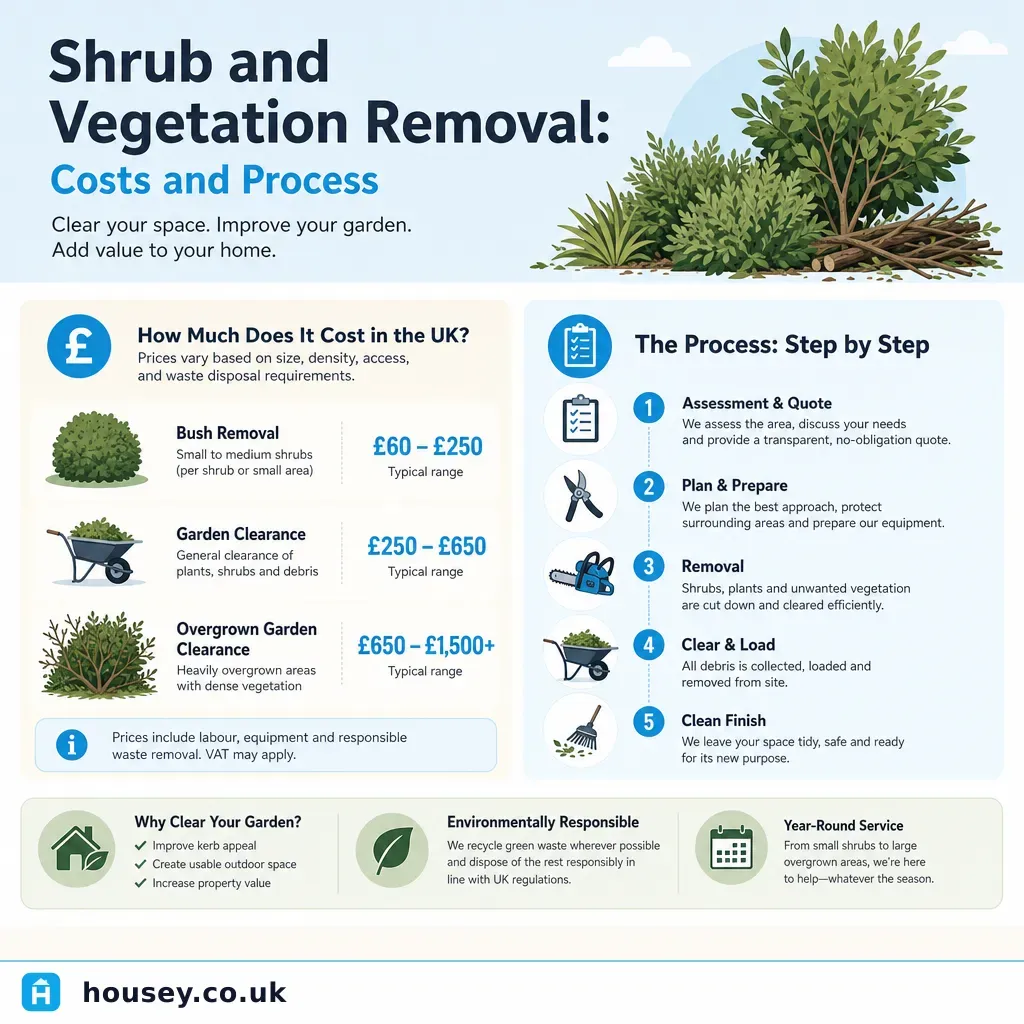
Shrub and Vegetation Removal: Costs and Process
Shrub and vegetation removal costs £50–£2,500 or more depending on area size, species involved, and whether stumps need grinding.
 Improvement & Build
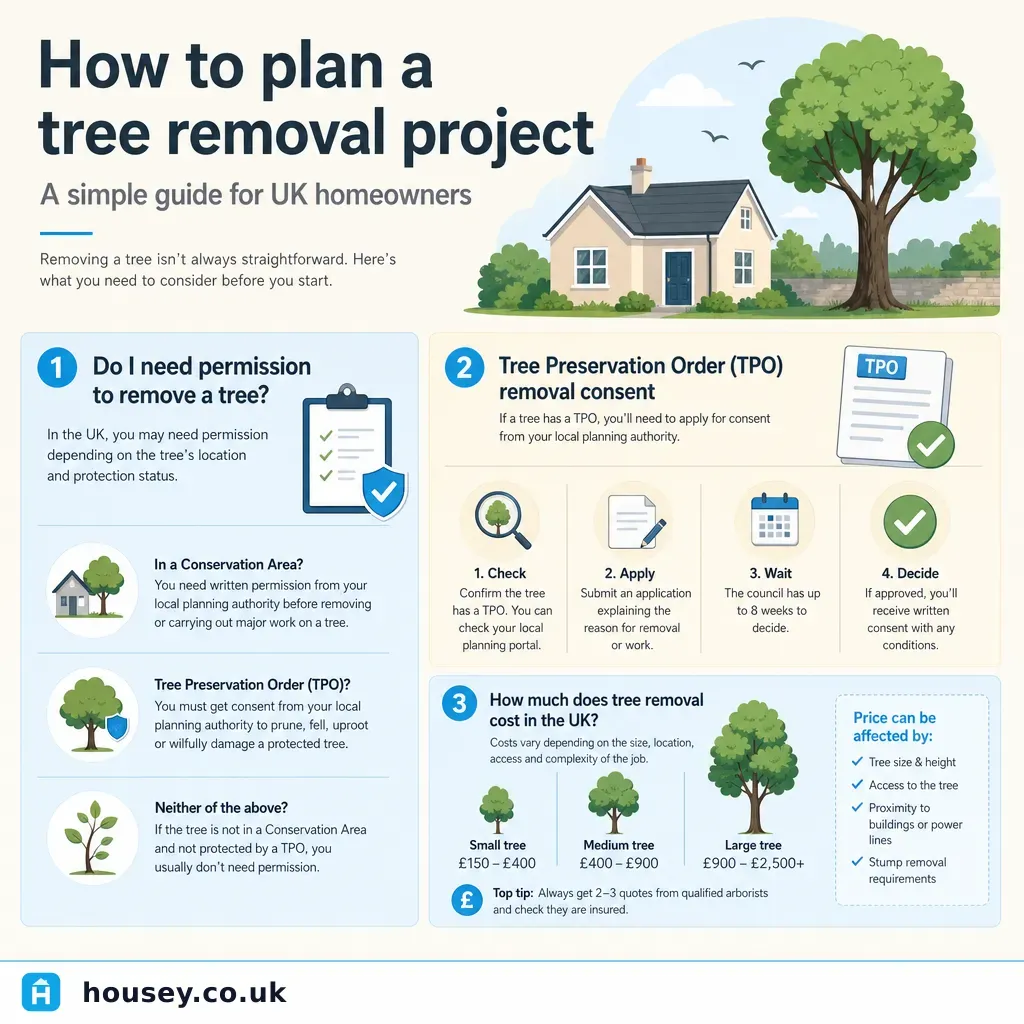
How to plan a tree removal project
Planning a tree removal project starts with checking whether the tree is protected by a Tree Preservation Order or sits in a conservation area, as both require council consent before any work begins.