Understanding Conveyancing Disbursements and Legal Costs
By Housey · Last reviewed 25th of May 2026
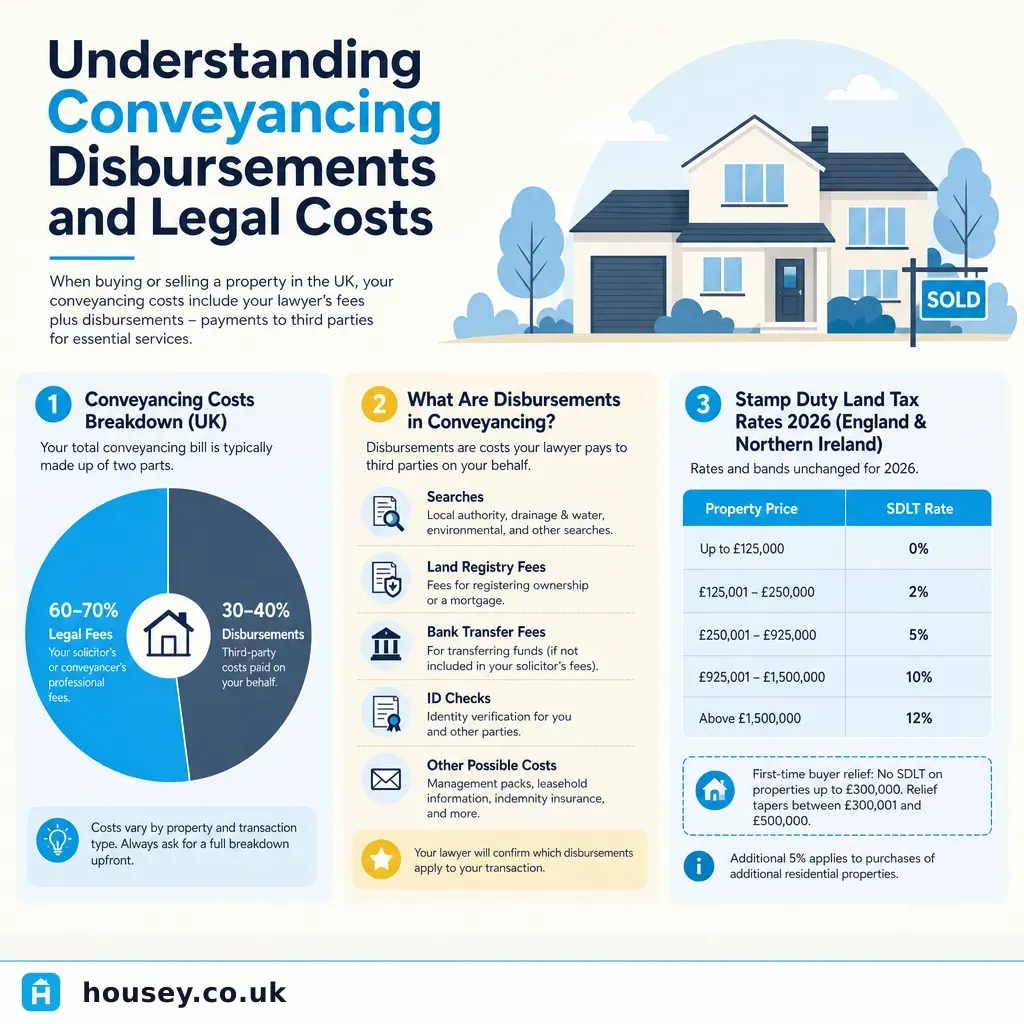
Understanding Conveyancing Disbursements and Legal Costs
Conveyancing costs have a habit of surprising buyers and home movers — a solicitor's quote arrives, and beneath the headline legal fee sits a longer list of charges that can add hundreds or thousands of pounds to the total. Understanding what each item represents, why it exists, and how it varies by property type or value helps you budget accurately and compare quotes on a like-for-like basis.
Key points
- Stamp Duty Land Tax (SDLT) in England uses a banded structure: 0% up to £125,000, 2% on £125,001–£250,000, and 5% on £250,001–£925,000 for standard residential purchases. Different taxes apply in Wales (Land Transaction Tax) and Scotland (Land and Buildings Transaction Tax).
- HM Land Registry registration fees range from £20 to £910 depending on property value, based on the published fee scale; electronic applications attract a reduced fee.
- Local authority searches typically cost between £50 and £250 — the fee is set by each council individually, and London borough searches are often higher.
- First-time buyers pay 0% SDLT on the first £300,000 and 5% on the portion from £300,001 to £500,000; above £500,000, standard rates apply with no first-time buyer relief.
- Buyers of additional residential properties pay a 5% surcharge on top of each standard SDLT band — a rate raised from 3% in October 2024.
What are conveyancing disbursements?
Disbursements are payments your solicitor makes on your behalf to third parties — government bodies, search providers, and official registries. They are passed on at cost (or near cost) and are distinct from the solicitor's own professional fee. The two are sometimes bundled into a single figure in a quote, which can make like-for-like comparison difficult.
The main disbursements in a residential purchase include:
- Stamp Duty Land Tax (SDLT) — England only; payable to HMRC on completion.
- HM Land Registry registration fee — mandatory for all purchases; registers you as the new legal owner.
- Local authority search — reveals planning decisions, enforcement notices, road adoption status, and other matters affecting the property.
- Water and drainage search — confirms the property's connection to public sewers and water mains, and whether a public sewer runs within the boundary.
- Environmental search — screens for flood risk, ground contamination, landfill proximity, and radon levels.
- Chancel repair liability search — checks whether the property falls within a historic parish boundary that could require a contribution to church repairs.
- Electronic ID and anti-money laundering (AML) checks — typically £10–£30 per person; required under the Money Laundering Regulations 2017.
- Bank transfer (CHAPS) fee — for sending completion funds to the seller's solicitor; usually £25–£40.
Disbursements cost breakdown
Indicative UK costs, last reviewed 2026-05-25. Figures vary by location, property value, and solicitor. Always request a fully itemised quote.
Disbursement | Typical cost | Notes |
|---|---|---|
Stamp Duty Land Tax (England) | £0 – varies | Depends on price, buyer type, and property use |
HM Land Registry fee | £20 – £910 | Based on official fee scale; reduced for e-registrations |
Local authority search | £50 – £250 | Council-set fee; London boroughs often higher |
Water and drainage search | £30 – £60 | Set by the relevant water company |
Environmental search | £35 – £60 | Provided by commercial search firms |
Chancel repair search | £20 – £30 | One-off check; rarely triggers liability |
AML / ID checks | £10 – £30 per person | Required under Money Laundering Regulations 2017 |
CHAPS transfer fee | £25 – £40 | Per bank transfer |
Bankruptcy search | £2 – £6 per name | Required by most mortgage lenders |
Land Registry official copy entries | £3 – £7 | Copies of the existing registered title |
How SDLT works in practice
Stamp Duty Land Tax is calculated in bands — similar to income tax — not as a flat percentage of the whole purchase price. The following rates apply to standard residential purchases in England (effective from April 2025):
Purchase price portion | SDLT rate |
|---|---|
Up to £125,000 | 0% |
£125,001 to £250,000 | 2% |
£250,001 to £925,000 | 5% |
£925,001 to £1,500,000 | 10% |
Over £1,500,000 | 12% |
First-time buyers pay 0% on the first £300,000 and 5% on the portion from £300,001 to £500,000. Above £500,000, standard rates apply without first-time buyer relief.
Additional-property surcharge: buyers who already own another residential property pay an extra 5% on each band (raised from 3% in October 2024).
Wales uses Land Transaction Tax and Scotland uses Land and Buildings Transaction Tax — both operate different rate structures. Always verify current rates via GOV.UK's SDLT guidance before exchange, as rates can change at any Budget.
Understanding the solicitor's legal fee
The professional legal fee — separate from disbursements — covers the solicitor's time: reviewing the contract pack, raising enquiries, reporting on the title and mortgage offer, managing exchange and completion, and registering your ownership with HM Land Registry.
Factors that typically affect the legal fee:
- Property value — most solicitors scale fees with purchase price.
- Leasehold vs freehold — leasehold involves additional work reviewing the lease, liaising with management companies, and obtaining a management information pack.
- New build — often carries a premium due to developer-driven timelines and complex title arrangements.
- Shared ownership — requires extra legal steps and may involve housing association approval.
- Remortgage — usually cheaper than a purchase, as no title transfer to a new owner is involved.
Homeowner checklist: comparing conveyancing quotes
Use this checklist to ensure you are comparing quotes on a like-for-like basis:
Important limitations
This article provides general information about conveyancing costs in England. Rules and rates differ in Wales (Land Transaction Tax), Scotland (Land and Buildings Transaction Tax), and Northern Ireland. SDLT rates, thresholds, and reliefs can change at any UK Budget. Disbursements vary by property location, value, tenure, and individual lender requirements.
This is not legal or financial advice. Always instruct a qualified solicitor or licensed conveyancer regulated by the Solicitors Regulation Authority (SRA) or the Council for Licensed Conveyancers (CLC) for your specific transaction.
What to ask a qualified professional
Before instructing a solicitor or licensed conveyancer, ask:
- Can you provide a fully itemised quote separating your legal fee, VAT, and each disbursement?
- Are there any additional charges for leasehold, new build, or Help to Buy not included in the initial quote?
- What is your policy on abortive fees if the transaction does not complete?
- Are you on my mortgage lender's approved panel?
- How do you handle the management information pack for a leasehold property?
- What is your expected timeline from instruction to exchange?
When to get professional help
Conveyancing should always be handled by a qualified solicitor or licensed conveyancer regulated by the SRA or CLC. Seek professional advice promptly if:
- Your completion statement differs significantly from the original quote without clear explanation.
- Your solicitor cannot confirm they are on your mortgage lender's approved panel.
- An unexpected SDLT liability arises that was not identified at the quote stage.
- The transaction is leasehold and no management information pack has been requested within three to four weeks of instruction.
How Housey can help
Housey connects you with regulated solicitors who provide fully itemised quotes for UK property transactions. Compare quotes and find a conveyancer suited to your property type and tenure through our conveyancing service.
Frequently asked questions
Are conveyancing disbursements negotiable?
Most disbursements are set by third parties — HMRC, HM Land Registry, local councils, and search providers — and are passed on at cost. The solicitor's own legal fee is where negotiation is possible. Some firms offer fixed-fee packages that bundle in standard searches; ask whether the firm uses a personal search provider or a standard council search, as this can affect both cost and turnaround time.
Do I pay disbursements if my purchase falls through?
Searches submitted before the transaction collapsed are non-refundable. If your purchase falls through before exchange, you will typically be responsible for any searches already run and Land Registry copy fees already paid. Some solicitors offer "no completion, no fee" arrangements for their own legal fees — but this does not typically extend to third-party disbursements already paid. Check the terms carefully before instructing.
What is a search indemnity in conveyancing?
A search indemnity is an insurance policy that stands in for some or all of the standard property searches. It may reduce cost or speed up a transaction, but it does not reveal actual property-specific information the way a real search does. Mortgage lenders may not accept one in place of a proper search, so always confirm with your lender and consider whether the saving justifies the information gap.
Why does leasehold conveyancing cost more than freehold?
Leasehold transactions involve reviewing the lease (which can run to hundreds of pages), liaising with the freeholder or managing agent, obtaining a management information pack (typically £100–£400 or more), and checking service charge and ground rent history. This is substantially more work than a straightforward freehold transaction and is reflected in a higher professional fee — often an additional £200–£400 on top of the base legal fee.
Sources and further reading
- Stamp Duty Land Tax — rates and calculator — GOV.UK
- HM Land Registry registration fees — HM Land Registry
- Find a regulated solicitor — Solicitors Regulation Authority
- Find a licensed conveyancer — Council for Licensed Conveyancers
- Land Transaction Tax guidance — Wales — Welsh Government
Useful next reads
 Buying & Moving
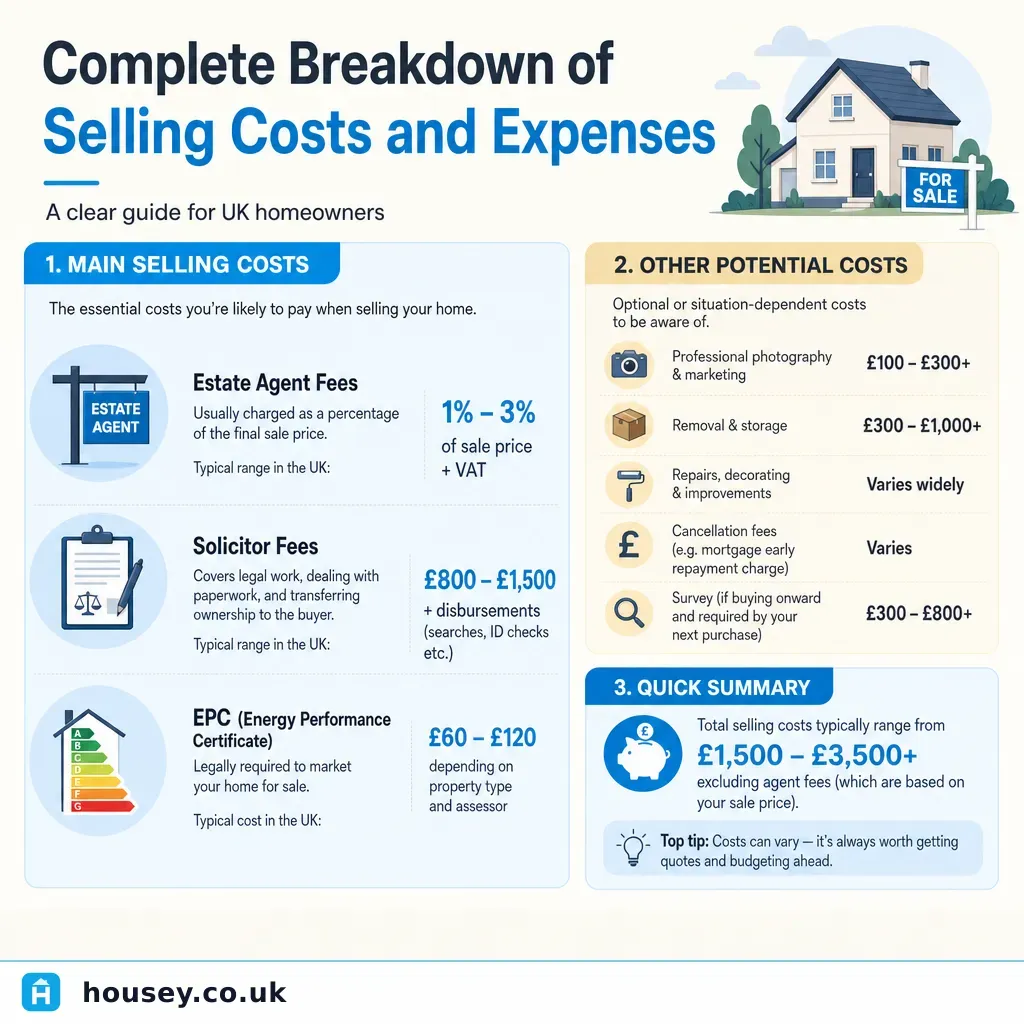
Complete Breakdown of Selling Costs and Expenses
Selling a house in England typically costs 3–5% of the sale price in total fees.
 Buying & Moving
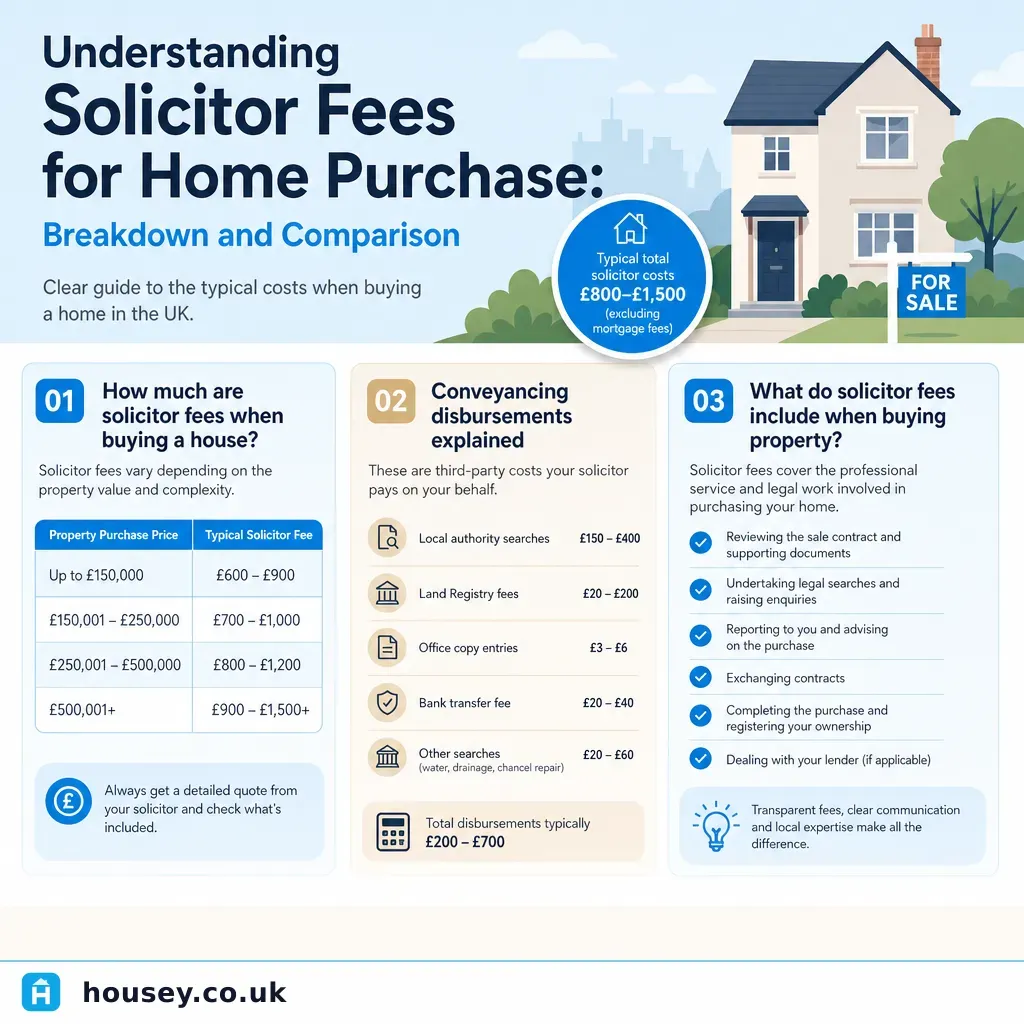
Understanding Solicitor Fees for Home Purchase: Breakdown and Comparison
Solicitor fees for buying a house in England and Wales have two parts: the professional legal fee, typically £850–£1,500 plus VAT for a standard freehold purchase, and disbursements — third-party costs such as search fees, Land Registry registration, and an electronic transfer charge.
 Buying & Moving
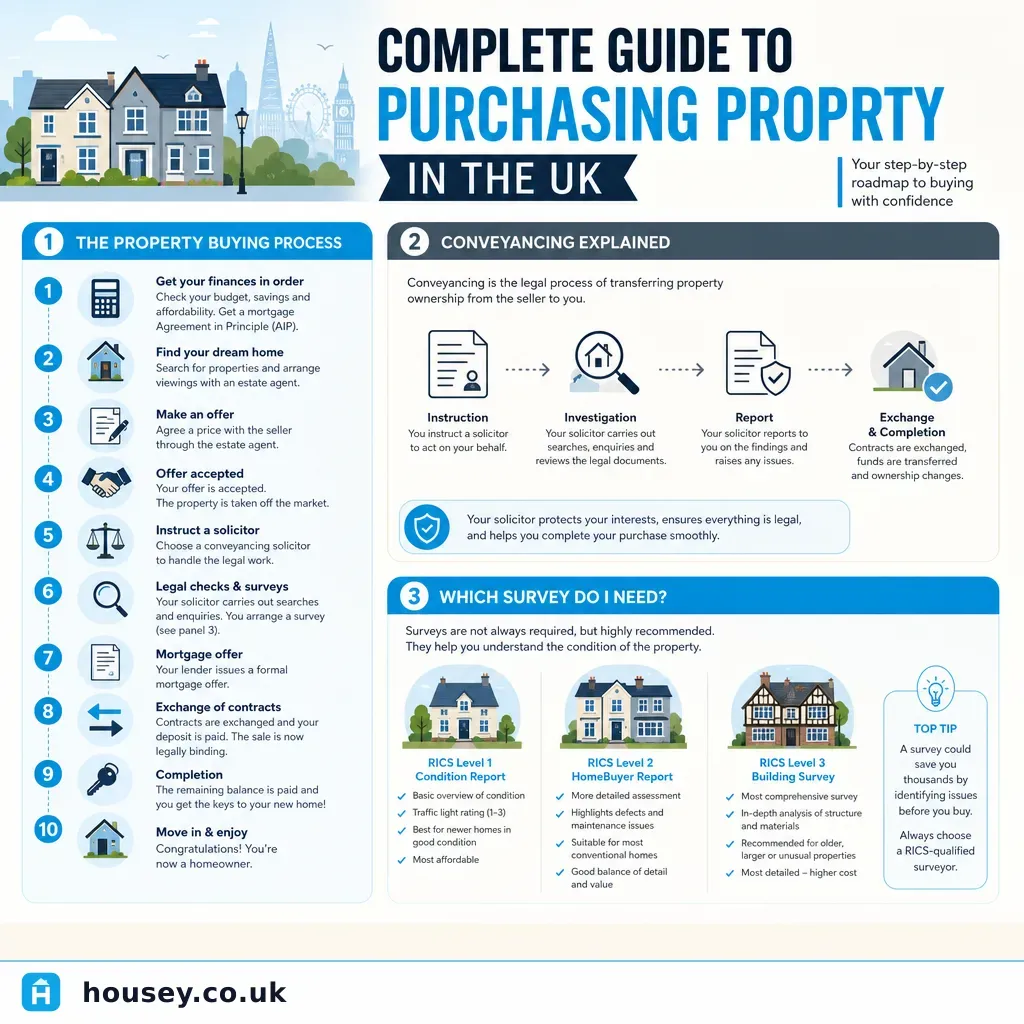
Complete Guide to Purchasing Property in the UK
Buying property in England and Wales typically takes 12 to 16 weeks from offer acceptance to completion.
 Buying & Moving
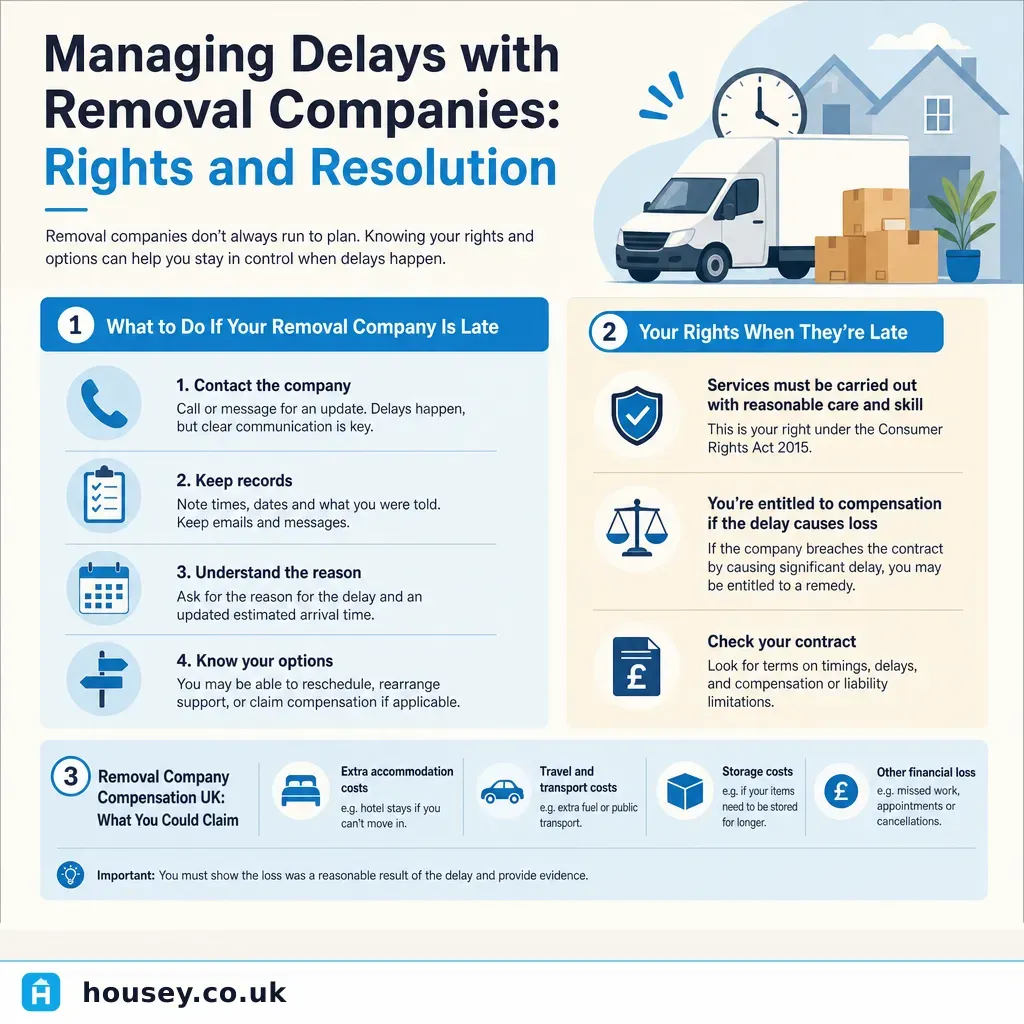
Managing Delays with Removal Companies: Rights and Resolution
If a removal company is late, your rights depend on your contract and whether the company is BAR-registered.
 Buying & Moving
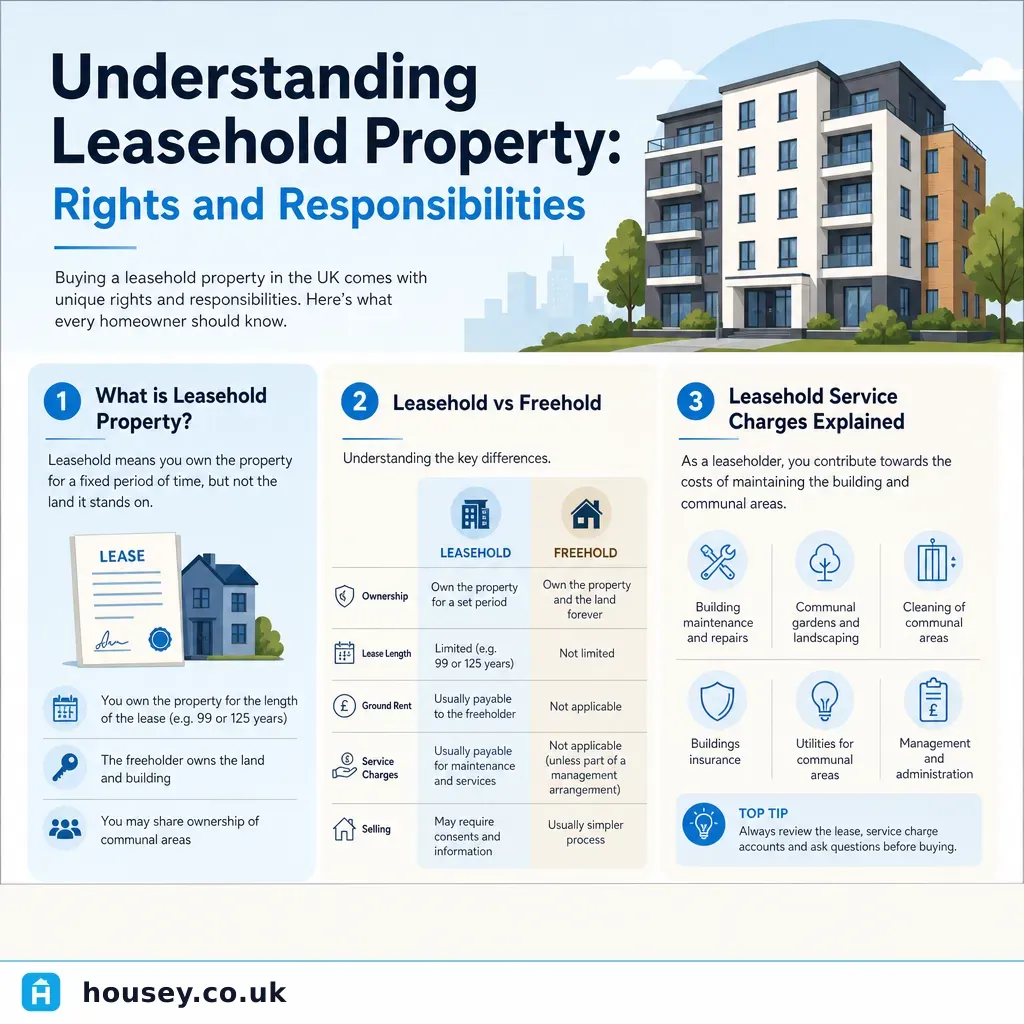
Understanding Leasehold Property: Rights and Responsibilities
Leasehold means you own a time-limited interest in a property while the freeholder owns the land and building.