Understanding Solicitor Fees for Home Purchase: Breakdown and Comparison
By Housey · Last reviewed 25th of May 2026
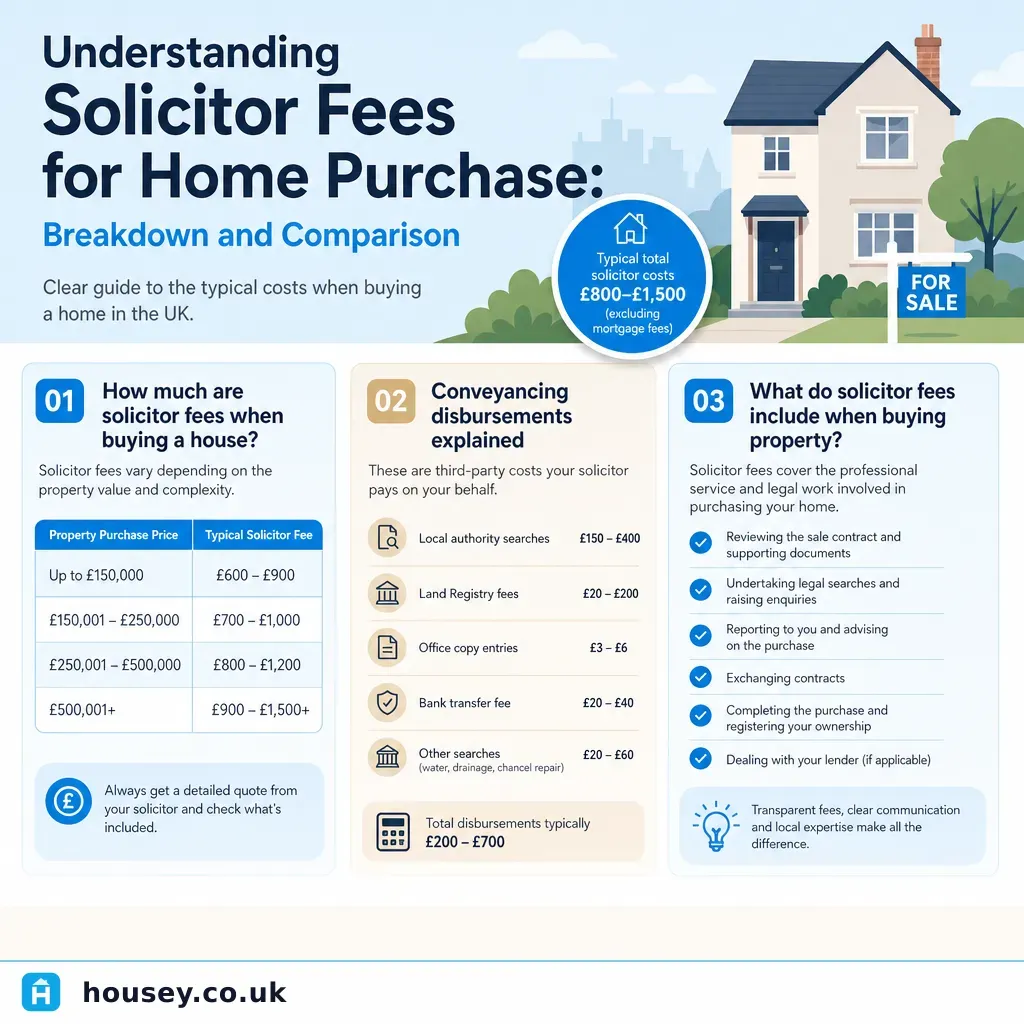
Understanding Solicitor Fees for Home Purchase: Breakdown and Comparison
When you receive a conveyancing quote in England and Wales, the total can look deceptively simple — until you compare it with a quote from a different firm and find the numbers diverge significantly. The most common cause is structural: one quote may bundle disbursements in, another may list them separately. Understanding what makes up solicitor fees for a home purchase lets you compare quotes on a genuinely like-for-like basis and avoid unexpected charges on completion day.
Key points
- Solicitor and licensed conveyancer fees for a standard freehold purchase typically range from £850 to £1,500 plus VAT at 20%; indicative UK costs, last reviewed 2026-05-25 — quotes vary by property value, tenure, location, and complexity.
- Disbursements — third-party costs passed on at cost — are usually charged on top of the professional fee and include search fees, Land Registry registration, and an electronic transfer charge.
- The Land Registry registration fee is set by HM Land Registry on a sliding scale linked to purchase price; online applications attract a lower fee than paper ones — check the current scale on GOV.UK before exchange.
- Stamp Duty Land Tax (SDLT) is collected and submitted to HMRC by your conveyancer but is a tax, not a legal fee; it can be the largest single figure on your completion statement.
- Leasehold purchases usually attract an additional professional fee of £150–£400 compared with equivalent freehold transactions, reflecting the extra legal work involved.
The two parts of every conveyancing quote
Every conveyancing quote for a property purchase contains two distinct categories. Confusing them is the most common reason buyers feel a quote was misleading.
Professional fee: What the firm charges for its legal work. Most residential conveyancers now offer a fixed fee; hourly-rate billing is less common for standard purchases. The professional fee is subject to VAT at 20%.
Disbursements: Third-party costs your conveyancer pays on your behalf and recoups from you. Reputable firms charge these at cost, without a mark-up. They include property searches, Land Registry registration, and electronic transfer charges.
SDLT may appear on a completion statement alongside disbursements for clarity, but it is a separate tax liability paid to HMRC — not a charge retained by the firm.
Disbursements: what to expect
Disbursement | Typical cost (indicative, 2026) | Notes |
|---|---|---|
Local authority search | £100–£350 | Varies by council; some are slower and charge more |
Environmental / flood search | £30–£60 | Usually a standard online search |
Water and drainage search | £50–£80 | Required by most mortgage lenders |
Land Registry official copies | £7–£15 per document | Copies of existing title register and plan |
Land Registry registration fee | £20–£910 | Sliding scale by purchase price; lower for online applications |
Electronic transfer (CHAPS) | £20–£40 | Per transfer; typically one payment on completion |
Bankruptcy search | £4–£6 per name | Required where a mortgage is involved |
ID verification | £15–£30 per person | Some firms use third-party verification services |
Indicative UK costs, last reviewed 2026-05-25. Source: HM Land Registry fee guidance (GOV.UK); local authority search fees vary — check the relevant council.
Decision tree: is the quote you've received comparable?
Before accepting a quote, work through these checks:
- Does the quoted fee include VAT on the professional fee? If not, add 20%.
- Does the quote include disbursements, or are those listed separately?
- Is SDLT included? It should appear as a separate tax estimate, not embedded in the legal fee.
- Is the fee fixed, or are there conditions under which it may increase — for example, leasehold, new build, gifted deposit, or Help to Buy?
- Is there a no-sale-no-fee clause, or will you owe something if the purchase falls through before exchange?
What drives fee differences between firms
- Property value: Some firms still price as a percentage of purchase price; fixed fees are now more common.
- Tenure: Leasehold (including most new-build flats) involves reviewing the lease, liaising with the freeholder, and obtaining management information packs. Expect a higher fee.
- New build: Developers often impose additional legal requirements and tight exchange deadlines. A supplement of £150–£300 is common.
- Gifted deposit: Lenders typically require additional verification where part of the deposit is a gift; some firms add a charge.
- Firm location: London-based firms often charge more than regional or online conveyancers.
- Shared ownership: Complex structures attract higher fees than standard freehold transactions.
What to ask before accepting a quote
- Is the professional fee fixed, and what circumstances would cause it to increase?
- Is VAT included or excluded in the quoted figure?
- What disbursements are included, and what is not covered?
- Will there be a charge if the purchase falls through before exchange of contracts?
- Who will handle my matter, and can I contact them directly by phone or email?
- What completion statement and certificate of title will I receive?
- Are there additional charges for leasehold, new build, or Help to Buy?
Important limitations
This article provides indicative cost information only. Conveyancing fees vary between firms, regions, and property types. SDLT rates and Land Registry fees are set by government and are subject to change. Always obtain itemised written quotes from at least two regulated firms before instructing. This article does not constitute legal or financial advice.
What to ask a qualified professional
Before instructing a conveyancer for a purchase:
- Can you provide a full itemised quote in writing, including all disbursements and VAT?
- What is your process for reporting progress, and how quickly do you typically respond to queries?
- Do you act for the lender as well as me in this transaction, and is there any potential conflict of interest?
- Are there any aspects of this property that might cause the fee to increase beyond the quoted figure?
- What happens to any funds I have already paid if the transaction falls through after searches have been ordered?
When to get professional help
Seek further advice if:
- You cannot reconcile significantly different quotes, and a firm cannot clearly explain the difference.
- A completion statement includes charges materially above the original quote with no prior notification.
- You are purchasing a leasehold, shared ownership, or new-build property and the quoted fee appears unusually low — key disbursements may have been omitted.
- You suspect the property has a complex legal history — disputes, missing documents, or unusual title — that may affect both cost and timeline.
How Housey can help
Housey lets you compare itemised quotes from regulated solicitors and licensed conveyancers for your purchase, sale, or remortgage. Our compare conveyancing quotes tool shows professional fees and disbursements side by side so you can make a fair comparison before committing.
Frequently asked questions
What is a typical solicitor fee for buying a house in the UK?
For a standard freehold purchase at around £250,000–£350,000, professional legal fees typically range from £850 to £1,400 plus VAT. Adding disbursements of £400–£700 brings the total before Stamp Duty Land Tax to roughly £1,500–£2,500. Costs vary with property value, tenure, and firm. Indicative UK costs, last reviewed 2026-05-25.
Do I pay solicitor fees if the purchase falls through?
It depends on the agreement. Some firms offer no-sale-no-fee arrangements, waiving the professional fee if the purchase does not complete. Others charge an abortive fee for work already carried out. Disbursements already paid — particularly searches — are usually owed regardless. Always clarify this before instructing.
Is VAT charged on solicitor conveyancing fees?
Yes. The professional fee charged by a solicitor or licensed conveyancer is subject to VAT at the standard rate of 20%. Disbursements passed on at cost are generally not subject to additional VAT, though some third-party search services may include VAT within their own charge.
Can I negotiate solicitor fees for a property purchase?
Fixed-fee conveyancers rarely negotiate on price. It is more effective to obtain three or four itemised quotes and compare them on a like-for-like basis, checking that disbursements, VAT, and conditions for price increases are all clearly stated. Regulatory status and communication standards are as important as price.
Sources and further reading
- HM Land Registry registration services fees — GOV.UK
- Stamp Duty Land Tax rates and thresholds — GOV.UK / HMRC
- SRA — choosing a conveyancer — Solicitors Regulation Authority
- CLC — consumer information — Council for Licensed Conveyancers
- Citizens Advice — using a solicitor — Citizens Advice
Useful next reads
 Buying & Moving
Identifying and Resolving Delays in Property Transactions
Delays in UK property transactions most often arise from slow local authority searches, incomplete identity documents, mortgage hold-ups, leasehold complications, or a problem elsewhere in the chain.
 Buying & Moving
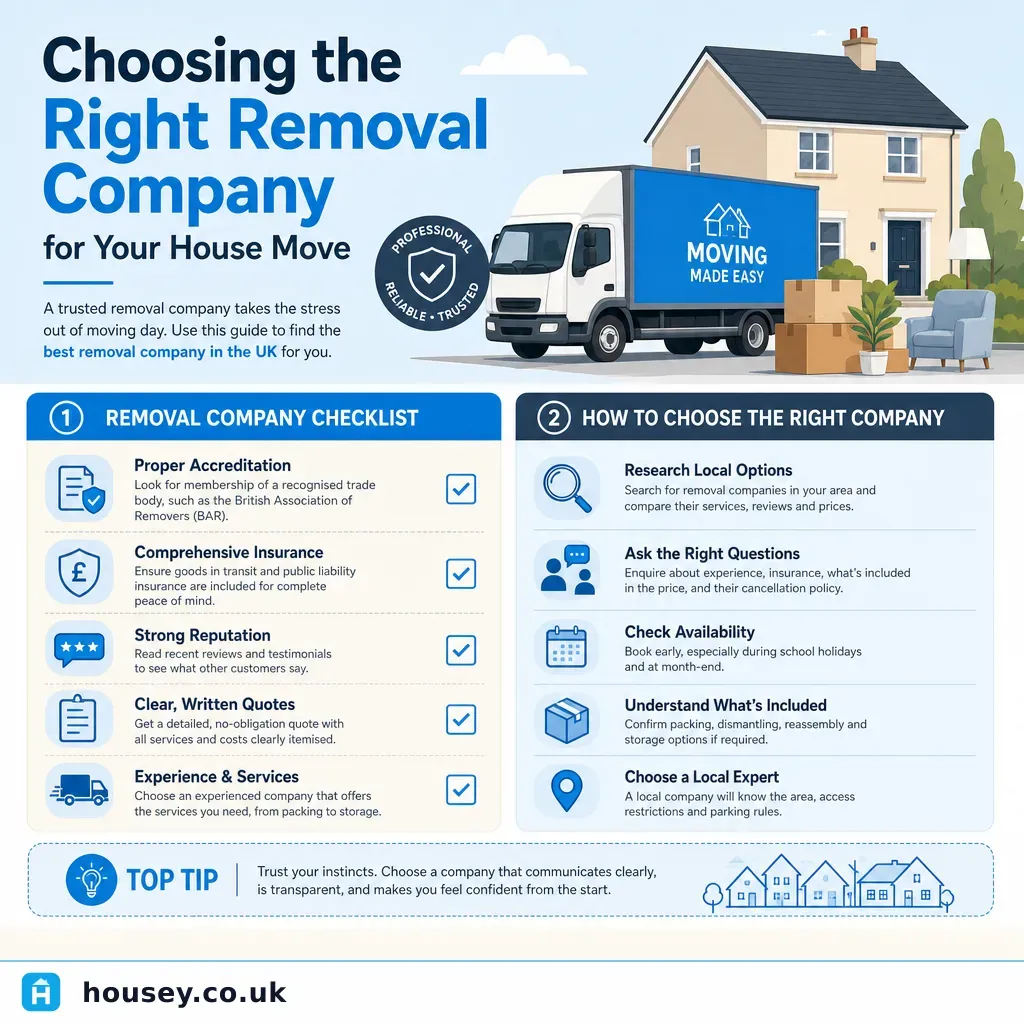
Choosing the Right Removal Company for Your House Move
To choose the right removal company, get three quotes from British Association of Removers (BAR) members or similarly accredited firms.
 Buying & Moving
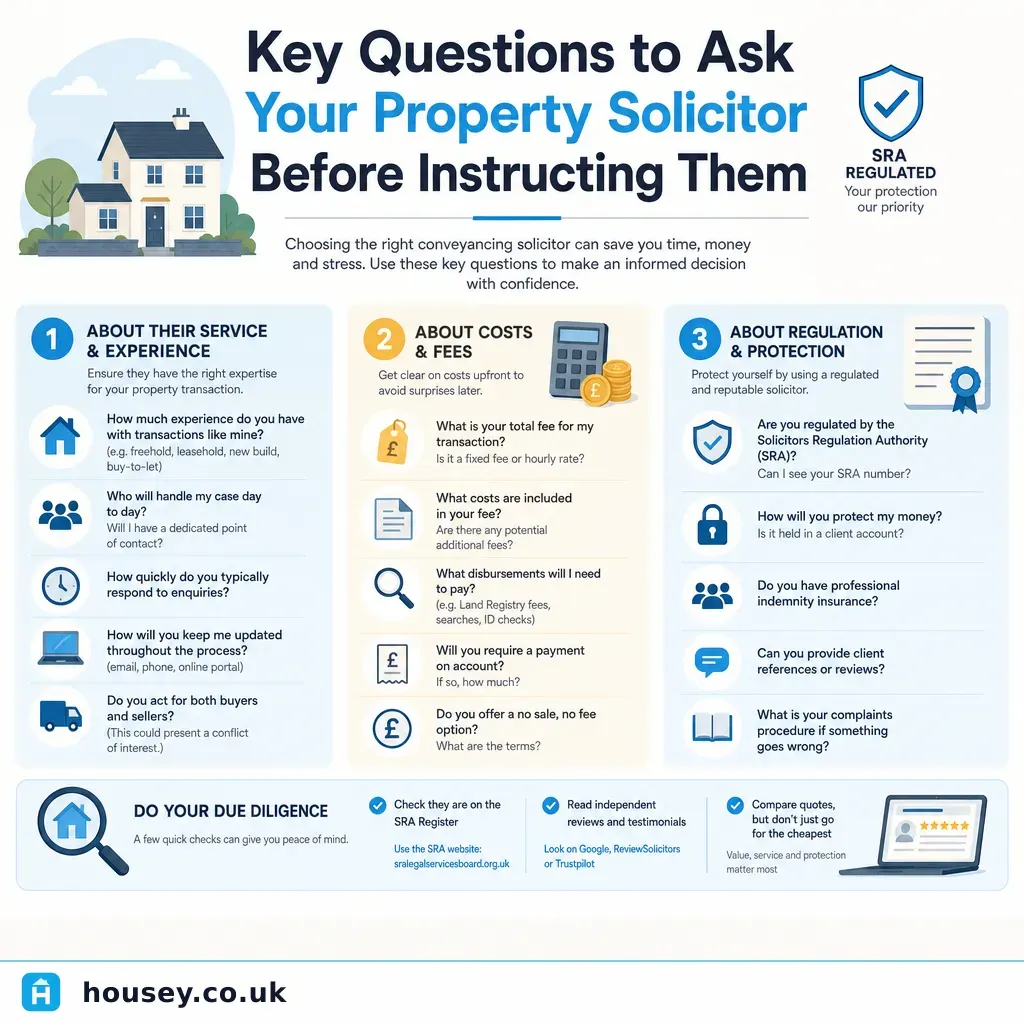
Key Questions to Ask Your Property Solicitor Before Instructing Them
Before instructing a property solicitor, ask whether they are on your mortgage lender's approved panel, whether their quote is fixed and includes VAT and all disbursements, who will personally handle your case, and what their abortive-fee policy is.
 Buying & Moving
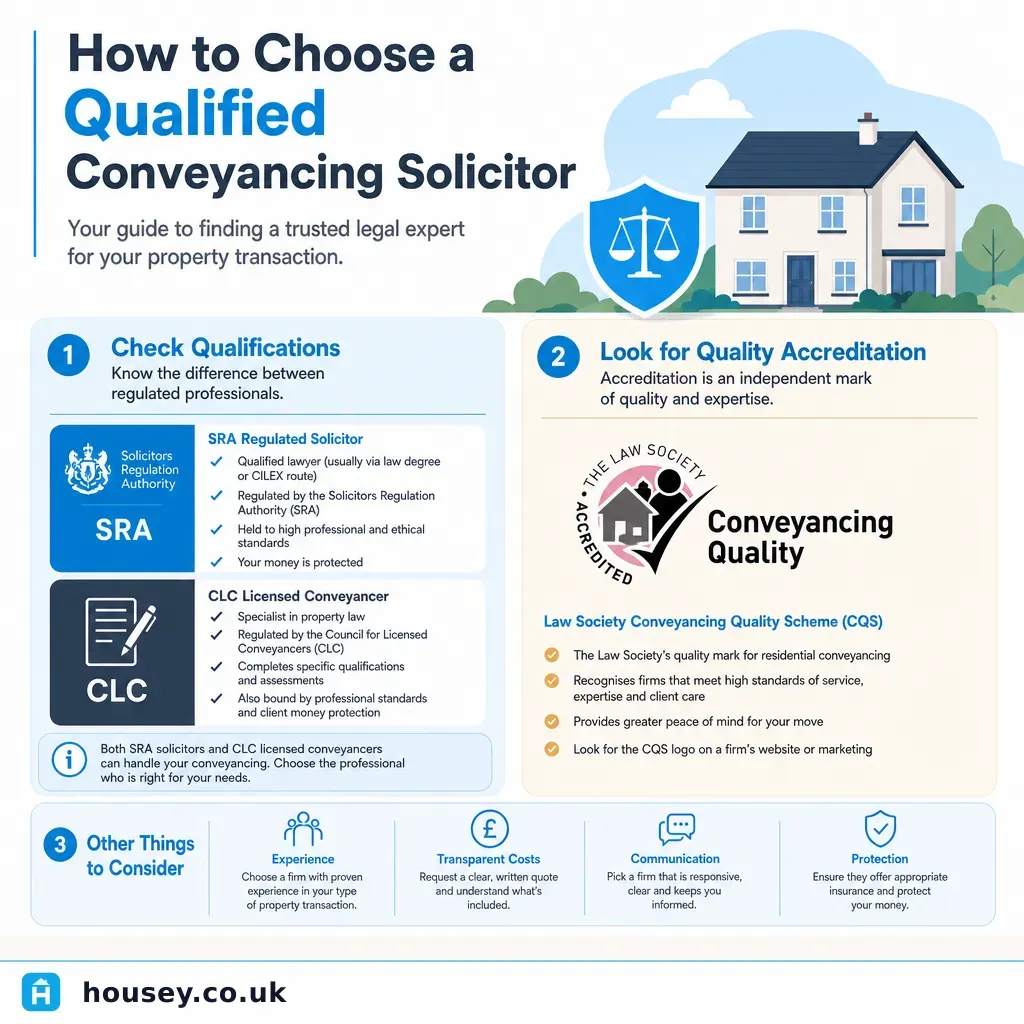
How to Choose a Qualified Conveyancing Solicitor
To choose a qualified conveyancing solicitor, verify they are regulated by the Solicitors Regulation Authority (SRA) or the Council for Licensed Conveyancers (CLC), check whether they hold Law Society CQS accreditation, and confirm they are on your mortgage lender's approved panel.
 Buying & Moving
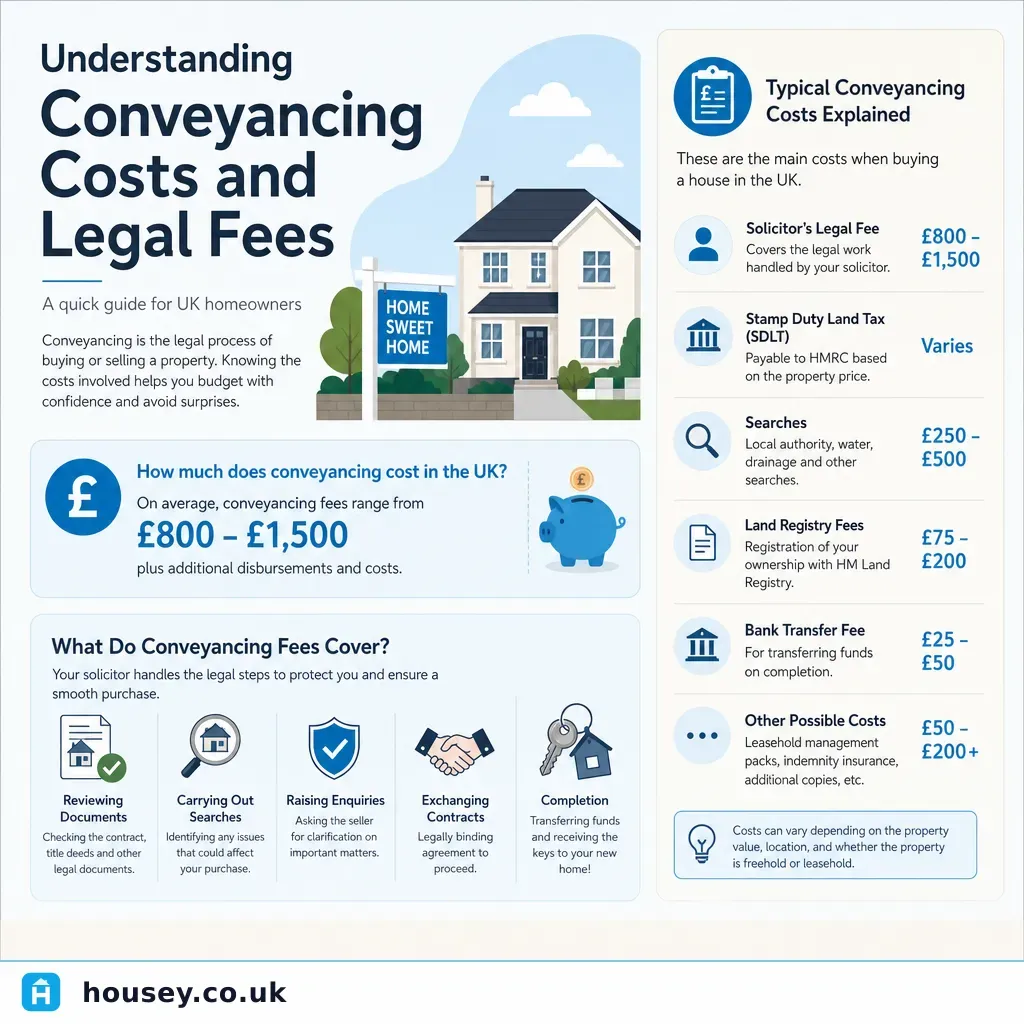
Understanding Conveyancing Costs and Legal Fees
Conveyancing costs in England and Wales include a solicitor's or licensed conveyancer's professional fee plus disbursements such as searches, Land Registry registration, and bank transfer charges.