Key Questions to Ask Your Property Solicitor Before Instructing Them
By Housey · Last reviewed 25th of May 2026
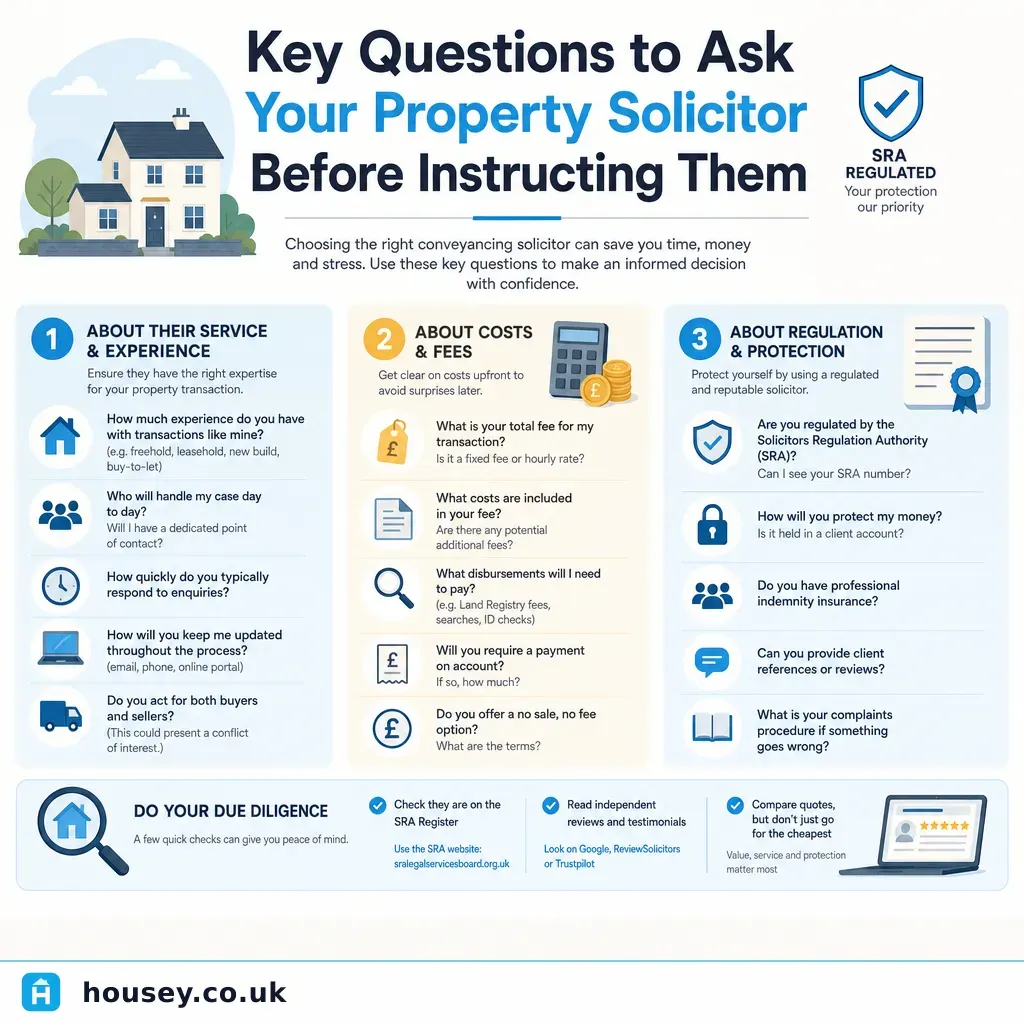
Key Questions to Ask Your Property Solicitor Before Instructing Them
Choosing a conveyancing solicitor is often treated as an afterthought — a quick search, a low quote, instructed. But the solicitor you appoint will manage one of the most significant legal transactions of your life, and the questions you ask upfront can determine how smoothly exchange and completion go. Most buyers instruct too quickly, comparing on price alone and overlooking factors that genuinely affect the outcome.
Key points
- Solicitors and licensed conveyancers must be regulated by either the Solicitors Regulation Authority (SRA) or the Council for Licensed Conveyancers (CLC); always verify registration independently before instructing.
- Being on your mortgage lender's approved panel is a legal necessity — an off-panel firm requires the lender to appoint a separate solicitor, adding cost and delay.
- Under SRA transparency rules (in force since December 2018), regulated firms must publish indicative prices and service information for residential conveyancing on their website.
- Fixed-fee quotes frequently exclude leasehold supplements, new-build premiums, and charges for acting for the mortgage lender — read the small print before comparing.
- The Legal Ombudsman handles complaints about solicitor service quality; the SRA handles complaints about conduct — knowing the difference matters if things go wrong.
Why the questions you ask matter
The cheapest conveyancing quote can become the most expensive if delays, miscommunications, or panel issues arise at a critical point. A solicitor who is off your lender's panel, slow to respond to the seller's solicitor, or unfamiliar with leasehold complexities can delay or collapse a transaction. Asking the right questions before you instruct gives you a concrete baseline to hold the firm to — and helps you identify firms that will communicate clearly throughout.
Which professional do you need?
Professional | Regulated by | Scope | Best for |
|---|---|---|---|
Conveyancing solicitor | SRA | Full property law and conveyancing | Complex, leasehold, disputed, or unusual transactions |
Licensed conveyancer | CLC | Residential conveyancing only | Straightforward freehold or standard leasehold purchases |
Online conveyancing firm | SRA or CLC | Volume-based, portal-led | Budget buyers on uncomplicated transactions |
Solicitor with specialist experience | SRA | Listed buildings, shared ownership, new build | Non-standard properties or tenure types |
What to ask before instructing: the full list
About fees and costs
- Is your quote fixed or an estimate? A fixed fee means no surprises; an estimate can rise.
- Does the quote include VAT? Always clarify — quotes sometimes appear lower before VAT is added.
- Are all disbursements itemised? Search fees, SDLT, Land Registry, AML checks, and CHAPS transfer should all be listed separately.
- What is your abortive-fee policy? If the transaction falls through before exchange, what do you charge?
- Are there supplements for leasehold, new build, shared ownership, or Help to Buy? These are commonly excluded from headline quotes.
- Is there a separate charge for acting for my mortgage lender? Many firms include this; some do not.
About qualifications and compliance
- Are you regulated by the SRA or CLC? Verify independently on the respective register before instructing.
- Are you on my mortgage lender's approved panel? Confirm the lender name specifically — panel membership varies by lender.
- Who will handle my case day-to-day? In volume firms, a qualified solicitor may supervise while a paralegal or case manager handles routine correspondence.
- Will I have a named contact for the duration of the transaction? Handovers between handlers mid-transaction cause delays and errors.
About process and timelines
- What is your typical timeline from instruction to exchange for a property like mine? This sets realistic expectations and signals experience with your property type.
- How will you communicate progress — portal, email, or phone? Match the approach to your own preferences.
- How quickly do you respond to enquiries from the seller's solicitor? Delays in raising or responding to enquiries are the most common source of transaction slowdown.
- Do you use digital onboarding and electronic ID verification? Faster AML checks speed up the instruction stage.
- What experience do you have with this type of transaction? Ask specifically about leasehold, new build, or listed buildings if relevant.
About risk and contingency
- What happens if my survey reveals defects that affect the agreed price? Can the firm advise on renegotiation or does that fall outside scope?
- How do you handle missing documents, restrictive covenants, or title defects? Some issues require indemnity insurance; ask about the firm's experience arranging it.
- What are the most common causes of delay in transactions like mine? A well-experienced solicitor will name specific risks rather than giving a generic answer.
Red flags when vetting a solicitor
Be cautious if:
- The firm cannot confirm panel membership with your named mortgage lender before you instruct.
- The quote excludes VAT and itemises no disbursements — the headline figure will bear no resemblance to the final invoice.
- The SRA or CLC register shows no current authorisation for the firm or the named individual.
- You cannot get a named case handler confirmed in writing before instruction.
- The firm declines to give a fixed-fee commitment for a straightforward freehold purchase without explanation.
- Online reviews show a consistent pattern of poor communication or missed completion deadlines — check the Legal Ombudsman's published case summaries as well as Google and Trustpilot.
Decision tree: which type of conveyancer should you use?
- Choose a local high-street solicitor if your transaction is leasehold, involves unusual title issues, is a listed building, or you prefer the option of face-to-face meetings.
- Choose a licensed conveyancer or online firm if your transaction is a straightforward freehold purchase, you are comfortable managing the process via a digital portal, and cost and speed are the priorities.
- Ask for a solicitor with new-build experience if buying off-plan or from a developer — developer-imposed exchange deadlines require specific expertise.
- Ask for a solicitor with listed building or conservation area experience if the property is Grade I or II listed.
- Check the SRA register or CLC register if you are uncertain whether a firm is currently authorised to practise.
Important limitations
This article provides general guidance on selecting a property solicitor in England and Wales. The right choice depends on your specific transaction, property type, tenure, lender, and personal circumstances. This is not legal advice. Always verify a firm's regulatory status independently before instructing, and seek advice from a qualified professional for your specific situation.
What to ask a qualified professional
Once you have a shortlist, confirm in writing:
- Can you confirm you are on [specific lender name]'s approved panel?
- Can you provide a fully itemised quote with VAT shown separately and all disbursements listed?
- Who will be the named case handler on my file, and what is their qualification?
- What is your process if the seller's solicitor is slow to respond to enquiries?
- Do you hold professional indemnity insurance, and what is the cover limit?
When to get professional help
If at any point your solicitor is unable to answer basic questions about your transaction, is uncontactable for extended periods, or fails to take key steps within a reasonable timeframe — such as not raising enquiries within two to three weeks of receiving the contract pack — you may need to consider changing solicitor or making a formal complaint. Changing solicitor mid-transaction is disruptive but sometimes necessary. Complaints about service go to the Legal Ombudsman; complaints about conduct go to the SRA or CLC.
How Housey can help
Housey works with regulated conveyancing solicitors who provide transparent, itemised quotes for freehold, leasehold, and new-build transactions. Compare solicitors suited to your property type through our conveyancing service.
Frequently asked questions
How many solicitors should I get quotes from before instructing?
Two or three quotes is usually sufficient. Compare the fully itemised costs including VAT and all disbursements, not just the headline legal fee. Also compare confirmed panel status, communication approach, and whether a fixed fee is on offer. A firm that is slightly more expensive but offers a named case handler, confirmed panel membership, and a clear abortive-fee policy is generally the sounder choice.
Can buyer and seller use the same solicitor?
It is technically possible but rarely advisable in practice. Under SRA rules, known as "dual representation", this is only permitted where the transaction is straightforward, both parties give informed consent, and there is no conflict of interest. Most solicitors will decline, and doing so is generally the safer approach. Using separate solicitors protects each party's independent interests throughout.
What is the Legal Ombudsman and when should I contact them?
The Legal Ombudsman is the official complaints body for legal services in England and Wales. If you have an unresolved complaint about a solicitor's standard of service — poor communication, unexplained delays, or billing disputes — and cannot resolve it with the firm directly, you can refer it to the Ombudsman. The SRA handles conduct complaints separately. Scotland uses the Scottish Legal Complaints Commission.
Do I need to use a local solicitor for conveyancing?
Not necessarily. Most conveyancing is handled remotely by email and secure portal, so geographic proximity is rarely a practical requirement. The key criteria are regulatory status, lender panel membership, relevant experience, and communication quality. A local firm may suit complex transactions where face-to-face meetings are likely, but for the majority of straightforward purchases, location is a minor factor.
Sources and further reading
- Find a solicitor — SRA register — Solicitors Regulation Authority
- Find a licensed conveyancer — CLC register — Council for Licensed Conveyancers
- Legal Ombudsman — how to make a complaint — Legal Ombudsman
- SRA transparency rules for legal services — Solicitors Regulation Authority
- Buying a home — guidance — GOV.UK
Useful next reads
 Buying & Moving
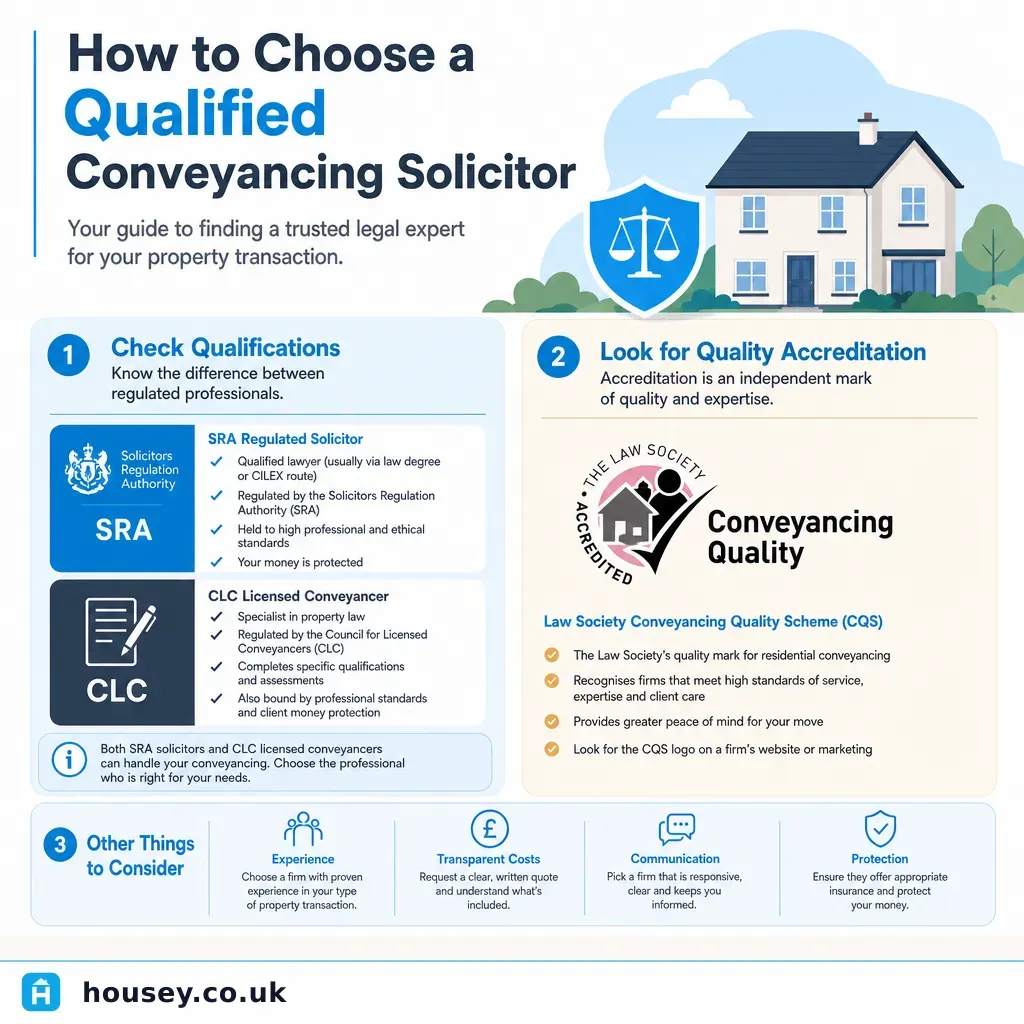
How to Choose a Qualified Conveyancing Solicitor
To choose a qualified conveyancing solicitor, verify they are regulated by the Solicitors Regulation Authority (SRA) or the Council for Licensed Conveyancers (CLC), check whether they hold Law Society CQS accreditation, and confirm they are on your mortgage lender's approved panel.
 Buying & Moving
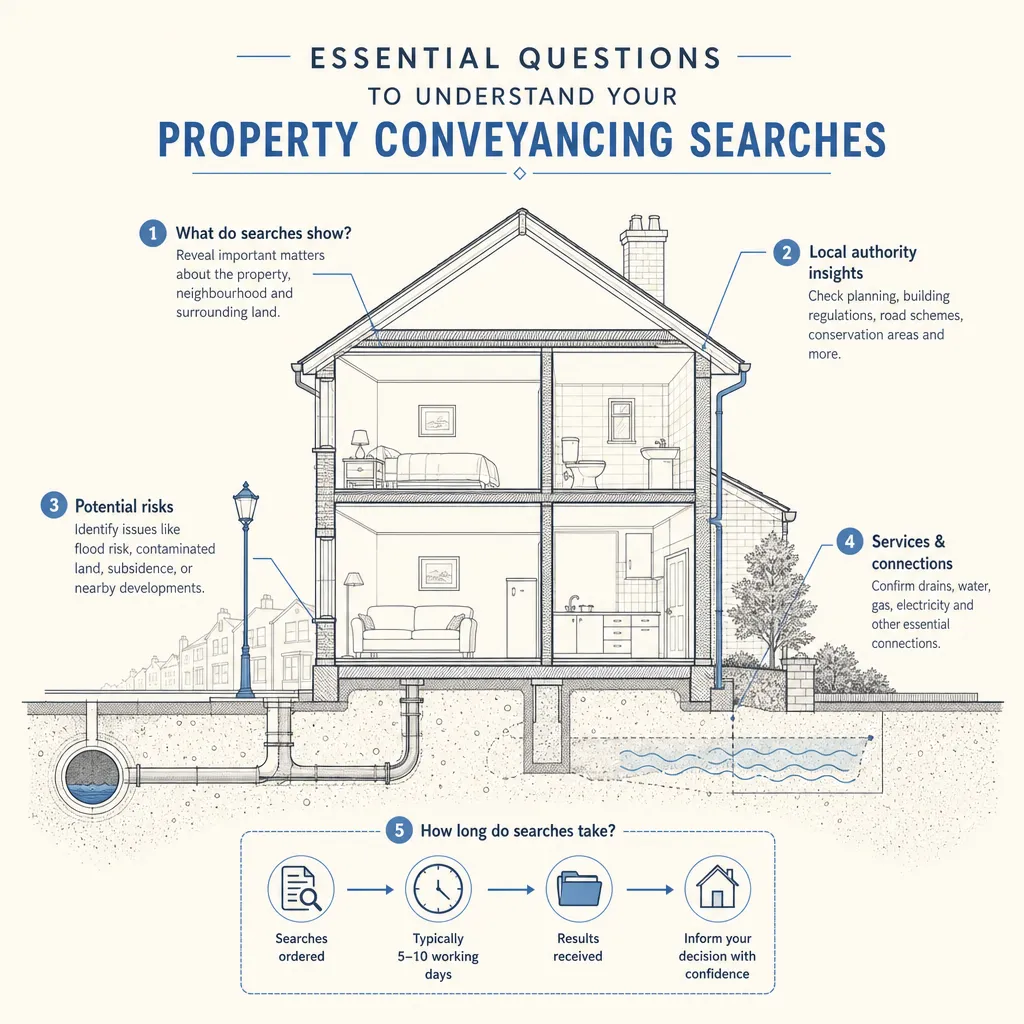
Essential Questions to Understand Your Property Conveyancing Searches
Conveyancing searches are formal enquiries to official bodies revealing planning history, flood risk, drainage infrastructure, and environmental hazards affecting a property.
 Buying & Moving
Identifying and Resolving Delays in Property Transactions
Delays in UK property transactions most often arise from slow local authority searches, incomplete identity documents, mortgage hold-ups, leasehold complications, or a problem elsewhere in the chain.
 Buying & Moving
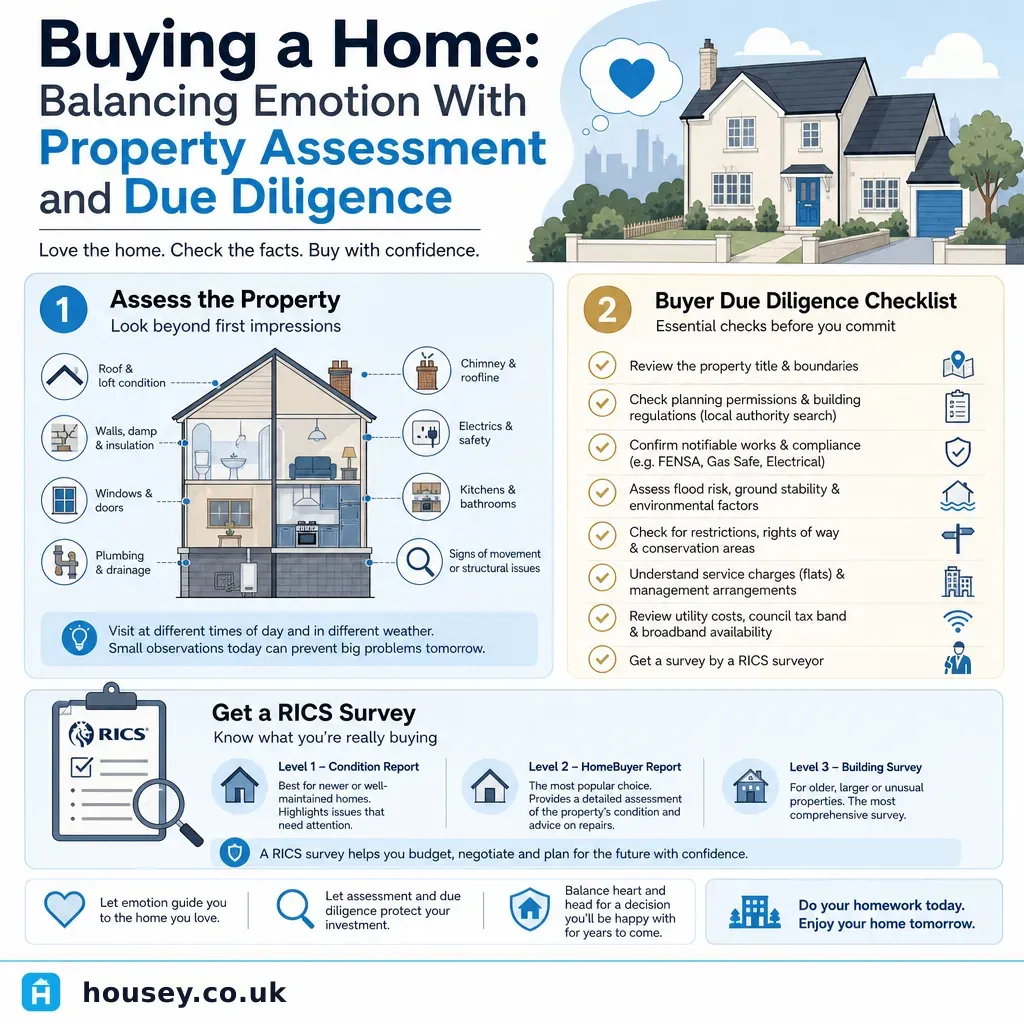
Buying a Home: Balancing Emotion With Property Assessment and Due Diligence
It's natural to feel strongly about a property, but buying decisions should be supported by a formal survey, proper searches, and independent legal advice.
 Buying & Moving
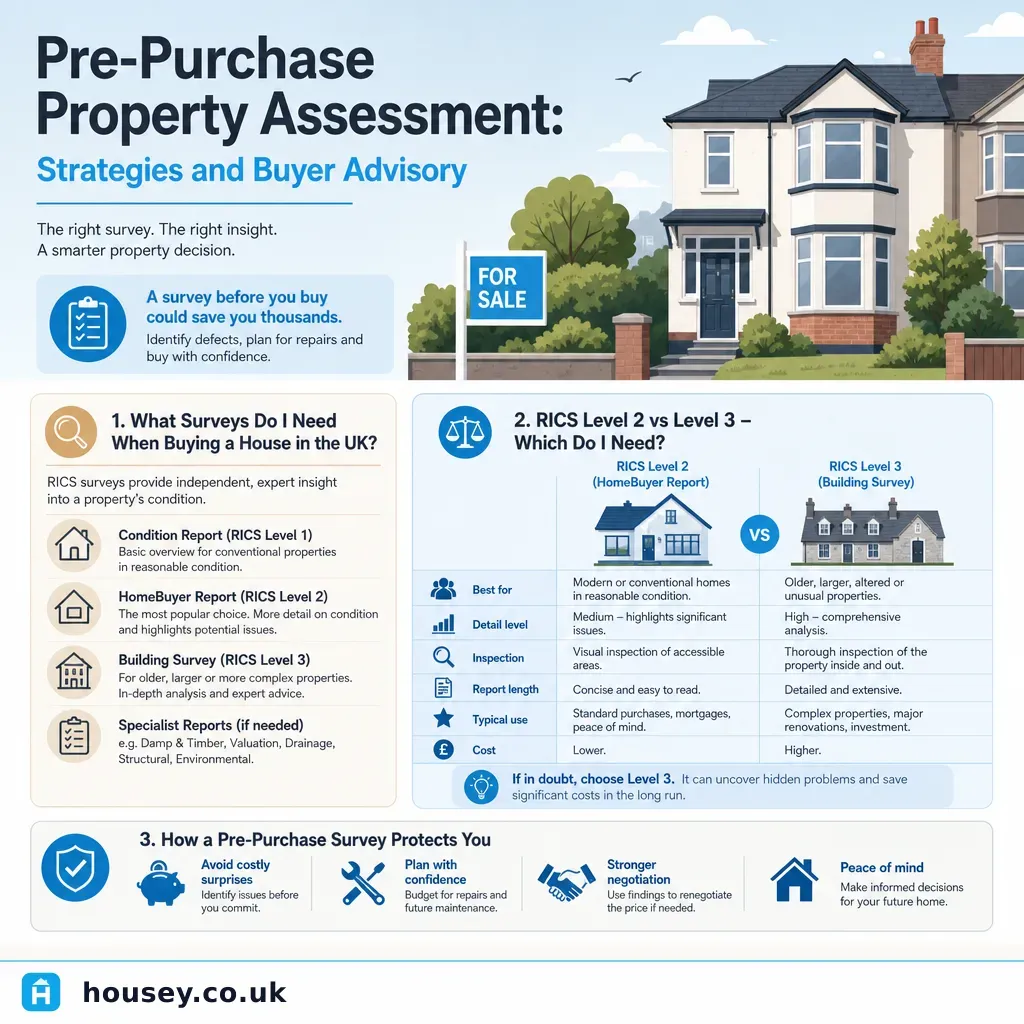
Pre-Purchase Property Assessment: Strategies and Buyer Advisory
A pre-purchase property assessment in the UK typically combines an independent RICS Home Survey, conveyancing searches, and specialist inspections for damp or electrical condition where needed.