Understanding Conveyancing Costs and Legal Fees
By Housey · Last reviewed 24th of May 2026
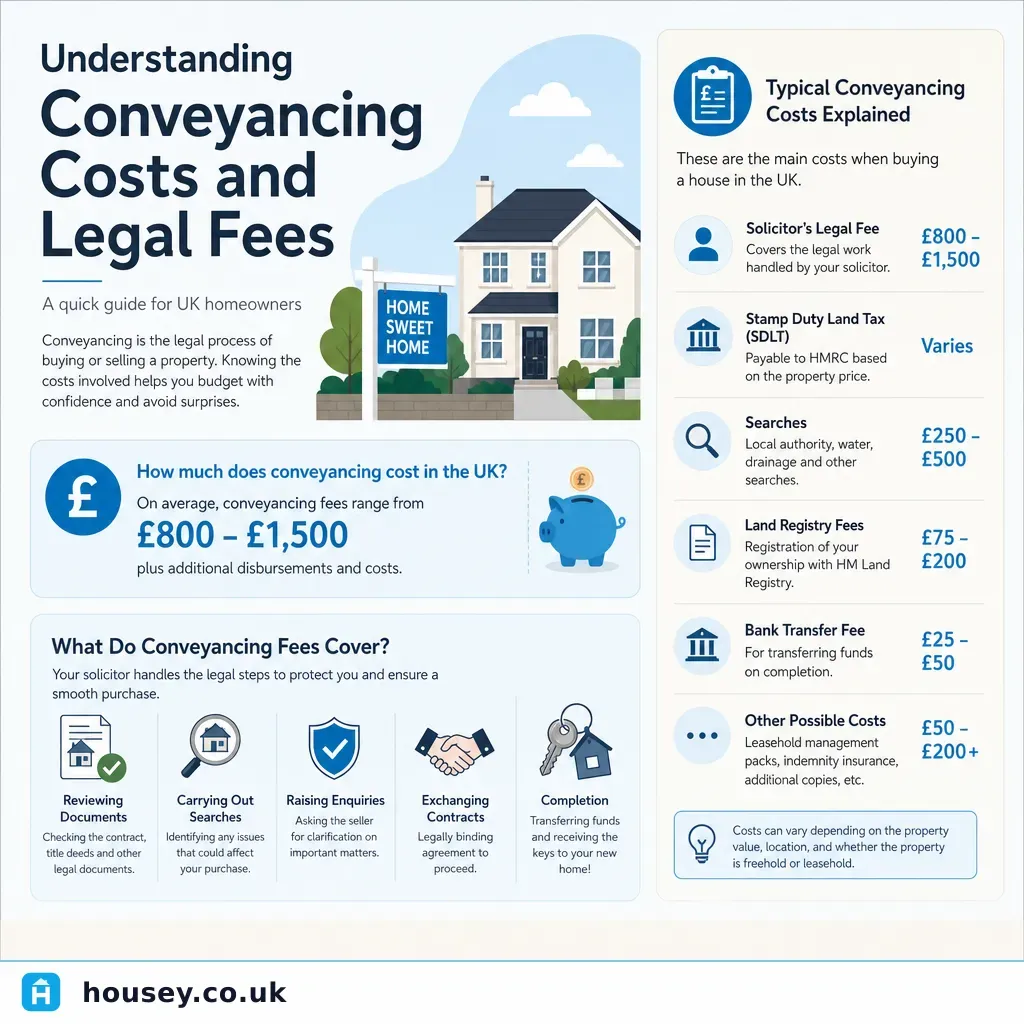
Understanding Conveyancing Costs and Legal Fees
Conveyancing costs catch many buyers and sellers off guard — not because the fees are unreasonable, but because the total is made up of several distinct components that quotes sometimes present inconsistently. Understanding the difference between professional fees, disbursements, and taxes before you instruct a solicitor enables you to compare quotes accurately and budget with confidence for one of the largest financial transactions most people undertake.
Key points
- Conveyancing costs in England and Wales are split into two main categories: the solicitor's or licensed conveyancer's professional fee, and disbursements — third-party costs such as searches, Land Registry registration fees, and bank transfer charges.
- Stamp Duty Land Tax (SDLT) in England is a government tax payable to HMRC and is entirely separate from conveyancing fees; Wales uses Land Transaction Tax (LTT) and Scotland uses Land and Buildings Transaction Tax (LBTT).
- A local authority search — one of the standard required disbursements for buyers — costs approximately £60 to £350 depending on the local authority, with most councils in the range of £100 to £200 (Indicative UK costs, last reviewed 2026-05-24).
- Leasehold conveyancing is consistently more expensive than freehold, owing to the additional work of reviewing the lease, obtaining a management pack, and in some cases seeking freeholder consent.
- Online conveyancers may quote lower professional fees but sometimes exclude disbursements or VAT from their headline figure; always compare quotes on a fully itemised, like-for-like basis.
What does conveyancing cover?
Conveyancing is the regulated legal process of transferring property ownership. For buyers, this includes reviewing the contract and title documents, ordering and analysing property searches, raising enquiries with the seller's solicitor, advising on mortgage conditions, exchanging contracts, transferring completion funds, and registering the new ownership at HM Land Registry. For sellers, the work involves drafting the contract, completing the TA6 and TA10 property information forms, providing title evidence, responding to enquiries, and managing the fund transfer at completion.
Only solicitors regulated by the Solicitors Regulation Authority (SRA) or licensed conveyancers regulated by the Council for Licensed Conveyancers (CLC) are authorised to carry out conveyancing for others in England and Wales.
Freehold vs. leasehold: how costs compare
Tenure significantly affects conveyancing costs. The table below illustrates the typical difference:
Transaction type | Professional fee range | Key additional disbursements | Reason for higher cost |
|---|---|---|---|
Freehold purchase | £900 – £1,800 | Searches, Land Registry fee, SDLT return | Standard title review and registration |
Leasehold purchase | £1,200 – £2,500+ | Searches, registration, management pack (£200 – £400+) | Lease review, service charge history, possible freeholder consent |
Freehold sale | £700 – £1,400 | Official copy documents, bank transfer fee | Draft contract, respond to enquiries |
Leasehold sale | £900 – £1,800+ | As above plus managing agent requirements | Additional lease-related documentation |
Indicative UK costs, last reviewed 2026-05-24. Fees vary by region, property value, firm, and transaction complexity. Get itemised quotes from at least two regulated firms.
What are disbursements?
Disbursements are third-party costs your solicitor pays on your behalf and passes on at cost. For a standard residential purchase in England and Wales, these typically include:
- Local authority search: £60 – £350 (most councils charge £100 – £200).
- Drainage and water search: approximately £30 – £60.
- Environmental search: approximately £30 – £60.
- HM Land Registry registration fee: calculated on a sliding scale based on the purchase price. Current fees are published on the HM Land Registry fee schedule.
- SDLT return preparation: sometimes included in the professional fee; sometimes charged separately at £50 – £100. Confirm which applies in your quote.
- Bank transfer fee (CHAPS): typically £25 – £50.
- Official copies of title documents: £3 – £7 per document.
- Indemnity insurance (if required for a title defect): premiums vary widely, typically £100 – £400 for standard single-defect policies, but potentially more for complex issues.
For sellers, disbursements are fewer, primarily limited to official copy documents and the bank transfer fee at completion.
Stamp Duty Land Tax and devolved equivalents
SDLT is a government tax, not a conveyancing fee, but your solicitor submits the SDLT return to HMRC and handles payment at completion. Thresholds and rates are set by government and have changed several times in recent years, including temporary holidays and revisions to first-time buyer relief. Always verify the current rates and applicable reliefs using the official SDLT calculator on GOV.UK before exchanging contracts — do not rely on rates quoted informally or in older articles.
If you are purchasing in Wales, Land Transaction Tax (LTT) applies — rates and thresholds differ from SDLT and are set by the Welsh Government. Guidance is available from Revenue Wales. In Scotland, Land and Buildings Transaction Tax (LBTT) applies — see Revenue Scotland for current rates.
An additional dwelling surcharge applies when buying a second or subsequent residential property in England and Wales. The current surcharge rate should be confirmed on GOV.UK before proceeding, as it has been subject to amendment.
Quote comparison: what to check
When comparing conveyancing quotes, use this checklist to ensure you are comparing like for like:
Quote comparison checklist
- Is the professional fee clearly separated from disbursements in the quote?
- Does the quote include VAT on the professional fee?
- Are search fees included, and which specific searches are covered?
- Is the HM Land Registry registration fee included or listed separately?
- Is SDLT return preparation included in the professional fee?
- Are bank transfer (CHAPS) fees included?
- For leasehold: is the cost of obtaining the management pack included?
- What additional charges apply if the transaction becomes complex — for example, if indemnity insurance is needed, or if this involves Help to Buy or shared ownership?
- Is there a no-completion, no-fee guarantee, and if so, which disbursements will already have been spent and remain payable?
Important limitations
This article provides general information about conveyancing costs in England and Wales and is intended to help buyers and sellers understand the components of a quote. It does not constitute legal advice. The specifics of your transaction — including property type, tenure, title history, mortgage conditions, and location — will affect both the process and the fees involved. Conveyancing is a regulated legal activity; you should instruct a solicitor regulated by the SRA or a licensed conveyancer regulated by the CLC for your specific transaction. SDLT, LTT, and LBTT rates are set by government and change periodically — always verify current rates with HMRC, Revenue Wales, or Revenue Scotland before proceeding. Fee ranges in this article are indicative only, last reviewed 2026-05-24.
When to get professional help
You should instruct a regulated conveyancer before exchanging contracts in every residential property transaction — this is not an optional step in England and Wales. Seek a second opinion or specialist input if:
- Your quote contains unexplained charges, significant exclusions, or terms that differ substantially from others you have received.
- Your solicitor identifies a title defect, restrictive covenant, or adverse entry on the Land Register.
- You are purchasing a leasehold property with a lease of under 80 years, a high ground rent, or other onerous terms — these require specialist legal advice and may affect mortgage eligibility.
- You are using Help to Buy, shared ownership, or another government-backed scheme, which involves additional legal steps and documentation.
- You are in a chain and need to understand your legal position if the chain collapses before exchange.
What to ask a qualified professional
Before instructing a conveyancer, ask:
- Are you regulated by the Solicitors Regulation Authority (SRA) or the Council for Licensed Conveyancers (CLC)?
- Who will handle my transaction day to day — a qualified solicitor or licensed conveyancer, or a supervised member of staff?
- What is your typical time from instruction to exchange of contracts for a transaction of this type?
- How do you communicate progress — email updates, telephone, or an online case-tracking portal?
- How do you handle situations where a chain is at risk, or where a lender raises conditions on the mortgage offer?
- What do I owe if the transaction falls through before exchange, and which disbursements will already have been spent?
How Housey can help
Housey connects buyers and sellers with regulated conveyancing solicitors and licensed conveyancers across England and Wales. Use Housey to get itemised, comparable quotes, confirm exactly what is included, and find a conveyancer with a clear communication process and relevant experience for your transaction type.
Frequently asked questions
What is the typical total cost of conveyancing for a buyer?
For a standard freehold purchase in England, buyers typically pay £1,500 to £3,000 in professional fees and disbursements combined, excluding Stamp Duty Land Tax and any lender's own legal fees. Leasehold properties, higher-value transactions, and those with title complications usually cost more. Always get itemised quotes from at least two regulated firms before instructing. Indicative UK costs, last reviewed 2026-05-24.
Do I need a solicitor, or can I use a licensed conveyancer?
Both solicitors regulated by the SRA and licensed conveyancers regulated by the CLC can handle residential conveyancing. Solicitors offer a broader range of legal services if complications arise outside property law, while licensed conveyancers specialise in property transfer. For most straightforward purchases, either is appropriate. For complex transactions involving boundary disputes, unusual tenure, or commercial elements, a solicitor with property law expertise is often preferable.
When do I pay conveyancing fees?
Most firms request a payment on account at the outset — typically £200 to £400 to cover early disbursements such as search fees. The professional fee is usually deducted from transaction funds at or shortly before completion. Always check the payment schedule in your client care letter before instructing, and clarify what remains payable if the transaction does not complete.
Are online conveyancers cheaper than local firms?
Online conveyancers may quote lower professional fees, but the comparison is not always straightforward. Some exclude disbursements or VAT from their headline figure, or apply additional charges for complexity that local firms include as standard. Service levels also vary. The cheapest headline quote is not always the lowest overall cost, and responsiveness during a time-sensitive transaction has real value.
Sources and further reading
- Stamp Duty Land Tax: guidance and calculator — HMRC / GOV.UK
- HM Land Registry registration fees — HM Land Registry
- Find a solicitor: Solicitors Regulation Authority — Solicitors Regulation Authority
- Find a licensed conveyancer: Council for Licensed Conveyancers — Council for Licensed Conveyancers
- Land Transaction Tax guidance — Revenue Wales
- Buying a home: legal aspects — Citizens Advice
Useful next reads
 Buying & Moving
Identifying and Resolving Delays in Property Transactions
Delays in UK property transactions most often arise from slow local authority searches, incomplete identity documents, mortgage hold-ups, leasehold complications, or a problem elsewhere in the chain.
 Buying & Moving
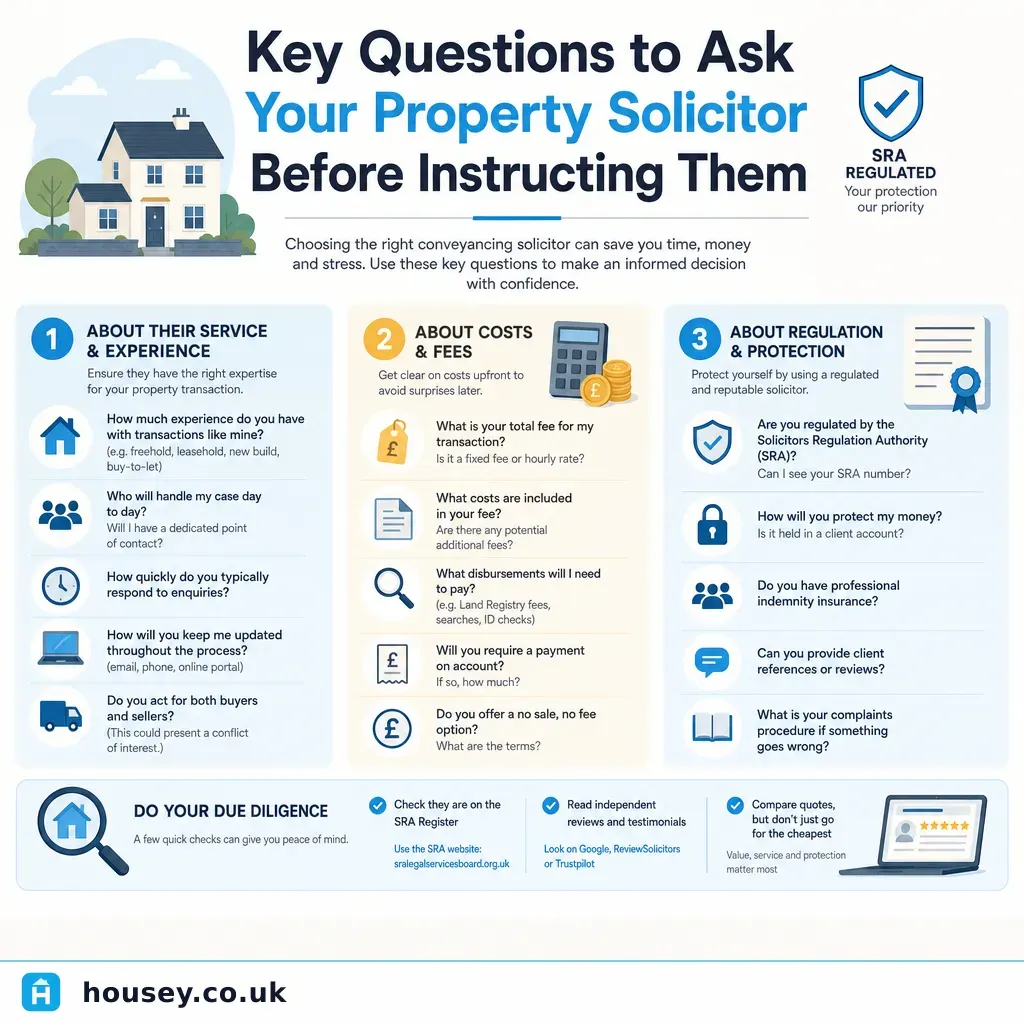
Key Questions to Ask Your Property Solicitor Before Instructing Them
Before instructing a property solicitor, ask whether they are on your mortgage lender's approved panel, whether their quote is fixed and includes VAT and all disbursements, who will personally handle your case, and what their abortive-fee policy is.
 Buying & Moving
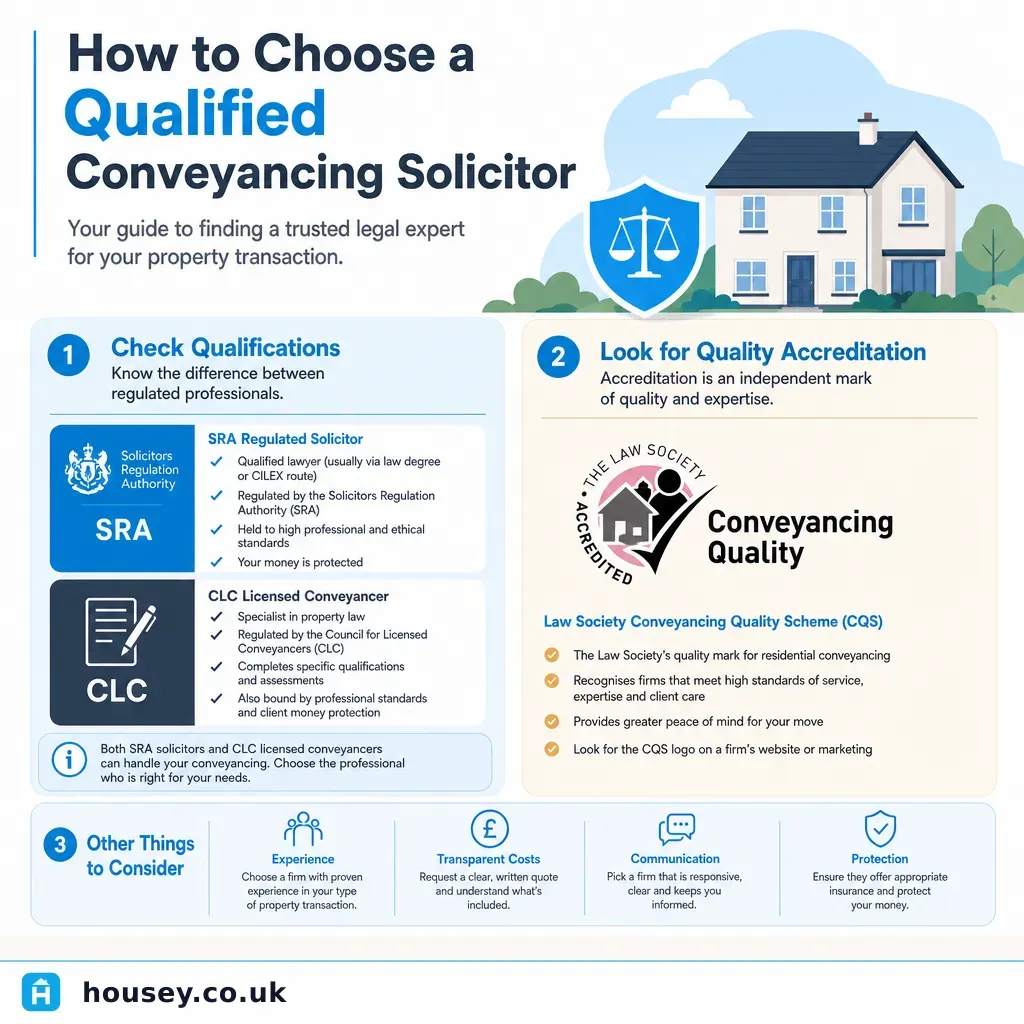
How to Choose a Qualified Conveyancing Solicitor
To choose a qualified conveyancing solicitor, verify they are regulated by the Solicitors Regulation Authority (SRA) or the Council for Licensed Conveyancers (CLC), check whether they hold Law Society CQS accreditation, and confirm they are on your mortgage lender's approved panel.
 Buying & Moving
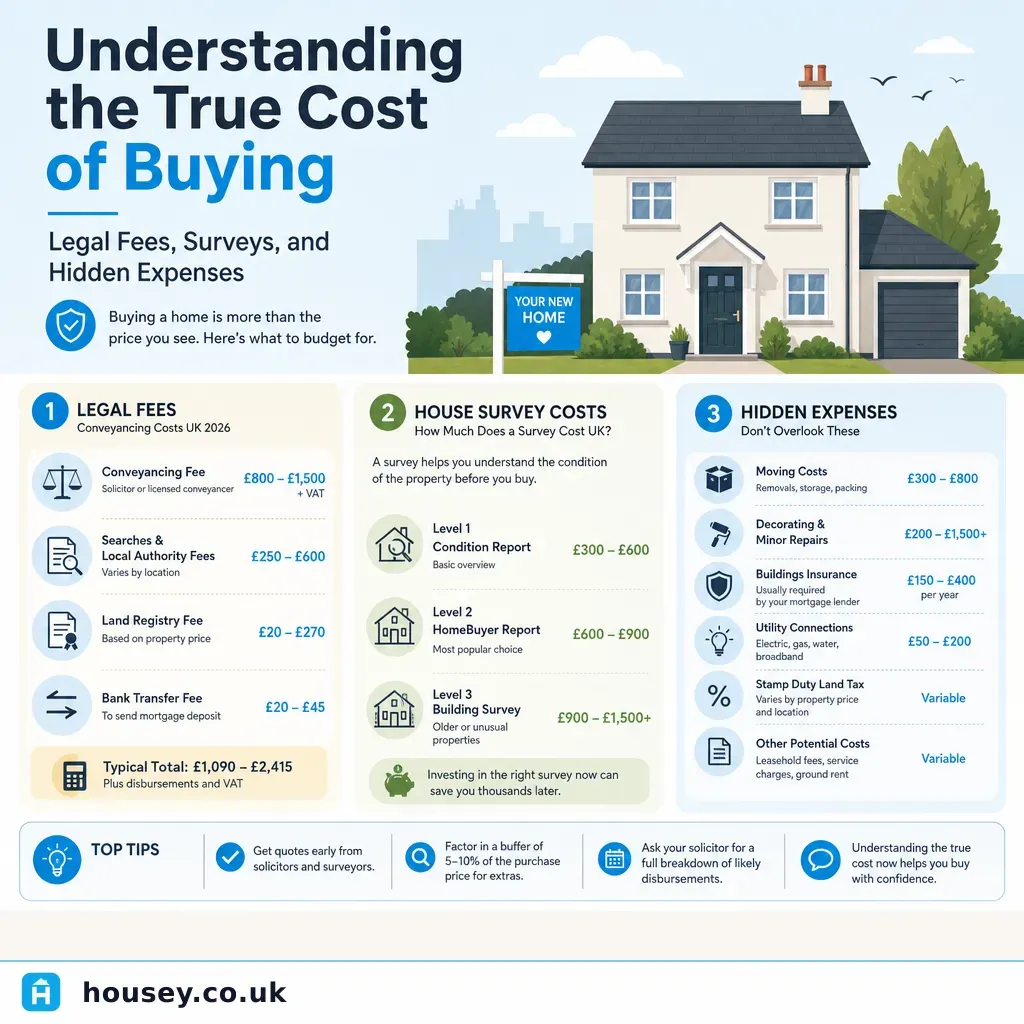
Understanding the True Cost of Buying: Legal Fees, Surveys, and Hidden Expenses
The true cost of buying a UK home typically adds 3–5% on top of the purchase price.
 Buying & Moving
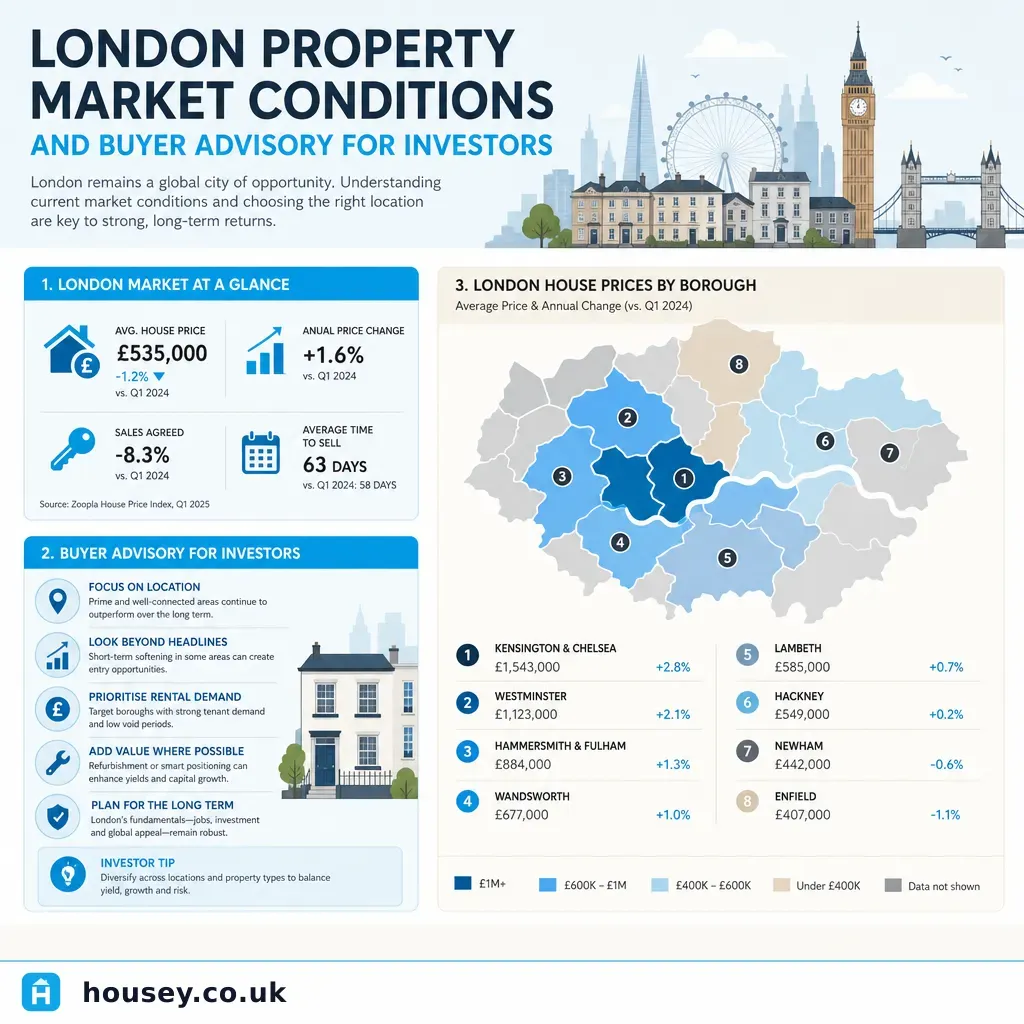
London Property Market Conditions And Buyer Advisory For Investors
London's property market varies enormously by borough, tenure, and property type.