Velux Window Servicing and Maintenance: A Complete Guide
By Housey · Last reviewed 12th of May 2026
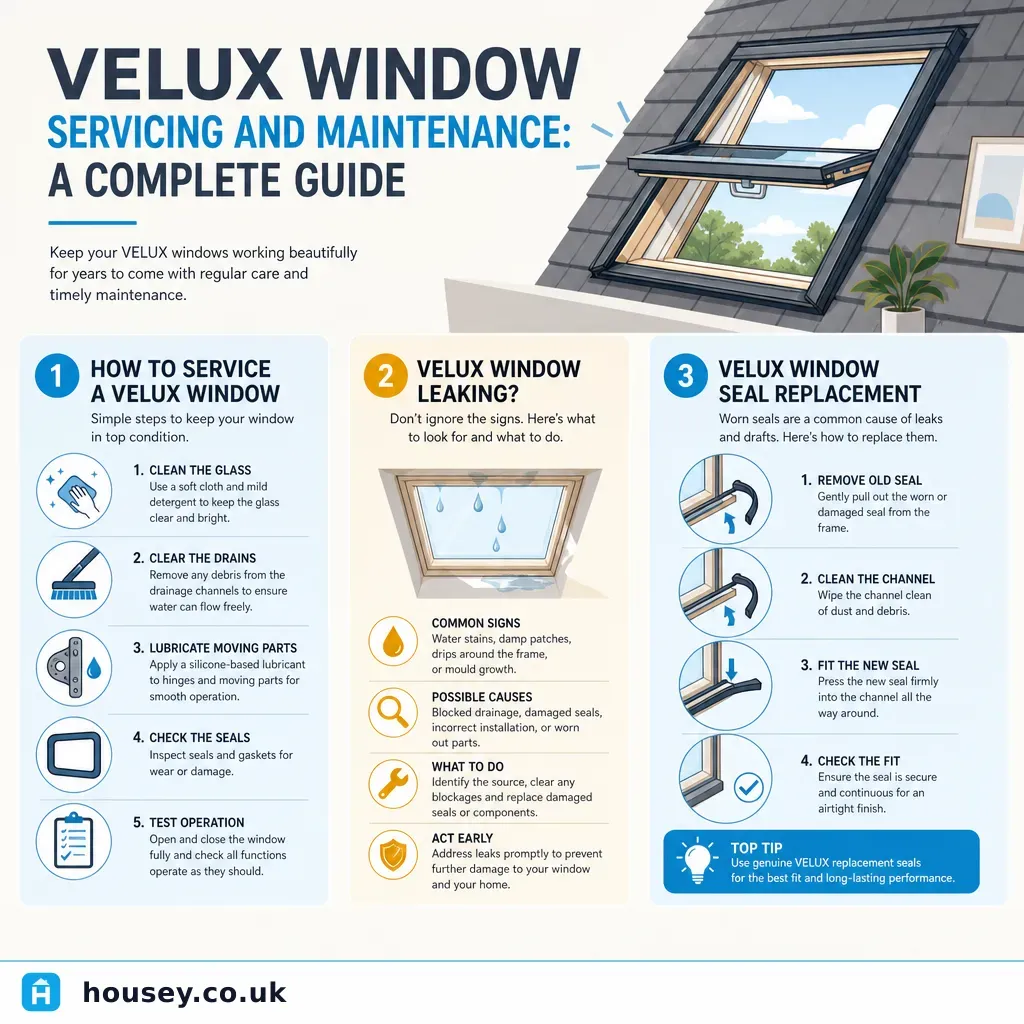
Velux Window Servicing and Maintenance: A Complete Guide
Roof windows are exposed to considerably harsher conditions than vertical glazing — rain, UV, wind, debris, and temperature extremes all take their toll on frames, seals, hardware, and flashings. Many UK homes with loft conversions go years without any formal maintenance on their roof windows, leading to leaks, stiff handles, failed seals, and premature replacement. An annual check-and-clean routine, carried out at the right time of year, significantly extends the working life of a roof window and keeps energy performance at its designed level.
Key points
- Velux recommends inspecting roof windows at least once a year; spring or autumn suits UK conditions best — after winter debris has settled or before cold weather arrives.
- The most common causes of roof window leaks are blocked drainage channels, failed flashing seals, and degraded weatherstripping — all preventable with routine maintenance.
- Replacement Velux spares — handles, hinges, weatherstrips, and glazing units — are ordered by model code, found on the production label inside the window frame.
- Replacing the glazing cassette inside an existing frame is a maintenance task; replacing the full frame involves working at height and is better left to a specialist.
- Any maintenance requiring access to the roof slope — including flashing repairs — should not be attempted without proper safe-working-at-height equipment and experience.
Why roof windows need regular servicing
A Velux roof window — or any pitched-roof window from manufacturers such as Fakro, Roto, or Keylite — sits within a flashed kerb in the roof structure. The flashing system, usually an insulated upstand kit, directs rainwater away from the frame. Over time:
- Drainage channels in the frame accumulate debris (moss, grit, leaf fragments), causing water to pond and eventually seep past the flashing.
- Weatherstripping (the foam or rubber seal around the opening sash) degrades, allowing draught and water ingress.
- Hinges, stays, and locking mechanisms collect dirt and corrosion, making the window harder to open and close smoothly.
- The glazing unit can develop a failed seal, producing permanent condensation between the panes — this indicates that the inert gas fill has been lost.
These problems are progressive; a window that is stiff or slightly draughty in year two may be letting in water or failing to lock securely by year four.
Annual maintenance checklist
Carry out the following checks once a year. Spring is often preferred in the UK — winter debris has accumulated but the weather allows comfortable working conditions.
External checks (opening the sash outward from inside the room):
Internal checks (window closed):
Hardware:
Common problems and what they usually mean
Problem | Most likely cause | Recommended action |
|---|---|---|
Water ingress around the frame | Blocked drainage channel or failed flashing sealant | Clear drainage; if flashing sealant is cracked, reseal or arrange a roofer's inspection |
Condensation between the glass panes | Failed glazing unit seal | Order replacement glazing unit by model code from the production label |
Stiff or heavy handle | Dirty or corroded pivot mechanism, or worn friction hold | Clean and lubricate; replace friction hold if still stiff |
Draught around the closed sash | Degraded weatherstrip or gasket | Replace weatherstrip — available from Velux spare parts |
Window will not stay open | Worn or broken stay arm | Replace stay arm; match to window model code |
Mould at internal reveal | Cold bridging or recurring water ingress | Check flashing; also check insulation around the frame upstand |
Discolouration of the frame | UV degradation or algae growth | Clean with appropriate product; timber frames may need re-oiling or repainting |
Which parts can a homeowner replace?
Most internal components can be replaced by a competent homeowner with the correct Velux part number and basic tools:
- Weatherstripping and gaskets
- Lock and handle assemblies
- Hinge pivot bars
- Stay arms
- Glazing units (the double-glazed cassette follows a slide-and-clip replacement procedure on most Velux models)
Work better delegated to a specialist:
- Flashing repairs or replacement — requires safe roof access and specific knowledge of the flashing system installed.
- Full frame replacement — involves cutting roofing materials, working at height, and usually a scaffolding platform.
- Electrical components in solar-powered or electrically operated models — motor or sensor failures are best directed to Velux's service network or a competent electrician.
Seasonal maintenance summary
Season | Priority tasks |
|---|---|
Spring | Full annual check; clear winter debris from drainage channels; inspect flashing after frost and wind season |
Summer | Check ventilation function; clean glass; inspect frame for UV degradation |
Autumn | Clear leaf debris; test opening mechanism before winter; check weatherstrip condition |
Winter | Visual check for ice damming around flashing; do not force a frozen mechanism |
What to ask before hiring a roof window specialist
If you prefer a contractor for the annual service or for specific repairs, ask:
- Do you have specific experience with Velux (or the relevant manufacturer's) roof windows?
- Do you carry appropriate public liability insurance and are you equipped to work safely at roof level?
- Can you provide a written quotation separating labour, parts, and VAT?
- Will you use genuine manufacturer spare parts or alternatives, and what warranty applies to the work?
- Will you inspect the flashing system as part of the service and confirm its condition in writing?
When to get professional help
Routine cleaning and lubrication are well within the ability of most homeowners. Get a specialist if:
- Draughts or water marks persist after replacing the weatherstrip, suggesting a flashing or frame-level problem.
- The window is in a position requiring leaning out from the opening or working on the roof slope — do not work at height above 2 m without proper equipment and experience.
- An electrically operated window has stopped responding — do not attempt to open the motor housing yourself.
- The flashing collar appears lifted, tiles are displaced around the kerb, or persistent water marks appear at the internal reveal.
How Housey can help
For anything beyond routine cleaning and lubrication, Housey can help you find and compare quotes from experienced window and door installers who work with roof windows. Getting two or three written quotes gives you both a fair price and a clear specification of what the work covers.
Frequently asked questions
How often should Velux windows be serviced?
Velux recommends checking and cleaning roof windows at least once a year. Properties surrounded by trees, or in exposed locations, may benefit from checks in both spring and autumn to keep drainage channels clear of leaves and debris. A missed annual service often leads to blocked channels and, eventually, water ingress.
How do I find my Velux window model code?
Open the window fully and look on the inside of the frame — usually the top rail or side stile — for a production label. This gives the model code, size code, and production date. The model code is essential for ordering the correct spares, as incorrect parts will not fit or seal properly.
Can a Velux glazing unit be replaced without replacing the whole window?
Yes, for most Velux models the double-glazed unit is a replaceable cassette. The replacement is ordered by model code and slides in once the old unit is removed. This is a task most competent DIYers or a window fitter can carry out without disturbing the flashing or roof structure.
Does replacing a Velux window require planning permission?
A like-for-like replacement of an existing roof window does not normally require planning permission. However, properties in a conservation area or listed buildings may have restricted permitted development rights — check with your local planning authority before proceeding with any changes to size or specification.
Sources and further reading
- Service and maintenance guidance — Velux UK
- Building Regulations Approved Document L: Conservation of Fuel and Power — GOV.UK
- Working at height: a brief guide — Health and Safety Executive
- Planning permission: roof windows and skylights — GOV.UK
Useful next reads
 Improvement & Build
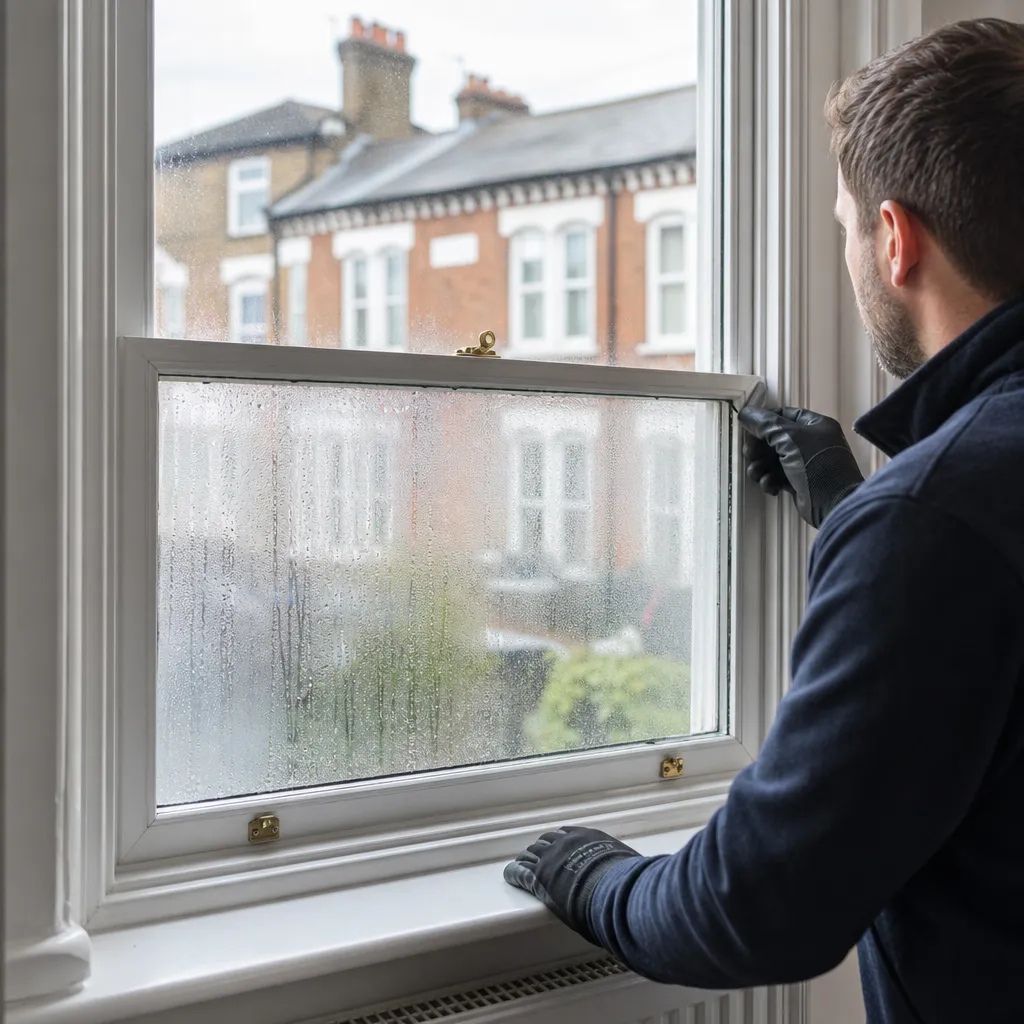
Repairing Failed Window Seals and Condensation Issues
Condensation between double-glazed panes means the hermetic seal on the insulated glass unit has failed.
 Improvement & Build
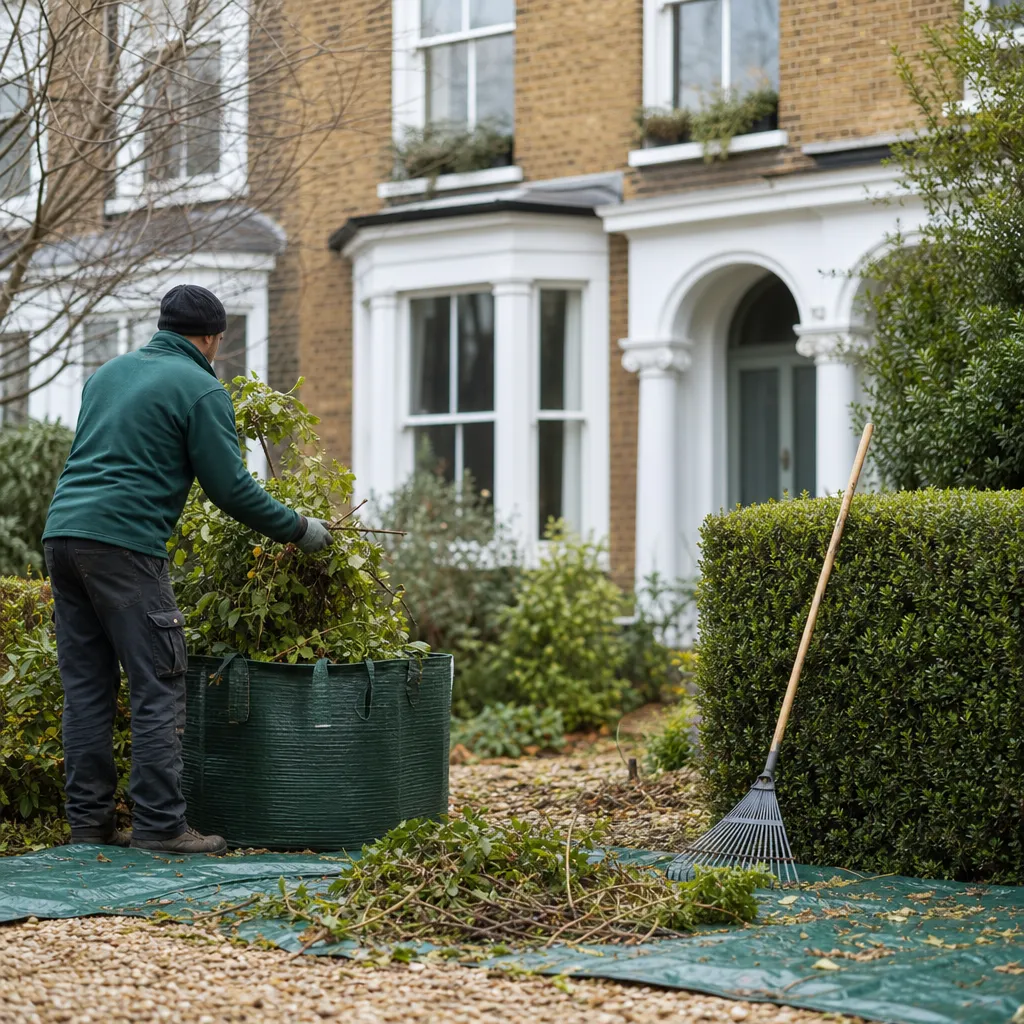
When to Call In Professional Garden Maintenance for Seasonal Cleanup
Professional garden maintenance is worth considering when seasonal work exceeds DIY capacity — typically autumn leaf removal, lawn scarification, hedge trimming at height, or post-winter clearance on large plots.
 Improvement & Build
Roof Window Maintenance and Servicing Costs
Roof window servicing in the UK typically costs £80–£200 per window for a professional visit covering seals, flashings, and the opening mechanism.
 Improvement & Build
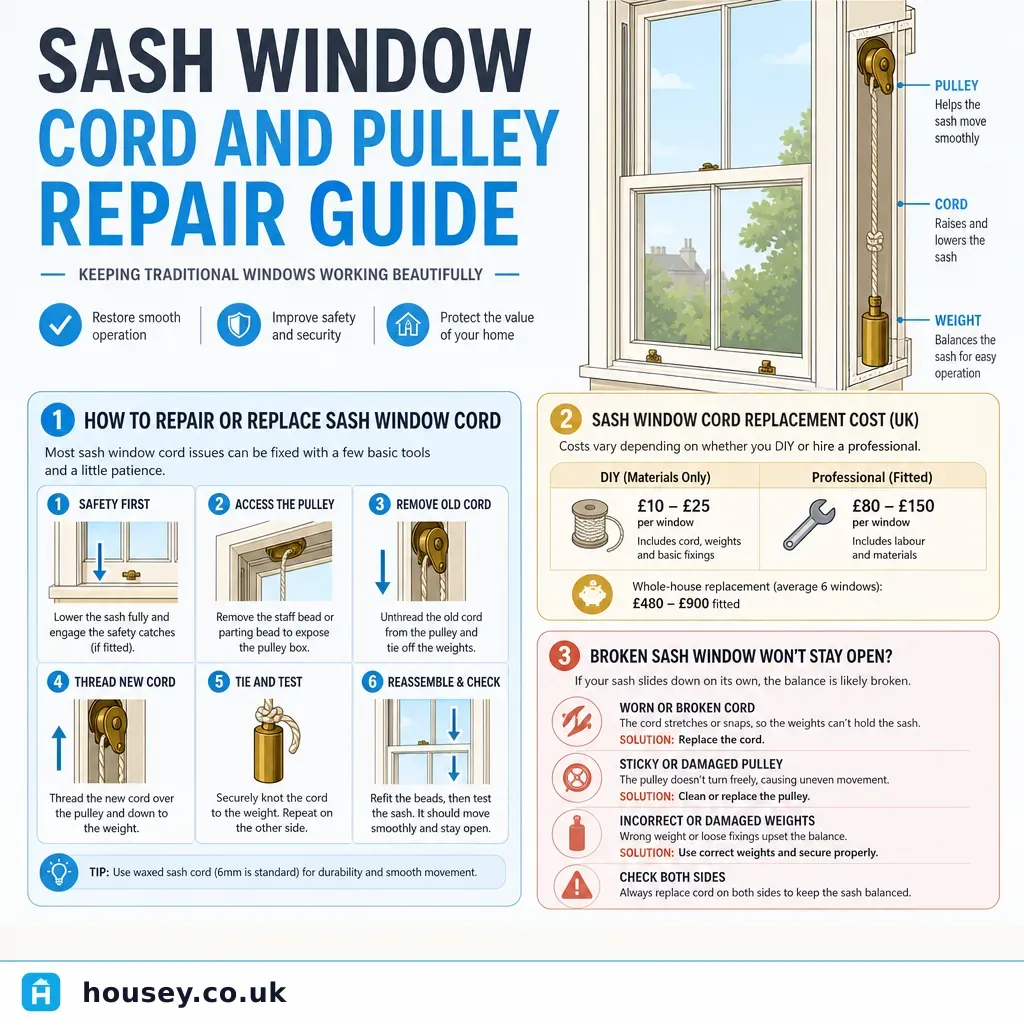
Sash Window Cord and Pulley Repair Guide
Repairing a broken sash window cord involves removing the staff bead, lifting out the lower sash, threading new wax-coated cord through the pulley, and tying it securely to the sash weight.
 Improvement & Build
Maintaining window tracks: cleaning and care tips
Window tracks should be cleaned at least once a year using a soft brush, warm soapy water, and a silicone-based lubricant — not WD-40, which degrades rubber seals.