Cost-Effective Relocation: Strategies for Saving Money When Moving House
By Housey · Last reviewed 30th of May 2026
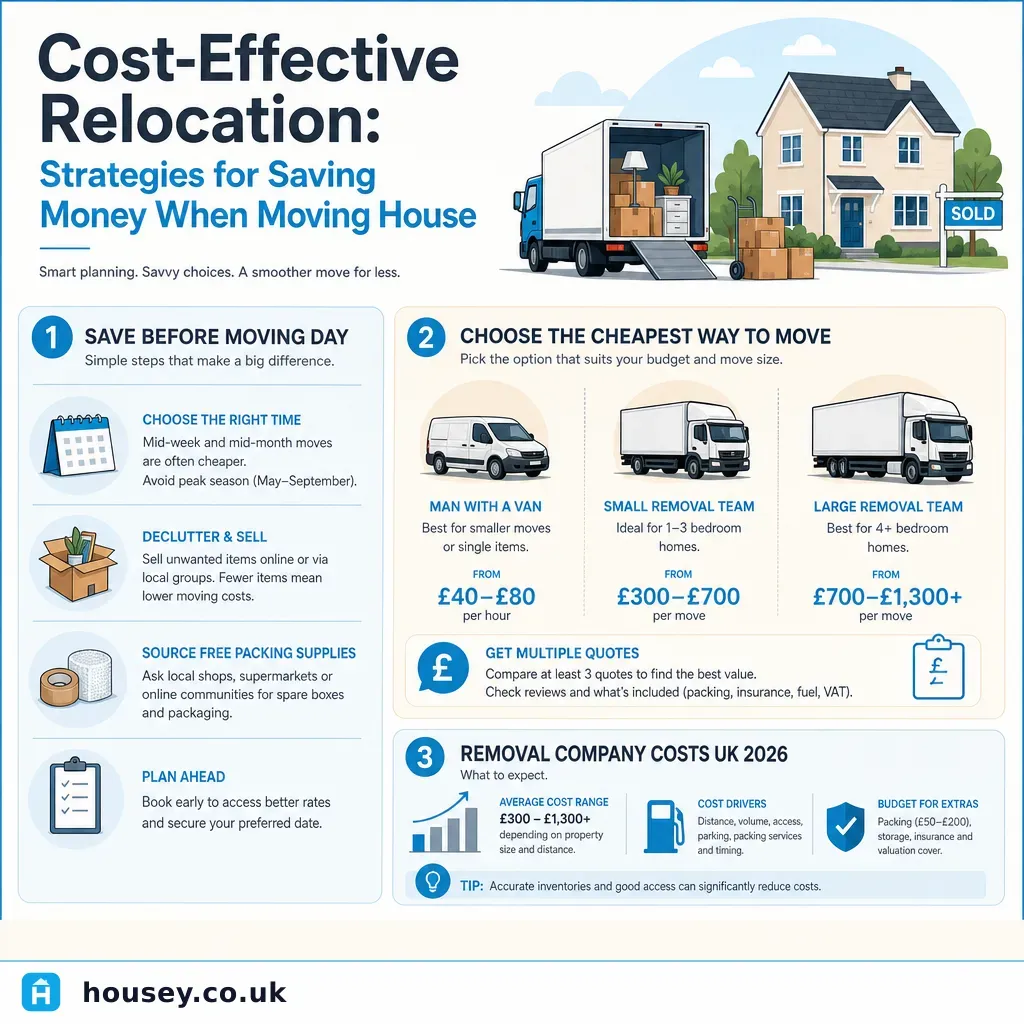
Cost-Effective Relocation: Strategies for Saving Money When Moving House
Moving house is one of the most expensive events in a homeowner's life, and costs can escalate quickly when not planned carefully. Stamp duty, solicitor fees, removal companies, and storage all add up — yet many of these costs are negotiable or avoidable with the right approach. Whether you are upsizing from a 1930s semi or downsizing from a larger family home, a methodical budget reduces surprises and gives you more control over one of the biggest financial transitions you will make.
Key points
- Stamp Duty Land Tax (SDLT) thresholds in England returned to pre-2022 levels from April 2025: the standard residential nil-rate threshold is £125,000; first-time buyers benefit from relief on the first £425,000 (subject to a property price cap of £625,000).
- Conveyancing fees for a residential purchase typically range from £800 to £2,000 excluding disbursements (searches, Land Registry fees, SDLT); obtaining at least three quotes from SRA-regulated solicitors or CLC-licensed conveyancers is standard practice and can save hundreds of pounds.
- Removal companies in England and Wales charge an average of £800–£1,500 for a 3-bedroom local move and £1,200–£2,500+ for long-distance moves; prices on Fridays and at month-end are typically 10–20% higher due to demand. (Indicative UK costs, last reviewed 2026-05-30.)
- Decluttering before obtaining removal quotes directly reduces the volume you pay to move; selling unwanted items can partially offset moving costs.
- Mid-week, mid-month completions are consistently cheaper for removal services than Friday or end-of-month completions.
Understanding the full cost of moving
Many movers underestimate total outlay by focusing only on the removal van. A realistic budget should account for every cost category before you commit.
Cost category | Typical range (England, 2026) | Notes |
|---|---|---|
Estate agent fee (when selling) | 1–3% of sale price + VAT | Negotiable; fixed-fee agents from ~£1,000 |
Conveyancing (purchase) | £800–£2,000 + disbursements | Disbursements include searches and Land Registry fees |
Conveyancing (sale) | £600–£1,500 | Varies by complexity |
Stamp Duty Land Tax | Variable (0–12%) | Use the GOV.UK SDLT calculator for your situation |
Removal company | £800–£2,500 | Depends on distance, volume, and access |
Storage (if needed) | £30–£150/month per unit | Self-storage vs managed storage |
Mortgage arrangement fee | £0–£2,000 | Often added to mortgage balance |
Survey | £400–£1,500+ | RICS Level 2 or Level 3 depending on property |
EPC (if required) | £60–£120 | Required before marketing a property |
Indicative UK costs, last reviewed 2026-05-30. Obtain quotes for your specific move.
DIY van versus removal company
The instinct to hire a van and move yourself can save money — but not always. The right choice depends on your volume, distance, physical capacity, and what happens if things go wrong.
Option | Best for | Not ideal for | Main risk |
|---|---|---|---|
DIY van hire | Small moves, short distances, flexible timeline | Large families, long distance, pianos or antiques | Injury, damage, underestimating van size |
Man-and-van service | 1–2 bedroom homes, local moves | Full household moves with furniture assembly | Variable insurance cover |
Full removal company | 3+ bedrooms, fragile items, long distance | Tight budgets where volume is genuinely small | Cost if not comparing quotes |
Part-load or shared load | Longer-distance moves with lighter loads | Strict completion-day timing requirements | Delivery window may span 24–72 hours |
When choosing a removal company, check for membership of the British Association of Removers (BAR) or the National Guild of Removers and Storers (NGRS), both of which provide consumer dispute resolution schemes.
Strategies for reducing removal costs
Move mid-week and mid-month. Friday is the most popular completion day, meaning removal companies charge a premium and have reduced availability. Tuesday to Thursday completions are typically cheaper and offer more flexibility if completion is delayed.
Declutter before obtaining quotes. Removal firms quote on volume. Reducing your load by 10–20% through decluttering and selling items via Facebook Marketplace, Gumtree, or eBay directly lowers the quoted price — and can generate income to offset moving costs.
Pack your own boxes. Full packing services add £200–£600 or more to removal costs. Starting to pack non-essential items 4–6 weeks before your completion date lets you handle most of this yourself.
Source free packing materials. Supermarkets, off-licences, and local community groups frequently have free cardboard boxes. Towels, duvets, and clothing make excellent padding for fragile items and cost nothing extra.
Compare at least three quotes. Prices for identical moves can vary by 30–50% between firms. Request itemised quotes and check what is included — packing, furniture dismantling, insurance, and access equipment all vary between providers.
Ask about part-load options. For long-distance moves with a modest amount of furniture, a part-load or groupage service shares the lorry with other consignments and costs significantly less than a dedicated vehicle.
Reducing conveyancing and legal costs
Conveyancing is one of the largest variable costs in a move, and shopping around is straightforward.
- Compare quotes from SRA-regulated solicitors and CLC-licensed conveyancers. Licensed conveyancers often offer competitive rates for straightforward transactions.
- Check what is included. Quotes should separately itemise professional fees, VAT, and disbursements (local authority searches, Land Registry fees, drainage and environmental searches).
- Consider online conveyancers for standard transactions. For straightforward freehold purchases, online conveyancers can be significantly cheaper. Leasehold properties, shared ownership, new builds, and complex titles may warrant a more experienced local solicitor.
- Use the same firm for sale and purchase where appropriate. This can reduce total cost and improve chain communication.
Quote comparison checklist
Before accepting any quote for removals or conveyancing, ask:
- What is included in the price, and what is treated as an extra?
- Who will carry out the work, and what accreditation or regulatory body applies?
- Is VAT included in the quoted figure?
- What happens if completion is delayed to a different day — is there a rescheduling fee?
- What insurance covers goods in transit, and what is the claims process if something is damaged?
- Are there assumptions in the quote (parking restrictions, lift access, number of floors, estimated box count) that could change the final price?
- What is the payment schedule and the cancellation policy?
When to get professional help
Moving costs rarely require specialist intervention, but consider seeking advice if:
- Your conveyancing involves leasehold, shared ownership, or an unusual title — where selecting the cheapest provider may mean lacking the expertise the transaction requires
- You are moving high-value items such as antiques, fine art, or a piano, and need to confirm specialist transit insurance is in place
- Your chain has collapsed more than once and you are accumulating repeated survey and legal costs — an independent property professional may help identify a more cost-efficient path
How Housey can help
Housey makes it straightforward to compare costs before you commit. You can find and compare house removal companies matched to your move size and location, get quotes from SRA-regulated conveyancers, or arrange house clearance to reduce your volume before the van arrives — all through one platform.
Frequently asked questions
What is the average total cost of moving house in England?
Total moving costs vary widely depending on property price, distance, and services used. For a typical owner-occupier purchasing at £350,000 (not a first-time buyer), total costs including SDLT, conveyancing, survey, and removals might range from £12,000 to £25,000. Model your specific scenario using the GOV.UK SDLT calculator and obtain itemised quotes for each cost category.
Is it cheaper to move on a weekday?
Yes, generally. Friday is by far the most popular completion day — removal firms often charge 10–20% more for Friday moves and have reduced availability. Mid-week completions (Tuesday to Thursday) are typically cheaper and offer more flexibility if completion is delayed at the last minute.
Should I use a cheap online conveyancer?
For a straightforward freehold purchase or sale, an SRA-regulated or CLC-licensed online conveyancer can offer good value. Leasehold transactions, short-lease flats, new builds, or properties with complex titles benefit from a conveyancer with specific relevant experience, even at a higher cost. Always check regulatory status and read recent reviews before instructing.
Sources and further reading
- Stamp Duty Land Tax calculator and guidance — GOV.UK
- British Association of Removers: find a remover — British Association of Removers
- Council for Licensed Conveyancers: find a conveyancer — Council for Licensed Conveyancers
- Solicitors Regulation Authority: check a solicitor — Solicitors Regulation Authority
- Citizens Advice: moving home — Citizens Advice
Useful next reads
 Buying & Moving
How to Plan a House Move: A Practical Guide to Residential Relocations
A UK house move goes more smoothly with planning that starts 6–8 weeks before moving day.
 Buying & Moving
Managing Property Relocation in Major Urban Centres
Urban house moves require planning beyond a standard removal, particularly around vehicle emission zone compliance, parking bay suspensions, and lift access in purpose-built flats.
 Buying & Moving
What House Removers Do: Services, Process, and Costs
House removers load, transport, and unload your belongings between properties.
 Buying & Moving
Understanding the Costs Involved in Your Property Transaction
Buying a property in the UK typically costs 2–5% above the headline price once stamp duty, conveyancing fees, survey costs, mortgage arrangement fees, and removal costs are added.
 Buying & Moving
Planning your house move before the festive season: timing and logistics
Moving before Christmas requires careful planning.