Window Components Explained: Understanding Frame, Sash, and Glazing
By Housey · Last reviewed 11th of May 2026
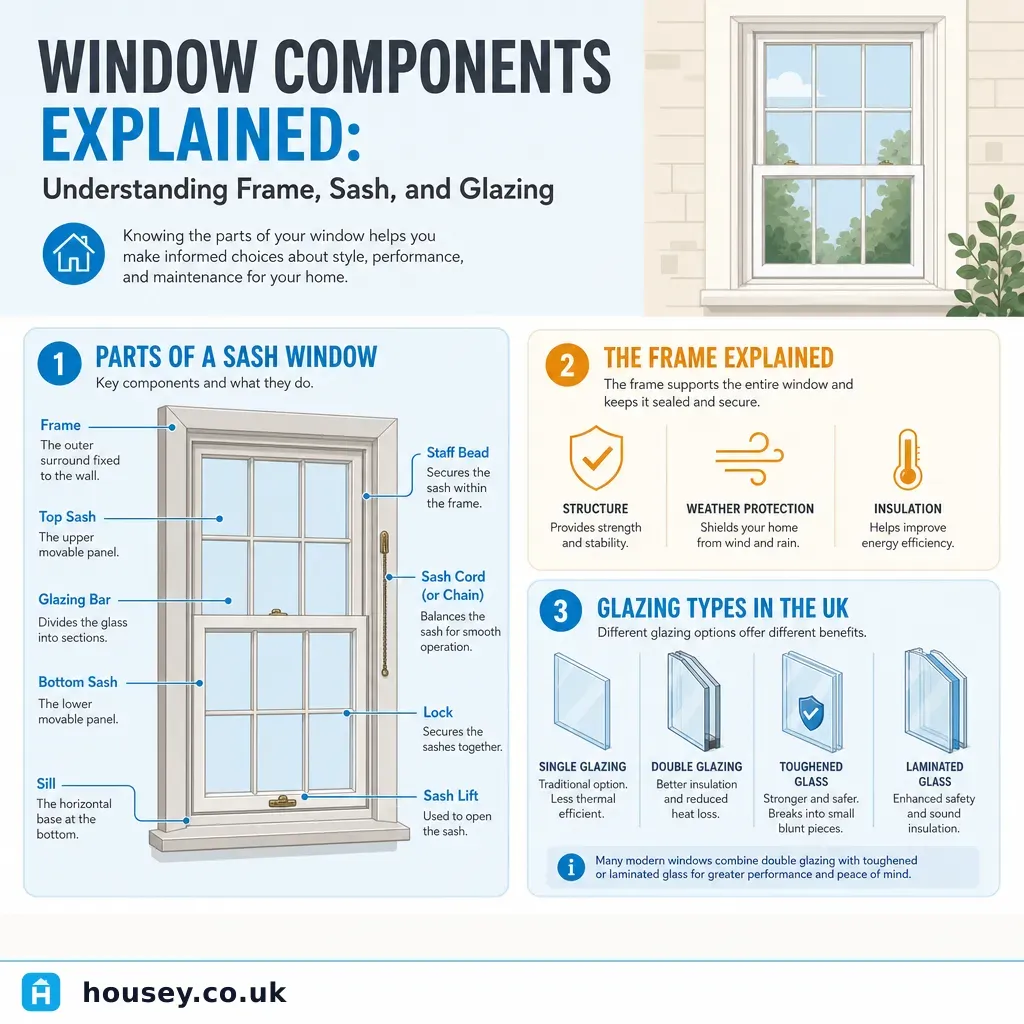
Window Components Explained: Understanding Frame, Sash, and Glazing
Understanding window anatomy helps UK homeowners make informed decisions when replacing windows, identifying failing components, or discussing specification with installers. Whether you are dealing with rattling sash windows in a Victorian terrace, misting double glazing in a 1990s estate house, or planning new windows for a loft conversion, knowing the correct terminology gives you a clearer conversation with your contractor and a better grasp of what you are paying for.
Key points
- Building Regulations Approved Document L (conservation of fuel and power) requires replacement windows in existing dwellings to achieve a whole-window U-value of 1.6 W/m²K or better; windows in new dwellings must meet a centre-pane U-value of 1.2 W/m²K as a minimum.
- FENSA (Fenestration Self-Assessment Scheme) registered installers can self-certify that replacement windows comply with Building Regulations, removing the need for a separate building control application — always ask for a FENSA certificate on completion.
- A sash is not the same as a sash frame: the sash is the opening panel that moves; the frame is the fixed outer structure installed in the wall opening.
- Double-glazed sealed units typically last 15–25 years before the hermetic seal fails and condensation appears between the panes; the unit can usually be replaced independently of the frame if the frame itself is in good condition.
- Secondary glazing does not require Building Regulations approval and is commonly used in listed buildings and conservation areas where like-for-like replacement conditions apply.
The main components of a window
Understanding each part helps you describe problems accurately and assess quotes from installers.
Frame
The frame is the fixed outer structure installed into the wall opening. It provides structural support and weatherproofing for the whole window assembly. Frames are typically made from uPVC, timber, aluminium, or aluminium-clad timber. In UK domestic construction, uPVC dominates post-1980s homes, while timber is common in pre-war and period properties.
Sash and casement
The sash is the moveable panel within the frame. In a traditional sash window, the sash slides vertically — a double-hung sash has two independently moveable sashes; a single-hung has one. In a casement window, the opening panel is hinged at the side and swings outward. The term casement is often used loosely to refer to any hinged opening light.
Glazing and sealed unit
The glazing is the glass itself. In modern windows this is almost always a sealed unit — also called an insulating glass unit (IGU) — comprising two or more panes of glass separated by a spacer bar and hermetically sealed at the edges. The cavity between panes is typically argon-filled to improve thermal performance. Triple glazing uses three panes and is increasingly common in higher-specification UK homes and deep-retrofit projects.
Glazing bead
The glazing bead is the strip of material, usually matching the frame, that holds the sealed unit in place within the sash or frame. It can be internal (most modern windows) or external (older installations). Internal beads are more secure because they cannot be removed from outside.
Sill and cill
The window sill — externally sometimes spelled cill — is the horizontal surface at the base of the window. The external sill should slope to shed rainwater away from the wall face. A cracked or poorly maintained external sill can allow water ingress and lead to dampness in the wall below.
Head, jambs, transom, and mullion
- Head: the top horizontal member of the frame
- Jambs: the vertical side members of the frame
- Transom: a horizontal bar dividing the window into upper and lower sections
- Mullion: a vertical bar dividing the window into side-by-side sections
Hardware
Window hardware (or furniture) includes handles, espagnolette bolts (the multi-point locking mechanism in many modern windows), friction hinges on casements, and sash weights or spiral balances in traditional sash windows. Worn or seized friction hinges are a common cause of windows that will not stay open.
Frame material comparison
Material | Typical lifespan | Maintenance | Thermal performance | Common UK use |
|---|---|---|---|---|
uPVC | 20–35 years | Low | Good with argon-filled IGU | Post-1980s new-builds and replacements |
Softwood timber | 30–60+ years (with maintenance) | High — painting or staining | Moderate–good with double glazing | Victorian, Edwardian, and period homes |
Hardwood timber | 50–80+ years (with maintenance) | Moderate–high | Moderate–good | High-end or heritage properties |
Aluminium | 30–45 years | Low | Moderate (requires thermal break) | Contemporary or commercial-style homes |
Aluminium-clad timber | 40–60+ years | Low externally | Good | Contemporary builds and premium replacements |
Indicative UK lifespan ranges, last reviewed 2026-05-11. Actual lifespan depends on installation quality, exposure, and maintenance.
Which window type or replacement option should you choose?
- Choose double-hung sash replacement if you have a Victorian or Edwardian property and want to retain its character; check whether the property is listed or in a conservation area before ordering.
- Choose casement replacement if the existing windows are casements, thermal performance is the priority, and there are no heritage restrictions.
- Choose secondary glazing if the property is listed or in a conservation area with restrictive conditions, or if the existing frame is structurally sound but poorly insulated.
- Choose triple glazing if building new or undertaking a deep retrofit, and targeting low-energy performance such as Passivhaus-aligned U-values of 0.8 W/m²K or better.
- Ask a FENSA-registered installer about the glazing specification required for your planning context before placing any order.
Window installation checklist for homeowners
Before work begins:
After work is completed:
What to ask a window installer before accepting a quote
- What centre-pane and whole-window U-values will the sealed units achieve?
- Are the frames manufactured to PAS 24:2022 (enhanced security performance requirements)?
- What is the cavity width and gas fill of the sealed unit?
- What guarantee is provided — frame, sealed unit, and hardware separately?
- Who carries out the installation — employees or subcontractors?
- Is VAT included in the quote, and what are the FENSA notification fees?
- What happens if the lintel or surrounding masonry is found to be defective on opening up?
When to get professional help
Misting between panes, draughts despite closed windows, and difficulty operating handles or hinges are usually component-level issues that a window installer can assess without a full building survey. However, if cracks appear in the masonry above a window opening, if a window has dropped in its frame, or if water ingress is causing damp patches in adjacent walls, ask a surveyor or builder to assess the lintel and surrounding structure before simply ordering a replacement window.
How Housey can help
Housey connects homeowners with qualified window and door installers who can assess, specify, and install replacement windows — including FENSA-compliant certification and guidance on heritage or conservation area constraints. Submit a request to compare quotes from up to four vetted local installers.
Frequently asked questions
Do I need planning permission to replace windows in the UK?
In most cases, replacing windows on a house is permitted development and does not require planning permission, provided the replacement is similar in appearance. However, if your property is listed or in a designated conservation area, restrictions may apply and you may need listed building consent or conservation area consent. Always check with your local planning authority before ordering.
What does a FENSA certificate do?
A FENSA certificate confirms that the replacement window installation has been registered with the local authority and complies with Building Regulations — principally Part L for thermal performance and Part K for safety glazing. It is a required document when selling a property. Without it, you may need to commission a retrospective building control inspection, which adds cost and delay.
Can I replace just the sealed unit rather than the whole window?
Yes, in many cases. If the frame is structurally sound and the glazing bead is undamaged, a sealed unit can be replaced independently. This is usually significantly cheaper than full window replacement. A window installer or glazier can measure the unit and supply a replacement, though access depends on whether the glazing bead is internal or external.
How long do double-glazed sealed units last?
Most double-glazed sealed units last between 15 and 25 years before the hermetic seal fails, allowing moisture into the cavity and causing the characteristic misting or condensation between panes. Quality of manufacture, installation, and weather exposure all affect lifespan. Units in exposed, south-facing elevations typically fail earlier than those in more sheltered positions.
Sources and further reading
- Approved Document L: Conservation of fuel and power — GOV.UK
- FENSA: homeowner guidance on replacement windows — FENSA
- Windows: guidance for repair and replacement in historic buildings — Historic England
- Double glazing — Energy Saving Trust
- Planning permission: windows and doors — Planning Portal
Useful next reads
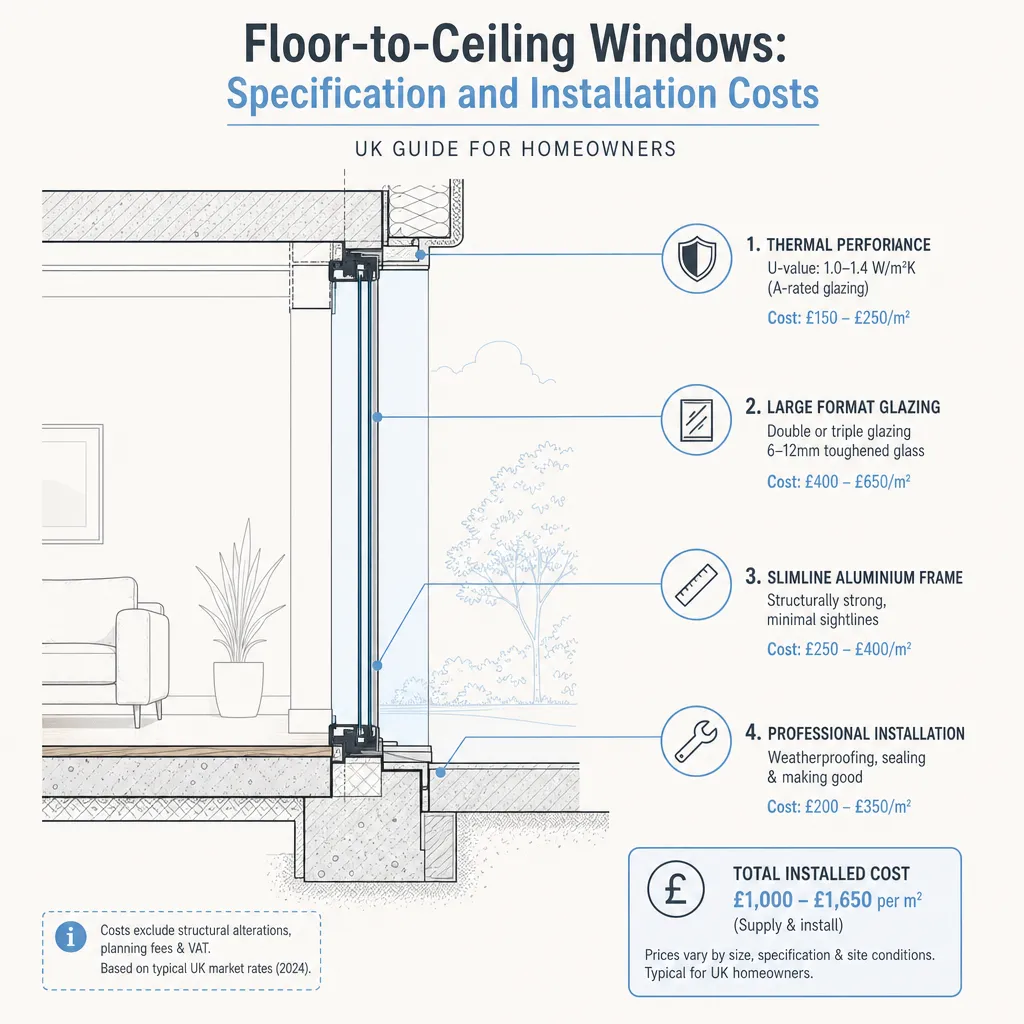 Improvement & Build
Floor-to-Ceiling Windows: Specification and Installation Costs
Floor-to-ceiling windows in the UK typically cost £1,800–£6,500 per unit installed, depending on glazing type, frame material, and whether structural alterations are needed.
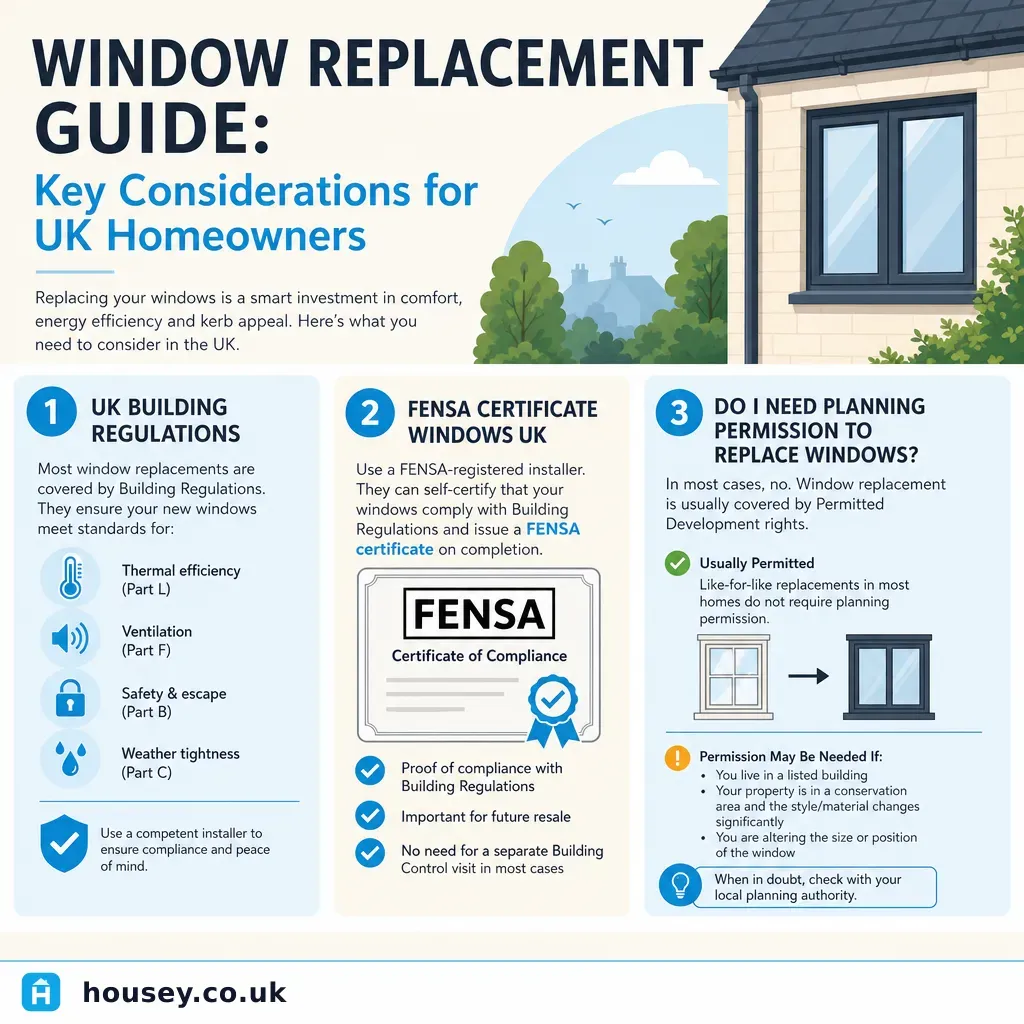 Improvement & Build
Window Replacement Guide: Key Considerations for UK Homeowners
Replacing windows in England and Wales requires compliance with Building Regulations Part L, with a minimum whole-window U-value of 1.
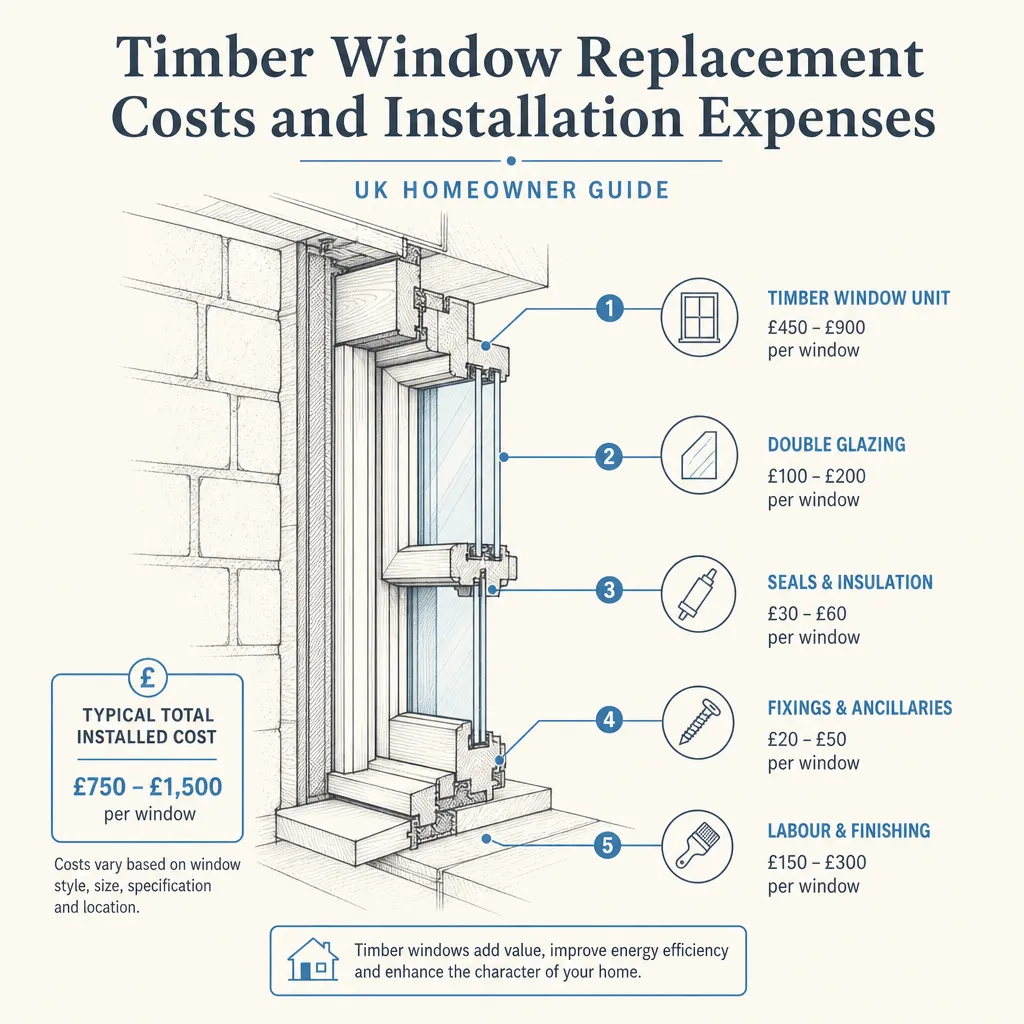 Improvement & Build
Timber Window Replacement Costs and Installation Expenses
Replacing timber windows in the UK typically costs £400 to £900 per casement window and £700 to £1,800 per sash window, including supply and installation.
 Improvement & Build
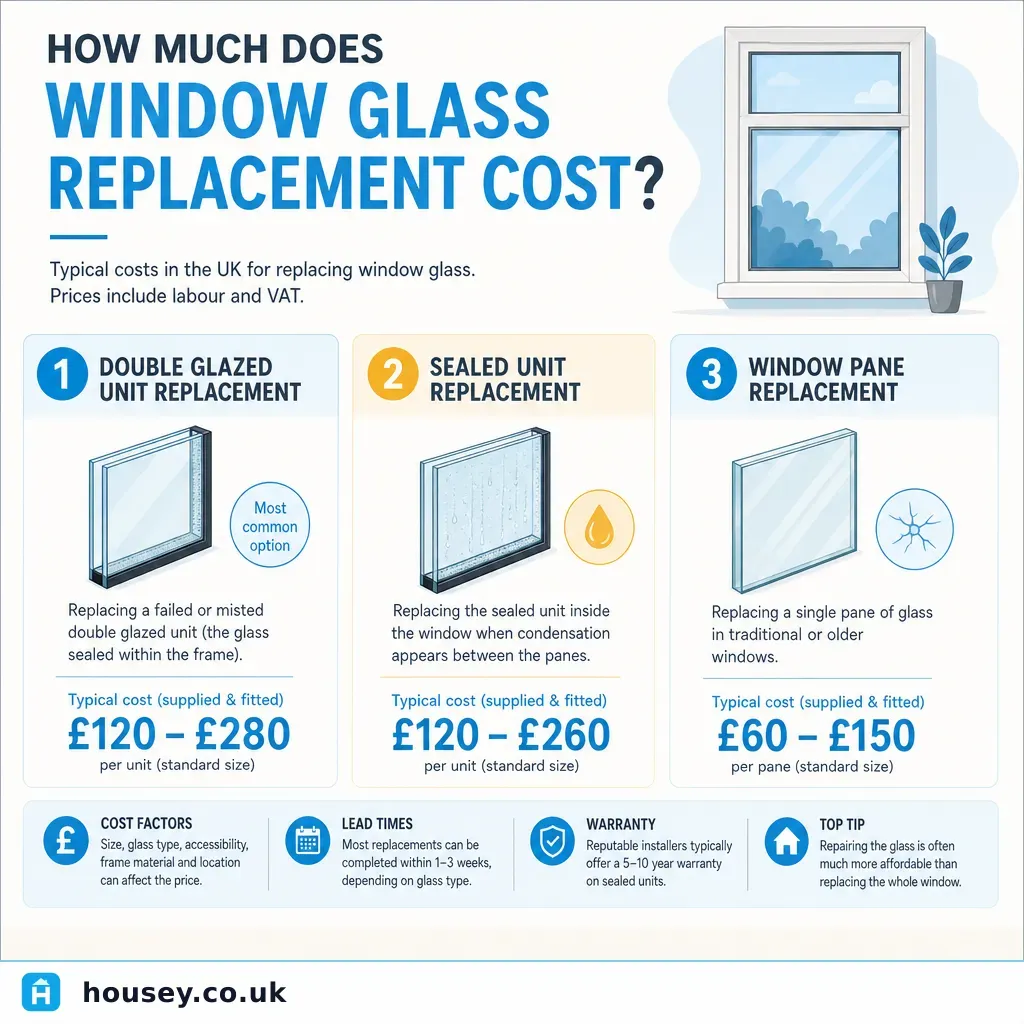
How much does window glass replacement cost
Replacing a standard double-glazed sealed unit typically costs £80–£300 in the UK, depending on glass size, type, and access.
 Improvement & Build
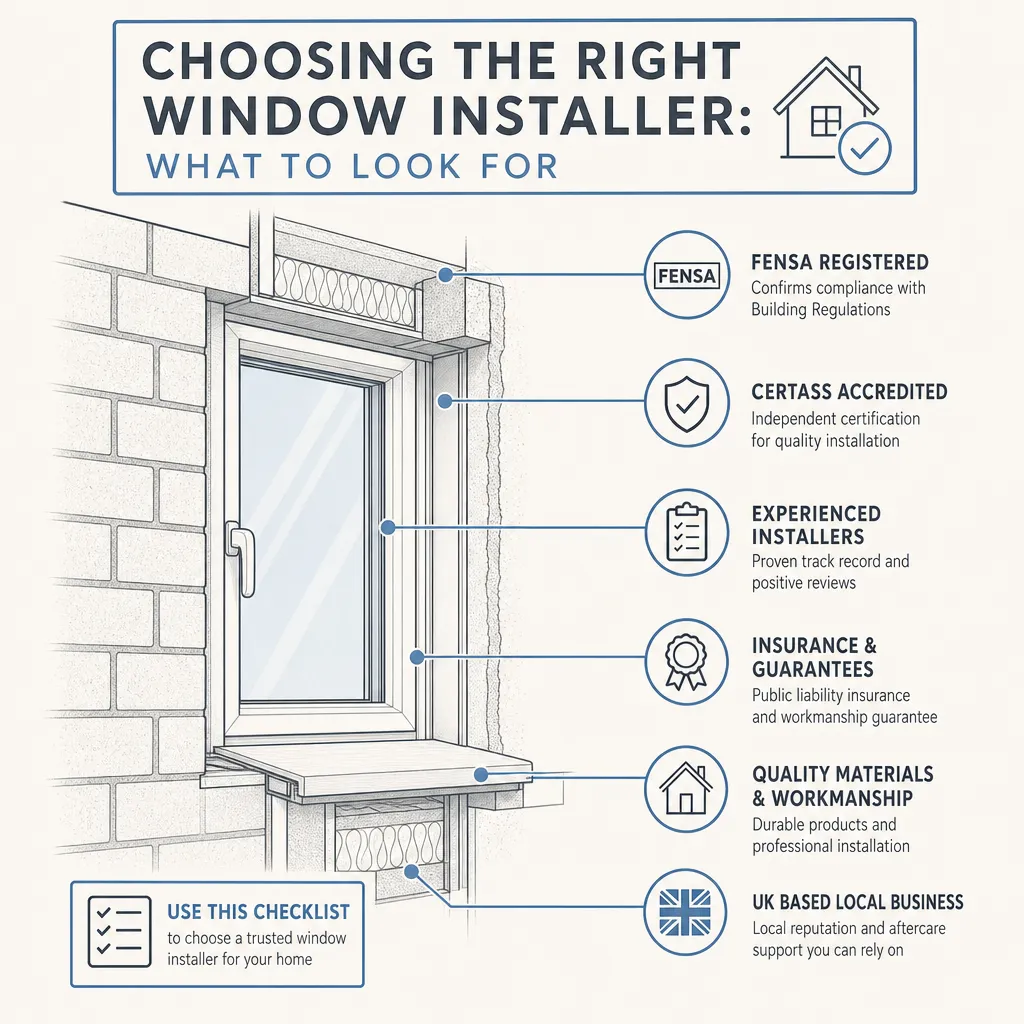
Choosing the Right Window Installer: What to Look For
When choosing a window installer in the UK, verify FENSA or CERTASS registration first — these schemes allow installers to self-certify Building Regulations compliance and issue the completion certificate you will need at resale.