Timber Window Replacement Costs and Installation Expenses
By Housey · Last reviewed 6th of May 2026
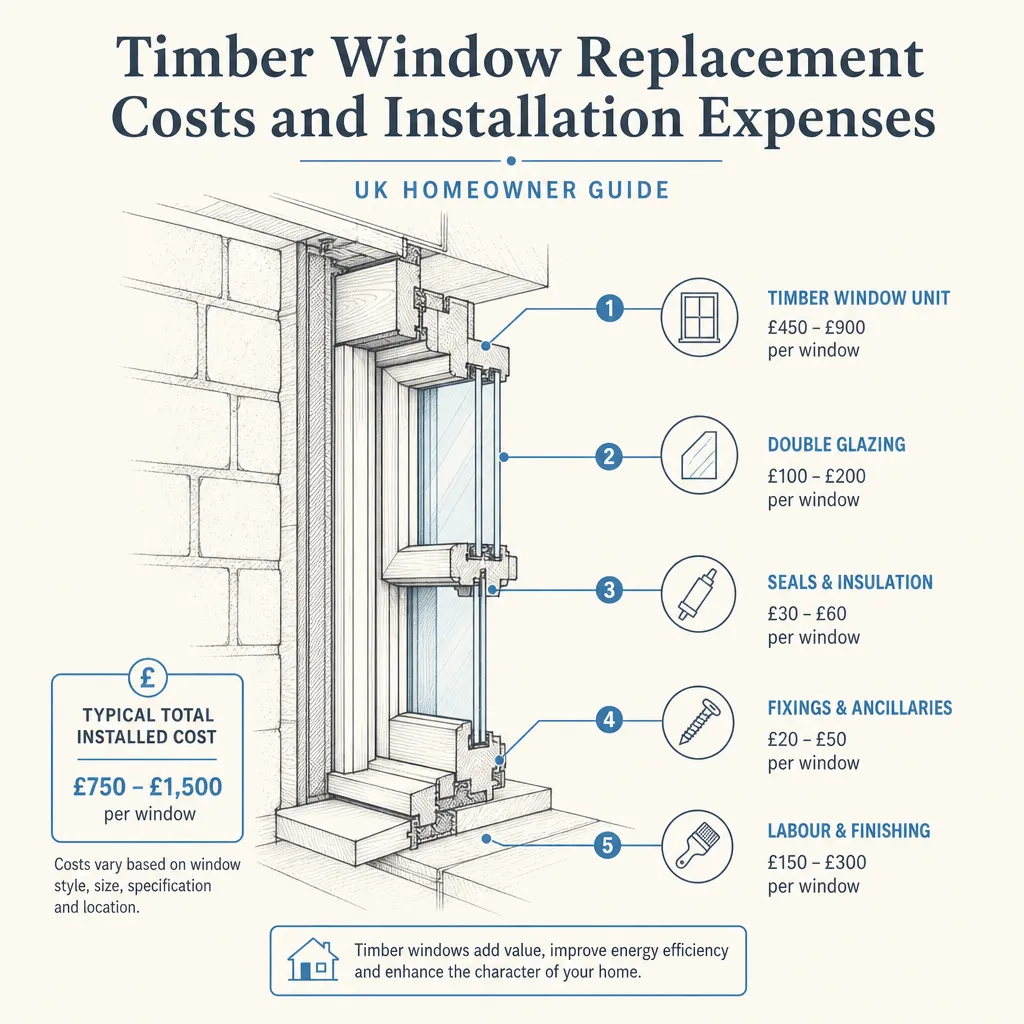
Timber Window Replacement Costs and Installation Expenses
Timber windows are a defining feature of millions of UK homes, from Victorian terraces and Edwardian semis to 1930s bay-windowed semis and contemporary self-builds. Whether original sash windows are failing, persistent draughts are increasing heating bills, or rot has made repair uneconomical, understanding realistic costs and the regulatory landscape before requesting quotes will save time and prevent surprises. For homeowners in conservation areas or listed buildings, the rules around what can be replaced — and with what material — are particularly important to clarify before any contractor is instructed.
Key points
- Replacement windows must comply with Building Regulations Part L (Approved Document L1B), which requires a minimum thermal performance of 1.6 W/m²K (U-value) for replacement windows in existing dwellings.
- Installers registered with FENSA or CERTASS can self-certify compliance with Building Regulations; using an unregistered installer requires a separate building control application and fee.
- Properties in conservation areas or those that are listed require householder planning permission or listed building consent before windows can be replaced; local planning authorities typically specify timber as the required material.
- Timber casement window replacement typically costs £400 to £900 per window including installation; timber sash windows cost £700 to £1,800+ per window depending on size and specification (indicative UK costs, last reviewed 2026-05-06).
- Draught-proofing and slim-profile double-glazed unit upgrades to existing sash frames can cost £200 to £500 per window — significantly less than full replacement — and may avoid the need for planning consent in designated areas.
What affects the cost of timber window replacement?
Several factors drive the final quote, and no two properties are identical:
Window size and style — larger windows, bay windows with angled frames, and shaped or arched heads cost more to manufacture and install than standard rectangular openings.
Glazing specification — standard double glazing (4-16-4 configuration) is the baseline. Slim-profile units for heritage settings, acoustic glass, or triple glazing all increase costs.
Timber species and finish — engineered timber (such as Accoya or finger-jointed softwood) is more dimensionally stable than solid softwood and better suited to long-term painting. Hardwood frames cost more upfront but typically have a longer service life. Factory-applied microporous paint finishes extend maintenance cycles.
Access and scaffolding — upper-floor windows usually require scaffolding or specialist access equipment, adding £400 to £1,500+ to the overall project depending on the number of lifts and duration required.
Number of windows — most installers price more competitively per unit for larger orders; replacing all windows in one project usually costs less per window than a single replacement.
Heritage or conservation requirements — purpose-made windows matched to original profiles, slim double-glazed units, and planning-related specifications all add cost compared with standard catalogue products.
Removal and disposal — stripping out old frames, making good internal and external reveals, and disposing of materials is usually included in an installation quote; confirm this explicitly before accepting.
Timber, uPVC, and aluminium: which is right for your home?
Window material | Best for | Not ideal for | Typical maintained lifespan | Heritage and planning suitability |
|---|---|---|---|---|
Timber | Conservation areas, listed buildings, period homes, homeowners wanting a natural material | Homeowners preferring minimal maintenance | 40–80+ years | Usually required or preferred by planning authorities |
uPVC | Budget-conscious replacements in modern or non-designated homes | Conservation areas, listed buildings | 20–35 years | Rarely approved in designated areas |
Aluminium (powder-coated) | Contemporary or modern extensions, large glazed areas | Traditional period properties where timber profiles are required | 40–60+ years | Case-by-case; slim sightlines can sometimes satisfy planners |
Engineered timber composite | Timber aesthetics with improved dimensional stability | Highest upfront cost of timber options | 40–60+ years | Generally acceptable in heritage settings |
Indicative costs for timber window replacement
Indicative UK costs, last reviewed 2026-05-06. Quotes vary significantly by region, installer, specification, and access requirements. Always obtain at least three written quotes.
Window type | Supply and fit cost per window | Notes |
|---|---|---|
Timber casement (small to medium) | £400 – £700 | Standard double glazing, softwood, factory painted |
Timber casement (large or bay) | £700 – £1,200+ | Bay windows often priced per light |
Timber sash (standard Victorian size) | £700 – £1,200 | Single or double hung, standard double glazing |
Timber sash (large or heritage specification) | £1,200 – £1,800+ | Slim-profile units, matched profiles, hardwood option |
Sash window draught-proofing and glazing upgrade | £200 – £500 | Retains original frames; may avoid planning consent |
Scaffolding (per lift, one to two weeks) | £400 – £1,000 | Varies by property size and access |
VAT at 20% applies to the supply and installation of new windows. Repair work to existing windows may attract a reduced VAT rate in some circumstances; confirm with your installer and, if in doubt, with HMRC.
Conservation areas and listed buildings
If your home is in a conservation area or is listed, replacing windows is subject to planning control. Permitted development rights that allow like-for-like window replacement in ordinary dwellings do not automatically apply in designated areas.
Conservation area properties: replacing windows generally requires householder planning permission. Local planning authorities typically specify that replacement windows must match the original in material (timber), profile, glazing bar configuration, and colour. Some councils publish specific supplementary planning documents on acceptable window specifications.
Listed buildings: any alteration to a listed building's windows — including like-for-like replacement — requires listed building consent from the LPA. In many cases, repair rather than replacement will be required.
Failure to obtain consent where required is a planning enforcement matter and can result in enforcement notices requiring reinstatement at the owner's cost.
Check your property's designation on the Historic England National Heritage List for England or via your local planning authority before instructing any contractor.
Worked example: replacing sash windows on an Edwardian terrace
A homeowner in a Bristol conservation area wants to replace six original single-glazed timber sash windows on a 1910 Edwardian terrace. Two windows are on the ground floor; four are on the first floor.
After speaking to the local planning authority:
- Planning permission is required because the property is in a conservation area.
- The LPA specifies replacement windows must be timber, match the existing sash profile, and use slim-profile double-glazed units to meet Part L thermal requirements.
- A short heritage statement is recommended to support the application; a planning consultant charges approximately £400 for this.
- An installer prices the six windows at £6,800 including first-floor scaffolding, purpose-made slim-profile units, and a factory-applied painted finish.
- Planning takes eight weeks to determine; installation takes two days once consent is granted.
Total project cost: approximately £7,500 including planning support, installer fees, and VAT.
Homeowner checklist before getting quotes
Use this checklist before approaching installers:
When to get professional help
Most timber window replacement is straightforward when handled by a registered installer, but seek additional advice if:
- Your property is listed or in a conservation area and you are unsure whether consent is required.
- Window openings show signs of structural movement — cracks in the surround, out-of-square openings, or lintels that appear to be deflecting — in which case a chartered surveyor or structural engineer should advise before replacement proceeds.
- There is evidence of damp penetration, rot spreading beyond the frame into the surrounding wall, or mould inside the reveals; a damp and timber specialist should assess the cause before installation begins.
- The work forms part of a broader refurbishment that requires building control oversight for other elements.
How Housey can help
Housey connects homeowners with vetted window and door installation specialists who can advise on timber window replacement, supply specifications suited to heritage or conservation requirements, and provide written quotes for comparison.
Frequently asked questions
Do replacement timber windows need Building Regulations approval?
Yes. Replacement windows must comply with Building Regulations Part L, which sets minimum thermal performance standards. If you use a FENSA or CERTASS registered installer, they self-certify compliance and issue a certificate. If the installer is not registered, you or the installer must apply to your local building control body for approval. The certificate matters for future property sales.
Can I replace timber windows with uPVC in a conservation area?
In most cases, no. Local planning authorities in conservation areas generally require replacement windows to match the original material, profile, and glazing bar configuration. uPVC is typically refused because it cannot replicate the slim sightlines and traditional appearance of original timber. Some councils publish supplementary planning documents on window replacement; check with your LPA before proceeding.
How long do timber windows last?
Properly maintained timber windows can last 40 to 80 years or more. The key factor is maintenance: repainting every five to eight years, keeping putty and beading sealed, and addressing minor rot early will significantly extend service life. Engineered or modified timber products such as Accoya offer improved stability and decay resistance compared with standard softwood.
What is the difference between sash window restoration and replacement?
Restoration involves repairing the existing timber frame — addressing rot, renewing sash cords, draught-proofing, and sometimes upgrading to slim-profile double-glazed units within the original frame. Replacement involves removing the entire frame and fitting a new window. Restoration is usually cheaper and, in conservation areas or listed buildings, often preferred or required by the local planning authority. A specialist sash window company can advise which is appropriate.
Do I need a FENSA certificate for timber window replacement?
FENSA certification is the most common self-certification route in England and Wales for replacement window installations. If your installer is FENSA registered, they notify building control on your behalf and you receive a certificate after installation. This certificate is important for home insurance and future property sales. Check whether your installer is registered at fensa.org.uk.
Sources and further reading
- Approved Document L1B: Conservation of fuel and power in existing dwellings — GOV.UK
- FENSA registered installer check — FENSA
- CERTASS registered installer check — CERTASS
- Windows in historic buildings — Historic England
- Windows and doors permitted development guidance — Planning Portal
- Draught-proofing and secondary glazing guidance — Energy Saving Trust
Useful next reads
 Improvement & Build
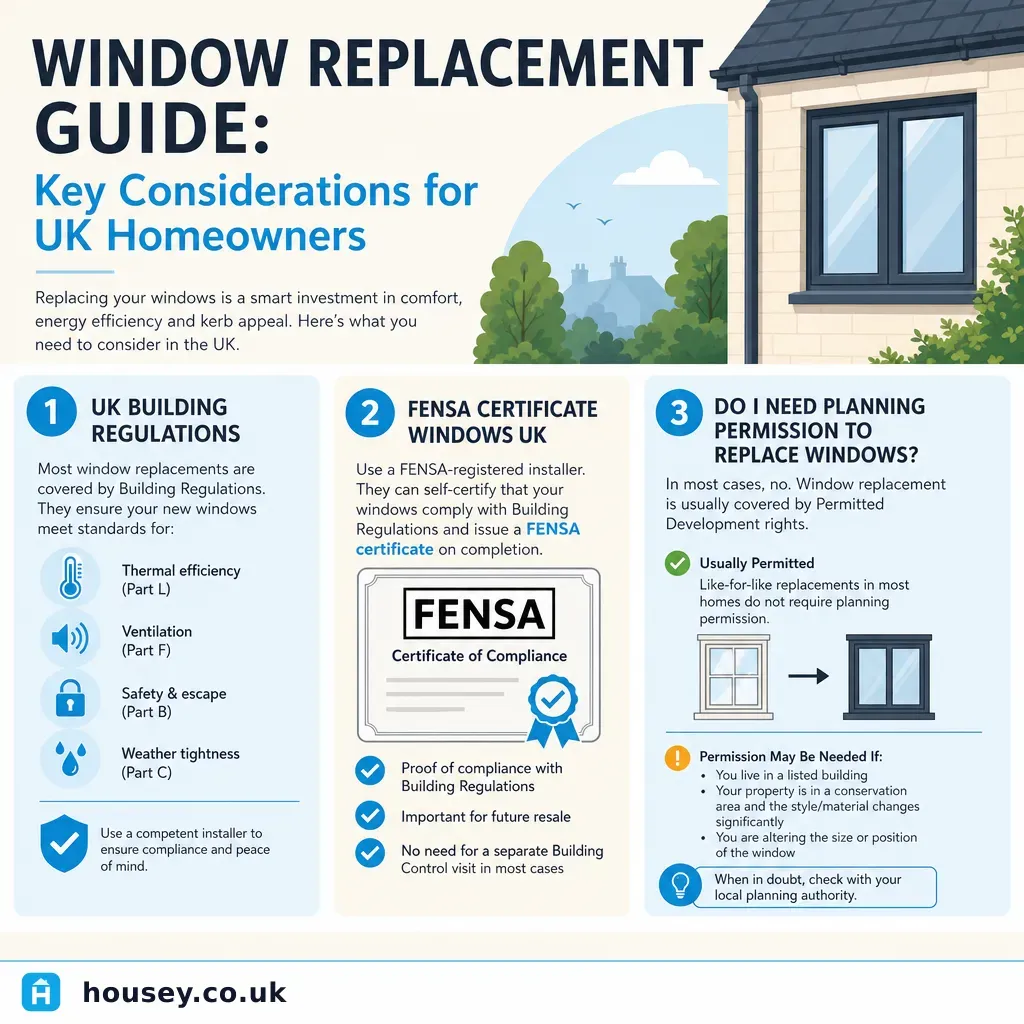
Window Replacement Guide: Key Considerations for UK Homeowners
Replacing windows in England and Wales requires compliance with Building Regulations Part L, with a minimum whole-window U-value of 1.
 Improvement & Build
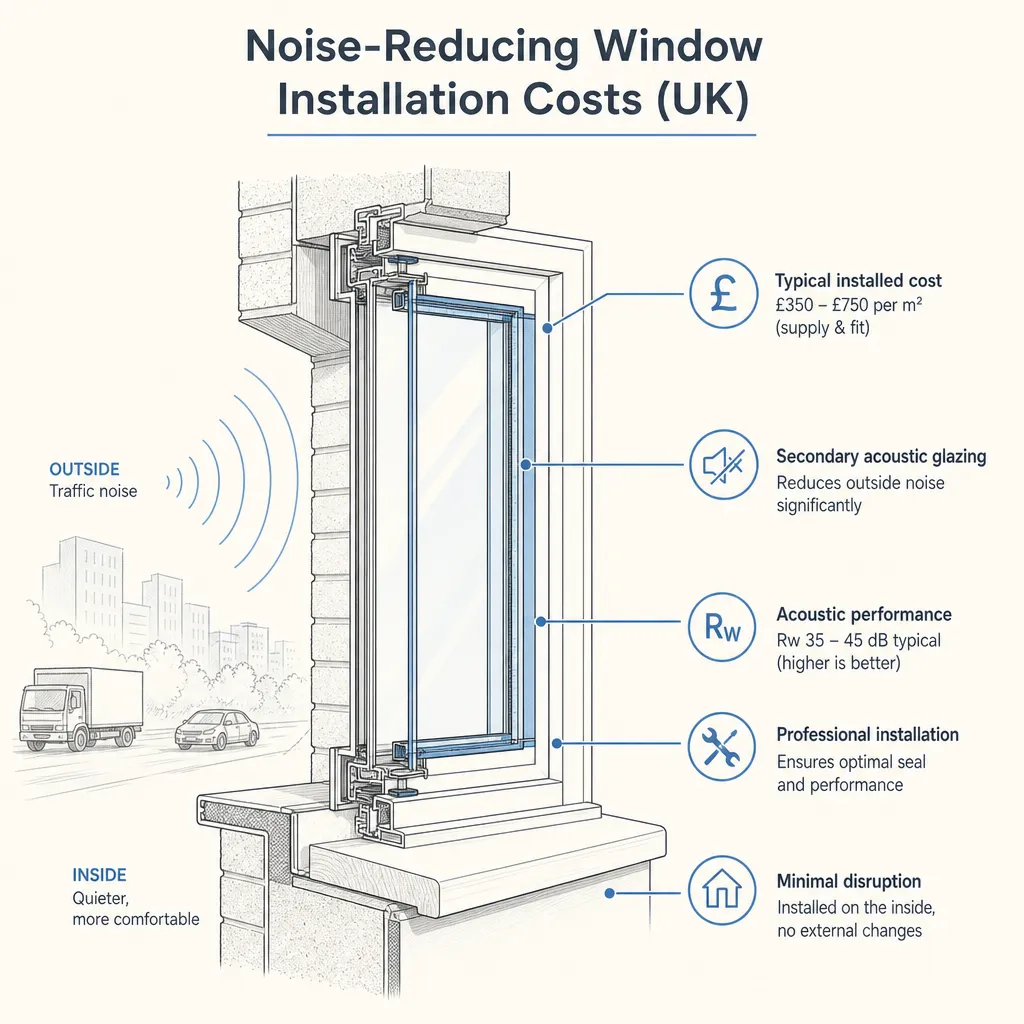
Noise-Reducing Window Installation Costs
Noise-reducing window installation in the UK typically costs £400–£1,500 per window depending on glazing specification, frame material, and property type.
 Improvement & Build
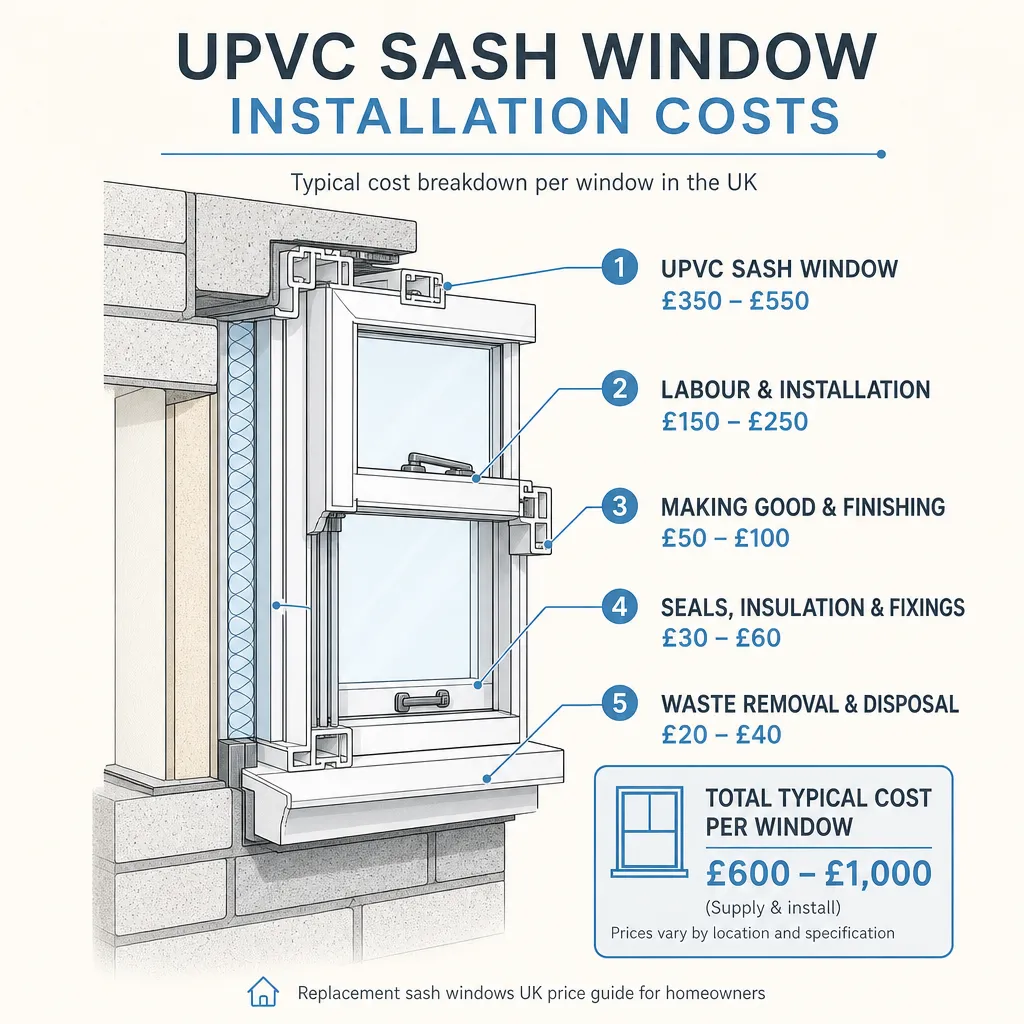
UPVC Sash Window Installation Costs
UPVC sash windows typically cost between £400 and £1,200 per window installed in the UK, depending on size, glazing specification, and access.
 Improvement & Build
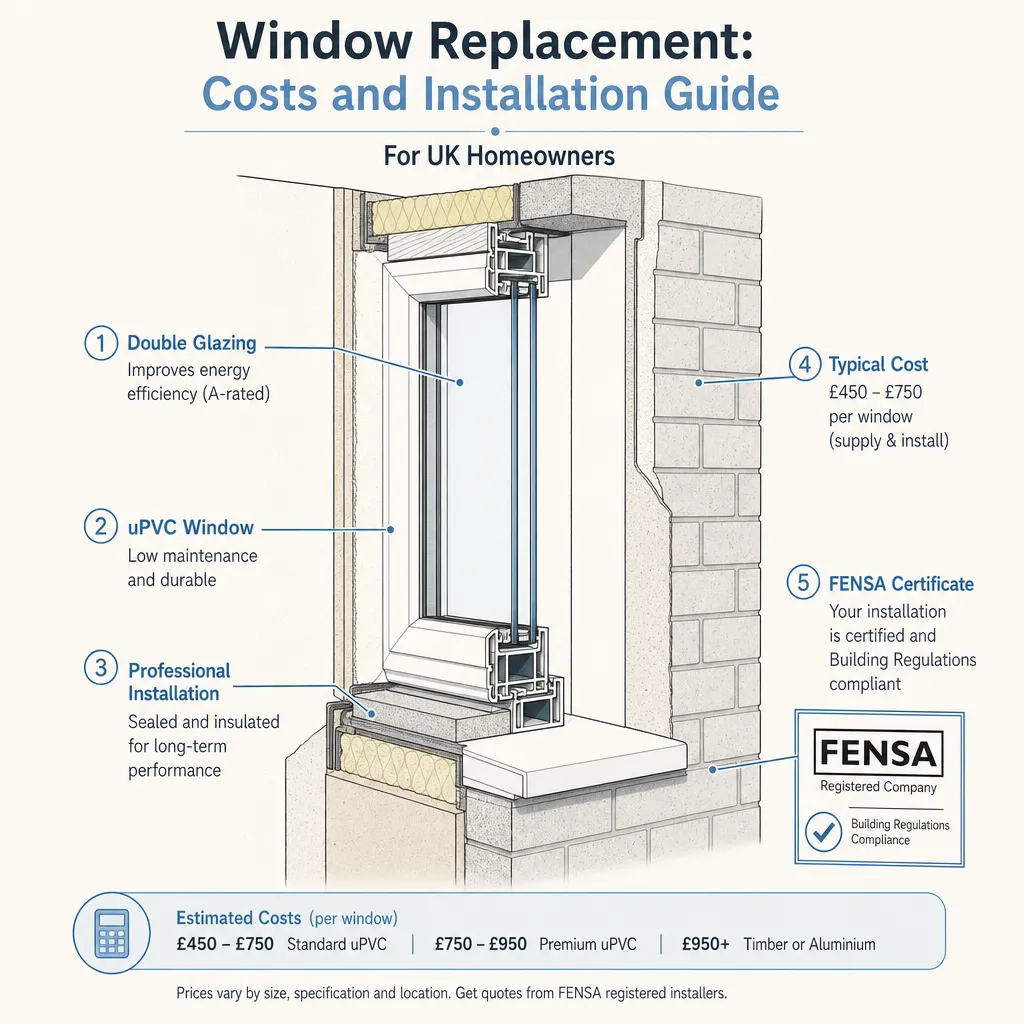
Window Replacement: Costs and Installation Guide
Replacing windows in a UK home typically costs £400–£900 per uPVC casement window installed, rising to £1,500–£3,000 for timber sash windows.
 Improvement & Build
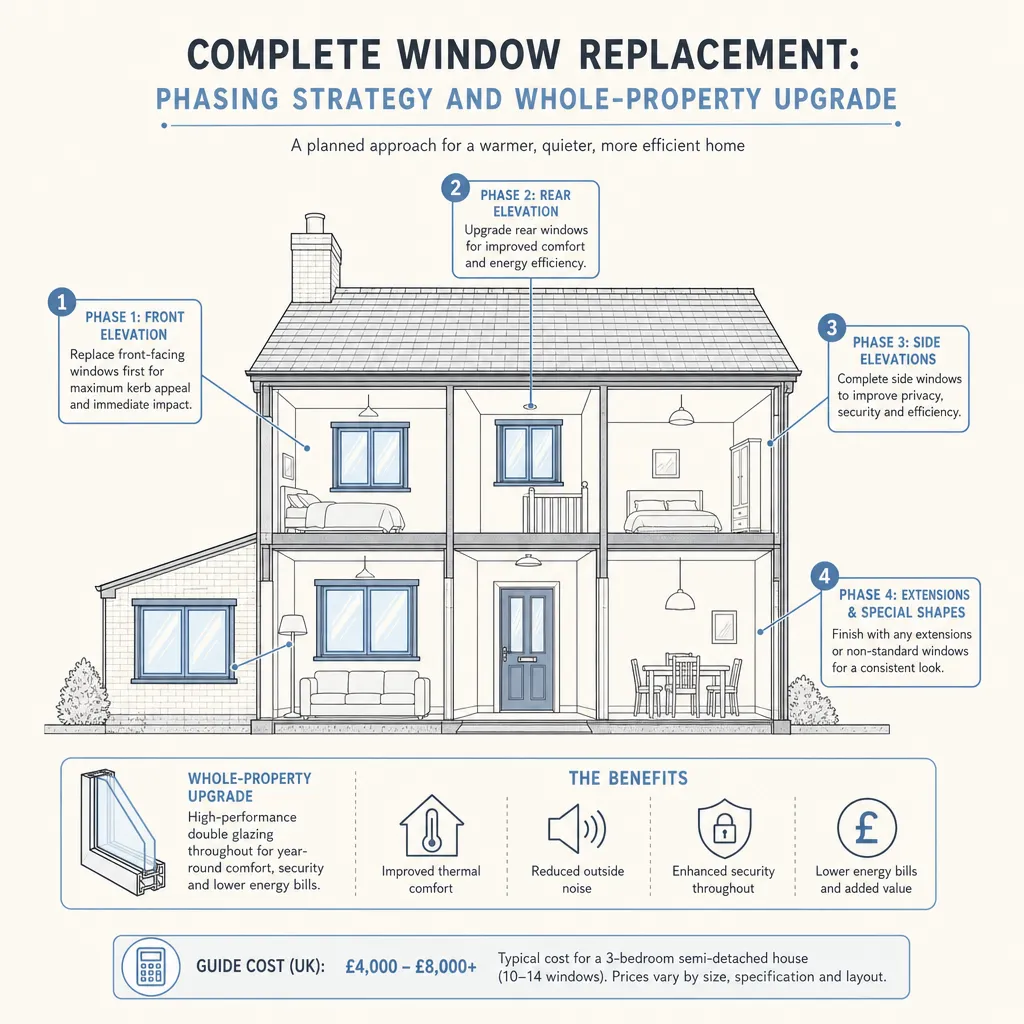
Complete Window Replacement: Phasing Strategy and Whole-Property Upgrade
Replacing all windows in a UK home requires FENSA or CERTASS-registered installers to certify compliance with Building Regulations Part L.