Choosing the Right Window Installer: What to Look For
By Housey · Last reviewed 24th of May 2026
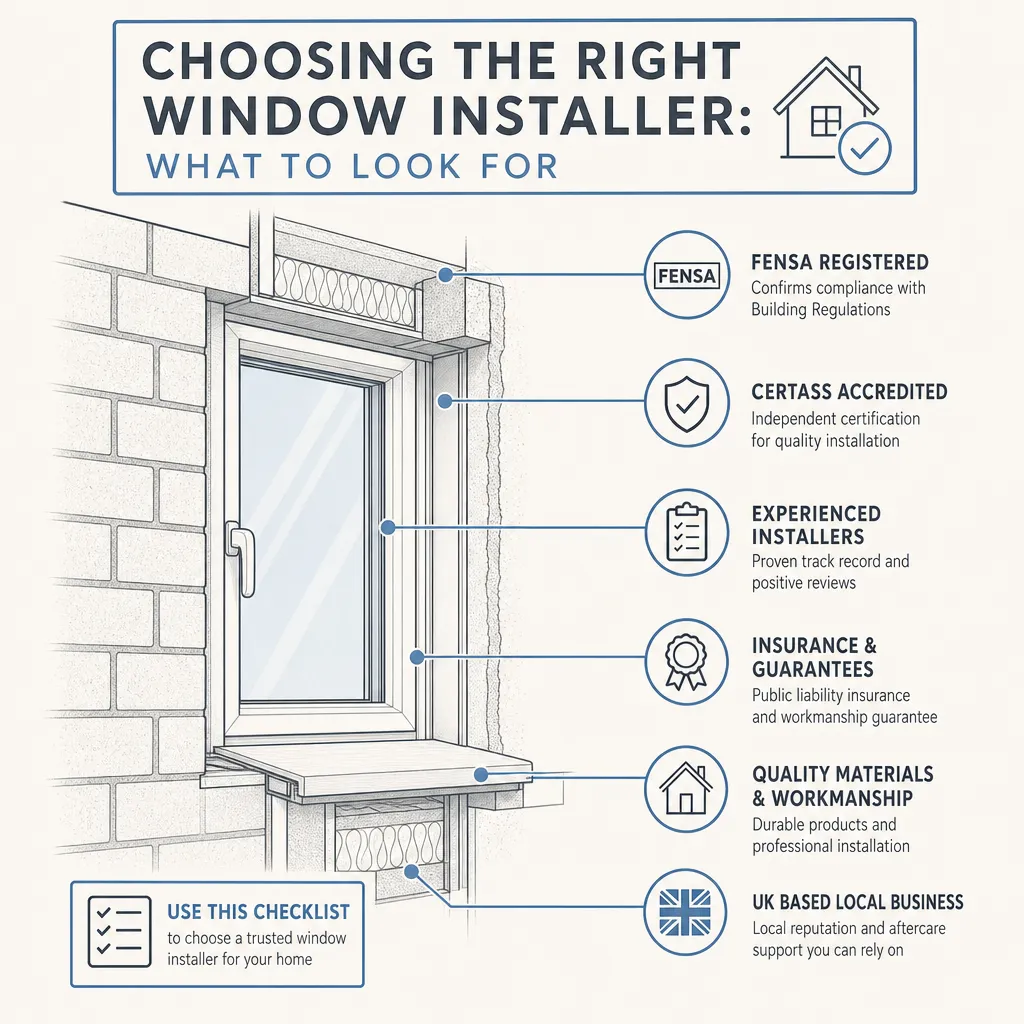
Choosing the Right Window Installer: What to Look For
Window replacement is one of the most common home improvement projects in the UK, yet picking the wrong installer can result in poorly sealed frames, a failed building regulations inspection, or a missing completion certificate that complicates conveyancing years later. Whether you are upgrading single glazing in a 1930s semi or fitting new double-glazed units throughout a Victorian terrace, the competence and accreditation of the company you hire matters as much as the glass specification itself.
Key points
- FENSA and CERTASS are the two principal Competent Person Schemes for window and door replacement in England and Wales; membership allows installers to self-certify Building Regulations compliance without a separate building control application.
- Under Approved Document L (2021 edition, effective June 2022), replacement windows in England must achieve a minimum whole-window U-value of 1.4 W/m²K or a Window Energy Rating (WER) of Band C or better.
- A Competent Person Scheme completion certificate must be issued within 30 days of installation; this document is registered with your local authority and expected by solicitors at resale.
- FENSA membership can lapse — always verify an installer's current registration directly at fensa.org.uk or certass.co.uk before signing a contract.
- Insurance-backed guarantees (IBGs) protect your installation warranty if the installer ceases trading; confirm the IBG provider's name and guarantee term before committing.
FENSA, CERTASS, and building regulations compliance
When an installer replaces a window or external door in England, the work must comply with Building Regulations — principally Approved Document L (energy efficiency). Rather than requiring every homeowner to submit a building control application, the government authorises Competent Person Schemes to let registered installers self-certify their own work.
FENSA (Fenestration Self-Assessment Scheme) and CERTASS are the two schemes covering the glazing industry in England and Wales. Registered members are assessed on their knowledge of building regulations and quality standards, and they notify the relevant local authority on your behalf after each installation.
In Scotland, a similar self-certification route operates through SBSi (Scottish Building Services). In Northern Ireland, a separate building control application is typically required. If your installer holds no scheme registration, you will need to apply for building control approval yourself — which adds cost and delay, and the absence of a certificate can complicate your mortgage and conveyancing on resale.
Accreditation schemes compared
Scheme | Operated by | What it covers | How to verify |
|---|---|---|---|
FENSA | Fenestration Self-Assessment Scheme | Windows, doors, rooflights — England and Wales | fensa.org.uk |
CERTASS | CERTASS Trade Association | Windows, doors, conservatories — England and Wales | certass.co.uk |
BFRC | British Fenestration Rating Council | Window Energy Ratings (product performance, not installer scheme) | bfrc.org |
TrustMark | Government-endorsed scheme | Quality assurance across home improvement trades | trustmark.org.uk |
Which? Trusted Traders | Which? | Vetted tradespeople across all trades | trustedtraders.which.co.uk |
Decision tree: which installer do you need?
Use this guide to narrow down the right type of installer for your project:
- Standard like-for-like replacement: Choose a FENSA or CERTASS registered company — they handle self-certification and issue the completion certificate.
- Energy performance upgrade or EPC improvement: Prioritise installers supplying BFRC-rated products at WER A or better; ask for the U-value data sheet for the proposed unit.
- Listed building or conservation area property: Check with your local planning authority before ordering — you may need planning consent for any change in appearance, material, or glazing bar profile, regardless of FENSA membership.
- Enlarging an existing opening: Consult a structural engineer or building control officer before instructing any glazier — widening or creating a new opening carries structural implications outside a standard installer's scope.
- New build or extension: Building control covers window performance as part of the wider project; coordinate with your main contractor and building control officer rather than instructing a window company independently.
What to ask a window installer before hiring
Before accepting any quote, work through this checklist:
- Are you registered with FENSA or CERTASS? Please provide your membership number so I can verify it on the scheme's website.
- What Window Energy Rating (WER band) or U-value do the proposed windows carry?
- Are the sealed units manufactured to BS EN 1279 and do they carry a UKCA or CE mark?
- What warranties cover the frame, the sealed glass units, and the installation workmanship — and for how long?
- Are the frame and workmanship warranties backed by an insurance-backed guarantee (IBG)? Who is the IBG provider?
- What is included and excluded from the quote, and what could change the final price (access constraints, non-standard sizes, structural complications)?
- Is VAT included in the quoted figure?
- When will the Competent Person Scheme completion certificate be issued, and to whom?
- How will the property be made secure overnight if the installation spans more than one day?
Red flags to watch for
The following warning signs suggest an installer may not deliver compliant or quality work:
- No current FENSA or CERTASS registration — always verify on the scheme's own website, not solely on the installer's leaflet or website, as membership can lapse.
- Requesting full payment upfront — reputable installers typically take a deposit of 10–30% with the balance due on satisfactory completion.
- No written specification or contract — without a signed document specifying glass spec, frame material, and timeline, you have limited recourse if anything changes mid-installation.
- High-pressure selling or expiring discount offers — quality installers do not need to rush a purchasing decision.
- No mention of a completion certificate — this is a legal requirement under Building Regulations, not an optional extra.
- Very low quote with no product specifications — below-market pricing often indicates unrated glass units, profile systems that fall below minimum standards, or labour-only terms with materials added later.
Windows in conservation areas and listed buildings
Standard permitted development rights do not apply fully to listed buildings, properties in Article 4 Direction areas, or many conservation areas. In these cases, even a like-for-like window replacement can require planning permission — particularly where the appearance, material, or glazing bar profile would change.
FENSA or CERTASS membership does not override planning law. An installer can self-certify Building Regulations compliance but cannot grant planning consent. Check with your local planning authority and, if relevant, your local conservation officer before ordering any windows. Historic England publishes detailed guidance on appropriate window replacement for traditional and historic buildings.
When to get professional help
Most window replacements proceed without difficulty, but seek additional specialist input if:
- You are enlarging an existing window opening — structural implications require a structural engineer or building control sign-off before any glazing is ordered or existing masonry is disturbed.
- Your property is listed or in a conservation area — a planning consultant or your local conservation officer should advise on acceptable materials and styles before you commit.
- You are experiencing widespread condensation between glass panes across multiple units — new windows alone may not resolve an underlying moisture or ventilation issue; a RICS-accredited surveyor can assess the root cause.
- An existing installer's completed work is causing water ingress or draughts — an independent surveyor can document defects and advise on remediation options.
How Housey can help
Housey connects homeowners with vetted window and door installers who hold current FENSA or CERTASS membership. Submit one quote request and receive responses from up to four local installers — with accreditation details visible so you can verify credentials before you commit to any work.
Frequently asked questions
Do I need planning permission to replace my windows in the UK?
In most cases, no. Replacing windows with similar ones is permitted development in England and does not require a planning application. Exceptions apply to listed buildings, properties in Article 4 Direction areas, and many conservation areas. Always check with your local planning authority before ordering if your property falls into any of these categories.
What is a FENSA certificate and why does it matter?
A FENSA certificate confirms that your replacement windows or doors comply with Building Regulations and have been registered with the local authority. Solicitors typically request it when you sell the property. Without it, you may need to obtain retrospective building control approval or an indemnity insurance policy — both add cost and can delay conveyancing.
How many quotes should I get for window replacement?
Getting three written quotes is standard practice for most home improvement work. For larger jobs — five or more windows, bay windows, or properties with restricted access — three quotes give you a meaningful price range and let you compare specifications rather than just headline figures. Ask each installer to itemise frame, glass, and installation costs separately.
What is an insurance-backed guarantee for windows?
An insurance-backed guarantee (IBG) ensures your installation warranty remains valid even if the installing company ceases trading. It is separate from the manufacturer's warranty on frames and glass units. Reputable FENSA and CERTASS members often offer IBGs as standard or as an add-on; ask for the provider's name and confirm the guarantee term — usually 10 years — before signing.
Sources and further reading
- FENSA: find a registered installer — FENSA
- GOV.UK: Building Regulations Approved Document L — Conservation of Fuel and Power — MHCLG
- CERTASS Trade Association — CERTASS
- British Fenestration Rating Council: window energy ratings — BFRC
- Historic England: energy efficiency and historic buildings — Historic England
- TrustMark: government-endorsed quality scheme — TrustMark
Useful next reads
 Improvement & Build
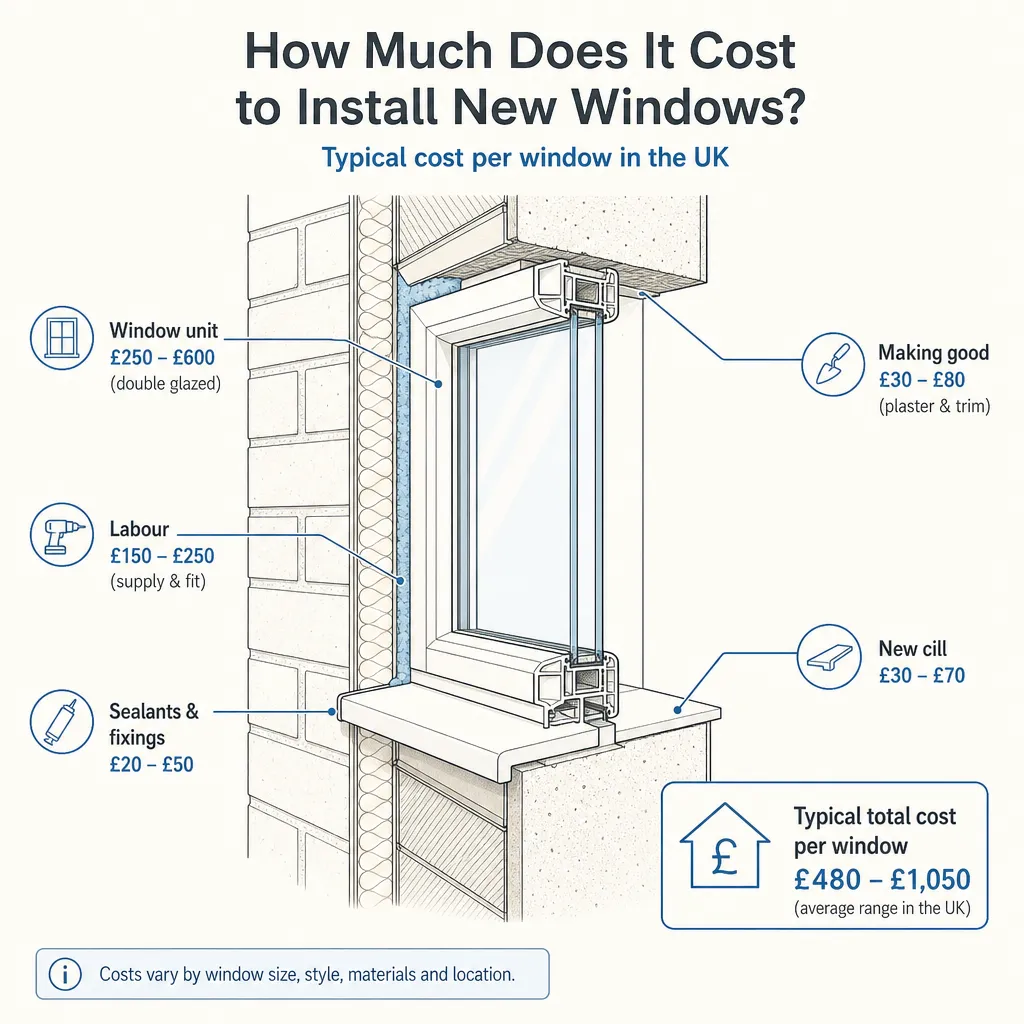
How Much Does It Cost to Install New Windows?
New window installation in the UK typically costs £300–£700 per uPVC double-glazed window (supply and fit), rising to £800–£2,500 for timber or sash windows.
 Improvement & Build
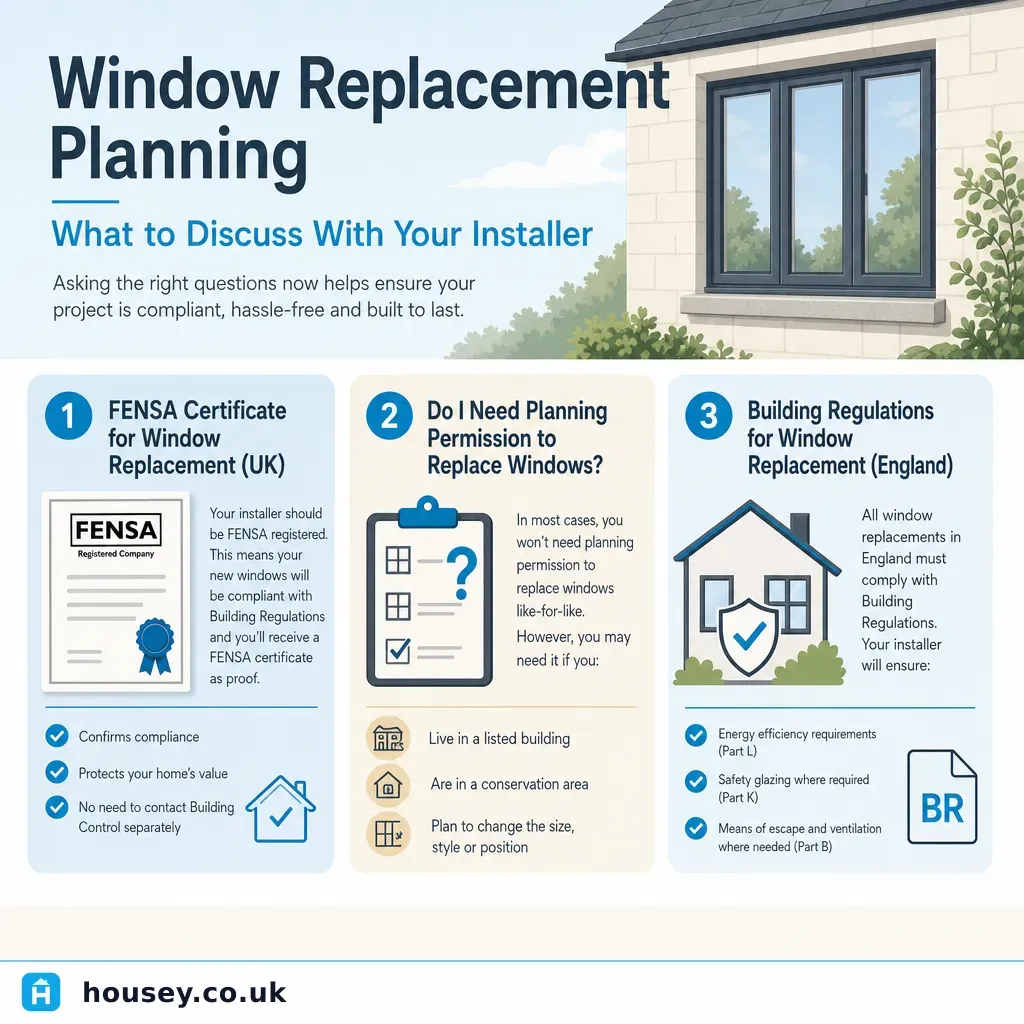
Window Replacement Planning: What to Discuss With Your Installer
Most window replacements in England fall under permitted development rights and do not require planning permission, but they must comply with Building Regulations Part L and Part K.
 Improvement & Build
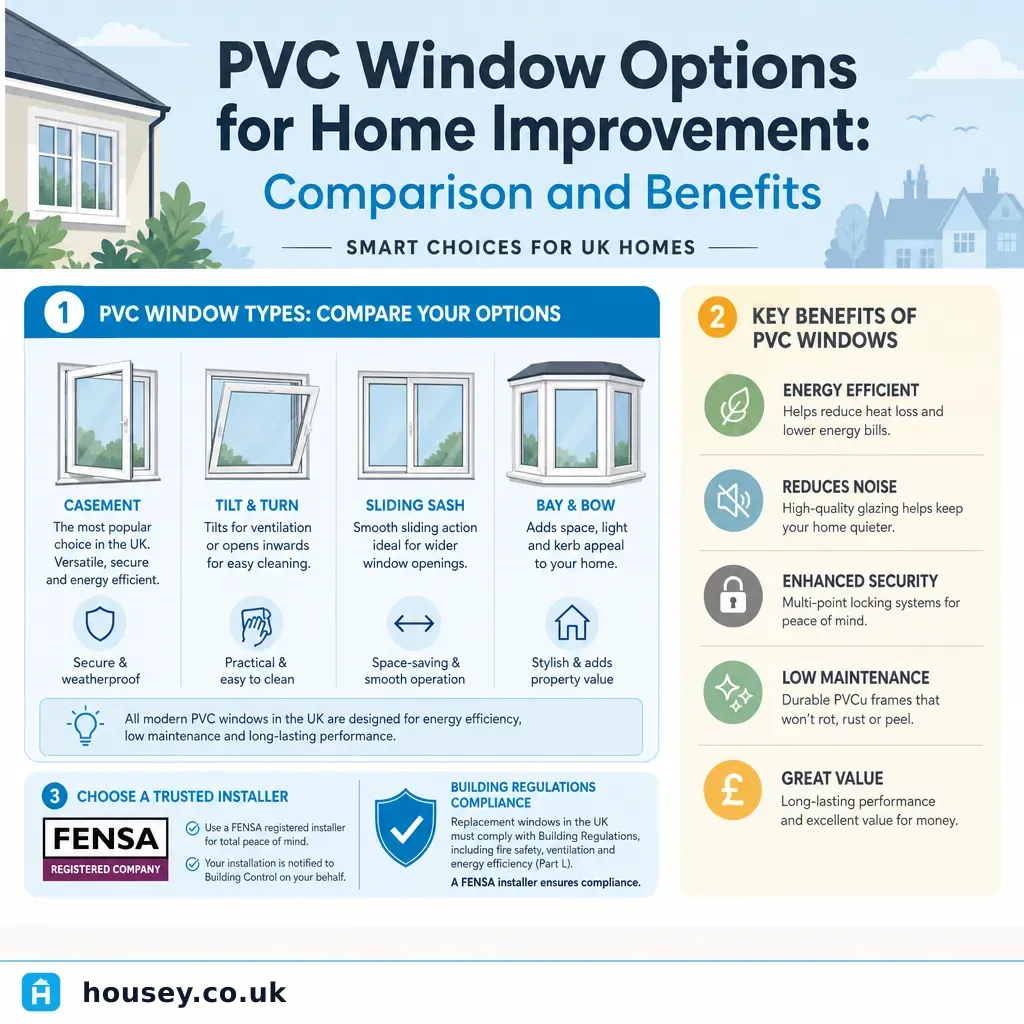
PVC Window Options for Home Improvement: Comparison and Benefits
uPVC (unplasticised PVC) is the most widely fitted material for replacement windows in UK homes, combining low maintenance with good thermal performance.
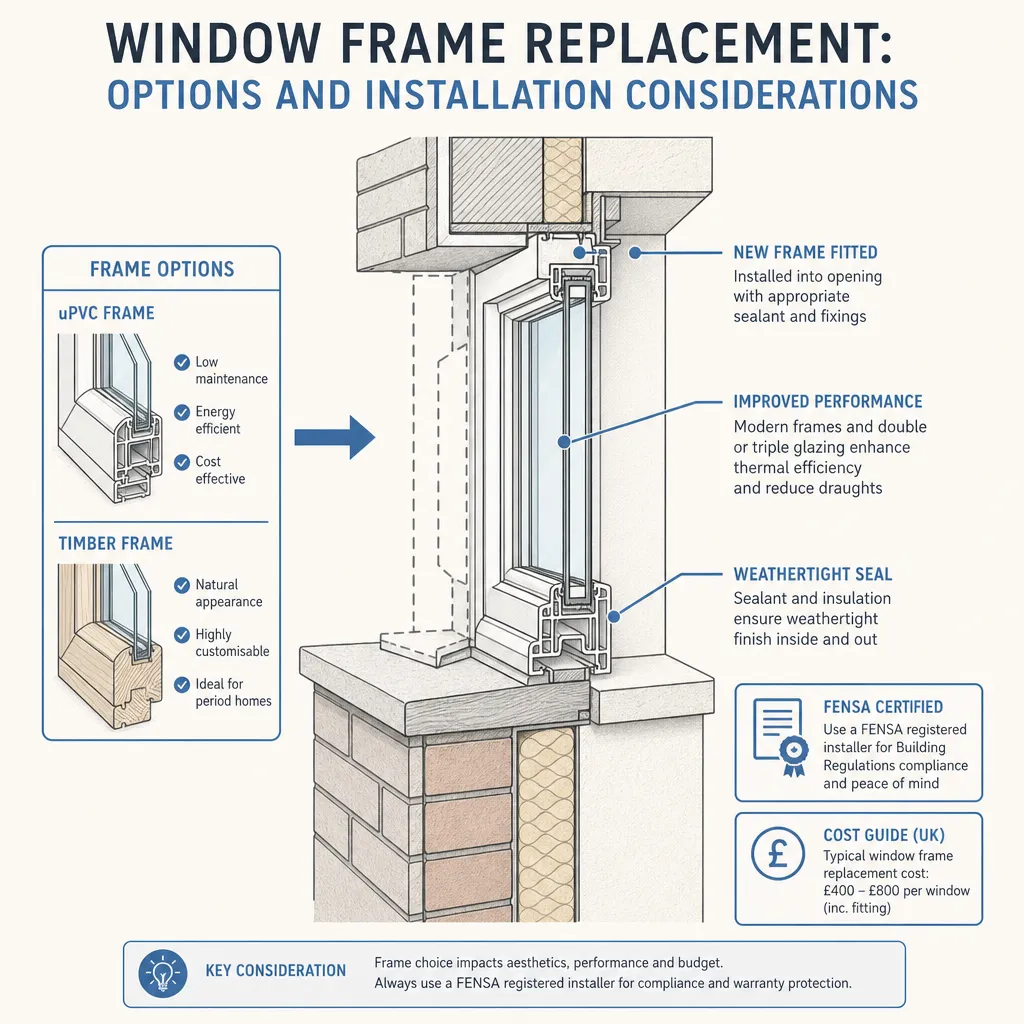 Improvement & Build
Window Frame Replacement: Options and Installation Considerations
Replacing window frames in the UK requires compliance with Part L of the Building Regulations and, in most cases, a FENSA or Certass certificate.
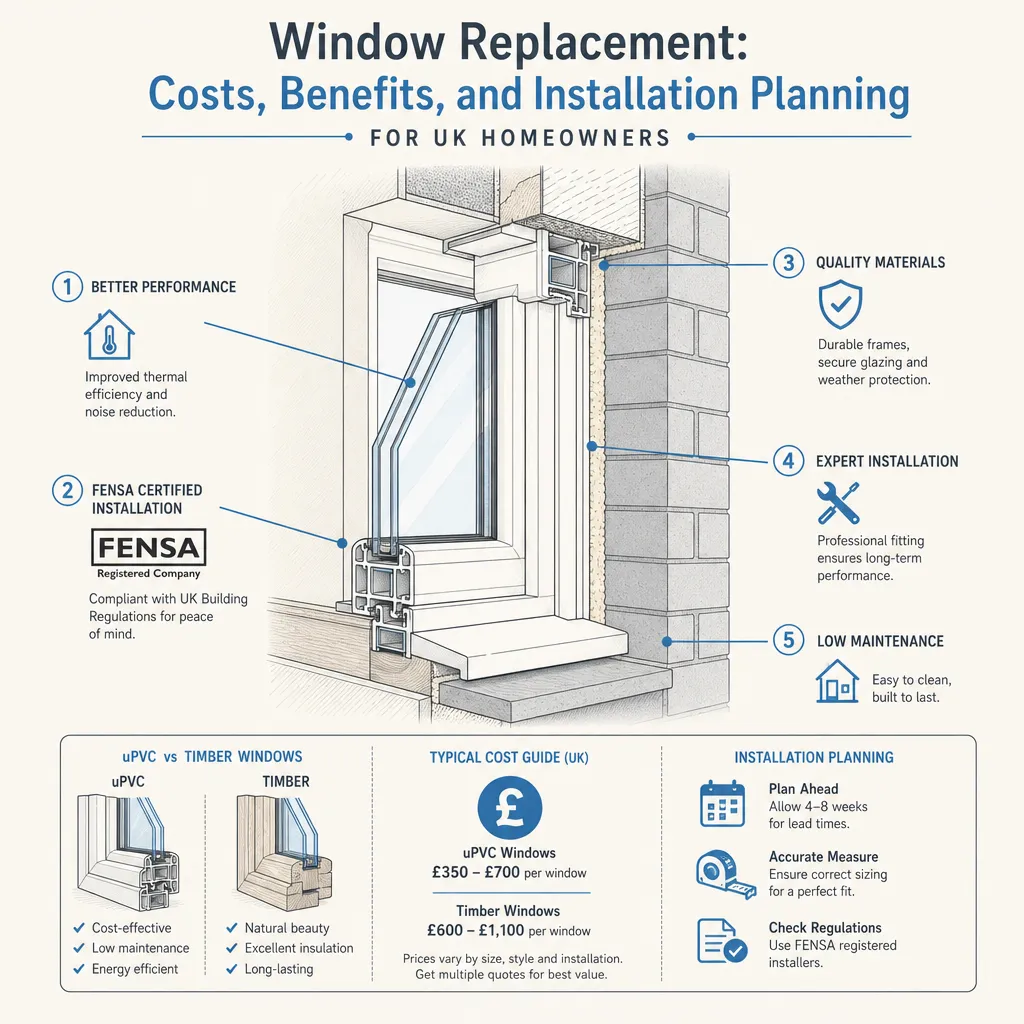 Improvement & Build
Window Replacement: Costs, Benefits, and Installation Planning
Replacing windows in most UK homes is permitted development but must meet Building Regulations Part L, requiring a whole-window U-value of 1.