Window Glass Types and Glazing Options for UK Properties
By Housey · Last reviewed 26th of May 2026
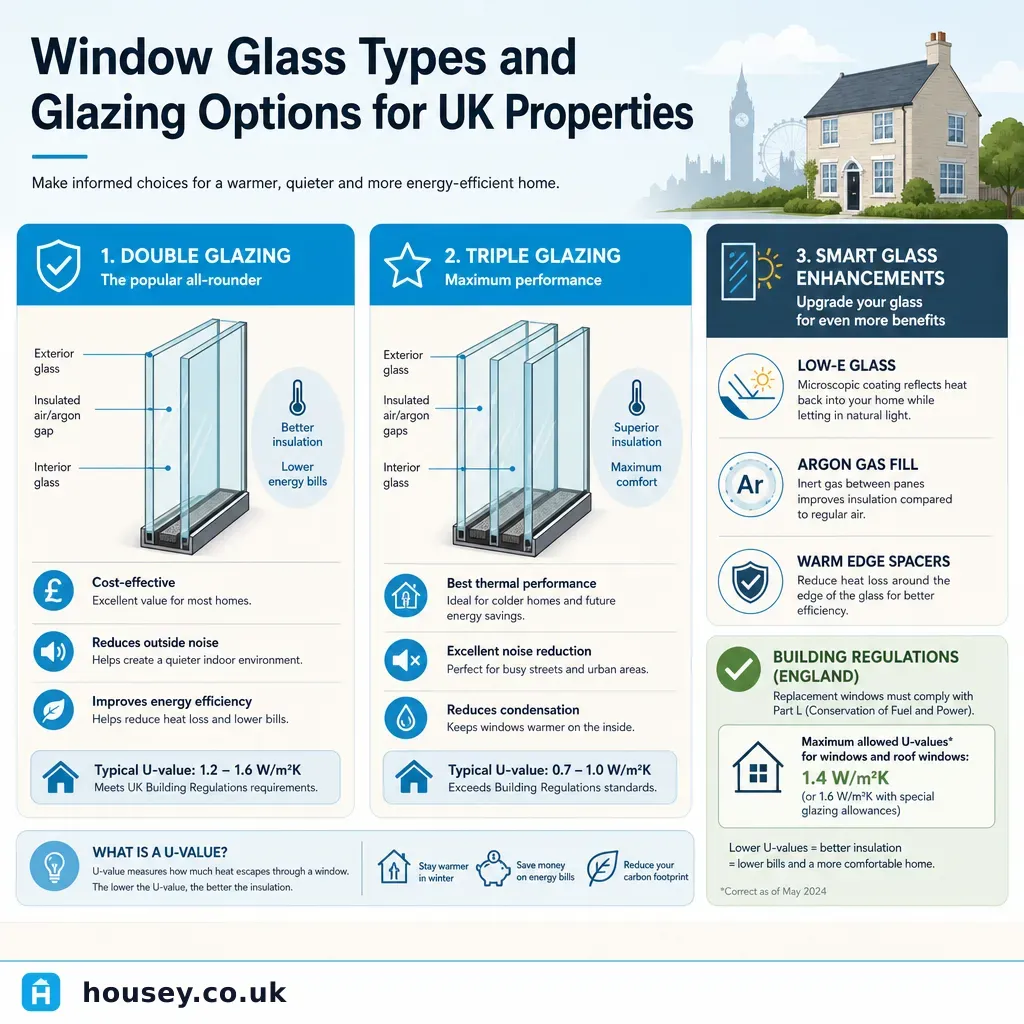
Window Glass Types and Glazing Options for UK Properties
Replacing or upgrading windows is one of the most frequent home improvement decisions UK homeowners face — prompted by draughts, failed double-glazed seals, a renovation project, or the need to improve an EPC rating ahead of a sale or re-let. The range of glazing specifications, coatings, and energy ratings available can be confusing, and the wrong choice may fail to meet Building Regulations, underperform thermally, or fall foul of listed building or conservation area requirements.
Key points
- Building Regulations Approved Document L requires replacement windows in England to achieve a minimum whole-window U-value of 1.6 W/m²K, or to be rated Band C or above under the British Fenestration Rating Council (BFRC) energy rating scheme.
- Safety glazing — toughened or laminated glass — is mandatory in critical locations under Approved Document K, including glazing in door leaves, side panels within 300 mm of a door edge, and shower or bath enclosures.
- Low-emissivity (low-E) coatings applied to the inner pane surface reflect radiant heat back into the room, significantly improving U-values compared with uncoated glass of the same thickness.
- Triple glazing achieves typical whole-window U-values of 0.8–1.1 W/m²K versus 1.2–1.6 W/m²K for modern argon-filled double glazing with a soft-coat low-E coating.
- Listed buildings require listed building consent for window replacement; properties in conservation areas may require planning permission or be restricted by an Article 4 Direction.
Understanding glazing performance metrics
U-value (thermal transmittance)
The U-value measures how much heat passes through a window per square metre for every 1°C of temperature difference between inside and outside. Lower values mean less heat loss. Building Regulations require the whole-window U-value — covering both glass and frame — not just the centre-pane figure, which is always lower and sometimes quoted by glass manufacturers in isolation.
BFRC energy rating
The British Fenestration Rating Council (BFRC) energy rating grades windows from A++ (most efficient) to G (least efficient). The rating balances thermal transmittance (U-value) against solar heat gain (g-value) and air leakage. A Band C rating or above meets the standard required by Building Regulations Part L for replacement windows in England.
g-value (solar factor)
The g-value represents the proportion of solar energy that passes through the glass. A higher g-value lets in more passive solar heat — useful on south-facing elevations in winter but potentially contributing to overheating in highly glazed south- or west-facing rooms during summer.
Rw (weighted sound reduction index)
The Rw value (measured in decibels) indicates acoustic performance. For properties near busy roads, railways, or airports, specifying acoustic laminated glass with a higher Rw — typically 35–45 dB — can significantly reduce interior noise levels.
Comparison of glazing types for UK homes
Glazing type | Typical whole-window U-value | Best for | Not ideal for | Key consideration |
|---|---|---|---|---|
Standard double glazing, air-filled | 2.0–2.8 W/m²K | Budget replacement of single glazing | Meeting current Building Regulations | Often fails Part L; rarely specified for new work |
Argon-filled double glazing + soft-coat low-E | 1.2–1.6 W/m²K | Most UK replacement projects | Very high insulation targets | Meets Part L in most cases; standard modern specification |
Triple glazing | 0.8–1.1 W/m²K | High-performance builds and Passivhaus | Existing frames (added weight) and standard budgets | Higher cost; marginal payback in UK climate vs quality double glazing |
Secondary glazing | Combined ~1.5–2.5 W/m²K (varies with gap) | Listed buildings, conservation areas, rented properties | New builds or primary window replacement | Planning-friendly; retains original window |
Acoustic laminated glass (in a double unit) | As equivalent double unit | Properties near roads, railways, or airports | Projects where thermal performance alone is the priority | Rw 35–45 dB; adds cost; can incorporate low-E coating |
Toughened (tempered) glass | Similar to standard float | Critical Approved Document K locations and roof glazing | Where on-site cutting is needed | Cannot be cut once toughened; must be ordered to size |
Laminated safety glass | Similar to standard float | Critical locations and overhead glazing | General replacement where safety glazing is not required | Holds together on breakage; mandatory in many positions |
Self-cleaning glass | As equivalent double unit | Conservatories, rooflights, and difficult-access glazing | Shaded north-facing elevations (requires UV light to activate) | Photocatalytic coating; carries a premium cost |
Low-emissivity coatings, gas fills, and warm-edge spacer bars
Low-E coatings
Low-E coatings are microscopically thin metallic layers applied to the glass surface. They reflect long-wave infrared radiation (room heat) back into the interior while allowing short-wave solar radiation to pass through. Two types are used in UK windows:
- Soft coat (magnetron sputtered): Applied after glass manufacture; must be sealed inside a double or triple unit to protect it. More thermally effective than hard coat; the standard for modern sealed units.
- Hard coat (pyrolytic): Applied during manufacturing; more durable and usable as a single pane. Less thermally effective than soft coat; used in some secondary glazing applications.
Most modern argon-filled double-glazed sealed units include a soft-coat low-E coating as standard. Always ask your supplier to confirm this, as uncoated argon-filled units still exist in the market.
Gas fills
The cavity between panes in a sealed unit is typically filled with argon (the standard, reducing conductive heat transfer compared with air) or, in slim-profile units for conservation areas, krypton (more expensive but effective at narrower cavity widths). Wider cavities — typically 12–16 mm for argon-filled units — generally perform better thermally.
Warm-edge spacer bars
The spacer bar around the perimeter of a sealed unit affects both thermal performance and condensation risk. Traditional aluminium spacer bars create a thermal bridge at the edge, increasing the risk of condensation on the inner pane near the frame. Warm-edge spacer systems — made from polymer or hybrid materials — reduce this thermal bridge and are increasingly standard in quality UK glazing products.
Safety glazing requirements under Approved Document K
Approved Document K (Protection from Falling, Collision and Impact) specifies where safety glazing is mandatory in England. Critical locations include:
- Any glazing in a door leaf.
- Glazing in side panels of a door, within 300 mm of the door edge and below 1,500 mm from floor level.
- Glazing below 800 mm from floor level in windows in areas where people could fall against the glass.
- Glazing in a shower cubicle or bath enclosure.
Safety glazing must meet BS EN 12150 (toughened glass) or BS EN ISO 12543 (laminated glass). FENSA-registered installers are required to record which panes are safety glass on the installation certificate — an important point when selling the property.
Secondary glazing — when it is the right choice
Secondary glazing adds a second pane on the room side of an existing window without replacing the outer window. It is typically most appropriate when:
- The property is listed and listed building consent for primary window replacement cannot be obtained or is unlikely to be granted.
- The property is in a conservation area and the planning authority requires retention of original timber windows.
- The existing windows are structurally sound but thermally or acoustically poor.
- Works are in a rented property where the landlord has not consented to full replacement.
A cavity gap of 100–150 mm between the primary and secondary pane gives reasonable acoustic performance (Rw around 40 dB when combined with acoustic glass); a 20–50 mm gap provides primarily thermal benefit.
Decision tree: which glazing should you specify?
- Is the property listed? → Listed building consent is required before replacing windows; secondary glazing with a slim hard-coat glass is often more readily consented. Consult your local planning authority or a heritage consultant before proceeding.
- Is the property in a conservation area? → Check whether an Article 4 Direction removes permitted development rights; planning permission may be required even for like-for-like replacement.
- Does the glazing fall in a critical location under Approved Document K? → Safety glazing (toughened or laminated) is mandatory; confirm pane positions with your installer before placing any order.
- Is your primary goal thermal improvement? → Modern argon-filled double glazing with soft-coat low-E and warm-edge spacer meets Part L for most projects; triple glazing offers further improvement but may not be cost-effective unless building to Passivhaus or equivalent standards.
- Is acoustic performance also important? → Specify acoustic laminated glass as part of the sealed unit; wider cavities also help reduce sound transmission.
- Is full replacement impractical or undesirable? → Secondary glazing can achieve significant thermal and acoustic improvement without planning risk.
- Is the glazing overhead or in a rooflight? → Laminated glass is required on the lower pane of overhead glazing for safety; consider self-cleaning glass for maintenance in inaccessible locations.
When to get professional help
A FENSA- or CERTASS-registered installer can self-certify window replacement under Building Regulations, removing the need for a separate building control application. Always confirm registration before instructing. Also consider specialist advice from:
- A heritage consultant or conservation architect if the property is listed or in a conservation area with restrictions on window design or profile.
- An acoustic consultant if Rw specification is critical — for example, in a property affected by aircraft noise, a motorway, or a main railway line.
- A structural engineer if new or enlarged openings are being formed in load-bearing walls.
How Housey can help
Our window and door installers can advise on the glazing specification appropriate for your property — whether you need an argon-filled unit meeting Part L, safety glass in a critical location, or slim-profile glazing for a conservation area — and can provide FENSA-registered installation with the documentation needed for future property sales.
Frequently asked questions
What does FENSA registration mean?
FENSA is a government-authorised competent person scheme for window and door installers in England and Wales. A registered installer can self-certify that window replacements meet Building Regulations without a separate local authority building control application. On completion they issue a FENSA certificate that should be kept with the property deeds, as it will be required by solicitors when you come to sell.
Can I replace windows without planning permission?
In most cases, replacing windows with similar-sized units in a comparable style is permitted development and requires no planning permission. Exceptions include listed buildings (which require listed building consent), conservation areas where an Article 4 Direction removes permitted development rights, and some new-build estates where planning conditions restrict alterations. If in doubt, check with your local planning authority before ordering.
Will new windows improve my EPC rating?
Replacing single-glazed windows with modern double glazing typically produces a noticeable EPC improvement. Upgrading from existing double glazing to triple glazing generally produces a smaller rating improvement relative to cost. An EPC assessor models your existing and replacement glazing performance; the rating improvement depends on the proportion of glazing area to floor area and the overall fabric of the property.
What is the difference between a centre-pane U-value and a whole-window U-value?
The centre-pane U-value measures heat loss through the glass only, ignoring the frame. The whole-window U-value — which is what Building Regulations Part L requires — includes the thermal performance of the frame as well. Frames typically conduct more heat than modern glazing units, so the whole-window U-value is always higher (worse) than the centre-pane figure. Always ask for the whole-window U-value when assessing Part L compliance.
Sources and further reading
- Approved Document L: Conservation of Fuel and Power — GOV.UK
- Approved Document K: Protection from Falling, Collision and Impact — GOV.UK
- BFRC Window Energy Ratings — British Fenestration Rating Council
- FENSA: competent person scheme for windows and doors — FENSA
- Energy Saving Trust: double glazing — Energy Saving Trust
Useful next reads
 Improvement & Build
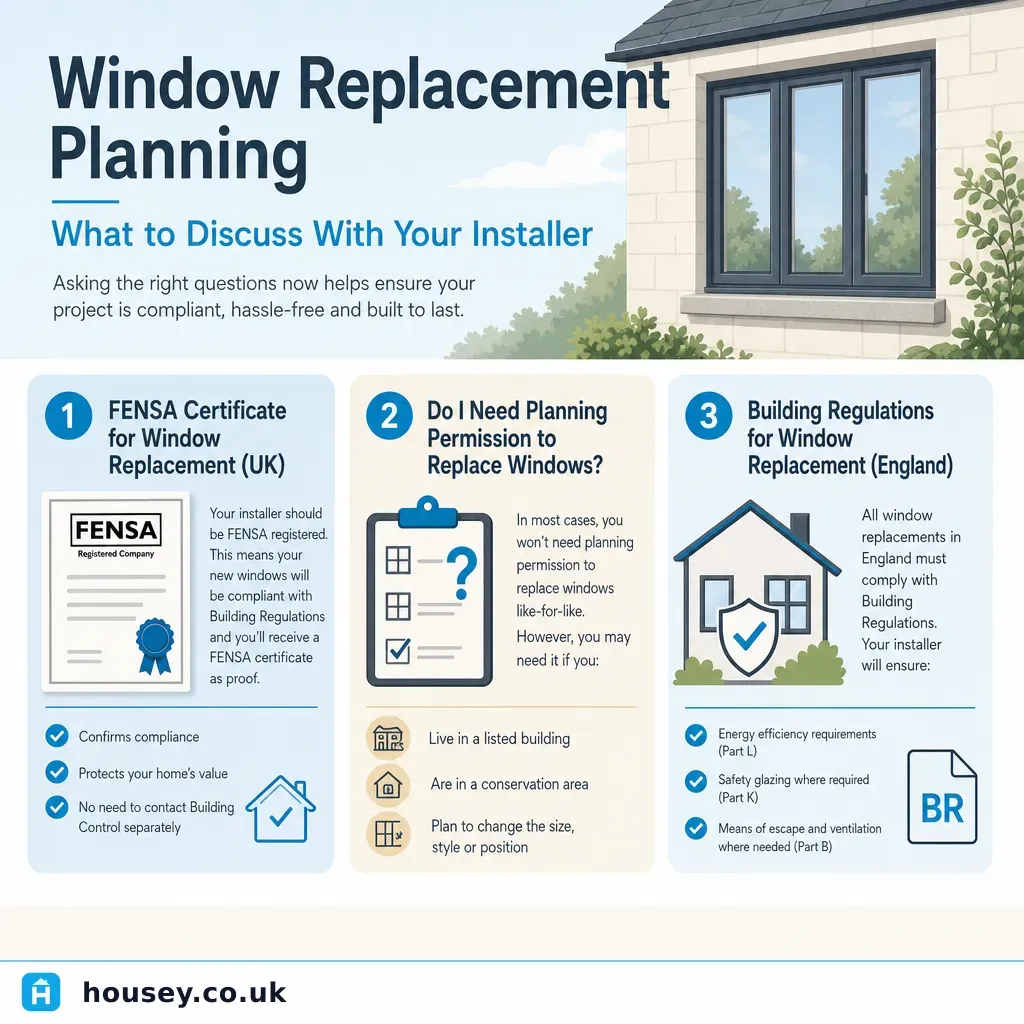
Window Replacement Planning: What to Discuss With Your Installer
Most window replacements in England fall under permitted development rights and do not require planning permission, but they must comply with Building Regulations Part L and Part K.
 Improvement & Build
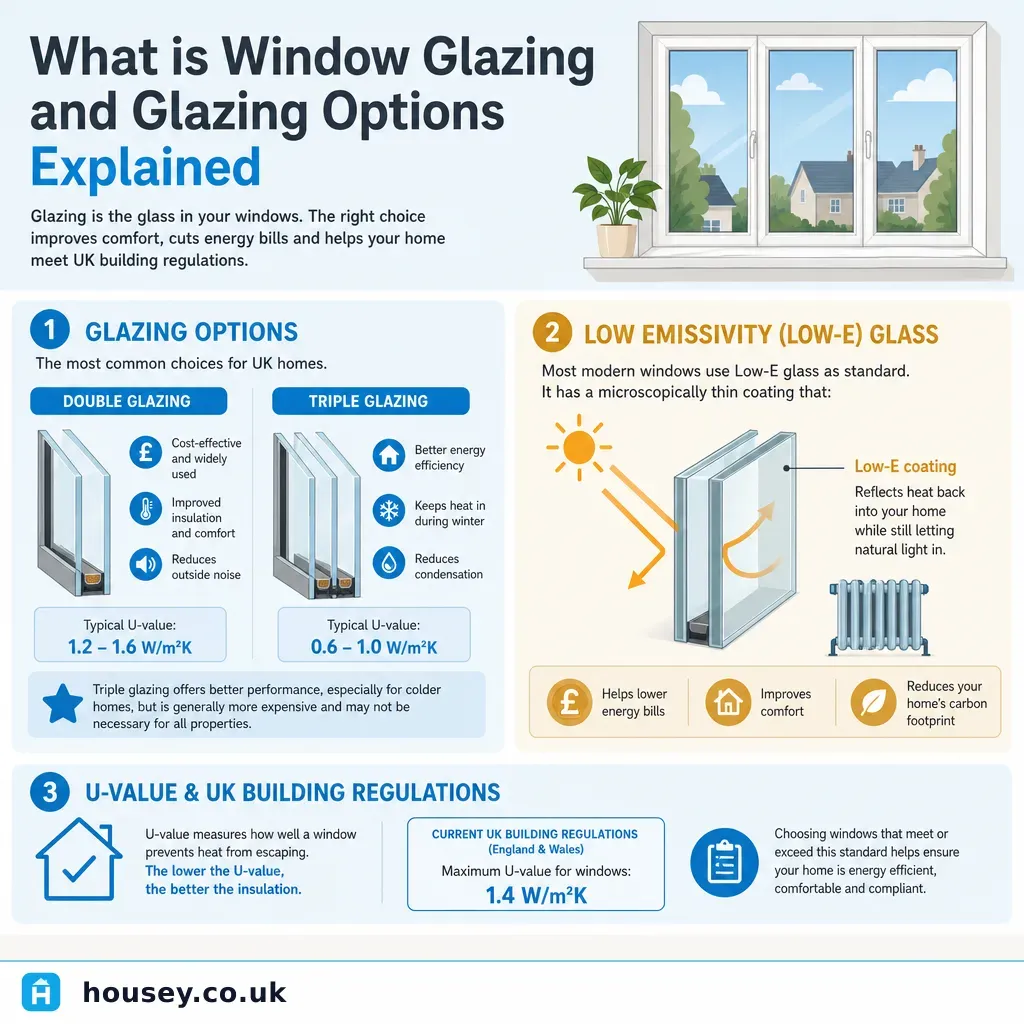
What is window glazing and glazing options explained
Window glazing refers to the sealed glass unit fitted within a window frame.
 Improvement & Build
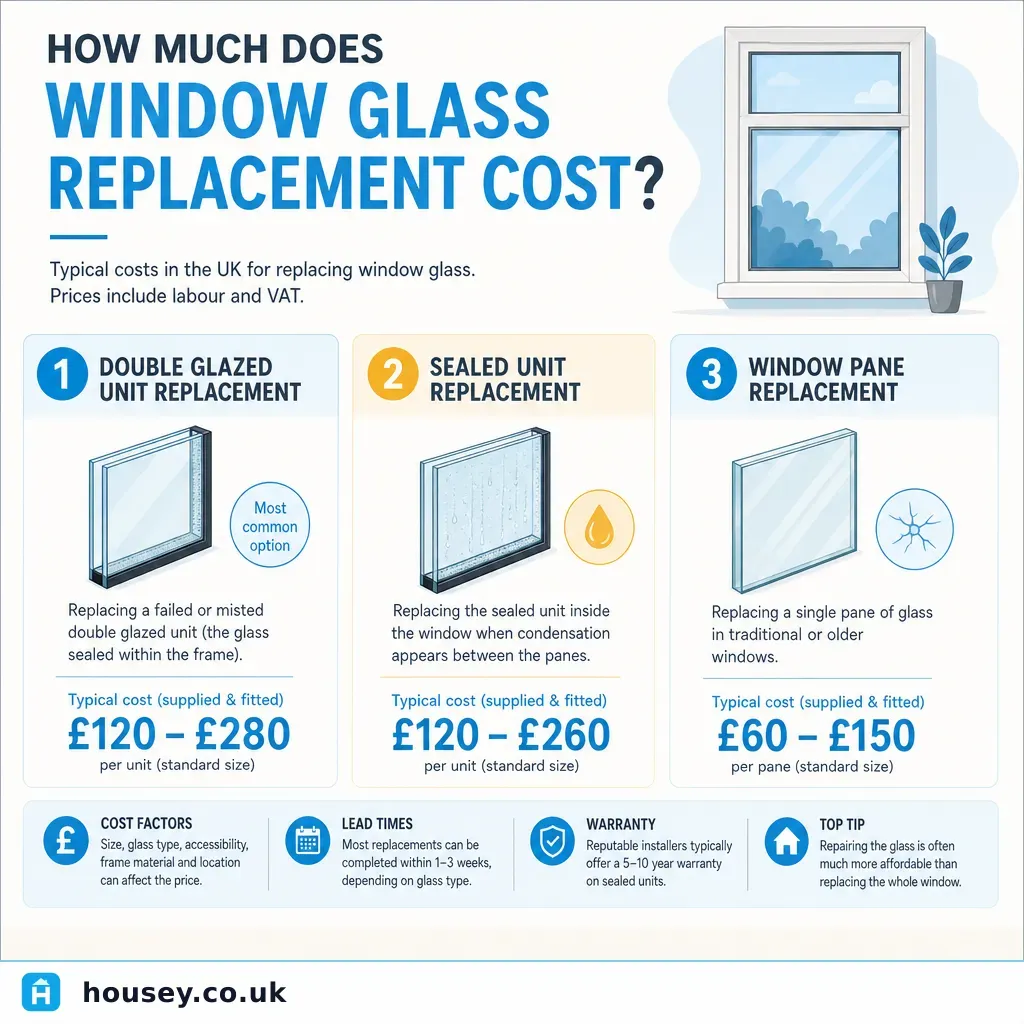
How much does window glass replacement cost
Replacing a standard double-glazed sealed unit typically costs £80–£300 in the UK, depending on glass size, type, and access.
 Improvement & Build
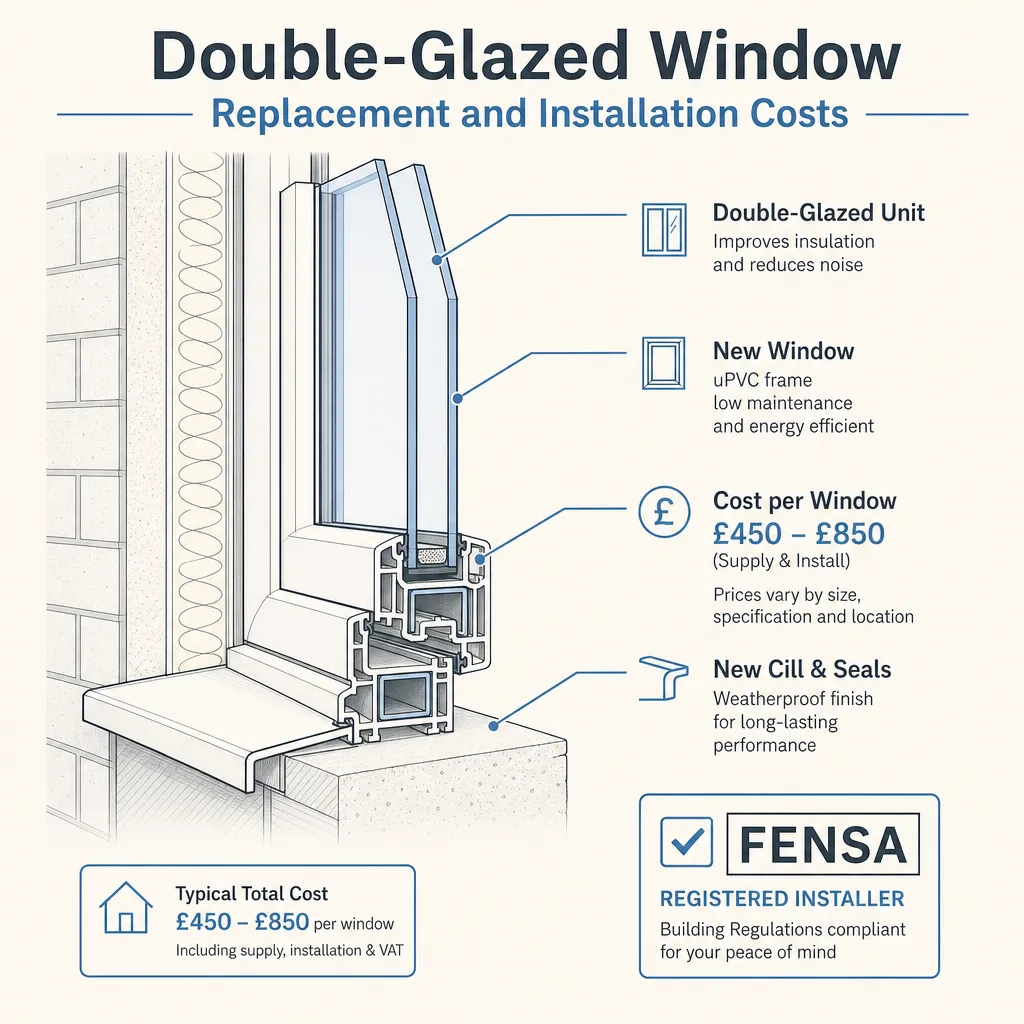
Double-Glazed Window Replacement and Installation Costs
Replacing double-glazed windows in a typical UK home costs roughly £300–£600 per uPVC casement window installed, rising to £500–£1,200 for timber and £400–£800 for aluminium.
 Improvement & Build
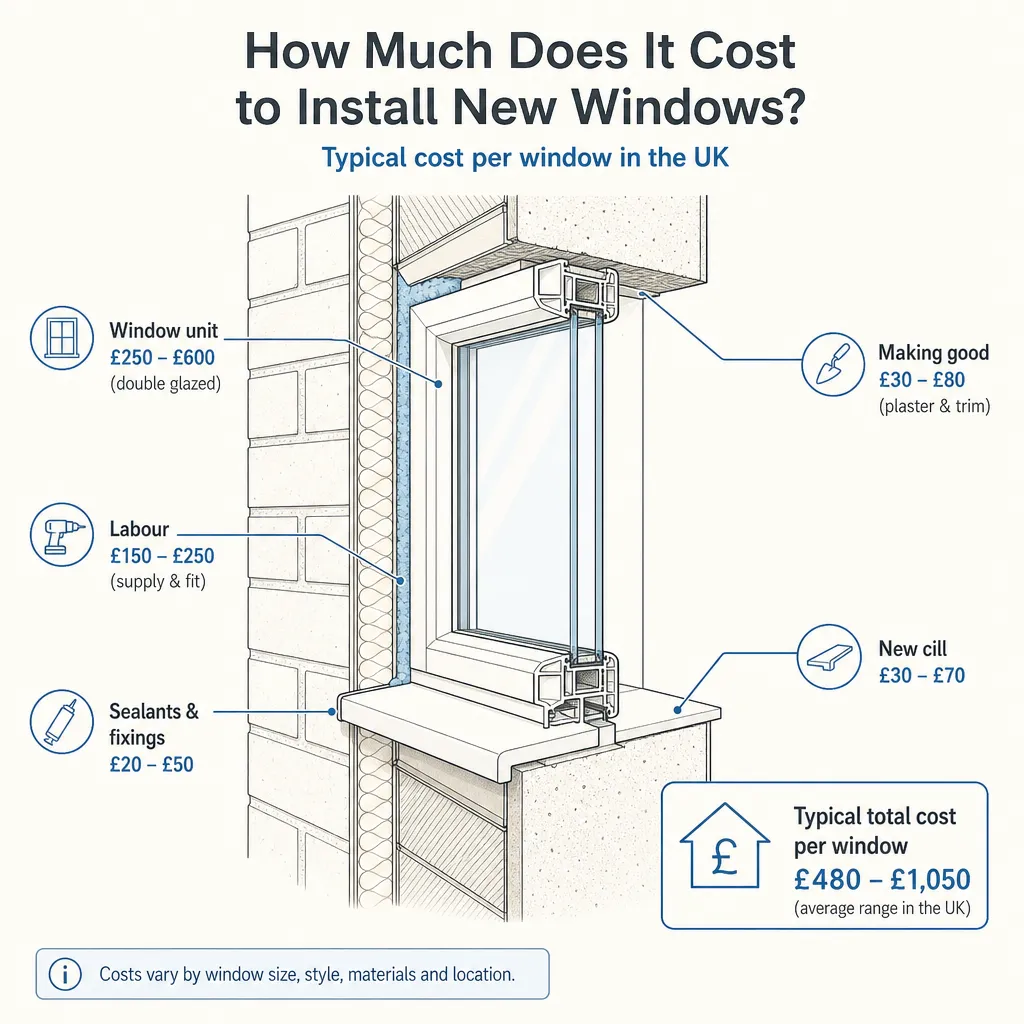
How Much Does It Cost to Install New Windows?
New window installation in the UK typically costs £300–£700 per uPVC double-glazed window (supply and fit), rising to £800–£2,500 for timber or sash windows.