Window Replacement Planning: What to Discuss With Your Installer
By Housey · Last reviewed 7th of May 2026
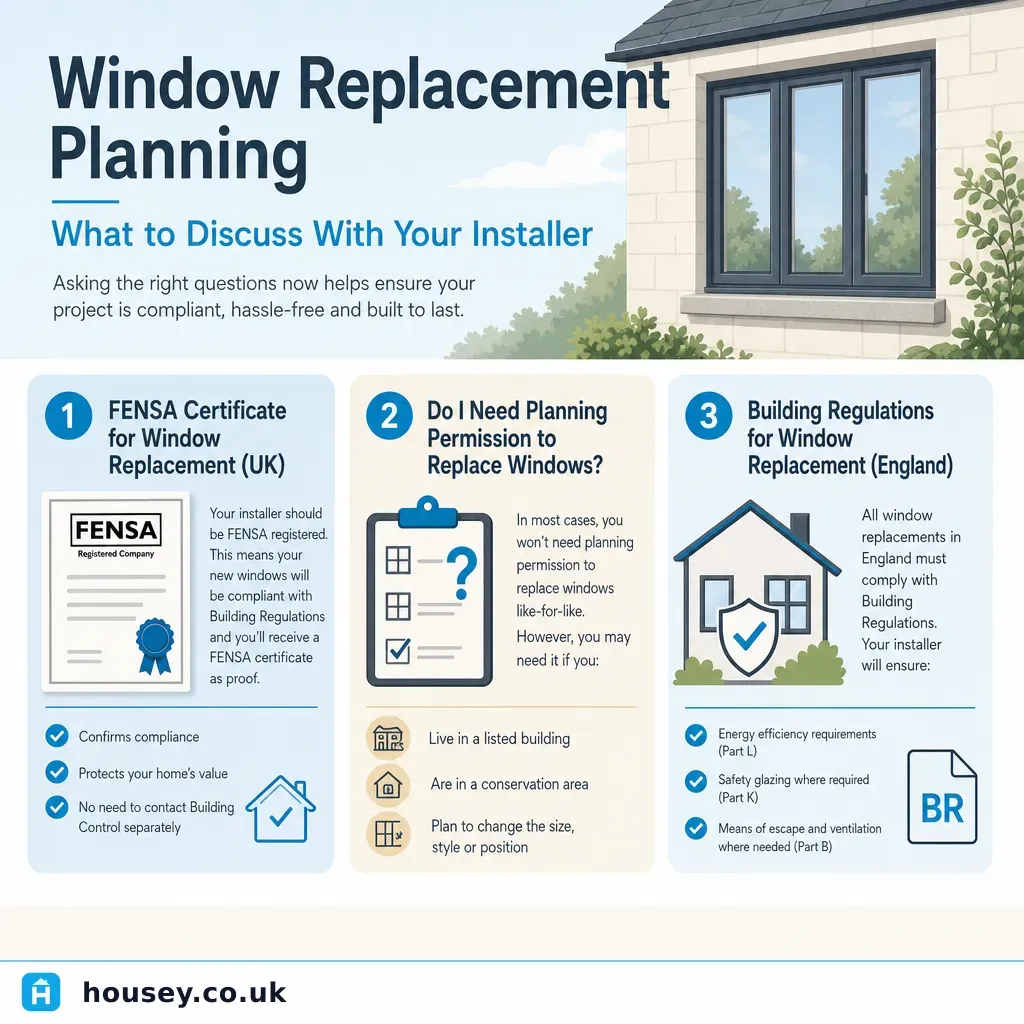
Window Replacement Planning: What to Discuss With Your Installer
Replacing windows is one of the most common home improvement projects undertaken in the UK each year, but a poorly planned installation can leave homeowners with draughts, condensation problems, compliance gaps, or a finish that clashes with the character of their property. Knowing what to raise before your first survey visit will help you get accurate quotes, avoid surprises on the day, and choose the right installer for your property type — whether a post-war semi, a 1930s terrace, or a period home in a conservation area.
Key points
- Window replacement in England and Wales must comply with Building Regulations Part L (energy performance) and Part K (safety glazing); installers registered with a competent person scheme such as FENSA or CERTASS can self-certify compliance without a separate Building Regulations application.
- In a conservation area or for a listed building, permitted development rights for window replacement are restricted or removed; planning permission or listed building consent may be required before any work begins.
- FENSA was established under the Building Act 1984 and maintains a searchable register of certified installation companies at fensa.org.uk — check any installer before signing a contract.
- Double glazing typically achieves a centre-pane U-value of around 1.1 W/m²K; triple glazing typically achieves 0.6–0.8 W/m²K, though Building Regulations assess the whole-window U-value (including frames), which is higher for both.
- A FENSA or CERTASS certificate — or a local authority completion certificate — is required when selling the property; missing certificates can delay or complicate conveyancing.
Do you need planning permission to replace windows?
Most window replacements in England fall under permitted development rights, meaning no planning application is needed. However, you will need planning permission or listed building consent if:
- Your property is a listed building — any changes to windows in all grades of listed building require listed building consent, regardless of whether the changes are visible from the street.
- Your property is in a conservation area and you are replacing front-elevation or side-elevation windows visible from a highway, where an Article 4 Direction has removed permitted development rights.
- Your property is subject to a local Article 4 Direction that specifically removes permitted development rights for window alterations.
- The replacement windows would materially alter the external appearance of the building in a way that conflicts with local planning policy.
If you are unsure, check with your local planning authority before instructing any installer. For listed buildings, speak with a conservation officer or a suitably experienced architect before specifying replacement glazing — unapproved work on a listed building is a criminal offence.
Window frame materials: what the options mean for your home
Choosing the right frame material affects appearance, maintenance requirements, thermal performance, and cost. The table below summarises the main options available in the UK market.
Frame material | Typical lifespan | Maintenance | Best for | Key considerations |
|---|---|---|---|---|
uPVC | 20–35 years | Low | Modern or post-war homes, rental properties | Can look bulky on period homes; limited standard colour palette |
Timber | 30–60+ years (with maintenance) | High | Period, listed, or conservation area properties | Higher cost; must be painted or stained regularly or will deteriorate |
Aluminium | 30–45 years | Low | Contemporary homes, large glazed openings | Requires a thermal break to comply with Part L; higher cost than uPVC |
Composite (timber/aluminium) | 30–50 years | Low externally | Period appearance with low external upkeep | Higher cost; popular in conservation areas where uPVC is discouraged |
Steel/slim section | 30–50 years | Moderate | Listed buildings, Crittall-style replacements | Specialist product; lower thermal performance due to slim profiles |
What to discuss with your installer before signing anything
Compliance and certification
- Is your company registered with FENSA or CERTASS? Will the installation be self-certified under a competent person scheme, and will I receive a certificate on completion?
- If not registered with a scheme, how will Building Regulations compliance be demonstrated? A local authority Building Regulations application and completion certificate would be required.
- Does my property have any planning constraints, Article 4 Directions, or listed building status that affects what glazing can be installed?
Specification and performance
- What whole-window U-value will the replacement windows achieve? Building Regulations Approved Document L requires replacement windows in existing dwellings to achieve a minimum whole-window U-value of 1.4 W/m²K in England — check the current Approved Document for the latest threshold.
- What glass specification are you proposing — double or triple glazed, low-emissivity (low-E) coating, gas fill (argon or krypton)?
- For aluminium frames, are they thermally broken? Without a thermal break, aluminium frames cannot comply with Part L.
Installation details
- How will you manage the reveals and make good internally and externally? Is this included in the price?
- Will existing window boards, architraves, or external sills need replacing, and is any making-good work included?
- How will background ventilation be provided? Replacement windows must include trickle ventilators where the original windows had them, under Approved Document F.
- What is the manufacturing lead time, and how long will the installation take per opening?
Warranty and aftercare
- What warranty is provided on frames, glass units, and hardware, and is it backed by an insurance-backed guarantee (IBG)?
- If a sealed unit fails — shown by misting between the panes — what is the replacement process and typical timescale?
- Are you a member of the Glass and Glazing Federation (GGF) or another recognised trade body?
Homeowner checklist: before the installer visits
Use this checklist to prepare for your first survey appointment and ensure you receive like-for-like quotes:
Red flags to watch for
The following should prompt closer scrutiny or a second quote:
- A written quote with no mention of FENSA, CERTASS, or Building Regulations compliance.
- Pressure-selling tactics or a discount offered only on the day of the survey visit.
- A specification that does not confirm the whole-window U-value or glass type in writing.
- No mention of an insurance-backed guarantee on the sealed units or the installation itself.
- Vague descriptions of what making good involves — particularly around reveals, internal sills, and architraves.
- No physical site survey before the quote is issued; accurate measurement and assessment of existing frames and reveals is essential for a reliable price.
When to get professional help
Window replacement is generally straightforward when instructed through a FENSA-registered installer. However, seek additional professional input if:
- Your home is a listed building — consult a conservation architect or the local planning authority's conservation officer before specifying any glazing.
- You are in a conservation area and are unsure whether permitted development rights apply to your specific elevation or window type.
- You are experiencing significant damp, condensation, or structural movement around window openings — these may indicate underlying problems that window replacement alone will not resolve.
- You are managing a large or complex replacement programme across a block of flats or HMO.
How Housey can help
Housey can connect you with vetted, FENSA-registered window and door installers working across the UK. Request quotes from local professionals, compare their specifications, warranties, and insurance-backed guarantees side by side, and find the right installer for your property — whether you need a standard uPVC double-glaze replacement or a bespoke timber window for a period home in a conservation area.
Frequently asked questions
Do replacement windows need Building Regulations approval?
Yes. Replacement windows must comply with Building Regulations, principally Part L (thermal performance) and Part K (safety glazing). If your installer is registered with FENSA or CERTASS, they can self-certify compliance and issue a certificate on your behalf. If not, a separate Building Regulations application to your local authority is required before or alongside the installation.
What is a FENSA certificate and why does it matter?
A FENSA certificate confirms that replacement windows were installed in compliance with Building Regulations by a scheme-registered company, and the record is held on a national register. When selling your property, your conveyancer will ask for compliance evidence for any window replacements since April 2002; a missing certificate can delay exchange or require a retrospective local authority inspection.
Can I replace windows in a conservation area?
Rules vary. In many conservation areas, Article 4 Directions remove permitted development rights for window replacement visible from a highway, meaning planning permission is required. Always check with your local planning authority before proceeding. Using materials and styles that reflect the character of the conservation area generally improves the likelihood of planning consent being granted.
Is triple glazing worth it in the UK?
Triple glazing offers better thermal performance and noise reduction than standard double glazing but typically costs 20–40% more per window. It tends to be most cost-effective in properties with high heat loss through glazing, north-facing elevations, or where noise reduction is a priority. Ask your installer to model the improvement in whole-window U-value and likely payback period for your specific property before committing.
What is an insurance-backed guarantee (IBG) for windows?
An IBG is a warranty policy protecting you if the installer ceases trading during the guarantee period. If the company goes out of business, the IBG provider honours valid claims for defects covered under the original guarantee. Reputable FENSA-registered and GGF-member installers typically offer IBGs. Check the duration, what is covered, and the financial strength of the IBG provider before signing.
Sources and further reading
- FENSA — Check a company or find a registered installer — FENSA
- GOV.UK — Building Regulations: windows, doors and rooftop windows — GOV.UK
- Approved Document L: Conservation of fuel and power — Ministry of Housing, Communities and Local Government
- Planning Portal — Conservation areas — Planning Portal
- Glass and Glazing Federation — Consumer guidance — Glass and Glazing Federation
- Historic England — Owning a historic property — Historic England
Useful next reads
 Improvement & Build
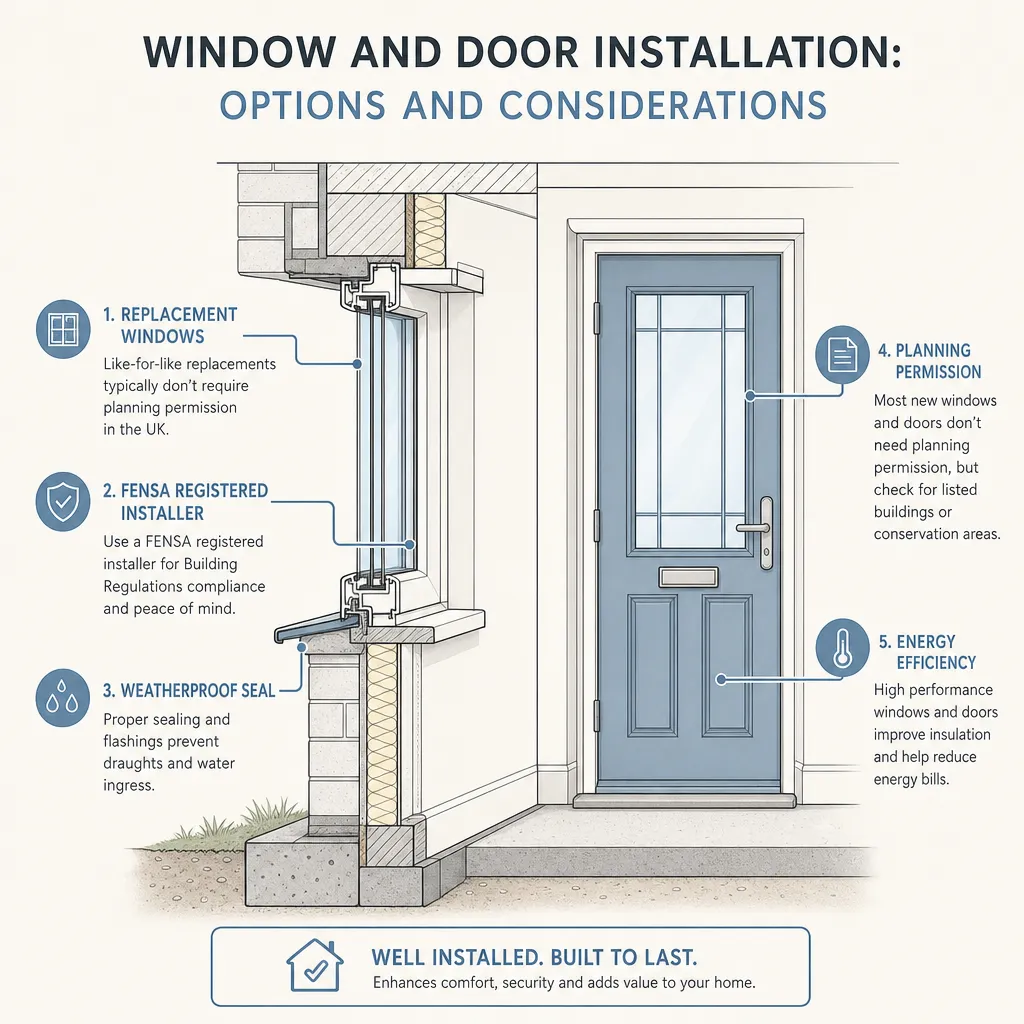
Window and Door Installation: Options and Considerations
Replacing windows and external doors in the UK requires compliance with Building Regulations Part L (thermal performance) and Part K (safety glazing).
 Improvement & Build
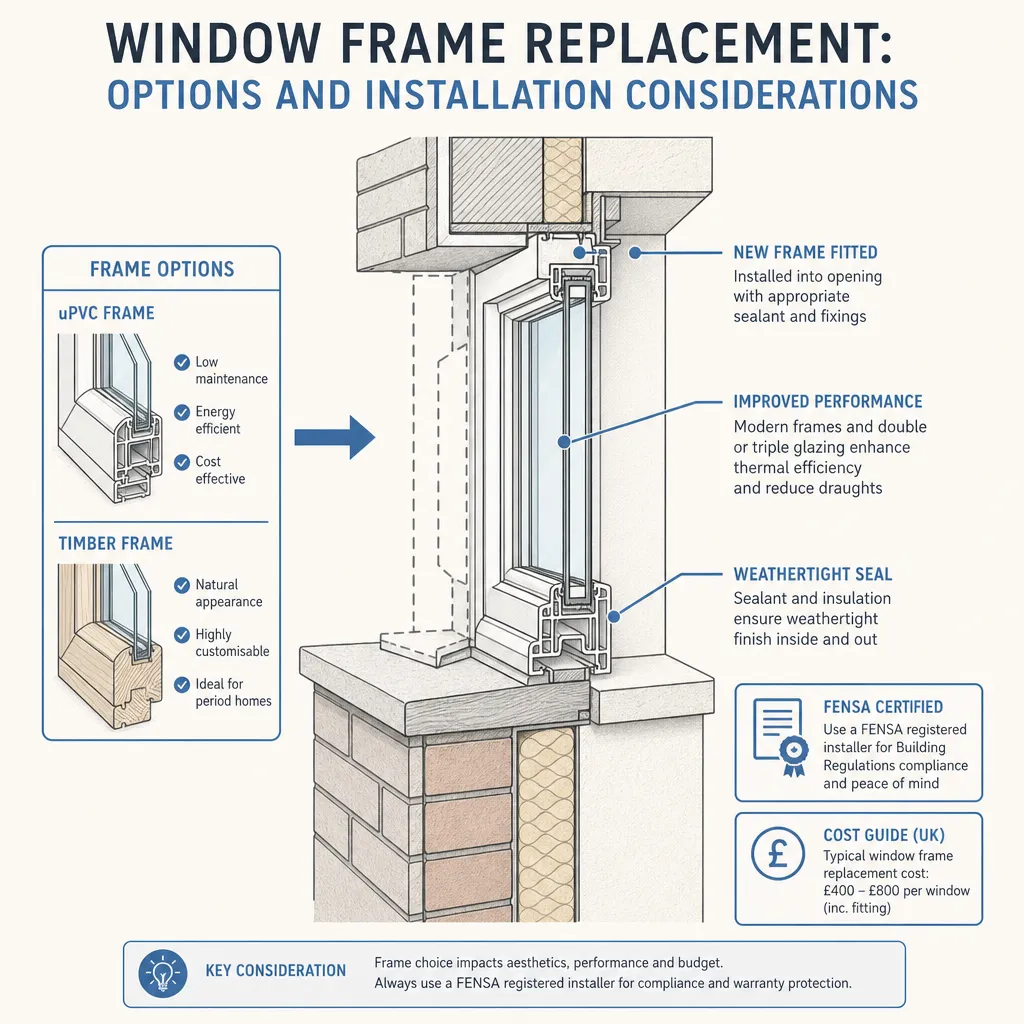
Window Frame Replacement: Options and Installation Considerations
Replacing window frames in the UK requires compliance with Part L of the Building Regulations and, in most cases, a FENSA or Certass certificate.
 Improvement & Build
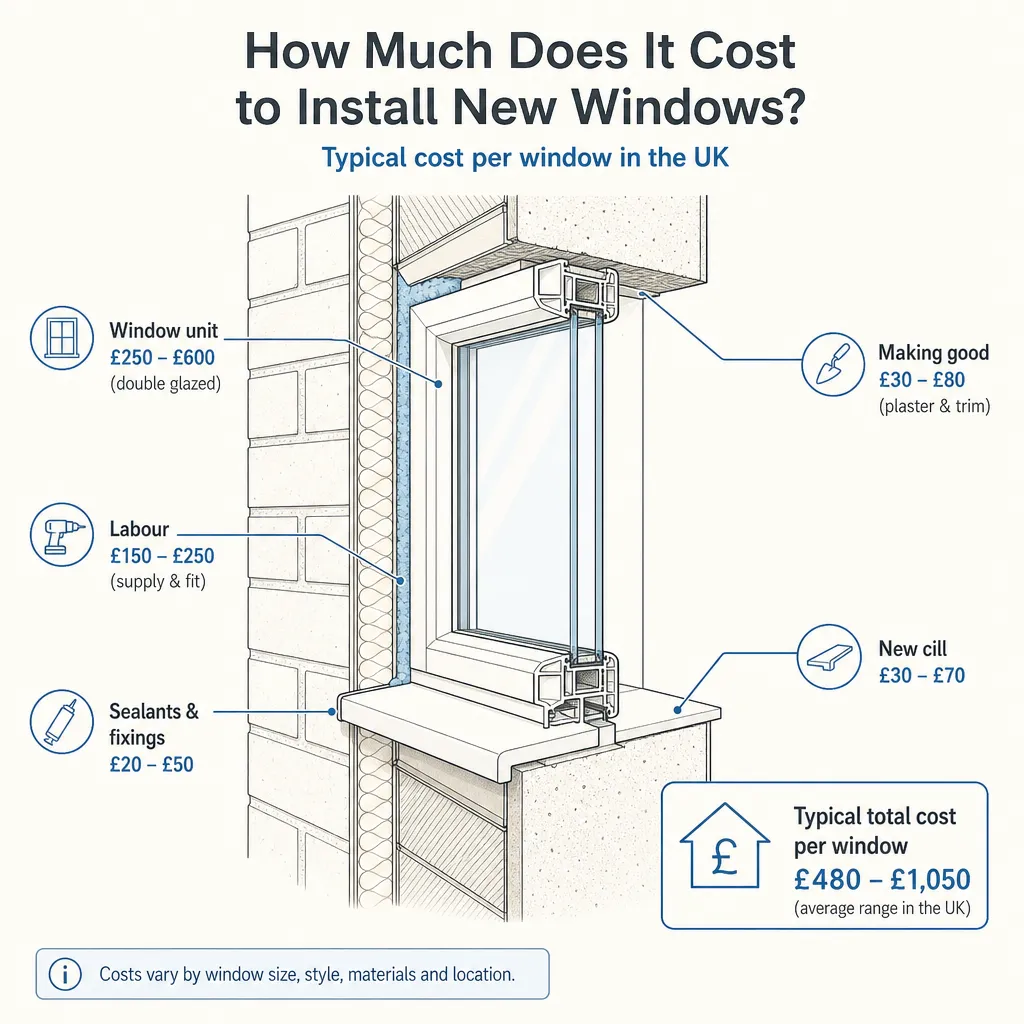
How Much Does It Cost to Install New Windows?
New window installation in the UK typically costs £300–£700 per uPVC double-glazed window (supply and fit), rising to £800–£2,500 for timber or sash windows.
 Improvement & Build
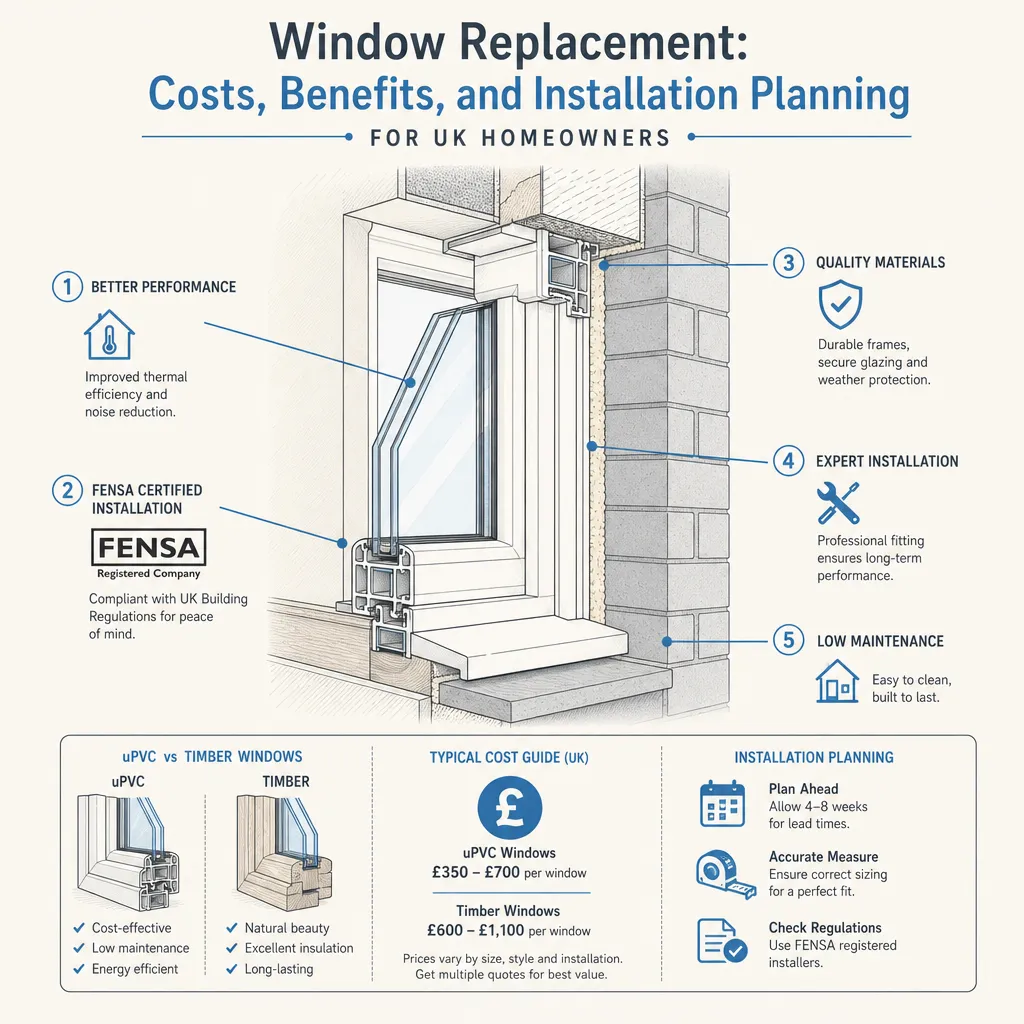
Window Replacement: Costs, Benefits, and Installation Planning
Replacing windows in most UK homes is permitted development but must meet Building Regulations Part L, requiring a whole-window U-value of 1.
 Improvement & Build
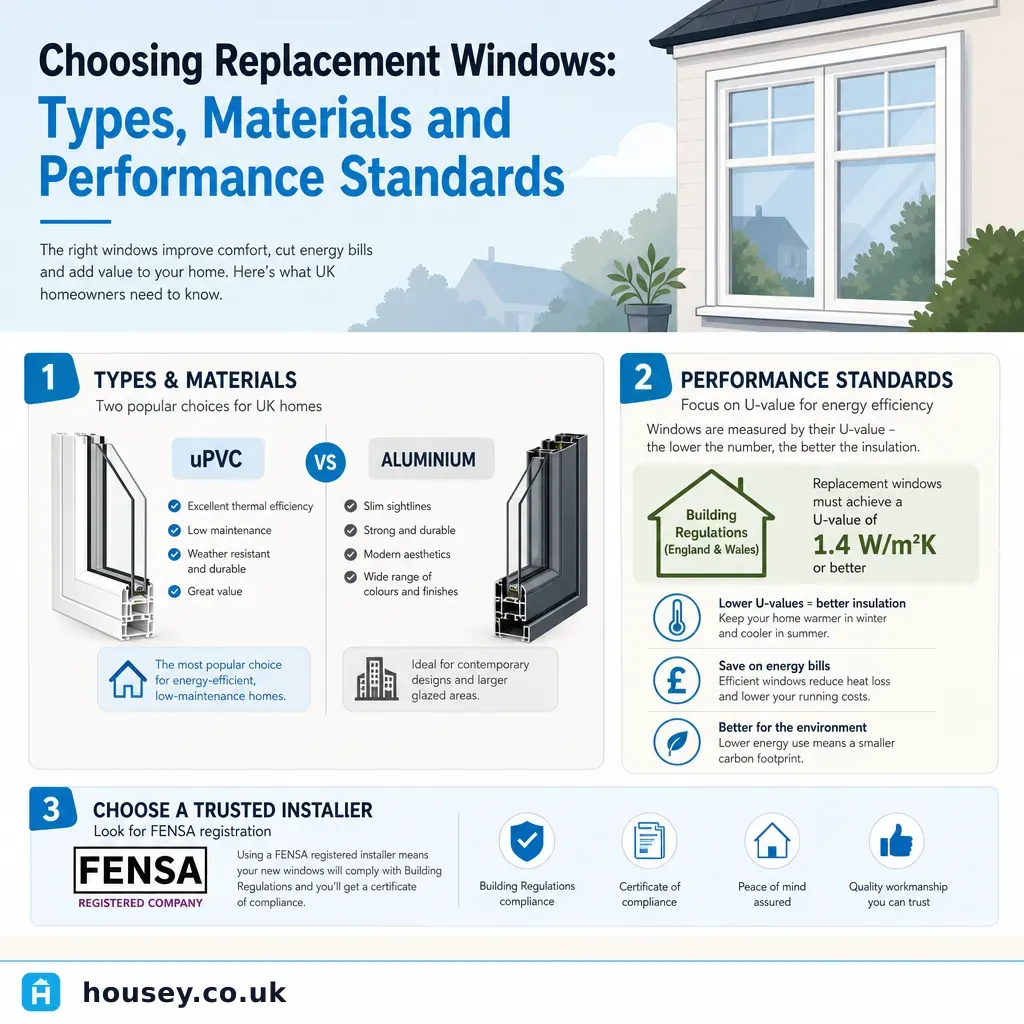
Choosing Replacement Windows: Types, Materials and Performance Standards
Replacement windows in the UK must meet a whole-window U-value of 1.