Winterising Your Central Heating System
By Housey · Last reviewed 11th of May 2026
Winterising Your Central Heating System
As temperatures drop through October and November, UK homeowners routinely face the same question: is the heating system ready for the season, and has anything deteriorated since it last ran? The question matters most for properties left empty over summer, for owners of older boilers approaching the end of their service life, and for landlords where a heating failure could cause pipe damage or leave tenants without heat.
Key points
- Annual boiler servicing must be carried out by a Gas Safe registered engineer for gas systems; this is a legal requirement for landlords under the Gas Safety (Installation and Use) Regulations 1998 and strongly recommended for owner-occupiers.
- Central heating inhibitor concentration should be checked and topped up annually — typically around 1 litre of product per 10 litres of system water, though always follow the specific product manufacturer's guidance.
- System pressure on a sealed (pressurised) heating system should sit between 1.0 and 1.5 bar when cold; a reading below 0.8 bar usually indicates a leak or a failing pressure relief valve.
- Radiators that are cold at the top but warm at the bottom contain trapped air and need bleeding — a simple task with a radiator key that does not require a gas engineer.
- Leaving a heating system set to frost protection (typically 7–10 °C) in a vacant property is usually safer than a full drain-down, which carries risks of trapped water, airlocks, and re-pressurisation errors.
What winterising actually involves
In a UK context, the term covers two distinct situations:
- Preparing an occupied home's heating system for active seasonal use — bleeding radiators, checking pressure, topping up inhibitor, and arranging a boiler service.
- Preparing a system in a property that will be left unoccupied — deciding between frost protection, partial drain-down, or full drain-down.
Most owner-occupiers need the first scenario. The second applies to holiday homes, rental voids, probate properties, and homes being sold or undergoing major works.
Which approach is right for your situation?
- Choose annual boiler service and pre-season checks if the property is occupied and the heating will run through winter — this covers the vast majority of UK households.
- Choose frost protection mode if the property will be unoccupied for a few weeks to several months, has a functioning boiler, and the electricity supply will remain on to run the programmer or smart thermostat.
- Choose partial drain-down (draining exposed pipework, external tap feeds, and the hot water cylinder) if the property will be empty all winter and there is any risk that the heating may fail.
- Choose full drain-down if the boiler is being replaced, significant repairs are planned, or the property will be without power and heat for an extended period. Plan this with a Gas Safe registered engineer — do not attempt a full drain-down of a sealed system without professional guidance.
- Call a Gas Safe registered engineer immediately if you notice a gas smell, yellow or irregular boiler flame, excessive condensate discharge, a persistent fault code, or if a carbon monoxide alarm activates.
Preparing an occupied home's system for winter
Step 1 — Arrange a boiler service
Book early: Gas Safe engineers are in high demand from September onwards. A service typically includes checking the heat exchanger, burner, controls, flue integrity, and safety devices. It is the single most important step in winter preparation. Ask whether inhibitor testing is included, as some engineers charge separately.
Step 2 — Check and repressurise the system
On a sealed system, find the pressure gauge — usually on the boiler's front panel. If it reads below 1.0 bar, repressurise using the filling loop: a short braided hose connecting cold mains water to the central heating circuit. Open the valves slowly, watch the gauge, and stop at 1.2–1.5 bar. If the system loses pressure repeatedly within a short period, a leak or failing pressure relief valve needs investigation by a qualified engineer.
Step 3 — Bleed the radiators
Starting from the radiator farthest from the boiler, use a radiator key to open the bleed valve — a square-headed brass fitting on the upper side of the radiator — a quarter turn anti-clockwise. Hold a cloth beneath. When water runs steadily rather than air, close the valve. Bleeding reduces system pressure slightly; check the gauge and repressurise if needed after completing all radiators.
Step 4 — Check and top up inhibitor
Corrosion inhibitor — such as Fernox F1 or Sentinel X100 — protects the system against rust and sludge build-up. A test strip or liquid test kit (available at builders' merchants) checks concentration. If levels are low, top up via a radiator bleed valve, the feed-and-expansion tank on open-vented systems, or a dedicated inhibitor pot on sealed systems. If the system has never been treated, a power flush may be advisable before adding inhibitor.
Step 5 — Check thermostatic radiator valves (TRVs)
TRVs can seize over summer when they are not in regular operation. Turn each valve by hand to confirm it moves freely. A seized TRV keeps a radiator either permanently hot or permanently cold, wasting energy or leaving rooms unheated.
Step 6 — Confirm frost protection settings
Ensure the programmer's frost protection function is set to at least 7 °C. On smart thermostats such as Nest, Hive, or Tado, this is usually an away or frost-protect mode. Test the setting by temporarily lowering the temperature to confirm the boiler fires correctly.
Homeowner winterisation checklist
Important limitations
This article provides general guidance for UK homeowners on common central heating maintenance tasks. It does not constitute professional or safety advice. Any work on gas appliances, boiler repairs, flue inspections, and consumer-unit electrical connections must only be carried out by a qualified, registered professional. Landlords have specific legal obligations under the Gas Safety (Installation and Use) Regulations 1998, including an annual Gas Safety Certificate (CP12) for all gas appliances in rented properties. Rules and best practice vary by system type — open-vented, sealed pressurised, combination boiler, or heat pump — and by boiler manufacturer. If in doubt, seek professional advice before carrying out any work.
When this becomes urgent
Seek professional help without delay if:
- You can smell gas — leave the property immediately, do not operate electrical switches, and call the National Gas Emergency Service on 0800 111 999.
- The boiler flame is yellow or orange rather than crisp blue — a possible sign of incomplete combustion and carbon monoxide risk.
- A carbon monoxide alarm is sounding — treat this as an emergency.
- The boiler is displaying a persistent fault code and will not reset after following the manufacturer's guidance.
- Radiators remain cold after bleeding and repressurising.
- There is visible water damage, dripping, or corrosion around the boiler, pipes, or radiator valves.
- You or household members experience unexplained headaches, dizziness, or nausea when in the property.
What to ask a qualified professional
Before instructing a Gas Safe registered engineer or heating contractor, ask:
- Are you Gas Safe registered, and can I verify your registration number at gassaferegister.co.uk?
- What does your annual service include — specifically, will you test inhibitor concentration and check the condensate pipe?
- How old is the boiler, and is it worth servicing or more cost-effective to replace?
- If sludge or low inhibitor is found, do you recommend a power flush, and what would that involve and cost?
- Is the condensate pipe properly insulated and correctly routed to a drain to prevent freezing?
- For a vacant property: what drain-down procedure do you recommend, and will you provide written instructions for refilling and recommissioning?
- Will you provide a Gas Safety Certificate (CP12) at the end of the service, and is that included in the quoted price?
How Housey can help
If you are considering moving away from gas heating entirely, Housey can connect you with heat pump survey specialists who can assess whether your home is a suitable candidate. For a broader view of improving your property's energy performance alongside seasonal heating maintenance, an energy-efficiency consultant can identify the highest-impact measures for your home and budget.
Frequently asked questions
Can I bleed radiators myself, or do I need a Gas Safe engineer?
Bleeding radiators is a straightforward DIY task that does not involve the gas circuit and does not require a Gas Safe registered engineer. You need a radiator key (available at hardware shops for about £1–£2) and a cloth. After bleeding, check the boiler pressure gauge and repressurise via the filling loop if it has dropped below 1.0 bar.
How often should a gas boiler be serviced in the UK?
Gas boilers should be serviced annually by a Gas Safe registered engineer. For landlords, an annual Gas Safety Certificate (CP12) is a legal requirement under the Gas Safety (Installation and Use) Regulations 1998. For owner-occupiers, annual servicing is strongly recommended to maintain warranty conditions, system efficiency, and safety.
What is corrosion inhibitor and why does it matter for central heating?
Corrosion inhibitor is a chemical added to central heating system water to prevent rust and scale build-up inside radiators, pipes, and the boiler's heat exchanger. Without it, magnetite sludge and scale accumulate, reducing efficiency, causing cold spots, and shortening the boiler's lifespan. It should be checked and topped up annually.
What happens if a condensate pipe freezes on a condensing boiler?
On condensing boilers, a frozen condensate pipe — which carries acidic wastewater from the flue to the drains — causes the boiler to lock out. You may be able to thaw an accessible pipe with warm (not boiling) water. If the pipe is inaccessible or the boiler continues to lock out, call a Gas Safe registered engineer.
Sources and further reading
- Gas Safe Register — find a registered engineer — Gas Safe Register
- HSE — Gas Safety (Installation and Use) Regulations 1998 — Health and Safety Executive
- Energy Saving Trust — heating your home efficiently — Energy Saving Trust
- Heating and Hot Water Industry Council — system water quality — HHIC
Useful next reads
 Energy & Retrofit
Heat Pump Servicing and Maintenance: Regular Care and Costs
Heat pumps should be serviced by a qualified engineer once a year; most manufacturers require this to keep the warranty valid.
 Energy & Retrofit
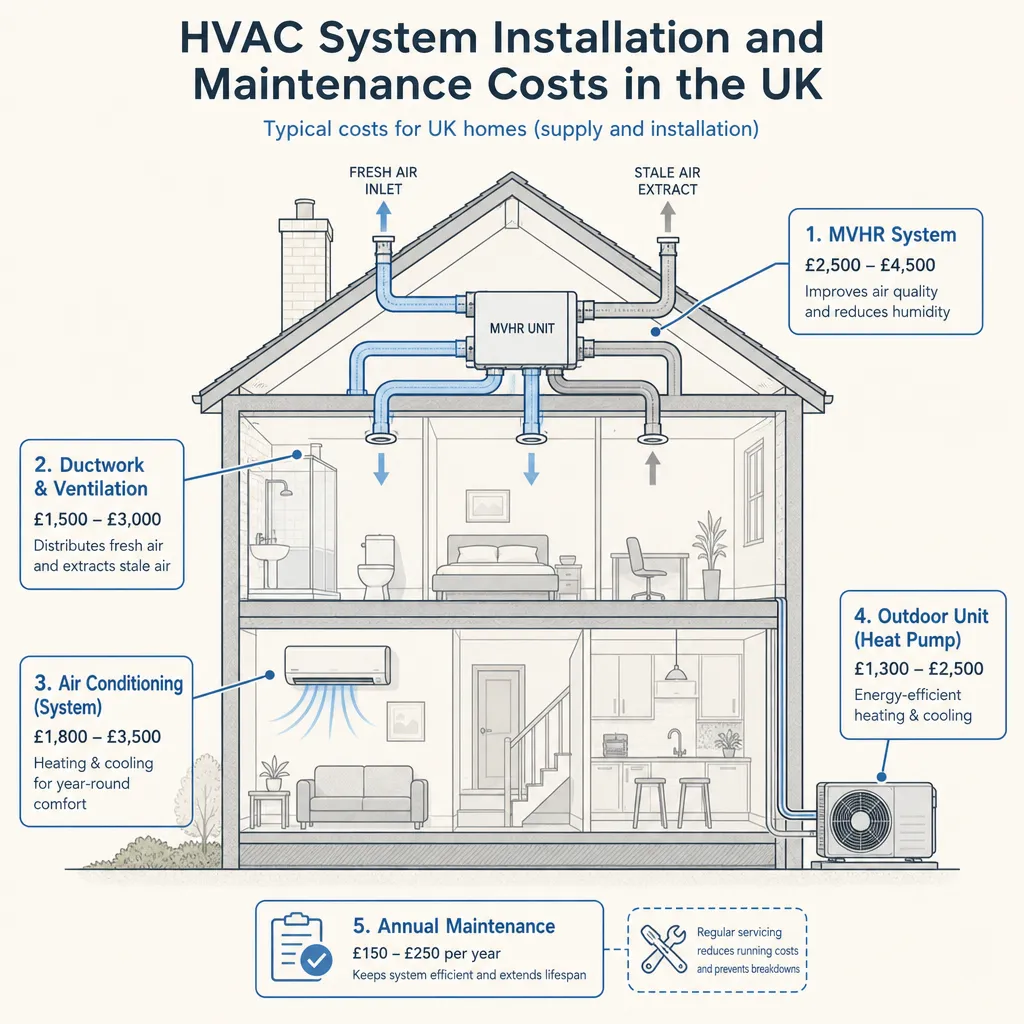
HVAC System Installation and Maintenance Costs in the UK
HVAC costs in UK homes vary by system type.
 Energy & Retrofit
Gas Central Heating Running Costs and Budget Planning
Running gas central heating in the UK typically costs £900–£1,400 per year for a medium-sized home, based on Ofgem's typical domestic consumption values.
 Energy & Retrofit
Professional solar panel inspection: what to expect and why it matters
A professional solar panel inspection typically takes 1–3 hours and covers visual panel condition, mounting hardware, inverter performance, wiring integrity, and often thermal imaging to detect hidden faults.
 Energy & Retrofit
Budget for converting warm air heating to a modern system
Converting a warm air heating system to wet central heating typically costs £5,000–£15,000 in the UK, depending on property size, system choice, and pipework complexity.