Gas Central Heating Running Costs and Budget Planning
By Housey · Last reviewed 6th of May 2026
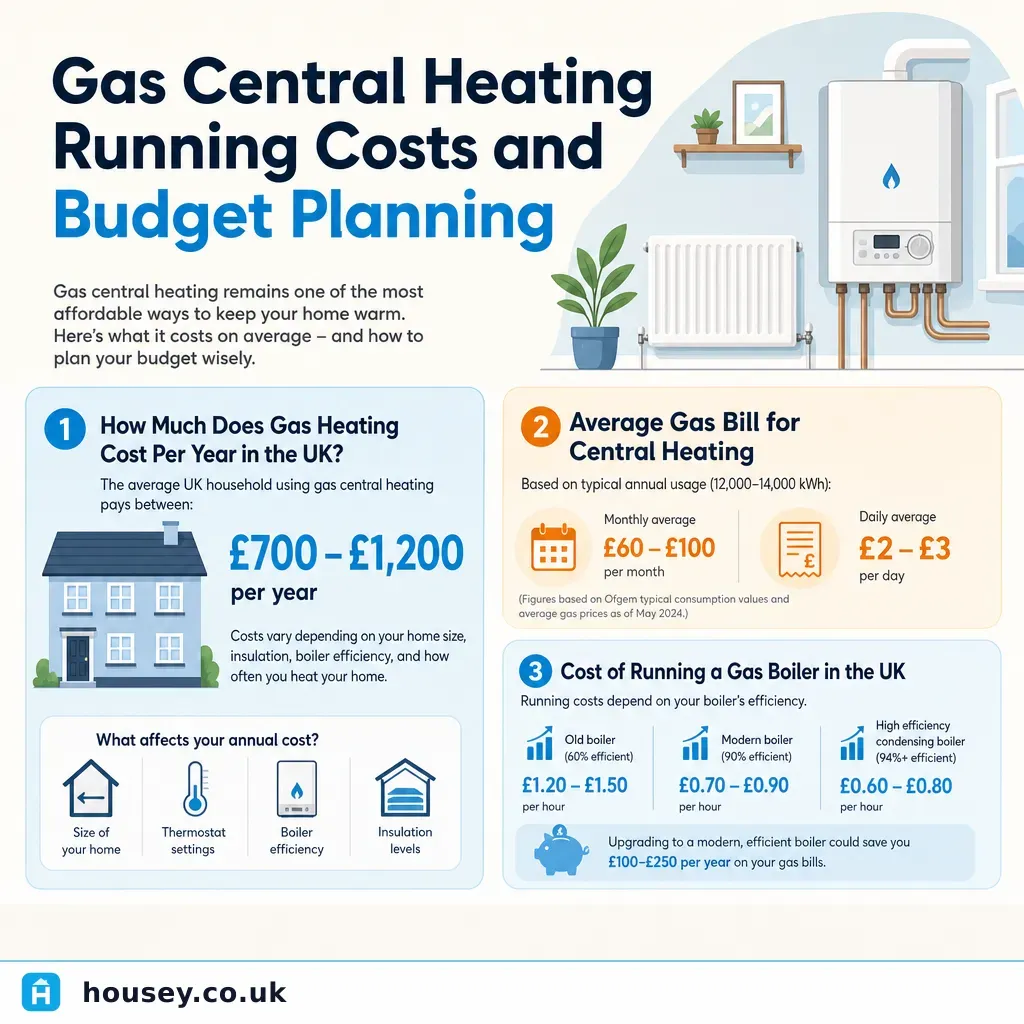
Gas Central Heating Running Costs and Budget Planning
Understanding the true annual cost of running gas central heating helps UK homeowners budget accurately, evaluate alternatives, and identify where savings are possible. Costs typically come into sharp focus when energy bills rise unexpectedly, when a boiler is approaching the end of its useful life, or when a household is weighing whether to switch to a heat pump or another low-carbon system. The figures involved vary more than most homeowners expect — and the assumptions people make about them are often wrong.
Key points
- A medium-sized UK home typically uses 11,000–15,000 kWh of gas per year for space heating and hot water, according to Ofgem's typical domestic consumption values.
- The Ofgem Energy Price Cap sets the maximum unit rate suppliers can charge on default tariffs — reviewed quarterly, it directly determines the upper limit of your annual gas bill.
- A modern A-rated condensing boiler operates at around 89–93% seasonal efficiency; a pre-2005 boiler may be as low as 60–70%, wasting up to 30–40p in every £1 spent on gas.
- The annual Gas Safe boiler service — typically £80–£150 — is a legal requirement for landlords and strongly recommended for owner-occupiers for both safety and efficiency.
- Reducing your thermostat setpoint by 1°C typically cuts space-heating energy consumption by approximately 10%, according to CIBSE guidance.
What does it cost to run gas central heating in the UK?
Gas heating costs depend on four main variables: the size and insulation level of your home, the efficiency of your boiler, your thermostat and usage behaviour, and the prevailing gas unit price under the Ofgem Energy Price Cap.
Indicative annual costs by property size
The table below uses Ofgem's typical domestic consumption values as a reference point. Actual bills will differ based on tariff, usage habits, insulation quality, and boiler efficiency.
Property type | Typical gas consumption | Indicative annual cost at 6.0p/kWh | Notes |
|---|---|---|---|
Small flat or 1-bed property | 8,000–10,000 kWh | £480–£600 | Lower consumption; often single-zone heating |
2–3 bed semi-detached | 11,000–15,000 kWh | £660–£900 | Most common UK household profile |
3–4 bed detached (cavity walls, insulated) | 14,000–18,000 kWh | £840–£1,080 | Varies significantly by insulation quality |
Older detached (solid walls, poor insulation) | 18,000–28,000 kWh | £1,080–£1,680 | High consumption; retrofit often cost-effective |
Indicative UK costs, last reviewed 2026-05-06. Based on Ofgem typical domestic consumption values. The illustrative gas unit rate of 6.0p/kWh is used for comparison only — check the current Ofgem Energy Price Cap and your own tariff for accurate figures.
What drives the difference in costs?
Boiler efficiency: A boiler installed before 2005 may have a seasonal efficiency of 70% or lower, meaning a significant fraction of every £1 spent on gas is lost as waste heat through the flue. Replacing it with a modern condensing boiler rated 92%+ can reduce gas consumption by 20–30%.
Home insulation: The Energy Saving Trust estimates that loft insulation alone can save £150–£300 per year in a typical semi-detached home. Cavity wall insulation can save a further £100–£200 annually. Figures vary by property size, construction type, and tariff.
Thermostat behaviour: Reducing your heating setpoint by 1°C typically reduces space-heating energy use by approximately 10% (CIBSE). Programming heating around occupancy rather than running it continuously can deliver further meaningful savings.
Boiler controls: Smart thermostats with weather compensation, room-by-room control via smart thermostatic radiator valves (TRVs), and hot water scheduling can reduce gas use by 10–20% in many homes without changing the boiler.
What not to assume about gas heating costs
A number of widespread assumptions lead UK homeowners to make poor decisions about gas heating costs and upgrades.
Don't assume your current boiler is efficient: Many UK homes still have pre-2005 boilers rated E, F, or G under the ErP energy labelling system. If your boiler was installed before 2005 and has not been replaced, its real-world efficiency may be well below the original nameplate figure due to age-related wear and component degradation.
Don't assume a new gas boiler is always the cheapest long-term path: If you plan to stay in the property for ten or more years and your insulation is poor, the cost-benefit case for a phased retrofit — fabric improvements followed by a heat pump — may be stronger than a like-for-like boiler replacement, particularly as the gas-to-electricity price ratio shifts.
Don't assume your direct debit reflects your actual consumption: Many energy suppliers estimate monthly direct debits based on past usage or regional averages. Submit regular meter readings or install a smart meter to ensure you are paying for what you actually use, not an estimate that may be significantly out of date.
Don't assume a gas boiler can always be swapped like-for-like: Condensate drainage requirements, flue positions, and system pressure ratings differ between boiler models and manufacturers. Changing make or model may require additional pipework or flue modifications. Always have a Gas Safe registered engineer survey the installation before accepting a quote.
Don't assume heat pump running costs will always be higher than gas: The comparison depends on the prevailing gas-to-electricity price ratio and the heat pump's Coefficient of Performance (COP) in your specific property. As electricity prices fall with increased renewable generation and gas prices remain volatile, the running cost gap narrows. Use current tariff data and a qualified assessor's COP estimate for an accurate comparison.
Gas boiler vs air source heat pump: cost comparison
Factor | Gas boiler | Air source heat pump |
|---|---|---|
Fuel type | Mains natural gas | Electricity |
Typical seasonal efficiency | 89–93% (modern condensing) | 250–350% COP-equivalent (varies by installation) |
Indicative annual fuel cost (medium home) | £900–£1,400 | £800–£1,600 (varies by tariff and COP) |
Carbon intensity | Higher (natural gas) | Lower and falling with grid decarbonisation |
Typical installed cost | £2,000–£4,500 | £10,000–£18,000 (before £7,500 BUS grant) |
Suitable for poorly insulated homes? | Yes, with caveats on efficiency | Usually not without prior fabric upgrade |
Regulatory requirement for installation | Gas Safe registered engineer | MCS-certified heat pump engineer |
Indicative UK costs, last reviewed 2026-05-06. Running costs vary significantly by property, usage patterns, and tariff.
Homeowner checklist: controlling your gas heating costs
Important limitations
This article provides general guidance on gas central heating costs for UK homeowners. Gas prices, efficiency standards, and regulatory requirements change frequently. The Ofgem Energy Price Cap is reviewed quarterly — unit rates used in this article are illustrative only. Check Ofgem's website and your own tariff for current figures.
Gas safety is regulated by law in Great Britain. Any work on gas appliances — including servicing, repair, installation, and flue modification — must be carried out by a Gas Safe registered engineer. Do not attempt to work on gas appliances yourself. If you smell gas, leave the building immediately and call the National Gas Emergency Service on 0800 111 999.
This article does not constitute professional energy, heating system, or gas safety advice.
What to ask a qualified professional
Before instructing a Gas Safe engineer, boiler installer, or energy assessor:
- Are you registered with Gas Safe, and can I verify your registration number on the Gas Safe Register website?
- What is the SEDBUK rating of the boiler you are recommending, and what ErP efficiency band does it carry?
- Is my current flue position, condensate pipe route, and system pressure compatible with the replacement model?
- What controls — smart thermostat, TRVs, hot water programmer — are included in the quote, and what are the cost implications of each?
- What warranty does the boiler carry, and what are the annual service requirements to keep the warranty valid?
- Given my EPC rating and boiler age, would a wider retrofit assessment be worthwhile before committing to a replacement?
When to get professional help
Contact a Gas Safe registered engineer immediately if you:
- Smell gas or suspect a gas leak — also call the National Gas Emergency Service on 0800 111 999
- Notice the boiler flame is yellow or orange rather than blue
- Have a carbon monoxide alarm alerting, or anyone in the household has symptoms of CO poisoning (headache, nausea, dizziness, confusion)
- See fault codes on your boiler display that you cannot resolve via the manufacturer's manual
- Notice water leaking from the boiler body or adjacent pipework
Contact a qualified energy assessor or Retrofit Coordinator if:
- Your annual gas bill exceeds £1,500 and you want a systematic plan to reduce consumption
- You are considering switching to a heat pump or another low-carbon heating system
- Your EPC rating is E, F, or G — particularly if you are a landlord subject to Minimum Energy Efficiency Standards (MEES)
How Housey can help
Housey helps UK homeowners find and compare quotes from qualified service providers. If you are considering a retrofit assessment to reduce your gas consumption, exploring insulation measures to improve your EPC rating, or evaluating whether a heat pump is suitable for your property, Housey can help you request quotes from accredited professionals in your area.
Frequently asked questions
How much does it cost to run a gas boiler per hour in the UK?
A typical gas boiler uses 24–35 kW at full output. At a gas unit rate of around 6p per kWh, this equates to roughly £1.44–£2.10 per hour of full-output operation. Modern condensing boilers modulate their output based on demand, so actual per-hour costs are usually lower than the full-output figure. Annual running costs are a more useful planning figure than hourly rates.
Is it worth replacing my old gas boiler before it breaks down?
Usually yes, if your boiler is over 15 years old. Older boilers often operate at 70% efficiency or below, versus 92%+ for a modern condensing model — meaning you pay significantly more per unit of heat delivered. A Gas Safe registered engineer or energy assessor can estimate likely savings and help you weigh proactive replacement against waiting for the boiler to fail.
Can I reduce my gas heating bill without replacing the boiler?
Yes. Improving loft insulation, sealing draughts, bleeding radiators, and fitting smart thermostat controls can collectively reduce gas consumption by 15–30% in many homes. These measures often cost less than a new boiler and should be considered first if the boiler is relatively modern and well-maintained, and annual servicing is up to date.
What is the Ofgem Energy Price Cap and how does it affect my gas bill?
The Ofgem Energy Price Cap sets the maximum unit rate and standing charge that energy suppliers can charge domestic customers on default tariffs in England, Scotland, and Wales. It is reviewed quarterly. It does not cap your total bill — your annual spend still depends on how much gas you consume. Check the current cap on Ofgem's website for up-to-date figures.
Do landlords have to service gas boilers every year?
Yes. Under the Gas Safety (Installation and Use) Regulations 1998, landlords in Great Britain must have all gas appliances, fittings, and flues checked by a Gas Safe registered engineer at least once a year. A copy of the Gas Safety Record must be provided to tenants within 28 days of the check. Owner-occupiers are not legally required to service annually, but it is strongly recommended for safety and to maintain efficiency.
Sources and further reading
- Typical domestic consumption values — Ofgem
- Energy Price Cap — Ofgem
- Gas Safety (Installation and Use) Regulations 1998 — legislation.gov.uk
- Gas Safe Register: find a registered engineer — Gas Safe Register
- Heating and hot water advice — Energy Saving Trust
- National Gas Emergency Service — National Gas
Useful next reads
 Energy & Retrofit
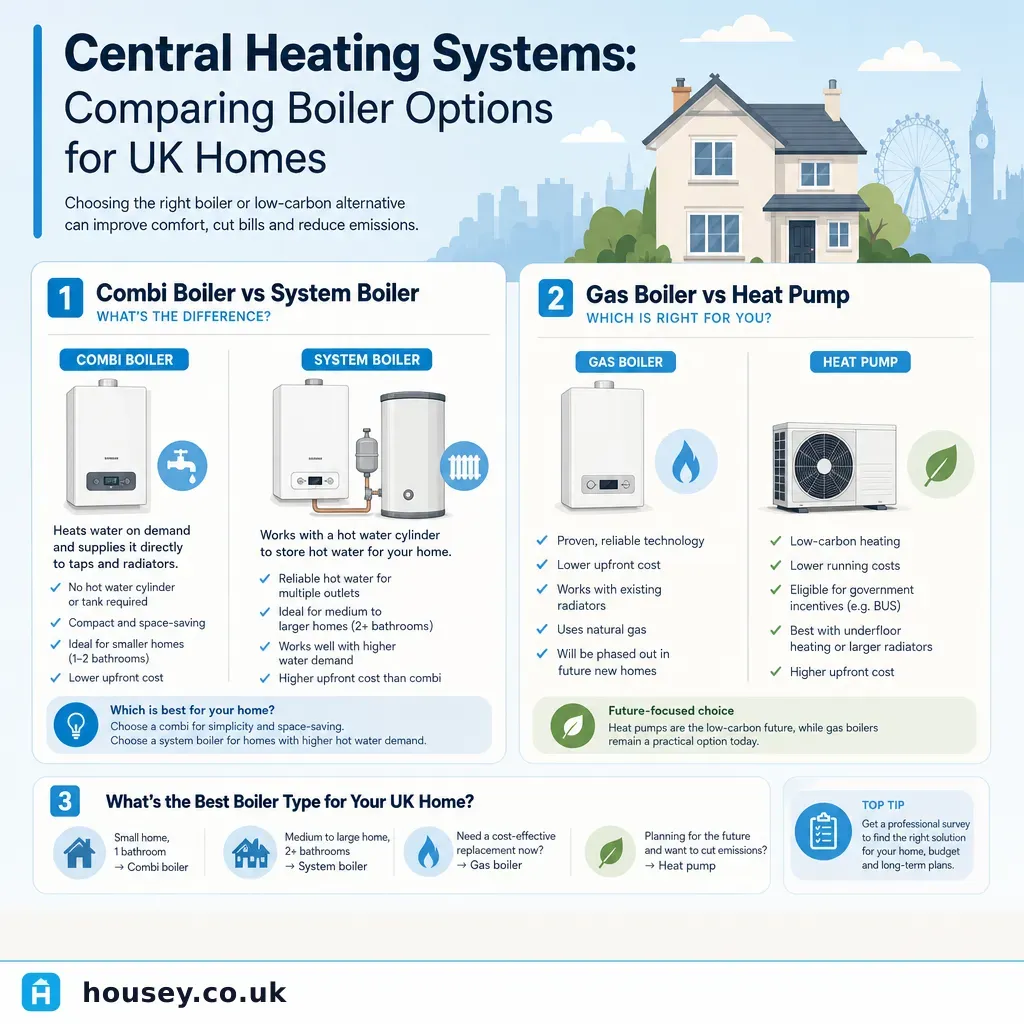
Central Heating Systems: Comparing Boiler Options for UK Homes
UK homes are generally heated by a combi boiler (no cylinder needed), system boiler (needs a hot water cylinder), or regular boiler (needs both a cylinder and cold-water tank).
 Energy & Retrofit
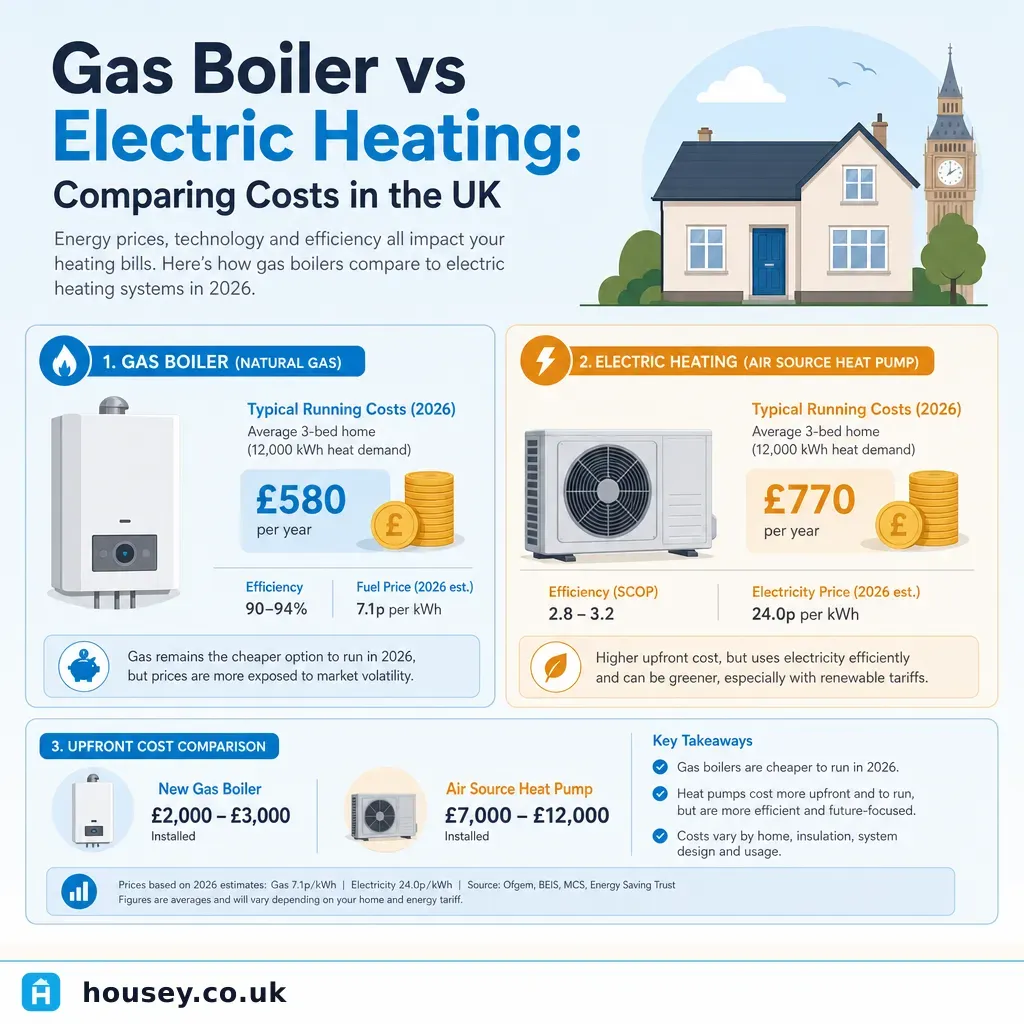
Gas Boiler vs Electric Heating: Comparing Costs in the UK
Gas boilers currently cost around 6.
 Energy & Retrofit
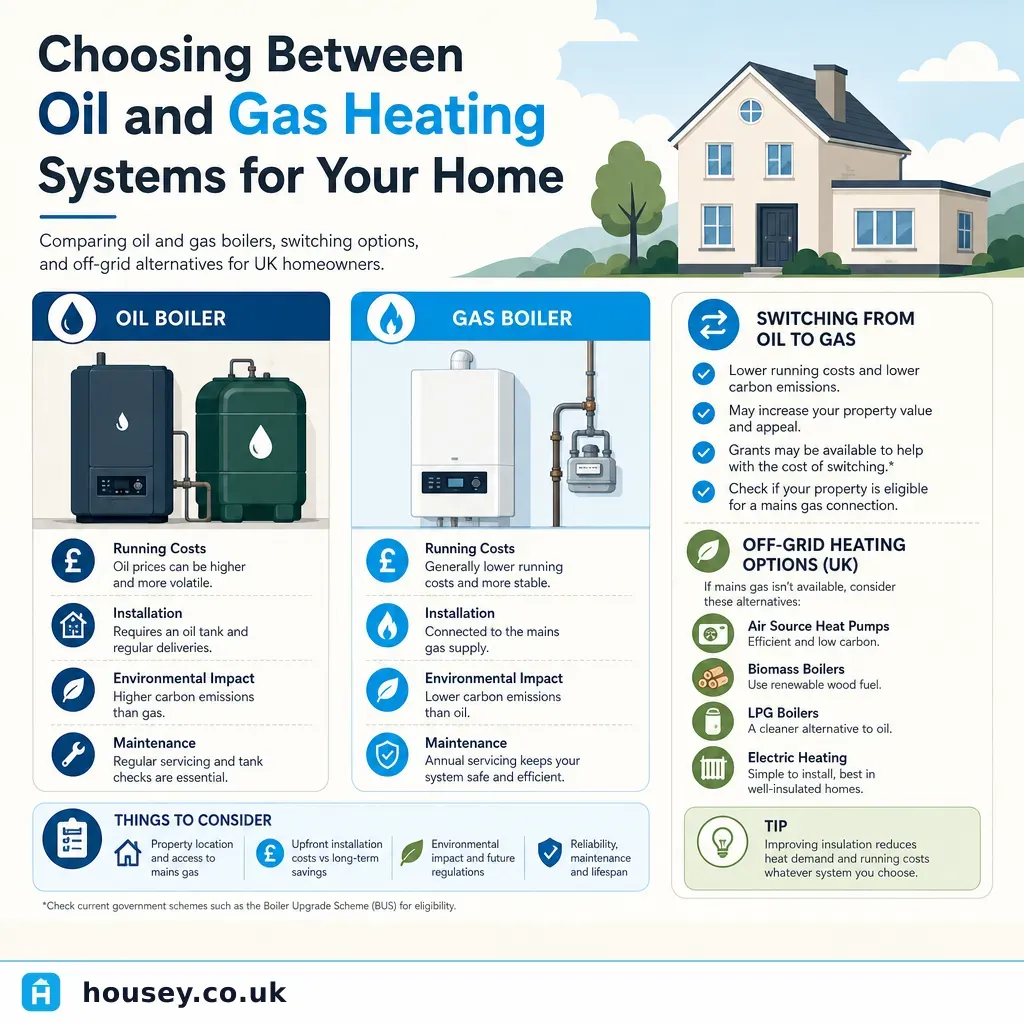
Choosing Between Oil and Gas Heating Systems for Your Home
Oil central heating suits rural UK properties without mains gas access, while gas remains the default for connected homes.
 Energy & Retrofit
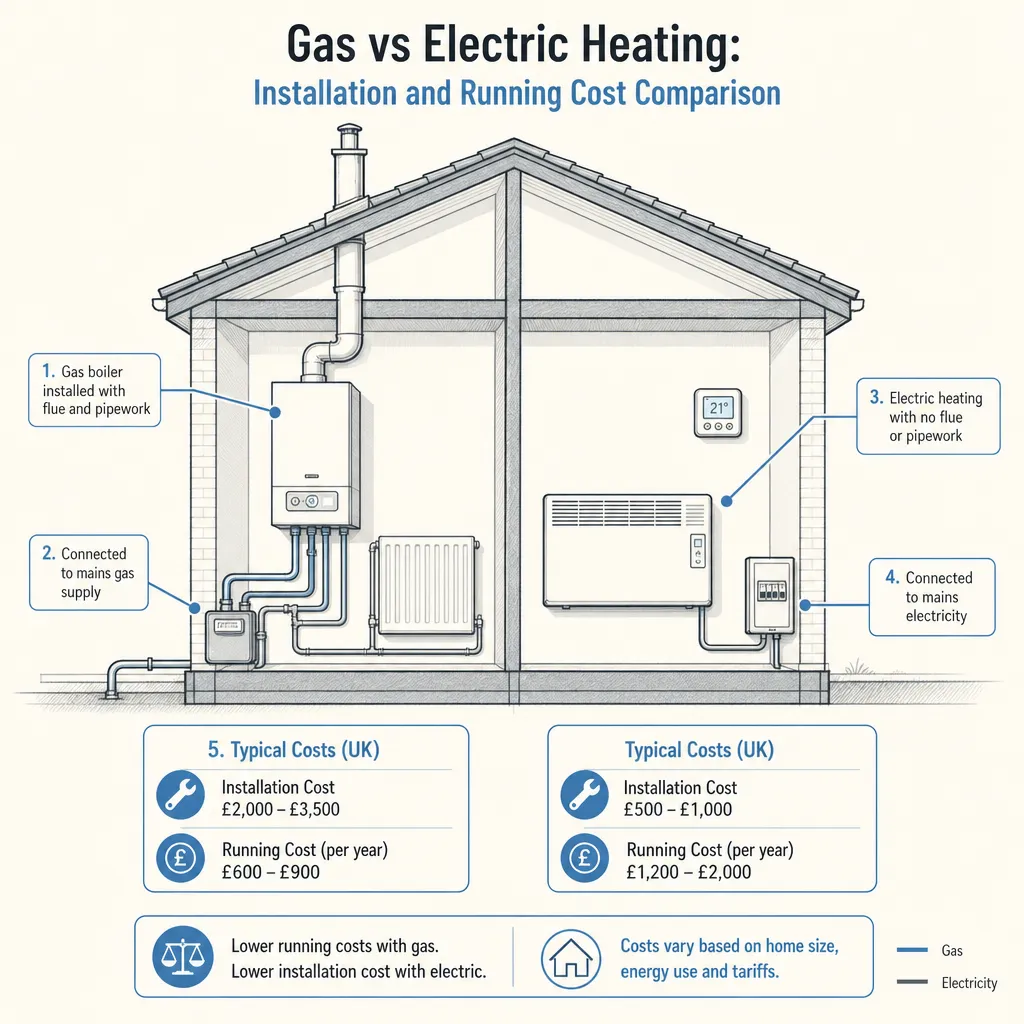
Gas vs Electric Heating: Installation and Running Cost Comparison
Gas central heating usually has lower running costs per kWh than direct electric heating in the UK, though heat pumps can change that equation.
 Energy & Retrofit
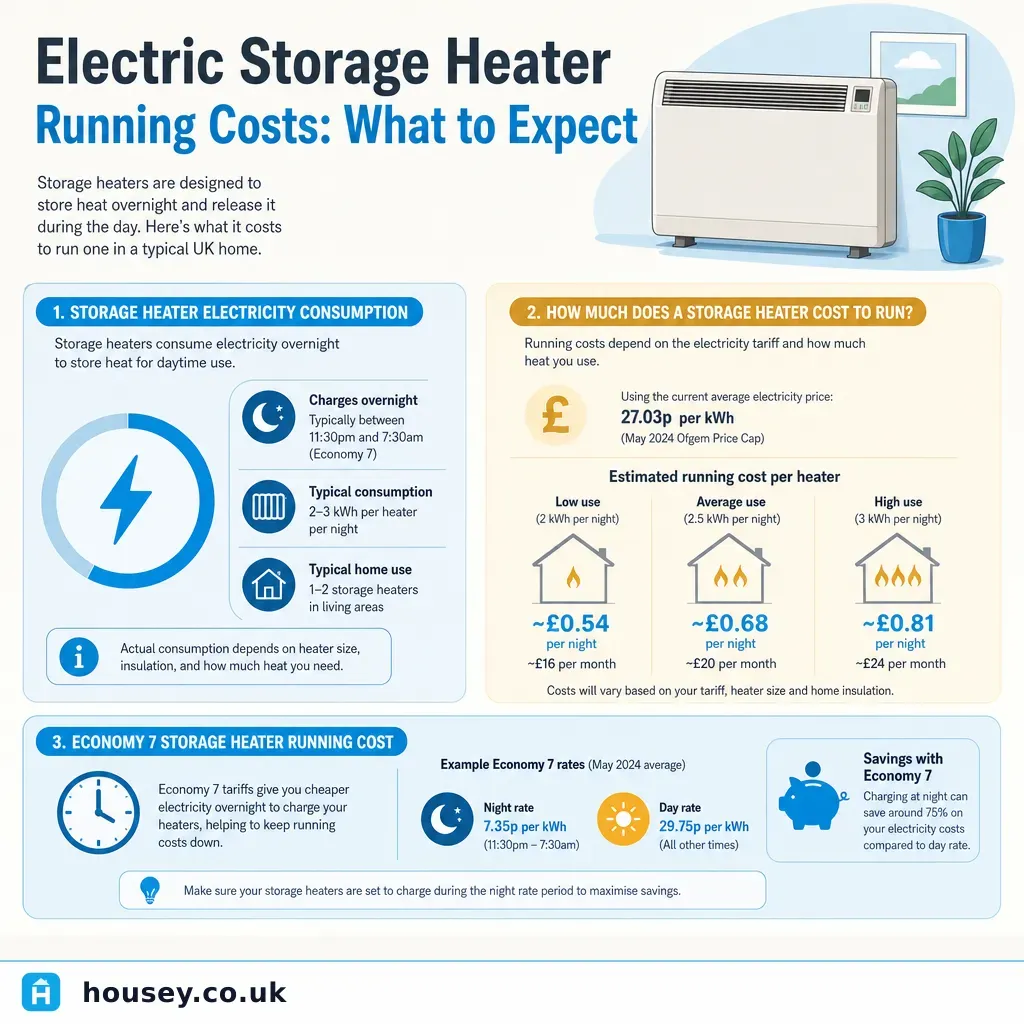
Electric Storage Heater Running Costs: What to Expect
Electric storage heaters typically cost £84–£572 per heater per year to run, depending on size and off-peak tariff rate.