Accessible Home Design: Making Your Property Work for Everyone
By Housey · Last reviewed 30th of May 2026
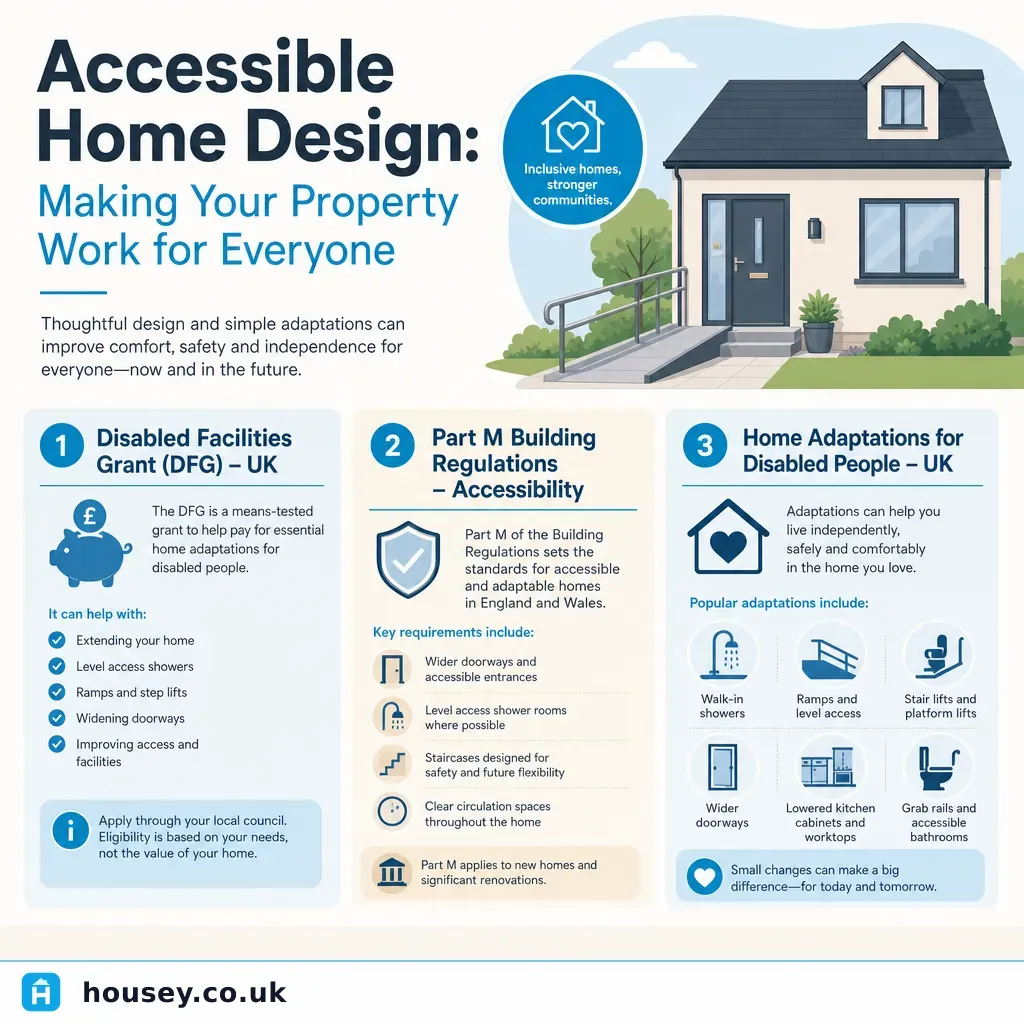
Accessible Home Design: Making Your Property Work for Everyone
Accessibility in the home is a practical concern for millions of UK households — whether you are adapting a property for a family member with a disability, planning ahead for older age, or designing a new home intended to work across every life stage. Getting design decisions right at the start avoids expensive retrofitting later, and a structured body of UK guidance and grant support exists to help.
Key points
- Building Regulations Approved Document M (Access to and Use of Buildings) sets minimum accessibility standards for new dwellings and material changes of use; for existing homes, adaptations are guided by BS 8300:2018.
- The Disabled Facilities Grant (DFG) provides means-tested funding of up to £30,000 in England (£36,000 in Wales) for eligible adaptations, administered by local authorities under the Housing Grants, Construction and Regeneration Act 1996.
- Doorways serving wheelchair users should provide a minimum 775 mm clear opening width under Part M Category 2; standard UK internal door sets at 762 mm typically require replacing.
- A level-access shower or wet room is one of the most commonly funded DFG adaptations; correct tanking with a specialist membrane system beneath tiles is critical to prevent moisture damage to the building fabric.
- The Lifetime Homes standard — now largely reflected in Part M Category 2 (accessible and adaptable dwellings) — provides a 16-point design checklist applicable to new-build and major renovation projects.
Understanding the UK standards
Three overlapping frameworks govern accessible home design in the UK.
Building Regulations Part M — Approved Document M (2015 edition for England)
Part M applies primarily to new dwellings and conversions. It sets three categories:
- Category 1: Visitable dwellings — the minimum standard applying to all new homes.
- Category 2: Accessible and adaptable dwellings — broadly equivalent to the Lifetime Homes standard; local planning authorities can require this via planning policy conditions.
- Category 3: Wheelchair user dwellings — designed for wheelchair occupation from the outset.
For existing homes being adapted — the most common scenario for homeowners — Part M does not automatically apply, but the technical standards within it and in BS 8300:2018 provide useful benchmarks for any contractor or designer specifying adaptations.
BS 8300:2018 — Design of an accessible and inclusive built environment
This British Standard provides detailed technical guidance on ramp gradients, turning circles, reach heights, sanitary provision, and lighting levels. It is the primary reference for designers and occupational therapists specifying home adaptations in existing properties.
Disabled Facilities Grant (DFG)
Administered by local authorities under the Housing Grants, Construction and Regeneration Act 1996, the DFG is a mandatory grant — meaning eligible applicants have a legal right to be assessed — for adaptations necessary to allow a disabled person to remain in their home. The maximum grant is £30,000 in England and £36,000 in Wales. Scotland and Northern Ireland operate separate schemes.
Which professional do you need?
Situation | Recommended professional | Why |
|---|---|---|
Adapting an existing home for a specific disability or mobility condition | Occupational therapist first, then contractor | OT assesses functional needs and specifies required adaptations; this is typically required for a DFG application |
Designing an accessible new build or major renovation | Architect with Part M and BS 8300 experience | Integrating accessibility at design stage is far more cost-effective than retrofitting later |
DFG application involving structural alterations | Architect or architectural technologist alongside OT | Building Regulations drawings may be required; OT provides the formal needs assessment |
Step-free access: ramps, platform lifts, stairlifts | Specialist adaptation contractor (check TrustMark registration) | Installation and structural implications vary significantly by product, gradient, and site |
Wet room or accessible bathroom | Specialist bathroom contractor with waterproofing certification | Tanking and drainage falls require specific expertise; incorrect work causes long-term building-fabric damage |
Common accessible design modifications
Step-free access
A ramp gradient of 1:20 or shallower is recommended for independent wheelchair access; 1:15 is the practical maximum in many retrofit situations where space is constrained. Platform lifts are often preferable where the available gradient or footprint prevents a compliant ramp. Any structural work to create a level threshold through an external wall requires building regulations approval.
Doorways and internal circulation
Part M Category 2 specifies 775 mm minimum clear opening width. Widening a door opening in a load-bearing wall requires a structural assessment and, depending on the scale of work, building regulations approval. Lever handles should replace knob fittings, and flush or low-profile thresholds should replace standard door sills throughout.
Accessible bathroom and wet room
A level-access shower with a fold-down seat, grab rails positioned to BS 8300 guidance, and a thermostatic mixer valve is the most commonly specified adaptation. The floor must drain adequately to a linear or point drain without creating trip risks. A correctly tanked wet room uses a membrane system applied to the substrate behind and beneath tiles — applying waterproofing only to the tiled surface is a common and costly error.
Kitchen adaptability
Adjustable-height worktops, pull-out drawer storage rather than fixed base-unit shelves, contrasting colour edges for visual impairment, and knee clearance under counters for wheelchair users are features of a fully accessible kitchen brief. Full kitchen remodels are eligible for DFG funding where clinically justified by an occupational therapist's assessment.
Homeowner checklist: preparing for an accessible design project
When to get professional help
Accessible adaptations range from fitting a grab rail — low risk, often suitable for a competent handyperson — to full wheelchair-standard remodelling involving structural, plumbing, and building control requirements. Seek professional input when:
- Structural walls need to be altered to widen doorways or create level-access thresholds.
- You are applying for DFG funding — a formal OT assessment and often architectural drawings are required.
- The project involves an extension, loft conversion, or change of use alongside the accessibility works.
- You are designing a new build and wish to achieve Part M Category 2 or Category 3 compliance.
- The property is listed or in a conservation area and external changes are needed.
How Housey can help
Housey connects homeowners with qualified architects experienced in accessible and inclusive residential design, from DFG-linked adaptation projects to full accessible new-build briefs. Visit our architecture services page to describe your project and receive quotes from local practices.
Frequently asked questions
What is the Disabled Facilities Grant and how do I apply?
The Disabled Facilities Grant (DFG) is a means-tested grant from your local authority for adaptations that help a disabled person live more independently. In England, the maximum grant is £30,000. You apply through your local council; an occupational therapist assesses which adaptations are necessary. GOV.UK provides a step-by-step guide to the application process.
Do accessible home adaptations require planning permission?
Most internal adaptations do not require planning permission. External works such as ramps and platform lifts often fall within permitted development rights for householders. However, if your property is listed or in a conservation area, you will likely need planning consent before starting external alterations. Check with your local planning authority before committing any contractor.
What is the difference between Part M Category 2 and Category 3?
Category 2 (accessible and adaptable) means the home can be adapted over time as occupants' needs change — wider doorways, adaptable bathroom provision, step-free entry. Category 3 (wheelchair user dwelling) means the home is designed for full wheelchair occupation from the outset, with larger turning circles, lower kitchen layouts, and wider corridor widths specified throughout.
Can I get accessible design help if I rent my home?
Yes. Renters can apply for a Disabled Facilities Grant, but the landlord must provide written consent for the works before an application proceeds. If consent is refused, you may have rights under the Equality Act 2010. Citizens Advice provides guidance on the rights of disabled tenants and the obligations of landlords towards reasonable adjustments.
Sources and further reading
- Approved Document M: Access to and Use of Buildings — GOV.UK
- Disabled Facilities Grant — GOV.UK
- Housing Grants, Construction and Regeneration Act 1996 — legislation.gov.uk
- Lifetime Homes design criteria — Lifetime Homes
Useful next reads
 Planning & Pre-Build
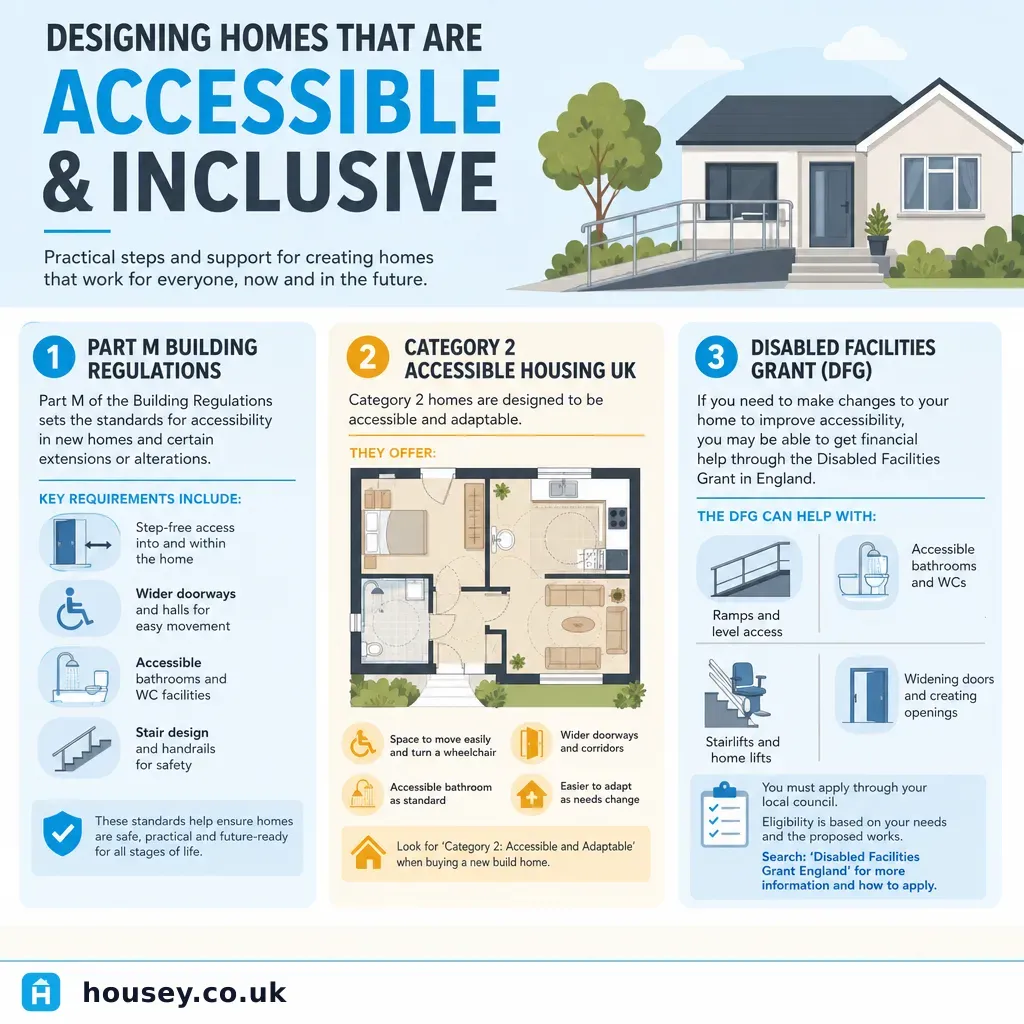
Designing Homes That Are Accessible and Inclusive
Accessible home design in the UK is guided by Building Regulations Approved Document M, which sets three standards for new dwellings: Category 1 (Visitable), Category 2 (Accessible and Adaptable), and Category 3 (Wheelchair User Dwelling).
 Planning & Pre-Build
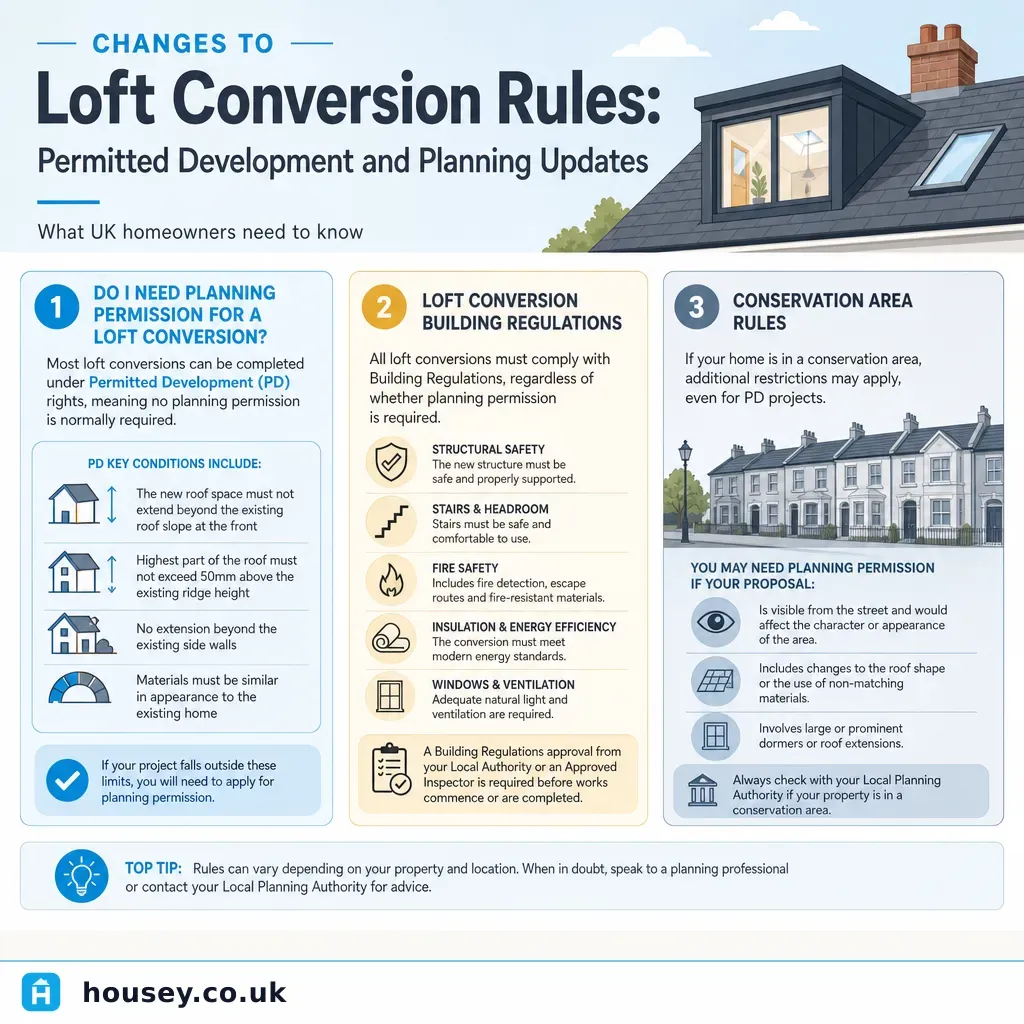
Changes to Loft Conversion Rules: Permitted Development and Planning Updates
In England, most loft conversions on standard houses qualify as Permitted Development under Class B of the GPDO 2015, allowing up to 40 cubic metres (terraced) or 50 cubic metres (detached or semi-detached) without a planning application — if conditions are met.
 Planning & Pre-Build
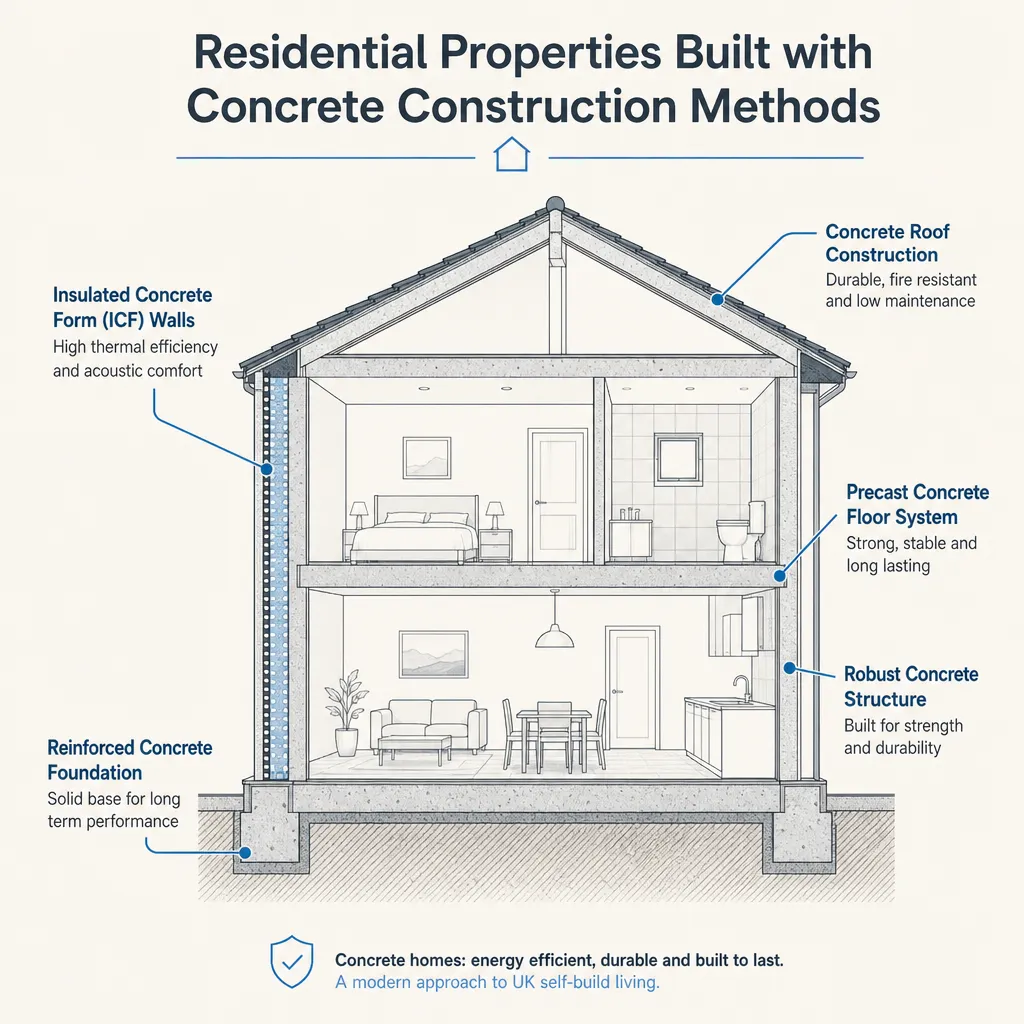
Residential Properties Built with Concrete Construction Methods
UK homes are built using several concrete methods: in-situ cast concrete, precast panel systems, insulating concrete formwork (ICF), and older non-traditional types such as Wimpey No-Fines and Laing Easiform.
 Planning & Pre-Build
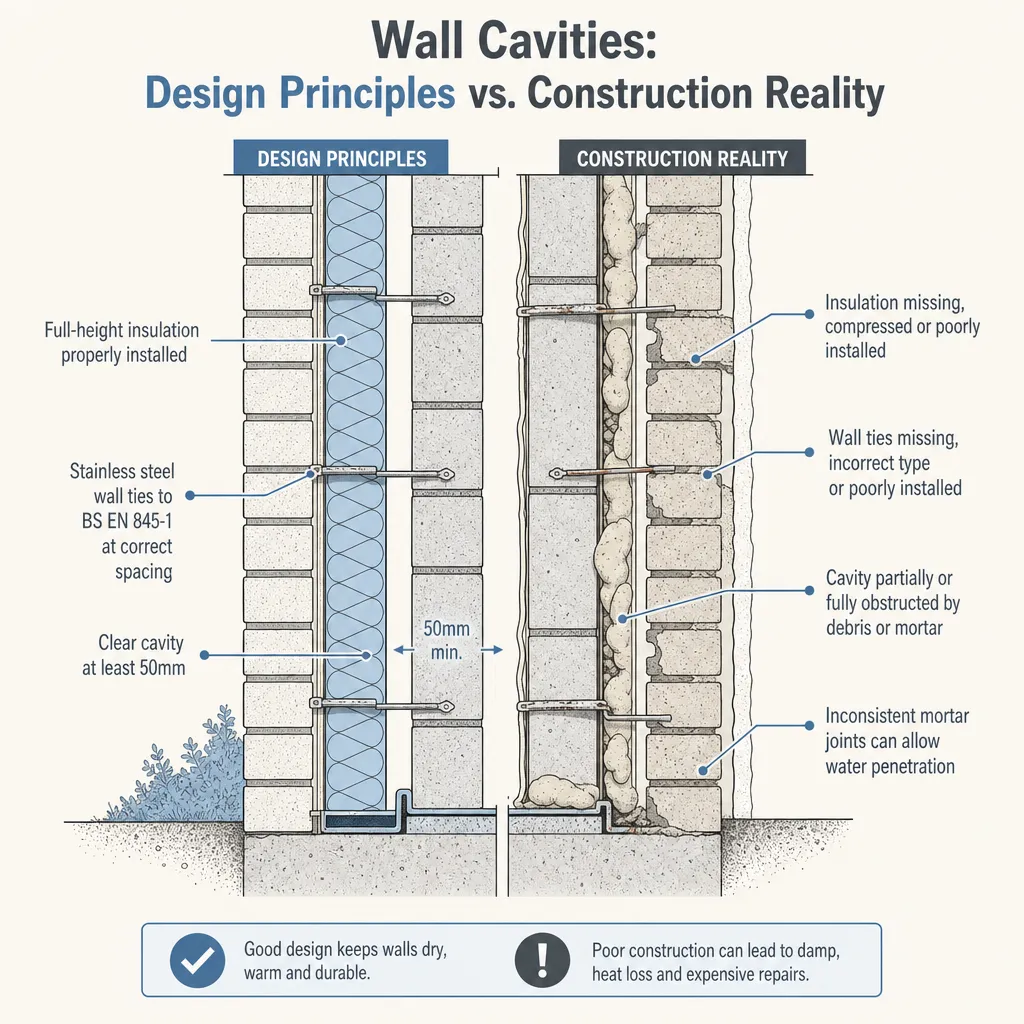
Wall Cavities: Design Principles vs. Construction Reality
A UK cavity wall is designed to resist weather, control heat loss, and structurally link two masonry leaves.
 Planning & Pre-Build
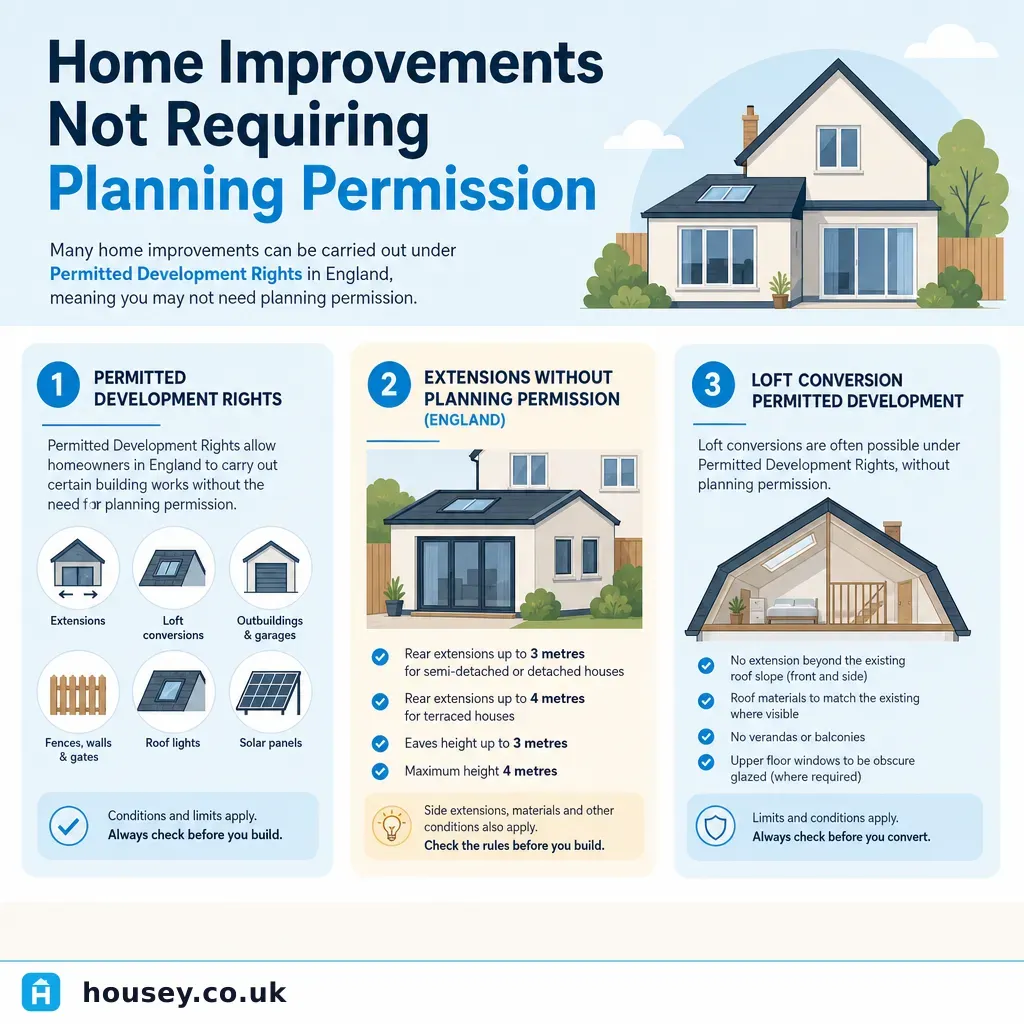
Home Improvements Not Requiring Planning Permission
Many common home improvements in England fall under Permitted Development Rights and do not require a planning application.