Wall Cavities: Design Principles vs. Construction Reality
By Housey · Last reviewed 25th of May 2026
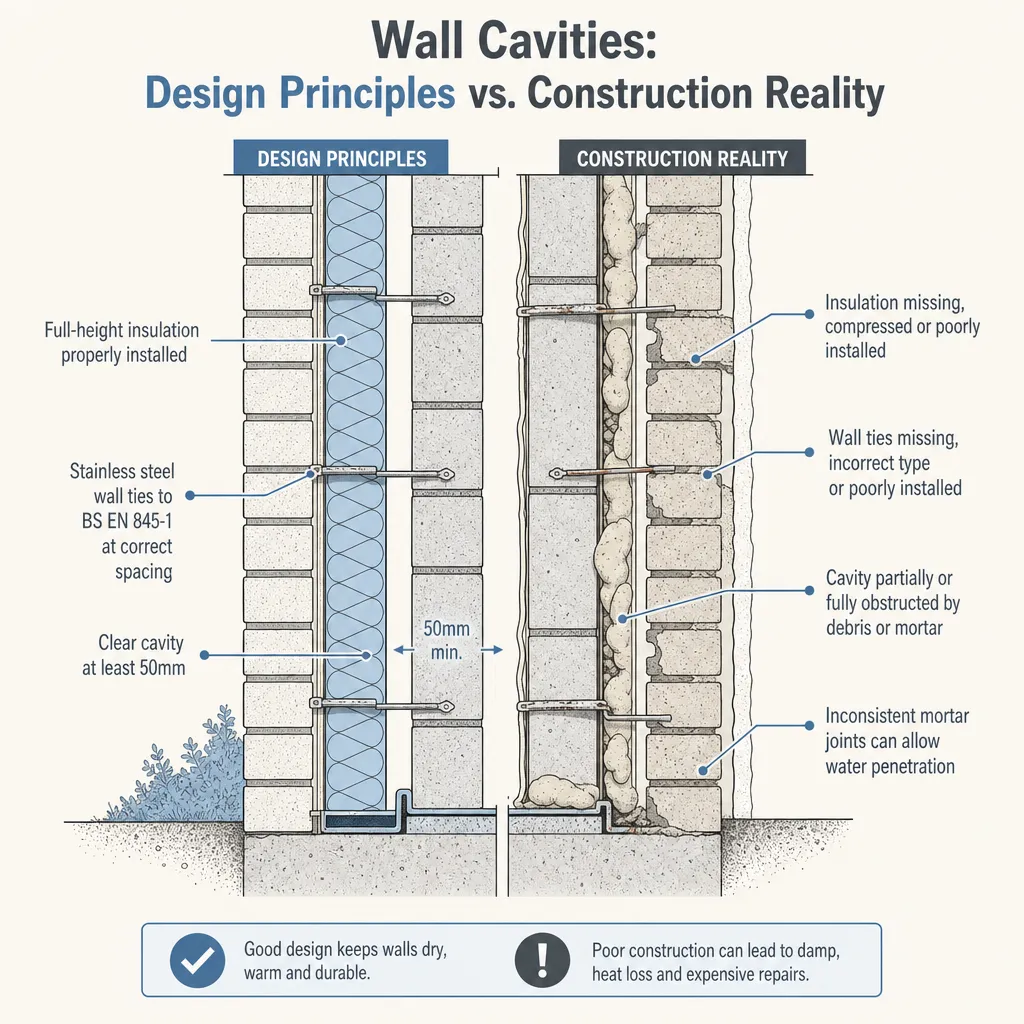
Wall Cavities: Design Principles vs. Construction Reality
Cavity walls are among the most widely used forms of external wall construction in the UK, found in homes built from the 1920s onwards and in virtually all new residential construction today. Questions about how they work — and why they sometimes fail — arise at the design stage of extensions and new builds, during building regulations submissions, and when homeowners investigate damp or cold spots in existing walls. The gap between what a cavity wall is designed to achieve and what is actually built on site is one of the most consequential, and most under-discussed, aspects of UK residential construction.
Key points
- Modern UK new-build cavity walls must achieve a U-value of 0.18 W/m²K or better under Approved Document L (Conservation of Fuel and Power, 2021 edition).
- Cavity widths in new construction are commonly 100–150 mm to accommodate full-fill or partial-fill mineral wool or rigid insulation boards.
- Wall ties must comply with BS EN 845-1 and be spaced no more than 900 mm horizontally and 450 mm vertically in standard bonding zones, with closer spacing at openings and edges.
- Mortar droppings on cavity ties or insulation batts are one of the most frequently recorded construction defects — they create thermal bridges and provide a direct moisture pathway across the cavity.
- Vertical damp-proof courses (DPCs) are required at all window and door reveals to prevent water from tracking between the two masonry leaves.
What a cavity wall is designed to do
A cavity wall consists of two masonry or timber-frame leaves separated by a continuous air gap. The original purpose, developed in the early 20th century, was to prevent rain penetration: water that soaks through the outer leaf cannot easily bridge an unobstructed air gap to reach the inner leaf. Since the 1970s, and increasingly after the Building Regulations reforms of 2006 and 2021, the cavity has also become the primary location for thermal insulation.
In a well-designed and well-built modern cavity wall, the assembly achieves four things simultaneously:
- Weather resistance — the outer leaf deflects driving rain; the cavity drains residual moisture to weep holes at the base.
- Thermal performance — insulation within the cavity reduces heat loss to meet Approved Document L targets.
- Structural stability — wall ties link the two leaves so they act together under wind load, as specified in BS EN 1996-2.
- Vapour control — the arrangement of materials from warm inner leaf to cold outer leaf must avoid interstitial condensation, assessed via BS EN ISO 13788.
Where design and site practice diverge
Architects and engineers specify cavity walls on drawings. What happens between drawing and handover is where thermal and moisture performance is won or lost.
Mortar droppings
Bricklayers working efficiently will inevitably drop mortar into the cavity. If this lands on a wall tie, it forms a bridge capable of conducting both heat and moisture from the outer leaf to the inner leaf — directly undermining the cavity's purpose. NHBC Standards Chapter 6.1 requires that cavities be kept clean and that mortar be removed before it sets. On many sites, this obligation is managed inconsistently.
Design-stage mitigations include specifying cavity boards — plastic trays fixed to ties that catch droppings as work proceeds and are removed floor by floor — and noting the risk explicitly in the specification so the contractor is formally on notice.
Insulation continuity
Partial-fill insulation — rigid boards held against the inner leaf with a residual clear cavity of 25–50 mm — is less vulnerable to moisture than full-fill mineral wool, but boards can be installed with gaps at corners, reveals, and junctions. Each gap is a thermal bridge that pushes the effective U-value above the designed value. Full-fill mineral wool performs well only if the outer leaf is reliably waterproof and mortar droppings are controlled throughout the build.
Wall tie corrosion
Older galvanised ties in homes built between roughly 1950 and 1980 are subject to corrosion-induced failure. When steel ties corrode, they expand and can cause horizontal cracking in the outer leaf — visible as regular cracks at approximately every fourth or fifth brick course. Replacement requires drilling and inserting new stainless steel ties, which is a specialist task. Ties in new construction must be stainless steel or a conforming polymer, per BS EN 845-1.
Reveal detailing at openings
Every window and door opening interrupts the cavity and requires a vertical DPC to prevent water from tracking across from the outer to the inner leaf. If this detail is omitted or poorly lapped, the junction becomes a persistent moisture pathway — a common cause of damp patches around window frames in both Victorian terraces and more recent new builds.
Insulation options: a comparison
Insulation type | Typical cavity width | Installation risk | Moisture sensitivity | Indicative U-value (W/m²K) |
|---|---|---|---|---|
Full-fill mineral wool batts | 100 mm | Mortar droppings cause bridging; requires clean cavity | Moderate — absorbs moisture if outer leaf leaks | 0.18–0.22 |
Partial-fill rigid PIR board | 100 mm (75 mm board + 25 mm clear gap) | Gaps at junctions and reveals are common | Low — board face repels water | 0.17–0.20 |
Full-fill EPS bead (retrofit or new-build) | 50–100 mm | Even fill around ties; reduced gap risk | Low-moderate — bonded bead handles occasional moisture well | 0.25–0.35 retrofit; 0.18 new-build with wider cavity |
Partial-fill mineral wool slab | 100 mm | Similar to batts; board stiffness reduces sagging | Moderate | 0.18–0.22 |
Indicative performance figures only; actual U-values depend on leaf construction, tie type, and thermal bridging corrections. Consult a building regulations specialist for project-specific calculations.
Wall tie specification: what to check
- Tie material: stainless steel austenitic grade 316 for coastal or high-exposure locations; standard austenitic for most UK sites.
- Tie spacing: 900 mm horizontal × 450 mm vertical in the field of the wall; 300 mm vertical at reveals; no more than 225 mm from any opening.
- Tie slope: ties must slope slightly toward the outer leaf, or incorporate a drip, to prevent water running inward along the tie body.
- Embedment depth: minimum 50 mm into each leaf.
Pre-build and during-construction checklist
Use this when commissioning an extension or new build and checking progress on site.
When to get professional help
Contact a chartered structural engineer or RICS-qualified building surveyor if:
- You notice regular horizontal cracking in the outer leaf of a home built between 1950 and 1990 — this may indicate corroding wall ties requiring investigation.
- A new build or extension shows persistent damp patches around window frames or at the base of walls after completion.
- You plan to add external wall insulation to an existing cavity-wall home — this affects structural loads, ventilation, and moisture management in ways that require professional assessment.
- You are preparing or reviewing building regulations drawings and are unsure whether the cavity wall specification meets the required U-value under Approved Document L.
How Housey can help
If you are planning an extension or new build and need a cavity wall specification that satisfies current building regulations, Housey can connect you with professionals who provide building regulations drawings and structural engineering services. Resolving specification questions at design stage costs far less than diagnosing a damp or thermal failure in a finished wall.
Frequently asked questions
What is the minimum cavity width for a new-build UK home?
There is no single mandated minimum, but in practice most new UK residential cavity walls use a 100 mm cavity to accommodate insulation that meets the 0.18 W/m²K U-value required by Approved Document L. Some high-performance builds use 150 mm or wider. A 50 mm clear cavity is the traditional weather-resistance minimum but is rarely used in new construction where thermal performance is also required.
Can I insulate an existing cavity wall myself?
Cavity wall insulation for existing homes is typically injected through drilled holes in the outer leaf. This is a specialist process requiring assessment of the cavity and should be carried out by a registered installer. The work is regulated under PAS 2030 and funded in some cases through the ECO4 scheme or the Great British Insulation Scheme. DIY injection is not advisable.
How do I know if my existing home already has cavity wall insulation?
A borescope inspection — a small drill hole and camera — will confirm whether insulation is present. A thermal imaging survey carried out on a cold day can reveal unfilled cavities as cold patches on an infrared image. Some local councils and energy assessors offer free or subsidised surveys under ECO4 or Great British Insulation Scheme programmes.
What causes regular horizontal cracking in external brick walls?
Regular horizontal cracks at every fourth or fifth brick course in homes built between 1950 and 1985 are a classic indicator of corroding wall ties. As corroding steel expands it forces the surrounding mortar apart. A RICS-qualified surveyor or structural engineer should inspect to confirm the cause and recommend a tie replacement programme before further movement occurs.
Sources and further reading
- Approved Document L (2021) — GOV.UK / DLUHC: Building Regulations conservation of fuel and power
- NHBC Standards Chapter 6.1 — NHBC: External masonry walls construction standards
- BS EN 845-1 — BSI: Specification for ancillary components for masonry including wall ties
- Cavity wall insulation guidance — Energy Saving Trust: Retrofit cavity fill guidance for homeowners
- BRE Group — building fabric performance — BRE: Research on thermal bridging and moisture in wall assemblies
Useful next reads
 Planning & Pre-Build
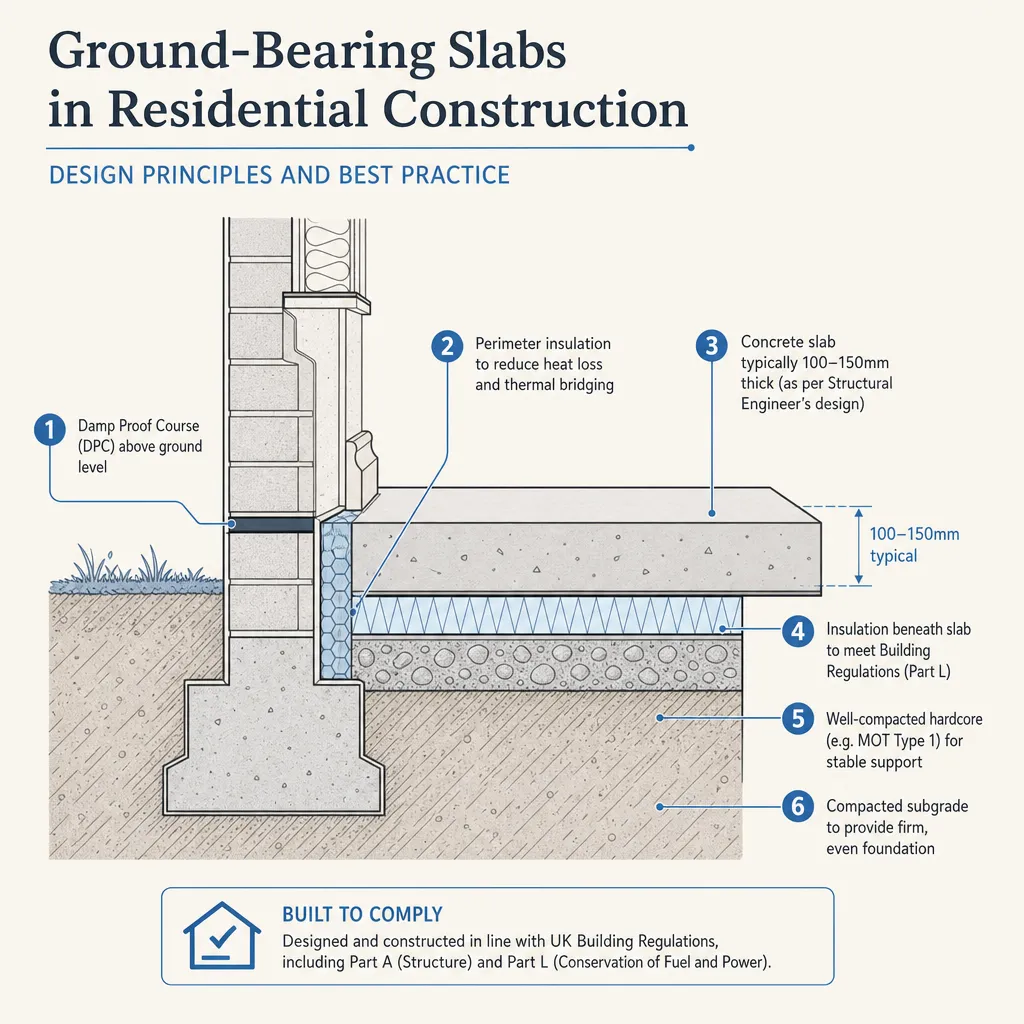
Ground-Bearing Slabs in Residential Construction: Design Principles and Best Practice
A ground-bearing slab sits directly on compacted ground and must comply with Building Regulations Approved Documents A, C, and L.
 Planning & Pre-Build
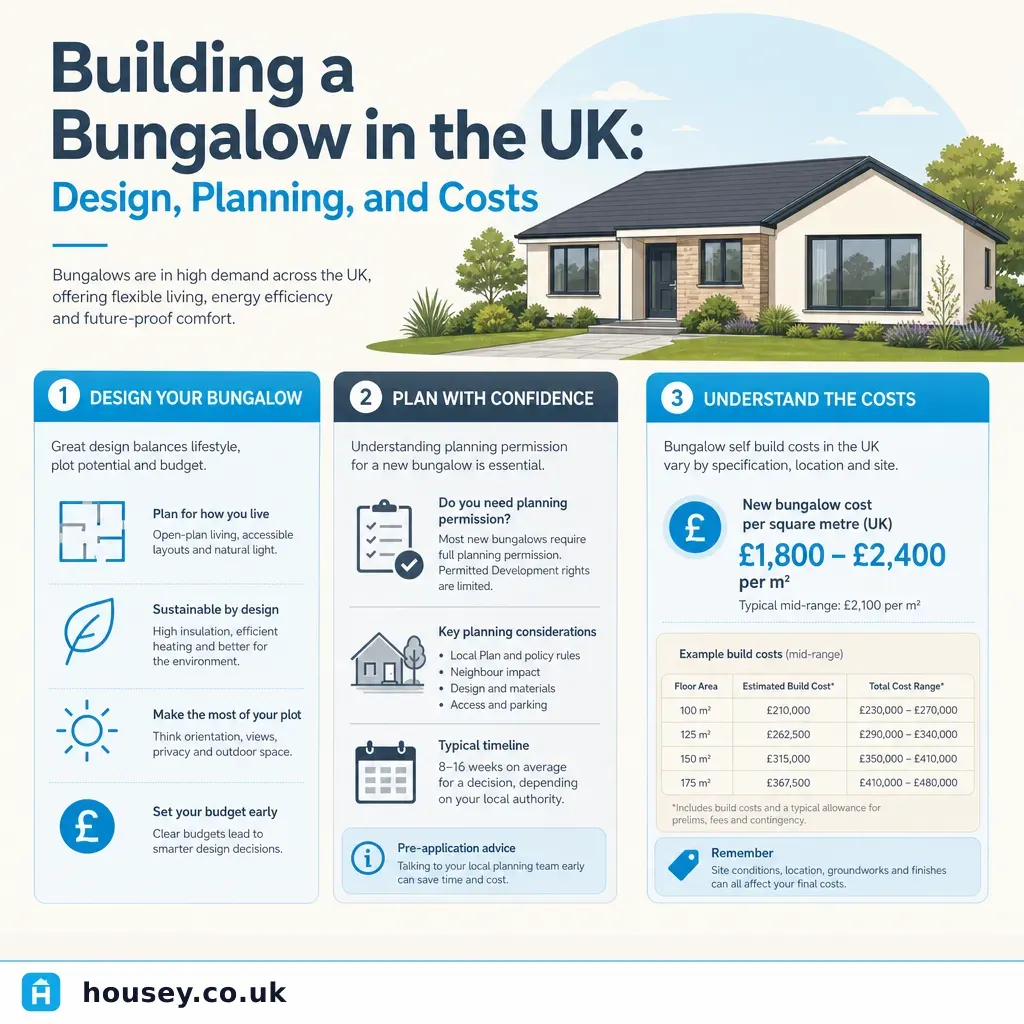
Building a Bungalow in the UK: Design, Planning, and Costs
Building a bungalow in the UK typically costs £1,500–£3,000 per square metre, putting a 100m² bungalow at roughly £150,000–£300,000 in build costs before land, professional fees, and VAT.
 Planning & Pre-Build
Craftsman Style Homes: Architectural Features and Design Elements
Craftsman style homes are defined by natural materials, low-pitched gabled roofs with wide eaves, covered porches, exposed timber details, and grouped casement windows.
 Planning & Pre-Build
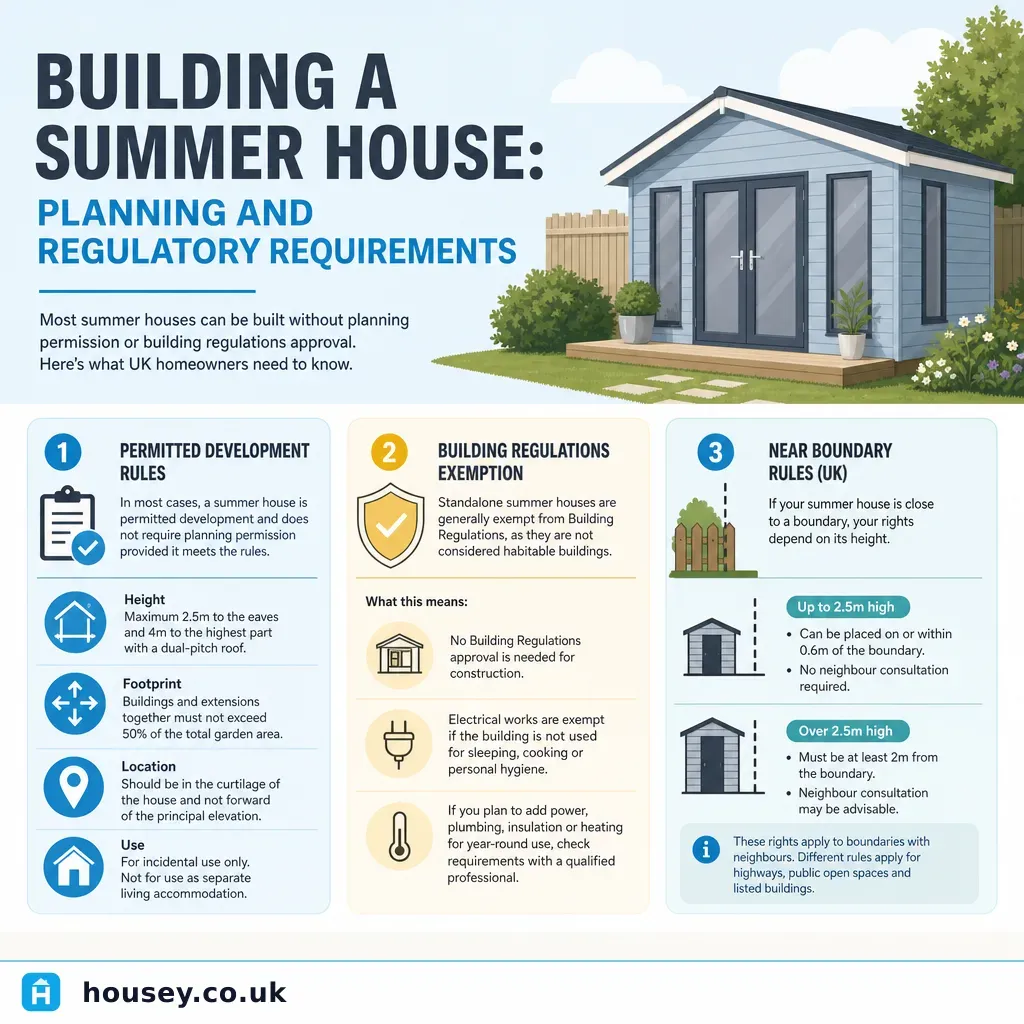
Building a Summer House: Planning and Regulatory Requirements
Most garden summer houses in England fall under Class E permitted development and need no planning permission, provided they are single-storey, within height limits, and not used for sleeping.
 Planning & Pre-Build
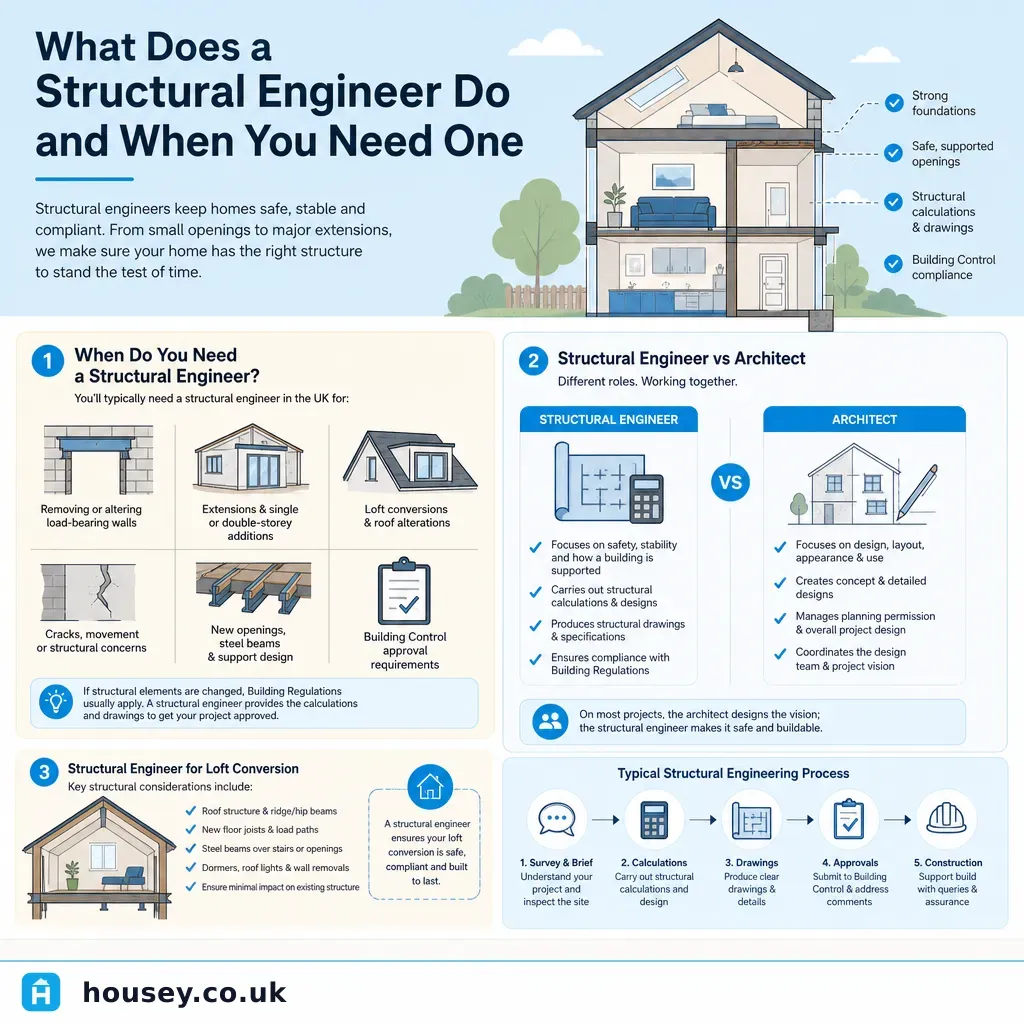
What Does a Structural Engineer Do and When You Need One
A structural engineer analyses and designs the load-bearing elements of a building — foundations, beams, columns, walls, and floors.