Designing Homes That Are Accessible and Inclusive
By Housey · Last reviewed 11th of May 2026
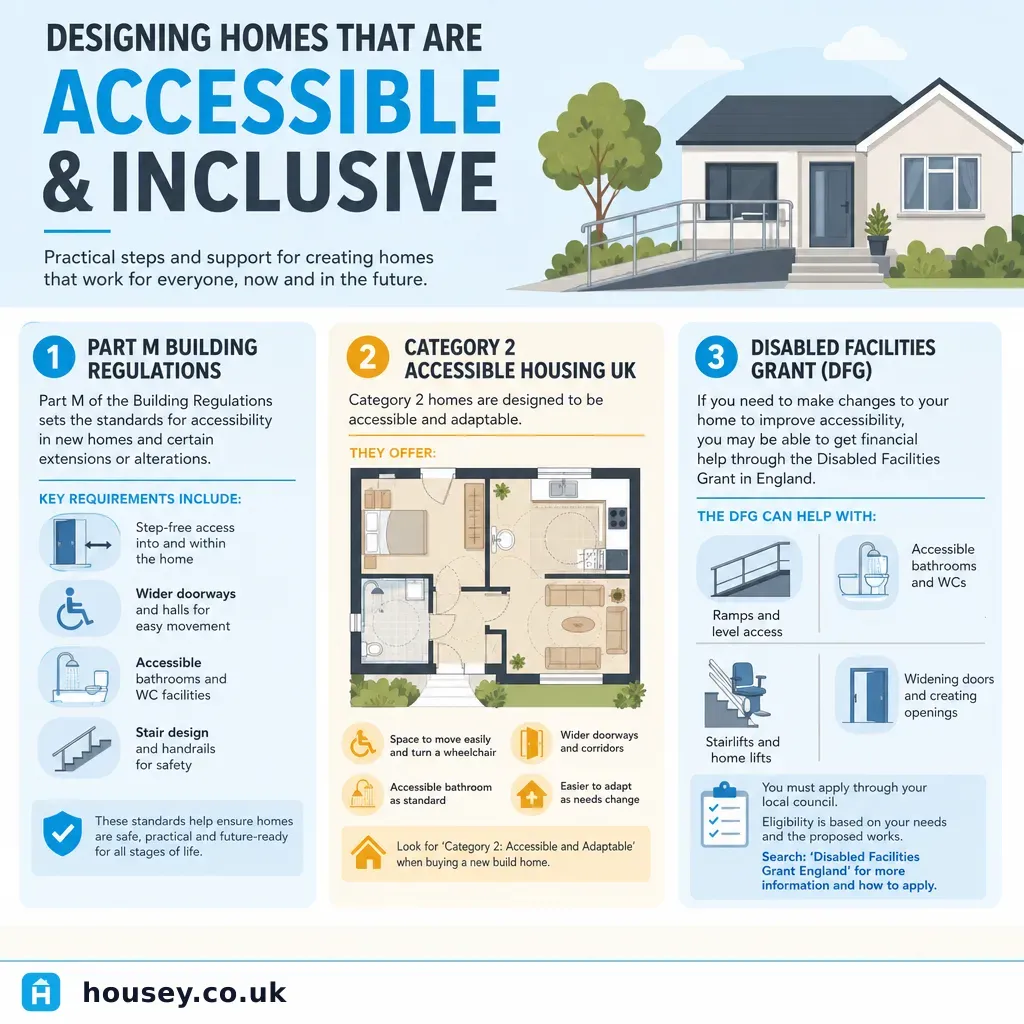
Designing Homes That Are Accessible and Inclusive
Accessible design is moving from specialist niche to mainstream practice in UK residential architecture. Whether you're planning a new build, extending an existing property, or adapting a family home for a disabled relative, understanding the regulatory framework and design principles early in the process saves money, avoids retrospective work, and creates homes that function better for everyone at every stage of life.
Key points
- Building Regulations Approved Document M (Volume 1: Dwellings) sets three accessibility standards for new homes in England: Category 1 (Visitable), Category 2 (Accessible and Adaptable), and Category 3 (Wheelchair User Dwelling) — Category 1 is the minimum for all new dwellings.
- Local planning authorities can require Category 2 or Category 3 as a planning condition on new residential developments, particularly in areas with an adopted accessibility policy in their local plan.
- The Disabled Facilities Grant (DFG) provides means-tested grants of up to £30,000 in England (£36,000 in Wales) for eligible adaptations to existing homes, administered by local housing authorities under the Housing Grants, Construction and Regeneration Act 1996.
- BS 8300:2018 — the British Standard for accessible and inclusive built environments — provides detailed design guidance beyond the minimum thresholds in Building Regulations.
- Including Category 2 features in a new build typically adds only 1–3% to build cost; retrofitting the same features to an existing property can cost significantly more.
What do Building Regulations require for accessible dwellings?
Approved Document M (Volume 1) applies to new dwellings in England. The three categories are designed to support different levels of accessibility:
Category | Standard name | Who requires it | Key features |
|---|---|---|---|
Category 1 (M4(1)) | Visitable dwelling | All new homes (minimum) | Step-free approach, 750mm clear door width, WC provision at entrance level |
Category 2 (M4(2)) | Accessible and adaptable | Required by some local planning authorities as a planning condition | Wider circulation, level-access shower provision, turning circles in key ground-floor rooms |
Category 3 (M4(3)) | Wheelchair user dwelling | Required by some LPAs; higher proportion in social housing allocations | Full wheelchair accessibility throughout; accessible kitchen and bathroom; wider doors and corridors |
Most private new-build homes are currently built to Category 1. If you want Category 2 or 3 for a self-build or commissioned home, raise this with your architect at the earliest design stage — incorporating these features at the outset costs far less than retrospective adaptation.
Building regulations in Wales are similar but managed by Welsh Government; Scotland operates under its own Technical Handbooks. Always confirm requirements with the relevant building control body for your jurisdiction.
Which professional do you need?
Situation | Professional | What to ask |
|---|---|---|
New build or extension: accessible design from the start | Architect (ARB registered) or Architectural Technologist (CIAT member) | Experience with Part M compliance; Category 2 or 3 projects in portfolio |
Adapting an existing home for a disabled resident | Occupational therapist (OT) first, then a specialist contractor | OT assessment before committing to any works; DFG application support |
Accessible adaptation in a listed building | Architect with conservation accreditation | Discuss heritage constraints with the local planning authority before proceeding |
Planning application with an accessibility condition | Architect or planning consultant | Review local plan and any supplementary planning document on housing standards |
Core principles of accessible home design
Well-executed accessible design does not look institutional. The following principles apply to new builds, extensions, and whole-house refurbishments:
Step-free access. A level or gently ramped approach — no steeper than 1:20 for ambulant users; 1:12 for wheelchair users — from the street or parking area to the principal entrance is one of the most fundamental requirements.
Door widths and circulation. Category 1 requires a minimum 775mm clear opening width on the principal entrance; Category 2 requires 850mm. Internal doors for wheelchair use should ideally be 800mm clear. Turning circles of 1,500mm diameter should be provided in at least the main ground-floor rooms under Category 2.
Ground-floor WC. A toilet at entrance level keeps the home usable for a wide range of users without access to upper floors. Category 2 requires a space provision for a future shower at ground-floor level.
Stairlifts and through-floor lifts. Structural provisions during build or major refurbishment — a reinforced landing, appropriate stair geometry — make future stairlift or lift installation significantly easier and less costly. Discuss stair configuration with your architect at design stage.
Bathroom and wet room design. A level-access or wet-room shower removes the single biggest barrier to independent bathing. Category 2 requires a minimum 900mm × 900mm shower area; Category 3 requires 1,500mm × 1,500mm. Blocking walls for future grabrail installation during build is low cost; retrofitting it later is not.
Lighting and contrast. Adequate lux levels, contrast between walls and floors, and avoidance of glare are particularly important for users with visual impairments. BS 8300:2018 provides detailed lux-level guidance for residential spaces.
Decision tree: which standard should your project target?
- Choose Category 2 if you are building a new home without a specific current accessibility need — the cost premium at new-build stage is modest, and retrofitting later is expensive.
- Target Category 3 if you are building for or with a wheelchair user — engage an architect experienced in this area from the outset.
- If you are adapting an existing home for a disabled family member — commission an occupational therapist assessment first, then explore a Disabled Facilities Grant application.
- If you are applying for planning permission in an area with an adopted accessibility policy — check the local plan and any housing supplementary planning document before submitting.
- If the property is listed or in a conservation area — discuss adaptation options with the local planning authority's conservation officer before committing to any approach.
- Ask a qualified architect if you are unsure which category applies or if planning conditions may be imposed on your site.
Funding accessible adaptations: the Disabled Facilities Grant
The Disabled Facilities Grant (DFG) is a means-tested grant administered by local housing authorities in England and Wales under the Housing Grants, Construction and Regeneration Act 1996:
- Maximum grant: £30,000 in England; £36,000 in Wales — verify current maximums on GOV.UK before applying, as these figures are subject to change.
- Eligible works: ramps, wider doorways, stairlifts, through-floor lifts, accessible bathrooms, and adapted kitchens.
- Application via your local authority; an occupational therapist assessment is typically required.
- Available to owner-occupiers, private tenants, and council tenants — tenants generally need the landlord's consent for permanent adaptations.
- Local authorities have a statutory duty to process DFG applications under the 1996 Act.
GOV.UK provides current DFG guidance and eligibility information.
What not to assume about accessible design
"It will look clinical." Modern accessible design is largely indistinguishable from considered general design. Level-access showers, wider doors, and step-free thresholds are features many homeowners choose regardless of disability.
"It only matters if someone in the household is disabled." Accessible design benefits everyone — people carrying shopping, parents with buggies, older adults with reduced mobility, and visitors. It also future-proofs the property for changing circumstances.
"It's too expensive for a standard self-build." The Category 2 cost premium over Category 1 in a new build is typically 1–3% of build cost. Retrofitting Category 2 features to an existing property can cost many times this.
"Building control will flag non-compliance automatically." Building control checks for minimum compliance, not best practice. Engaging an architect experienced in accessible design is the most reliable route to genuinely inclusive spaces.
Important limitations
This article provides general guidance only. Building regulations requirements, planning policies, and grant eligibility vary by location, property type, tenure, and individual circumstances. A qualified architect, occupational therapist, or building control officer should assess your specific project. Nothing in this article constitutes legal or regulatory advice. Rules can vary by property and local authority.
What to ask a qualified professional
Before engaging an architect or architectural technologist for an accessible design project:
- What accessibility category does the local planning authority require for this site, and is there a relevant supplementary planning document?
- What experience do you have with Category 2 or Category 3 projects under Approved Document M?
- What is the likely cost premium for Category 2 features in our project, and which elements give the most benefit for the cost?
- How will accessible features be integrated into the overall design without compromising the home's aesthetic?
- If the building is listed, what are the heritage constraints on adaptation, and how do we approach listed building consent?
- Can you support a Disabled Facilities Grant application, or recommend an occupational therapist familiar with the DFG process?
When to get professional help
- New build or major extension: engage an architect or architectural technologist to advise on Part M compliance from the outset — not after planning submission.
- Adapting a home for a disabled family member: commission an occupational therapist assessment before committing to any works or spending.
- Planning application with accessibility conditions: seek professional advice on the local authority's policies before submitting.
- Listed building or conservation area: consult the local planning authority's conservation officer before starting any accessible adaptation works.
How Housey can help
Housey connects you with qualified architects and architectural technologists experienced in inclusive home design. Whether you're planning a new build to Category 2 standards or exploring an accessible extension, find an architect through Housey or connect with an architectural technologist to discuss accessible design for your specific project.
Frequently asked questions
What is the difference between Category 2 and Category 3 under Part M?
Category 2 (M4(2)) creates an accessible and adaptable dwelling that can be readily modified over time — suitable for most users including ambulant disabled people and easily adapted for wheelchair users later. Category 3 (M4(3)) creates a wheelchair user dwelling designed for full independent use from day one, with larger turning circles, lower worktops, and wider circulation throughout.
Does a planning application need to specify an accessibility category?
In areas where the local planning authority has adopted an accessibility policy — in the local plan or a housing supplementary planning document — applications for new residential development may need to demonstrate compliance with a specific category. Always check the local development plan and planning policy before submitting an application.
Can I get a Disabled Facilities Grant for a rented property?
Yes. DFG is available to private tenants, council tenants, and owner-occupiers. Tenants generally need the landlord's written consent for permanent adaptations. Contact your local authority's housing team to begin the application process and request an occupational therapist assessment.
How does accessible design interact with listed building consent?
Listed building consent is required for alterations to a listed building that affect its special architectural or historic interest, including accessible adaptations. Local authorities must give reasonable consideration to the needs of disabled users, but works must still respect the building's significance. Engage an architect with conservation experience and speak to the local planning authority's conservation officer early.
Sources and further reading
- Building Regulations Approved Document M (Volume 1: Dwellings) — GOV.UK
- Disabled Facilities Grant — GOV.UK
- Housing Grants, Construction and Regeneration Act 1996 — legislation.gov.uk
- BS 8300:2018 Design of accessible and inclusive built environments — British Standards Institution
- Lifetime Homes design criteria — Lifetime Homes
Useful next reads
 Planning & Pre-Build
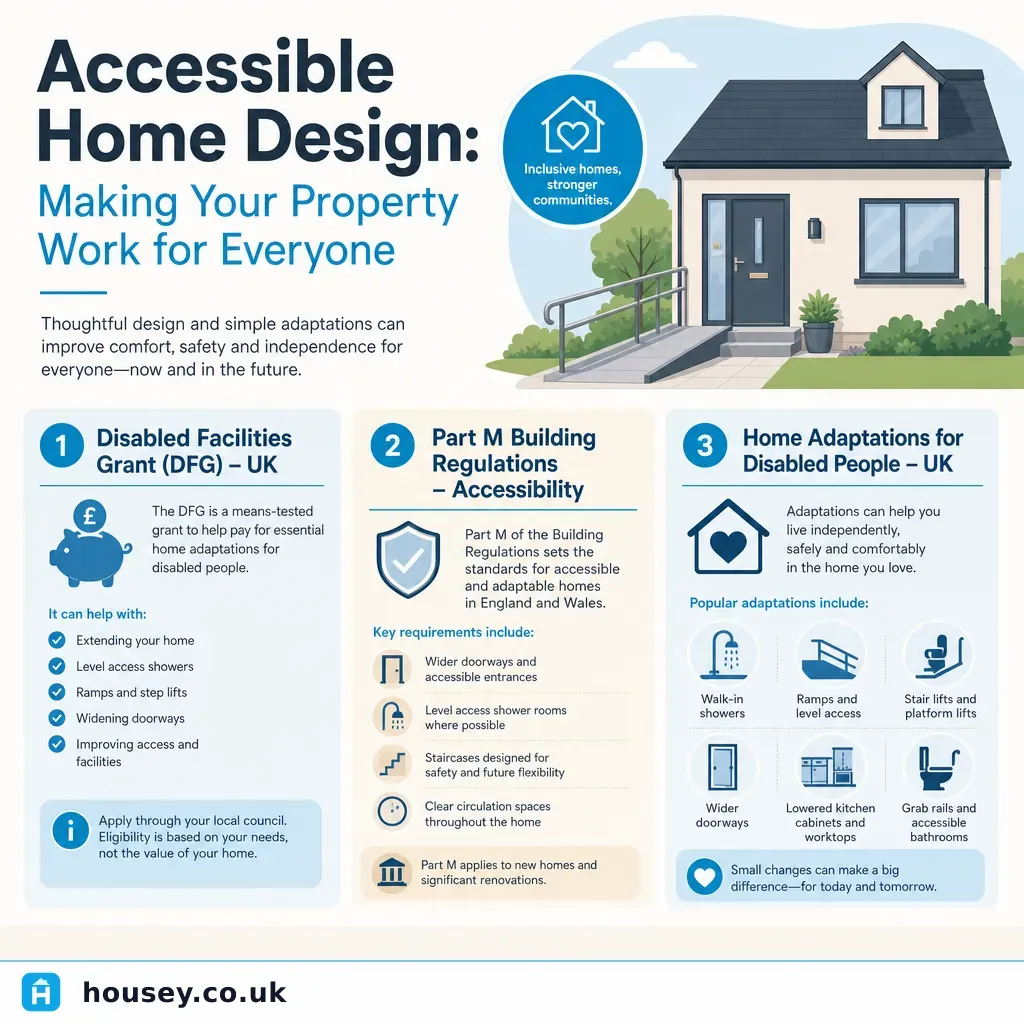
Accessible Home Design: Making Your Property Work for Everyone
Accessible home design in the UK is guided by Building Regulations Part M and BS 8300:2018.
 Planning & Pre-Build
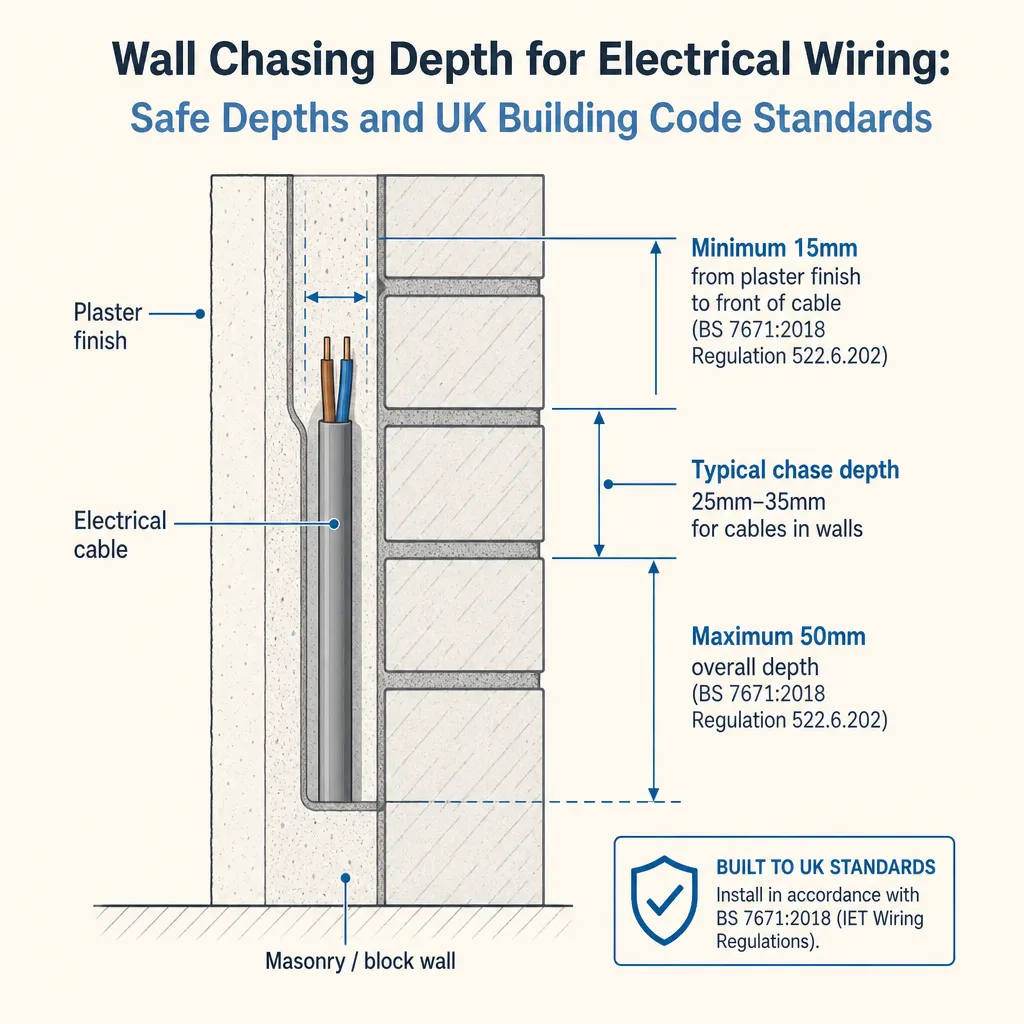
Wall Chasing Depth for Electrical Wiring: Safe Depths and UK Building Code Standards
Cables chased into walls must be within BS 7671 safe zones — within 150 mm of a ceiling, floor, or corner junction — or enclosed in rigid conduit for mechanical protection.
 Planning & Pre-Build
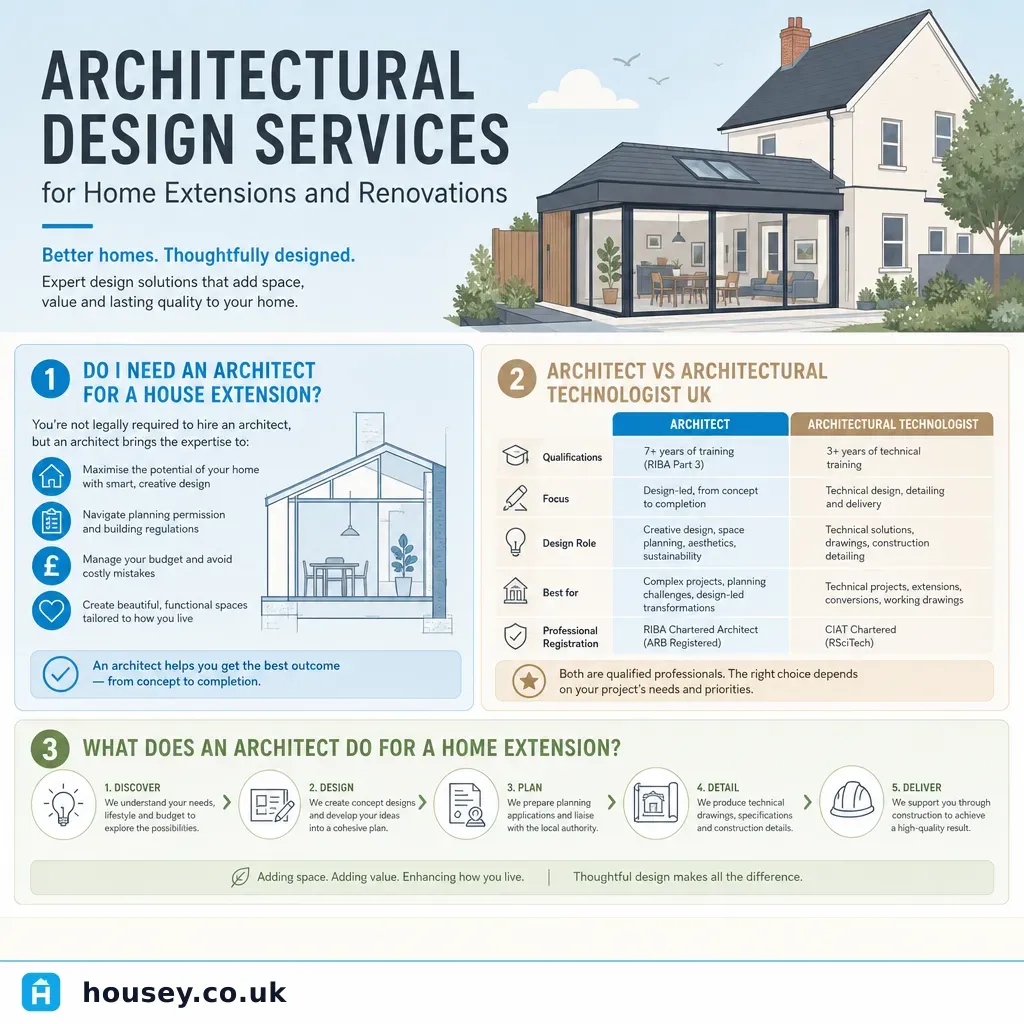
Architectural Design Services for Home Extensions and Renovations
Architectural design services for UK extensions and renovations span initial feasibility, planning drawings, building regulations packages, and site monitoring.
 Planning & Pre-Build
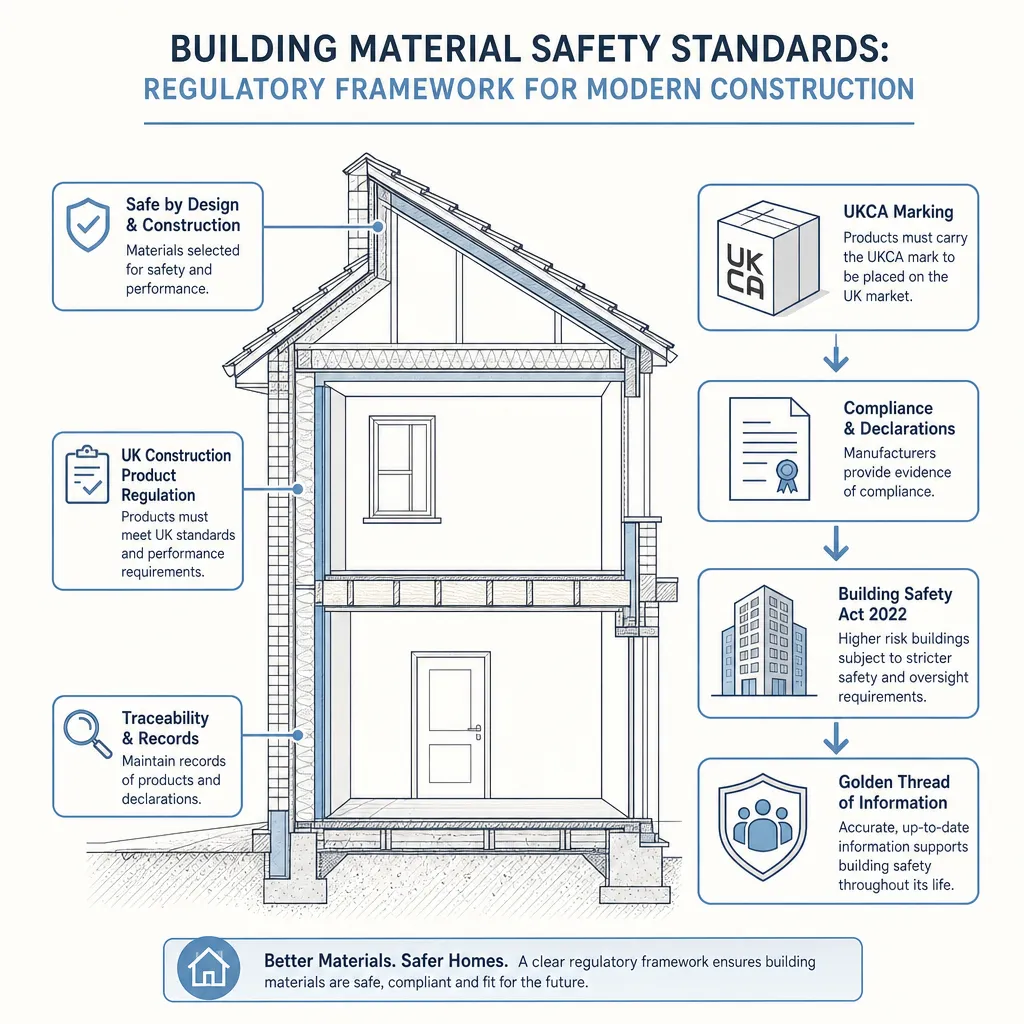
Building Material Safety Standards: Regulatory Framework for Modern Construction
UK building material safety standards are set through the Building Regulations 2010 and associated Approved Documents covering structure, fire, damp, energy, and ventilation.
 Planning & Pre-Build
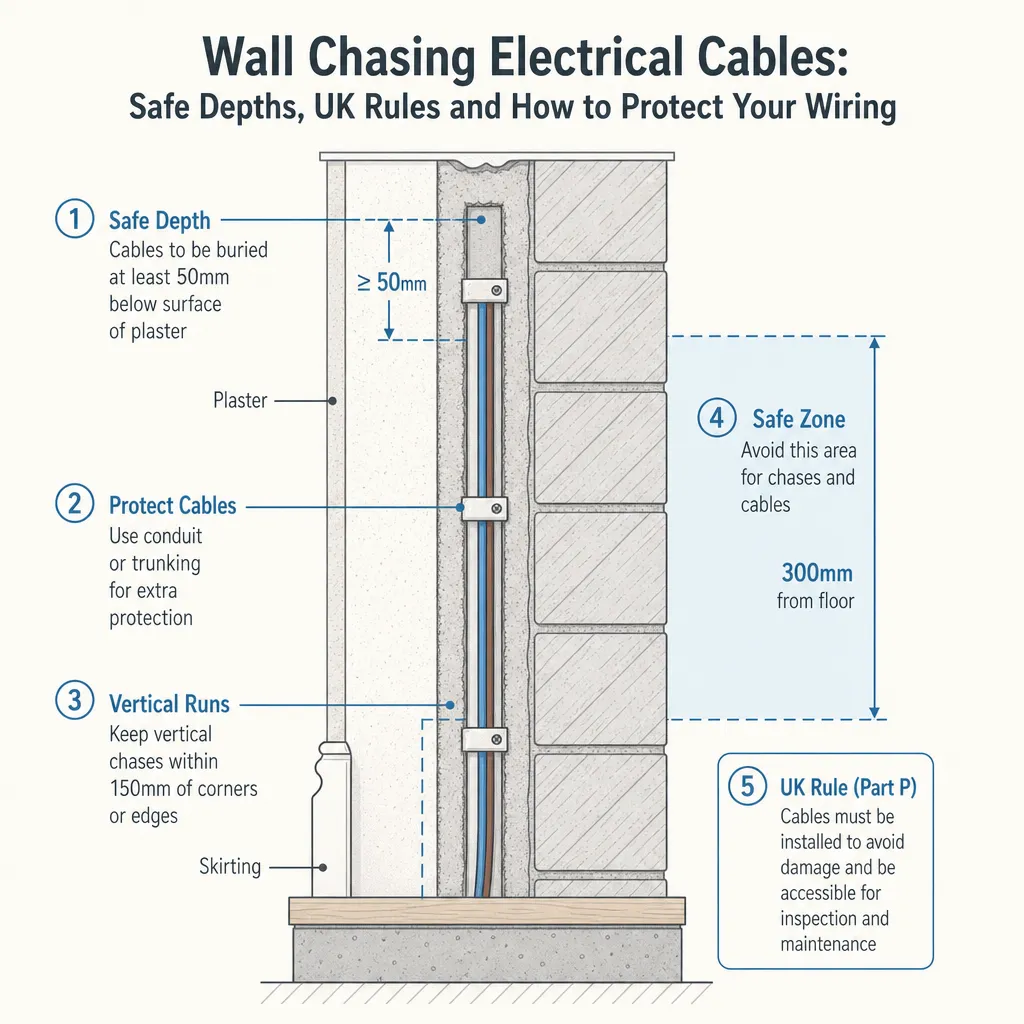
Wall Chasing Electrical Cables: Safe Depths, UK Rules and How to Protect Your Wiring
Wall chasing depth for electrical cables in UK homes must allow around 25mm of plaster or render cover over the cable.