Accessible Home Renovation: Combining Style With Inclusive Design
By Housey · Last reviewed 7th of May 2026
Accessible Home Renovation: Combining Style With Inclusive Design
Inclusive design is no longer the preserve of specialist adaptations or clinical-looking add-ons — UK homeowners are increasingly weaving accessibility into renovations from the outset, whether for a family member with changing needs, a multigenerational household, or simply to future-proof a property they plan to stay in long-term. Getting it right from the start is considerably cheaper than retrofitting later: the Centre for Accessible Environments notes that incorporating access features during a build or renovation typically adds 1–3% to costs, compared with 10–15% to introduce them retrospectively. Pre-2000 UK housing stock, from Victorian terraces to 1960s semis, often needs the most thought — narrow hallways, raised thresholds, and step-heavy layouts were the norm when these homes were built.
Key points
- Building Regulations Approved Document M (Access to and Use of Buildings) sets minimum accessibility standards for new dwellings and material alterations in England and Wales.
- The Disabled Facilities Grant (DFG) provides means-tested funding of up to £30,000 in England (up to £36,000 in Wales) for eligible adaptations — applied for through your local authority.
- BS 8300:2018 recommends a minimum clear doorway opening of 775 mm for wheelchair users, with 850 mm preferred; standard UK door sets are typically only 762 mm wide.
- VAT relief at 5% (rather than 20%) may apply to certain adaptations for disabled people under HMRC VAT Notice 701/7 — confirm eligibility for specific works with your contractor and HMRC before starting.
- Planning permission is not normally required for internal adaptations, but listed buildings and conservation area properties may need consent even for internal works.
What does accessible design mean for a UK home?
Accessible design is often conflated with disability-specific adaptation, but the two are not the same. True universal design aims to create homes that work for children, elderly residents, people with temporary injuries, and disabled people — while remaining visually indistinguishable from any other well-designed property.
In a UK renovation context, this typically means considering:
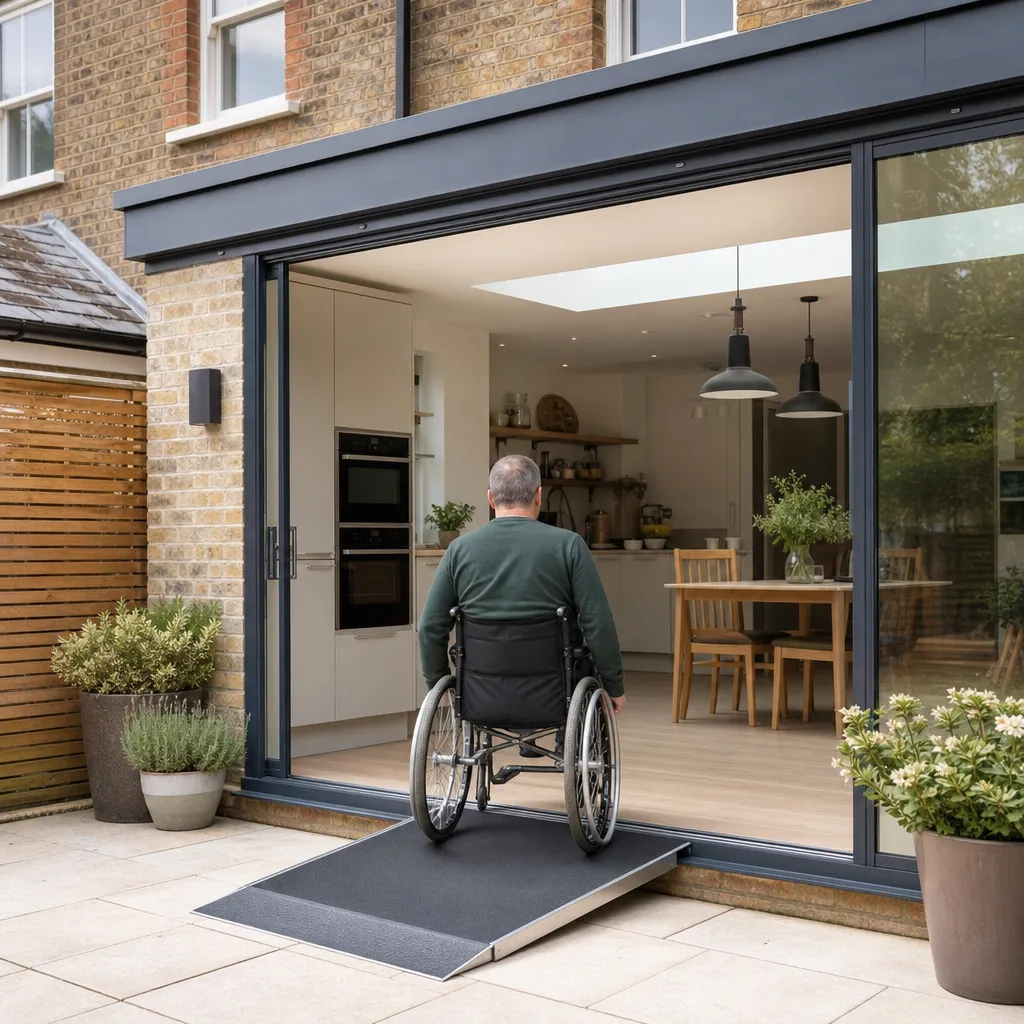
- Level-access thresholds at external doors (no step or upstand greater than 15 mm, per Approved Document M).
- Wider hallways and doorways — a clear corridor width of at least 900 mm and door openings of 775–850 mm clear.
- Step-free or ramped ground-floor circulation where the layout allows.
- Lever handles rather than round knobs on doors and taps — easier for anyone with reduced grip strength.
- Contrasting colours at edges, steps, and key junctions — important for people with low vision and useful for everyone in low-light conditions.
- Level-access showers or wet rooms in at least one bathroom — easier to clean and consistently popular with buyers of all ages.
Accessibility features done well rarely reduce a property's mainstream appeal; in many cases they enhance it.
Decision tree: where should you start?
- Renovating a whole house? Begin with structural circulation — hallway width, door positions, and stair or lift provisions. These are the most expensive elements to alter once walls and floors are finished.
- Adapting for a specific household need? Apply through your local authority for a Disabled Facilities Grant assessment before engaging a contractor. The occupational therapist (OT) assessment is free and informs the recommended scope of works.
- Carrying out a bathroom or kitchen renovation? Specify level-access shower trays, grabrail-ready wall backing boards, and knee space under worktops from the outset — retrofitting these is straightforward if the preparatory work is done now.
- Working on a listed building or in a conservation area? Engage your local planning authority early. Accessible design can usually be achieved within heritage constraints, but listed building consent or planning permission may be required.
- Unsure about legal requirements? Check with a chartered architect or architectural technologist who is familiar with Approved Document M and BS 8300:2018 before starting work.
Room-by-room comparison: standard vs accessible specification
Room | Standard specification | Accessible specification | Key difference |
|---|---|---|---|
Entrance | Single step, 762 mm door | Level threshold (≤15 mm upstand), 850 mm clear opening | Removes the most common mobility barrier |
Hallway | 900 mm wide | 1,200 mm with passing place | Allows wheelchair turning and easier pram access |
Bathroom | Fixed shower tray or bath | Level-access wet room, grabrail backing boards, 1,500 mm turning circle | Enables safe independent use across all ages |
Kitchen | Fixed-height worktops | Adjustable-height sections, knee clearance, lever taps | Works for seated users and different user heights |
Switches and sockets | Sockets at 300–450 mm; switches at 1,400 mm | All controls within 450–1,000 mm accessible zone | Reduces bending and stretching for all users |
Staircase | Varying rise and going | Consistent rise/going, contrasting nosings, handrails both sides | Reduces trip risk and assists those with balance difficulties |
Funding accessible renovation in the UK
The main public funding route is the Disabled Facilities Grant (DFG), administered by local housing authorities in England and Wales.
- Maximum grant in England: £30,000 (as of 2026; some local authorities provide top-up funding).
- Maximum grant in Wales: £36,000.
- Eligibility: means-tested. The property can be owner-occupied or rented — with the landlord's written consent required for rented properties. A formal OT assessment determines what adaptations are recommended.
- Timescales: local authorities must determine applications within 6 months of a formal submission. Actual delivery timescales vary between authorities.
In Scotland, the Scheme of Assistance provides adaptation funding through local councils. In Northern Ireland, the Housing Adaptation Grant and the Home Repair Assistance Grant are the primary routes.
VAT relief at 5% may apply to qualifying adaptations for disabled people under HMRC VAT Notice 701/7. Confirm eligibility for each element of work with your contractor and HMRC before starting.
What not to assume
Don't assume accessible means clinical. Level-access showers, lever handles, contrasting trims, and wider doorways are standard in quality contemporary hotel and residential design. Done well, they are indistinguishable from any other thoughtful renovation.
Don't assume you won't qualify for funding. Many homeowners are unaware the DFG exists or assume the means test will exclude them. Eligibility is broader than commonly assumed — contact your local housing authority to find out.
Don't assume permitted development covers everything. Most internal adaptations do not need planning permission, but adding an external ramp or making structural changes to a listed building may require consent.
Don't assume any builder can deliver accessible work to the required standard. For DFG-funded projects, local authorities often specify contractors who must meet defined standards. Check that your builder is familiar with BS 8300:2018 and Approved Document M.
Don't assume the cheapest specification is the most practical long-term. Omitting grabrail backing boards now, for example, means costly structural work to add them later. A modest additional upfront cost can avoid significant future expense.
Homeowner checklist: planning an accessible renovation
When to get professional help
Most accessible renovation projects benefit from professional input from the outset. Consider instructing:
- A chartered architect or architectural technologist for structural or layout changes and Approved Document M compliance.
- An occupational therapist — especially where a DFG application is involved. The local authority OT assessment is free and shapes the recommended specification.
- A contractor experienced in DFG-funded or Part M work for the construction phase.
- Your local planning authority, consulted early, if the property is listed or in a conservation area.
Red flags that mean you should seek professional input before proceeding:
- The renovation involves moving load-bearing walls or widening structural openings.
- A household member has complex or rapidly changing access requirements.
- You are applying for DFG funding — an OT assessment is a mandatory part of the application process.
- The property is listed or in a conservation area and external changes are planned.
How Housey can help
Housey connects UK homeowners with architects, architectural technologists, and experienced contractors who understand accessible renovation standards including Approved Document M and BS 8300:2018. Use the Housey platform to compare quotes from vetted local professionals, whether you are planning a full renovation, a new extension, or a targeted bathroom or kitchen upgrade.
Frequently asked questions
Does accessible design reduce the value of my home?
Evidence suggests the opposite for well-executed work. Level-access showers, wider doorways, and step-free circulation appeal to a broad market — older buyers, families with young children, and anyone who has experienced injury. Poorly fitted clinical grab rails can look dated, but quality inclusive design typically adds market appeal rather than reducing it.
Do I need planning permission for a home accessibility adaptation?
Most internal adaptations do not need planning permission. External ramps, widened vehicle crossings, or structural changes to listed buildings may require consent. Always check with your local planning authority if the property is listed, in a conservation area, or if any external changes are involved.
What is Approved Document M?
Approved Document M is one of the Building Regulations Approved Documents for England and Wales, covering accessibility requirements for new dwellings and material alterations to existing ones. It sets standards for access, circulation, and sanitary facilities. The equivalent in Scotland is Technical Handbook Section 4; in Northern Ireland, Technical Booklet R.
How long does a Disabled Facilities Grant application take?
Local authorities must determine a formal DFG application within 6 months of submission. In practice, the end-to-end process — from initial inquiry to completed works — often takes 12–18 months depending on local authority capacity. Your local housing authority or a welfare rights adviser can advise on current timescales in your area.
Can private tenants apply for a Disabled Facilities Grant?
Yes. Private tenants can apply for a DFG, but landlord consent is required before works proceed. The adaptation must be reasonable and practical given the property's age and condition. The grant is paid to the applicant rather than the landlord, and the means test is based on the applicant's financial circumstances.
Sources and further reading
- Disabled Facilities Grant: guidance — GOV.UK
- Approved Document M: Access to and Use of Buildings — GOV.UK
- BS 8300:2018 Design of an accessible and inclusive built environment — BSI
- Centre for Accessible Environments — Centre for Accessible Environments
- VAT Notice 701/7: VAT reliefs for disabled and older people — HMRC
Useful next reads
 Improvement & Build
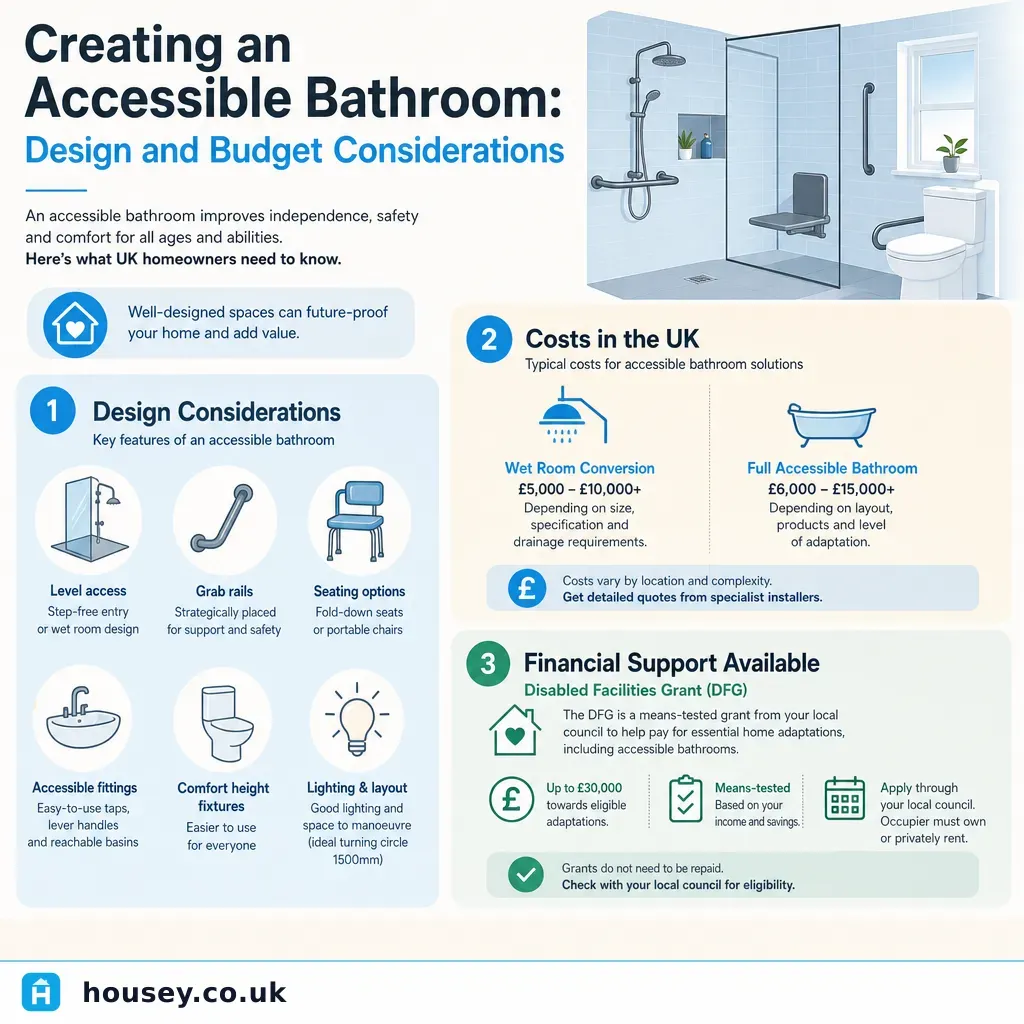
Creating an Accessible Bathroom: Design and Budget Considerations
An accessible bathroom typically combines a level-access or wet-room shower, grab rails, a comfort-height WC, and non-slip flooring.
 Improvement & Build
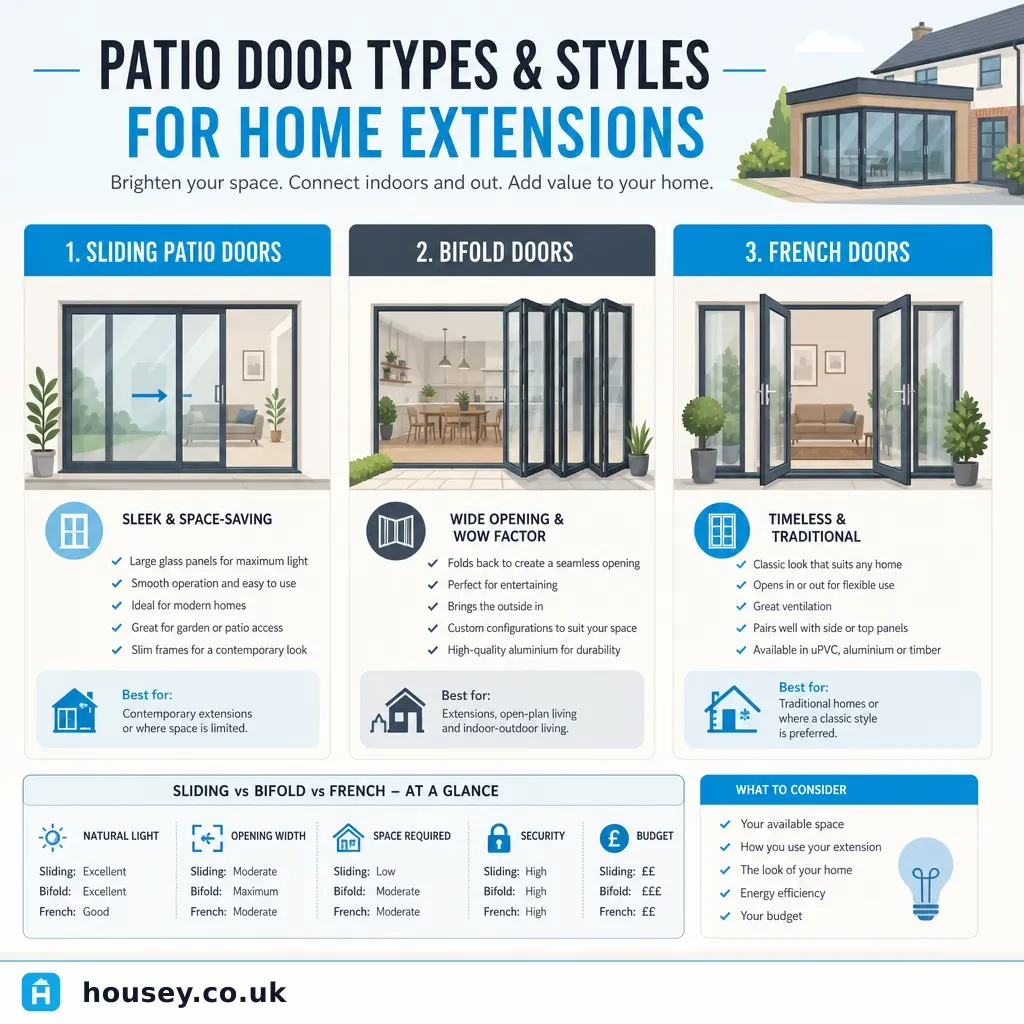
Patio Door Types and Styles for Home Extensions
For most UK home extensions, sliding doors suit openings up to 3.
 Improvement & Build
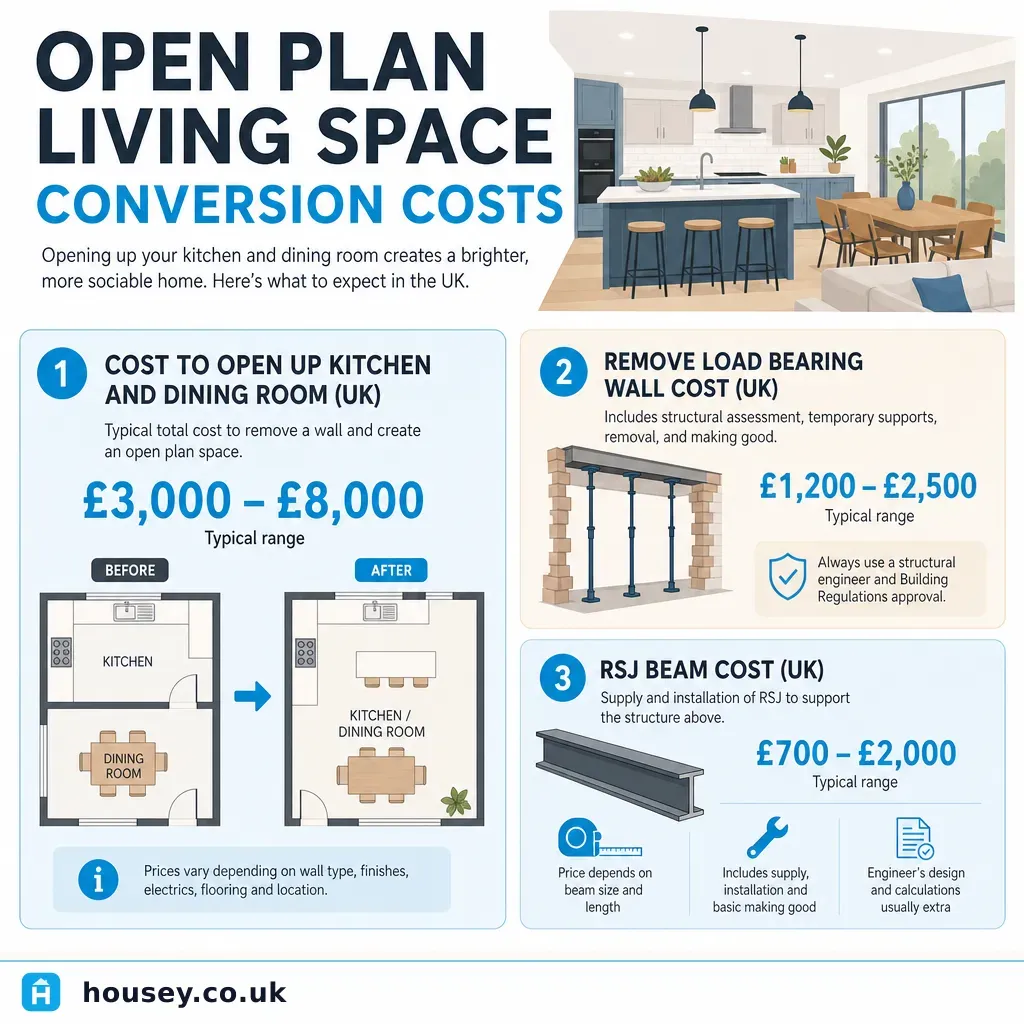
Open Plan Living Space Conversion Costs
Opening up a living space in the UK typically costs £3,000–£15,000+ depending on whether walls are load-bearing, the beam specification required, and the extent of remodelling.
 Improvement & Build
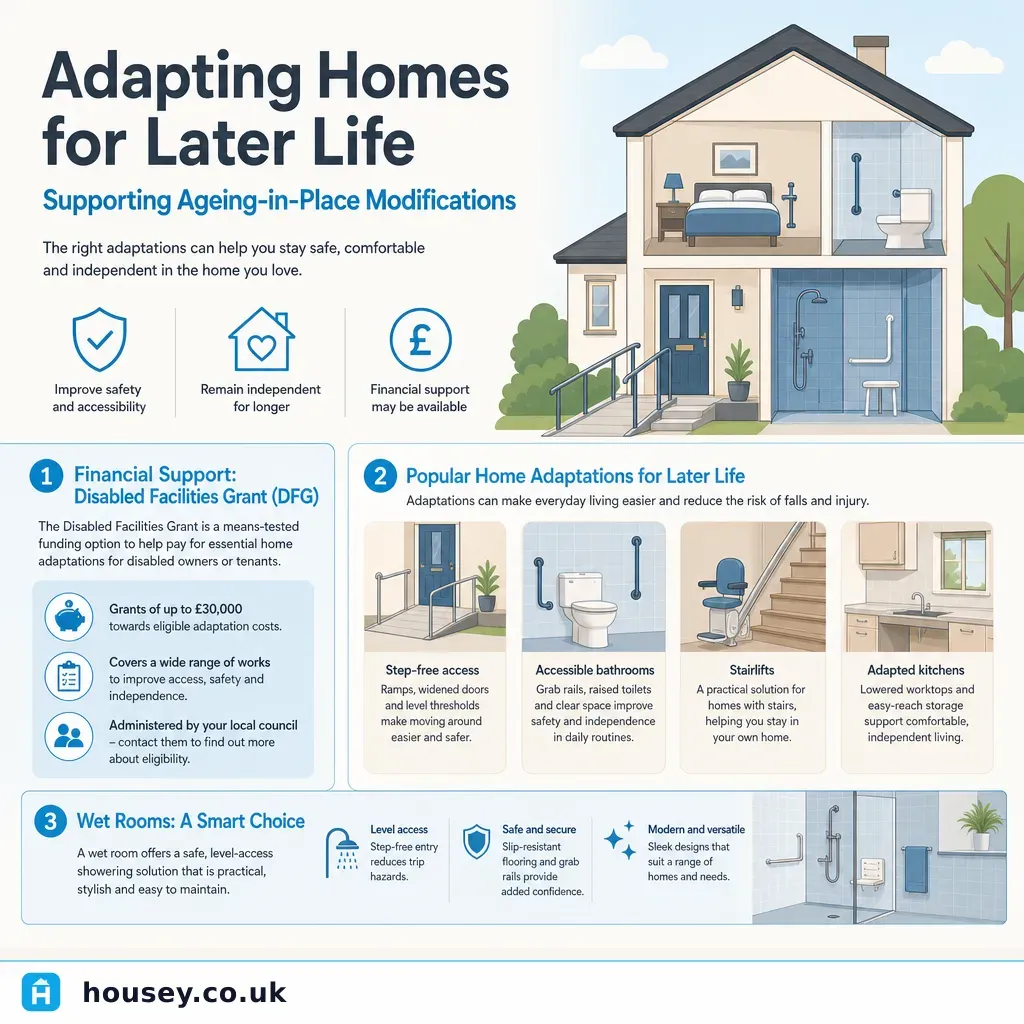
Adapting Homes for Later Life: Supporting Ageing-in-Place Modifications
Ageing-in-place adaptations in the UK range from simple aids such as grab rails and lever taps to major works including wet rooms, stairlifts, and single-storey extensions.
 Improvement & Build
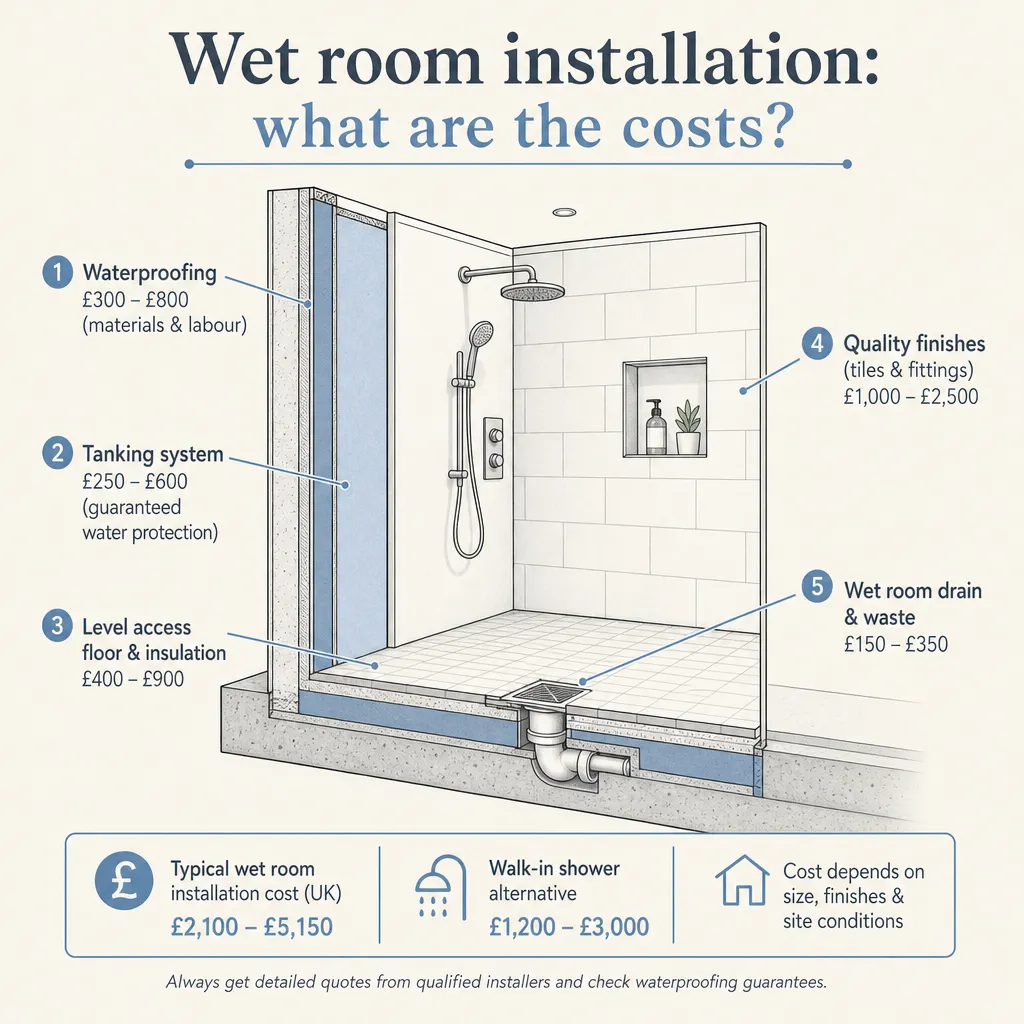
Wet room installation: what are the costs?
A wet room installation in a UK home typically costs between £3,500 and £10,000 depending on room size, materials, and structural requirements.