Adapting Homes for Later Life: Supporting Ageing-in-Place Modifications
By Housey · Last reviewed 31st of May 2026
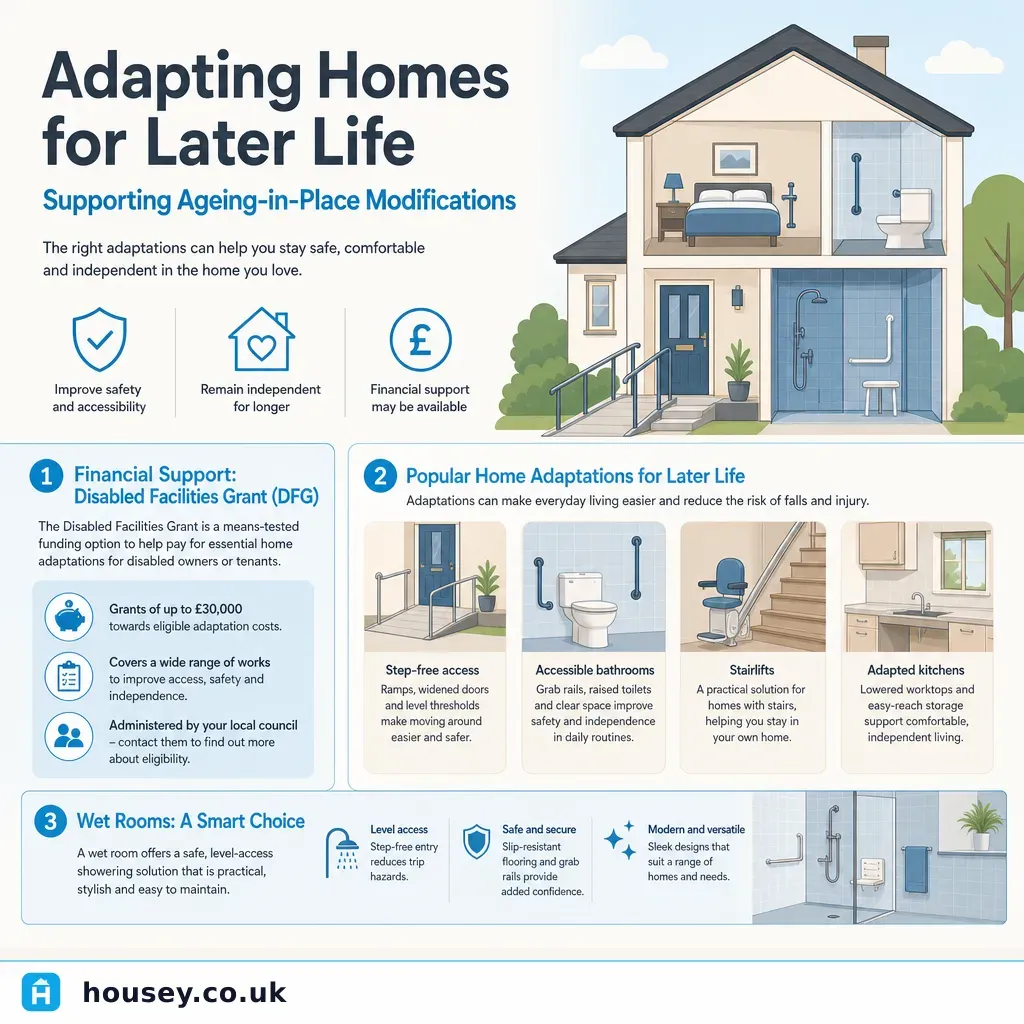
Adapting Homes for Later Life: Supporting Ageing-in-Place Modifications
The UK's population is ageing: by 2040, around one in four people in England will be aged 65 or over, according to ONS projections. For many, the preferred option is to remain in a familiar home rather than move to specialist accommodation — but most UK housing stock was not designed with later-life mobility needs in mind. Whether you are adapting your own home or helping a family member, understanding which changes are practical, fundable, and regulation-compliant will help you make the right decisions at the right time.
Key points
- Disabled Facilities Grants (DFGs) of up to £30,000 in England (up to £36,000 in Wales) are available via local councils to fund means-tested adaptations for disabled or older residents.
- Minor adaptations such as grab rails, lever taps, and raised toilet seats are often arranged free of charge by local occupational therapy services and do not require Building Regulations approval.
- More extensive works — wet rooms replacing bathrooms, through-floor lifts, and rear extensions for ground-floor living — are notifiable under Building Regulations and may require planning permission.
- VAT at zero rate applies to many adaptations for disabled people under HMRC VAT Notice 701/7, including installation of ramps, grab rails, lifts, and certain sanitary facilities.
- An occupational therapist (OT) assessment is the recommended first step before any funded adaptation, and a formal OT report strengthens a Disabled Facilities Grant application.
What does ageing in place mean in practice?
Ageing in place describes the ability to live safely and independently in your own home as physical capabilities change. Adaptations range from simple aids that can be fitted in a day to significant building works requiring professional design and Building Regulations approval. The right combination depends on the individual's specific needs, the property layout, available budget, and whether the home is owned or rented.
Rented homes require the landlord's consent before adaptations can be made. Under the Equality Act 2010, landlords cannot unreasonably withhold consent for reasonable adjustments where the tenant has a disability.
Types of adaptation and what they involve
Level 1: Low-level aids (no building work required)
These are typically assessed and arranged by the local authority occupational therapy team, often at no cost:
- Grab rails and handrails for bathrooms, staircases, and external steps
- Lever taps and lever door handles
- Raised toilet seats and toilet-frame supports
- Non-slip bath and shower mats
- Motion-activated night lights on stairways and landings
Level 2: Mid-level adaptations (minor building work, may need Building Regulations)
- Level-access shower or wet room replacing a bath (Part P for electrics, Part H for drainage)
- Stairlift installation (no Building Regulations notification normally required, but staircase condition should be assessed)
- Door widening for wheelchair access, with a minimum 775 mm clear opening recommended
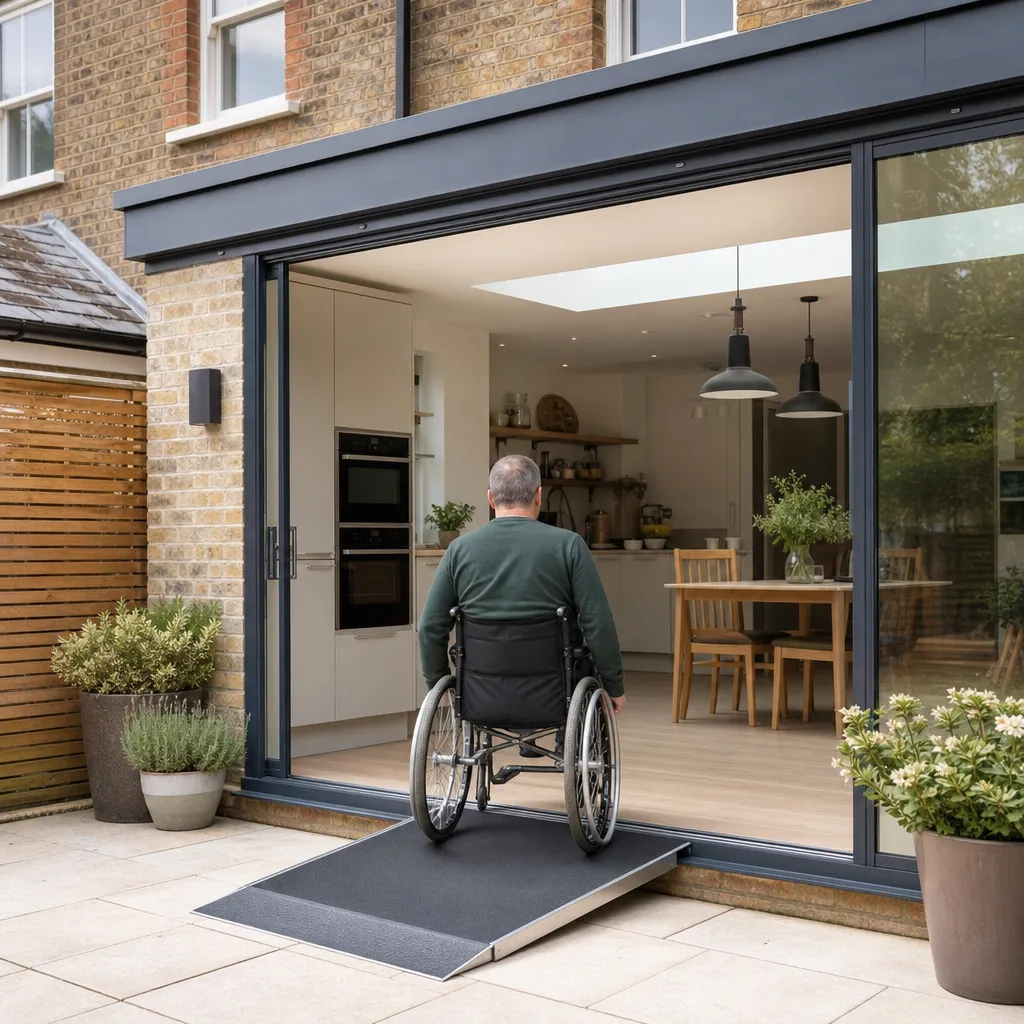
- Entrance ramp installation
Level 3: Major works (Building Regulations, possibly planning permission)
- Through-floor or platform lift installation
- Ground-floor bedroom or bathroom relocation
- Single-storey extension to create an accessible bedroom or bathroom
- Garage conversion to an accessible ground-floor annex
Which adaptation path should you take?
Use this decision tree to identify your starting point:
- Has an occupational therapist assessed the individual's needs? If not, contact your GP or local adult social care team before making any adaptation decisions.
- If the adaptation is minor (grab rails, lever taps, small equipment): contact your local council OT service or purchase directly from a reputable retailer; no Building Regulations approval is needed.
- If work involves plumbing, electrics, or structural change: confirm whether it is notifiable under Building Regulations and contact your local building control body if uncertain.
- If the cost of adaptations is significant and the person may qualify for funding: apply for a Disabled Facilities Grant through the local council before committing to a contractor.
- If the property layout cannot accommodate ground-floor living: consult an architect or extension builder about the feasibility of a rear or side extension.
- If the property is rented: obtain written landlord consent; DFGs can still fund work in rented homes with the landlord's agreement.
- If the property is listed or in a conservation area: check consent requirements with the local planning authority before designing any external alterations.
Adaptation comparison at a glance
Adaptation type | Indicative cost (2026-05-31) | Building Regs needed? | DFG eligible? | Key professional |
|---|---|---|---|---|
Grab rails (bathroom, hall) | £50–£200 fitted | No | Often free via OT | Occupational therapist or handyperson |
Wet room / level-access shower | £3,000–£8,000 | Yes (Part H, Part P) | Yes | Bathroom fitter, building control |
Stairlift | £2,500–£5,000 | Usually no | Yes | Stairlift installer |
Through-floor lift | £8,000–£20,000 | Yes (Part K) | Yes | Lift installer, building control |
Door widening | £200–£800 per door | Possibly (if structural) | Yes | Carpenter, building control |
Ground-floor extension | £40,000–£100,000+ | Yes | Partial (up to DFG cap) | Architect, extension builder, building control |
Accessible kitchen refit | £5,000–£20,000 | Possibly | Yes | Kitchen fitter, occupational therapist |
Indicative UK costs, last reviewed 2026-05-31. Costs vary significantly by property, region, and specification. Always obtain at least three quotes.
Funding options
Disabled Facilities Grant
The DFG is the main public funding route for home adaptations in England and Wales. It is means-tested for adults. The maximum grant is £30,000 in England and £36,000 in Wales. Applications are made through the local council, which arranges an OT assessment as part of the process. Timescales vary between councils; ask about expedited procedures if the adaptation is urgently needed on safety grounds.
VAT relief
Many adaptation works for disabled people qualify for zero-rate VAT under HMRC VAT Notice 701/7. This covers installation of ramps, grab rails, lifts, widened doorways, and some bathroom adaptations. VAT relief is applied by the contractor at invoicing — homeowners do not need to apply separately, but should confirm eligibility with the contractor before accepting a quote.
Better Care Fund and local top-up schemes
Local councils in England distribute DFG funding via the Better Care Fund. Some councils operate supplementary loan or grant schemes for adaptations that exceed the DFG maximum. Contact your local council's housing or adult social care team to find out what additional funding is available in your area.
Building Regulations and planning permission
Most Level 2 and Level 3 adaptations require Building Regulations approval. The key Approved Documents likely to apply are:
- Part M (Access to and use of buildings) — accessible design standards
- Part K (Protection from falling, collision and impact) — lifts and stair safety
- Part P (Electrical safety) — new or altered electrical circuits
- Part H (Drainage and waste disposal) — wet rooms and accessible bathroom installations
Extensions to create ground-floor living accommodation will also require compliance with Part A (structure), Part B (fire safety), Part C (moisture resistance), and Part L (energy efficiency).
Planning permission is generally not required for internal adaptations or for extensions within permitted development limits. Extensions that exceed size or siting thresholds will require a householder planning application.
When to get professional help
- Commission an independent specialist OT assessment if the individual's needs are complex, unusual, or changing rapidly
- Appoint a structural engineer if proposed works involve removing walls or altering load-bearing elements
- Consult the local planning authority if the property is listed or in a conservation area before designing any external changes
- Seek advice from Citizens Advice or Shelter if a DFG application has been declined or a landlord has unreasonably refused consent
- Ensure any contractor carrying out gas or electrical work is Gas Safe or NICEIC/NAPIT-registered respectively
How Housey can help
For major adaptations — including ground-floor extensions, accessible annexes, or significant structural works — Housey can connect you with experienced extension builders and building control consultants who can guide your project from feasibility through to final sign-off. Use the Housey quote tool to describe your project and compare quotes from local professionals.
Frequently asked questions
Does a stairlift require planning permission or Building Regulations approval?
Stairlifts fitted inside the property do not require planning permission and do not normally require Building Regulations approval. However, a structural assessment of the staircase is advisable before installation, particularly in older properties where stringer boards or newel posts may not be in good condition. Confirm with the installer that the staircase structure is sound before proceeding.
Can a landlord refuse to allow home adaptations for a disabled tenant?
Under the Equality Act 2010, a landlord cannot unreasonably refuse consent for reasonable adjustments where the tenant has a disability. For significant structural adaptations, landlords can reasonably ask for assurance that a qualified contractor will carry out the work and that the property will be reinstated on departure if required. Citizens Advice or Shelter can advise on specific disputes.
How long does a Disabled Facilities Grant application take?
Timescales vary by local authority but the process typically takes three to six months from application to grant approval. Urgent cases where the person faces an immediate safety risk can sometimes be fast-tracked. Contact your local council housing or adult social care team as early as possible and ask about expedited procedures.
What is the difference between a level-access shower and a wet room?
A level-access shower has a low-profile tray with a threshold typically under 25 mm. A wet room has no tray — the tiled floor itself is the shower area, draining to a central or linear drain. Wet rooms offer the greatest accessibility for wheelchair users but require robust waterproofing to prevent damp. Both types are commonly funded through the Disabled Facilities Grant.
Sources and further reading
- Disabled Facilities Grant — GOV.UK
- VAT Notice 701/7: reliefs for disabled and older people — HMRC
- Approved Document M: access to and use of buildings — GOV.UK
- Home adaptations advice and assistance — Foundations
- Adapting your home — Age UK
- Housing rights and repairs — Citizens Advice
Useful next reads
 Improvement & Build
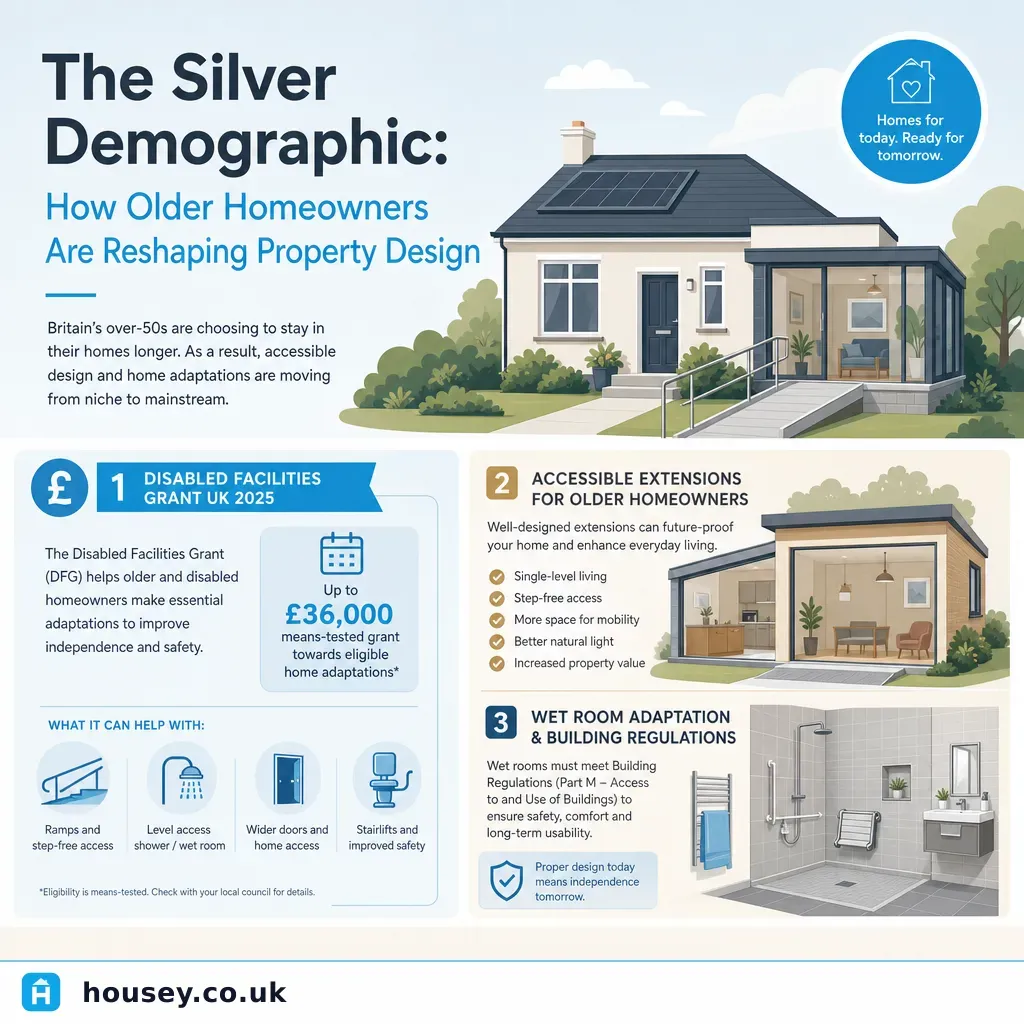
The Silver Demographic: How Older Homeowners Are Reshaping Property Design
Older homeowners — around 76% of England's 65-plus population are owner-occupiers — are driving demand for accessible extensions, wet rooms, and single-storey living zones.
 Improvement & Build
Raised Garden Beds: Design Benefits and Implementation
Raised garden beds suit most UK gardens, particularly those with heavy clay, poor drainage, or limited growing space.
 Improvement & Build
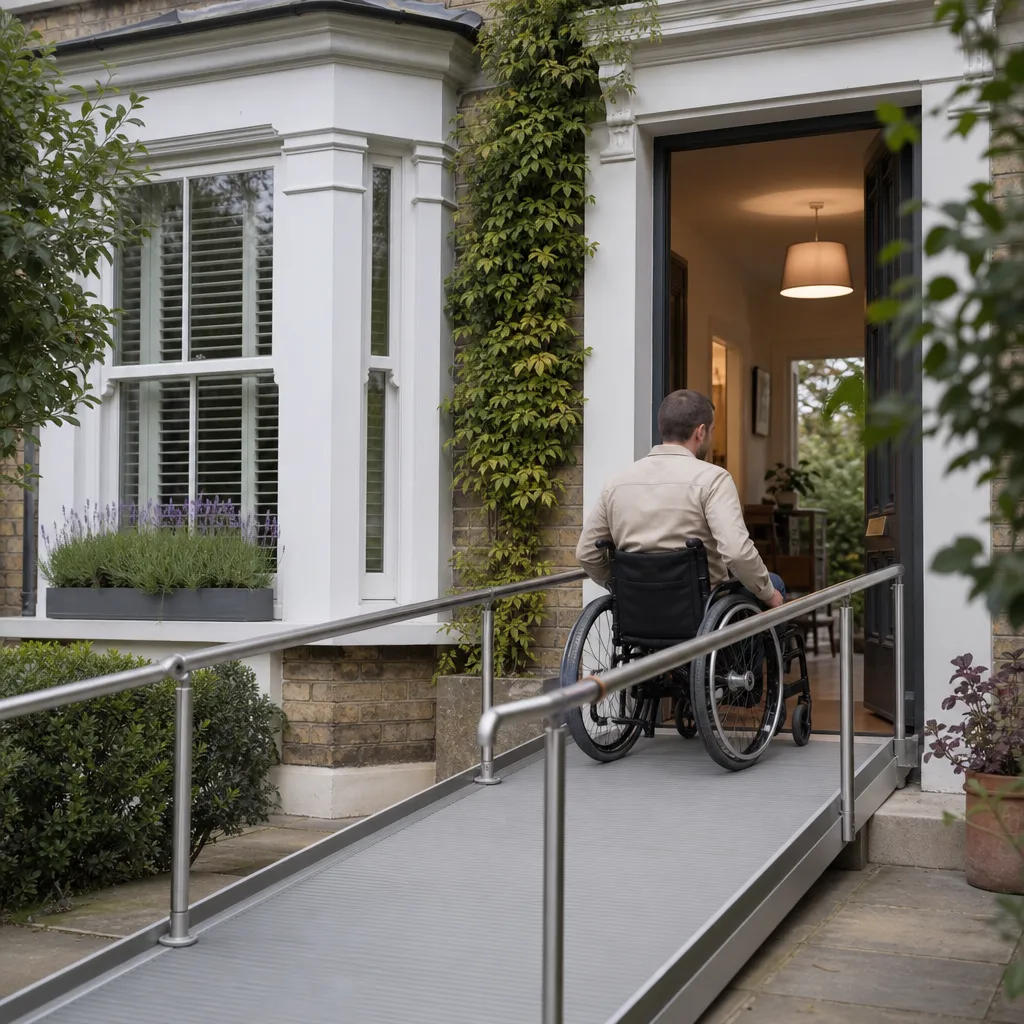
Universal Design Principles: Adding Value and Accessibility to Your Home
Universal design creates homes that work for the widest range of people without requiring costly retrofitting later.
 Improvement & Build
Accessible Home Renovation: Combining Style With Inclusive Design
Accessible home renovation incorporates level thresholds, wider doorways, lever handles, and wet rooms into quality design from the outset.
 Improvement & Build
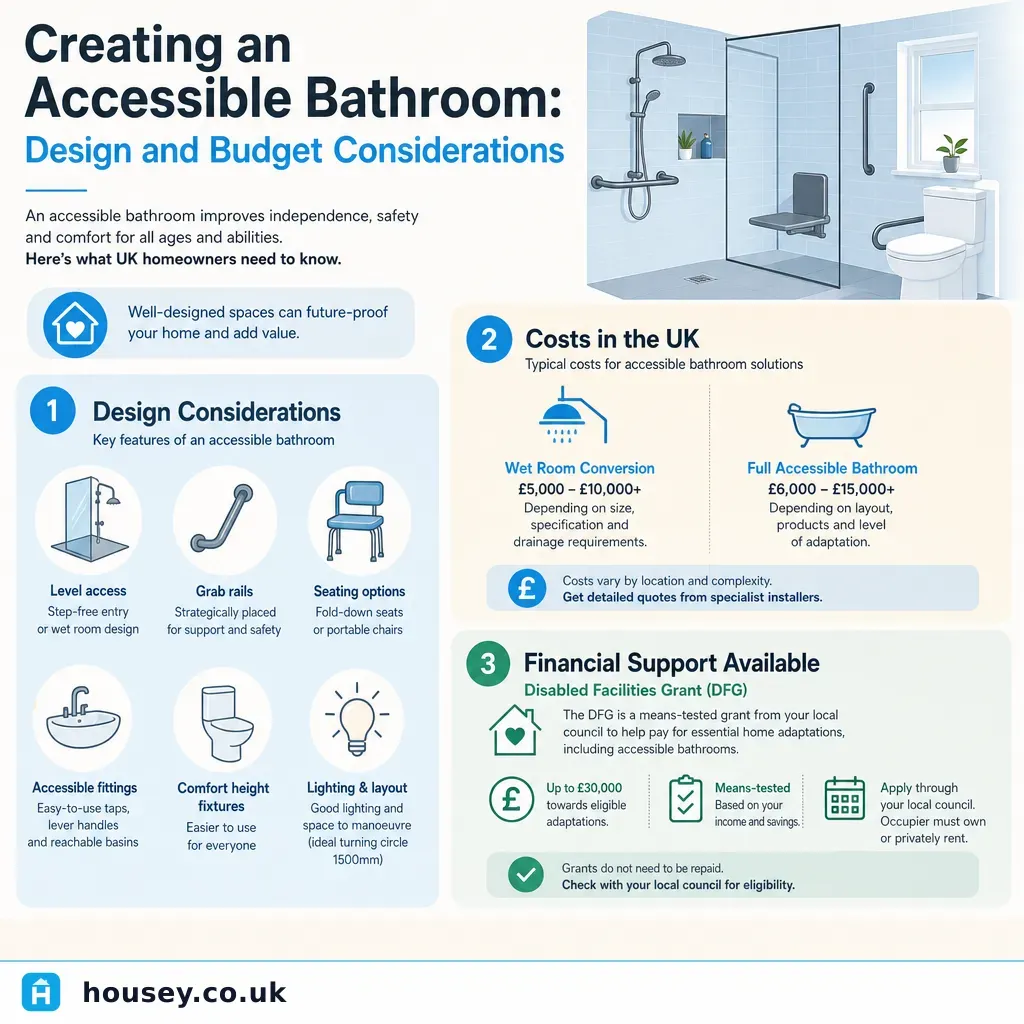
Creating an Accessible Bathroom: Design and Budget Considerations
An accessible bathroom typically combines a level-access or wet-room shower, grab rails, a comfort-height WC, and non-slip flooring.