Creating an Accessible Bathroom: Design and Budget Considerations
By Housey · Last reviewed 7th of May 2026
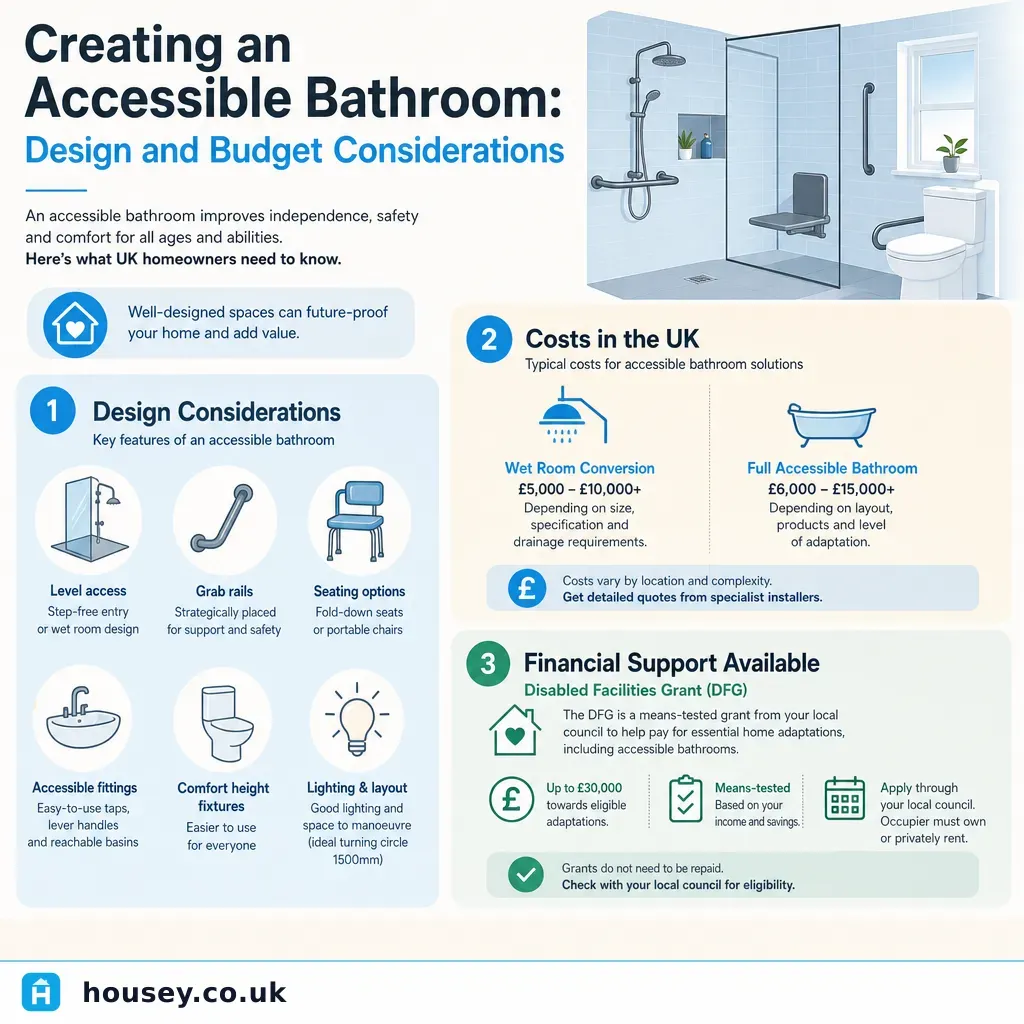
Creating an Accessible Bathroom: Design and Budget Considerations
Bathrooms are the room most likely to pose a daily challenge when mobility changes — whether through ageing, disability, or recovery from illness or surgery. Most UK homes were built without accessible design in mind, leaving homeowners to retrofit solutions that range from simple grab-rail installations to full wet-room conversions. Understanding what works structurally, what qualifies for grant funding, and what the process involves helps you plan a conversion that genuinely meets your needs without overspending.
Key points
- Disabled Facilities Grants (DFGs) can fund up to £30,000 per application in England for eligible adaptations to private or rented homes; the grant is means-tested for adults aged 18 and over.
- Part M of the Building Regulations sets minimum accessibility standards for new builds and extensions; some adaptation works will trigger compliance requirements.
- Non-slip flooring should achieve a Pendulum Test Value (PTV) of at least 36 in wet conditions, per HSE slip-resistance guidance.
- An Occupational Therapist (OT) assessment is typically required before a local authority will approve a Disabled Facilities Grant application.
- A level-access wet room removes the step threshold entirely, making it the most practical long-term solution for wheelchair users and ambulant disabled people alike.
What makes a bathroom accessible?
Accessibility in bathrooms is not a single standard — it depends on the user's specific needs and the property's existing layout. The most commonly adapted elements are:
Shower and bathing
- Wet room / level-access shower: no threshold, slip-resistant tiled floor with a concealed drain — the most flexible long-term option.
- Walk-in shower with low tray: a 25mm or 40mm low-profile tray with a wide opening (minimum 760mm door width for wheelchair users).
- Shower over bath: of limited value for reduced mobility; not recommended if balance is a primary concern.
- Bath with integral seat or powered hoist: relevant where bathing is preferred and funding is available.
Toilet
- Comfort-height WC (typically 460–480mm from floor to seat): reduces knee and hip strain on sitting and rising.
- Wall-hung WC with adjustable height: allows future adjustment and easier floor cleaning.
- Lateral transfer space: at least 750mm clear on one side of the WC for a carer or mobility frame.
Grab rails and support
BS 8300 and Approved Document M recommend rails at the WC (both sides where possible), shower entry, and beside the bath. Rails must anchor into studs or a reinforced backing board — hollow-wall fixings are not suitable for load-bearing grab rails.
Circulation space
Wheelchair-accessible bathrooms typically require a minimum 1,500mm turning circle. Even ambulant-accessible designs benefit from unobstructed floor space around the WC and shower area.
What does an accessible bathroom conversion cost?
Indicative UK costs, last reviewed 2026-05-07. Costs vary significantly by region, existing layout, and specification. Always obtain at least three quotes.
Scope of work | Indicative cost range |
|---|---|
Grab rails (supply and fit, 3–5 rails) | £300–£700 |
Walk-in shower with low tray (replace bath) | £2,500–£6,000 |
Full wet-room conversion (tiled, level access) | £5,000–£12,000 |
Accessible bathroom full refurbishment (WC, shower, basin) | £8,000–£18,000 |
Bathroom extension to create accessible space | £15,000–£35,000+ |
Key cost drivers:
- Floor structure: wet rooms require waterproofed floor systems (tanking) and a lowered drainage outlet — in suspended timber floors this is more complex than in concrete.
- Pipework relocation: moving the WC or shower drain significantly increases cost.
- Wall condition: tiles removed from plasterboard walls often damage the board, requiring full re-boarding before retiling.
- Ventilation: Part F of the Building Regulations requires mechanical extract ventilation (minimum 15 litres/second in a shower room) — adding ducting adds cost.
- Regional labour rates: London and the South East typically run 20–30% above national averages.
How do Disabled Facilities Grants work?
The Disabled Facilities Grant is a statutory means-tested grant administered by local authorities in England, Wales, and Northern Ireland (Scotland operates its own scheme via Care and Repair). In England, the grant can fund up to £30,000 for eligible adaptations.
Eligibility: the disabled person must live in — or intend to live in — the property. Both private homeowners and private tenants can apply, with landlord consent required for tenants. The grant is means-tested for adults aged 18 and over; adaptations for children under 18 are not means-tested.
The process:
- Contact your local authority's housing adaptations team.
- Receive a referral for an Occupational Therapist assessment — the OT identifies what adaptations are necessary and appropriate.
- Submit the grant application with the OT report and contractor quotes.
- The local authority approves or rejects within a statutory period (in England, 6 months from a completed application).
- Work is carried out; the local authority may inspect on completion.
The OT assessment is not optional — local authorities will not usually approve a DFG without one. Waiting times for OT assessment vary considerably by area.
Other funding routes worth checking:
- Home Improvement Agencies (HIAs): local not-for-profit bodies that help older and disabled people plan and manage adaptations, often at low or no cost to the client.
- VAT relief: adaptations for disabled people are zero-rated for VAT under HMRC Notice 701/7 — confirm eligibility with your installer before work begins.
Homeowner checklist: planning your accessible bathroom
Worked example: converting a 1970s semi-detached bathroom
A homeowner in their seventies lives in a 1970s three-bedroom semi. The existing bathroom (2.2m × 1.8m) has a bath, pedestal basin, and close-coupled WC. Following a hip replacement, the priority is a level-access shower, a comfort-height WC, and grab rails.
OT assessment outcome: wet-room conversion recommended; WC to remain in situ; a lateral grab rail at the WC and a fold-down shower seat specified.
Structural finding: concrete floor throughout — wet-room tanking and drainage outlet are feasible without structural works to the floor.
DFG outcome: homeowner passes the means test; grant approved to cover costs up to £12,500, funding the wet-room conversion, new WC, basin, and rails in full.
This scenario is not universal — suspended floors, larger bathrooms, or more complex pipework can increase costs significantly. But it illustrates why starting with the OT assessment and DFG application, before engaging contractors, is the right order of operations.
When to get professional help
Most accessible bathroom work combines wet trades (tiling, waterproofing), plumbing, and electrics. Always involve qualified professionals for:
- Any wet-room installation — tanking must be applied correctly to avoid long-term water damage to the floor structure.
- Electrical work within the bathroom (Zone 1/2 compliance under Part P of the Building Regulations).
- Structural changes to floors or walls.
- Any work that alters the drainage configuration.
- The OT assessment — do not skip this step even if you are confident about the design; the OT report protects your DFG application.
Red flags to watch for:
- A contractor who makes no mention of Part P (electrical) compliance in a bathroom quote.
- Grab rails fitted into hollow walls without backing boards.
- A wet-room conversion proposed in a suspended timber floor without a clear plan for drainage and tanking.
- Quotes that do not include a ventilation strategy.
How Housey can help
Finding a contractor experienced in accessible bathroom design — rather than a general bathroom fitter — is one of the most important decisions in this type of project. Housey connects UK homeowners with vetted tradespeople and specialists. Browse available professionals and request quotes via the Housey platform to compare experience and pricing before committing.
Frequently asked questions
Do I need planning permission for an accessible bathroom conversion?
Planning permission is not usually needed for an accessible bathroom conversion inside your existing home. If you are extending the property to create a larger accessible bathroom, a standard householder planning application may be required. Check with your local planning authority if the works involve external changes, or if you live in a listed building or conservation area.
How long does a Disabled Facilities Grant take?
Local authorities must make a decision within six months of a completed application in England. In practice, the full process — from initial contact through to completed works — often takes nine to eighteen months, including the OT assessment, approval, and contractor lead times. Home Improvement Agencies can help manage the process and reduce delays.
Can a private tenant apply for a Disabled Facilities Grant?
Yes. Private tenants can apply for a DFG, but the landlord must consent to the adaptations. Most landlords cannot unreasonably withhold consent under the Equality Act 2010. The grant is paid to the applicant, not the landlord. Discuss the proposed works with your landlord early in the process.
Is VAT charged on accessible bathroom adaptations?
Goods and services supplied to a disabled person for their personal use — where adaptations enable them to use or access the bathroom — are zero-rated for VAT under HMRC Notice 701/7. This applies to wet rooms, grab rails, level-access showers, and specialist WCs. Confirm zero-rating eligibility with your installer before work begins.
What qualifications should a contractor have for accessible bathroom work?
Look for a plumber registered with CIPHE or WaterSafe, and an electrician registered with NICEIC or NAPIT for any electrical work within the bathroom. For wet-room tanking systems, check whether the installer is manufacturer-trained. TrustMark-registered firms provide an additional layer of consumer protection for this type of specialist work.
Sources and further reading
- Disabled Facilities Grant — GOV.UK
- Building Regulations Approved Document M: Access to and use of buildings — GOV.UK / MHCLG
- Slip resistance guidance — Health and Safety Executive
- Home adaptations for disabled people — Citizens Advice
- Foundations — national body for Home Improvement Agencies — Foundations
Useful next reads
 Improvement & Build
Accessible Home Renovation: Combining Style With Inclusive Design
Accessible home renovation incorporates level thresholds, wider doorways, lever handles, and wet rooms into quality design from the outset.
 Improvement & Build
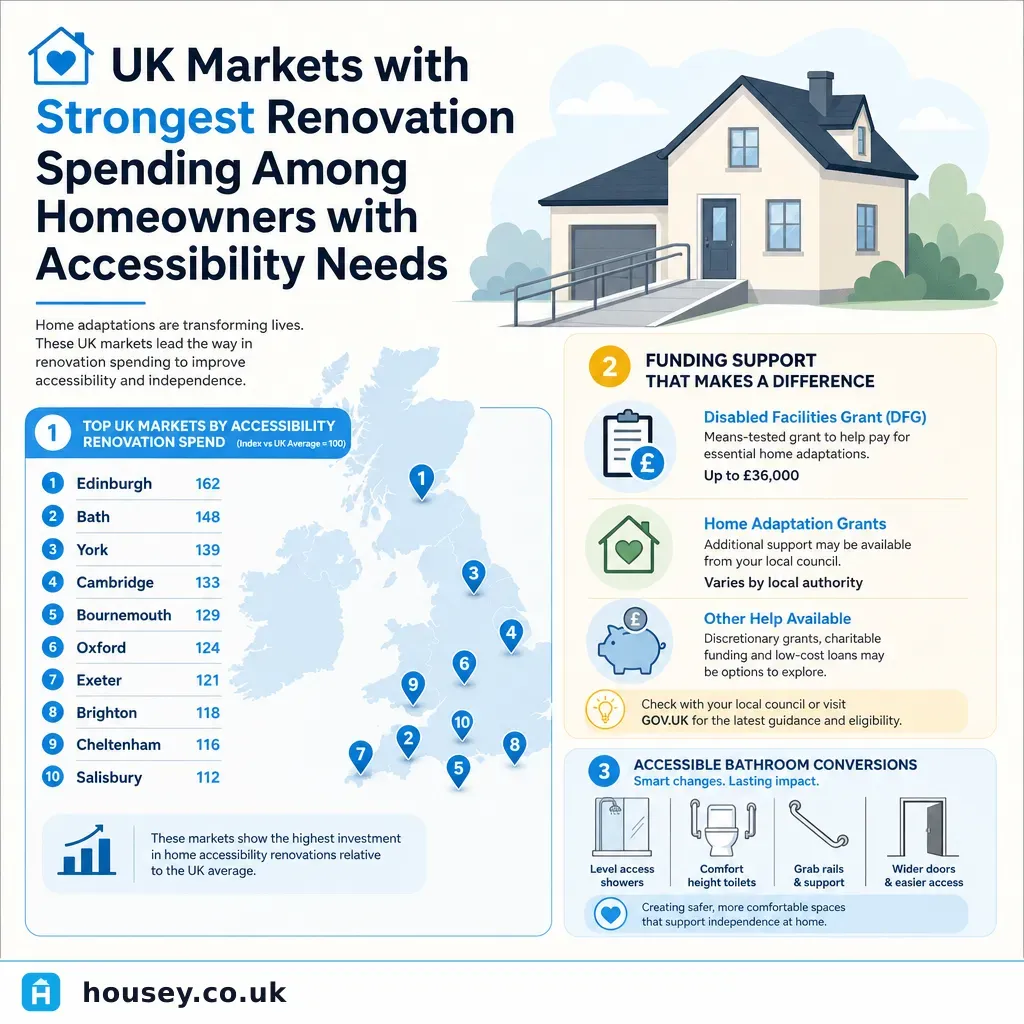
UK Markets with Strongest Renovation Spending Among Homeowners with Accessibility Needs
Accessibility renovation spending in the UK is concentrated in areas with older housing stock and higher proportions of over-65 residents, particularly parts of the South West, Yorkshire, and Wales.
 Improvement & Build
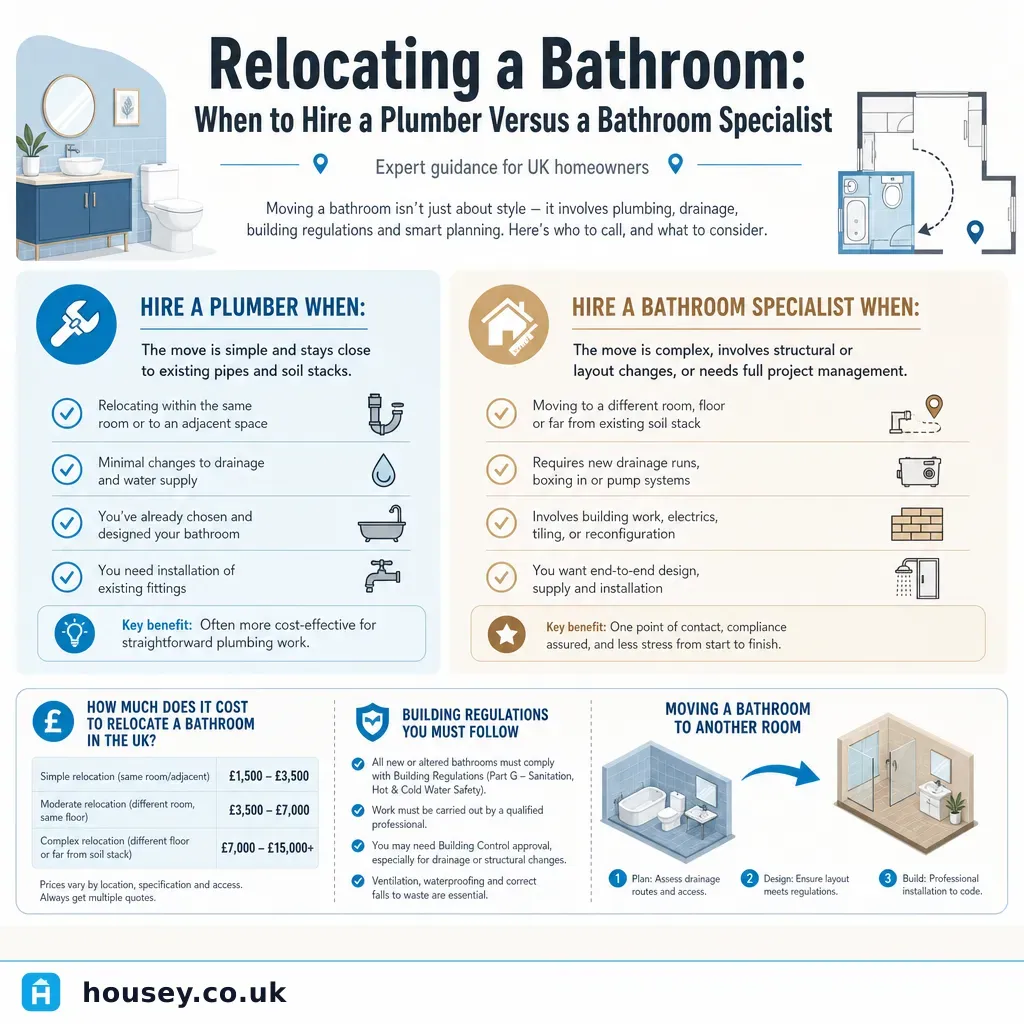
Relocating a Bathroom: When to Hire a Plumber Versus a Bathroom Specialist
Relocating a bathroom usually requires both a qualified plumber for pipework and drainage and other specialist trades for electrics, tiling, and finishes.
 Improvement & Build
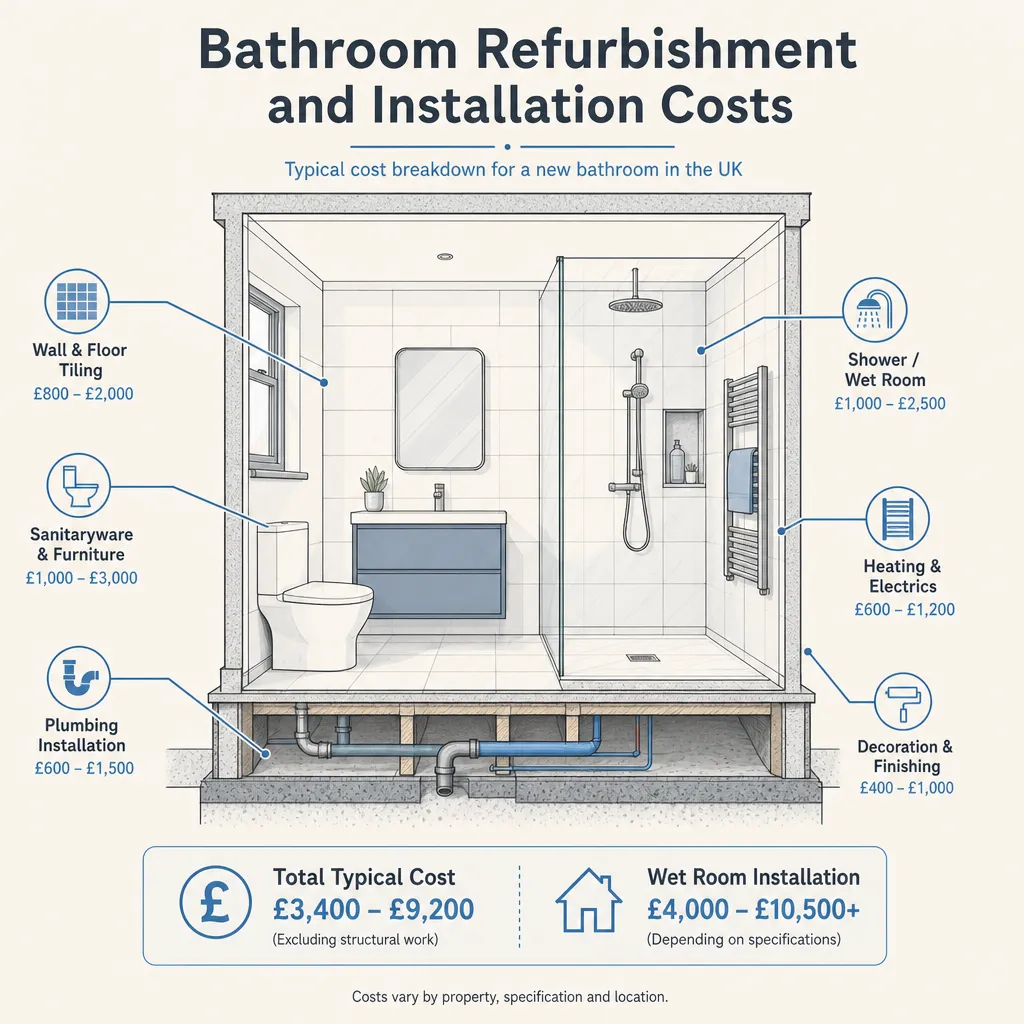
Bathroom Refurbishment and Installation Costs
A basic UK bathroom refurbishment typically costs £2,500–£5,000; a mid-range renovation with a revised layout runs £5,000–£10,000; a high-end or wet room installation can reach £12,000–£16,000 or more.
 Improvement & Build
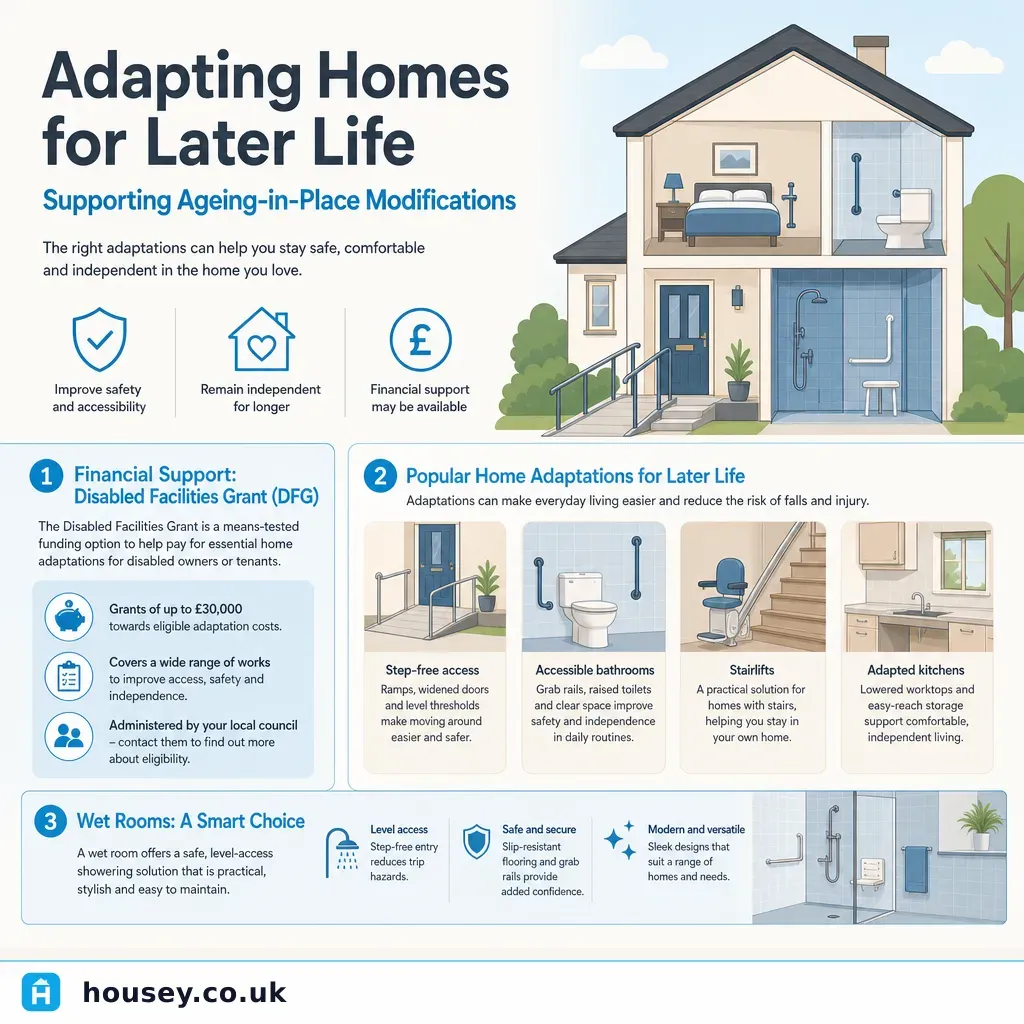
Adapting Homes for Later Life: Supporting Ageing-in-Place Modifications
Ageing-in-place adaptations in the UK range from simple aids such as grab rails and lever taps to major works including wet rooms, stairlifts, and single-storey extensions.